08/28/2024 1
Supply Chain Management
08/28/2024 2
Introduction
– Supply Chain – the core business processes in an
organization that create and deliver a product or
service, from concept through development and
manufacturing or conversion, and into a market for
consumption.
– Supply Chain Management – the methods,
systems and leadership that continuously improve
an organization’s integrated processes for product
and service design, purchasing, inventory
management, logistics, distribution and customer
satisfaction.
08/28/2024 3
Definitions
Supply Chain Management deals with the
management of materials, information, and
financial flows in a network consisting of
suppliers, manufacturers, distributors and
customers.
08/28/2024 4
Value vs. Supply Chain
 Value chain
 every step from raw materials to the eventual end user.
 ultimate goal is delivery of maximum value to the end user.
 Supply chain
 activities that get raw materials and subassemblies into
manufacturing operation.
 Terms are used interchangeably
08/28/2024 5
Decision Phases in a Supply Chain
 Supply chain strategy or design.
 Supply chain planning.
 Supply chain operation.
08/28/2024 6
Process view of a supply chain
 Cycle view
 Push/pull view
08/28/2024 7
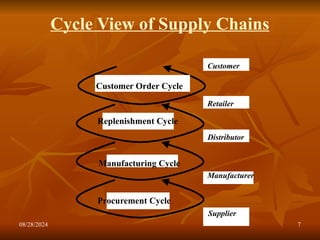
Cycle View of Supply Chains
Customer Order Cycle
Replenishment Cycle
Manufacturing Cycle
Procurement Cycle
Customer
Retailer
Distributor
Manufacturer
Supplier
08/28/2024 8
Customer order cycle
 Customer arrival.
 Customer order entry.
 Customer order fulfillment.
 Customer order receiving.
08/28/2024 9
Replenishment cycle
 Retail order trigger.
 Retail order entry.
 Retail order fulfillment.
 Retail order receiving.
08/28/2024 10
Manufacturing cycle
 Order arrival from the distributor, retailer, or
customer.
 Production scheduling.
 Manufacturing and shipping.
 Receiving at the distributor, retailer, or customer.
08/28/2024 11
Push/Pull View of Supply Chains
 Pull processes: execution is initiated in
response to a customer order.
 Push processes: execution is initiated in
anticipation of customer orders.
08/28/2024 12
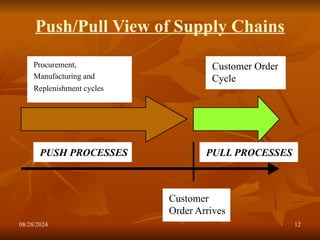
Push/Pull View of Supply Chains
Procurement,
Manufacturing and
Replenishment cycles
Customer Order
Cycle
Customer
Order Arrives
PUSH PROCESSES PULL PROCESSES
08/28/2024 13
Supply Chain Management (SCM)
 Managing flow of information through supply chain in
order to attain the level of synchronization that will
make it more responsive to customer needs while
lowering costs.
 Keys to effective SCM
 information
 communication
 cooperation
 trust
08/28/2024 14
Why is SCM Important?
 Strategic Advantage – It Can Drive Strategy
* Manufacturing is becoming more efficient.
* SCM offers opportunity for differentiation (Dell) or
cost reduction (Wal-Mart or Big Bazaar)
 Globalization – It Covers The World
* Requires greater coordination of production and
distribution.
* Increased risk of supply chain interruption.
* Increases need for robust and flexible supply chains.
08/28/2024 15
Examples of Supply Chains
 Dell / Compaq
 Toyota / Ford
 Milk Distribution System
 Dabbawalas of Mumbai
08/28/2024 16
Supply Chain Uncertainty
 Inaccurate demand forecasting.
 Long variable lead times.
 Late deliveries.
 Incomplete shipments.
 Product changes batch ordering.
 Price fluctuations and discounts.
 Inflated orders.
08/28/2024 17
Contd……..
 One goal in SCM:
 respond to uncertainty in customer demand without
creating costly excess inventory.
 Negative effects of uncertainty
 lateness
 incomplete orders
 Inventory
 insurance against supply chain uncertainty.
08/28/2024 18
Information Technology: A Supply
Chain Enabler
 Information links all aspects of supply chain.
 E-business
 replacement of physical business processes with
electronic ones.
 Electronic data interchange (EDI)
 a computer-to-computer exchange of business
documents.
08/28/2024 19
 Bar code and point-of-sale
 data creates a computer record of a sale.
 Radio frequency identification (RFID)
 technology can send product data from an item to a
reader via radio waves.
 Internet
 allows companies to communicate with suppliers,
customers, shippers and other businesses around
the world.
08/28/2024 20
Collaborative Planning, Forecasting, and
Replenishment
 Process for two or more companies in a supply chain to
synchronize their demand forecasts into a single plan to
meet customer demand.
 Parties electronically exchange
 past sales trends
 point-of-sale data
 on-hand inventory
 scheduled promotions
 forecasts
08/28/2024 21
Suppliers
 Procurement
 purchase of goods and services from suppliers.
 On-demand (direct response) delivery
 requires supplier to deliver goods when demanded by
customer.
 Continuous replenishment
 supplying orders in a short period of time according to
a predetermined schedule.
 Cross-enterprise teams coordinate processes between
company and supplier.
08/28/2024 22
Outsourcing
 Sourcing
 selection of suppliers.
 Outsourcing
 purchase of goods and services from an outside
supplier.
 Core competencies
 what a company does best.
 Single sourcing
 a company purchases goods and services from only a
few (or one) suppliers.
08/28/2024 23
E-Procurement
 Direct purchase from suppliers over the Internet.
 E-marketplaces
 web sites where companies and suppliers conduct
business-to-business activities.
 Reverse auction
 a company posts orders on the Internet for suppliers to
bid on.
08/28/2024 24
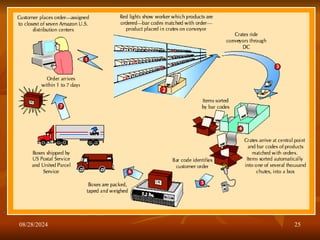
Distribution
 Encompasses all channels, processes, and functions,
including warehousing and transportation, that a product
passes on its way to final customer.
 Often called logistics.
 Logistics
 transportation and distribution of goods and services.
08/28/2024 25
08/28/2024 26
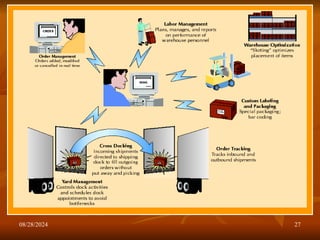
Warehouse Management Systems
 Highly automated system that runs day-to-day operations of
a DC.
 Controls item putaway, picking, packing, and shipping.
 Features
 transportation management
 order management
 yard management
 labor management
 warehouse optimization
08/28/2024 27
08/28/2024 28
Vendor-Managed Inventory
 Manufacturers generate orders, not distributors or
retailers.
 Stocking information is accessed using EDI.
 A first step towards supply chain collaboration.
 Increased speed, reduced errors, and improved
service.
08/28/2024 29
Transportation
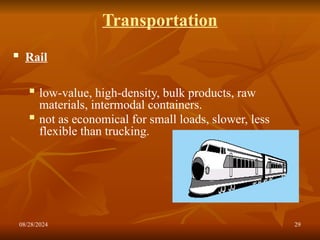
 Rail
 low-value, high-density, bulk products, raw
materials, intermodal containers.
 not as economical for small loads, slower, less
flexible than trucking.
08/28/2024 30
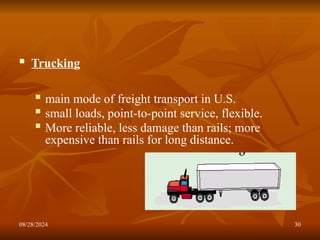
 Trucking
 main mode of freight transport in U.S.
 small loads, point-to-point service, flexible.
 More reliable, less damage than rails; more
expensive than rails for long distance.
08/28/2024 31
 Air
most expensive and fast.
lightweight, small packages.
high-value, perishable and critical goods.
less theft.
08/28/2024 32
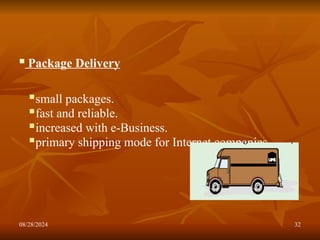
 Package Delivery
small packages.
fast and reliable.
increased with e-Business.
primary shipping mode for Internet companies.
08/28/2024 33
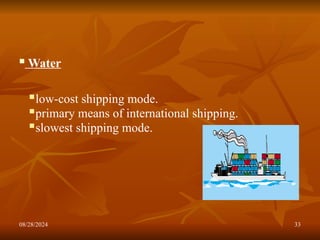
 Water
low-cost shipping mode.
primary means of international shipping.
slowest shipping mode.
08/28/2024 34
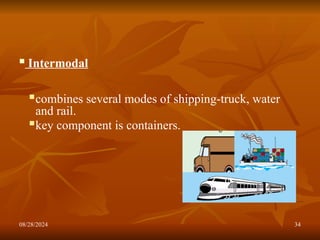
 Intermodal
combines several modes of shipping-truck, water
and rail.
key component is containers.
08/28/2024 35
 Pipeline
transport oil and products in liquid form.
high capital cost, economical use.
long life and low operating cost.
08/28/2024 36
Internet Transportation Exchanges
 Bring together shippers and carriers.
 Initial contact, negotiations, auctions.
 Examples
 www.nte.com
 www.freightquote.com
08/28/2024 37
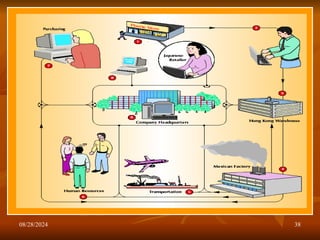
SCM Software
 Enterprise Resource Planning (ERP)
 software that integrates components of a company
by sharing and organizing information and data.
 SAP was first ERP software.
 mySAP.com
 web enabled modules that allow collaboration
between companies along the supply chain.
08/28/2024 38
08/28/2024 39
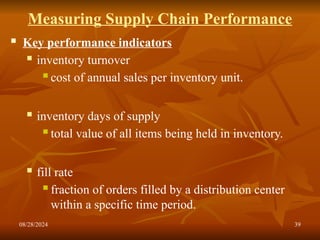
Measuring Supply Chain Performance
 Key performance indicators
 inventory turnover
 cost of annual sales per inventory unit.
 inventory days of supply
 total value of all items being held in inventory.
 fill rate
 fraction of orders filled by a distribution center
within a specific time period.
08/28/2024 40
Contd….
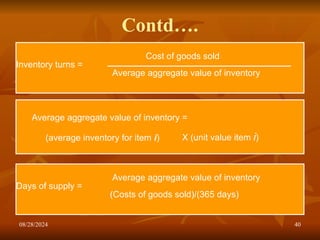
Inventory turns =
Average aggregate value of inventory
Cost of goods sold
Average aggregate value of inventory =
(average inventory for item i) X (unit value item i)
Days of supply =
(Costs of goods sold)/(365 days)
Average aggregate value of inventory
08/28/2024 41
Other Measures of Supply Chain
Performance
 Process Control
 used to monitor and control any process in supply
chain.
 Supply Chain Operations Reference (SCOR)
 establish targets to achieve “best in class”
performance.
08/28/2024 42
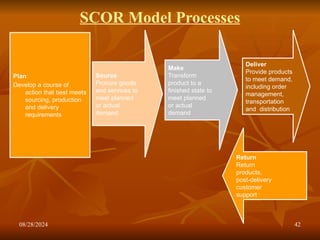
SCOR Model Processes
Plan
Develop a course of
action that best meets
sourcing, production
and delivery
requirements
Source
Procure goods
and services to
meet planned
or actual
demand
Make
Transform
product to a
finished state to
meet planned
or actual
demand
Deliver
Provide products
to meet demand,
including order
management,
transportation
and distribution
Return
Return
products,
post-delivery
customer
support
08/28/2024 43
Global Supply Chain
 To compete globally requires an effective supply
chain.
 Information technology is an “enabler” of global
trade.
 Nations form trading groups.
08/28/2024 44
Obstacles to Global Chain Transactions
 Increased documentation for invoices, cargo insurance,
letters of credit, ocean bills of lading or air waybills, and
inspections.
 Ever changing regulations that vary from country to
country that govern the import and export of goods.
 Trade groups, tariffs, duties, and landing costs.
 Limited shipping modes.
 Differences in communication technology and
availability.
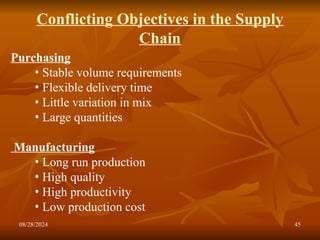
08/28/2024 45
Conflicting Objectives in the Supply
Chain
Purchasing
• Stable volume requirements
• Flexible delivery time
• Little variation in mix
• Large quantities
Manufacturing
• Long run production
• High quality
• High productivity
• Low production cost
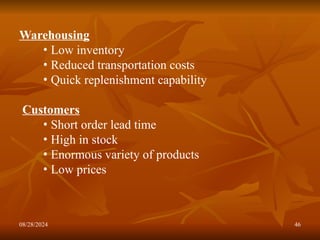
08/28/2024 46
Warehousing
• Low inventory
• Reduced transportation costs
• Quick replenishment capability
Customers
• Short order lead time
• High in stock
• Enormous variety of products
• Low prices
120
08/28/2024 47

Supply Chain Management.presentationnnanna

  • 1.
  • 2.
    08/28/2024 2 Introduction – SupplyChain – the core business processes in an organization that create and deliver a product or service, from concept through development and manufacturing or conversion, and into a market for consumption. – Supply Chain Management – the methods, systems and leadership that continuously improve an organization’s integrated processes for product and service design, purchasing, inventory management, logistics, distribution and customer satisfaction.
  • 3.
    08/28/2024 3 Definitions Supply ChainManagement deals with the management of materials, information, and financial flows in a network consisting of suppliers, manufacturers, distributors and customers.
  • 4.
    08/28/2024 4 Value vs.Supply Chain  Value chain  every step from raw materials to the eventual end user.  ultimate goal is delivery of maximum value to the end user.  Supply chain  activities that get raw materials and subassemblies into manufacturing operation.  Terms are used interchangeably
  • 5.
    08/28/2024 5 Decision Phasesin a Supply Chain  Supply chain strategy or design.  Supply chain planning.  Supply chain operation.
  • 6.
    08/28/2024 6 Process viewof a supply chain  Cycle view  Push/pull view
  • 7.
    08/28/2024 7 Cycle Viewof Supply Chains Customer Order Cycle Replenishment Cycle Manufacturing Cycle Procurement Cycle Customer Retailer Distributor Manufacturer Supplier
  • 8.
    08/28/2024 8 Customer ordercycle  Customer arrival.  Customer order entry.  Customer order fulfillment.  Customer order receiving.
  • 9.
    08/28/2024 9 Replenishment cycle Retail order trigger.  Retail order entry.  Retail order fulfillment.  Retail order receiving.
  • 10.
    08/28/2024 10 Manufacturing cycle Order arrival from the distributor, retailer, or customer.  Production scheduling.  Manufacturing and shipping.  Receiving at the distributor, retailer, or customer.
  • 11.
    08/28/2024 11 Push/Pull Viewof Supply Chains  Pull processes: execution is initiated in response to a customer order.  Push processes: execution is initiated in anticipation of customer orders.
  • 12.
    08/28/2024 12 Push/Pull Viewof Supply Chains Procurement, Manufacturing and Replenishment cycles Customer Order Cycle Customer Order Arrives PUSH PROCESSES PULL PROCESSES
  • 13.
    08/28/2024 13 Supply ChainManagement (SCM)  Managing flow of information through supply chain in order to attain the level of synchronization that will make it more responsive to customer needs while lowering costs.  Keys to effective SCM  information  communication  cooperation  trust
  • 14.
    08/28/2024 14 Why isSCM Important?  Strategic Advantage – It Can Drive Strategy * Manufacturing is becoming more efficient. * SCM offers opportunity for differentiation (Dell) or cost reduction (Wal-Mart or Big Bazaar)  Globalization – It Covers The World * Requires greater coordination of production and distribution. * Increased risk of supply chain interruption. * Increases need for robust and flexible supply chains.
  • 15.
    08/28/2024 15 Examples ofSupply Chains  Dell / Compaq  Toyota / Ford  Milk Distribution System  Dabbawalas of Mumbai
  • 16.
    08/28/2024 16 Supply ChainUncertainty  Inaccurate demand forecasting.  Long variable lead times.  Late deliveries.  Incomplete shipments.  Product changes batch ordering.  Price fluctuations and discounts.  Inflated orders.
  • 17.
    08/28/2024 17 Contd……..  Onegoal in SCM:  respond to uncertainty in customer demand without creating costly excess inventory.  Negative effects of uncertainty  lateness  incomplete orders  Inventory  insurance against supply chain uncertainty.
  • 18.
    08/28/2024 18 Information Technology:A Supply Chain Enabler  Information links all aspects of supply chain.  E-business  replacement of physical business processes with electronic ones.  Electronic data interchange (EDI)  a computer-to-computer exchange of business documents.
  • 19.
    08/28/2024 19  Barcode and point-of-sale  data creates a computer record of a sale.  Radio frequency identification (RFID)  technology can send product data from an item to a reader via radio waves.  Internet  allows companies to communicate with suppliers, customers, shippers and other businesses around the world.
  • 20.
    08/28/2024 20 Collaborative Planning,Forecasting, and Replenishment  Process for two or more companies in a supply chain to synchronize their demand forecasts into a single plan to meet customer demand.  Parties electronically exchange  past sales trends  point-of-sale data  on-hand inventory  scheduled promotions  forecasts
  • 21.
    08/28/2024 21 Suppliers  Procurement purchase of goods and services from suppliers.  On-demand (direct response) delivery  requires supplier to deliver goods when demanded by customer.  Continuous replenishment  supplying orders in a short period of time according to a predetermined schedule.  Cross-enterprise teams coordinate processes between company and supplier.
  • 22.
    08/28/2024 22 Outsourcing  Sourcing selection of suppliers.  Outsourcing  purchase of goods and services from an outside supplier.  Core competencies  what a company does best.  Single sourcing  a company purchases goods and services from only a few (or one) suppliers.
  • 23.
    08/28/2024 23 E-Procurement  Directpurchase from suppliers over the Internet.  E-marketplaces  web sites where companies and suppliers conduct business-to-business activities.  Reverse auction  a company posts orders on the Internet for suppliers to bid on.
  • 24.
    08/28/2024 24 Distribution  Encompassesall channels, processes, and functions, including warehousing and transportation, that a product passes on its way to final customer.  Often called logistics.  Logistics  transportation and distribution of goods and services.
  • 25.
  • 26.
    08/28/2024 26 Warehouse ManagementSystems  Highly automated system that runs day-to-day operations of a DC.  Controls item putaway, picking, packing, and shipping.  Features  transportation management  order management  yard management  labor management  warehouse optimization
  • 27.
  • 28.
    08/28/2024 28 Vendor-Managed Inventory Manufacturers generate orders, not distributors or retailers.  Stocking information is accessed using EDI.  A first step towards supply chain collaboration.  Increased speed, reduced errors, and improved service.
  • 29.
    08/28/2024 29 Transportation  Rail low-value, high-density, bulk products, raw materials, intermodal containers.  not as economical for small loads, slower, less flexible than trucking.
  • 30.
    08/28/2024 30  Trucking main mode of freight transport in U.S.  small loads, point-to-point service, flexible.  More reliable, less damage than rails; more expensive than rails for long distance.
  • 31.
    08/28/2024 31  Air mostexpensive and fast. lightweight, small packages. high-value, perishable and critical goods. less theft.
  • 32.
    08/28/2024 32  PackageDelivery small packages. fast and reliable. increased with e-Business. primary shipping mode for Internet companies.
  • 33.
    08/28/2024 33  Water low-costshipping mode. primary means of international shipping. slowest shipping mode.
  • 34.
    08/28/2024 34  Intermodal combinesseveral modes of shipping-truck, water and rail. key component is containers.
  • 35.
    08/28/2024 35  Pipeline transportoil and products in liquid form. high capital cost, economical use. long life and low operating cost.
  • 36.
    08/28/2024 36 Internet TransportationExchanges  Bring together shippers and carriers.  Initial contact, negotiations, auctions.  Examples  www.nte.com  www.freightquote.com
  • 37.
    08/28/2024 37 SCM Software Enterprise Resource Planning (ERP)  software that integrates components of a company by sharing and organizing information and data.  SAP was first ERP software.  mySAP.com  web enabled modules that allow collaboration between companies along the supply chain.
  • 38.
  • 39.
    08/28/2024 39 Measuring SupplyChain Performance  Key performance indicators  inventory turnover  cost of annual sales per inventory unit.  inventory days of supply  total value of all items being held in inventory.  fill rate  fraction of orders filled by a distribution center within a specific time period.
  • 40.
    08/28/2024 40 Contd…. Inventory turns= Average aggregate value of inventory Cost of goods sold Average aggregate value of inventory = (average inventory for item i) X (unit value item i) Days of supply = (Costs of goods sold)/(365 days) Average aggregate value of inventory
  • 41.
    08/28/2024 41 Other Measuresof Supply Chain Performance  Process Control  used to monitor and control any process in supply chain.  Supply Chain Operations Reference (SCOR)  establish targets to achieve “best in class” performance.
  • 42.
    08/28/2024 42 SCOR ModelProcesses Plan Develop a course of action that best meets sourcing, production and delivery requirements Source Procure goods and services to meet planned or actual demand Make Transform product to a finished state to meet planned or actual demand Deliver Provide products to meet demand, including order management, transportation and distribution Return Return products, post-delivery customer support
  • 43.
    08/28/2024 43 Global SupplyChain  To compete globally requires an effective supply chain.  Information technology is an “enabler” of global trade.  Nations form trading groups.
  • 44.
    08/28/2024 44 Obstacles toGlobal Chain Transactions  Increased documentation for invoices, cargo insurance, letters of credit, ocean bills of lading or air waybills, and inspections.  Ever changing regulations that vary from country to country that govern the import and export of goods.  Trade groups, tariffs, duties, and landing costs.  Limited shipping modes.  Differences in communication technology and availability.
  • 45.
    08/28/2024 45 Conflicting Objectivesin the Supply Chain Purchasing • Stable volume requirements • Flexible delivery time • Little variation in mix • Large quantities Manufacturing • Long run production • High quality • High productivity • Low production cost
  • 46.
    08/28/2024 46 Warehousing • Lowinventory • Reduced transportation costs • Quick replenishment capability Customers • Short order lead time • High in stock • Enormous variety of products • Low prices
  • 47.

Editor's Notes

  • #7 The supply chain is a concatenation of cycles with each cycle at the interface of two successive stages in the supply chain. Each cycle involves the customer stage placing an order and receiving it after it has been supplied by the supplier stage. One difference is in size of order. Second difference is in predictability of orders - orders in the procurement cycle are predictable once manufacturing planning has been done. This is the predominant view for ERP systems. It is a transaction level view and clearly defines each process and its owner.
  • #12 In this view processes are divided based on their timing relative to the timing of a customer order. Define push and pull processes. They key difference is the uncertainty during the two phases. Give examples at Amazon and Borders to illustrate the two views
  • #15 Dell has three production sites worldwide and builds to order. Compaq does both. Consider some decisions involved - where to locate facilities? How to size them? Where is the push/pull boundary? What modes of transport to use? How much inventory to carry? In what form? Where to source from?