CIRCUIT BREAKER
Prepared by: Mabel Espinosa
ELXT 2101
Submitted to: Mr. Oscar B. Barte
Instructor I – ELXT 211
Industrial Electrical Components, Control Devices, and
Test Instruments
Circuit Breaker Basics:
• Applications
• Operations
• Characteristics
• Functions
• Kinds
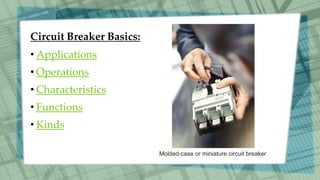
Molded-case or miniature circuit breaker
HD TV
Prepared by: Mabel Espinosa
ELXT 2101
Submitted to: Mr. Oscar B. Barte
Instructor I – ELXT 211
Television Systems
HD TV Basics:
• Applications
• Operations
• Characteristics
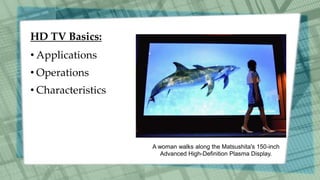
A woman walks along the Matsushita's 150-inch
Advanced High-Definition Plasma Display.
Applications
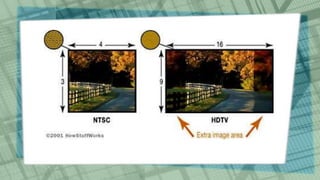
• HDTV is a high-quality video standard developed to replace older
video formats often referred to as SDTV (standard definition
television).
• High-definition television (HDTV) provides a resolution that is
substantially higher than that of standard-definition television.
• It is a television display technology that provides picture quality
similar to 35 mm. movies with sound quality similar to that of
today's compact disc. Some television stations have begun
transmitting HDTV broadcasts to users on a limited number of
channels.
Operations
• HDTV generally uses digital rather than analog signal transmission.
• Standard TV broadcasts send the radio waves they consist of in an
analog fashion. They modulate the signal to provide changes that the
television can process into images.
• Digital signals use a changing pattern of 1's and 0's, just like computers.
The result is an image with much higher resolution, less fuzzy, fewer
sharp corners in parts of the picture and overall a better looking display
but in an HDTV The results are clearer pictures, sharper, more realistic
colors and a look that's much closer to the 35mm film resolution on
which most movies were originally shot.
• Most HDTV sets support 5.1 Dolby surround sound stereo.
• Different manufacturers offer different frame rates and techniques for
'painting' the screen.
• A 'frame rate' is the number of times per second the gun moves
completely across the screen. Anywhere from 25 to 60 frames per
second.
• The 'painting' is done by moving the gun from top to bottom, in one
or two passes. When it is done in two passes, the gun skips every
other line, then comes back and does the skipped lines. That is
called interlacing whereas in 'progressive scan' systems all the lines
are illuminated in one pass.
• For example, 1080i50 is equivalent to 1920 x 1080 pixels, interlaced,
projecting 50 fields (25 frames) per second.
• The visual results of the different frame rates and of using 'i' vs 'p'
methods is often debated. In general a higher frame rate results in a
smoother looking image. Interlacing helps to reduce flicker under
certain conditions.
•
Characteristics
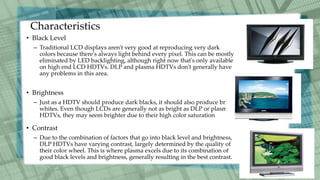
• Black Level
– Traditional LCD displays aren't very good at reproducing very dark
colors because there's always light behind every pixel. This can be mostly
eliminated by LED backlighting, although right now that's only available
on high end LCD HDTVs. DLP and plasma HDTVs don't generally have
any problems in this area.
• Brightness
– Just as a HDTV should produce dark blacks, it should also produce bright
whites. Even though LCDs are generally not as bright as DLP or plasma
HDTVs, they may seem brighter due to their high color saturation
• Contrast
– Due to the combination of factors that go into black level and brightness,
DLP HDTVs have varying contrast, largely determined by the quality of
their color wheel. This is where plasma excels due to its combination of
good black levels and brightness, generally resulting in the best contrast.
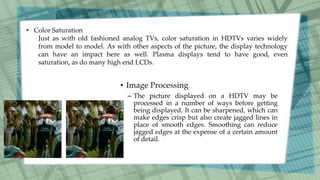
• Image Processing
– The picture displayed on a HDTV may be
processed in a number of ways before getting
being displayed. It can be sharpened, which can
make edges crisp but also create jagged lines in
place of smooth edges. Smoothing can reduce
jagged edges at the expense of a certain amount
of detail.
• Color Saturation
Just as with old fashioned analog TVs, color saturation in HDTVs varies widely
from model to model. As with other aspects of the picture, the display technology
can have an impact here as well. Plasma displays tend to have good, even
saturation, as do many high end LCDs.
• Screen Composition
– Screens made of different material obviously have different reflective
properties. Even a display that performs well in a well lit room can be affected
by glare, particularly from direct sunlight. The glass screens on plasma
displays are generally most prone to this problem. No display performs at its
peak with light shining directly on the screen, so this is mainly an issue in
rooms where you don't have much control over lighting conditions.
• Tuners and Cable Card
– Depending on how you'll be getting your HDTV broadcasts you may want to
consider a HDTV with multiple tuners or a CableCard interface. Multiple
tuners can be used to receive DVB-C cable television and DVB-T Over The Air
(OTA) signals on the same TV. In the U.S. a CableCard interface is used to
connect digital cable television directly to your TV (or DVR) without requiring
a set-top box.
References/Sources
• https://en.wikipedia.org/wiki/Circuit_breaker
• www.automation.com/...news/.../circuit-breakers-for-industrial-applications
• http://www.electrical4u.com/circuit-breaker-operation/
• https://en.wikipedia.org/wiki/Circuit_breaker#Operation
• http://www.electrical-installation.org/enwiki/Fundamental_characteristics_of_a_circuit-breaker
• https://www.reference.com/home-garden/function-circuit-breaker-95c10d733ceb66f9#
• http://www.studyelectrical.com/2014/05/classification-types-of-circuit-breakers.html
• http://www.miniature-circuit-breaker.com/protect-your-home-and-business-with-low-voltage-circuit-breaker-3/
• https://en.wikipedia.org/wiki/Circuit_breaker#Medium-voltage_circuit_breakers
• http://wjem.net/portfolio-item/high-speed-circuit-breaker-pneumatic-type/
• http://www.miniature-circuit-breaker.com/hydraulic-magnetic-circuit-breaker-theory/
• http://www.studyelectrical.com/2016/06/oil-circuit-breakers-types-working-construction.html
• http://www.studyelectrical.com/2014/05/air-blast-circuit-breakers.html
• https://www.google.com.ph/search?q=circuit+breaker&source=lnms&tbm=isch&sa=X&ved=0ah
UKEwju-
u3A4vfQAhVEOrwKHcU0BlkQ_AUICCgB&biw=911&bih=409#tbm=isch&q=HD+TV&imgrc=1J
y-CkqBEOsx_M%3A
• https://en.wikipedia.org/wiki/Television#HD
• http://www.afterdawn.com/guides/archive/afterdawn_hdtv_buyer_s_guide_part_2-
picking_out_your_hdtv_page_2.cfm
• http://techterms.com/definition/hdtv
• http://whatis.techtarget.com/definition/HDTV-high-definition-television
• http://www.hometechanswers.com/hdtv/how-hdtv-works.html
Circuit breaker

Circuit breaker

  • 1.
    CIRCUIT BREAKER Prepared by:Mabel Espinosa ELXT 2101 Submitted to: Mr. Oscar B. Barte Instructor I – ELXT 211 Industrial Electrical Components, Control Devices, and Test Instruments
  • 2.
    Circuit Breaker Basics: •Applications • Operations • Characteristics • Functions • Kinds Molded-case or miniature circuit breaker
  • 3.
    HD TV Prepared by:Mabel Espinosa ELXT 2101 Submitted to: Mr. Oscar B. Barte Instructor I – ELXT 211 Television Systems
  • 4.
    HD TV Basics: •Applications • Operations • Characteristics A woman walks along the Matsushita's 150-inch Advanced High-Definition Plasma Display.
  • 5.
    Applications • HDTV isa high-quality video standard developed to replace older video formats often referred to as SDTV (standard definition television). • High-definition television (HDTV) provides a resolution that is substantially higher than that of standard-definition television. • It is a television display technology that provides picture quality similar to 35 mm. movies with sound quality similar to that of today's compact disc. Some television stations have begun transmitting HDTV broadcasts to users on a limited number of channels.
  • 6.
    Operations • HDTV generallyuses digital rather than analog signal transmission. • Standard TV broadcasts send the radio waves they consist of in an analog fashion. They modulate the signal to provide changes that the television can process into images. • Digital signals use a changing pattern of 1's and 0's, just like computers. The result is an image with much higher resolution, less fuzzy, fewer sharp corners in parts of the picture and overall a better looking display but in an HDTV The results are clearer pictures, sharper, more realistic colors and a look that's much closer to the 35mm film resolution on which most movies were originally shot. • Most HDTV sets support 5.1 Dolby surround sound stereo. • Different manufacturers offer different frame rates and techniques for 'painting' the screen.
  • 8.
    • A 'framerate' is the number of times per second the gun moves completely across the screen. Anywhere from 25 to 60 frames per second. • The 'painting' is done by moving the gun from top to bottom, in one or two passes. When it is done in two passes, the gun skips every other line, then comes back and does the skipped lines. That is called interlacing whereas in 'progressive scan' systems all the lines are illuminated in one pass. • For example, 1080i50 is equivalent to 1920 x 1080 pixels, interlaced, projecting 50 fields (25 frames) per second. • The visual results of the different frame rates and of using 'i' vs 'p' methods is often debated. In general a higher frame rate results in a smoother looking image. Interlacing helps to reduce flicker under certain conditions. •
  • 9.
    Characteristics • Black Level –Traditional LCD displays aren't very good at reproducing very dark colors because there's always light behind every pixel. This can be mostly eliminated by LED backlighting, although right now that's only available on high end LCD HDTVs. DLP and plasma HDTVs don't generally have any problems in this area. • Brightness – Just as a HDTV should produce dark blacks, it should also produce bright whites. Even though LCDs are generally not as bright as DLP or plasma HDTVs, they may seem brighter due to their high color saturation • Contrast – Due to the combination of factors that go into black level and brightness, DLP HDTVs have varying contrast, largely determined by the quality of their color wheel. This is where plasma excels due to its combination of good black levels and brightness, generally resulting in the best contrast.
  • 10.
    • Image Processing –The picture displayed on a HDTV may be processed in a number of ways before getting being displayed. It can be sharpened, which can make edges crisp but also create jagged lines in place of smooth edges. Smoothing can reduce jagged edges at the expense of a certain amount of detail. • Color Saturation Just as with old fashioned analog TVs, color saturation in HDTVs varies widely from model to model. As with other aspects of the picture, the display technology can have an impact here as well. Plasma displays tend to have good, even saturation, as do many high end LCDs.
  • 11.
    • Screen Composition –Screens made of different material obviously have different reflective properties. Even a display that performs well in a well lit room can be affected by glare, particularly from direct sunlight. The glass screens on plasma displays are generally most prone to this problem. No display performs at its peak with light shining directly on the screen, so this is mainly an issue in rooms where you don't have much control over lighting conditions. • Tuners and Cable Card – Depending on how you'll be getting your HDTV broadcasts you may want to consider a HDTV with multiple tuners or a CableCard interface. Multiple tuners can be used to receive DVB-C cable television and DVB-T Over The Air (OTA) signals on the same TV. In the U.S. a CableCard interface is used to connect digital cable television directly to your TV (or DVR) without requiring a set-top box.
  • 12.
    References/Sources • https://en.wikipedia.org/wiki/Circuit_breaker • www.automation.com/...news/.../circuit-breakers-for-industrial-applications •http://www.electrical4u.com/circuit-breaker-operation/ • https://en.wikipedia.org/wiki/Circuit_breaker#Operation • http://www.electrical-installation.org/enwiki/Fundamental_characteristics_of_a_circuit-breaker • https://www.reference.com/home-garden/function-circuit-breaker-95c10d733ceb66f9# • http://www.studyelectrical.com/2014/05/classification-types-of-circuit-breakers.html • http://www.miniature-circuit-breaker.com/protect-your-home-and-business-with-low-voltage-circuit-breaker-3/ • https://en.wikipedia.org/wiki/Circuit_breaker#Medium-voltage_circuit_breakers • http://wjem.net/portfolio-item/high-speed-circuit-breaker-pneumatic-type/ • http://www.miniature-circuit-breaker.com/hydraulic-magnetic-circuit-breaker-theory/
  • 13.
    • http://www.studyelectrical.com/2016/06/oil-circuit-breakers-types-working-construction.html • http://www.studyelectrical.com/2014/05/air-blast-circuit-breakers.html •https://www.google.com.ph/search?q=circuit+breaker&source=lnms&tbm=isch&sa=X&ved=0ah UKEwju- u3A4vfQAhVEOrwKHcU0BlkQ_AUICCgB&biw=911&bih=409#tbm=isch&q=HD+TV&imgrc=1J y-CkqBEOsx_M%3A • https://en.wikipedia.org/wiki/Television#HD • http://www.afterdawn.com/guides/archive/afterdawn_hdtv_buyer_s_guide_part_2- picking_out_your_hdtv_page_2.cfm • http://techterms.com/definition/hdtv • http://whatis.techtarget.com/definition/HDTV-high-definition-television • http://www.hometechanswers.com/hdtv/how-hdtv-works.html