CAMERA ANGLES IN
CINEMATOGRAPHY
Extreme close up
An extreme close up
shows us objects and
people differently than
we see them, calls
attention to the
subjects, making them
more memorable
visually.
CLOSE UP
A close up is a shot
that keeps only the
face full in the frame,
can show the
emotion of the
character through
their facial
expressions.
MID SHOT
Mid shots are used during
sequences with dialogue
or a small group of people
acting, also gives the
viewer a partial view of the
background, shows
subjects facial expressions
in the context of their body
language.
LONG SHOT
A shot that depicts an
entire characters or
object from head to foot,
not as an establishing
shot. Typically shows the
entire object or subject,
usually intended to play it
in some relation to its
surrounding.
EXTREME LONG SHOT
Generally used for
setting the scene or
establishing the shot,
often used in scenes of
thrilling action such as
disaster movies, there
would also be very little
detail visible.
ESTABLISHING SHOT
An establishing shot
establishes the
context of the scene,
showing the
relationship between
its important figures
and objects, generally
used at the beginning
of a scene.
POINT OF VIEW
A shot that depicts
the point of view of
a character so that
we see exactly
what they see.
Often used In
Horror cinema to
see the world
through a killer’s
eyes.
OVER THE SHOULDER
A shot where the
camera is positioned
behind one subject’s
shoulder usually during
a conversation, implies
a connection between
the speakers as
opposed to the single
shot that suggests
distance
LOW ANGLE
A shot looking up at a
character or subject,
often making them
look bigger in the
frame, it can make the
subject look heroic or
dominant. Also good
for making cities look
empty
HIGH ANGLE
A shot looking down on
a character or subject
often isolating them in
the frame. Makes the
subject seem
vulnerable.
CAMERA SHOTS IN
CINEMATOGRAPHY
PANNING
Panning refers to
rotating or pivoting a
motion picture or
camera horizontally,
from a fixed position,
similar to the motion of a
person when they turn
their head.
TRACKING/DOLLY SHOT
A tracking shot is
when a camera
follows a person or an
object physically
moving with the
subject, can be done
by using tracks and
ropes. Typically
parallel to action.
TILT
Tilting is a technique which
the camera stays in a fixed
position, but rotates up and
down on a vertical plane,
results in a motion similar to
someone raising or lowering
their head. It is also the
vertical equivalent of a pan.
CRANE
A crane shot is a shot taken
by a camera on a crane or
jib, uses are to view the
actors from above or to
transition the camera above
the actors. A crane shot is a
common way of ending a
movie.
ZOOM
Zooming refers to the
technique of changing the
focal length of a zoom lens,
can be performed towards
longer focal lengths which
gives a “zoom in” effect.
Zooming in typically focuses
attention, while zooming out
reveals more of the situation.
MATCH ON ACTION
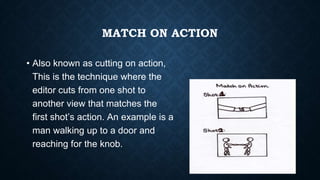
• Also known as cutting on action,
This is the technique where the
editor cuts from one shot to
another view that matches the
first shot’s action. An example is a
man walking up to a door and
reaching for the knob.
180 DEGREE RULE
• The 180 degree rule is a
cinematography guideline that states
that two . Characters in a scene should
maintain the same left/right relationship
to one another, when the camera
passes over the invisible axis
connecting three two subject.
SHOT REVERSE SHOT
• Shot reverse shot is a film
technique where one character is
shown looking at another
character (often off screen), and
then the other character is shown
looking back at the first character.
CUT AWAY
• In film and video, a cutaway shot is the interruption of a
continuously filmed action by inserting a view of something
else. It is usually, although not always, followed by a cut back
to the first shot, when the cutaway avoids a jump cut.

Camera angles presentation.pptx

  • 1.
  • 2.
    Extreme close up Anextreme close up shows us objects and people differently than we see them, calls attention to the subjects, making them more memorable visually.
  • 3.
    CLOSE UP A closeup is a shot that keeps only the face full in the frame, can show the emotion of the character through their facial expressions.
  • 4.
    MID SHOT Mid shotsare used during sequences with dialogue or a small group of people acting, also gives the viewer a partial view of the background, shows subjects facial expressions in the context of their body language.
  • 5.
    LONG SHOT A shotthat depicts an entire characters or object from head to foot, not as an establishing shot. Typically shows the entire object or subject, usually intended to play it in some relation to its surrounding.
  • 6.
    EXTREME LONG SHOT Generallyused for setting the scene or establishing the shot, often used in scenes of thrilling action such as disaster movies, there would also be very little detail visible.
  • 7.
    ESTABLISHING SHOT An establishingshot establishes the context of the scene, showing the relationship between its important figures and objects, generally used at the beginning of a scene.
  • 8.
    POINT OF VIEW Ashot that depicts the point of view of a character so that we see exactly what they see. Often used In Horror cinema to see the world through a killer’s eyes.
  • 9.
    OVER THE SHOULDER Ashot where the camera is positioned behind one subject’s shoulder usually during a conversation, implies a connection between the speakers as opposed to the single shot that suggests distance
  • 10.
    LOW ANGLE A shotlooking up at a character or subject, often making them look bigger in the frame, it can make the subject look heroic or dominant. Also good for making cities look empty
  • 11.
    HIGH ANGLE A shotlooking down on a character or subject often isolating them in the frame. Makes the subject seem vulnerable.
  • 12.
  • 13.
    PANNING Panning refers to rotatingor pivoting a motion picture or camera horizontally, from a fixed position, similar to the motion of a person when they turn their head.
  • 14.
    TRACKING/DOLLY SHOT A trackingshot is when a camera follows a person or an object physically moving with the subject, can be done by using tracks and ropes. Typically parallel to action.
  • 15.
    TILT Tilting is atechnique which the camera stays in a fixed position, but rotates up and down on a vertical plane, results in a motion similar to someone raising or lowering their head. It is also the vertical equivalent of a pan.
  • 16.
    CRANE A crane shotis a shot taken by a camera on a crane or jib, uses are to view the actors from above or to transition the camera above the actors. A crane shot is a common way of ending a movie.
  • 17.
    ZOOM Zooming refers tothe technique of changing the focal length of a zoom lens, can be performed towards longer focal lengths which gives a “zoom in” effect. Zooming in typically focuses attention, while zooming out reveals more of the situation.
  • 18.
    MATCH ON ACTION •Also known as cutting on action, This is the technique where the editor cuts from one shot to another view that matches the first shot’s action. An example is a man walking up to a door and reaching for the knob.
  • 19.
    180 DEGREE RULE •The 180 degree rule is a cinematography guideline that states that two . Characters in a scene should maintain the same left/right relationship to one another, when the camera passes over the invisible axis connecting three two subject.
  • 20.
    SHOT REVERSE SHOT •Shot reverse shot is a film technique where one character is shown looking at another character (often off screen), and then the other character is shown looking back at the first character.
  • 21.
    CUT AWAY • Infilm and video, a cutaway shot is the interruption of a continuously filmed action by inserting a view of something else. It is usually, although not always, followed by a cut back to the first shot, when the cutaway avoids a jump cut.