Responding to the Government’s National Data
Strategy Consultation
Round-table event, 24.11.2020
Nick Poole, Chief Executive, CILIP
For this session, we will be using Padlet (a simple online collaborative
document) to capture your comments and ideas:
https://padlet.com/nick_poole/CILIPNDS
Welcome!
We believe that information professionals in all-sectors have a key role to play in ensuring that we realise
and maximise the benefits of a data-driven world while minimising the harms.
The consultation towards a National Data Strategy is an opportunity to consider how the Government and
industry are thinking about those benefits and potential harms and to set out the role that we believe our
professional community can play.
The objectives for today are:
i) To consider the overall positioning of our profession in relation to the intended outcomes of the NDS
ii) To inform a response to be submitted by CILIP on behalf of our professional community.
Housekeeping
We have had a fantastic response to today’s meeting, so we need to ask you to observe one or two
housekeeping rules:
• Please mute your microphone unless speaking
• If you’d like to contribute, please use the ‘Raise Hand’ function on Zoom and the Chair will ask you to speak
• When first contributing, please state who you are and which organisation or group you represent (if any!)
• Please treat other delegates with respect, use inclusive language & respect other perspectives
• The meeting will be recorded for note-taking purposes but will not be broadcast
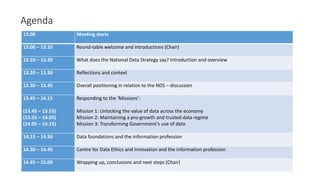
Agenda
13.00 Meeting starts
13.00 – 13.10 Round-table welcome and introductions (Chair)
13.10 – 13.20 What does the National Data Strategy say? Introduction and overview
13.20 – 13.30 Reflections and context
13.30 – 13.45 Overall positioning in relation to the NDS – discussion
13.45 – 14.15
(13.45 – 13.55)
(13.55 – 14.05)
(14.05 – 14.15)
Responding to the ‘Missions’:
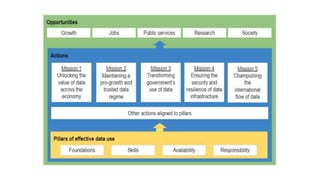
Mission 1: Unlocking the value of data across the economy
Mission 2: Maintaining a pro-growth and trusted data regime
Mission 3: Transforming Government’s use of data
14.15 – 14.30 Data foundations and the information profession
14.30 – 14.45 Centre for Data Ethics and Innovation and the information profession
14.45 – 15.00 Wrapping up, conclusions and next steps (Chair)
What does the National Data Strategy say?
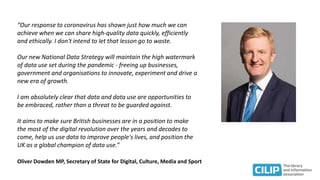
“Our response to coronavirus has shown just how much we can
achieve when we can share high-quality data quickly, efficiently
and ethically. I don't intend to let that lesson go to waste.
Our new National Data Strategy will maintain the high watermark
of data use set during the pandemic - freeing up businesses,
government and organisations to innovate, experiment and drive a
new era of growth.
I am absolutely clear that data and data use are opportunities to
be embraced, rather than a threat to be guarded against.
It aims to make sure British businesses are in a position to make
the most of the digital revolution over the years and decades to
come, help us use data to improve people's lives, and position the
UK as a global champion of data use.”
Oliver Dowden MP, Secretary of State for Digital, Culture, Media and Sport
Mission 1: Unlocking the value of data across the economy
Our first mission is to create an environment where data is appropriately usable, accessible and
available across the economy – fuelling growth in organisations large and small.
We will create a clearer policy framework to identify where greater data access and availability across the
economy can and should support growth and innovation, in what form, and what government’s role
should be, in the UK and globally.
• What is the role of data literacy in achieving these ambitions?
• Understanding how and where data creates economic and social value
• Improving the flow of data between public, private and 3rd sector
• Understanding where regulatory or other Government intervention is needed
• Considering the potential role of ‘Data Foundations’ in ensuring accessibility and data quality
Mission 2: Maintaining a pro-growth & trusted data regime
Building on our status as a world leader in technological innovation and our robust data protection
standards, we will maintain a data regime that supports the future objectives of the UK outside of the
EU and promotes growth and innovation while maintaining public trust.
This regime will not be overly burdensome for the average company, nor will it be unnecessarily complex
or vague; it will help innovators and entrepreneurs use data legitimately to build and expand their
businesses, without undue regulatory uncertainty or risk at both the domestic and international levels.
• How do we ensure the primacy of the rights of the data citizen?
• How can regulation keep pace with the speed of technology change?
• What does ‘fit for purpose’ legislation for Data Protection look like?
• What is the role of Data Ethics and the Centre for Data Ethics and Innovation?
Mission 3: Transforming Government’s use of data
There is massive untapped potential in the way the government uses data.
We will implement major and radical changes in the way that the government uses data to drive
innovation and productivity across the UK. In doing so, we will improve the delivery of public services, as
well as our ability to measure the impact of policies and programmes, and to ensure resources are used
effectively.
i) Quality, availability and access
ii) Standards and assurance
iii) Capability, leadership and culture
iv) Accountability and productivity
v) Ethics and public trust
• How do we ensure that the Government maximises its use of data while protecting the rights of the
citizen?
The consultation
The Government is keen to ensure that the National Data Strategy has been subject to appropriate
scrutiny and that as many industry sectors as possible have had an opportunity to respond.
CILIP’s response will be on behalf of information professionals – people working in libraries, knowledge
and information across the public, private and 3rd sector.
We will be submitting a response in two parts:
• An open, written response setting out our vision of how the sector can maximise the opportunities and
mitigate the risks in the National Data Strategy, and;
• A line response to the 22 questions in the consultation document
Open discussion: Reflections and context
Open discussion: Positioning our professional community
Breakout Rooms: Responding to the ‘Missions’
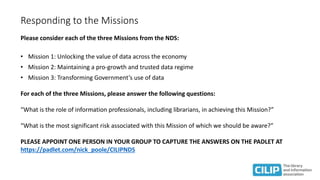
Responding to the Missions
Please consider each of the three Missions from the NDS:
• Mission 1: Unlocking the value of data across the economy
• Mission 2: Maintaining a pro-growth and trusted data regime
• Mission 3: Transforming Government’s use of data
For each of the three Missions, please answer the following questions:
“What is the role of information professionals, including librarians, in achieving this Mission?”
“What is the most significant risk associated with this Mission of which we should be aware?”
PLEASE APPOINT ONE PERSON IN YOUR GROUP TO CAPTURE THE ANSWERS ON THE PADLET AT
https://padlet.com/nick_poole/CILIPNDS
Discussion: Data foundations and the information profession
What are ‘Data foundations’?
“Data foundations" are defined in the document as follows: The true value of data can only be fully
realised when it is fit for purpose, recorded in standardised formats on modern, future-proof systems and
held in a condition that means it is findable, accessible, interoperable and reusable. By improving the
quality of the data we are using, we can use it more effectively, and drive better insights and outcomes
from its use.
i) Understanding the data you have and the data you need to develop or acquire - and what you need
to create a solid foundation and drive data based insights.
ii) Organising that data. After you understand and procure the right data, you need to streamline,
organise and integrate it - which typically involves data in the cloud, data lakes, and other emerging
data storage and integration technologies.
iii) Building trust in the data. It needs to be transparent and secure, with good data governance, data
quality and data cleansing processes in place.
Key questions
• What is the role of information professionals in helping their organisations and communities
understand what data they need to acquire in order to meet their objectives?
• What is the role of information professionals in helping organisations and communities to organise,
store and manage data?
• What is the role of information professionals in developing trusted services, including accountable and
transparent data governance?
Discussion: Centre for Data Ethics and Innovation and the
Information Profession
The Centre for Data Ethics and Innovation (CDEI)
The Centre for Data Ethics and Innovation (CDEI) is part of DCMS:
“We’re tasked by the Government to connect policymakers, industry, civil society, and the public to develop
the right governance regime for data-driven technologies.”
Current activities:
• Review of online targeting (how data is used to target messages, content and services)
• ‘AI Barometer’ – assessing risks and opportunities across 5 sectors (incl. Health)
• Use of data in COVID-19 response
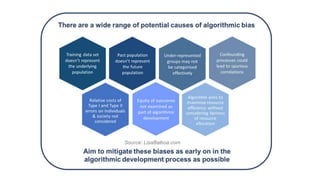
• Review of algorithmic bias
Key questions
• What is the relationship between the CILIP Ethical Principles (at the heart of our Professional
Knowledge and Skills Base) and Data Ethics?
• Should we be building a stronger or clearer relationship between ethical information professionals and
ethical data professionals?
• Would we support the idea of the CDEI acquiring statutory status? What would this enable?
Wrapping-up, conclusions and next steps
Thankyou!
It is incredibly important that we can represent the interests of our
professional community as we move further towards a data-driven society
and economy.
We would like to keep this discussion going after today’s session. Please
share any thoughts or suggestions for further activity with me at
nick.poole@cilip.org.uk.

CILIP Round-table on the National Data Strategy consultation

  • 1.
    Responding to theGovernment’s National Data Strategy Consultation Round-table event, 24.11.2020 Nick Poole, Chief Executive, CILIP
  • 2.
    For this session,we will be using Padlet (a simple online collaborative document) to capture your comments and ideas: https://padlet.com/nick_poole/CILIPNDS
  • 3.
    Welcome! We believe thatinformation professionals in all-sectors have a key role to play in ensuring that we realise and maximise the benefits of a data-driven world while minimising the harms. The consultation towards a National Data Strategy is an opportunity to consider how the Government and industry are thinking about those benefits and potential harms and to set out the role that we believe our professional community can play. The objectives for today are: i) To consider the overall positioning of our profession in relation to the intended outcomes of the NDS ii) To inform a response to be submitted by CILIP on behalf of our professional community.
  • 4.
    Housekeeping We have hada fantastic response to today’s meeting, so we need to ask you to observe one or two housekeeping rules: • Please mute your microphone unless speaking • If you’d like to contribute, please use the ‘Raise Hand’ function on Zoom and the Chair will ask you to speak • When first contributing, please state who you are and which organisation or group you represent (if any!) • Please treat other delegates with respect, use inclusive language & respect other perspectives • The meeting will be recorded for note-taking purposes but will not be broadcast
  • 5.
    Agenda 13.00 Meeting starts 13.00– 13.10 Round-table welcome and introductions (Chair) 13.10 – 13.20 What does the National Data Strategy say? Introduction and overview 13.20 – 13.30 Reflections and context 13.30 – 13.45 Overall positioning in relation to the NDS – discussion 13.45 – 14.15 (13.45 – 13.55) (13.55 – 14.05) (14.05 – 14.15) Responding to the ‘Missions’: Mission 1: Unlocking the value of data across the economy Mission 2: Maintaining a pro-growth and trusted data regime Mission 3: Transforming Government’s use of data 14.15 – 14.30 Data foundations and the information profession 14.30 – 14.45 Centre for Data Ethics and Innovation and the information profession 14.45 – 15.00 Wrapping up, conclusions and next steps (Chair)
  • 6.
    What does theNational Data Strategy say?
  • 7.
    “Our response tocoronavirus has shown just how much we can achieve when we can share high-quality data quickly, efficiently and ethically. I don't intend to let that lesson go to waste. Our new National Data Strategy will maintain the high watermark of data use set during the pandemic - freeing up businesses, government and organisations to innovate, experiment and drive a new era of growth. I am absolutely clear that data and data use are opportunities to be embraced, rather than a threat to be guarded against. It aims to make sure British businesses are in a position to make the most of the digital revolution over the years and decades to come, help us use data to improve people's lives, and position the UK as a global champion of data use.” Oliver Dowden MP, Secretary of State for Digital, Culture, Media and Sport
  • 11.
    Mission 1: Unlockingthe value of data across the economy Our first mission is to create an environment where data is appropriately usable, accessible and available across the economy – fuelling growth in organisations large and small. We will create a clearer policy framework to identify where greater data access and availability across the economy can and should support growth and innovation, in what form, and what government’s role should be, in the UK and globally. • What is the role of data literacy in achieving these ambitions? • Understanding how and where data creates economic and social value • Improving the flow of data between public, private and 3rd sector • Understanding where regulatory or other Government intervention is needed • Considering the potential role of ‘Data Foundations’ in ensuring accessibility and data quality
  • 12.
    Mission 2: Maintaininga pro-growth & trusted data regime Building on our status as a world leader in technological innovation and our robust data protection standards, we will maintain a data regime that supports the future objectives of the UK outside of the EU and promotes growth and innovation while maintaining public trust. This regime will not be overly burdensome for the average company, nor will it be unnecessarily complex or vague; it will help innovators and entrepreneurs use data legitimately to build and expand their businesses, without undue regulatory uncertainty or risk at both the domestic and international levels. • How do we ensure the primacy of the rights of the data citizen? • How can regulation keep pace with the speed of technology change? • What does ‘fit for purpose’ legislation for Data Protection look like? • What is the role of Data Ethics and the Centre for Data Ethics and Innovation?
  • 13.
    Mission 3: TransformingGovernment’s use of data There is massive untapped potential in the way the government uses data. We will implement major and radical changes in the way that the government uses data to drive innovation and productivity across the UK. In doing so, we will improve the delivery of public services, as well as our ability to measure the impact of policies and programmes, and to ensure resources are used effectively. i) Quality, availability and access ii) Standards and assurance iii) Capability, leadership and culture iv) Accountability and productivity v) Ethics and public trust • How do we ensure that the Government maximises its use of data while protecting the rights of the citizen?
  • 14.
    The consultation The Governmentis keen to ensure that the National Data Strategy has been subject to appropriate scrutiny and that as many industry sectors as possible have had an opportunity to respond. CILIP’s response will be on behalf of information professionals – people working in libraries, knowledge and information across the public, private and 3rd sector. We will be submitting a response in two parts: • An open, written response setting out our vision of how the sector can maximise the opportunities and mitigate the risks in the National Data Strategy, and; • A line response to the 22 questions in the consultation document
  • 15.
  • 16.
    Open discussion: Positioningour professional community
  • 17.
    Breakout Rooms: Respondingto the ‘Missions’
  • 18.
    Responding to theMissions Please consider each of the three Missions from the NDS: • Mission 1: Unlocking the value of data across the economy • Mission 2: Maintaining a pro-growth and trusted data regime • Mission 3: Transforming Government’s use of data For each of the three Missions, please answer the following questions: “What is the role of information professionals, including librarians, in achieving this Mission?” “What is the most significant risk associated with this Mission of which we should be aware?” PLEASE APPOINT ONE PERSON IN YOUR GROUP TO CAPTURE THE ANSWERS ON THE PADLET AT https://padlet.com/nick_poole/CILIPNDS
  • 19.
    Discussion: Data foundationsand the information profession
  • 20.
    What are ‘Datafoundations’? “Data foundations" are defined in the document as follows: The true value of data can only be fully realised when it is fit for purpose, recorded in standardised formats on modern, future-proof systems and held in a condition that means it is findable, accessible, interoperable and reusable. By improving the quality of the data we are using, we can use it more effectively, and drive better insights and outcomes from its use. i) Understanding the data you have and the data you need to develop or acquire - and what you need to create a solid foundation and drive data based insights. ii) Organising that data. After you understand and procure the right data, you need to streamline, organise and integrate it - which typically involves data in the cloud, data lakes, and other emerging data storage and integration technologies. iii) Building trust in the data. It needs to be transparent and secure, with good data governance, data quality and data cleansing processes in place.
  • 21.
    Key questions • Whatis the role of information professionals in helping their organisations and communities understand what data they need to acquire in order to meet their objectives? • What is the role of information professionals in helping organisations and communities to organise, store and manage data? • What is the role of information professionals in developing trusted services, including accountable and transparent data governance?
  • 22.
    Discussion: Centre forData Ethics and Innovation and the Information Profession
  • 23.
    The Centre forData Ethics and Innovation (CDEI) The Centre for Data Ethics and Innovation (CDEI) is part of DCMS: “We’re tasked by the Government to connect policymakers, industry, civil society, and the public to develop the right governance regime for data-driven technologies.” Current activities: • Review of online targeting (how data is used to target messages, content and services) • ‘AI Barometer’ – assessing risks and opportunities across 5 sectors (incl. Health) • Use of data in COVID-19 response • Review of algorithmic bias
  • 24.
    Key questions • Whatis the relationship between the CILIP Ethical Principles (at the heart of our Professional Knowledge and Skills Base) and Data Ethics? • Should we be building a stronger or clearer relationship between ethical information professionals and ethical data professionals? • Would we support the idea of the CDEI acquiring statutory status? What would this enable?
  • 25.
  • 26.
    Thankyou! It is incrediblyimportant that we can represent the interests of our professional community as we move further towards a data-driven society and economy. We would like to keep this discussion going after today’s session. Please share any thoughts or suggestions for further activity with me at nick.poole@cilip.org.uk.