Session One: Leveraging Technology, Thursday 1 May, 2014
Robyn Cochrane, Fergal Coleman and Sarah Bishop
1
New Voices, Better Communities
Leveraging Technology to Enhance Community Consultation and Engagement
With an ever evolving demand for service provision at the Local Government level and the
continued push to do more with less, there has never been a more critical time to engage the
community in decision making.
Community engagement professionals recognise that effective consultation is often labour-
intensive, involves substantial costs and presents a variety of challenges. However,
advances in technology over the last five years have provided the sector with opportunities
to engage and consult faster and broader than ever before – and reach the people beyond
just the ‘loudest’ voices.
Traditional public meetings and written submissions alone are becoming less and less
relevant to communities today that are digitally enabled, time-poor and increasingly mobile.
The convenience of technology provides more opportunities to participate at any time, from
any place.
The community’s expectations are changing…
The private sector is leading the way when it comes to harnessing the power of digital
innovation, for example Michael Hart, CIO of the Commonwealth Bank has been quoted
saying that the CBA now conducts 95 percent of its transactions over the Internet.1
Similarly,
sites like Amazon.com allow people to buy and sell anywhere, anytime, make user-specific
product recommendations and provide 24 hour online assistance. Services are constantly
evolving to meet the expectations of their customers.
As a result, people now expect to have the same online experience with their Council,
whether it is customer service, program and service delivery or community consultation.
This presents challenges for Local Government trying to keep up with the community’s
changing expectations, the pace of technological change and how to manage and get the
most value from the large volumes of data now being generated.
“In the past we (local government) told the community what we were doing, we have now
evolved to engaging the community in what we propose to do, but the expectation of the
community today is that not only will they be engaged but they will directly influence and will
have control over what happens. This is not an unreasonable expectation.”
– John Nevins, CEO, City of Kingston.
How do we use technology to effectively reach our community, harness their insight
and use it to enhance productivity and deliver ongoing value?
Experience with the LivingKingston2035 project demonstrates three ways technology can
enhance consultation and engagement:
1. To create broader awareness about issues or consultations;
2. To increase reach and opportunities for participation; and
3. To manage, draw meaning and derive ongoing value from data.
1 Malcolm Turnbull, Minister for Communications. AIIA Speech: Navigating Analytics Summit, 20 March,
2014.
Session One: Leveraging Technology, Thursday 1 May, 2014
Robyn Cochrane, Fergal Coleman and Sarah Bishop
2
Case Study: LivingKingston2035
Throughout 2012, the City of Kingston undertook the most significant community
consultation in its history to inform the development of a shared vision for the municipality of
Kingston (located in Victoria) looking towards 2035. The project, Living Kingston 2035,
involved a 12-month staged consultation period from 1 January to 31 December 2012.
Key goals from the outset were to work in a genuine partnership with the community to
create a shared vision; embrace best practice public participation principles - inform, consult,
involve, collaborate and empower; and to embed technology throughout the entire
consultation.
Creating awareness and increasing participation
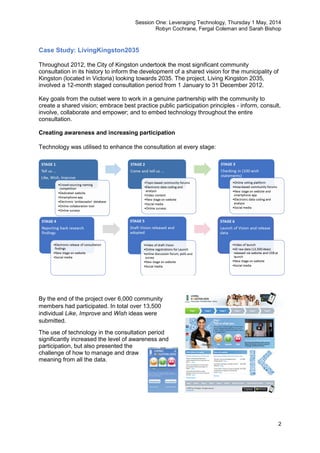
Technology was utilised to enhance the consultation at every stage:
By the end of the project over 6,000 community
members had participated. In total over 13,500
individual Like, Improve and Wish ideas were
submitted.
The use of technology in the consultation period
significantly increased the level of awareness and
participation, but also presented the
challenge of how to manage and draw
meaning from all the data.
Session One: Leveraging Technology, Thursday 1 May, 2014
Robyn Cochrane, Fergal Coleman and Sarah Bishop
3
Deriving ongoing value from the data
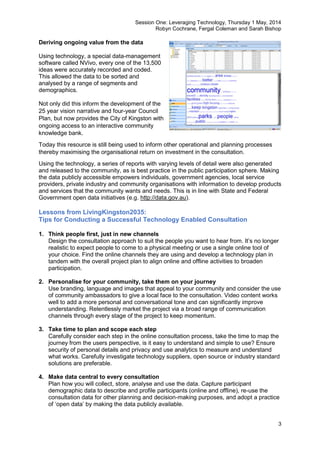
Using technology, a special data-management
software called NVivo, every one of the 13,500
ideas were accurately recorded and coded.
This allowed the data to be sorted and
analysed by a range of segments and
demographics.
Not only did this inform the development of the
25 year vision narrative and four-year Council
Plan, but now provides the City of Kingston with
ongoing access to an interactive community
knowledge bank.
Today this resource is still being used to inform other operational and planning processes
thereby maximising the organisational return on investment in the consultation.
Using the technology, a series of reports with varying levels of detail were also generated
and released to the community, as is best practice in the public participation sphere. Making
the data publicly accessible empowers individuals, government agencies, local service
providers, private industry and community organisations with information to develop products
and services that the community wants and needs. This is in line with State and Federal
Government open data initiatives (e.g. http://data.gov.au).
Lessons from LivingKingston2035:
Tips for Conducting a Successful Technology Enabled Consultation
1. Think people first, just in new channels
Design the consultation approach to suit the people you want to hear from. It’s no longer
realistic to expect people to come to a physical meeting or use a single online tool of
your choice. Find the online channels they are using and develop a technology plan in
tandem with the overall project plan to align online and offline activities to broaden
participation.
2. Personalise for your community, take them on your journey
Use branding, language and images that appeal to your community and consider the use
of community ambassadors to give a local face to the consultation. Video content works
well to add a more personal and conversational tone and can significantly improve
understanding. Relentlessly market the project via a broad range of communication
channels through every stage of the project to keep momentum.
3. Take time to plan and scope each step
Carefully consider each step in the online consultation process, take the time to map the
journey from the users perspective, is it easy to understand and simple to use? Ensure
security of personal details and privacy and use analytics to measure and understand
what works. Carefully investigate technology suppliers, open source or industry standard
solutions are preferable.
4. Make data central to every consultation
Plan how you will collect, store, analyse and use the data. Capture participant
demographic data to describe and profile participants (online and offline), re-use the
consultation data for other planning and decision-making purposes, and adopt a practice
of ‘open data’ by making the data publicly available.
Session One: Leveraging Technology, Thursday 1 May, 2014
Robyn Cochrane, Fergal Coleman and Sarah Bishop
4
5. Prepare for the future: open source, open data, open standards
The open government world is growing worldwide. It can save your organisation a lot of
money and allow you to harness the skills of a worldwide community for the benefit of
your stakeholders. Make sure you start developing your understanding of open source,
open data and open standards within your IT and communication departments.
Questions to consider
How well is your organisation leveraging technology in consultation to enhance
productivity?
 How much will your organisation spend on community consultation in 2013-14? Do you
have an organisation-wide online consultation model?
 Are your consultations reaching enough people and providing a mix of participation
options? Are you gathering a broad range of views and confidently making decisions
based on solid community evidence?
 Is data central to every consultation with the community? What happens with the data–
how are you collecting, analysing and storing it? Are you deriving ongoing value
internally or releasing it to the community?
Further information and resources
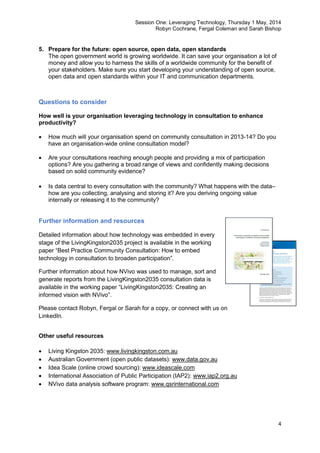
Detailed information about how technology was embedded in every
stage of the LivingKingston2035 project is available in the working
paper “Best Practice Community Consultation: How to embed
technology in consultation to broaden participation”.
Further information about how NVivo was used to manage, sort and
generate reports from the LivingKingston2035 consultation data is
available in the working paper “LivingKingston2035: Creating an
informed vision with NVivo”.
Please contact Robyn, Fergal or Sarah for a copy, or connect with us on
LinkedIn.
Other useful resources
 Living Kingston 2035: www.livingkingston.com.au
 Australian Government (open public datasets): www.data.gov.au
 Idea Scale (online crowd sourcing): www.ideascale.com
 International Association of Public Participation (IAP2): www.iap2.org.au
 NVivo data analysis software program: www.qsrinternational.com
Session One: Leveraging Technology, Thursday 1 May, 2014
Robyn Cochrane, Fergal Coleman and Sarah Bishop
5
Contact us
Sarah Bishop was the Communications and Public Affairs Manager at the City of Kingston
during the LivingKingston2035 project. She is now Director of Activate Consulting
specialising in strategic communications, community engagement and reputation
management. Sarah is passionate about helping organisations achieve their objectives by
improving communication with their people, key stakeholders and community.
Contact:
sarah@activatepeople.com
au.linkedin.com/in/sarahbishopau/
0403 214 449
Dr. Robyn Cochrane led the City of Kingston’s Living Kingston 2035 project. Robyn is Lead
Researcher for Cochrane Research Solutions, currently works with Monash University and
has a background in local government, vocational education and training and community
sectors. Robyn’s strengths include: qualitative and quantitative research; online and
traditional community consultation approaches and employee engagement.
Contact:
robyncoc@bigpond.net.au
au.linkedin.com/in/robyncochrane
0438 072 280
Fergal Coleman is a Director of Symphony3, a Melbourne based IT Consulting Firm. He
specialises in digital strategy and communications and is passionate about helping his
government clients to create successful digital strategies and develop social media
strategies that deliver community outcomes. Fergal has extensive experience facilitating
workshops and delivering training on digital strategy, social media and online business.
Contact:
Fergal.coleman@symphony3.com
au.linkedin.com/in/fergalcoleman/
0423 198 184
Acknowledgment
We would like to acknowledge the City of Kingston for granting permission to use its material
in this paper and commend the community inspired leadership shown by the City of Kingston
in undertaking this project.
For further information about the ongoing implementation of the LivingKingston2035 vision,
please contact the Performance Planning Department at the City of Kingston on 1300 356
653.

New+Voices-Better-Communities-Leveraging-Technology-LGMA_2014

  • 1.
    Session One: LeveragingTechnology, Thursday 1 May, 2014 Robyn Cochrane, Fergal Coleman and Sarah Bishop 1 New Voices, Better Communities Leveraging Technology to Enhance Community Consultation and Engagement With an ever evolving demand for service provision at the Local Government level and the continued push to do more with less, there has never been a more critical time to engage the community in decision making. Community engagement professionals recognise that effective consultation is often labour- intensive, involves substantial costs and presents a variety of challenges. However, advances in technology over the last five years have provided the sector with opportunities to engage and consult faster and broader than ever before – and reach the people beyond just the ‘loudest’ voices. Traditional public meetings and written submissions alone are becoming less and less relevant to communities today that are digitally enabled, time-poor and increasingly mobile. The convenience of technology provides more opportunities to participate at any time, from any place. The community’s expectations are changing… The private sector is leading the way when it comes to harnessing the power of digital innovation, for example Michael Hart, CIO of the Commonwealth Bank has been quoted saying that the CBA now conducts 95 percent of its transactions over the Internet.1 Similarly, sites like Amazon.com allow people to buy and sell anywhere, anytime, make user-specific product recommendations and provide 24 hour online assistance. Services are constantly evolving to meet the expectations of their customers. As a result, people now expect to have the same online experience with their Council, whether it is customer service, program and service delivery or community consultation. This presents challenges for Local Government trying to keep up with the community’s changing expectations, the pace of technological change and how to manage and get the most value from the large volumes of data now being generated. “In the past we (local government) told the community what we were doing, we have now evolved to engaging the community in what we propose to do, but the expectation of the community today is that not only will they be engaged but they will directly influence and will have control over what happens. This is not an unreasonable expectation.” – John Nevins, CEO, City of Kingston. How do we use technology to effectively reach our community, harness their insight and use it to enhance productivity and deliver ongoing value? Experience with the LivingKingston2035 project demonstrates three ways technology can enhance consultation and engagement: 1. To create broader awareness about issues or consultations; 2. To increase reach and opportunities for participation; and 3. To manage, draw meaning and derive ongoing value from data. 1 Malcolm Turnbull, Minister for Communications. AIIA Speech: Navigating Analytics Summit, 20 March, 2014.
  • 2.
    Session One: LeveragingTechnology, Thursday 1 May, 2014 Robyn Cochrane, Fergal Coleman and Sarah Bishop 2 Case Study: LivingKingston2035 Throughout 2012, the City of Kingston undertook the most significant community consultation in its history to inform the development of a shared vision for the municipality of Kingston (located in Victoria) looking towards 2035. The project, Living Kingston 2035, involved a 12-month staged consultation period from 1 January to 31 December 2012. Key goals from the outset were to work in a genuine partnership with the community to create a shared vision; embrace best practice public participation principles - inform, consult, involve, collaborate and empower; and to embed technology throughout the entire consultation. Creating awareness and increasing participation Technology was utilised to enhance the consultation at every stage: By the end of the project over 6,000 community members had participated. In total over 13,500 individual Like, Improve and Wish ideas were submitted. The use of technology in the consultation period significantly increased the level of awareness and participation, but also presented the challenge of how to manage and draw meaning from all the data.
  • 3.
    Session One: LeveragingTechnology, Thursday 1 May, 2014 Robyn Cochrane, Fergal Coleman and Sarah Bishop 3 Deriving ongoing value from the data Using technology, a special data-management software called NVivo, every one of the 13,500 ideas were accurately recorded and coded. This allowed the data to be sorted and analysed by a range of segments and demographics. Not only did this inform the development of the 25 year vision narrative and four-year Council Plan, but now provides the City of Kingston with ongoing access to an interactive community knowledge bank. Today this resource is still being used to inform other operational and planning processes thereby maximising the organisational return on investment in the consultation. Using the technology, a series of reports with varying levels of detail were also generated and released to the community, as is best practice in the public participation sphere. Making the data publicly accessible empowers individuals, government agencies, local service providers, private industry and community organisations with information to develop products and services that the community wants and needs. This is in line with State and Federal Government open data initiatives (e.g. http://data.gov.au). Lessons from LivingKingston2035: Tips for Conducting a Successful Technology Enabled Consultation 1. Think people first, just in new channels Design the consultation approach to suit the people you want to hear from. It’s no longer realistic to expect people to come to a physical meeting or use a single online tool of your choice. Find the online channels they are using and develop a technology plan in tandem with the overall project plan to align online and offline activities to broaden participation. 2. Personalise for your community, take them on your journey Use branding, language and images that appeal to your community and consider the use of community ambassadors to give a local face to the consultation. Video content works well to add a more personal and conversational tone and can significantly improve understanding. Relentlessly market the project via a broad range of communication channels through every stage of the project to keep momentum. 3. Take time to plan and scope each step Carefully consider each step in the online consultation process, take the time to map the journey from the users perspective, is it easy to understand and simple to use? Ensure security of personal details and privacy and use analytics to measure and understand what works. Carefully investigate technology suppliers, open source or industry standard solutions are preferable. 4. Make data central to every consultation Plan how you will collect, store, analyse and use the data. Capture participant demographic data to describe and profile participants (online and offline), re-use the consultation data for other planning and decision-making purposes, and adopt a practice of ‘open data’ by making the data publicly available.
  • 4.
    Session One: LeveragingTechnology, Thursday 1 May, 2014 Robyn Cochrane, Fergal Coleman and Sarah Bishop 4 5. Prepare for the future: open source, open data, open standards The open government world is growing worldwide. It can save your organisation a lot of money and allow you to harness the skills of a worldwide community for the benefit of your stakeholders. Make sure you start developing your understanding of open source, open data and open standards within your IT and communication departments. Questions to consider How well is your organisation leveraging technology in consultation to enhance productivity?  How much will your organisation spend on community consultation in 2013-14? Do you have an organisation-wide online consultation model?  Are your consultations reaching enough people and providing a mix of participation options? Are you gathering a broad range of views and confidently making decisions based on solid community evidence?  Is data central to every consultation with the community? What happens with the data– how are you collecting, analysing and storing it? Are you deriving ongoing value internally or releasing it to the community? Further information and resources Detailed information about how technology was embedded in every stage of the LivingKingston2035 project is available in the working paper “Best Practice Community Consultation: How to embed technology in consultation to broaden participation”. Further information about how NVivo was used to manage, sort and generate reports from the LivingKingston2035 consultation data is available in the working paper “LivingKingston2035: Creating an informed vision with NVivo”. Please contact Robyn, Fergal or Sarah for a copy, or connect with us on LinkedIn. Other useful resources  Living Kingston 2035: www.livingkingston.com.au  Australian Government (open public datasets): www.data.gov.au  Idea Scale (online crowd sourcing): www.ideascale.com  International Association of Public Participation (IAP2): www.iap2.org.au  NVivo data analysis software program: www.qsrinternational.com
  • 5.
    Session One: LeveragingTechnology, Thursday 1 May, 2014 Robyn Cochrane, Fergal Coleman and Sarah Bishop 5 Contact us Sarah Bishop was the Communications and Public Affairs Manager at the City of Kingston during the LivingKingston2035 project. She is now Director of Activate Consulting specialising in strategic communications, community engagement and reputation management. Sarah is passionate about helping organisations achieve their objectives by improving communication with their people, key stakeholders and community. Contact: sarah@activatepeople.com au.linkedin.com/in/sarahbishopau/ 0403 214 449 Dr. Robyn Cochrane led the City of Kingston’s Living Kingston 2035 project. Robyn is Lead Researcher for Cochrane Research Solutions, currently works with Monash University and has a background in local government, vocational education and training and community sectors. Robyn’s strengths include: qualitative and quantitative research; online and traditional community consultation approaches and employee engagement. Contact: robyncoc@bigpond.net.au au.linkedin.com/in/robyncochrane 0438 072 280 Fergal Coleman is a Director of Symphony3, a Melbourne based IT Consulting Firm. He specialises in digital strategy and communications and is passionate about helping his government clients to create successful digital strategies and develop social media strategies that deliver community outcomes. Fergal has extensive experience facilitating workshops and delivering training on digital strategy, social media and online business. Contact: Fergal.coleman@symphony3.com au.linkedin.com/in/fergalcoleman/ 0423 198 184 Acknowledgment We would like to acknowledge the City of Kingston for granting permission to use its material in this paper and commend the community inspired leadership shown by the City of Kingston in undertaking this project. For further information about the ongoing implementation of the LivingKingston2035 vision, please contact the Performance Planning Department at the City of Kingston on 1300 356 653.