Opening up public data to improve transparency and efficiencyGhent eGovernment Conference, December 2010Paul Davidson, CIO Sedgemoor District Council and Director of Standards of the Local e-Government Standards Body (LeGSB)
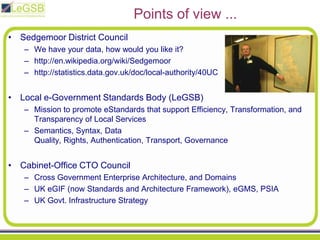
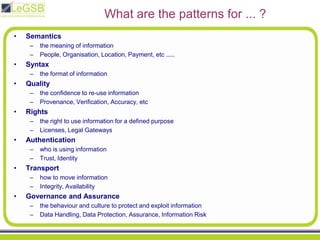
Sedgemoor District CouncilWe have your data, how would you like it?http://en.wikipedia.org/wiki/Sedgemoorhttp://statistics.data.gov.uk/doc/local-authority/40UCLocal e-Government Standards Body (LeGSB)Mission to promote eStandards that support Efficiency, Transformation, and Transparency of Local ServicesSemantics, Syntax, Data Quality, Rights, Authentication, Transport, GovernanceCabinet-Office CTO CouncilCross Government Enterprise Architecture, and DomainsUK eGIF (now Standards and Architecture Framework), eGMS, PSIAUK Govt. Infrastructure Strategy Points of view ...
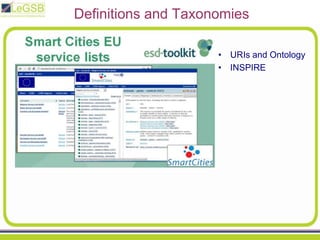
Supporting the Citadel Statementmaking public data open and accessible by establishing a well maintained repository of definitions and taxonomies that makes data consistent throughout Europe. Incorporate EU best practices into a common service delivery architecture (information, process and application-layer) that provides one common language and helps local governments share services Areas could include: public service lists, standard information on citizens, standard information on businesses, transport timetables, environmental information and geodata (GIS-data).
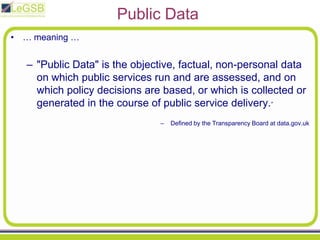
Public Data… meaning …"Public Data" is the objective, factual, non-personal data on which public services run and are assessed, and on which policy decisions are based, or which is collected or generated in the course of public service delivery.”Defined by the Transparency Board at data.gov.uk
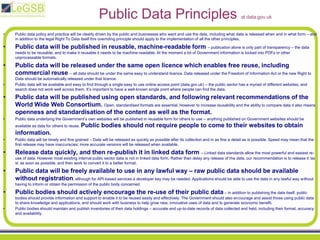
Public Data Principles at data.gov.ukPublic data policy and practice will be clearly driven by the public and businesses who want and use the data, including what data is released when and in what form – and in addition to the legal Right To Data itself this overriding principle should apply to the implementation of all the other principles.Public data will be published in reusable, machine-readable form – publication alone is only part of transparency – the data needs to be reusable, and to make it reusable it needs to be machine-readable. At the moment a lot of Government information is locked into PDFs or other unprocessable formats. Public data will be released under the same open licence which enables free reuse, including commercial reuse – all data should be under the same easy to understand licence. Data released under the Freedom of Information Act or the new Right to Data should be automatically released under that licence. Public data will be available and easy to find through a single easy to use online access point (data.gov.uk) – the public sector has a myriad of different websites, and search does not work well across them. It’s important to have a well-known single point where people can find the data. Public data will be published using open standards, and following relevant recommendations of the World Wide Web Consortium.Open, standardised formats are essential. However to increase reusability and the ability to compare data it also means openness and standardisation of the content as well as the format. Public data underlying the Government’s own websites will be published in reusable form for others to use – anything published on Government websites should be available as data for others to reuse. Public bodies should not require people to come to their websites to obtain information. Public data will be timely and fine grained – Data will be released as quickly as possible after its collection and in as fine a detail as is possible. Speed may mean that the first release may have inaccuracies; more accurate versions will be released when available. Release data quickly, and then re-publish it in linked data form – Linked data standards allow the most powerful and easiest re-use of data. However most existing internal public sector data is not in linked data form. Rather than delay any release of the data, our recommendation is to release it ‘as is’ as soon as possible, and then work to convert it to a better format. Public data will be freely available to use in any lawful way – raw public data should be available without registration, although for API-based services a developer key may be needed. Applications should be able to use the data in any lawful way without having to inform or obtain the permission of the public body concerned. Public bodies should actively encourage the re-use of their public data – in addition to publishing the data itself, public bodies should provide information and support to enable it to be reused easily and effectively. The Government should also encourage and assist those using public data to share knowledge and applications, and should work with business to help grow new, innovative uses of data and to generate economic benefit. Public bodies should maintain and publish inventories of their data holdings – accurate and up-to-date records of data collected and held, including their format, accuracy and availability.
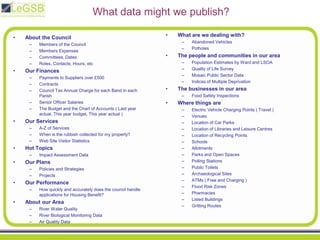
What data might we publish?What are we dealing with?
Abandoned Vehicles
Potholes
The people and communities in our area
Population Estimates by Ward and LSOA
Quality of Life Survey
Mosaic Public Sector Data
Indices of Multiple Deprivation
The businesses in our area
Food Safety Inspections
Where things are
Electric Vehicle Charging Points ( Travel )
Venues
Location of Car Parks
Location of Libraries and Leisure Centres
Location of Recycling Points

Paul Davidson – Opening up public data to improve transparancy and efficiency

  • 1.
    Opening up publicdata to improve transparency and efficiencyGhent eGovernment Conference, December 2010Paul Davidson, CIO Sedgemoor District Council and Director of Standards of the Local e-Government Standards Body (LeGSB)
  • 2.
    Sedgemoor District CouncilWehave your data, how would you like it?http://en.wikipedia.org/wiki/Sedgemoorhttp://statistics.data.gov.uk/doc/local-authority/40UCLocal e-Government Standards Body (LeGSB)Mission to promote eStandards that support Efficiency, Transformation, and Transparency of Local ServicesSemantics, Syntax, Data Quality, Rights, Authentication, Transport, GovernanceCabinet-Office CTO CouncilCross Government Enterprise Architecture, and DomainsUK eGIF (now Standards and Architecture Framework), eGMS, PSIAUK Govt. Infrastructure Strategy Points of view ...
  • 3.
    Supporting the CitadelStatementmaking public data open and accessible by establishing a well maintained repository of definitions and taxonomies that makes data consistent throughout Europe. Incorporate EU best practices into a common service delivery architecture (information, process and application-layer) that provides one common language and helps local governments share services Areas could include: public service lists, standard information on citizens, standard information on businesses, transport timetables, environmental information and geodata (GIS-data).
  • 4.
    Public Data… meaning…"Public Data" is the objective, factual, non-personal data on which public services run and are assessed, and on which policy decisions are based, or which is collected or generated in the course of public service delivery.”Defined by the Transparency Board at data.gov.uk
  • 5.
    Public Data Principlesat data.gov.ukPublic data policy and practice will be clearly driven by the public and businesses who want and use the data, including what data is released when and in what form – and in addition to the legal Right To Data itself this overriding principle should apply to the implementation of all the other principles.Public data will be published in reusable, machine-readable form – publication alone is only part of transparency – the data needs to be reusable, and to make it reusable it needs to be machine-readable. At the moment a lot of Government information is locked into PDFs or other unprocessable formats. Public data will be released under the same open licence which enables free reuse, including commercial reuse – all data should be under the same easy to understand licence. Data released under the Freedom of Information Act or the new Right to Data should be automatically released under that licence. Public data will be available and easy to find through a single easy to use online access point (data.gov.uk) – the public sector has a myriad of different websites, and search does not work well across them. It’s important to have a well-known single point where people can find the data. Public data will be published using open standards, and following relevant recommendations of the World Wide Web Consortium.Open, standardised formats are essential. However to increase reusability and the ability to compare data it also means openness and standardisation of the content as well as the format. Public data underlying the Government’s own websites will be published in reusable form for others to use – anything published on Government websites should be available as data for others to reuse. Public bodies should not require people to come to their websites to obtain information. Public data will be timely and fine grained – Data will be released as quickly as possible after its collection and in as fine a detail as is possible. Speed may mean that the first release may have inaccuracies; more accurate versions will be released when available. Release data quickly, and then re-publish it in linked data form – Linked data standards allow the most powerful and easiest re-use of data. However most existing internal public sector data is not in linked data form. Rather than delay any release of the data, our recommendation is to release it ‘as is’ as soon as possible, and then work to convert it to a better format. Public data will be freely available to use in any lawful way – raw public data should be available without registration, although for API-based services a developer key may be needed. Applications should be able to use the data in any lawful way without having to inform or obtain the permission of the public body concerned. Public bodies should actively encourage the re-use of their public data – in addition to publishing the data itself, public bodies should provide information and support to enable it to be reused easily and effectively. The Government should also encourage and assist those using public data to share knowledge and applications, and should work with business to help grow new, innovative uses of data and to generate economic benefit. Public bodies should maintain and publish inventories of their data holdings – accurate and up-to-date records of data collected and held, including their format, accuracy and availability.
  • 6.
    What data mightwe publish?What are we dealing with?
  • 7.
  • 8.
  • 9.
    The people andcommunities in our area
  • 10.
  • 11.
  • 12.
  • 13.
  • 14.
  • 15.
  • 16.
  • 17.
    Electric Vehicle ChargingPoints ( Travel )
  • 18.
  • 19.
  • 20.
    Location of Librariesand Leisure Centres
  • 21.