

Key challenges identified
Key challenges - transition
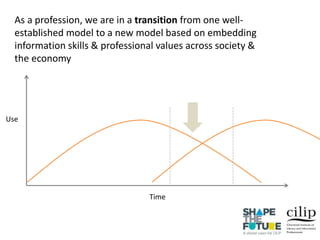
As a profession, we are in a transition from one well-
established model to a new model based on embedding
information skills & professional values across society &
the economy
Use
Time
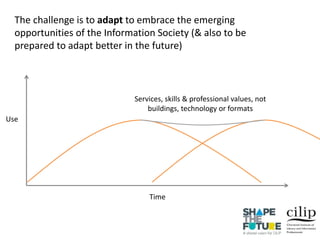
The challenge is to adapt to embrace the emerging
opportunities of the Information Society (& also to be
prepared to adapt better in the future)
Use
Time
Services, skills & professional values, not
buildings, technology or formats
Key challenges – value proposition
“Public libraries are about books. Saying they’re about skills,
technology or ‘3rd spaces’ is like the Managing Director of Pret
saying that their core business is free wifi, not sandwiches”
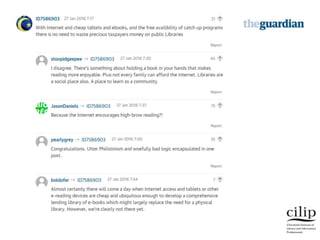
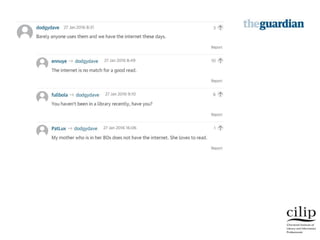
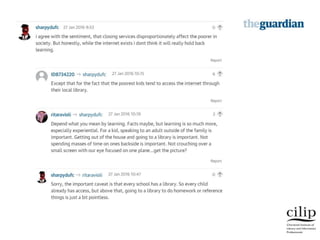
“Hardly anyone uses them”
“Everyone has the Internet & Kindles now”
“They’re for the poor & the elderly”
“I remember them from my childhood – that lovely smell”
“Public libraries = all libraries”
“Libraries gave us power”
We are awash with outmoded value propositions that need to be
challenged & replaced
Key challenges – valuing professional skills
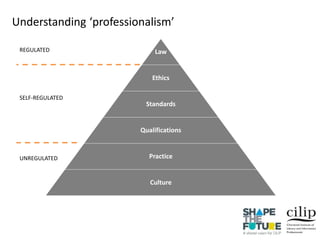
Law
Ethics
Standards
Qualifications
Practice
Culture
UNREGULATED
SELF-REGULATED
REGULATED
Understanding ‘professionalism’
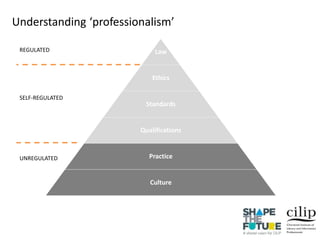
Law
Ethics
Standards
Qualifications
Practice
Culture
UNREGULATED
SELF-REGULATED
REGULATED
Understanding ‘professionalism’
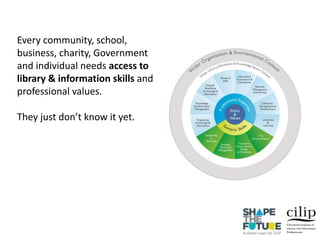
Every community, school,
business, charity, Government
and individual needs access to
library & information skills and
professional values.
They just don’t know it yet.
Key challenges – building partnership with Members
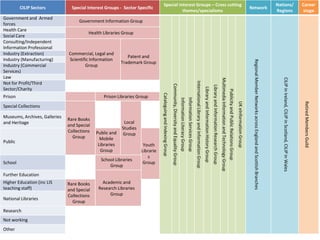
CILIP Sectors Special Interest Groups - Sector Specific
Special Interest Groups – Cross cutting
themes/specialisms
Network
Nations/
Regions
Career
stage
Government and Armed
forces
Government Information Group
CataloguingandIndexingGroup
Community,DiversityandEqualityGroup
InformationLiteracyGroup
InformationServicesGroup
InternationalLibraryandInformationGroup
LibraryandInformationHistoryGroup
LibraryandInformationResearchGroup
MultimediaInformationandTechnologyGroup
PublicityandPublicRelationsGroup
UKeInformationGroup
RegionalMemberNetworksacrossEnglandandScottishBranches
CILIPinIreland,CILIPinScotland,CILIPinWales
RetiredMembersGuild
Health Care
Health Libraries Group
Social Care
Consulting/Independent
Information Professional
Commercial, Legal and
Scientific Information
Group
Patent and
Trademark Group
Industry (Extraction)
Industry (Manufacturing)
Industry (Commercial
Services)
Law
Not for Profit/Third
Sector/Charity
Prison Prison Libraries Group
Special Collections
Rare Books
and Special
Collections
Group
Local
Studies
Group
Museums, Archives, Galleries
and Heritage
Public
Public and
Mobile
Libraries
Group
Youth
Librarie
s
GroupSchool
School Libraries
Group
Further Education
Academic and
Research Libraries
Group
Higher Education (inc LIS
teaching staff)
Rare Books
and Special
Collections
Group
National Libraries
Research
Not working
Other
CILIP Sectors Special Interest Groups - Sector Specific
Special Interest Groups – Cross cutting
themes/specialisms
Network
Nations/
Regions
Career
stage
Government and Armed
forces
Government Information Group
CataloguingandIndexingGroup
Community,DiversityandEqualityGroup
InformationLiteracyGroup
InformationServicesGroup
InternationalLibraryandInformationGroup
LibraryandInformationHistoryGroup
LibraryandInformationResearchGroup
MultimediaInformationandTechnologyGroup
PublicityandPublicRelationsGroup
UKeInformationGroup
RegionalMemberNetworksacrossEnglandandScottishBranches
CILIPinIreland,CILIPinScotland,CILIPinWales
RetiredMembersGuild
Health Care
Health Libraries Group
Social Care
Consulting/Independent
Information Professional
Commercial, Legal and
Scientific Information
Group
Patent and
Trademark Group
Industry (Extraction)
Industry (Manufacturing)
Industry (Commercial
Services)
Law
Not for Profit/Third
Sector/Charity
Prison Prison Libraries Group
Special Collections
Rare Books
and Special
Collections
Group
Local
Studies
Group
Museums, Archives, Galleries
and Heritage
Public
Public and
Mobile
Libraries
Group
Youth
Librarie
s
GroupSchool
School Libraries
Group
Further Education
Academic and
Research Libraries
Group
Higher Education (inc LIS
teaching staff)
Rare Books
and Special
Collections
Group
National Libraries
Research
Not working
Other
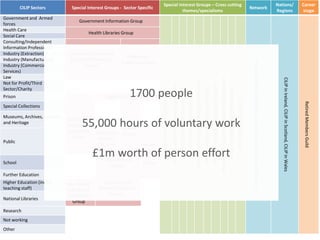
1700 people
55,000 hours of voluntary work
£1m worth of person effort
Key challenges – changing sector profile
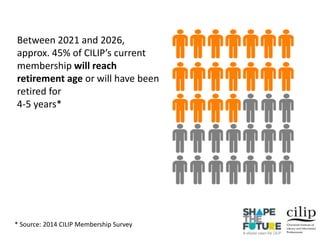
Between 2021 and 2026,
approx. 45% of CILIP’s current
membership will reach
retirement age or will have been
retired for
4-5 years*
* Source: 2014 CILIP Membership Survey
Key challenges – diversity & equality
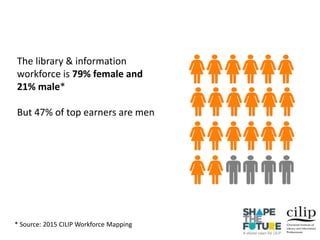
The library & information
workforce is 79% female and
21% male*
But 47% of top earners are men
* Source: 2015 CILIP Workforce Mapping
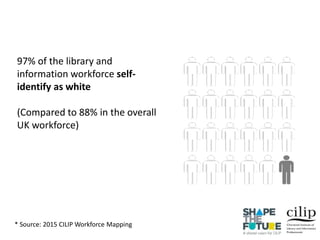
97% of the library and
information workforce self-
identify as white
(Compared to 88% in the overall
UK workforce)
* Source: 2015 CILIP Workforce Mapping
61% of the library and
information workforce hold a
postgraduate qualification
(Highest qualification of most of
the UK workforce is A-level or
equivalent)
* Source: 2015 CILIP Workforce Mapping
The solutions to most of these, on some level, involve addressing
challenges of marketing
CILIP’s objective for 2020 is to put library and information
skills at the heart of a democratic, equal and prosperous
society
We will develop a set of social, economic, cultural, creative,
educational and scientific outcomes and metrics to
demonstrate our progress toward this objective
CILIP’s Charitable Purpose (Royal Charter, 2014)
To work for the benefit of the public to promote education
and knowledge through the establishment and development
of libraries and information services and to advance
information science (being the science and practice of the
collection, collation, evaluation and organised dissemination
of information).
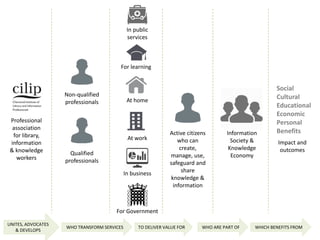
Active citizens
who can
create,
manage, use,
safeguard and
share
knowledge &
information
Information
Society &
Knowledge
Economy
In public
services
For learning
Qualified
professionals
Non-qualified
professionals
Professional
association
for library,
information
& knowledge
workers
Social
Cultural
Educational
Economic
Personal
Benefits
Impact and
outcomes
At home
At work
In business
For Government
UNITES, ADVOCATES
& DEVELOPS
WHO TRANSFORM SERVICES TO DELIVER VALUE FOR WHO ARE PART OF WHICH BENEFITS FROM
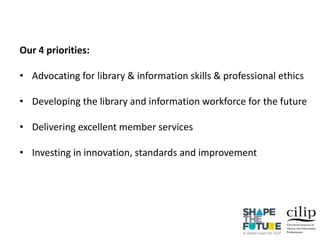
Our 4 priorities:
• Advocating for library & information skills & professional ethics
• Developing the library and information workforce for the future
• Delivering excellent member services
• Investing in innovation, standards and improvement
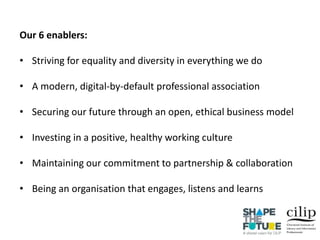
Our 6 enablers:
• Striving for equality and diversity in everything we do
• A modern, digital-by-default professional association
• Securing our future through an open, ethical business model
• Investing in a positive, healthy working culture
• Maintaining our commitment to partnership & collaboration
• Being an organisation that engages, listens and learns
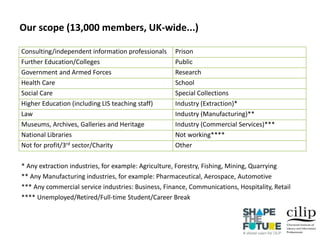
Our scope (13,000 members, UK-wide...)
Consulting/independent information professionals Prison
Further Education/Colleges Public
Government and Armed Forces Research
Health Care School
Social Care Special Collections
Higher Education (including LIS teaching staff) Industry (Extraction)*
Law Industry (Manufacturing)**
Museums, Archives, Galleries and Heritage Industry (Commercial Services)***
National Libraries Not working****
Not for profit/3rd sector/Charity Other
* Any extraction industries, for example: Agriculture, Forestry, Fishing, Mining, Quarrying
** Any Manufacturing industries, for example: Pharmaceutical, Aerospace, Automotive
*** Any commercial service industries: Business, Finance, Communications, Hospitality, Retail
**** Unemployed/Retired/Full-time Student/Career Break
Short-term challenges
• Delivering a new, more accessible Membership Model
• Securing My Library By Right
• 2 x advocacy campaigns per year
• 3 x policy inquiries per year (schools, FE, privacy in 2016)
• Developing our evidence base
• Promoting CPD & professional registration
2020 Challenges
• Promote transferrable skills/portfolio careers
• Encourage employers to create quality jobs
• Secure Manifesto commitments to Information Skills
• Demonstrate the value of information, knowledge & data for
society, the economy & culture
• Focus outward on common goals & shared ambitions, not
inward on definitions & internal politics
Promoting library & information skills at the heart of a
democratic, equal and prosperous society
Key marketing opportunities
• Outstanding (if misunderstood) brand & brand equity
• We fulfil a central purpose in people’s daily lives
• We actively promote self-discovery (rather than purchase)
• We deliver value & privacy, which generates trust
• Local/personal relationships & a highly adaptable product
• We offer value at multiple points in a person’s life
• We have the skills to unlock value in new ways
(including overcoming the limitations of technology)
Tactics & channels
• Flood the media with up-to-date value propositions to raise public
awareness & engagement
• Support self-advocacy, local & social marketing
• Target employer groups on a phased basis to demonstrate the value of
investing in library & information skills
• Secure political influence by positioning our skills & professional values as
drivers of social & economic progress
• Work with high-profile partners who share our aims and values
• Promote & celebrate a career in the library, information & knowledge
management sectors as part of Careers Advice
www.cilip.org.uk/strategy2020
@NickPoole1
Nick.poole@cilip.org.uk

CILIP Action Plan & key challenges for 2020

  • 4.
  • 5.
    Key challenges -transition
  • 6.
    As a profession,we are in a transition from one well- established model to a new model based on embedding information skills & professional values across society & the economy Use Time
  • 7.
    The challenge isto adapt to embrace the emerging opportunities of the Information Society (& also to be prepared to adapt better in the future) Use Time Services, skills & professional values, not buildings, technology or formats
  • 8.
    Key challenges –value proposition
  • 12.
    “Public libraries areabout books. Saying they’re about skills, technology or ‘3rd spaces’ is like the Managing Director of Pret saying that their core business is free wifi, not sandwiches”
  • 13.
    “Hardly anyone usesthem” “Everyone has the Internet & Kindles now” “They’re for the poor & the elderly” “I remember them from my childhood – that lovely smell” “Public libraries = all libraries” “Libraries gave us power” We are awash with outmoded value propositions that need to be challenged & replaced
  • 14.
    Key challenges –valuing professional skills
  • 15.
  • 16.
  • 17.
    Every community, school, business,charity, Government and individual needs access to library & information skills and professional values. They just don’t know it yet.
  • 18.
    Key challenges –building partnership with Members
  • 19.
    CILIP Sectors SpecialInterest Groups - Sector Specific Special Interest Groups – Cross cutting themes/specialisms Network Nations/ Regions Career stage Government and Armed forces Government Information Group CataloguingandIndexingGroup Community,DiversityandEqualityGroup InformationLiteracyGroup InformationServicesGroup InternationalLibraryandInformationGroup LibraryandInformationHistoryGroup LibraryandInformationResearchGroup MultimediaInformationandTechnologyGroup PublicityandPublicRelationsGroup UKeInformationGroup RegionalMemberNetworksacrossEnglandandScottishBranches CILIPinIreland,CILIPinScotland,CILIPinWales RetiredMembersGuild Health Care Health Libraries Group Social Care Consulting/Independent Information Professional Commercial, Legal and Scientific Information Group Patent and Trademark Group Industry (Extraction) Industry (Manufacturing) Industry (Commercial Services) Law Not for Profit/Third Sector/Charity Prison Prison Libraries Group Special Collections Rare Books and Special Collections Group Local Studies Group Museums, Archives, Galleries and Heritage Public Public and Mobile Libraries Group Youth Librarie s GroupSchool School Libraries Group Further Education Academic and Research Libraries Group Higher Education (inc LIS teaching staff) Rare Books and Special Collections Group National Libraries Research Not working Other
  • 20.
    CILIP Sectors SpecialInterest Groups - Sector Specific Special Interest Groups – Cross cutting themes/specialisms Network Nations/ Regions Career stage Government and Armed forces Government Information Group CataloguingandIndexingGroup Community,DiversityandEqualityGroup InformationLiteracyGroup InformationServicesGroup InternationalLibraryandInformationGroup LibraryandInformationHistoryGroup LibraryandInformationResearchGroup MultimediaInformationandTechnologyGroup PublicityandPublicRelationsGroup UKeInformationGroup RegionalMemberNetworksacrossEnglandandScottishBranches CILIPinIreland,CILIPinScotland,CILIPinWales RetiredMembersGuild Health Care Health Libraries Group Social Care Consulting/Independent Information Professional Commercial, Legal and Scientific Information Group Patent and Trademark Group Industry (Extraction) Industry (Manufacturing) Industry (Commercial Services) Law Not for Profit/Third Sector/Charity Prison Prison Libraries Group Special Collections Rare Books and Special Collections Group Local Studies Group Museums, Archives, Galleries and Heritage Public Public and Mobile Libraries Group Youth Librarie s GroupSchool School Libraries Group Further Education Academic and Research Libraries Group Higher Education (inc LIS teaching staff) Rare Books and Special Collections Group National Libraries Research Not working Other 1700 people 55,000 hours of voluntary work £1m worth of person effort
  • 21.
    Key challenges –changing sector profile
  • 22.
    Between 2021 and2026, approx. 45% of CILIP’s current membership will reach retirement age or will have been retired for 4-5 years* * Source: 2014 CILIP Membership Survey
  • 23.
    Key challenges –diversity & equality
  • 24.
    The library &information workforce is 79% female and 21% male* But 47% of top earners are men * Source: 2015 CILIP Workforce Mapping
  • 25.
    97% of thelibrary and information workforce self- identify as white (Compared to 88% in the overall UK workforce) * Source: 2015 CILIP Workforce Mapping
  • 26.
    61% of thelibrary and information workforce hold a postgraduate qualification (Highest qualification of most of the UK workforce is A-level or equivalent) * Source: 2015 CILIP Workforce Mapping
  • 27.
    The solutions tomost of these, on some level, involve addressing challenges of marketing
  • 28.
    CILIP’s objective for2020 is to put library and information skills at the heart of a democratic, equal and prosperous society We will develop a set of social, economic, cultural, creative, educational and scientific outcomes and metrics to demonstrate our progress toward this objective
  • 29.
    CILIP’s Charitable Purpose(Royal Charter, 2014) To work for the benefit of the public to promote education and knowledge through the establishment and development of libraries and information services and to advance information science (being the science and practice of the collection, collation, evaluation and organised dissemination of information).
  • 30.
    Active citizens who can create, manage,use, safeguard and share knowledge & information Information Society & Knowledge Economy In public services For learning Qualified professionals Non-qualified professionals Professional association for library, information & knowledge workers Social Cultural Educational Economic Personal Benefits Impact and outcomes At home At work In business For Government UNITES, ADVOCATES & DEVELOPS WHO TRANSFORM SERVICES TO DELIVER VALUE FOR WHO ARE PART OF WHICH BENEFITS FROM
  • 31.
    Our 4 priorities: •Advocating for library & information skills & professional ethics • Developing the library and information workforce for the future • Delivering excellent member services • Investing in innovation, standards and improvement
  • 32.
    Our 6 enablers: •Striving for equality and diversity in everything we do • A modern, digital-by-default professional association • Securing our future through an open, ethical business model • Investing in a positive, healthy working culture • Maintaining our commitment to partnership & collaboration • Being an organisation that engages, listens and learns
  • 33.
    Our scope (13,000members, UK-wide...) Consulting/independent information professionals Prison Further Education/Colleges Public Government and Armed Forces Research Health Care School Social Care Special Collections Higher Education (including LIS teaching staff) Industry (Extraction)* Law Industry (Manufacturing)** Museums, Archives, Galleries and Heritage Industry (Commercial Services)*** National Libraries Not working**** Not for profit/3rd sector/Charity Other * Any extraction industries, for example: Agriculture, Forestry, Fishing, Mining, Quarrying ** Any Manufacturing industries, for example: Pharmaceutical, Aerospace, Automotive *** Any commercial service industries: Business, Finance, Communications, Hospitality, Retail **** Unemployed/Retired/Full-time Student/Career Break
  • 34.
    Short-term challenges • Deliveringa new, more accessible Membership Model • Securing My Library By Right • 2 x advocacy campaigns per year • 3 x policy inquiries per year (schools, FE, privacy in 2016) • Developing our evidence base • Promoting CPD & professional registration
  • 35.
    2020 Challenges • Promotetransferrable skills/portfolio careers • Encourage employers to create quality jobs • Secure Manifesto commitments to Information Skills • Demonstrate the value of information, knowledge & data for society, the economy & culture • Focus outward on common goals & shared ambitions, not inward on definitions & internal politics
  • 36.
    Promoting library &information skills at the heart of a democratic, equal and prosperous society
  • 37.
    Key marketing opportunities •Outstanding (if misunderstood) brand & brand equity • We fulfil a central purpose in people’s daily lives • We actively promote self-discovery (rather than purchase) • We deliver value & privacy, which generates trust • Local/personal relationships & a highly adaptable product • We offer value at multiple points in a person’s life • We have the skills to unlock value in new ways (including overcoming the limitations of technology)
  • 38.
    Tactics & channels •Flood the media with up-to-date value propositions to raise public awareness & engagement • Support self-advocacy, local & social marketing • Target employer groups on a phased basis to demonstrate the value of investing in library & information skills • Secure political influence by positioning our skills & professional values as drivers of social & economic progress • Work with high-profile partners who share our aims and values • Promote & celebrate a career in the library, information & knowledge management sectors as part of Careers Advice
  • 39.