OPEN GOVERNMENT DATA:
WHAT IS IT, WHERE IT IS GOING, AND
THE OPPORTUNITIES FOR SAIS
Ryan Androsoff
OECD GOV
Quito, Ecuador
25 June 2015
• What is Open Government Data and why
should we care?
• Measuring the Status of Open Government
Data
– Indexes
– Trends in OECD countries
– Open Government Data in LAC
– Furthering the OECD’s work on Open Data
• SAIs and Open Data: Opportunities for
Action
Today’s Presentation
• Data = highest level of granularity from which information, content and
knowledge are derived.
• Public Sector Information = “information, including information
products and services, generated, created, collected, processed, preserved,
maintained, disseminated, or funded by or for a government or public
institution”
• Open Data = data that can be freely used, re-used and distributed by
anyone, only subject to (at the most) the requirement that users attribute
the data and that they make their work available to be shared as well.
• Big Data = A data-driven socio-economic model; as a phenomenon
emerged as available datasets produced by various sources have grown
larger and data users more aware of the value obtainable through linked
and combined data sets produced by different actors, both private and
public.
• Data analytics = the use of data to spot significant facts and trends to
improve policy making and service delivery (public sector intelligence).
Some Definitions
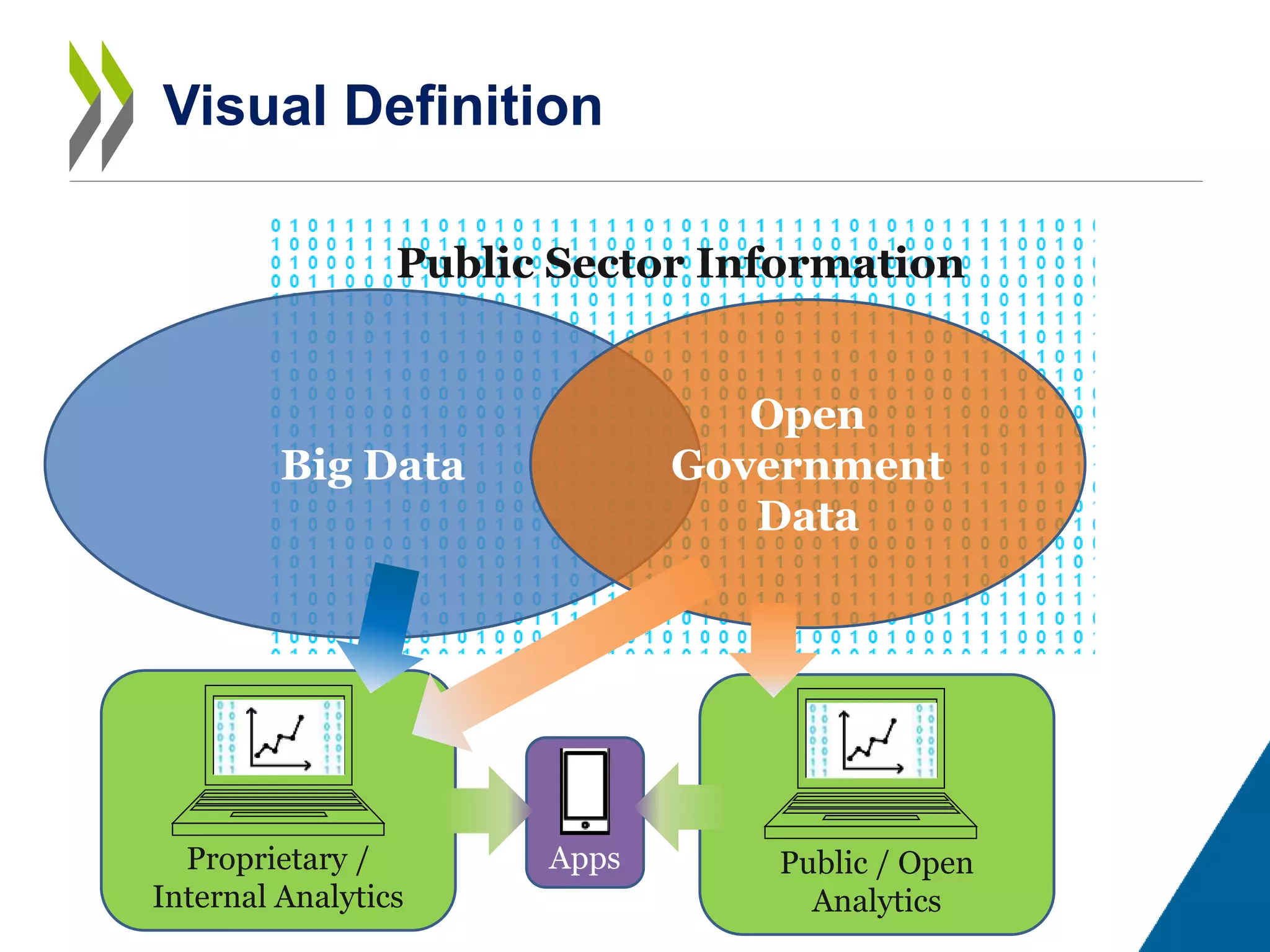
Public Sector Information
Visual Definition
Big Data
Open
Government
Data
Proprietary /
Internal Analytics
Apps Public / Open
Analytics
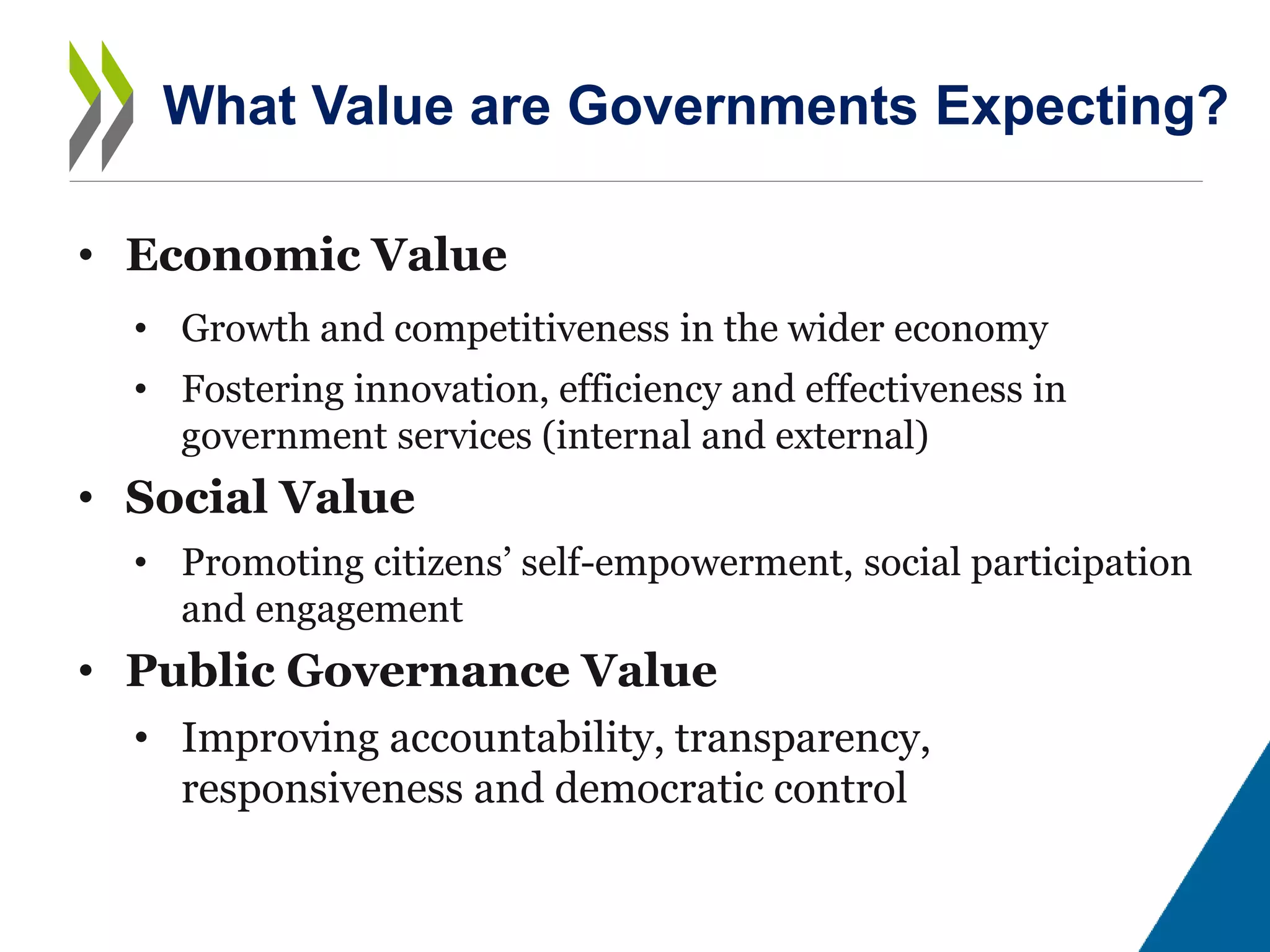
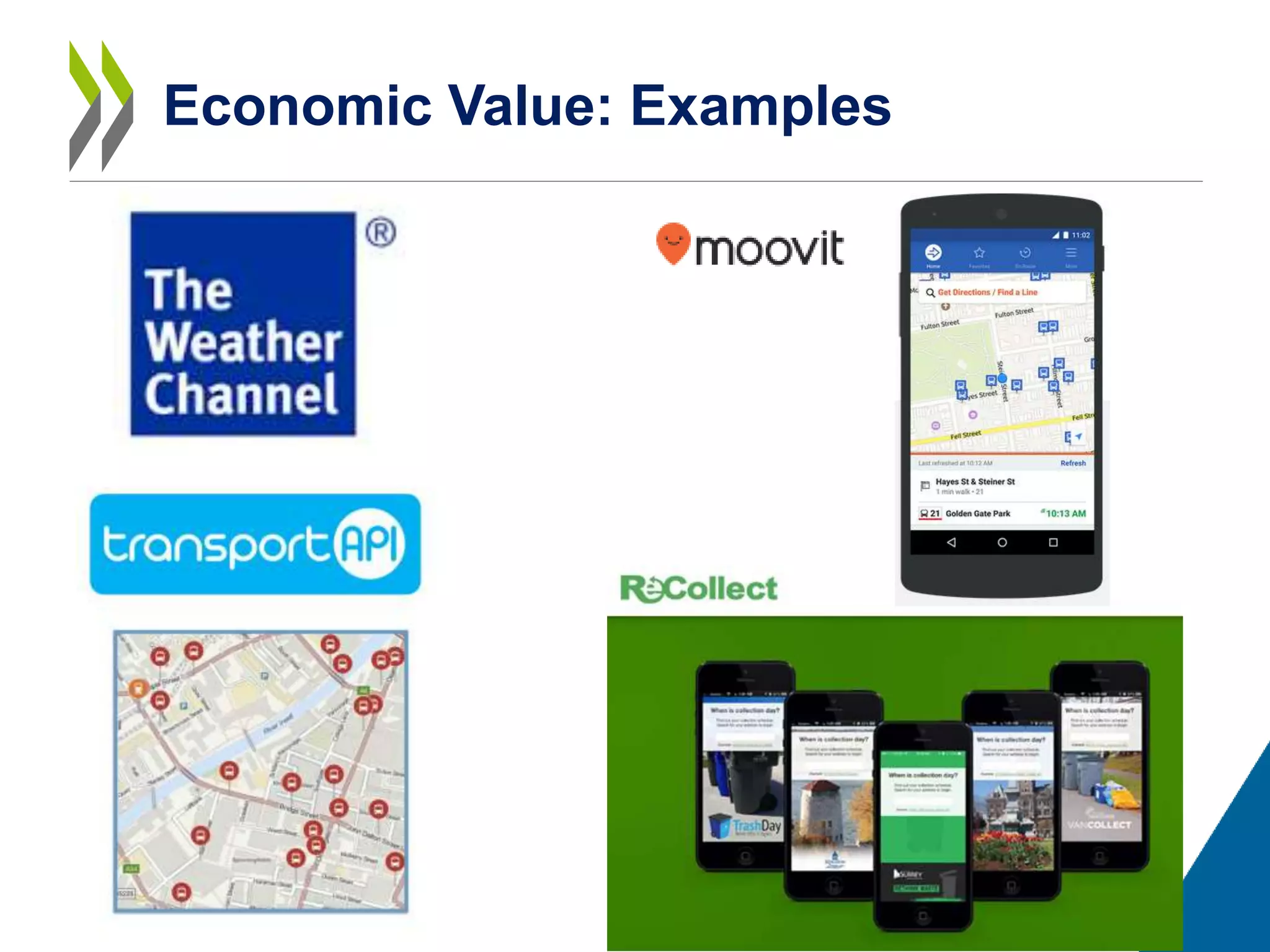
• Economic Value
• Growth and competitiveness in the wider economy
• Fostering innovation, efficiency and effectiveness in
government services (internal and external)
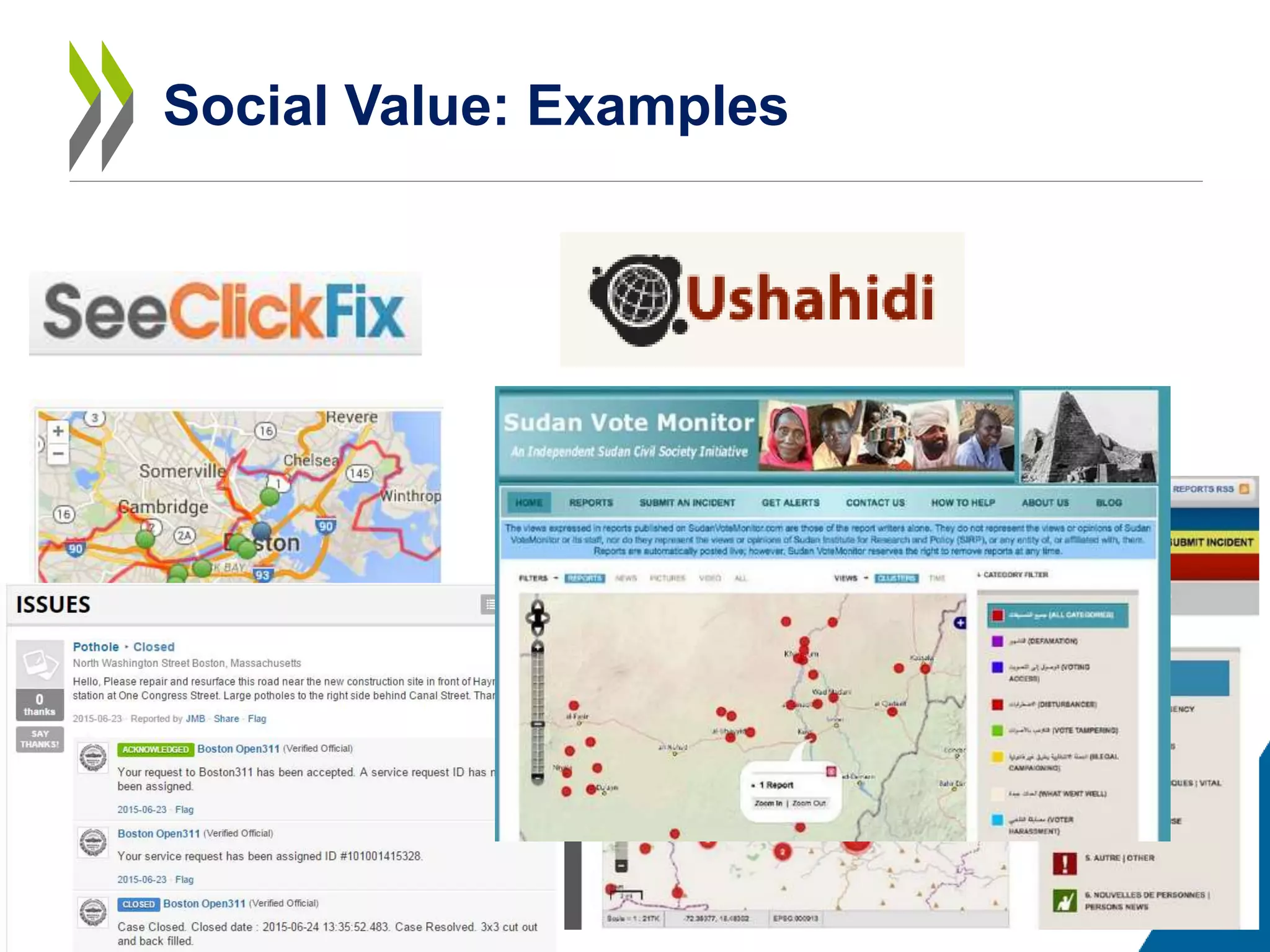
• Social Value
• Promoting citizens’ self-empowerment, social participation
and engagement
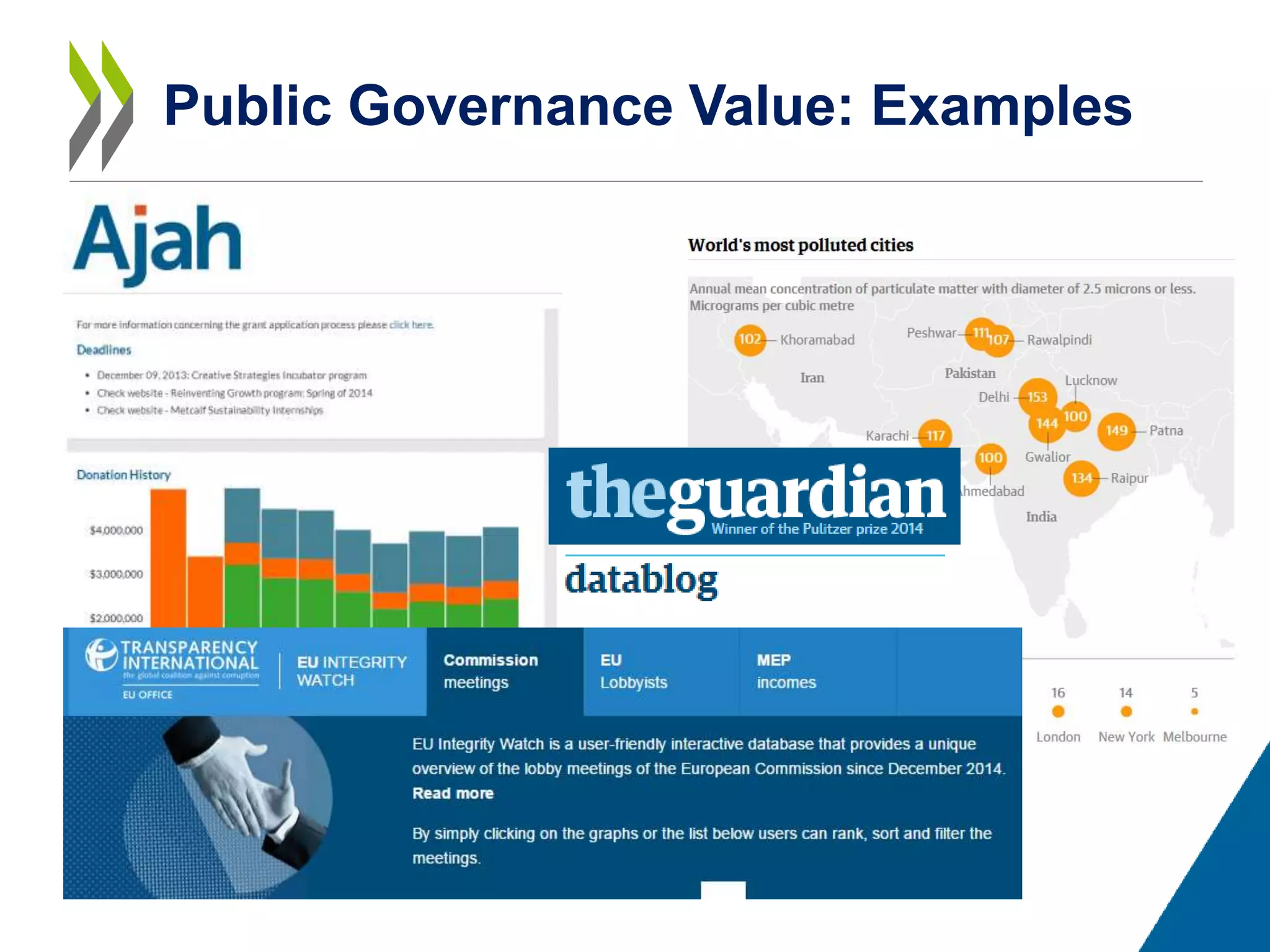
• Public Governance Value
• Improving accountability, transparency,
responsiveness and democratic control
What Value are Governments Expecting?
Economic Value: Examples
Social Value: Examples
Public Governance Value: Examples
Measuring the Status of
Open Government Data
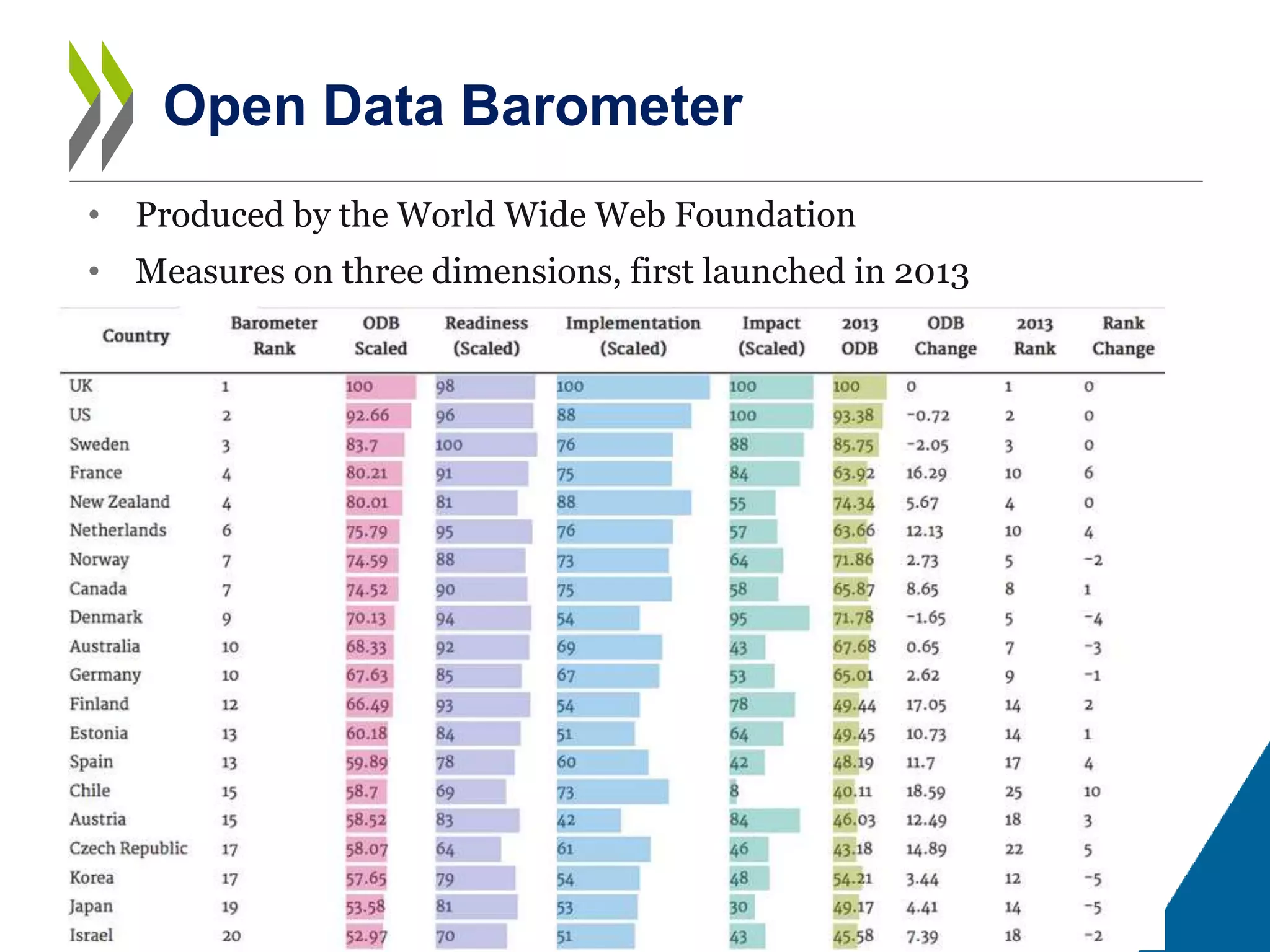
• Produced by the World Wide Web Foundation
• Measures on three dimensions, first launched in 2013
Open Data Barometer
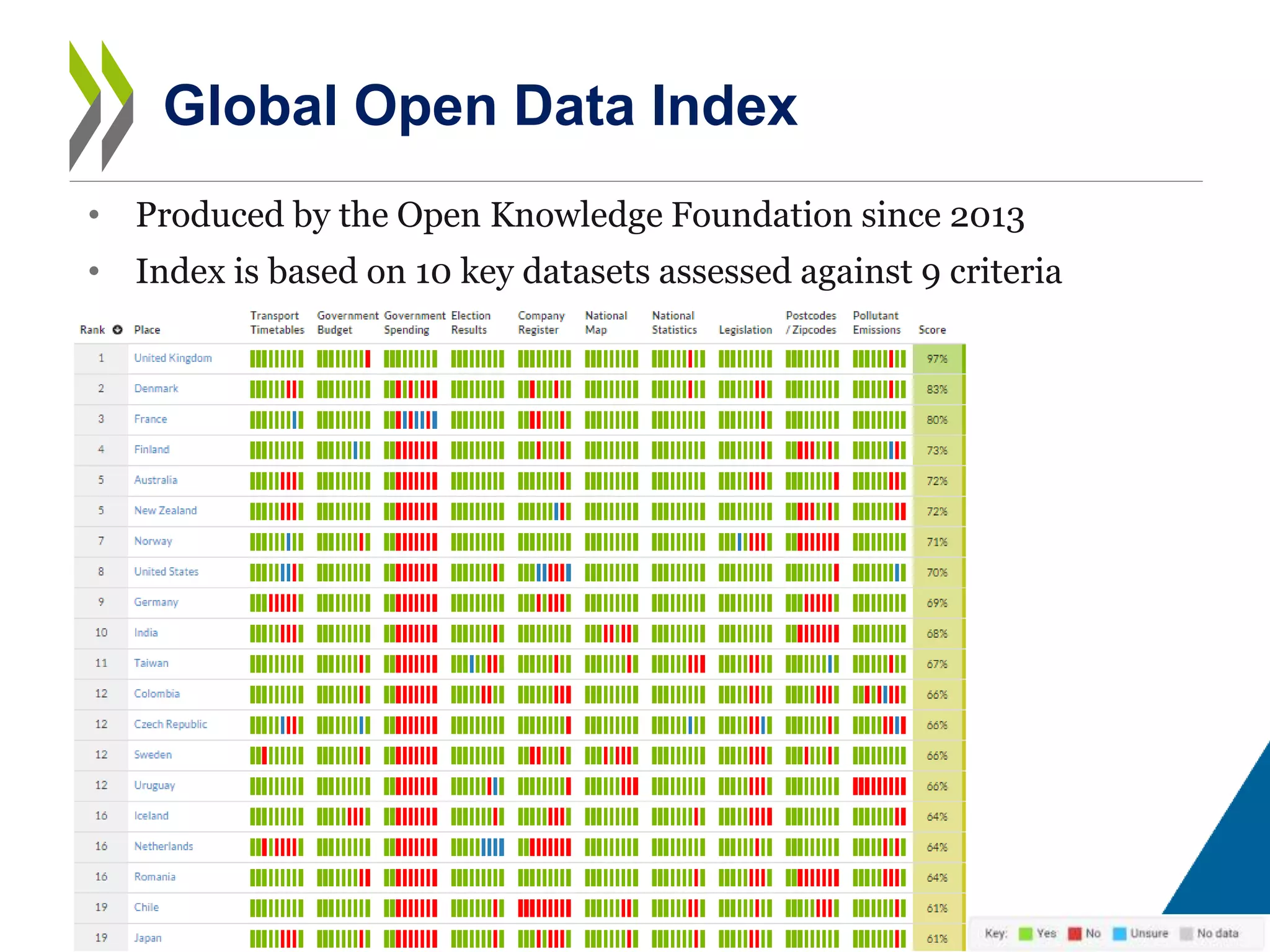
• Produced by the Open Knowledge Foundation since 2013
• Index is based on 10 key datasets assessed against 9 criteria
Global Open Data Index
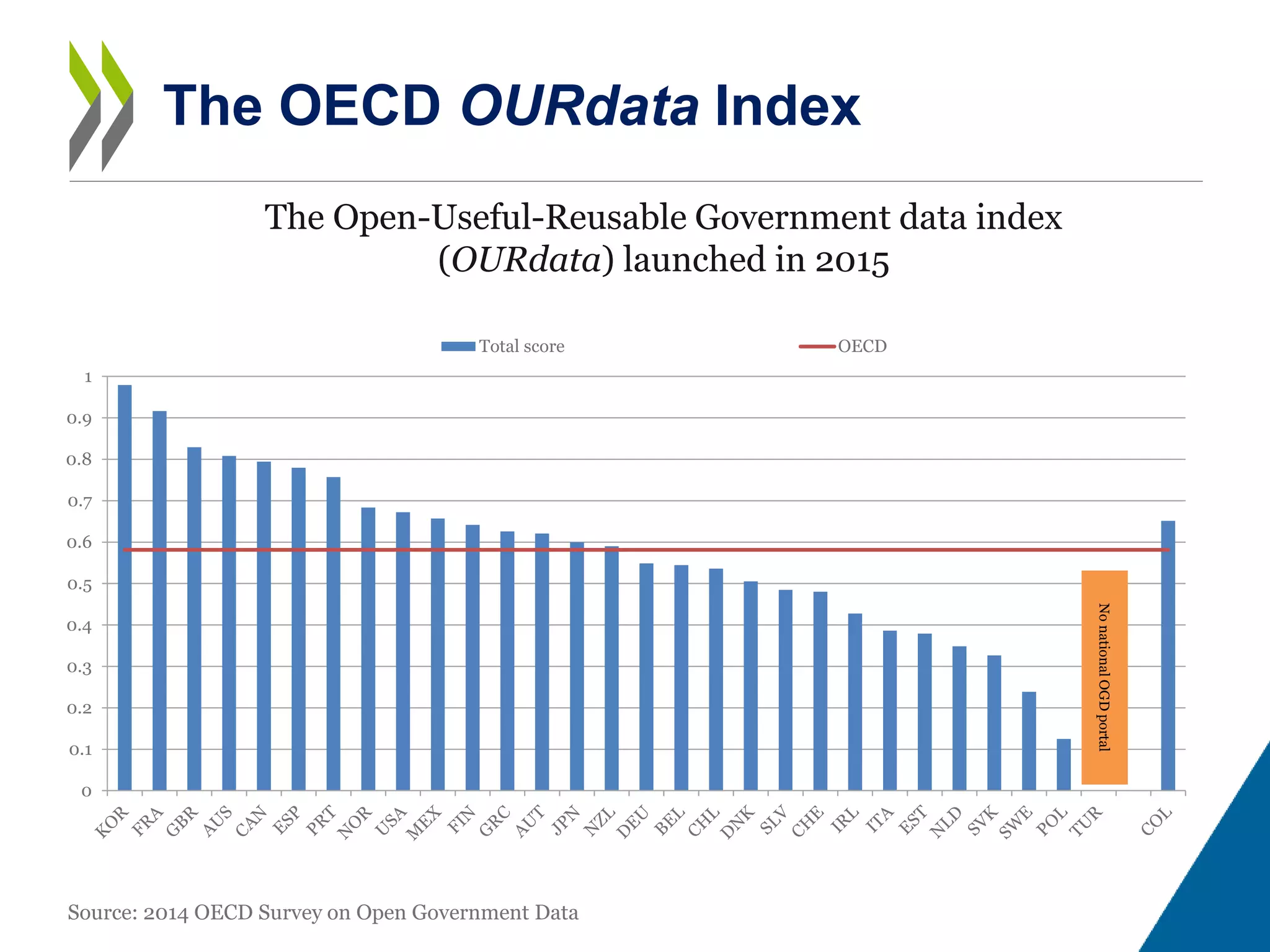
The OECD OURdata Index
The Open-Useful-Reusable Government data index
(OURdata) launched in 2015
0
0.1
0.2
0.3
0.4
0.5
0.6
0.7
0.8
0.9
1
Total score OECD
NonationalOGDportal
Source: 2014 OECD Survey on Open Government Data
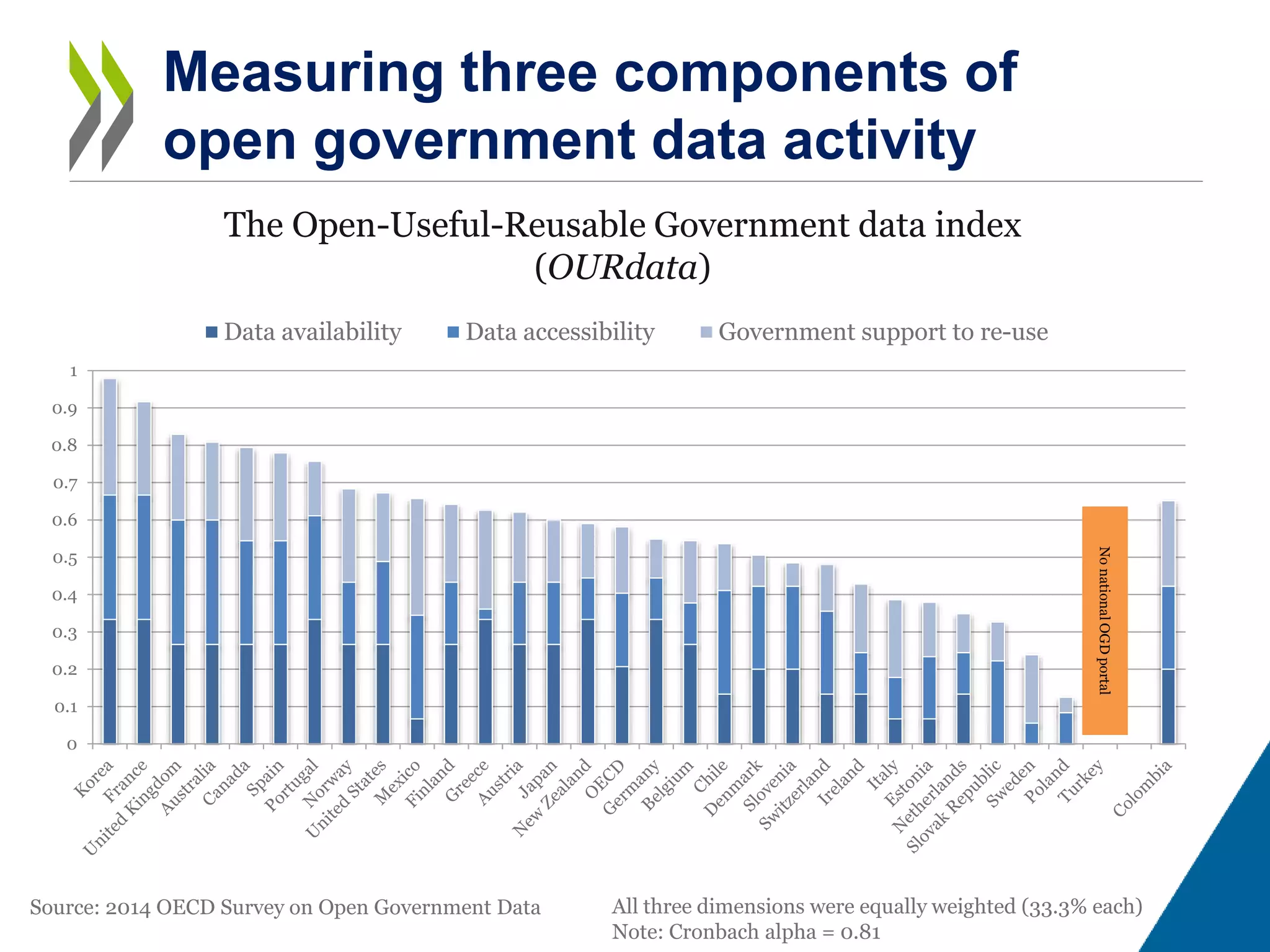
Measuring three components of
open government data activity
The Open-Useful-Reusable Government data index
(OURdata)
Source: 2014 OECD Survey on Open Government Data
0
0.1
0.2
0.3
0.4
0.5
0.6
0.7
0.8
0.9
1
Data availability Data accessibility Government support to re-use
NonationalOGDportal
All three dimensions were equally weighted (33.3% each)
Note: Cronbach alpha = 0.81
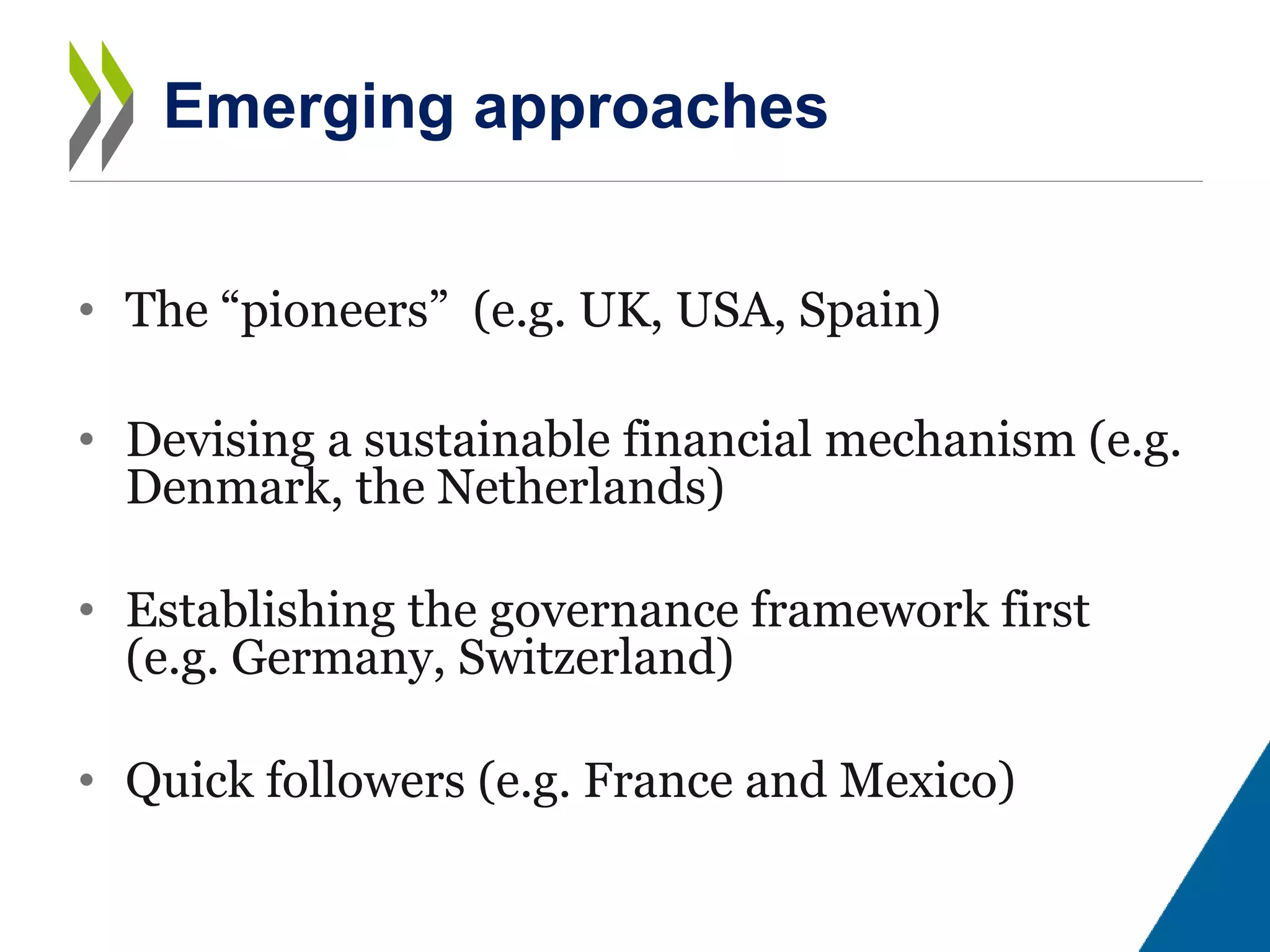
• The “pioneers” (e.g. UK, USA, Spain)
• Devising a sustainable financial mechanism (e.g.
Denmark, the Netherlands)
• Establishing the governance framework first
(e.g. Germany, Switzerland)
• Quick followers (e.g. France and Mexico)
Emerging approaches
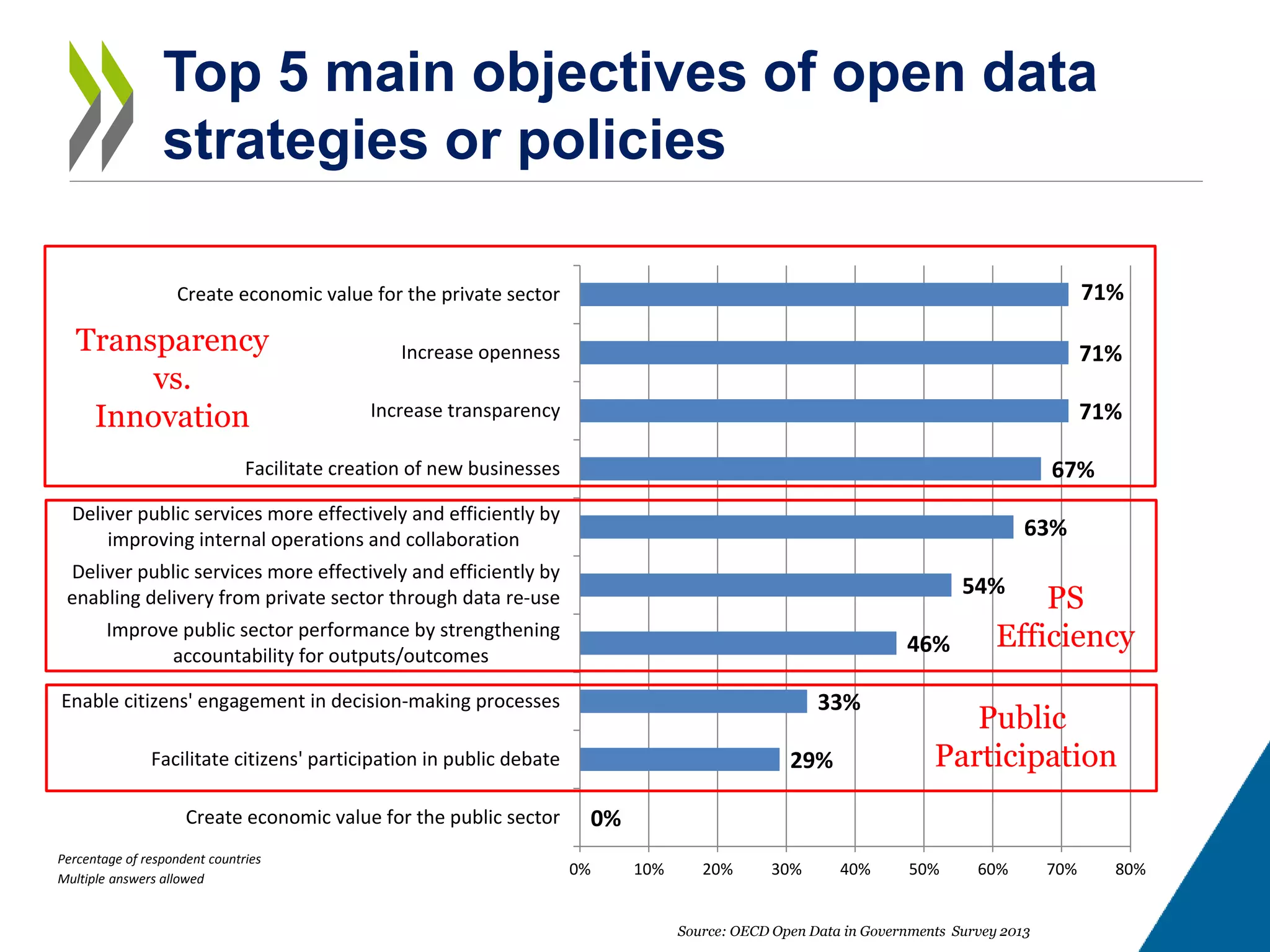
Top 5 main objectives of open data
strategies or policies
0%
29%
33%
46%
54%
63%
67%
71%
71%
71%
0% 10% 20% 30% 40% 50% 60% 70% 80%
Create economic value for the public sector
Facilitate citizens' participation in public debate
Enable citizens' engagement in decision-making processes
Improve public sector performance by strengthening
accountability for outputs/outcomes
Deliver public services more effectively and efficiently by
enabling delivery from private sector through data re-use
Deliver public services more effectively and efficiently by
improving internal operations and collaboration
Facilitate creation of new businesses
Increase transparency
Increase openness
Create economic value for the private sector
Multiple answers allowed
Percentage of respondent countries
Source: OECD Open Data in Governments Survey 2013
Transparency
vs.
Innovation
PS
Efficiency
Public
Participation
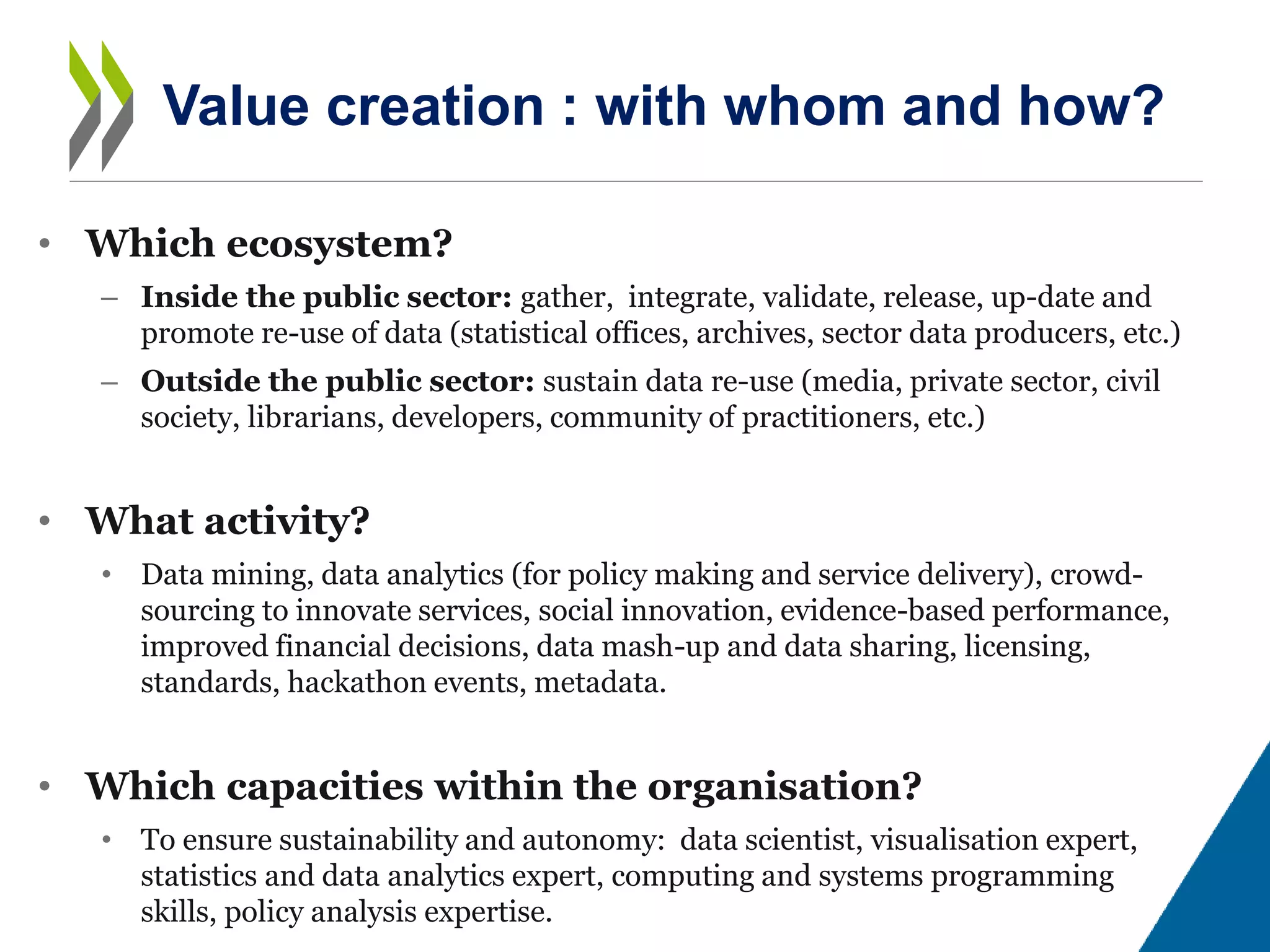
• Which ecosystem?
– Inside the public sector: gather, integrate, validate, release, up-date and
promote re-use of data (statistical offices, archives, sector data producers, etc.)
– Outside the public sector: sustain data re-use (media, private sector, civil
society, librarians, developers, community of practitioners, etc.)
• What activity?
• Data mining, data analytics (for policy making and service delivery), crowd-
sourcing to innovate services, social innovation, evidence-based performance,
improved financial decisions, data mash-up and data sharing, licensing,
standards, hackathon events, metadata.
• Which capacities within the organisation?
• To ensure sustainability and autonomy: data scientist, visualisation expert,
statistics and data analytics expert, computing and systems programming
skills, policy analysis expertise.
Value creation : with whom and how?
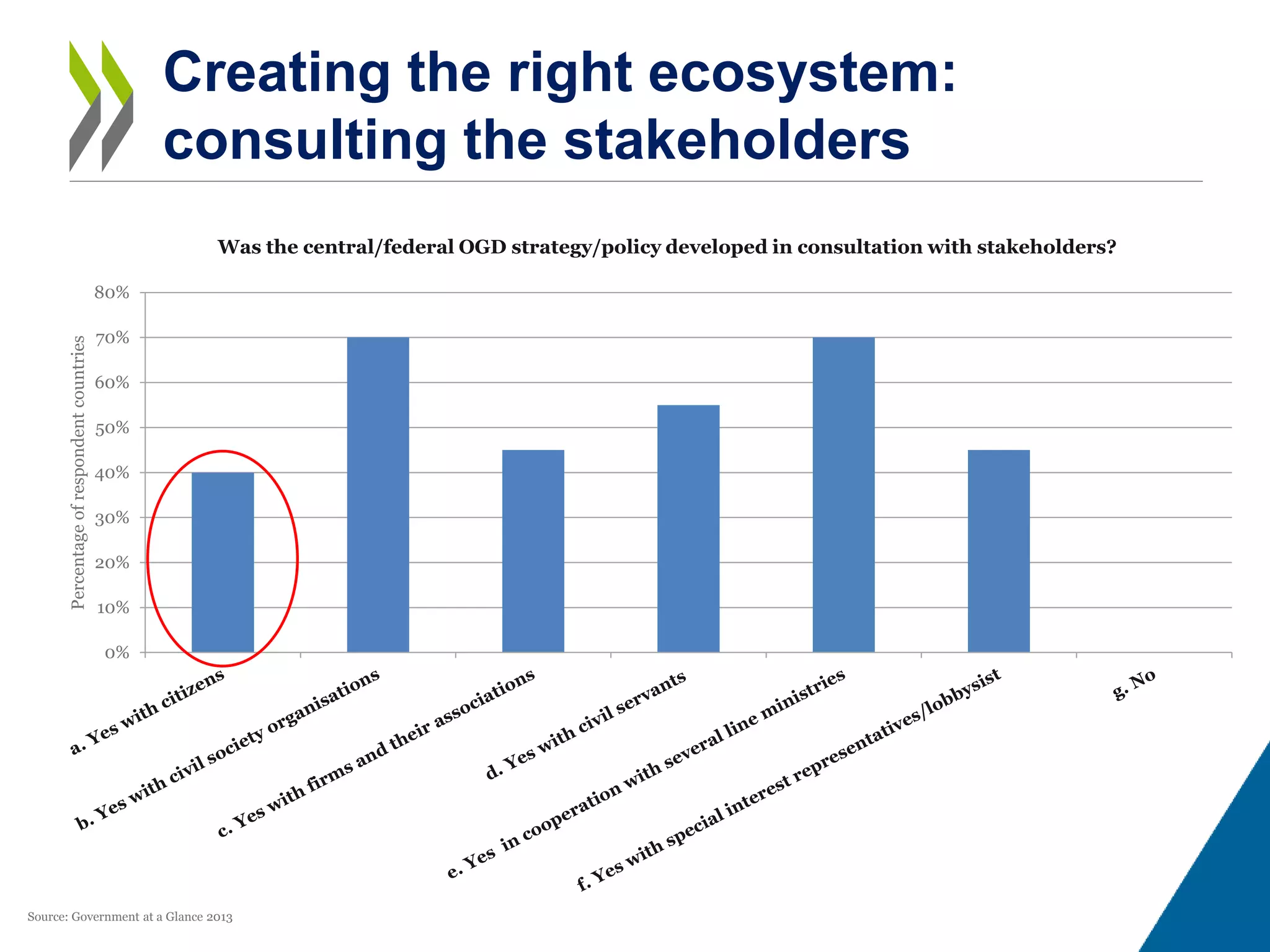
Creating the right ecosystem:
consulting the stakeholders
0%
10%
20%
30%
40%
50%
60%
70%
80%
Percentageofrespondentcountries
Was the central/federal OGD strategy/policy developed in consultation with stakeholders?
Source: Government at a Glance 2013
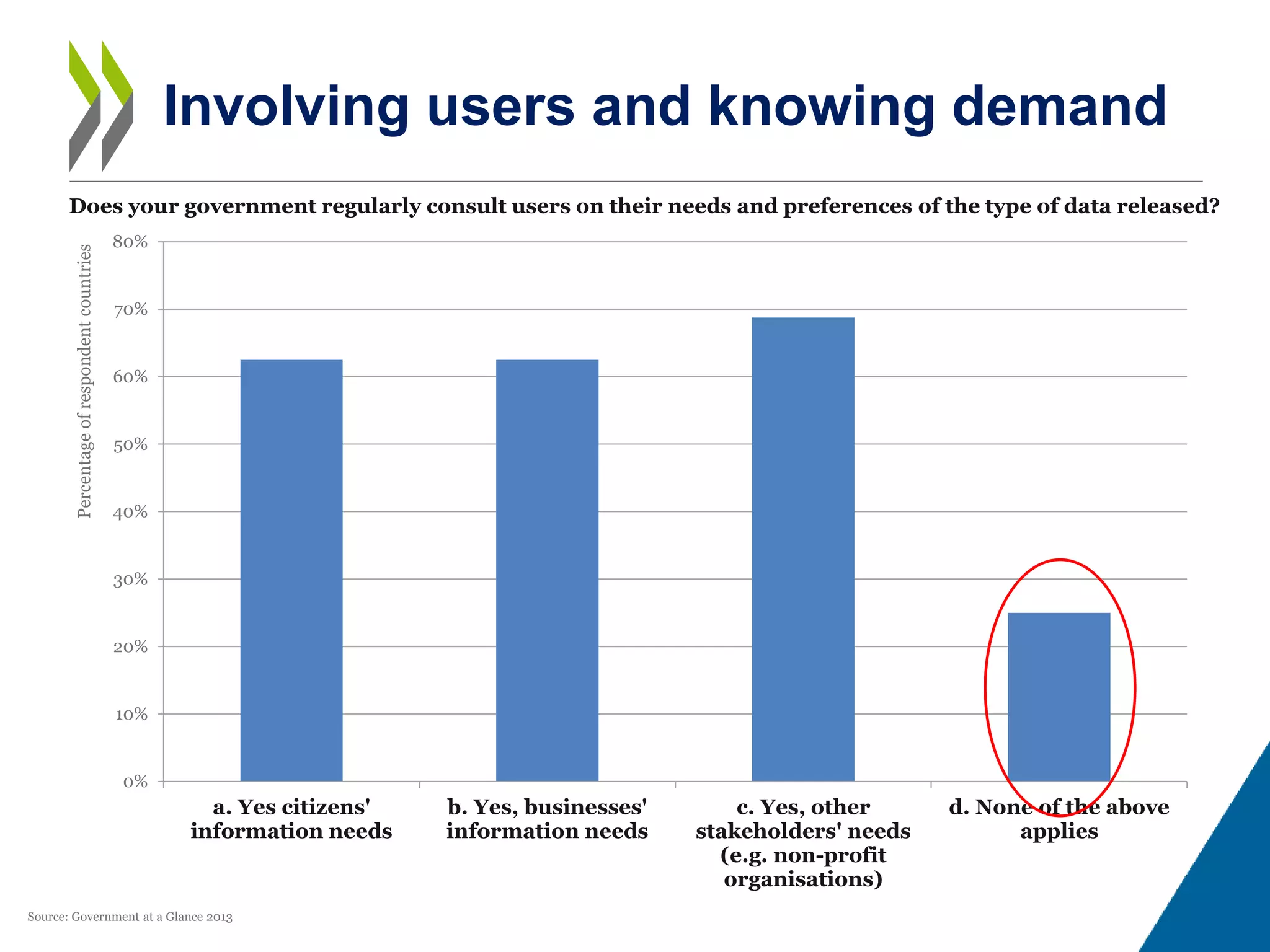
Involving users and knowing demand
0%
10%
20%
30%
40%
50%
60%
70%
80%
a. Yes citizens'
information needs
b. Yes, businesses'
information needs
c. Yes, other
stakeholders' needs
(e.g. non-profit
organisations)
d. None of the above
applies
Percentageofrespondentcountries
Source: Government at a Glance 2013
Does your government regularly consult users on their needs and preferences of the type of data released?
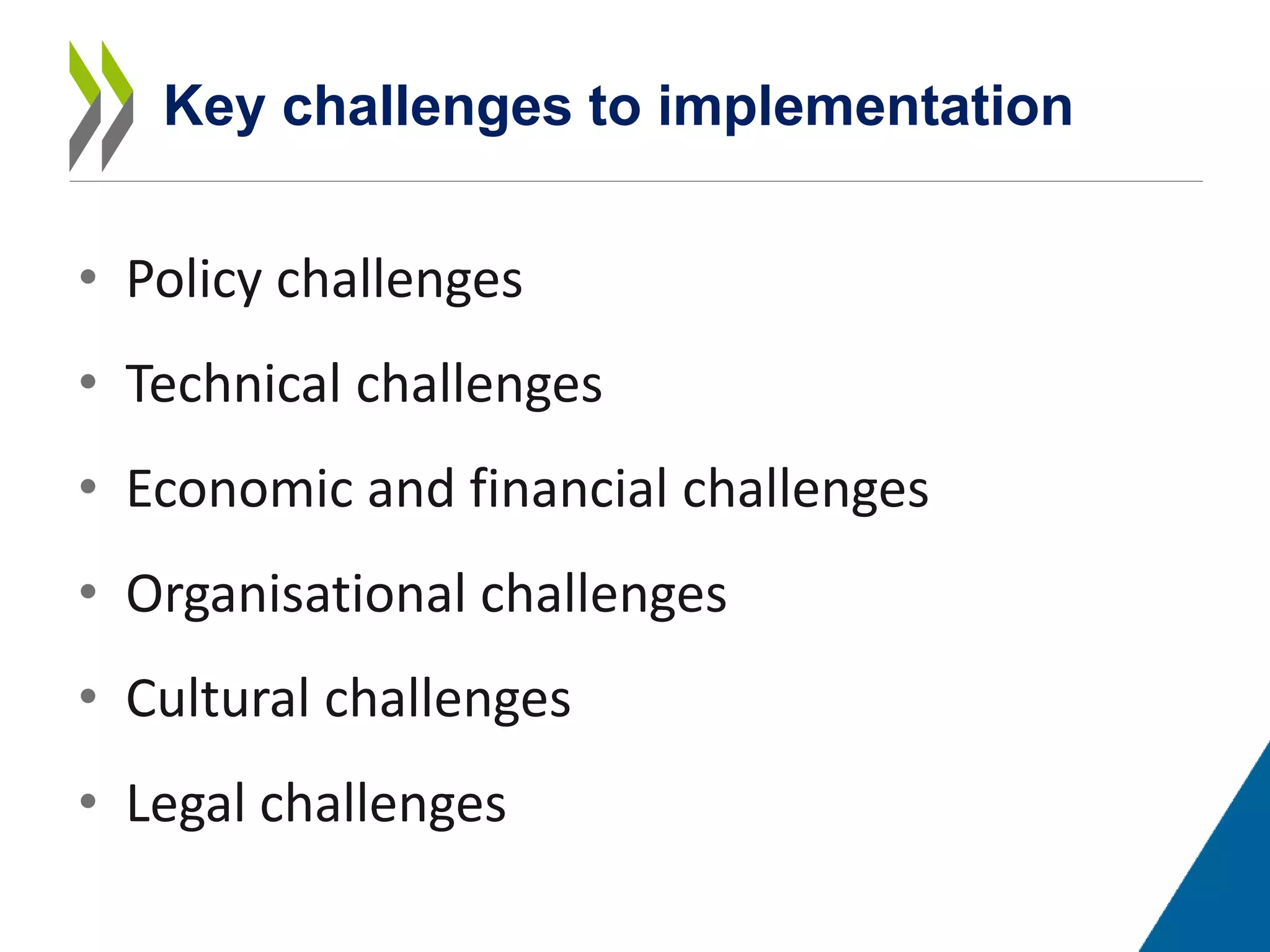
• Policy challenges
• Technical challenges
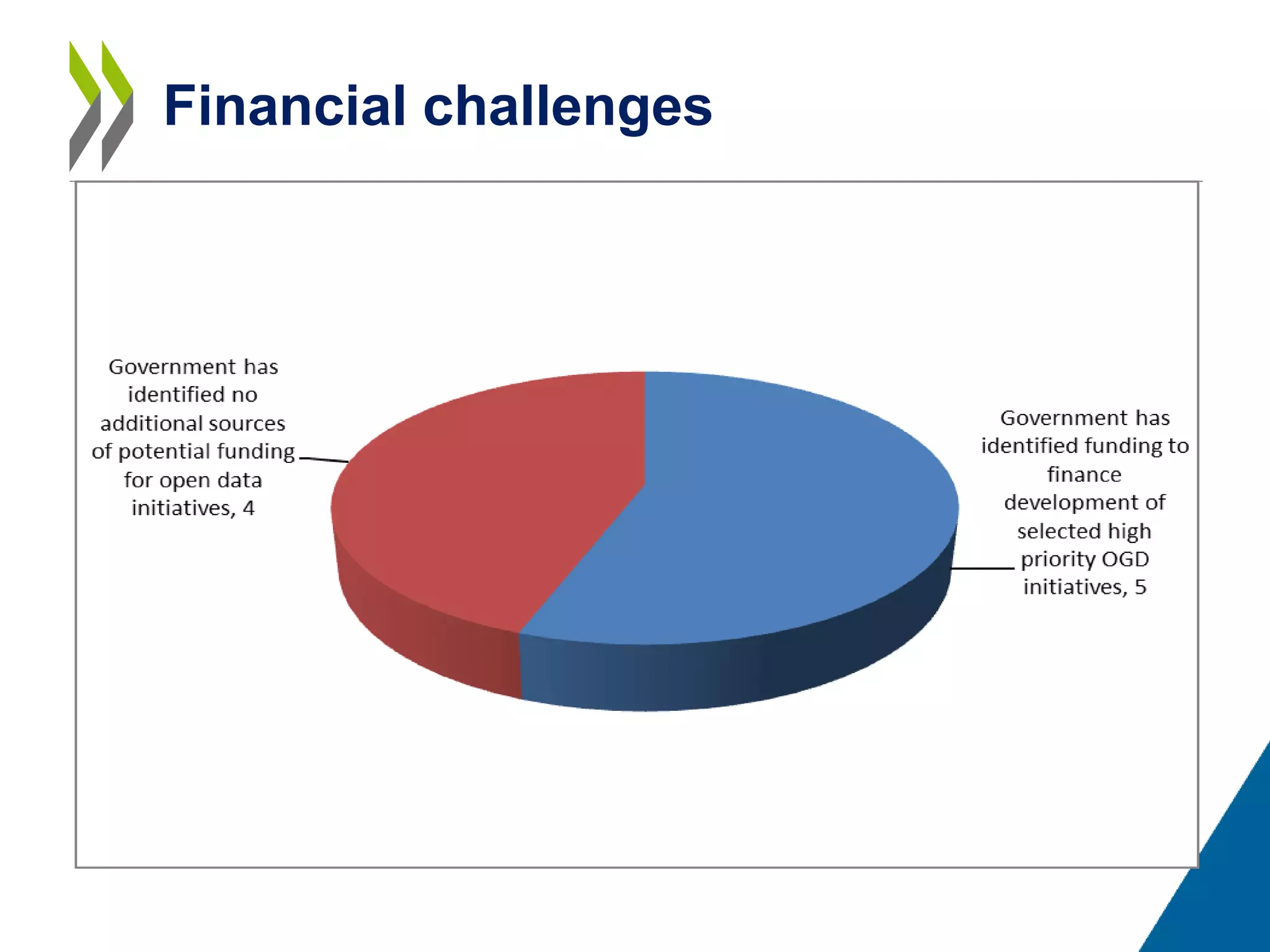
• Economic and financial challenges
• Organisational challenges
• Cultural challenges
• Legal challenges
Key challenges to implementation
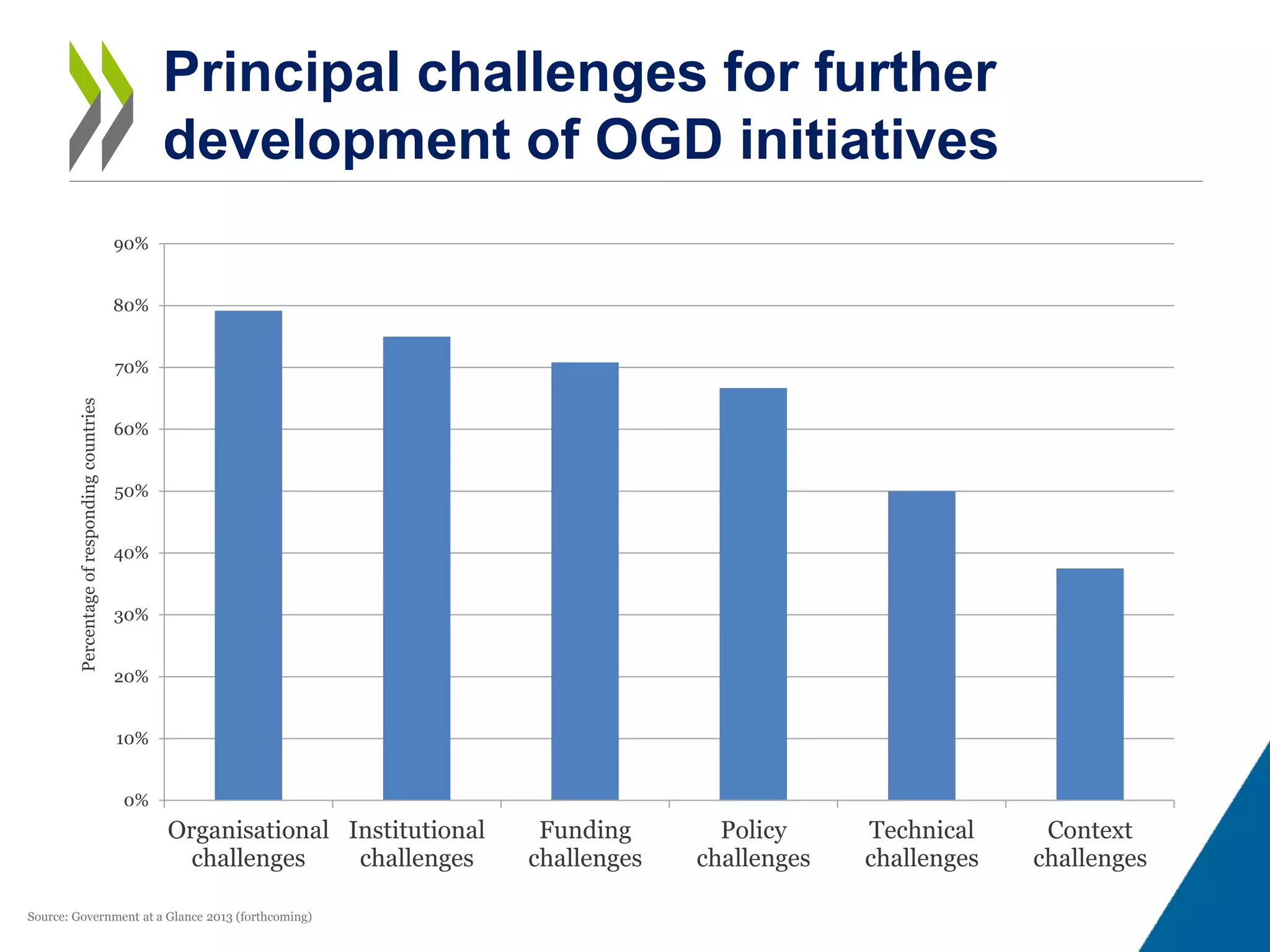
Principal challenges for further
development of OGD initiatives
0%
10%
20%
30%
40%
50%
60%
70%
80%
90%
Organisational
challenges
Institutional
challenges
Funding
challenges
Policy
challenges
Technical
challenges
Context
challenges
Percentageofrespondingcountries
Source: Government at a Glance 2013 (forthcoming)
Open Government Data in
Latin America
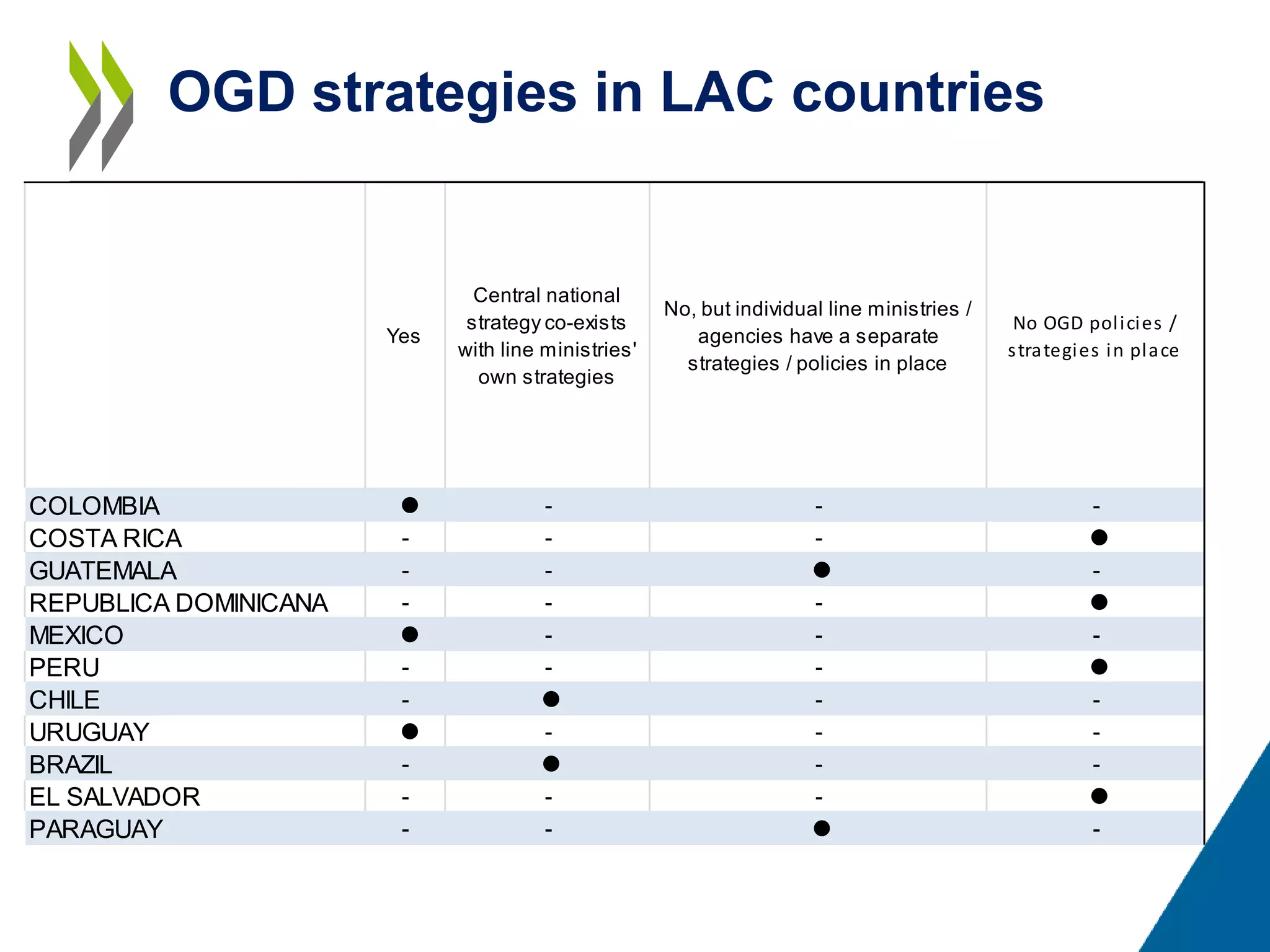
Yes
Central national
strategy co-exists
with line ministries'
own strategies
No, but individual line ministries /
agencies have a separate
strategies / policies in place
No OGD policies /
strategies in place
COLOMBIA  - - -
COSTA RICA - - - 
GUATEMALA - -  -
REPUBLICA DOMINICANA - - - 
MEXICO  - - -
PERU - - - 
CHILE -  - -
URUGUAY  - - -
BRAZIL -  - -
EL SALVADOR - - - 
PARAGUAY - -  -
OGD strategies in LAC countries
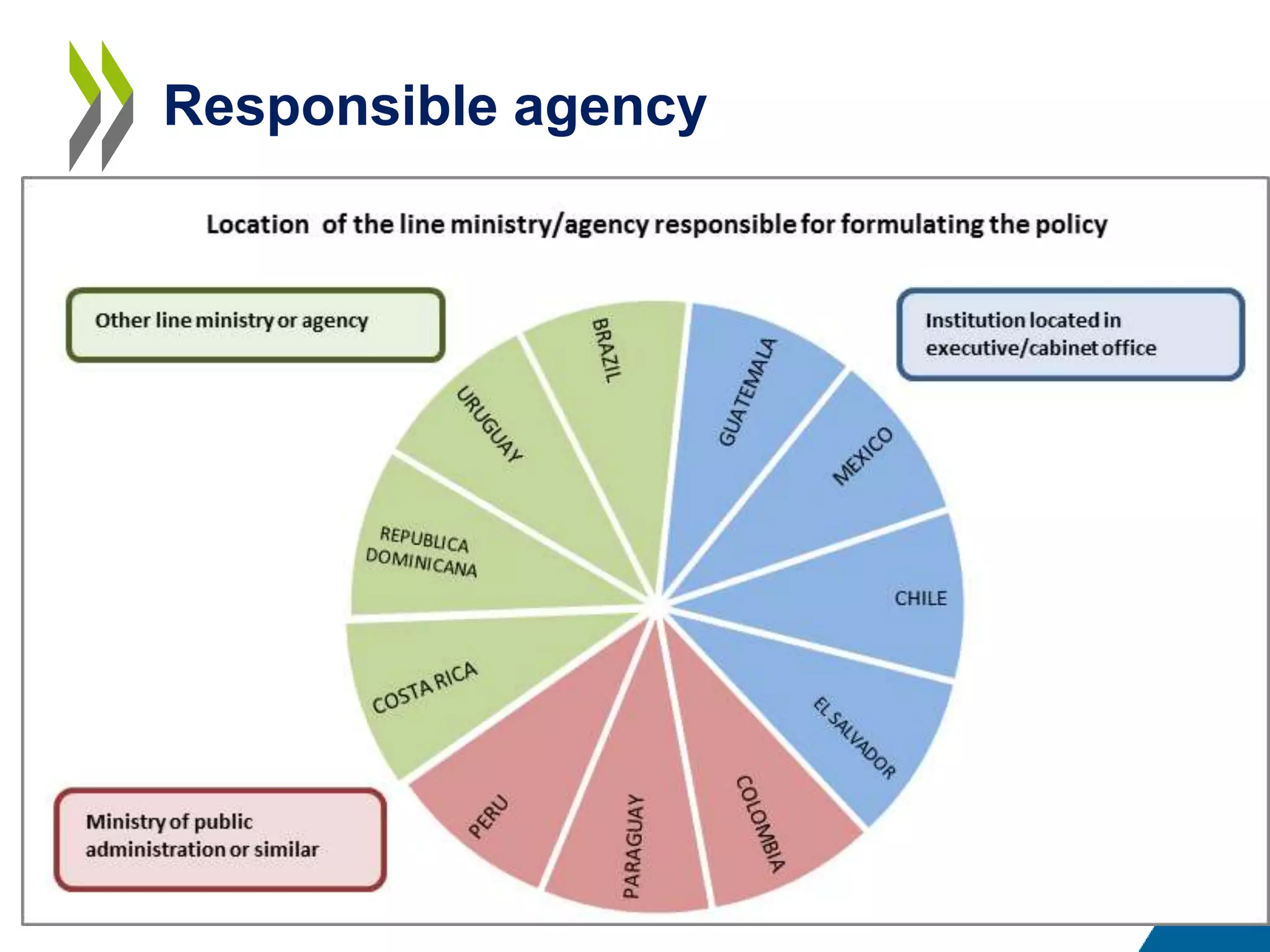
Responsible agency
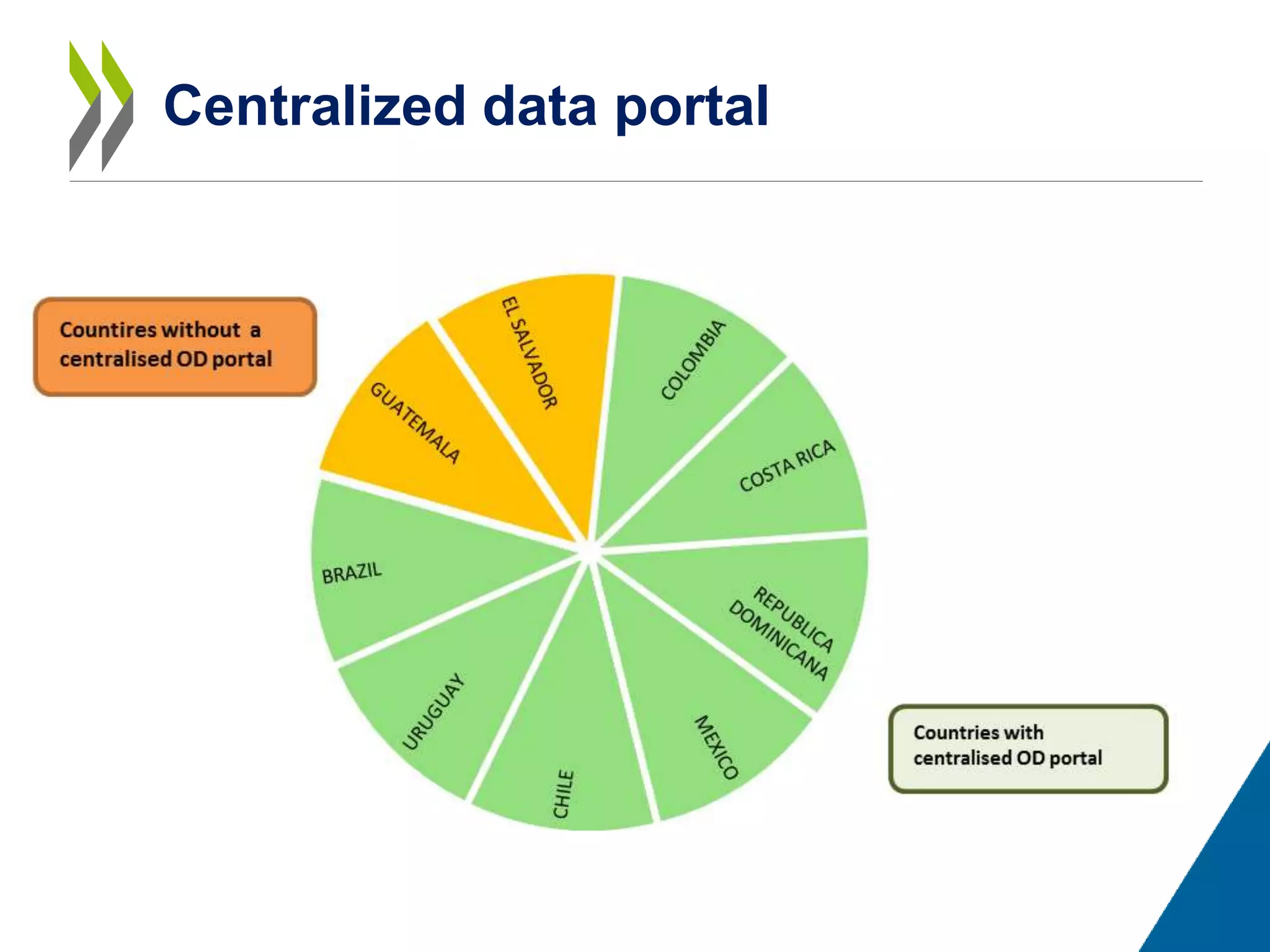
Centralized data portal
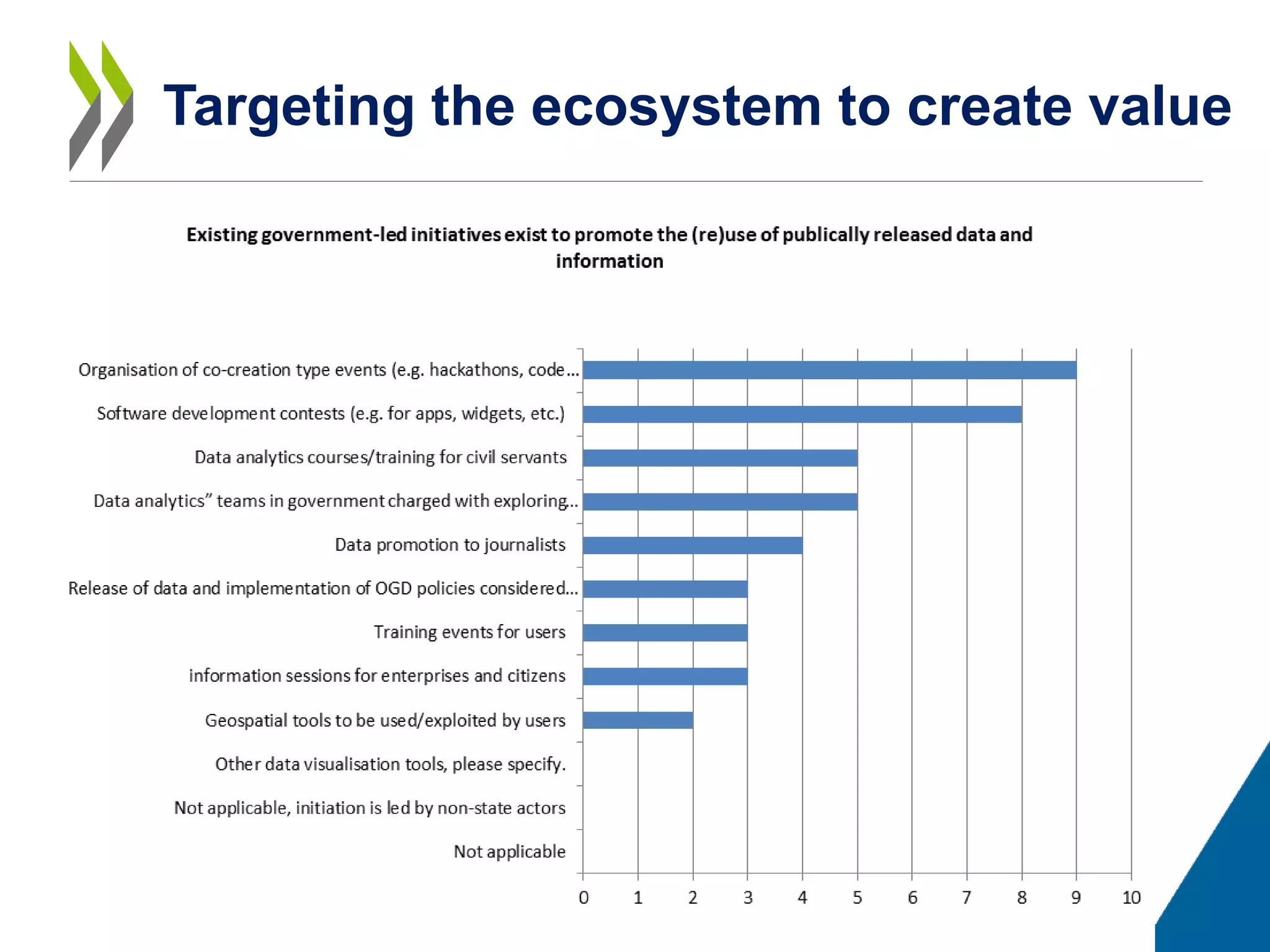
Targeting the ecosystem to create value
Financial challenges
Furthering the OECD’s Work on
Open Government Data
Phase 1
• Working Paper “Open Government Data: Towards Empirical
Analysis of Open Government Data Initiatives” with full assessment
methodology [Dec 2012-May 2013]
Phase 2
• OGD survey : strategy, implementation, value generation,
challenges [Apr – Sept 2013]
Phase 3
• Pilot testing in 8 OECD countries : validate methodology, map
initiatives, collect practices, impact assessment + MENA and LAC
regions [2013 – 2014]
Now
• OGD Country Reviews: Poland, Mexico
• OURdata Index 2015
• OECD Open Government Data Expert Group
OECD OGD PROJECT 2012-15
2015 OGD Report :
Data analysis and outcome of pilot testing
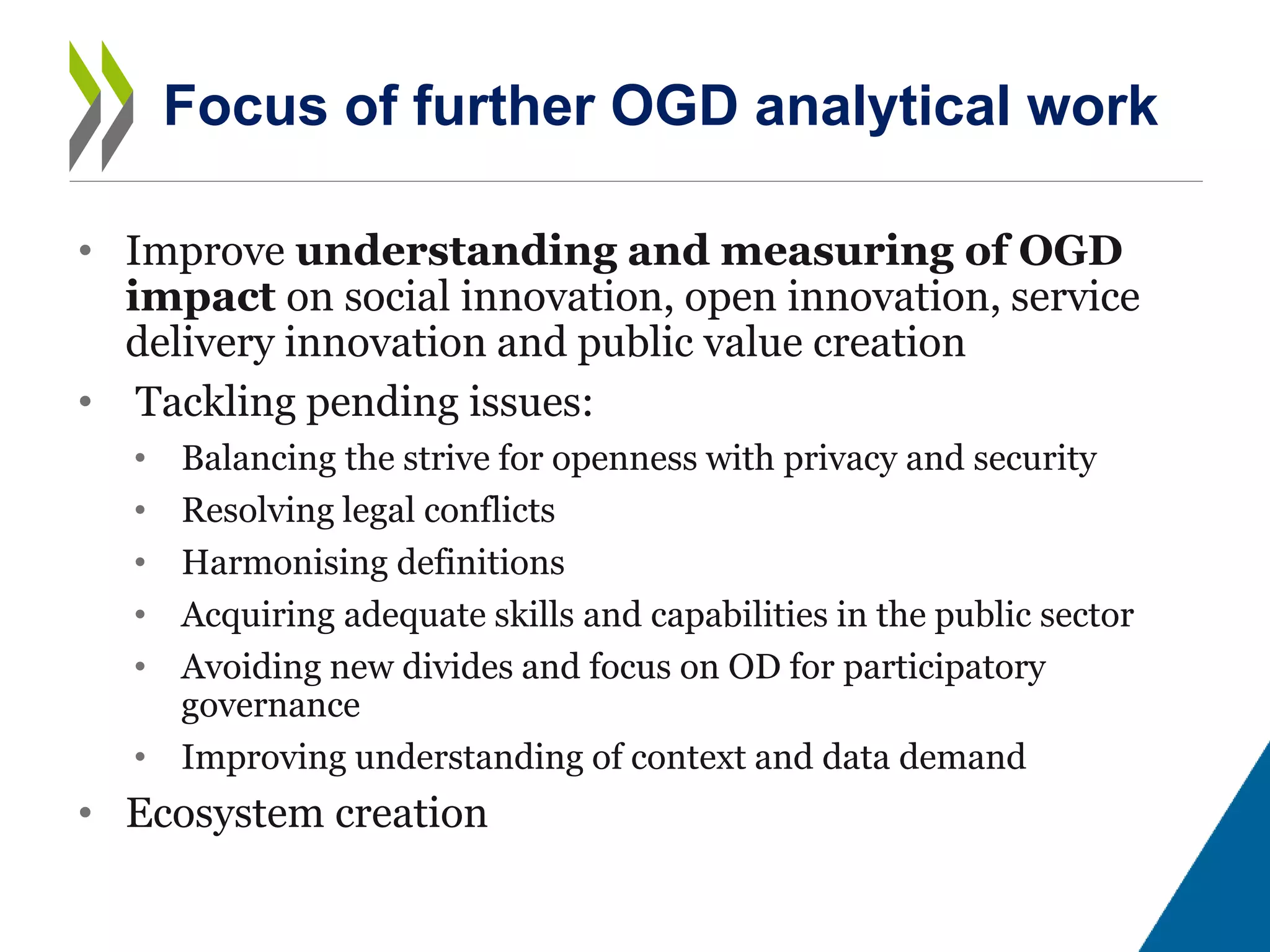
• Improve understanding and measuring of OGD
impact on social innovation, open innovation, service
delivery innovation and public value creation
• Tackling pending issues:
• Balancing the strive for openness with privacy and security
• Resolving legal conflicts
• Harmonising definitions
• Acquiring adequate skills and capabilities in the public sector
• Avoiding new divides and focus on OD for participatory
governance
• Improving understanding of context and data demand
• Ecosystem creation
Focus of further OGD analytical work
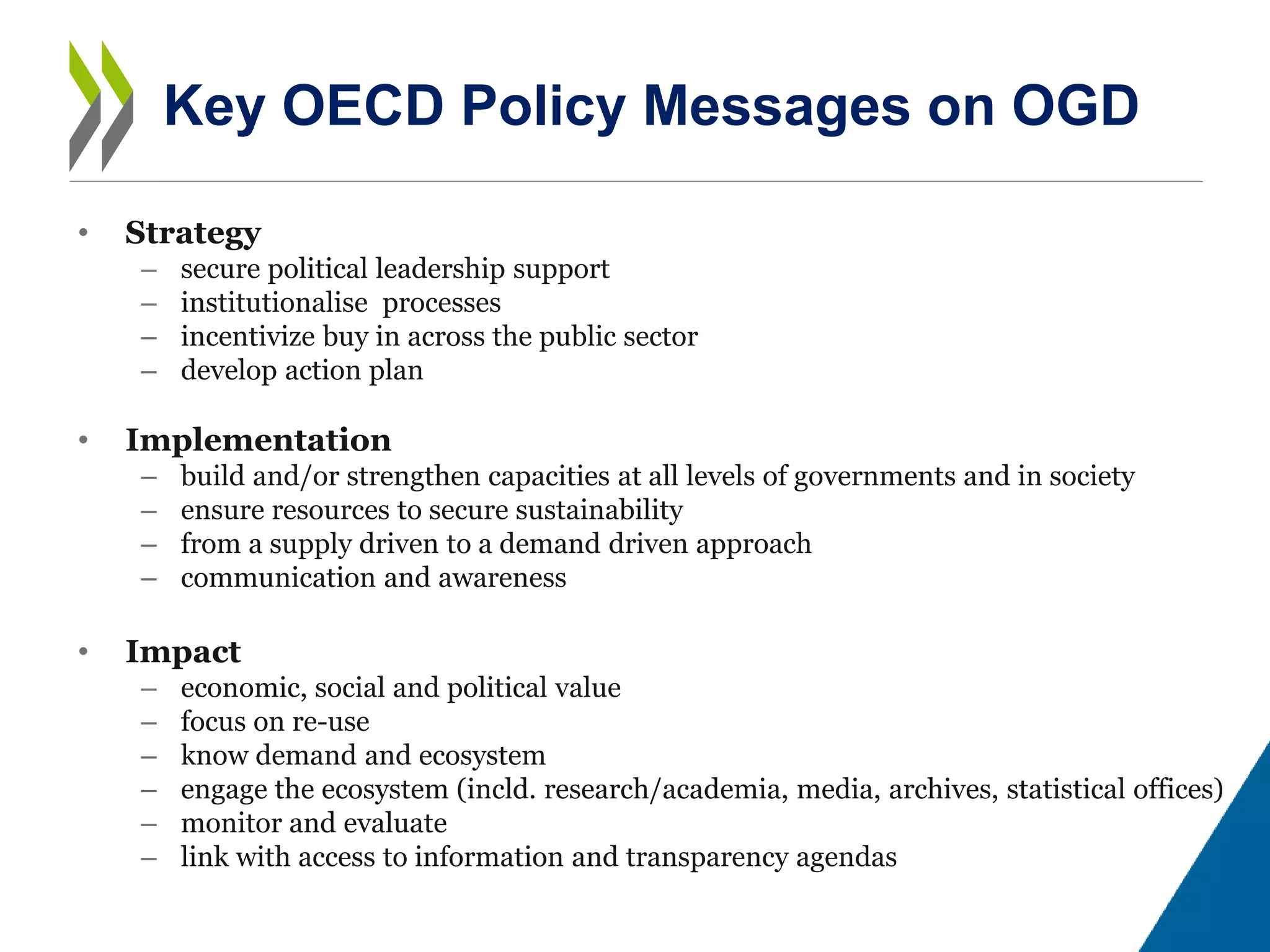
• Strategy
– secure political leadership support
– institutionalise processes
– incentivize buy in across the public sector
– develop action plan
• Implementation
– build and/or strengthen capacities at all levels of governments and in society
– ensure resources to secure sustainability
– from a supply driven to a demand driven approach
– communication and awareness
• Impact
– economic, social and political value
– focus on re-use
– know demand and ecosystem
– engage the ecosystem (incld. research/academia, media, archives, statistical offices)
– monitor and evaluate
– link with access to information and transparency agendas
Key OECD Policy Messages on OGD
SAIs and Open Data:
Opportunities for Action
• OECD (GOV-PSI) is conducting an ongoing internationally
comparative study with 12 SAIs
• Looking at the role of SAIs in supporting better formulation,
implementation and monitoring and evaluation of policies
and programmes, including:
– the openness of government-wide strategic planning processes
– the openness of budgetary planning processes including: the
existence and/or adequacy of participative and realistic debates on
budgetary choices
– the openness and consultation of the regulatory policy process
– the accessibility and reliability of data systems for collecting, storing
and using performance information
– the compliance with access to/freedom of information laws
• OECD publication on role of SAIs in better policy making
and governance to be launched November in Brazil
The role of SAIs in Good Governance
• Citizen portals for accountability and
complaints
– The GEO-CGR portal: Articulation, storage,
consultation and publication of information on
investment in public works.
• Co-ordinated audits
– Country level: The Amazon Biome, Protected areas,
Co-ordinated Audit between Brazil’s TCU and 9
State Courts of Audit in the Brazilian Amazon
– International level: Co-ordinated international
audit on climate change between 14 SAIs
Examples of Using OGD Principles in
the work of SAIs
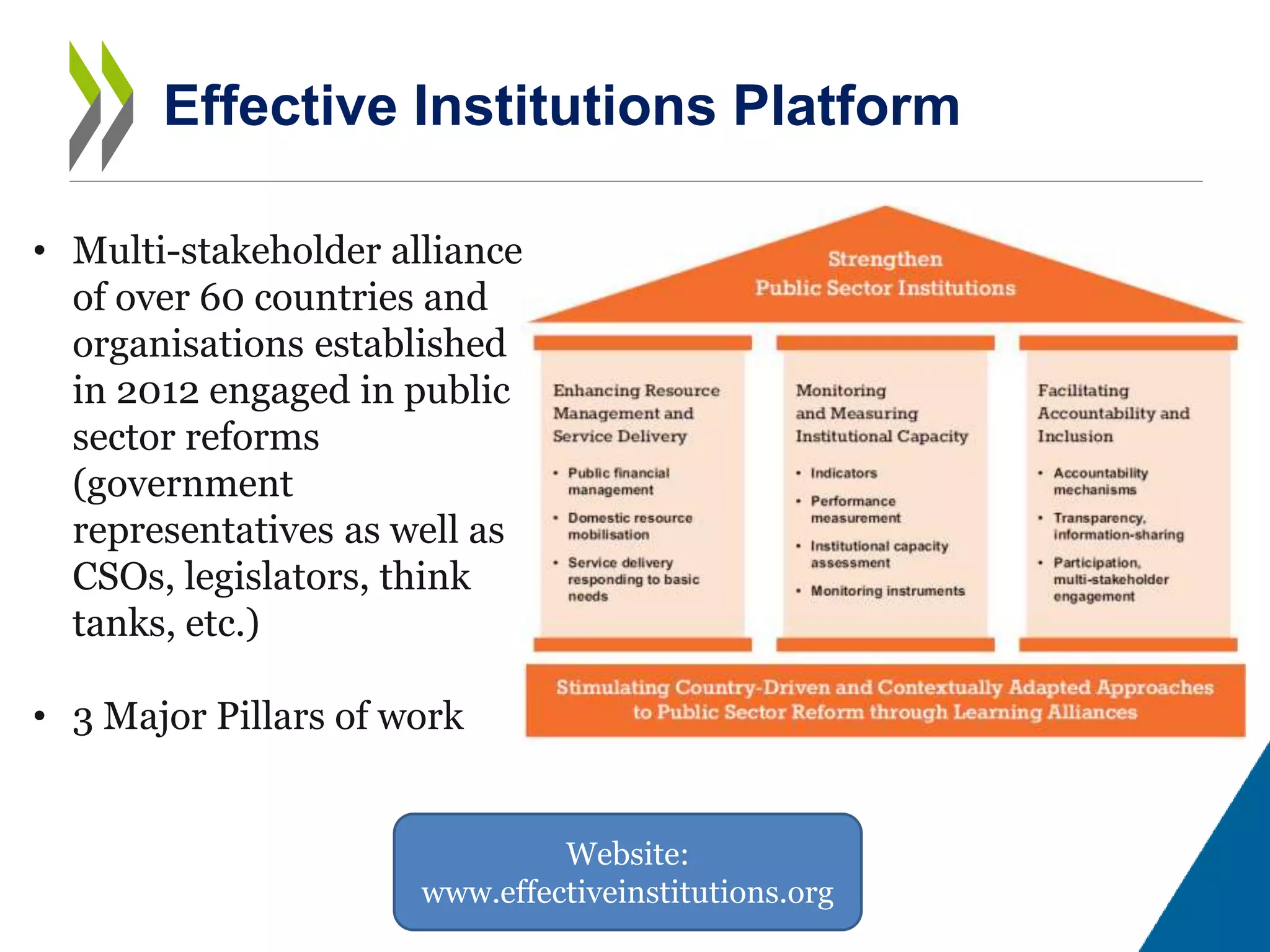
Effective Institutions Platform
• Multi-stakeholder alliance
of over 60 countries and
organisations established
in 2012 engaged in public
sector reforms
(government
representatives as well as
CSOs, legislators, think
tanks, etc.)
• 3 Major Pillars of work
Website:
www.effectiveinstitutions.org
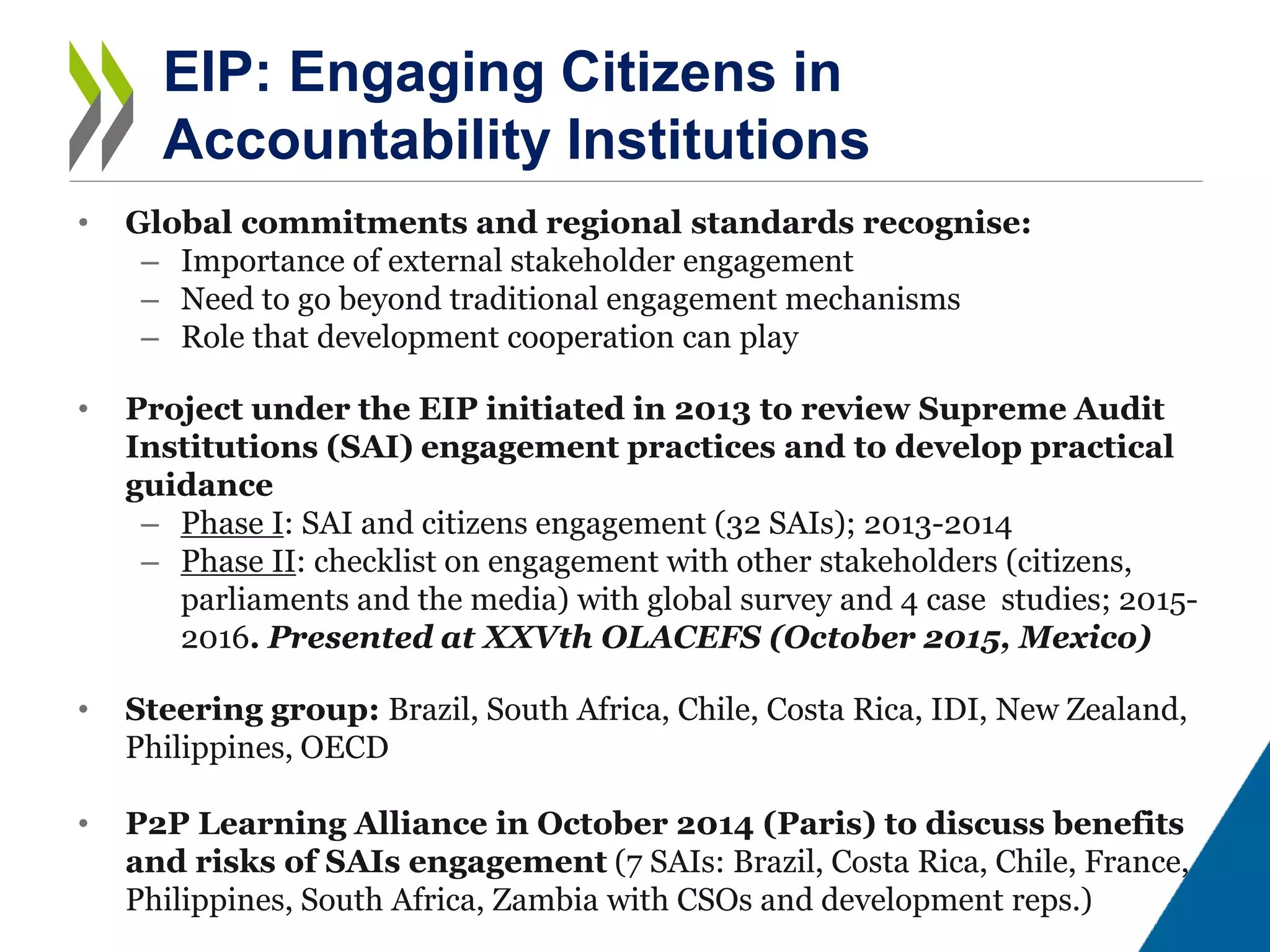
EIP: Engaging Citizens in
Accountability Institutions
• Global commitments and regional standards recognise:
– Importance of external stakeholder engagement
– Need to go beyond traditional engagement mechanisms
– Role that development cooperation can play
• Project under the EIP initiated in 2013 to review Supreme Audit
Institutions (SAI) engagement practices and to develop practical
guidance
– Phase I: SAI and citizens engagement (32 SAIs); 2013-2014
– Phase II: checklist on engagement with other stakeholders (citizens,
parliaments and the media) with global survey and 4 case studies; 2015-
2016. Presented at XXVth OLACEFS (October 2015, Mexico)
• Steering group: Brazil, South Africa, Chile, Costa Rica, IDI, New Zealand,
Philippines, OECD
• P2P Learning Alliance in October 2014 (Paris) to discuss benefits
and risks of SAIs engagement (7 SAIs: Brazil, Costa Rica, Chile, France,
Philippines, South Africa, Zambia with CSOs and development reps.)
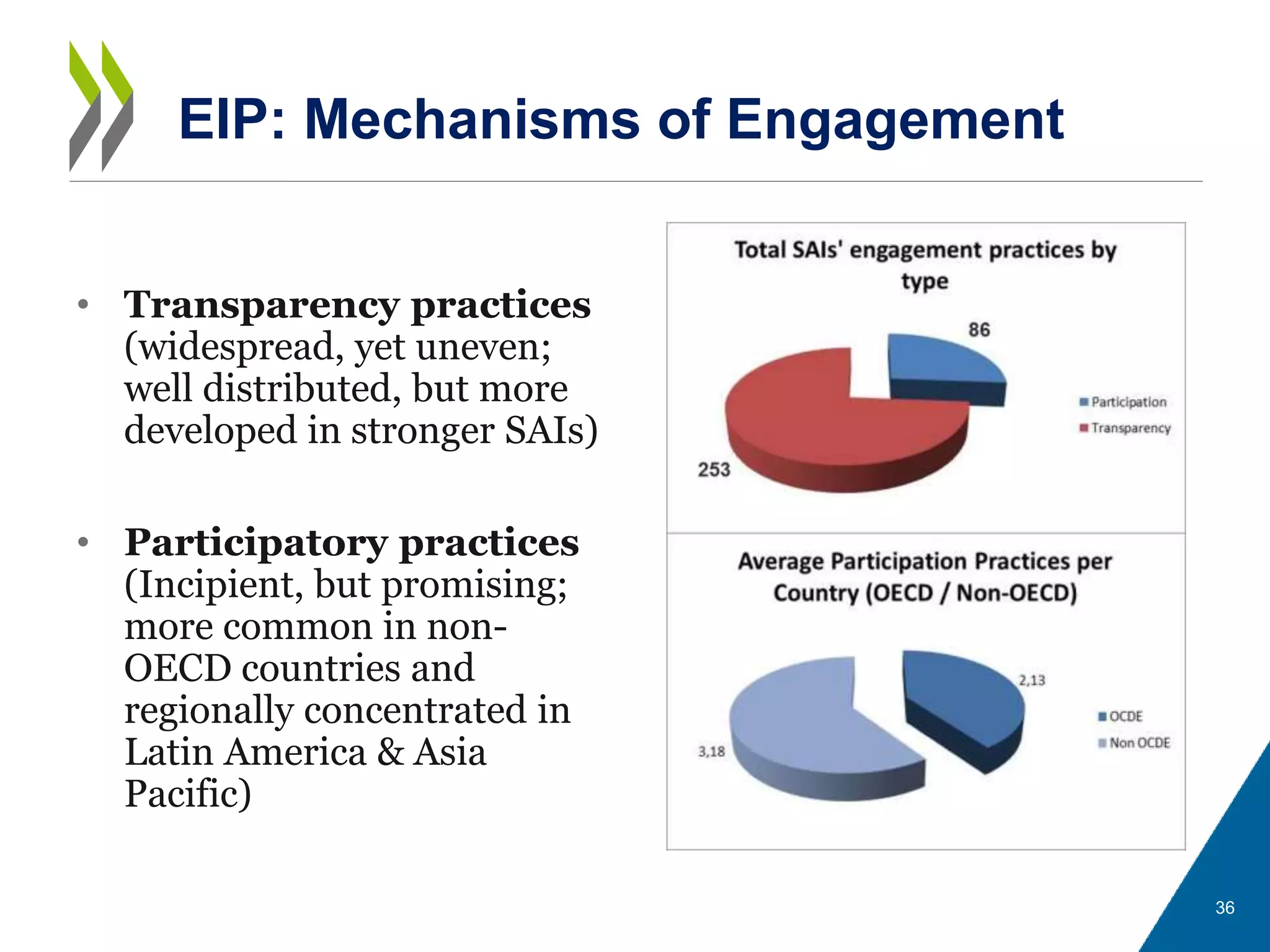
• Transparency practices
(widespread, yet uneven;
well distributed, but more
developed in stronger SAIs)
• Participatory practices
(Incipient, but promising;
more common in non-
OECD countries and
regionally concentrated in
Latin America & Asia
Pacific)
36
EIP: Mechanisms of Engagement
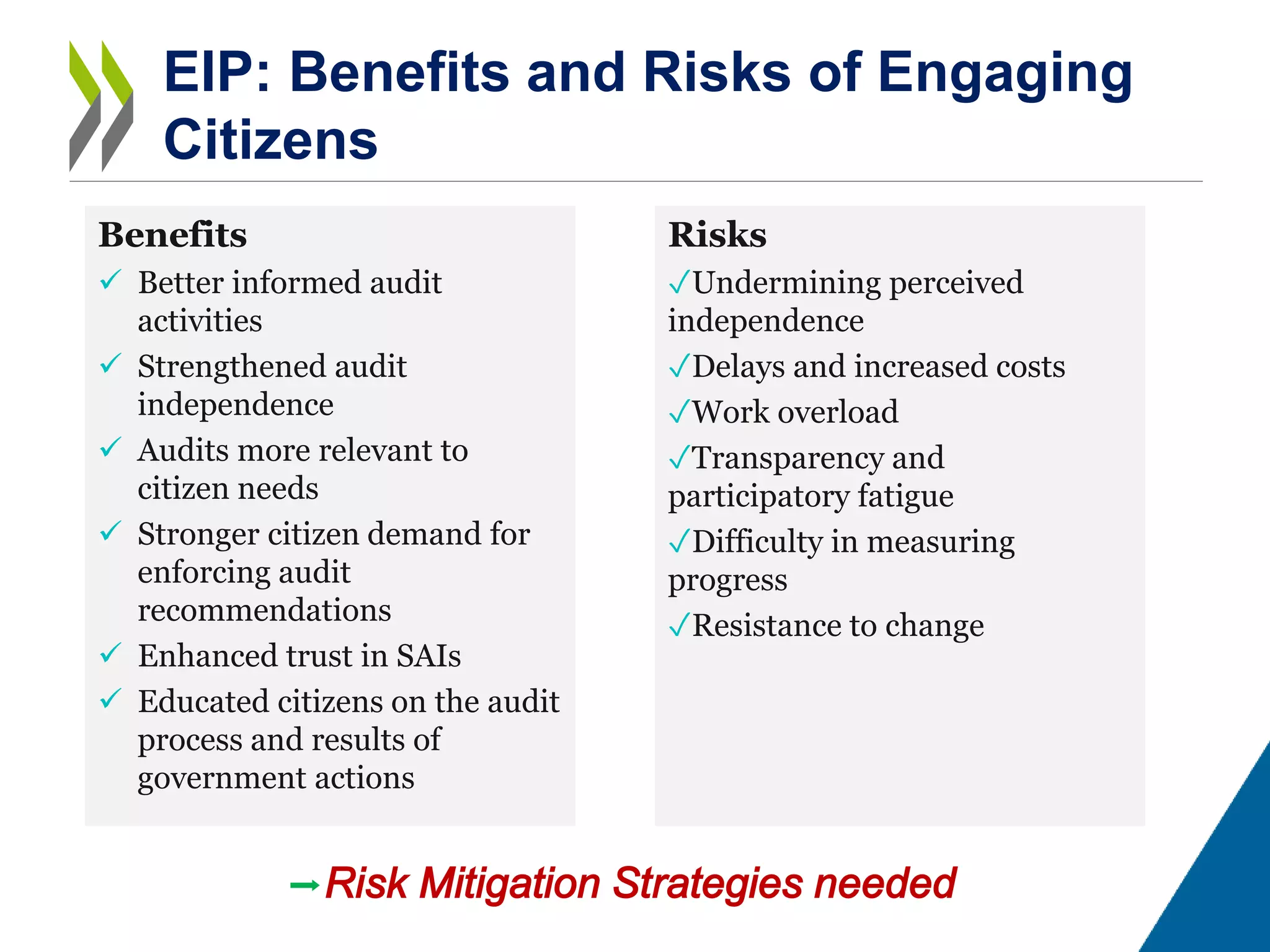
EIP: Benefits and Risks of Engaging
Citizens
Benefits
 Better informed audit
activities
 Strengthened audit
independence
 Audits more relevant to
citizen needs
 Stronger citizen demand for
enforcing audit
recommendations
 Enhanced trust in SAIs
 Educated citizens on the audit
process and results of
government actions
Risks
✓Undermining perceived
independence
✓Delays and increased costs
✓Work overload
✓Transparency and
participatory fatigue
✓Difficulty in measuring
progress
✓Resistance to change
➡Risk Mitigation Strategies needed
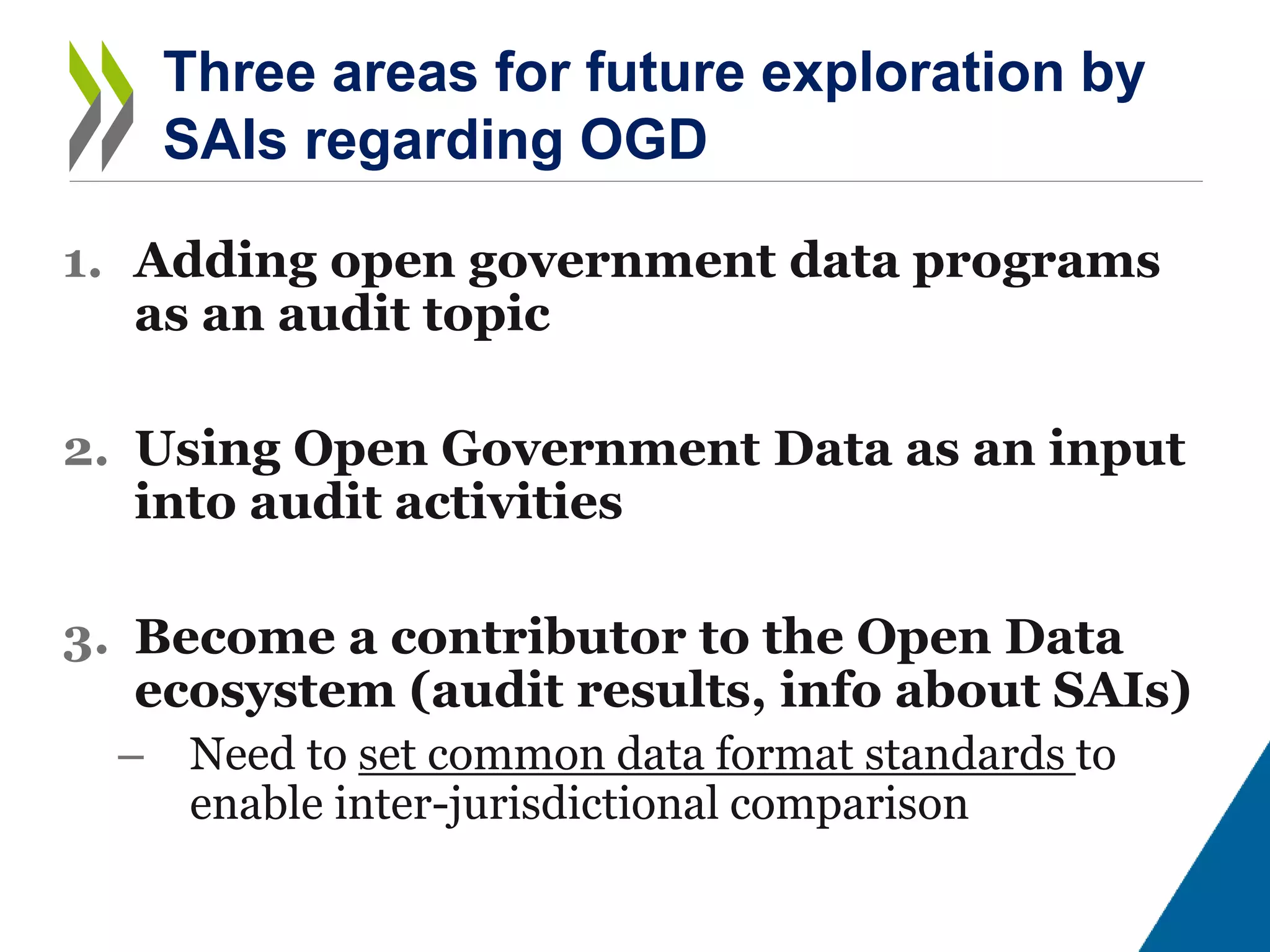
1. Adding open government data programs
as an audit topic
2. Using Open Government Data as an input
into audit activities
3. Become a contributor to the Open Data
ecosystem (audit results, info about SAIs)
– Need to set common data format standards to
enable inter-jurisdictional comparison
Three areas for future exploration by
SAIs regarding OGD
Thank You!
For more information:
www.oecd.org/gov/public-innovation/
ryan.androsoff@oecd.org
Twitter:
@RyanAndrosoff
LinkedIn:
ca.linkedin.com/in/ryanandrosoff

Open Government Data: What it is, Where it is Going, and the Opportunities for SAIs

  • 1.
    OPEN GOVERNMENT DATA: WHATIS IT, WHERE IT IS GOING, AND THE OPPORTUNITIES FOR SAIS Ryan Androsoff OECD GOV Quito, Ecuador 25 June 2015
  • 2.
    • What isOpen Government Data and why should we care? • Measuring the Status of Open Government Data – Indexes – Trends in OECD countries – Open Government Data in LAC – Furthering the OECD’s work on Open Data • SAIs and Open Data: Opportunities for Action Today’s Presentation
  • 3.
    • Data =highest level of granularity from which information, content and knowledge are derived. • Public Sector Information = “information, including information products and services, generated, created, collected, processed, preserved, maintained, disseminated, or funded by or for a government or public institution” • Open Data = data that can be freely used, re-used and distributed by anyone, only subject to (at the most) the requirement that users attribute the data and that they make their work available to be shared as well. • Big Data = A data-driven socio-economic model; as a phenomenon emerged as available datasets produced by various sources have grown larger and data users more aware of the value obtainable through linked and combined data sets produced by different actors, both private and public. • Data analytics = the use of data to spot significant facts and trends to improve policy making and service delivery (public sector intelligence). Some Definitions
  • 4.
    Public Sector Information VisualDefinition Big Data Open Government Data Proprietary / Internal Analytics Apps Public / Open Analytics
  • 5.
    • Economic Value •Growth and competitiveness in the wider economy • Fostering innovation, efficiency and effectiveness in government services (internal and external) • Social Value • Promoting citizens’ self-empowerment, social participation and engagement • Public Governance Value • Improving accountability, transparency, responsiveness and democratic control What Value are Governments Expecting?
  • 6.
  • 7.
  • 8.
  • 9.
    Measuring the Statusof Open Government Data
  • 10.
    • Produced bythe World Wide Web Foundation • Measures on three dimensions, first launched in 2013 Open Data Barometer
  • 11.
    • Produced bythe Open Knowledge Foundation since 2013 • Index is based on 10 key datasets assessed against 9 criteria Global Open Data Index
  • 12.
    The OECD OURdataIndex The Open-Useful-Reusable Government data index (OURdata) launched in 2015 0 0.1 0.2 0.3 0.4 0.5 0.6 0.7 0.8 0.9 1 Total score OECD NonationalOGDportal Source: 2014 OECD Survey on Open Government Data
  • 13.
    Measuring three componentsof open government data activity The Open-Useful-Reusable Government data index (OURdata) Source: 2014 OECD Survey on Open Government Data 0 0.1 0.2 0.3 0.4 0.5 0.6 0.7 0.8 0.9 1 Data availability Data accessibility Government support to re-use NonationalOGDportal All three dimensions were equally weighted (33.3% each) Note: Cronbach alpha = 0.81
  • 14.
    • The “pioneers”(e.g. UK, USA, Spain) • Devising a sustainable financial mechanism (e.g. Denmark, the Netherlands) • Establishing the governance framework first (e.g. Germany, Switzerland) • Quick followers (e.g. France and Mexico) Emerging approaches
  • 15.
    Top 5 mainobjectives of open data strategies or policies 0% 29% 33% 46% 54% 63% 67% 71% 71% 71% 0% 10% 20% 30% 40% 50% 60% 70% 80% Create economic value for the public sector Facilitate citizens' participation in public debate Enable citizens' engagement in decision-making processes Improve public sector performance by strengthening accountability for outputs/outcomes Deliver public services more effectively and efficiently by enabling delivery from private sector through data re-use Deliver public services more effectively and efficiently by improving internal operations and collaboration Facilitate creation of new businesses Increase transparency Increase openness Create economic value for the private sector Multiple answers allowed Percentage of respondent countries Source: OECD Open Data in Governments Survey 2013 Transparency vs. Innovation PS Efficiency Public Participation
  • 16.
    • Which ecosystem? –Inside the public sector: gather, integrate, validate, release, up-date and promote re-use of data (statistical offices, archives, sector data producers, etc.) – Outside the public sector: sustain data re-use (media, private sector, civil society, librarians, developers, community of practitioners, etc.) • What activity? • Data mining, data analytics (for policy making and service delivery), crowd- sourcing to innovate services, social innovation, evidence-based performance, improved financial decisions, data mash-up and data sharing, licensing, standards, hackathon events, metadata. • Which capacities within the organisation? • To ensure sustainability and autonomy: data scientist, visualisation expert, statistics and data analytics expert, computing and systems programming skills, policy analysis expertise. Value creation : with whom and how?
  • 17.
    Creating the rightecosystem: consulting the stakeholders 0% 10% 20% 30% 40% 50% 60% 70% 80% Percentageofrespondentcountries Was the central/federal OGD strategy/policy developed in consultation with stakeholders? Source: Government at a Glance 2013
  • 18.
    Involving users andknowing demand 0% 10% 20% 30% 40% 50% 60% 70% 80% a. Yes citizens' information needs b. Yes, businesses' information needs c. Yes, other stakeholders' needs (e.g. non-profit organisations) d. None of the above applies Percentageofrespondentcountries Source: Government at a Glance 2013 Does your government regularly consult users on their needs and preferences of the type of data released?
  • 19.
    • Policy challenges •Technical challenges • Economic and financial challenges • Organisational challenges • Cultural challenges • Legal challenges Key challenges to implementation
  • 20.
    Principal challenges forfurther development of OGD initiatives 0% 10% 20% 30% 40% 50% 60% 70% 80% 90% Organisational challenges Institutional challenges Funding challenges Policy challenges Technical challenges Context challenges Percentageofrespondingcountries Source: Government at a Glance 2013 (forthcoming)
  • 21.
    Open Government Datain Latin America
  • 22.
    Yes Central national strategy co-exists withline ministries' own strategies No, but individual line ministries / agencies have a separate strategies / policies in place No OGD policies / strategies in place COLOMBIA  - - - COSTA RICA - - -  GUATEMALA - -  - REPUBLICA DOMINICANA - - -  MEXICO  - - - PERU - - -  CHILE -  - - URUGUAY  - - - BRAZIL -  - - EL SALVADOR - - -  PARAGUAY - -  - OGD strategies in LAC countries
  • 23.
  • 24.
  • 25.
    Targeting the ecosystemto create value
  • 26.
  • 27.
    Furthering the OECD’sWork on Open Government Data
  • 28.
    Phase 1 • WorkingPaper “Open Government Data: Towards Empirical Analysis of Open Government Data Initiatives” with full assessment methodology [Dec 2012-May 2013] Phase 2 • OGD survey : strategy, implementation, value generation, challenges [Apr – Sept 2013] Phase 3 • Pilot testing in 8 OECD countries : validate methodology, map initiatives, collect practices, impact assessment + MENA and LAC regions [2013 – 2014] Now • OGD Country Reviews: Poland, Mexico • OURdata Index 2015 • OECD Open Government Data Expert Group OECD OGD PROJECT 2012-15 2015 OGD Report : Data analysis and outcome of pilot testing
  • 29.
    • Improve understandingand measuring of OGD impact on social innovation, open innovation, service delivery innovation and public value creation • Tackling pending issues: • Balancing the strive for openness with privacy and security • Resolving legal conflicts • Harmonising definitions • Acquiring adequate skills and capabilities in the public sector • Avoiding new divides and focus on OD for participatory governance • Improving understanding of context and data demand • Ecosystem creation Focus of further OGD analytical work
  • 30.
    • Strategy – securepolitical leadership support – institutionalise processes – incentivize buy in across the public sector – develop action plan • Implementation – build and/or strengthen capacities at all levels of governments and in society – ensure resources to secure sustainability – from a supply driven to a demand driven approach – communication and awareness • Impact – economic, social and political value – focus on re-use – know demand and ecosystem – engage the ecosystem (incld. research/academia, media, archives, statistical offices) – monitor and evaluate – link with access to information and transparency agendas Key OECD Policy Messages on OGD
  • 31.
    SAIs and OpenData: Opportunities for Action
  • 32.
    • OECD (GOV-PSI)is conducting an ongoing internationally comparative study with 12 SAIs • Looking at the role of SAIs in supporting better formulation, implementation and monitoring and evaluation of policies and programmes, including: – the openness of government-wide strategic planning processes – the openness of budgetary planning processes including: the existence and/or adequacy of participative and realistic debates on budgetary choices – the openness and consultation of the regulatory policy process – the accessibility and reliability of data systems for collecting, storing and using performance information – the compliance with access to/freedom of information laws • OECD publication on role of SAIs in better policy making and governance to be launched November in Brazil The role of SAIs in Good Governance
  • 33.
    • Citizen portalsfor accountability and complaints – The GEO-CGR portal: Articulation, storage, consultation and publication of information on investment in public works. • Co-ordinated audits – Country level: The Amazon Biome, Protected areas, Co-ordinated Audit between Brazil’s TCU and 9 State Courts of Audit in the Brazilian Amazon – International level: Co-ordinated international audit on climate change between 14 SAIs Examples of Using OGD Principles in the work of SAIs
  • 34.
    Effective Institutions Platform •Multi-stakeholder alliance of over 60 countries and organisations established in 2012 engaged in public sector reforms (government representatives as well as CSOs, legislators, think tanks, etc.) • 3 Major Pillars of work Website: www.effectiveinstitutions.org
  • 35.
    EIP: Engaging Citizensin Accountability Institutions • Global commitments and regional standards recognise: – Importance of external stakeholder engagement – Need to go beyond traditional engagement mechanisms – Role that development cooperation can play • Project under the EIP initiated in 2013 to review Supreme Audit Institutions (SAI) engagement practices and to develop practical guidance – Phase I: SAI and citizens engagement (32 SAIs); 2013-2014 – Phase II: checklist on engagement with other stakeholders (citizens, parliaments and the media) with global survey and 4 case studies; 2015- 2016. Presented at XXVth OLACEFS (October 2015, Mexico) • Steering group: Brazil, South Africa, Chile, Costa Rica, IDI, New Zealand, Philippines, OECD • P2P Learning Alliance in October 2014 (Paris) to discuss benefits and risks of SAIs engagement (7 SAIs: Brazil, Costa Rica, Chile, France, Philippines, South Africa, Zambia with CSOs and development reps.)
  • 36.
    • Transparency practices (widespread,yet uneven; well distributed, but more developed in stronger SAIs) • Participatory practices (Incipient, but promising; more common in non- OECD countries and regionally concentrated in Latin America & Asia Pacific) 36 EIP: Mechanisms of Engagement
  • 37.
    EIP: Benefits andRisks of Engaging Citizens Benefits  Better informed audit activities  Strengthened audit independence  Audits more relevant to citizen needs  Stronger citizen demand for enforcing audit recommendations  Enhanced trust in SAIs  Educated citizens on the audit process and results of government actions Risks ✓Undermining perceived independence ✓Delays and increased costs ✓Work overload ✓Transparency and participatory fatigue ✓Difficulty in measuring progress ✓Resistance to change ➡Risk Mitigation Strategies needed
  • 38.
    1. Adding opengovernment data programs as an audit topic 2. Using Open Government Data as an input into audit activities 3. Become a contributor to the Open Data ecosystem (audit results, info about SAIs) – Need to set common data format standards to enable inter-jurisdictional comparison Three areas for future exploration by SAIs regarding OGD
  • 39.
    Thank You! For moreinformation: www.oecd.org/gov/public-innovation/ ryan.androsoff@oecd.org Twitter: @RyanAndrosoff LinkedIn: ca.linkedin.com/in/ryanandrosoff