Chronic Pelvic Pain.
How to assess and manage?
Dr/ Mahmoud Abdel-Aleem
Professor of obstetrics and Gynecology, Faculty of medicine, Assiut
University.
Objectives
Review basics and updates
in the assessment and
management of chronic
pelvic pain in women
Introduction
• It is a symptom not a diagnosis
• Nature: Intermittent or constant pain
• Site: lower abdomen or pelvis, lumbosacral back, buttocks of a woman
• Duration: at least 6 months.
• NOT:
• Occurring exclusively with menstruation or intercourse
• Associated with pregnancy.
• Severity: sufficient to cause functional disability or lead to medical care.
• It presents in primary care as frequently as migraine or low-back pain.
• May significantly impact on a woman’s ability to function.
38
21
37
41
10
20
30
40
50
60
70
80
90
100
PrevalenceRateper1,000
Women
Prevalence of CPP is Comparable to Other Common
Medical Problems
• Cross-sectional analysis by UK Mediplus Primary Care database.
CPP Migraine Asthma Back Pain
Zondervan KT et al. Br J Obstet Gynaecol. 1999:106;1149-1155.
N=24,053
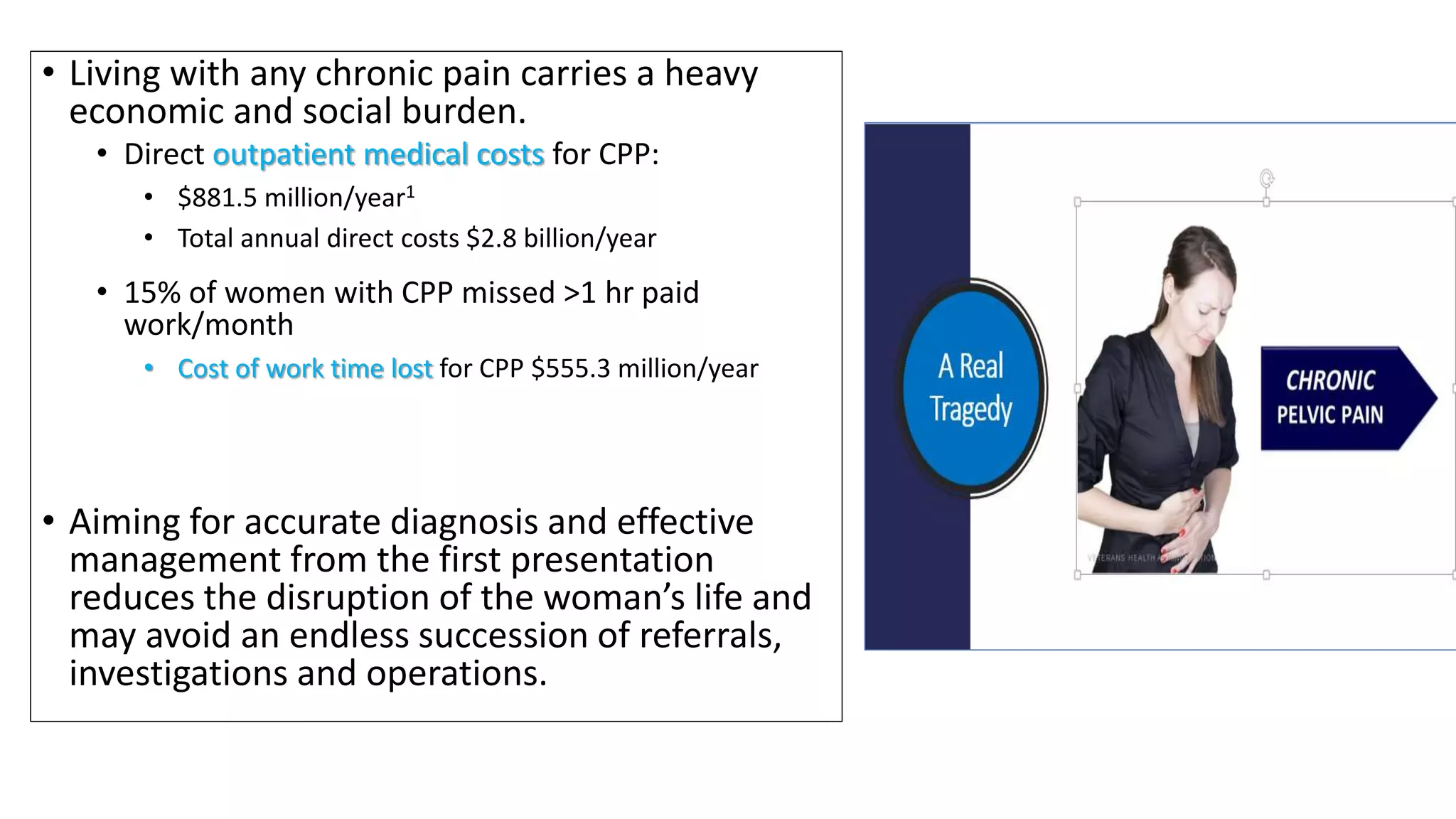
• Living with any chronic pain carries a heavy
economic and social burden.
• Direct outpatient medical costs for CPP:
• $881.5 million/year1
• Total annual direct costs $2.8 billion/year
• 15% of women with CPP missed >1 hr paid
work/month
• Cost of work time lost for CPP $555.3 million/year
• Aiming for accurate diagnosis and effective
management from the first presentation
reduces the disruption of the woman’s life and
may avoid an endless succession of referrals,
investigations and operations.
What is pain?
• Pain is, a sensory and emotional experience associated with actual or
potential tissue damage.
• The experience of pain is affected by physical, psychological and social
factors.
• The woman is often aware of these influences but may choose not to
discuss them, fearing that her pain will be dismissed as psychological
or that non-gynaecological symptoms will be considered irrelevant.
Types of pain
Nociceptive
Associated with tissue damage
or inflammation, so it is also
called ‘inflammatory pain’.
Neuropathic
Due to a lesion to peripheral or
central nervous systems.
Many pains will have a mixed neuropathic and
nociceptive aetiology
Difficultdiagnosis
ComplexNeuronetwork
Causes of CPP
8/32=25%
U
P
T
O
O
N
I. Endometriosis and adenomyosis
• Pelvic pain which varies markedly over the menstrual cycle is likely
to be attributable to a hormonally driven condition such as
endometriosis.
• Laparoscopy or laparotomy, the combination of clinical examination
and transvaginal ultrasound accurately identifies ovarian but not
peritoneal endometriosis.
II. Pelvic venous congestion
• NOW, it is well-established as a
cause of chronic pelvic pain.
• No valid test.
• Ovarian suppression (progestins
and GnRH agonists) is effective in
treating pelvic pain symptoms.
• Phelobtonics.
III. Adhesions
• Adhesions may be caused by endometriosis, previous surgery or
previous infection.
• Fine adhesions: there is no evidence to support the division of fine
adhesions in women with chronic pelvic pain.
• Dense vascular adhesion: beneficial as this is associated with pain
relief.
Two distinct forms of adhesive disease:
Residual ovary syndrome
• A small amount of ovarian tissue
inadvertently left behind
following oophorectomy which
may become buried in
adhesions).
Trapped ovary syndrome
• A retained ovary becomes
buried in dense adhesions post-
hysterectomy).
Removal of all ovarian tissue or suppression
using a GnRH analogue may relieve pain.
IV. IBS and interstitial cystitis
• Symptoms suggestive of IBS or interstitial cystitis are often present
in women with chronic pelvic pain.
• These conditions may be
• A primary cause of chronic pelvic pain.
• A component of chronic pelvic pain.
• A secondary effect caused by efferent neurological dysfunction in the
presence of chronic pain
V. Musculoskeletal
• May be a primary source of pelvic pain or an additional component
resulting from postural changes.
• Source:
• Joints in the pelvis.
• Damage to the muscles in the abdominal wall or pelvic floor.
• Pelvic organ prolapse.
• Trigger points:
• Localised areas of deep tenderness in a tight band of muscle.
• It may relate to chronic contraction of the muscle, with the stimulus coming from
misalignment of the pelvis or a discrete pain such as endometriosis.
• The pain from a trigger point may then become self-perpetuating.
VI. Nerve entrapment
• Nerve entrapment in scar tissue, fascia or a narrow foramen may
result in pain and dysfunction in the distribution of that nerve.
• Pain is (highly localised, sharp, stabbing or aching pain, exacerbated
by particular movements, and persisting beyond 5 weeks or occurring
after a pain-free interval).
• The incidence of nerve entrapment after one Pfannenstiel incision is
3.7%.
VII. Psychological and social issues
• Enquiry should be made regarding psychological and social issues
which commonly occur in association with chronic pelvic pain.
• Depression and sleep disorders are consequences rather than causes
of the pain.
Assessment
The Golden
Rules
Time: Adequate time should be allowed
for the initial assessment of women with
CPP.
Style: Women need to feel that they have
been able to tell their story and that they
have been listened to and believed.
Value: These ideas should be discussed in
the initial consultation.
The Golden
Rules
Scrutiny: to reveal factors that may be
contributing to the pain.
Patience:aAt the initial assessment, it may
not be possible to identify the cause of
the pain.
Comprehensiveness: assessment should
aim to identify contributory factors rather
than assign causality to a single pathology.
The Golden
Rules
Caution: the common and unusual and the
rare.
Partnership: encourage women to talk about
their symptoms and ideas, allowing them to
influence and shape the doctor–patient
relationship.
Sympathy: it is important not to leave the
woman with the feeling that nothing more
can be done to help her.
Step I: Initial History
The pattern.
1
Association with
problems, as
psychological,
bladder and bowel
symptoms.
2
Effect of
movement and
posture on the
pain.
3
Effect of pain on
work and activities
( A good monitor).
4
Therapeutic
History: previous
drugs, effect.
5
Step II:
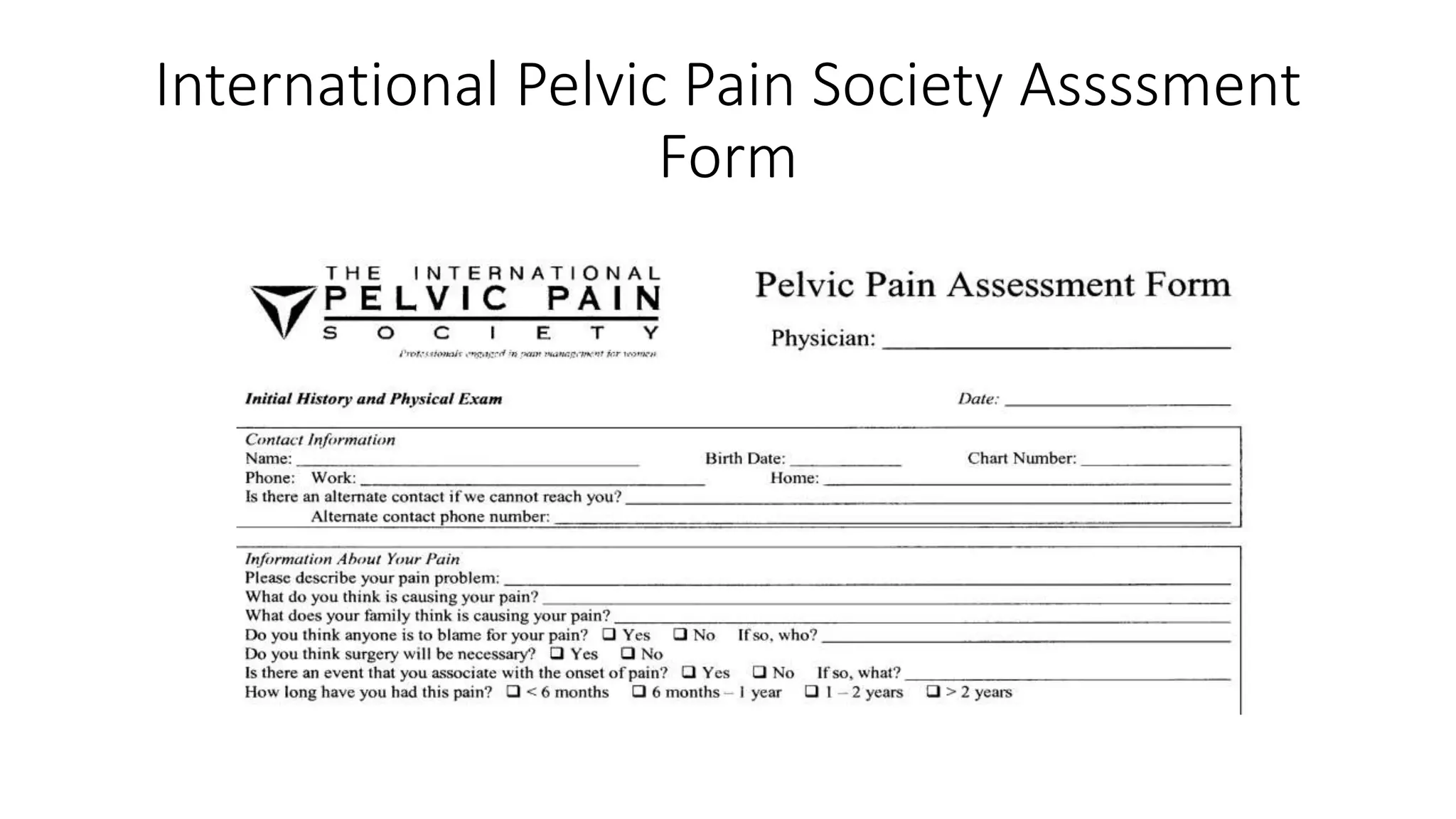
Pain diary
Completing a daily pain diary for 2-3 menstrual cycles may help the woman and
the doctor identify provoking factors or temporal associations
International Pelvic Pain Society Assssment
Form
1. New pain after the menopause
2. New bowel symptoms over 50
years of age
3. Excessive weight loss
4. Bleeding per rectum
5. Irregular vaginal bleeding over 40
years of age
6. Postcoital bleeding
7. Pelvic mass
8. Suicidal ideation
These need further investigation and referral to a specialist
Step III: Exclude
Step IV: Refer
If the history suggests to the woman and doctor that there is a
specific non-gynaecological component to the pain.
Refer to the relevant healthcare professional
( GE, GU, Physician, physiotherapist, psychologist)
Examination
• Done when there is time to explore the woman’s fears &anxieties.
• The examiner should be prepared for new information to be
exposed at this point.
• Includes
• Abdominal examination: focal tenderness, enlargement, distortion or
tethering
• Pelvic examination: prolapse.
• Highly localised trigger points may be identified in the abdominal wall and/or
pelvic floor.
• The sacroiliac joints or the symphysis pubis may also be tender, suggestive of
a musculoskeletal origin to the pain.
Patient Evaluation for
Bladder Tenderness
• Suprapubic
tenderness
• Anterior vaginal wall/
bladder base
tenderness
• Levator muscle spasm
• Rectal spasm
Howard FM, Perry CP, Carter JE, El-Minawi AM. Pelvic Pain: Diagnosis and Management. Lippincott. 2000:35-39.
X
Physical Examination: Pelvic
• Traditional bimanual
examination is the last
portion of the pelvic
examination
• Uterus
• Adnexa
• Anorectum
• Many layers palpated;
non-specific findings likely
Investigations
I. Laboratory:
Screening for infection: Suitable samples to screen for infection, esp Ch
trachomatis and gonorrhoea, should be taken if there is any suspicion
of PID.
• Persistently or frequently (more
than 12 times per month) – bloating,
early satiety, pelvic pain or urinary
urgency or frequency
• Any new IBS symptoms > 50 years.
II. Transvaginal scanning
(TVS) and MRI
• TVS is an appropriate investigation to
identify and assess adnexal masses.
• TVS and MRI are useful tests to diagnose
adenomyosis.
• The role of MRI in diagnosing small
deposits of endometriosis is uncertain.
III. Diagnostic laparoscopy
• A second line investigation if other therapeutic
lines fail.
• It is the only test capable of Dx peritoneal
endometriosis and adhesions.
• It may have a role in developing the woman’s
beliefs about her pain.
• 1/3-1/2 of DL will be negative and much of the
pathology identified is not necessarily the cause of
pain.
• Many women may feel disappointed that no
diagnosis has been made
Severe PID
and
adhesions
Severe
adhesions
Appendicitis
Chronic PID
Severe Pelvic
Endometriosis
Subtle
Endometriosis
Endometriosis
on bowel
surfaces
Endometriosis
on Appendix
IV. Microlaparoscopy or ‘conscious pain
mapping
• It is proposed as an
alternative to diagnostic
laparoscopy
• Not widely adopted.
• Questionable.
Management
Multidisciplinary
Cardinal Principles of Pain
Management
• Believe the Patient.
• Setup Appropriate Diagnostic Studies.
• Identify All Pain Generators.
• Have Realistic Goals.
• Explain the Reasons for Complexity.
• Institute Adequate Pain Relief.
The Golden Rules
1. Women should be offered appropriate analgesia.
2. Women with cyclical pain should be offered a therapeutic trial using hormonal
treatment for a period of 3–6 months before having a diagnostic laparoscopy.
3. Women with IBS should be offered a trial with antispasmodics.
4. Women with IBS should be encouraged to amend their diet to attempt to control
symptoms.
5. If pain is not adequately controlled, consideration should be given to referral to a
specialist pelvic pain clinic.
Approach to endometriosis-associated pain
Continuous low-dose monophasic oral contraceptive with NSAIDs as needed
Progestins (start with oral dosing, consider switching to levonorgestrel
intrauterine device or depo if well tolerated)
GnRH agonist with immediate add-back therapy
Repeat surgery, followed by 1, 2, or 3
Final Message
• Most providers focus on diagnosing and curing the patients condition as the primary goal.
• Focusing on empathic communication may make a meaningful difference to meeting the
CPP patients’ needs and strengthening the provider/ patient relationship.
• Please, providers should focus on actively listening to patients, providing a caring
attitude, spending adequate time and sharing the patient in the plan as keys to improving
care of women with CPP.
Chronic pelvic pain

Chronic pelvic pain

  • 1.
    Chronic Pelvic Pain. Howto assess and manage? Dr/ Mahmoud Abdel-Aleem Professor of obstetrics and Gynecology, Faculty of medicine, Assiut University.
  • 2.
    Objectives Review basics andupdates in the assessment and management of chronic pelvic pain in women
  • 3.
  • 4.
    • It isa symptom not a diagnosis • Nature: Intermittent or constant pain • Site: lower abdomen or pelvis, lumbosacral back, buttocks of a woman • Duration: at least 6 months. • NOT: • Occurring exclusively with menstruation or intercourse • Associated with pregnancy. • Severity: sufficient to cause functional disability or lead to medical care. • It presents in primary care as frequently as migraine or low-back pain. • May significantly impact on a woman’s ability to function.
  • 5.
    38 21 37 41 10 20 30 40 50 60 70 80 90 100 PrevalenceRateper1,000 Women Prevalence of CPPis Comparable to Other Common Medical Problems • Cross-sectional analysis by UK Mediplus Primary Care database. CPP Migraine Asthma Back Pain Zondervan KT et al. Br J Obstet Gynaecol. 1999:106;1149-1155. N=24,053
  • 6.
    • Living withany chronic pain carries a heavy economic and social burden. • Direct outpatient medical costs for CPP: • $881.5 million/year1 • Total annual direct costs $2.8 billion/year • 15% of women with CPP missed >1 hr paid work/month • Cost of work time lost for CPP $555.3 million/year • Aiming for accurate diagnosis and effective management from the first presentation reduces the disruption of the woman’s life and may avoid an endless succession of referrals, investigations and operations.
  • 7.
    What is pain? •Pain is, a sensory and emotional experience associated with actual or potential tissue damage. • The experience of pain is affected by physical, psychological and social factors. • The woman is often aware of these influences but may choose not to discuss them, fearing that her pain will be dismissed as psychological or that non-gynaecological symptoms will be considered irrelevant.
  • 8.
    Types of pain Nociceptive Associatedwith tissue damage or inflammation, so it is also called ‘inflammatory pain’. Neuropathic Due to a lesion to peripheral or central nervous systems. Many pains will have a mixed neuropathic and nociceptive aetiology
  • 9.
  • 10.
  • 11.
  • 12.
    I. Endometriosis andadenomyosis • Pelvic pain which varies markedly over the menstrual cycle is likely to be attributable to a hormonally driven condition such as endometriosis. • Laparoscopy or laparotomy, the combination of clinical examination and transvaginal ultrasound accurately identifies ovarian but not peritoneal endometriosis.
  • 13.
    II. Pelvic venouscongestion • NOW, it is well-established as a cause of chronic pelvic pain. • No valid test. • Ovarian suppression (progestins and GnRH agonists) is effective in treating pelvic pain symptoms. • Phelobtonics.
  • 16.
    III. Adhesions • Adhesionsmay be caused by endometriosis, previous surgery or previous infection. • Fine adhesions: there is no evidence to support the division of fine adhesions in women with chronic pelvic pain. • Dense vascular adhesion: beneficial as this is associated with pain relief.
  • 17.
    Two distinct formsof adhesive disease: Residual ovary syndrome • A small amount of ovarian tissue inadvertently left behind following oophorectomy which may become buried in adhesions). Trapped ovary syndrome • A retained ovary becomes buried in dense adhesions post- hysterectomy). Removal of all ovarian tissue or suppression using a GnRH analogue may relieve pain.
  • 18.
    IV. IBS andinterstitial cystitis • Symptoms suggestive of IBS or interstitial cystitis are often present in women with chronic pelvic pain. • These conditions may be • A primary cause of chronic pelvic pain. • A component of chronic pelvic pain. • A secondary effect caused by efferent neurological dysfunction in the presence of chronic pain
  • 19.
    V. Musculoskeletal • Maybe a primary source of pelvic pain or an additional component resulting from postural changes. • Source: • Joints in the pelvis. • Damage to the muscles in the abdominal wall or pelvic floor. • Pelvic organ prolapse. • Trigger points: • Localised areas of deep tenderness in a tight band of muscle. • It may relate to chronic contraction of the muscle, with the stimulus coming from misalignment of the pelvis or a discrete pain such as endometriosis. • The pain from a trigger point may then become self-perpetuating.
  • 20.
    VI. Nerve entrapment •Nerve entrapment in scar tissue, fascia or a narrow foramen may result in pain and dysfunction in the distribution of that nerve. • Pain is (highly localised, sharp, stabbing or aching pain, exacerbated by particular movements, and persisting beyond 5 weeks or occurring after a pain-free interval). • The incidence of nerve entrapment after one Pfannenstiel incision is 3.7%.
  • 21.
    VII. Psychological andsocial issues • Enquiry should be made regarding psychological and social issues which commonly occur in association with chronic pelvic pain. • Depression and sleep disorders are consequences rather than causes of the pain.
  • 22.
  • 23.
    The Golden Rules Time: Adequatetime should be allowed for the initial assessment of women with CPP. Style: Women need to feel that they have been able to tell their story and that they have been listened to and believed. Value: These ideas should be discussed in the initial consultation.
  • 24.
    The Golden Rules Scrutiny: toreveal factors that may be contributing to the pain. Patience:aAt the initial assessment, it may not be possible to identify the cause of the pain. Comprehensiveness: assessment should aim to identify contributory factors rather than assign causality to a single pathology.
  • 25.
    The Golden Rules Caution: thecommon and unusual and the rare. Partnership: encourage women to talk about their symptoms and ideas, allowing them to influence and shape the doctor–patient relationship. Sympathy: it is important not to leave the woman with the feeling that nothing more can be done to help her.
  • 26.
    Step I: InitialHistory The pattern. 1 Association with problems, as psychological, bladder and bowel symptoms. 2 Effect of movement and posture on the pain. 3 Effect of pain on work and activities ( A good monitor). 4 Therapeutic History: previous drugs, effect. 5
  • 27.
    Step II: Pain diary Completinga daily pain diary for 2-3 menstrual cycles may help the woman and the doctor identify provoking factors or temporal associations
  • 28.
    International Pelvic PainSociety Assssment Form
  • 29.
    1. New painafter the menopause 2. New bowel symptoms over 50 years of age 3. Excessive weight loss 4. Bleeding per rectum 5. Irregular vaginal bleeding over 40 years of age 6. Postcoital bleeding 7. Pelvic mass 8. Suicidal ideation These need further investigation and referral to a specialist Step III: Exclude
  • 30.
    Step IV: Refer Ifthe history suggests to the woman and doctor that there is a specific non-gynaecological component to the pain. Refer to the relevant healthcare professional ( GE, GU, Physician, physiotherapist, psychologist)
  • 31.
    Examination • Done whenthere is time to explore the woman’s fears &anxieties. • The examiner should be prepared for new information to be exposed at this point. • Includes • Abdominal examination: focal tenderness, enlargement, distortion or tethering • Pelvic examination: prolapse. • Highly localised trigger points may be identified in the abdominal wall and/or pelvic floor. • The sacroiliac joints or the symphysis pubis may also be tender, suggestive of a musculoskeletal origin to the pain.
  • 32.
    Patient Evaluation for BladderTenderness • Suprapubic tenderness • Anterior vaginal wall/ bladder base tenderness • Levator muscle spasm • Rectal spasm Howard FM, Perry CP, Carter JE, El-Minawi AM. Pelvic Pain: Diagnosis and Management. Lippincott. 2000:35-39. X
  • 33.
    Physical Examination: Pelvic •Traditional bimanual examination is the last portion of the pelvic examination • Uterus • Adnexa • Anorectum • Many layers palpated; non-specific findings likely
  • 34.
    Investigations I. Laboratory: Screening forinfection: Suitable samples to screen for infection, esp Ch trachomatis and gonorrhoea, should be taken if there is any suspicion of PID.
  • 35.
    • Persistently orfrequently (more than 12 times per month) – bloating, early satiety, pelvic pain or urinary urgency or frequency • Any new IBS symptoms > 50 years.
  • 36.
    II. Transvaginal scanning (TVS)and MRI • TVS is an appropriate investigation to identify and assess adnexal masses. • TVS and MRI are useful tests to diagnose adenomyosis. • The role of MRI in diagnosing small deposits of endometriosis is uncertain.
  • 37.
    III. Diagnostic laparoscopy •A second line investigation if other therapeutic lines fail. • It is the only test capable of Dx peritoneal endometriosis and adhesions. • It may have a role in developing the woman’s beliefs about her pain. • 1/3-1/2 of DL will be negative and much of the pathology identified is not necessarily the cause of pain. • Many women may feel disappointed that no diagnosis has been made
  • 38.
  • 39.
  • 40.
  • 41.
  • 42.
  • 43.
  • 44.
  • 45.
  • 46.
    IV. Microlaparoscopy or‘conscious pain mapping • It is proposed as an alternative to diagnostic laparoscopy • Not widely adopted. • Questionable.
  • 47.
  • 48.
    Cardinal Principles ofPain Management • Believe the Patient. • Setup Appropriate Diagnostic Studies. • Identify All Pain Generators. • Have Realistic Goals. • Explain the Reasons for Complexity. • Institute Adequate Pain Relief.
  • 49.
    The Golden Rules 1.Women should be offered appropriate analgesia. 2. Women with cyclical pain should be offered a therapeutic trial using hormonal treatment for a period of 3–6 months before having a diagnostic laparoscopy. 3. Women with IBS should be offered a trial with antispasmodics. 4. Women with IBS should be encouraged to amend their diet to attempt to control symptoms. 5. If pain is not adequately controlled, consideration should be given to referral to a specialist pelvic pain clinic.
  • 50.
    Approach to endometriosis-associatedpain Continuous low-dose monophasic oral contraceptive with NSAIDs as needed Progestins (start with oral dosing, consider switching to levonorgestrel intrauterine device or depo if well tolerated) GnRH agonist with immediate add-back therapy Repeat surgery, followed by 1, 2, or 3
  • 51.
    Final Message • Mostproviders focus on diagnosing and curing the patients condition as the primary goal. • Focusing on empathic communication may make a meaningful difference to meeting the CPP patients’ needs and strengthening the provider/ patient relationship. • Please, providers should focus on actively listening to patients, providing a caring attitude, spending adequate time and sharing the patient in the plan as keys to improving care of women with CPP.