Chronic pelvic pain
Undergraduate
Dr/ Ahmed Walid Anwar Morad
Assistant professor of OB/GYN
Benha University
2017
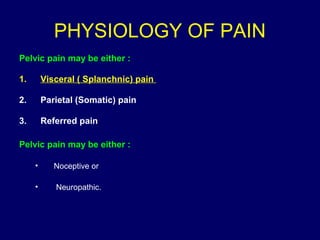
PHYSIOLOGY OF PAIN
Pelvic pain may be either :
1. Visceral ( Splanchnic) pain
2. Parietal (Somatic) pain
3. Referred pain
Pelvic pain may be either :
• Noceptive or
• Neuropathic.
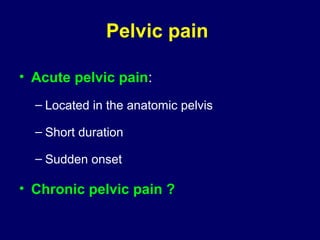
Pelvic pain
• Acute pelvic pain:
– Located in the anatomic pelvis
– Short duration
– Sudden onset
• Chronic pelvic pain ?
Chronic pelvic pain
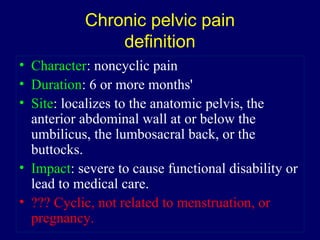
definition
• Character: noncyclic pain
• Duration: 6 or more months'
• Site: localizes to the anatomic pelvis, the
anterior abdominal wall at or below the
umbilicus, the lumbosacral back, or the
buttocks.
• Impact: severe to cause functional disability or
lead to medical care.
• ??? Cyclic, not related to menstruation, or
pregnancy.
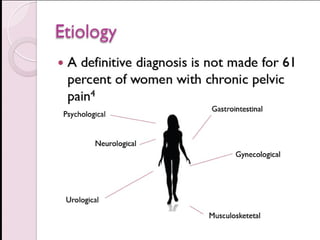
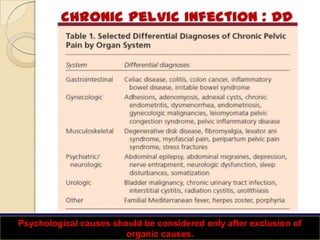
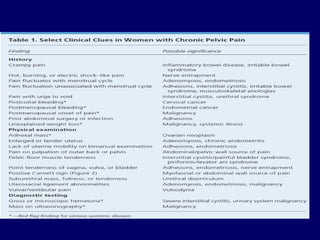
Causes of chronic pelvic pain
Psychological causes should be considered only after exclusion of
organic causes.
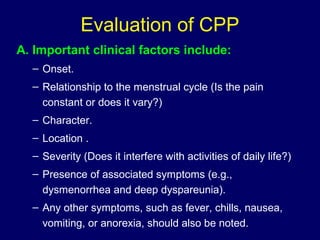
Evaluation of CPP
A. Important clinical factors include:
– Onset.
– Relationship to the menstrual cycle (Is the pain
constant or does it vary?)
– Character.
– Location .
– Severity (Does it interfere with activities of daily life?)
– Presence of associated symptoms (e.g.,
dysmenorrhea and deep dyspareunia).
– Any other symptoms, such as fever, chills, nausea,
vomiting, or anorexia, should also be noted.
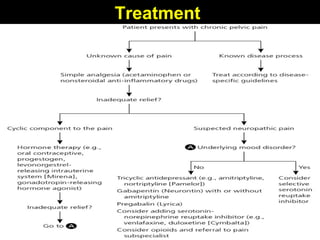
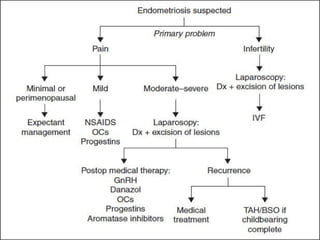
Treatment
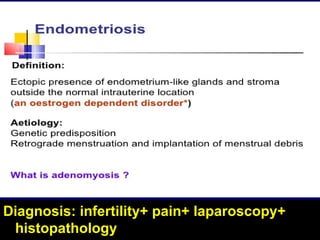
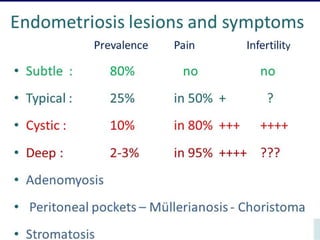
Diagnosis: infertility+ pain+ laparoscopy+
histopathology
• Residual ovary syndrome
– Def: symptoms from ovaries that are left at
time of hysterectomy.
– Symptoms:
• Commonest : CPP & Dyspareunia
• Less common: asymptomatic pelvic mass.
• Remnant ovary syndrome
– Def: symptoms from ovarian tissuescould not
removed at time of hysterectomy due to adhesion
or malignancy.
– Symptoms: CPP ,Dyspareunia & pelvic mass
– Investigations: premenopusal FSH, US, CT
– TTT: Excision.
• Neuropathic pain is pain caused by damage or
disease affecting the somatosensory nervous system.
[1] Neuropathic pain may be associated with
abnormal sensations called dysesthesia or pain from
normally non-painful stimuli (allodynia).
• Neuropathic pain may result from disorders of the
peripheral nervous system or the central nervous
system (brain and spinal cord). Thus, neuropathic
pain may be divided into peripheral neuropathic pain,
central neuropathic pain, or mixed (peripheral and
central) neuropathic pain.
Thank You
Any Questions or
Comments?

Chronic pelvic pain

  • 1.
    Chronic pelvic pain Undergraduate Dr/Ahmed Walid Anwar Morad Assistant professor of OB/GYN Benha University 2017
  • 3.
    PHYSIOLOGY OF PAIN Pelvicpain may be either : 1. Visceral ( Splanchnic) pain 2. Parietal (Somatic) pain 3. Referred pain Pelvic pain may be either : • Noceptive or • Neuropathic.
  • 4.
    Pelvic pain • Acutepelvic pain: – Located in the anatomic pelvis – Short duration – Sudden onset • Chronic pelvic pain ?
  • 5.
    Chronic pelvic pain definition •Character: noncyclic pain • Duration: 6 or more months' • Site: localizes to the anatomic pelvis, the anterior abdominal wall at or below the umbilicus, the lumbosacral back, or the buttocks. • Impact: severe to cause functional disability or lead to medical care. • ??? Cyclic, not related to menstruation, or pregnancy.
  • 9.
    Causes of chronicpelvic pain Psychological causes should be considered only after exclusion of organic causes.
  • 11.
    Evaluation of CPP A.Important clinical factors include: – Onset. – Relationship to the menstrual cycle (Is the pain constant or does it vary?) – Character. – Location . – Severity (Does it interfere with activities of daily life?) – Presence of associated symptoms (e.g., dysmenorrhea and deep dyspareunia). – Any other symptoms, such as fever, chills, nausea, vomiting, or anorexia, should also be noted.
  • 15.
  • 16.
    Diagnosis: infertility+ pain+laparoscopy+ histopathology
  • 21.
    • Residual ovarysyndrome – Def: symptoms from ovaries that are left at time of hysterectomy. – Symptoms: • Commonest : CPP & Dyspareunia • Less common: asymptomatic pelvic mass. • Remnant ovary syndrome – Def: symptoms from ovarian tissuescould not removed at time of hysterectomy due to adhesion or malignancy. – Symptoms: CPP ,Dyspareunia & pelvic mass – Investigations: premenopusal FSH, US, CT – TTT: Excision.
  • 22.
    • Neuropathic painis pain caused by damage or disease affecting the somatosensory nervous system. [1] Neuropathic pain may be associated with abnormal sensations called dysesthesia or pain from normally non-painful stimuli (allodynia). • Neuropathic pain may result from disorders of the peripheral nervous system or the central nervous system (brain and spinal cord). Thus, neuropathic pain may be divided into peripheral neuropathic pain, central neuropathic pain, or mixed (peripheral and central) neuropathic pain.
  • 23.