Dr. Shanjida Sultana Juthy
HMO
MU-1
ShSMCH.
INTRODUCTION
 The Kidney Disease Improving Global Outcomes (KDIGO) 2012
Clinical Practice Guideline for the Evaluation and Management of
Chronic Kidney Disease (CKD) serves to update the 2002 KDOQI
Clinical Practice Guideline includes definition, an enhanced
classification frame work.
 It also elaborates on the identification and prognosis of CKD;
management of progression and complications and expands on
the continuum of CKD care: timing of specialist referral, timing
of the initiation of dialysis, and finally the implementation of a
treatment program which includes comprehensive conservative
management.
Definition Of CKD
 CKD is defined as abnormalities of kidney structure or
function, present for>3 months, with implications for
health .
 CKD is classified based on cause, GFR category, and
albuminuria category (CGA).
Criteria For CKD (Either Of The Following
Present For >3 Months)
 Markers of kidney damage (one or more)
- Albuminuria (AER <30 mg/24 hours; ACR <30 mg/g [<3
mg/mmol])
-Urine sediment abnormalities
-Electrolyte and other abnormalities due to tubular
disorders
-Abnormalities detected by histology
-Structural abnormalities detected by imaging
-History of kidney transplantation
 Decreased GFR
GFR <60 ml/min/1.73 m2
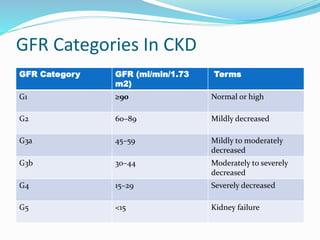
GFR Categories In CKD
GFR Category GFR (ml/min/1.73
m2)
Terms
G1 ≥90 Normal or high
G2 60–89 Mildly decreased
G3a 45–59 Mildly to moderately
decreased
G3b 30–44 Moderately to severely
decreased
G4 15–29 Severely decreased
G5 <15 Kidney failure
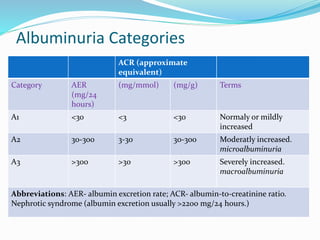
Albuminuria Categories
ACR (approximate
equivalent)
Category AER
(mg/24
hours)
(mg/mmol) (mg/g) Terms
A1 <30 <3 <30 Normaly or mildly
increased
A2 30-300 3-30 30-300 Moderatly increased.
microalbuminuria
A3 >300 >30 >300 Severely increased.
macroalbuminuria
Abbreviations: AER- albumin excretion rate; ACR- albumin-to-creatinine ratio.
Nephrotic syndrome (albumin excretion usually >2200 mg/24 hours.)
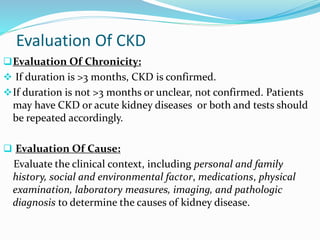
Evaluation Of CKD
Evaluation Of Chronicity:
 If duration is >3 months, CKD is confirmed.
If duration is not >3 months or unclear, not confirmed. Patients
may have CKD or acute kidney diseases or both and tests should
be repeated accordingly.
 Evaluation Of Cause:
Evaluate the clinical context, including personal and family
history, social and environmental factor, medications, physical
examination, laboratory measures, imaging, and pathologic
diagnosis to determine the causes of kidney disease.
Contd.
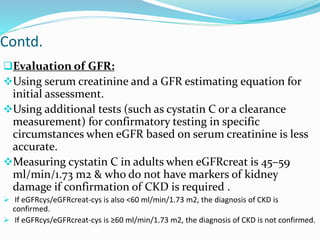
Evaluation of GFR:
Using serum creatinine and a GFR estimating equation for
initial assessment.
Using additional tests (such as cystatin C or a clearance
measurement) for confirmatory testing in specific
circumstances when eGFR based on serum creatinine is less
accurate.
Measuring cystatin C in adults when eGFRcreat is 45–59
ml/min/1.73 m2 & who do not have markers of kidney
damage if confirmation of CKD is required .
 If eGFRcys/eGFRcreat-cys is also <60 ml/min/1.73 m2, the diagnosis of CKD is
confirmed.
 If eGFRcys/eGFRcreat-cys is ≥60 ml/min/1.73 m2, the diagnosis of CKD is not confirmed.
Contd.
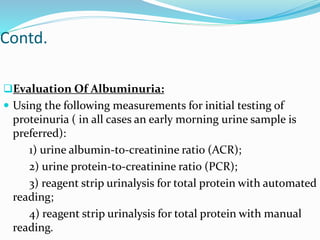
Evaluation Of Albuminuria:
 Using the following measurements for initial testing of
proteinuria ( in all cases an early morning urine sample is
preferred):
1) urine albumin-to-creatinine ratio (ACR);
2) urine protein-to-creatinine ratio (PCR);
3) reagent strip urinalysis for total protein with automated
reading;
4) reagent strip urinalysis for total protein with manual
reading.
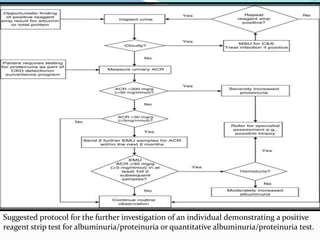
Suggested protocol for the further investigation of an individual demonstrating a positive
reagent strip test for albuminuria/proteinuria or quantitative albuminuria/proteinuria test.
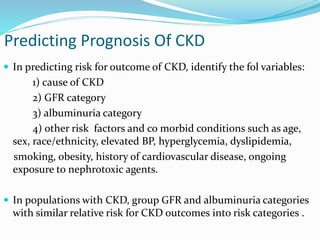
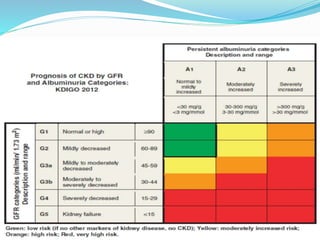
Predicting Prognosis Of CKD
 In predicting risk for outcome of CKD, identify the fol variables:
1) cause of CKD
2) GFR category
3) albuminuria category
4) other risk factors and co morbid conditions such as age,
sex, race/ethnicity, elevated BP, hyperglycemia, dyslipidemia,
smoking, obesity, history of cardiovascular disease, ongoing
exposure to nephrotoxic agents.
 In populations with CKD, group GFR and albuminuria categories
with similar relative risk for CKD outcomes into risk categories .
Definition And Identification Of CKD
Progression
 CKD Progression based on one of more of the following :
1) Decline in GFR category . A certain drop in eGFR is
defined as a drop in GFR category accompanied by a 25% or
greater drop in eGFR from baseline.
2) Rapid progression is defined as a sustained decline in
eGFR of more than 5 ml/min/1.73 m2/yr.
3) The confidence in assessing progression is increased with
increasing number of serum creatinine measurements and
duration of follow-up.
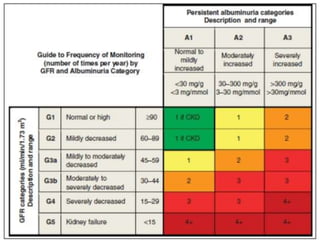
Contd.
 Assess GFR and albuminuria at least annually in people with
CKD.
 Assess GFR and albuminuria more often for individuals at
higher risk of progression or where measurement will impact
therapeutic decisions
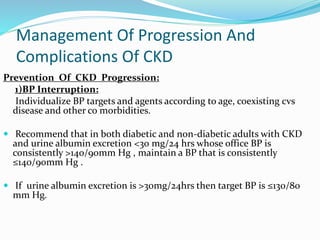
Management Of Progression And
Complications Of CKD
Prevention Of CKD Progression:
1)BP Interruption:
Individualize BP targets and agents according to age, coexisting cvs
disease and other co morbidities.
 Recommend that in both diabetic and non-diabetic adults with CKD
and urine albumin excretion <30 mg/24 hrs whose office BP is
consistently >140/90mm Hg , maintain a BP that is consistently
≤140/90mm Hg .
 If urine albumin excretion is >30mg/24hrs then target BP is ≤130/80
mm Hg.
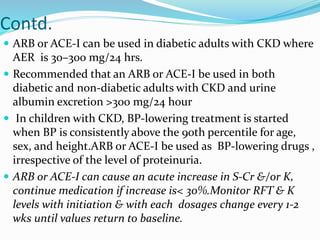
Contd.
 ARB or ACE-I can be used in diabetic adults with CKD where
AER is 30–300 mg/24 hrs.
 Recommended that an ARB or ACE-I be used in both
diabetic and non-diabetic adults with CKD and urine
albumin excretion >300 mg/24 hour
 In children with CKD, BP-lowering treatment is started
when BP is consistently above the 90th percentile for age,
sex, and height.ARB or ACE-I be used as BP-lowering drugs ,
irrespective of the level of proteinuria.
 ARB or ACE-I can cause an acute increase in S-Cr &/or K,
continue medication if increase is< 30%.Monitor RFT & K
levels with initiation & with each dosages change every 1-2
wks until values return to baseline.
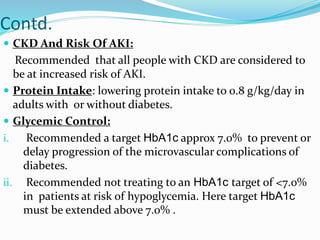
Contd.
 CKD And Risk Of AKI:
Recommended that all people with CKD are considered to
be at increased risk of AKI.
 Protein Intake: lowering protein intake to 0.8 g/kg/day in
adults with or without diabetes.
 Glycemic Control:
i. Recommended a target HbA1c approx 7.0% to prevent or
delay progression of the microvascular complications of
diabetes.
ii. Recommended not treating to an HbA1c target of <7.0%
in patients at risk of hypoglycemia. Here target HbA1c
must be extended above 7.0% .
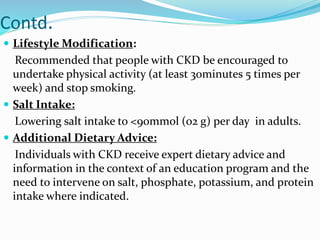
Contd.
 Lifestyle Modification:
Recommended that people with CKD be encouraged to
undertake physical activity (at least 30minutes 5 times per
week) and stop smoking.
 Salt Intake:
Lowering salt intake to <90mmol (o2 g) per day in adults.
 Additional Dietary Advice:
Individuals with CKD receive expert dietary advice and
information in the context of an education program and the
need to intervene on salt, phosphate, potassium, and protein
intake where indicated.
Complications Associated With Loss Of
Kidney Function
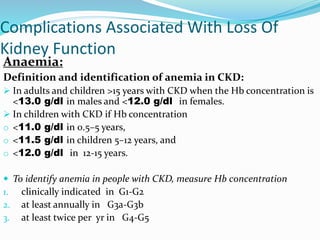
Anaemia:
Definition and identification of anemia in CKD:
 In adults and children >15 years with CKD when the Hb concentration is
<13.0 g/dl in males and <12.0 g/dl in females.
 In children with CKD if Hb concentration
o <11.0 g/dl in 0.5–5 years,
o <11.5 g/dl in children 5–12 years, and
o <12.0 g/dl in 12-15 years.
 To identify anemia in people with CKD, measure Hb concentration
1. clinically indicated in G1-G2
2. at least annually in G3a-G3b
3. at least twice per yr in G4-G5
Contd.
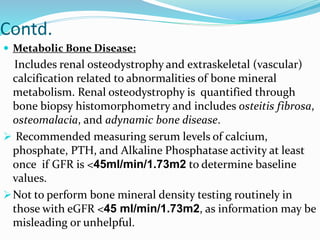
 Metabolic Bone Disease:
Includes renal osteodystrophy and extraskeletal (vascular)
calcification related to abnormalities of bone mineral
metabolism. Renal osteodystrophy is quantified through
bone biopsy histomorphometry and includes osteitis fibrosa,
osteomalacia, and adynamic bone disease.
 Recommended measuring serum levels of calcium,
phosphate, PTH, and Alkaline Phosphatase activity at least
once if GFR is <45ml/min/1.73m2 to determine baseline
values.
Not to perform bone mineral density testing routinely in
those with eGFR <45 ml/min/1.73m2, as information may be
misleading or unhelpful.
Contd.
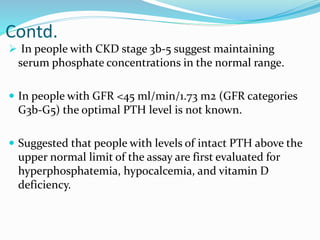
 In people with CKD stage 3b-5 suggest maintaining
serum phosphate concentrations in the normal range.
 In people with GFR <45 ml/min/1.73 m2 (GFR categories
G3b-G5) the optimal PTH level is not known.
 Suggested that people with levels of intact PTH above the
upper normal limit of the assay are first evaluated for
hyperphosphatemia, hypocalcemia, and vitamin D
deficiency.
Contd.
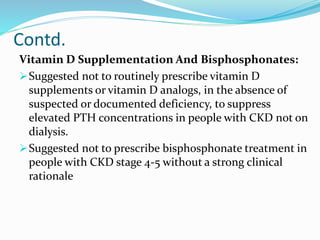
Vitamin D Supplementation And Bisphosphonates:
Suggested not to routinely prescribe vitamin D
supplements or vitamin D analogs, in the absence of
suspected or documented deficiency, to suppress
elevated PTH concentrations in people with CKD not on
dialysis.
Suggested not to prescribe bisphosphonate treatment in
people with CKD stage 4-5 without a strong clinical
rationale
Contd.
Acidosis: declining renal function is assosiated with metabolic
acidosis .
 In people with CKD and serum bicarbonate conc. <22 mmol/l
treatment with oral bicarbonate supplementation to maintain
bicarbonate within the normal range.
Risk of CVD:
 Recommended that all people with CKD should be considered at
increased risk for CVS disease.
 Suggested that adults with CKD at risk for atherosclerotic events
should get treatment with antiplatelet agents unless there is an
increased bleeding risk .
.
Condt.
 CKD And Risk Of Infections:
Recommended that all adults with CKD are offered annual
vaccination with influenza vaccine.
 Adults with GFR categories G4-G5 and at high risk of
pneumococcal infection receive polyvalent pneumococcal
vaccine and revaccination within 5 yrs.
 All adults who are at high risk of progression of CKD should
be immunized against hep B .
 Consideration of live vaccine should include an appreciation
of the patient’s immune status and should be in line with
recommendations from official or governmental bodies.
Contd.
Risk factors for infection in people with CKD:
1) Advanced age
2)High burden of coexisting illnesses such as DM
3) Hypoalbuminemia
4)Immunosuppressive therapy
5)Nephrotic syndrome
6)Uremia
7)Anemia and malnutrition
8)High prevalence of functional disabilities
Contd.
Drug Toxicity: Altered pharmacokinetics of drugs excreted
by the kidney and an increased risk of drug-interactions are
common and require adjustment in the dosage of many
drugs.
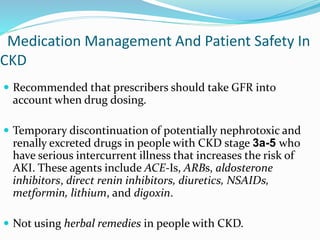
Medication Management And Patient Safety In
CKD
 Recommended that prescribers should take GFR into
account when drug dosing.
 Temporary discontinuation of potentially nephrotoxic and
renally excreted drugs in people with CKD stage 3a-5 who
have serious intercurrent illness that increases the risk of
AKI. These agents include ACE-Is, ARBs, aldosterone
inhibitors, direct renin inhibitors, diuretics, NSAIDs,
metformin, lithium, and digoxin.
 Not using herbal remedies in people with CKD.
Contd.
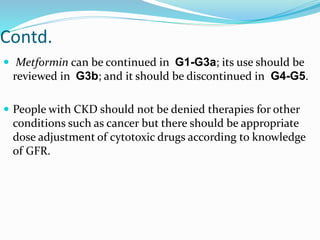
 Metformin can be continued in G1-G3a; its use should be
reviewed in G3b; and it should be discontinued in G4-G5.
 People with CKD should not be denied therapies for other
conditions such as cancer but there should be appropriate
dose adjustment of cytotoxic drugs according to knowledge
of GFR.
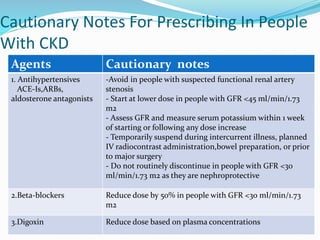
Cautionary Notes For Prescribing In People
With CKD
Agents Cautionary notes
1. Antihypertensives
ACE-Is,ARBs,
aldosterone antagonists
-Avoid in people with suspected functional renal artery
stenosis
- Start at lower dose in people with GFR <45 ml/min/1.73
m2
- Assess GFR and measure serum potassium within 1 week
of starting or following any dose increase
- Temporarily suspend during intercurrent illness, planned
IV radiocontrast administration,bowel preparation, or prior
to major surgery
- Do not routinely discontinue in people with GFR <30
ml/min/1.73 m2 as they are nephroprotective
2.Beta-blockers Reduce dose by 50% in people with GFR <30 ml/min/1.73
m2
3.Digoxin Reduce dose based on plasma concentrations
Condt.
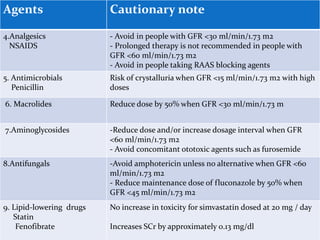
Agents Cauti0nary note
4.Analgesics
NSAIDS
- Avoid in people with GFR <30 ml/min/1.73 m2
- Prolonged therapy is not recommended in people with
GFR <60 ml/min/1.73 m2
- Avoid in people taking RAAS blocking agents
5. Antimicrobials
Penicillin
Risk of crystalluria when GFR <15 ml/min/1.73 m2 with high
doses
6. Macrolides Reduce dose by 50% when GFR <30 ml/min/1.73 m
7.Aminoglycosides -Reduce dose and/or increase dosage interval when GFR
<60 ml/min/1.73 m2
- Avoid concomitant ototoxic agents such as furosemide
8.Antifungals -Avoid amphotericin unless no alternative when GFR <60
ml/min/1.73 m2
- Reduce maintenance dose of fluconazole by 50% when
GFR <45 ml/min/1.73 m2
9. Lipid-lowering drugs
Statin
Fenofibrate
No increase in toxicity for simvastatin dosed at 20 mg / day
Increases SCr by approximately 0.13 mg/dl
Referral To Specialists
KDIGO recommendation is in the following circumstances
1) AKI or abrupt sustained fall in GFR;
2) GFR <30 ml/min/1.73 m2 (GFR categories G4-G5)
3) consistent finding of significant albuminuria (ACR >300
mg/g [>30 mg/mmol]
4) progression of CKD
5)urinary red cell casts, RBC >20 per high power field
sustained and not readily explained
6) CKD and hypertension refractory to treatment with 4 or
more antihypertensive agents
7) persistent abnormalities of serum potassium;
8) recurrent or extensive nephrolithiasis.
9) hereditary kidney disease
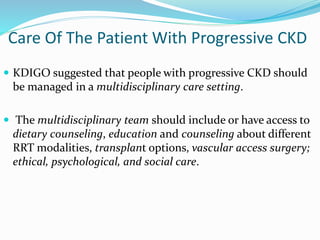
Care Of The Patient With Progressive CKD
 KDIGO suggested that people with progressive CKD should
be managed in a multidisciplinary care setting.
 The multidisciplinary team should include or have access to
dietary counseling, education and counseling about different
RRT modalities, transplant options, vascular access surgery;
ethical, psychological, and social care.
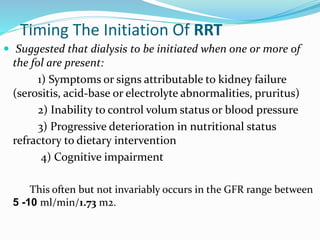
Timing The Initiation Of RRT
 Suggested that dialysis to be initiated when one or more of
the fol are present:
1) Symptoms or signs attributable to kidney failure
(serositis, acid-base or electrolyte abnormalities, pruritus)
2) Inability to control volum status or blood pressure
3) Progressive deterioration in nutritional status
refractory to dietary intervention
4) Cognitive impairment
This often but not invariably occurs in the GFR range between
5 -10 ml/min/1.73 m2.
Contd.
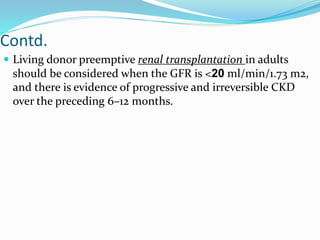
 Living donor preemptive renal transplantation in adults
should be considered when the GFR is <20 ml/min/1.73 m2,
and there is evidence of progressive and irreversible CKD
over the preceding 6–12 months.
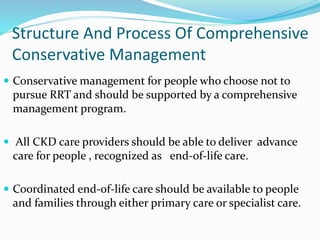
Structure And Process Of Comprehensive
Conservative Management
 Conservative management for people who choose not to
pursue RRT and should be supported by a comprehensive
management program.
 All CKD care providers should be able to deliver advance
care for people , recognized as end-of-life care.
 Coordinated end-of-life care should be available to people
and families through either primary care or specialist care.
Contd.
 This program should include protocols for symptoms and
pain management, psychological care, spiritual care, and
culturally sensitive care for the dying patient and their family
whether at home or in a hospital setting.
Ckd dr. shanjida

Ckd dr. shanjida

  • 2.
    Dr. Shanjida SultanaJuthy HMO MU-1 ShSMCH.
  • 3.
    INTRODUCTION  The KidneyDisease Improving Global Outcomes (KDIGO) 2012 Clinical Practice Guideline for the Evaluation and Management of Chronic Kidney Disease (CKD) serves to update the 2002 KDOQI Clinical Practice Guideline includes definition, an enhanced classification frame work.  It also elaborates on the identification and prognosis of CKD; management of progression and complications and expands on the continuum of CKD care: timing of specialist referral, timing of the initiation of dialysis, and finally the implementation of a treatment program which includes comprehensive conservative management.
  • 4.
    Definition Of CKD CKD is defined as abnormalities of kidney structure or function, present for>3 months, with implications for health .  CKD is classified based on cause, GFR category, and albuminuria category (CGA).
  • 5.
    Criteria For CKD(Either Of The Following Present For >3 Months)  Markers of kidney damage (one or more) - Albuminuria (AER <30 mg/24 hours; ACR <30 mg/g [<3 mg/mmol]) -Urine sediment abnormalities -Electrolyte and other abnormalities due to tubular disorders -Abnormalities detected by histology -Structural abnormalities detected by imaging -History of kidney transplantation  Decreased GFR GFR <60 ml/min/1.73 m2
  • 6.
    GFR Categories InCKD GFR Category GFR (ml/min/1.73 m2) Terms G1 ≥90 Normal or high G2 60–89 Mildly decreased G3a 45–59 Mildly to moderately decreased G3b 30–44 Moderately to severely decreased G4 15–29 Severely decreased G5 <15 Kidney failure
  • 7.
    Albuminuria Categories ACR (approximate equivalent) CategoryAER (mg/24 hours) (mg/mmol) (mg/g) Terms A1 <30 <3 <30 Normaly or mildly increased A2 30-300 3-30 30-300 Moderatly increased. microalbuminuria A3 >300 >30 >300 Severely increased. macroalbuminuria Abbreviations: AER- albumin excretion rate; ACR- albumin-to-creatinine ratio. Nephrotic syndrome (albumin excretion usually >2200 mg/24 hours.)
  • 9.
    Evaluation Of CKD EvaluationOf Chronicity:  If duration is >3 months, CKD is confirmed. If duration is not >3 months or unclear, not confirmed. Patients may have CKD or acute kidney diseases or both and tests should be repeated accordingly.  Evaluation Of Cause: Evaluate the clinical context, including personal and family history, social and environmental factor, medications, physical examination, laboratory measures, imaging, and pathologic diagnosis to determine the causes of kidney disease.
  • 10.
    Contd. Evaluation of GFR: Usingserum creatinine and a GFR estimating equation for initial assessment. Using additional tests (such as cystatin C or a clearance measurement) for confirmatory testing in specific circumstances when eGFR based on serum creatinine is less accurate. Measuring cystatin C in adults when eGFRcreat is 45–59 ml/min/1.73 m2 & who do not have markers of kidney damage if confirmation of CKD is required .  If eGFRcys/eGFRcreat-cys is also <60 ml/min/1.73 m2, the diagnosis of CKD is confirmed.  If eGFRcys/eGFRcreat-cys is ≥60 ml/min/1.73 m2, the diagnosis of CKD is not confirmed.
  • 11.
    Contd. Evaluation Of Albuminuria: Using the following measurements for initial testing of proteinuria ( in all cases an early morning urine sample is preferred): 1) urine albumin-to-creatinine ratio (ACR); 2) urine protein-to-creatinine ratio (PCR); 3) reagent strip urinalysis for total protein with automated reading; 4) reagent strip urinalysis for total protein with manual reading.
  • 12.
    Suggested protocol forthe further investigation of an individual demonstrating a positive reagent strip test for albuminuria/proteinuria or quantitative albuminuria/proteinuria test.
  • 13.
    Predicting Prognosis OfCKD  In predicting risk for outcome of CKD, identify the fol variables: 1) cause of CKD 2) GFR category 3) albuminuria category 4) other risk factors and co morbid conditions such as age, sex, race/ethnicity, elevated BP, hyperglycemia, dyslipidemia, smoking, obesity, history of cardiovascular disease, ongoing exposure to nephrotoxic agents.  In populations with CKD, group GFR and albuminuria categories with similar relative risk for CKD outcomes into risk categories .
  • 15.
    Definition And IdentificationOf CKD Progression  CKD Progression based on one of more of the following : 1) Decline in GFR category . A certain drop in eGFR is defined as a drop in GFR category accompanied by a 25% or greater drop in eGFR from baseline. 2) Rapid progression is defined as a sustained decline in eGFR of more than 5 ml/min/1.73 m2/yr. 3) The confidence in assessing progression is increased with increasing number of serum creatinine measurements and duration of follow-up.
  • 16.
    Contd.  Assess GFRand albuminuria at least annually in people with CKD.  Assess GFR and albuminuria more often for individuals at higher risk of progression or where measurement will impact therapeutic decisions
  • 18.
    Management Of ProgressionAnd Complications Of CKD Prevention Of CKD Progression: 1)BP Interruption: Individualize BP targets and agents according to age, coexisting cvs disease and other co morbidities.  Recommend that in both diabetic and non-diabetic adults with CKD and urine albumin excretion <30 mg/24 hrs whose office BP is consistently >140/90mm Hg , maintain a BP that is consistently ≤140/90mm Hg .  If urine albumin excretion is >30mg/24hrs then target BP is ≤130/80 mm Hg.
  • 19.
    Contd.  ARB orACE-I can be used in diabetic adults with CKD where AER is 30–300 mg/24 hrs.  Recommended that an ARB or ACE-I be used in both diabetic and non-diabetic adults with CKD and urine albumin excretion >300 mg/24 hour  In children with CKD, BP-lowering treatment is started when BP is consistently above the 90th percentile for age, sex, and height.ARB or ACE-I be used as BP-lowering drugs , irrespective of the level of proteinuria.  ARB or ACE-I can cause an acute increase in S-Cr &/or K, continue medication if increase is< 30%.Monitor RFT & K levels with initiation & with each dosages change every 1-2 wks until values return to baseline.
  • 20.
    Contd.  CKD AndRisk Of AKI: Recommended that all people with CKD are considered to be at increased risk of AKI.  Protein Intake: lowering protein intake to 0.8 g/kg/day in adults with or without diabetes.  Glycemic Control: i. Recommended a target HbA1c approx 7.0% to prevent or delay progression of the microvascular complications of diabetes. ii. Recommended not treating to an HbA1c target of <7.0% in patients at risk of hypoglycemia. Here target HbA1c must be extended above 7.0% .
  • 21.
    Contd.  Lifestyle Modification: Recommendedthat people with CKD be encouraged to undertake physical activity (at least 30minutes 5 times per week) and stop smoking.  Salt Intake: Lowering salt intake to <90mmol (o2 g) per day in adults.  Additional Dietary Advice: Individuals with CKD receive expert dietary advice and information in the context of an education program and the need to intervene on salt, phosphate, potassium, and protein intake where indicated.
  • 22.
    Complications Associated WithLoss Of Kidney Function Anaemia: Definition and identification of anemia in CKD:  In adults and children >15 years with CKD when the Hb concentration is <13.0 g/dl in males and <12.0 g/dl in females.  In children with CKD if Hb concentration o <11.0 g/dl in 0.5–5 years, o <11.5 g/dl in children 5–12 years, and o <12.0 g/dl in 12-15 years.  To identify anemia in people with CKD, measure Hb concentration 1. clinically indicated in G1-G2 2. at least annually in G3a-G3b 3. at least twice per yr in G4-G5
  • 23.
    Contd.  Metabolic BoneDisease: Includes renal osteodystrophy and extraskeletal (vascular) calcification related to abnormalities of bone mineral metabolism. Renal osteodystrophy is quantified through bone biopsy histomorphometry and includes osteitis fibrosa, osteomalacia, and adynamic bone disease.  Recommended measuring serum levels of calcium, phosphate, PTH, and Alkaline Phosphatase activity at least once if GFR is <45ml/min/1.73m2 to determine baseline values. Not to perform bone mineral density testing routinely in those with eGFR <45 ml/min/1.73m2, as information may be misleading or unhelpful.
  • 24.
    Contd.  In peoplewith CKD stage 3b-5 suggest maintaining serum phosphate concentrations in the normal range.  In people with GFR <45 ml/min/1.73 m2 (GFR categories G3b-G5) the optimal PTH level is not known.  Suggested that people with levels of intact PTH above the upper normal limit of the assay are first evaluated for hyperphosphatemia, hypocalcemia, and vitamin D deficiency.
  • 25.
    Contd. Vitamin D SupplementationAnd Bisphosphonates: Suggested not to routinely prescribe vitamin D supplements or vitamin D analogs, in the absence of suspected or documented deficiency, to suppress elevated PTH concentrations in people with CKD not on dialysis. Suggested not to prescribe bisphosphonate treatment in people with CKD stage 4-5 without a strong clinical rationale
  • 26.
    Contd. Acidosis: declining renalfunction is assosiated with metabolic acidosis .  In people with CKD and serum bicarbonate conc. <22 mmol/l treatment with oral bicarbonate supplementation to maintain bicarbonate within the normal range. Risk of CVD:  Recommended that all people with CKD should be considered at increased risk for CVS disease.  Suggested that adults with CKD at risk for atherosclerotic events should get treatment with antiplatelet agents unless there is an increased bleeding risk . .
  • 27.
    Condt.  CKD AndRisk Of Infections: Recommended that all adults with CKD are offered annual vaccination with influenza vaccine.  Adults with GFR categories G4-G5 and at high risk of pneumococcal infection receive polyvalent pneumococcal vaccine and revaccination within 5 yrs.  All adults who are at high risk of progression of CKD should be immunized against hep B .  Consideration of live vaccine should include an appreciation of the patient’s immune status and should be in line with recommendations from official or governmental bodies.
  • 28.
    Contd. Risk factors forinfection in people with CKD: 1) Advanced age 2)High burden of coexisting illnesses such as DM 3) Hypoalbuminemia 4)Immunosuppressive therapy 5)Nephrotic syndrome 6)Uremia 7)Anemia and malnutrition 8)High prevalence of functional disabilities
  • 29.
    Contd. Drug Toxicity: Alteredpharmacokinetics of drugs excreted by the kidney and an increased risk of drug-interactions are common and require adjustment in the dosage of many drugs.
  • 30.
    Medication Management AndPatient Safety In CKD  Recommended that prescribers should take GFR into account when drug dosing.  Temporary discontinuation of potentially nephrotoxic and renally excreted drugs in people with CKD stage 3a-5 who have serious intercurrent illness that increases the risk of AKI. These agents include ACE-Is, ARBs, aldosterone inhibitors, direct renin inhibitors, diuretics, NSAIDs, metformin, lithium, and digoxin.  Not using herbal remedies in people with CKD.
  • 31.
    Contd.  Metformin canbe continued in G1-G3a; its use should be reviewed in G3b; and it should be discontinued in G4-G5.  People with CKD should not be denied therapies for other conditions such as cancer but there should be appropriate dose adjustment of cytotoxic drugs according to knowledge of GFR.
  • 32.
    Cautionary Notes ForPrescribing In People With CKD Agents Cautionary notes 1. Antihypertensives ACE-Is,ARBs, aldosterone antagonists -Avoid in people with suspected functional renal artery stenosis - Start at lower dose in people with GFR <45 ml/min/1.73 m2 - Assess GFR and measure serum potassium within 1 week of starting or following any dose increase - Temporarily suspend during intercurrent illness, planned IV radiocontrast administration,bowel preparation, or prior to major surgery - Do not routinely discontinue in people with GFR <30 ml/min/1.73 m2 as they are nephroprotective 2.Beta-blockers Reduce dose by 50% in people with GFR <30 ml/min/1.73 m2 3.Digoxin Reduce dose based on plasma concentrations
  • 33.
    Condt. Agents Cauti0nary note 4.Analgesics NSAIDS -Avoid in people with GFR <30 ml/min/1.73 m2 - Prolonged therapy is not recommended in people with GFR <60 ml/min/1.73 m2 - Avoid in people taking RAAS blocking agents 5. Antimicrobials Penicillin Risk of crystalluria when GFR <15 ml/min/1.73 m2 with high doses 6. Macrolides Reduce dose by 50% when GFR <30 ml/min/1.73 m 7.Aminoglycosides -Reduce dose and/or increase dosage interval when GFR <60 ml/min/1.73 m2 - Avoid concomitant ototoxic agents such as furosemide 8.Antifungals -Avoid amphotericin unless no alternative when GFR <60 ml/min/1.73 m2 - Reduce maintenance dose of fluconazole by 50% when GFR <45 ml/min/1.73 m2 9. Lipid-lowering drugs Statin Fenofibrate No increase in toxicity for simvastatin dosed at 20 mg / day Increases SCr by approximately 0.13 mg/dl
  • 34.
    Referral To Specialists KDIGOrecommendation is in the following circumstances 1) AKI or abrupt sustained fall in GFR; 2) GFR <30 ml/min/1.73 m2 (GFR categories G4-G5) 3) consistent finding of significant albuminuria (ACR >300 mg/g [>30 mg/mmol] 4) progression of CKD 5)urinary red cell casts, RBC >20 per high power field sustained and not readily explained 6) CKD and hypertension refractory to treatment with 4 or more antihypertensive agents 7) persistent abnormalities of serum potassium; 8) recurrent or extensive nephrolithiasis. 9) hereditary kidney disease
  • 35.
    Care Of ThePatient With Progressive CKD  KDIGO suggested that people with progressive CKD should be managed in a multidisciplinary care setting.  The multidisciplinary team should include or have access to dietary counseling, education and counseling about different RRT modalities, transplant options, vascular access surgery; ethical, psychological, and social care.
  • 36.
    Timing The InitiationOf RRT  Suggested that dialysis to be initiated when one or more of the fol are present: 1) Symptoms or signs attributable to kidney failure (serositis, acid-base or electrolyte abnormalities, pruritus) 2) Inability to control volum status or blood pressure 3) Progressive deterioration in nutritional status refractory to dietary intervention 4) Cognitive impairment This often but not invariably occurs in the GFR range between 5 -10 ml/min/1.73 m2.
  • 37.
    Contd.  Living donorpreemptive renal transplantation in adults should be considered when the GFR is <20 ml/min/1.73 m2, and there is evidence of progressive and irreversible CKD over the preceding 6–12 months.
  • 38.
    Structure And ProcessOf Comprehensive Conservative Management  Conservative management for people who choose not to pursue RRT and should be supported by a comprehensive management program.  All CKD care providers should be able to deliver advance care for people , recognized as end-of-life care.  Coordinated end-of-life care should be available to people and families through either primary care or specialist care.
  • 39.
    Contd.  This programshould include protocols for symptoms and pain management, psychological care, spiritual care, and culturally sensitive care for the dying patient and their family whether at home or in a hospital setting.