Lecture 1(a)
Chromosomal Aberrations
Numerical changes in
chromosomes
Prof. (Dr.) Maneesha Singh
School of Agricultural Sciences,
Shri Guru Ram Rai University, Dehradun, Uttarakhand
Basic definitions
 Chromosomes, DNA and genes
 Karyotype
 Definition of Chromosomal aberrations
 Structural and numerical changes
 Numerical changes
 Euploidy
 Aneuploidy
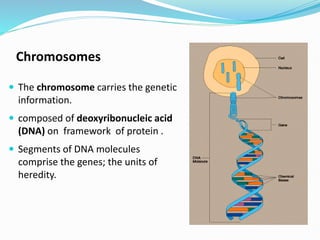
Chromosomes
 The chromosome carries the genetic
information.
 composed of deoxyribonucleic acid
(DNA) on framework of protein .
 Segments of DNA molecules
comprise the genes; the units of
heredity.
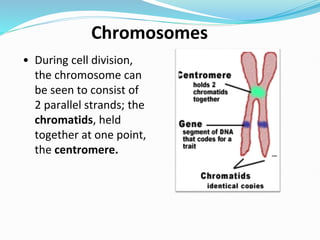
• During cell division,
the chromosome can
be seen to consist of
2 parallel strands; the
chromatids, held
together at one point,
the centromere.
Chromosomes
Karyotype
 It is the set of chromosomes of an individual.
 It is the systematized arrangement of the
chromosomes of a single cell.
 In the human cell, there are 46 chromosomes or 23
pairs (diploid number); of these 23 pairs, 22 are
similar in both sexes and are called the autosomes.
The remaining pair is called sex chromosomes : XX in
the female cells and XY in the male cells .
 Chromosomes are arranged in groups A to G
according to their shape & size.
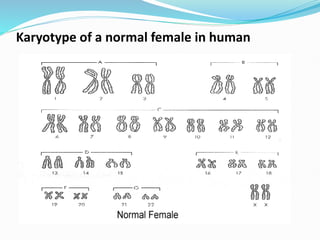
Karyotype of a normal female in human
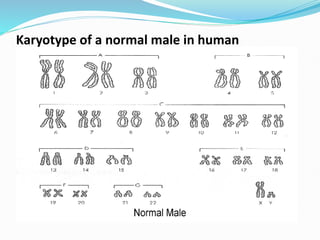
Karyotype of a normal male in human
CHROMOSOMAL ABERRATIONS
 A chromosome aberration, disorder, anomaly,
abnormality, or mutation is a missing, extra, or
irregular portion of chromosomal DNA. OR
 Mutations that cause change in the structure or
number of chromosomes are called chromosomal
aberrations. Generally, the incidence of chromosomal
abnormalities is 5-6 persons/1000.
 Many children with a chromosomal abnormality have
mental or physical birth defects.
HISTORY OF CHROMOSOMAL ABERRATIONS
 In 1959 two discoveries opened a new era of
genetics.
 Jerome Lejeune, Marthe Gautier, and M.
Raymond Turpin discovered the presence of an
extra chromosome in Down syndrome patients.
 C. E. Ford and his colleagues, P. A. Jacobs and J. A.
Strong first observed sex chromosome anomalies
in patients with sexual development disorders.
Types of Chromosomal aberrations
 Chromosomal aberrations are either numerical or
structural.
 They are a very common cause of early spontaneous
miscarriage.
 Usually, but not always, cause multiple congenital
anomalies and learning difficulties.
Chromosomal Aberrations (abnormalities)
• Structural Aberrations
o Deletion
o Duplication
o Inversion
o Translocation
• Numerical Aberrations
o Euploidy: the usual number and sets of chromosomes
o Polyploidy: the presence of three or more complete sets
of chromosomes
o Aneuploidy: the presence of additional chromosomes or
missing individual chromosomes
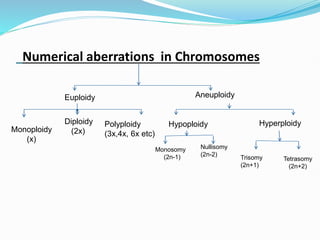
Numerical aberrations in Chromosomes
Euploidy Aneuploidy
Monoploidy
(x)
Diploidy
(2x)
Polyploidy
(3x,4x, 6x etc)
Hyperploidy
Hypoploidy
Trisomy
(2n+1)
Tetrasomy
(2n+2)
Monosomy
(2n-1)
Nullisomy
(2n-2)
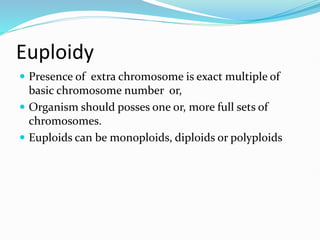
Euploidy
 Presence of extra chromosome is exact multiple of
basic chromosome number or,
 Organism should posses one or, more full sets of
chromosomes.
 Euploids can be monoploids, diploids or polyploids
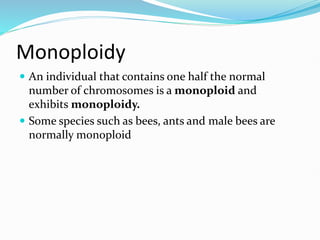
Monoploidy
 An individual that contains one half the normal
number of chromosomes is a monoploid and
exhibits monoploidy.
 Some species such as bees, ants and male bees are
normally monoploid
Common Wheat posses monoploidy
 The chromosomes of common wheat are believed to be
derived from three different ancestral species, each of
which had 7 chromosomes in its haploid gametes. The
monoploid number is thus 7 and the haploid number is
3 × 7 = 21. In general n is a multiple of x. The somatic cells
in a wheat plant have six sets of 7 chromosomes: three sets
from the egg and three sets from the sperm which fused to
form the plant, giving a total of 42 chromosomes. As a
formula, for wheat 2n = 6x = 42, so that the haploid
number n is 21 and the monoploid number x is 7.
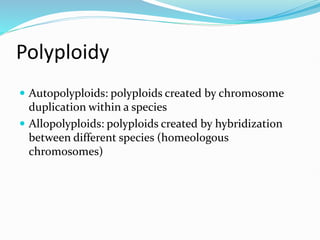
Polyploidy
 Autopolyploids: polyploids created by chromosome
duplication within a species
 Allopolyploids: polyploids created by hybridization
between different species (homeologous
chromosomes)
1. Autopolyploidy
 Even-numbered multiples of haploid number of
chromosomes. e.g.-
(a) Triploidy (23x3 or 63 chromosomes)
(b) Tetraploidy (23x4 or 92 chromosomes)
(c)Hexaploidy (23x6 or 138 chromosomes)
(d)Octaploidy (23x8 or 184 chromosomes)
Polyploidy conti…
 Triploidy is almost always sterile (bananas are
propagated by cuttings, some apple species by grafts,
 Triploids are often formed by fusion of a diploid (2x)
gamete from a tetraploid (4x) parent with a normal
gamete from a diploid parent.
 Autopolyploidy can also be induced artificially with
colchicine.
 Autotriploids are known in watermelons, sugarbeet,
tomato, grapes and banana, although in several of
these cases the polyploids have been artificially
produced.
 Autotetraploids are known in rye (Secale
cereale), corn (Zea mays), red clover (Trifolium
pratense), berseem (Trifolium alexandrium), marigolds
Tagetes), snapdragons (Antirrhinum), Phlox, grapes,
apples, etc.
2. Allopolyploidy
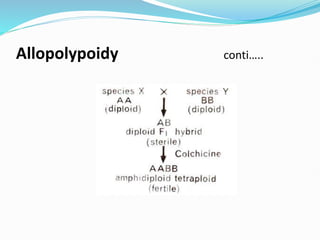
 Polyploidy may result from doubling of chromosome
number in a F1 hybrid which is derived from two
distinctly different species.
 Let A represent a set of chromosomes (genome) in species
X, and let B represent another genome in a species Y. The
F1 will then have one A genome and another B genome. The
doubling of chromosomes in this F1 hybrid (AB) will give
rise to a tetraploid with two A and two B genomes . Such a
polyploid is called an allopolyploid or amphidiploid.
Allopolypoidy conti…..
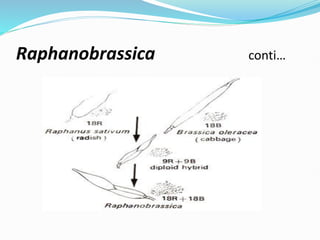
Raphanobrassica is a example of allopolyploidy
 In 1927, G.D. Karpechenko, a Russian geneticist,
reported a cross between Raphanus sativus (2n = 18)
and Brassica oleracea (2n = 8) to produce F1hybrid
which was completely sterile.
 On cytological examination these fertile plants were
found to have 2n = 36 chromosomes, which showed
normal pairing into 18 bivalents
Raphanobrassica conti…
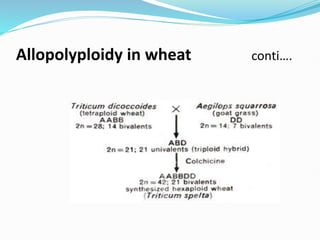
Common cultivated wheat is an example of
allopolyploidy
 There are three different chromosome numbers in the
genus Triticum, namely 2n = 14, 2n = 28 and 2n - 42.
 The common wheat is hexaploid with 2n = 42, and is
derived from three diploid species :
 (i) AA = Triticum aegilopoides (2n = 14),
 (ii) BB = Aegilops speltoides (2n = 14)
 (iii) DD = Aegilops squarrosa (2n = 14).
 The hexaploid wheat is designated as AABBDD,
Allopolyploidy in wheat conti….
Allopolyploidy examples
(i) Cotton: The new world cotton (Gossypium hirsutum) J.O.
Beasley crossed old world cotton (Gossypium herbaceum)
with American cotton (Gossypium raimondii) and doubled
the chromosome number in F1 hybrids. The allopolyploid
thus produced resembled the cultivated new world cotton
(Gossypium hirsutum) and when crossed, with it gave fertile
F1 hybrids.
(ii)Tobacco: There are two cultivated species of tobacco. i. e.
Nicotiana tabacum and Nicotiana rustica. Nicotiana tabacum
is an allotetraploid and available evidence suggests that it is
derived from a cross between Nicotiana sylvestris x Nicotiana
tomentosa
Aneuploidy
1. Aneuploidy: Individuals have a numerical change in
part of the genome. The chromosome number of
aneuploids is not an exact multiple of the haploid
number, n.
2. Hypoploidy: an organism in which a chromosome (or
part thereof) is under represented.
3. Hyperploidy: an organism in which a chromosome
(or part thereof) is overrepresented.
Types of Hypoploidy
Monosomy (2n-1):
 The diploid organism which lacks one chromosome of a single
homologous pair is called monosomic with genomic formula 2n-1.
 Turner Syndrome: (XO) female with retarded sexual
development who is usually sterile.
Nullisomy (2n-2):
 Diploid organisms which have lost a pair of homologous
chromosomes are called nullisomics with genomic formula 2n-2.
 Humans with this condition will not survive.
Types of Hyperploidy
Trisomy(2n+1): A particular chromosome represented three
times
 Trisomics were obtained for the first time in Datura
stramonium (jimson weed) by A.F. Blakeslee and his co-
workers.
Tetrasomy (2n+2): A particular chromosome represented four times.
 The four homologues tend to form a quadrivalent at meiosis and
disjunction often proceeds fairly regularly, two by two. All the
21 possible tetrasomics in wheat are viable.
Trisomy of Autosomes in Human beings
 Trisomy 13 or D-trisomy (Patau syndrome)
 Trisomy 18 or E-trisomy (Edward syndrome)
 Trisomy 21 or G-trisomy (Down syndrome)
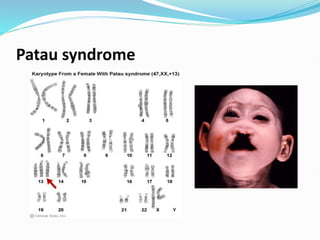
Trisomy 13 (Patau Syndrome)
 1st described by Bartholin (1657) & redefined by
Patau (1960).
 Chromosomal complement: 47,XX,+13 (female) or
47,XY,+13 (male)
 Phenotype: Male or female
 Incidence: 1:12,000 (increases with the age of
mother)
Patau syndrome
Trisomy 18 (Edward Syndrome)
 Chromosomal complement: 47,XX,+18 (female) or
47,XY,+18 (male)
 Phenotype: Male or female
 Incidence: 1:8000
Overlapping of the fingers
in Edwards' syndrome
Short broad hand
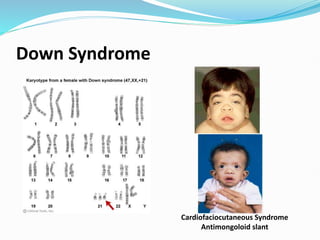
Down Syndrome (Mongolism) Trisomy 21
Incidence :
 The most common chromosomal aberration
 Incidence 1/700 live birth & 10 % of M.R.
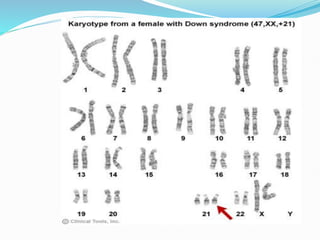
Definition : It is trisomy 21 i.e. the cell contain an extra
chromosome, number 21 i.e. the cell contains three
21 chromosomes instead of two .
Down Syndrome
Cardiofaciocutaneous Syndrome
Antimongoloid slant
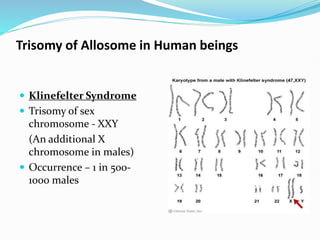
Trisomy of Allosome in Human beings
 Klinefelter Syndrome
 Trisomy of sex
chromosome - XXY
(An additional X
chromosome in males)
 Occurrence – 1 in 500-
1000 males
References:
 Strickberger, M.W. 2001. Genetics. Prentice Hall of India. Pvt. Ltd.,
New Delhi.
 Shekhawat, A.S. and Tripathi, B.K., 2009. A practical manual on
Element of Genetics. Publish by College of Agriculture, Bikaner.
 David Freidfelder, 2004. Essential of Molecular Biology
 Singh, B.D. 2020. Genetics
Thank you…..

Chromosomal-Aberrations.

  • 1.
    Lecture 1(a) Chromosomal Aberrations Numericalchanges in chromosomes Prof. (Dr.) Maneesha Singh School of Agricultural Sciences, Shri Guru Ram Rai University, Dehradun, Uttarakhand
  • 2.
    Basic definitions  Chromosomes,DNA and genes  Karyotype  Definition of Chromosomal aberrations  Structural and numerical changes  Numerical changes  Euploidy  Aneuploidy
  • 3.
    Chromosomes  The chromosomecarries the genetic information.  composed of deoxyribonucleic acid (DNA) on framework of protein .  Segments of DNA molecules comprise the genes; the units of heredity.
  • 4.
    • During celldivision, the chromosome can be seen to consist of 2 parallel strands; the chromatids, held together at one point, the centromere. Chromosomes
  • 5.
    Karyotype  It isthe set of chromosomes of an individual.  It is the systematized arrangement of the chromosomes of a single cell.  In the human cell, there are 46 chromosomes or 23 pairs (diploid number); of these 23 pairs, 22 are similar in both sexes and are called the autosomes. The remaining pair is called sex chromosomes : XX in the female cells and XY in the male cells .  Chromosomes are arranged in groups A to G according to their shape & size.
  • 6.
    Karyotype of anormal female in human
  • 7.
    Karyotype of anormal male in human
  • 8.
    CHROMOSOMAL ABERRATIONS  Achromosome aberration, disorder, anomaly, abnormality, or mutation is a missing, extra, or irregular portion of chromosomal DNA. OR  Mutations that cause change in the structure or number of chromosomes are called chromosomal aberrations. Generally, the incidence of chromosomal abnormalities is 5-6 persons/1000.  Many children with a chromosomal abnormality have mental or physical birth defects.
  • 9.
    HISTORY OF CHROMOSOMALABERRATIONS  In 1959 two discoveries opened a new era of genetics.  Jerome Lejeune, Marthe Gautier, and M. Raymond Turpin discovered the presence of an extra chromosome in Down syndrome patients.  C. E. Ford and his colleagues, P. A. Jacobs and J. A. Strong first observed sex chromosome anomalies in patients with sexual development disorders.
  • 10.
    Types of Chromosomalaberrations  Chromosomal aberrations are either numerical or structural.  They are a very common cause of early spontaneous miscarriage.  Usually, but not always, cause multiple congenital anomalies and learning difficulties.
  • 11.
    Chromosomal Aberrations (abnormalities) •Structural Aberrations o Deletion o Duplication o Inversion o Translocation • Numerical Aberrations o Euploidy: the usual number and sets of chromosomes o Polyploidy: the presence of three or more complete sets of chromosomes o Aneuploidy: the presence of additional chromosomes or missing individual chromosomes
  • 12.
    Numerical aberrations inChromosomes Euploidy Aneuploidy Monoploidy (x) Diploidy (2x) Polyploidy (3x,4x, 6x etc) Hyperploidy Hypoploidy Trisomy (2n+1) Tetrasomy (2n+2) Monosomy (2n-1) Nullisomy (2n-2)
  • 13.
    Euploidy  Presence ofextra chromosome is exact multiple of basic chromosome number or,  Organism should posses one or, more full sets of chromosomes.  Euploids can be monoploids, diploids or polyploids
  • 14.
    Monoploidy  An individualthat contains one half the normal number of chromosomes is a monoploid and exhibits monoploidy.  Some species such as bees, ants and male bees are normally monoploid
  • 15.
    Common Wheat possesmonoploidy  The chromosomes of common wheat are believed to be derived from three different ancestral species, each of which had 7 chromosomes in its haploid gametes. The monoploid number is thus 7 and the haploid number is 3 × 7 = 21. In general n is a multiple of x. The somatic cells in a wheat plant have six sets of 7 chromosomes: three sets from the egg and three sets from the sperm which fused to form the plant, giving a total of 42 chromosomes. As a formula, for wheat 2n = 6x = 42, so that the haploid number n is 21 and the monoploid number x is 7.
  • 16.
    Polyploidy  Autopolyploids: polyploidscreated by chromosome duplication within a species  Allopolyploids: polyploids created by hybridization between different species (homeologous chromosomes)
  • 17.
    1. Autopolyploidy  Even-numberedmultiples of haploid number of chromosomes. e.g.- (a) Triploidy (23x3 or 63 chromosomes) (b) Tetraploidy (23x4 or 92 chromosomes) (c)Hexaploidy (23x6 or 138 chromosomes) (d)Octaploidy (23x8 or 184 chromosomes)
  • 18.
    Polyploidy conti…  Triploidyis almost always sterile (bananas are propagated by cuttings, some apple species by grafts,  Triploids are often formed by fusion of a diploid (2x) gamete from a tetraploid (4x) parent with a normal gamete from a diploid parent.  Autopolyploidy can also be induced artificially with colchicine.
  • 19.
     Autotriploids areknown in watermelons, sugarbeet, tomato, grapes and banana, although in several of these cases the polyploids have been artificially produced.  Autotetraploids are known in rye (Secale cereale), corn (Zea mays), red clover (Trifolium pratense), berseem (Trifolium alexandrium), marigolds Tagetes), snapdragons (Antirrhinum), Phlox, grapes, apples, etc.
  • 20.
    2. Allopolyploidy  Polyploidymay result from doubling of chromosome number in a F1 hybrid which is derived from two distinctly different species.  Let A represent a set of chromosomes (genome) in species X, and let B represent another genome in a species Y. The F1 will then have one A genome and another B genome. The doubling of chromosomes in this F1 hybrid (AB) will give rise to a tetraploid with two A and two B genomes . Such a polyploid is called an allopolyploid or amphidiploid.
  • 21.
  • 22.
    Raphanobrassica is aexample of allopolyploidy  In 1927, G.D. Karpechenko, a Russian geneticist, reported a cross between Raphanus sativus (2n = 18) and Brassica oleracea (2n = 8) to produce F1hybrid which was completely sterile.  On cytological examination these fertile plants were found to have 2n = 36 chromosomes, which showed normal pairing into 18 bivalents
  • 23.
  • 24.
    Common cultivated wheatis an example of allopolyploidy  There are three different chromosome numbers in the genus Triticum, namely 2n = 14, 2n = 28 and 2n - 42.  The common wheat is hexaploid with 2n = 42, and is derived from three diploid species :  (i) AA = Triticum aegilopoides (2n = 14),  (ii) BB = Aegilops speltoides (2n = 14)  (iii) DD = Aegilops squarrosa (2n = 14).  The hexaploid wheat is designated as AABBDD,
  • 25.
  • 26.
    Allopolyploidy examples (i) Cotton:The new world cotton (Gossypium hirsutum) J.O. Beasley crossed old world cotton (Gossypium herbaceum) with American cotton (Gossypium raimondii) and doubled the chromosome number in F1 hybrids. The allopolyploid thus produced resembled the cultivated new world cotton (Gossypium hirsutum) and when crossed, with it gave fertile F1 hybrids. (ii)Tobacco: There are two cultivated species of tobacco. i. e. Nicotiana tabacum and Nicotiana rustica. Nicotiana tabacum is an allotetraploid and available evidence suggests that it is derived from a cross between Nicotiana sylvestris x Nicotiana tomentosa
  • 27.
    Aneuploidy 1. Aneuploidy: Individualshave a numerical change in part of the genome. The chromosome number of aneuploids is not an exact multiple of the haploid number, n. 2. Hypoploidy: an organism in which a chromosome (or part thereof) is under represented. 3. Hyperploidy: an organism in which a chromosome (or part thereof) is overrepresented.
  • 28.
    Types of Hypoploidy Monosomy(2n-1):  The diploid organism which lacks one chromosome of a single homologous pair is called monosomic with genomic formula 2n-1.  Turner Syndrome: (XO) female with retarded sexual development who is usually sterile. Nullisomy (2n-2):  Diploid organisms which have lost a pair of homologous chromosomes are called nullisomics with genomic formula 2n-2.  Humans with this condition will not survive.
  • 29.
    Types of Hyperploidy Trisomy(2n+1):A particular chromosome represented three times  Trisomics were obtained for the first time in Datura stramonium (jimson weed) by A.F. Blakeslee and his co- workers. Tetrasomy (2n+2): A particular chromosome represented four times.  The four homologues tend to form a quadrivalent at meiosis and disjunction often proceeds fairly regularly, two by two. All the 21 possible tetrasomics in wheat are viable.
  • 30.
    Trisomy of Autosomesin Human beings  Trisomy 13 or D-trisomy (Patau syndrome)  Trisomy 18 or E-trisomy (Edward syndrome)  Trisomy 21 or G-trisomy (Down syndrome)
  • 31.
    Trisomy 13 (PatauSyndrome)  1st described by Bartholin (1657) & redefined by Patau (1960).  Chromosomal complement: 47,XX,+13 (female) or 47,XY,+13 (male)  Phenotype: Male or female  Incidence: 1:12,000 (increases with the age of mother)
  • 32.
  • 33.
    Trisomy 18 (EdwardSyndrome)  Chromosomal complement: 47,XX,+18 (female) or 47,XY,+18 (male)  Phenotype: Male or female  Incidence: 1:8000
  • 34.
    Overlapping of thefingers in Edwards' syndrome Short broad hand
  • 35.
    Down Syndrome (Mongolism)Trisomy 21 Incidence :  The most common chromosomal aberration  Incidence 1/700 live birth & 10 % of M.R. Definition : It is trisomy 21 i.e. the cell contain an extra chromosome, number 21 i.e. the cell contains three 21 chromosomes instead of two .
  • 36.
  • 38.
    Trisomy of Allosomein Human beings  Klinefelter Syndrome  Trisomy of sex chromosome - XXY (An additional X chromosome in males)  Occurrence – 1 in 500- 1000 males
  • 39.
    References:  Strickberger, M.W.2001. Genetics. Prentice Hall of India. Pvt. Ltd., New Delhi.  Shekhawat, A.S. and Tripathi, B.K., 2009. A practical manual on Element of Genetics. Publish by College of Agriculture, Bikaner.  David Freidfelder, 2004. Essential of Molecular Biology  Singh, B.D. 2020. Genetics
  • 40.