SRLabs Template v12
Tales of 5G Hacking
Karsten Nohl <nohl@srlabs.de>
as Logo Horizontal
Pos / Neg
whoami – telco hacker and defender
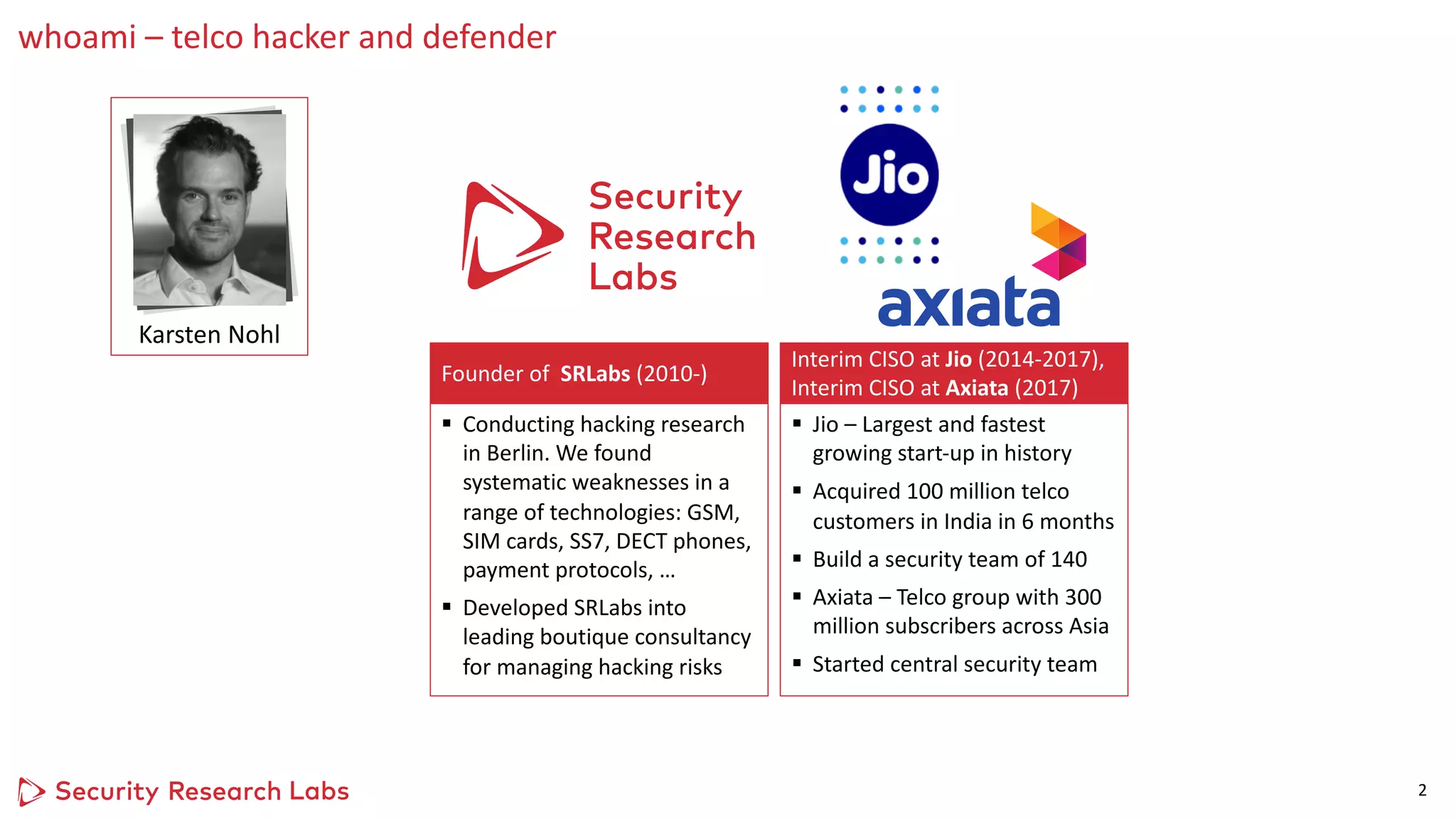
§ Conducting hacking research
in Berlin. We found
systematic weaknesses in a
range of technologies: GSM,
SIM cards, SS7, DECT phones,
payment protocols, …
§ Developed SRLabs into
leading boutique consultancy
for managing hacking risks
§ Jio – Largest and fastest
growing start-up in history
§ Acquired 100 million telco
customers in India in 6 months
§ Build a security team of 140
§ Axiata – Telco group with 300
million subscribers across Asia
§ Started central security team
Founder of SRLabs (2010-)
Interim CISO at Jio (2014-2017),
Interim CISO at Axiata (2017)
2
Karsten Nohl
as Logo Horizontal
Pos / Neg
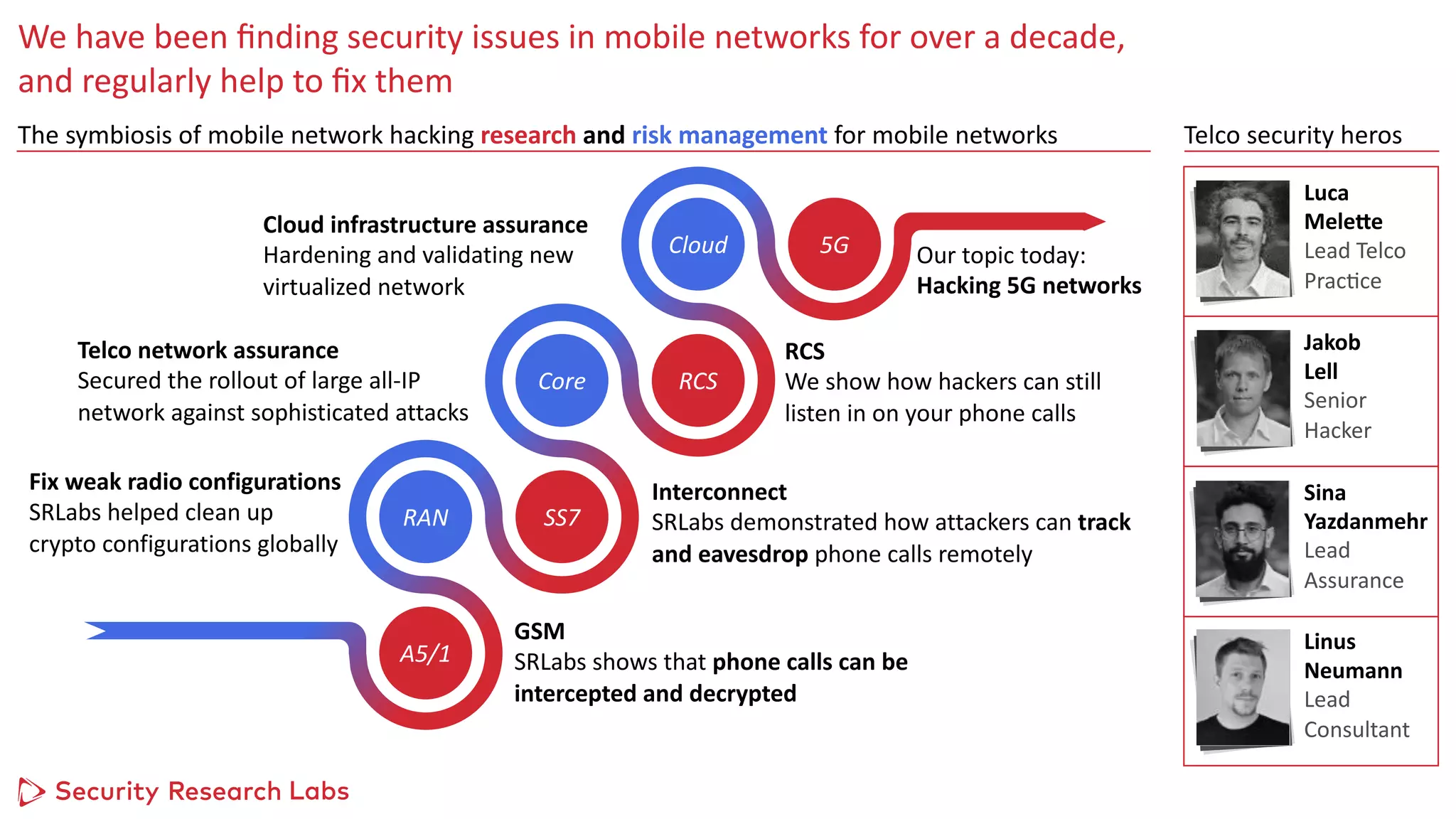
We have been finding security issues in mobile networks for over a decade,
and regularly help to fix them
GSM
SRLabs shows that phone calls can be
intercepted and decrypted
Our topic today:
Hacking 5G networks
A5/1
RAN SS7
Core RCS
Cloud 5G
RCS
We show how hackers can still
listen in on your phone calls
Interconnect
SRLabs demonstrated how attackers can track
and eavesdrop phone calls remotely
Fix weak radio configurations
SRLabs helped clean up
crypto configurations globally
Telco network assurance
Secured the rollout of large all-IP
network against sophisticated attacks
Cloud infrastructure assurance
Hardening and validating new
virtualized network
The symbiosis of mobile network hacking research and risk management for mobile networks
Luca
Mele2e
Lead Telco
PracZce
Linus
Neumann
Lead
Consultant
Telco security heros
Jakob
Lell
Senior
Hacker
Sina
Yazdanmehr
Lead
Assurance
as Logo Horizontal
Pos / Neg
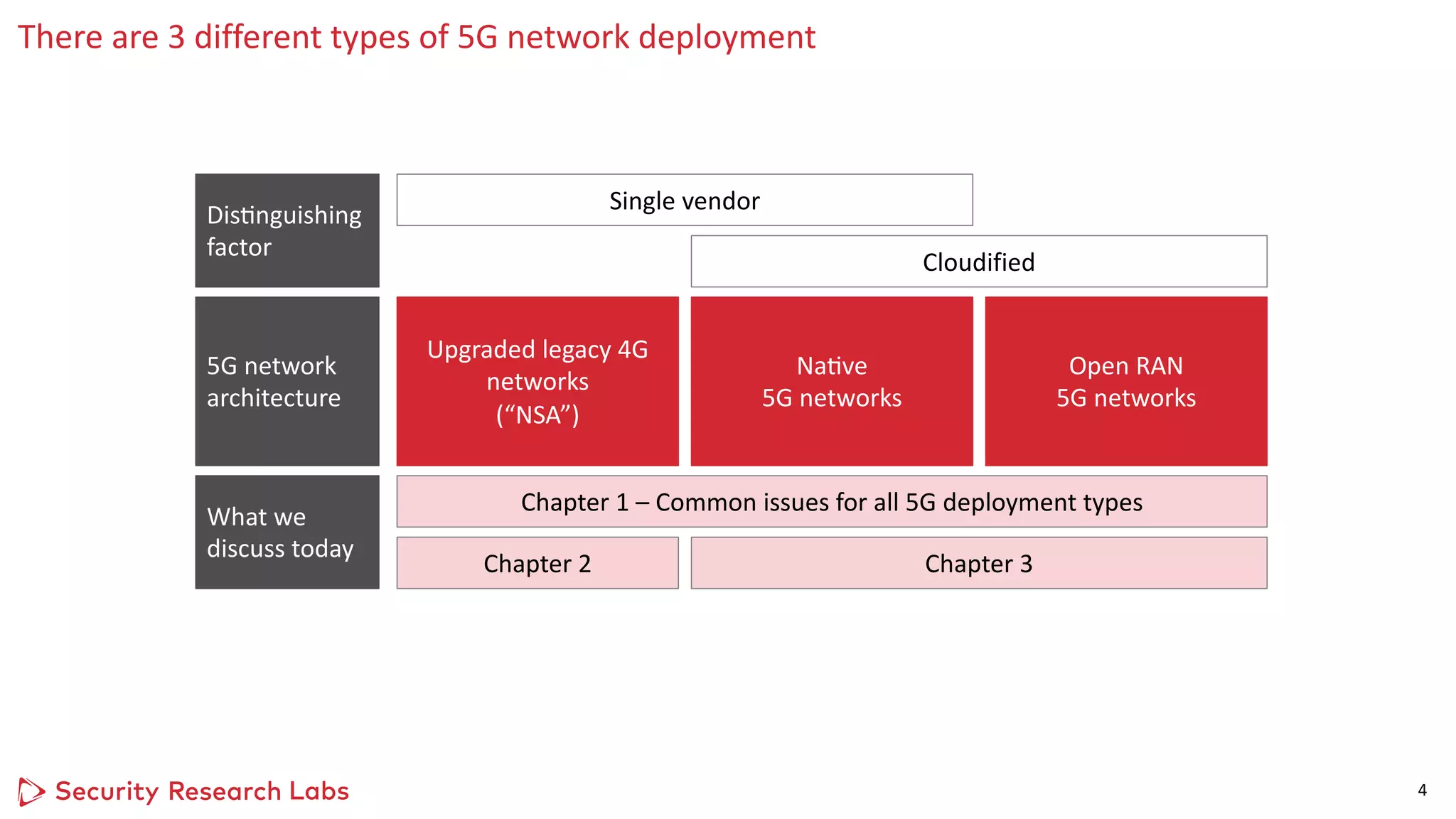
There are 3 different types of 5G network deployment
4
Upgraded legacy 4G
networks
(“NSA”)
NaCve
5G networks
Open RAN
5G networks
Single vendor
Cloudified
Chapter 2 Chapter 3
Chapter 1 – Common issues for all 5G deployment types
5G network
architecture
DisCnguishing
factor
What we
discuss today
as Logo Horizontal
Pos / Neg
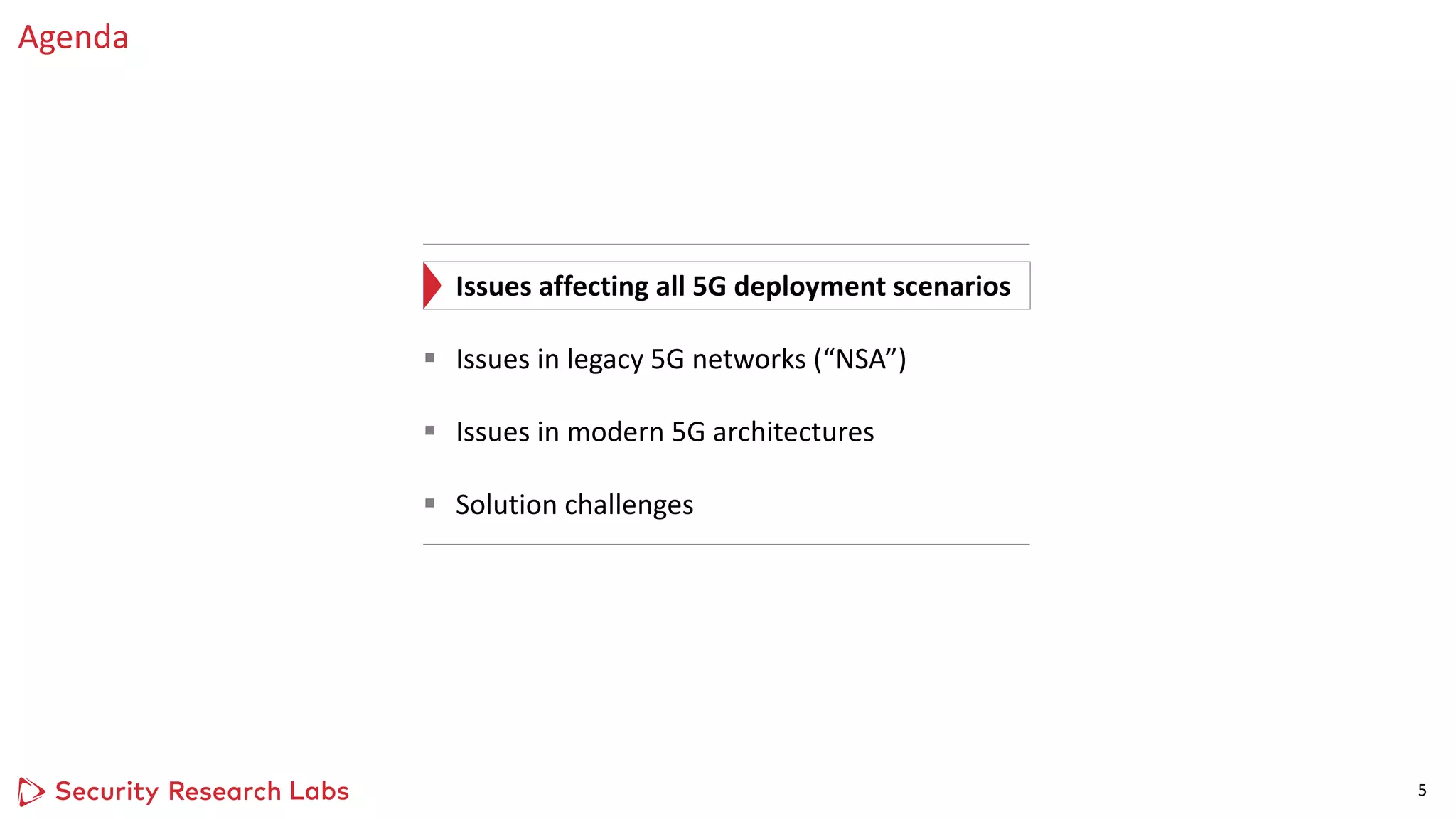
Agenda
5
§ Issues affecting all 5G deployment scenarios
§ Issues in legacy 5G networks (“NSA”)
§ Issues in modern 5G architectures
§ Solution challenges
as Logo Horizontal
Pos / Neg
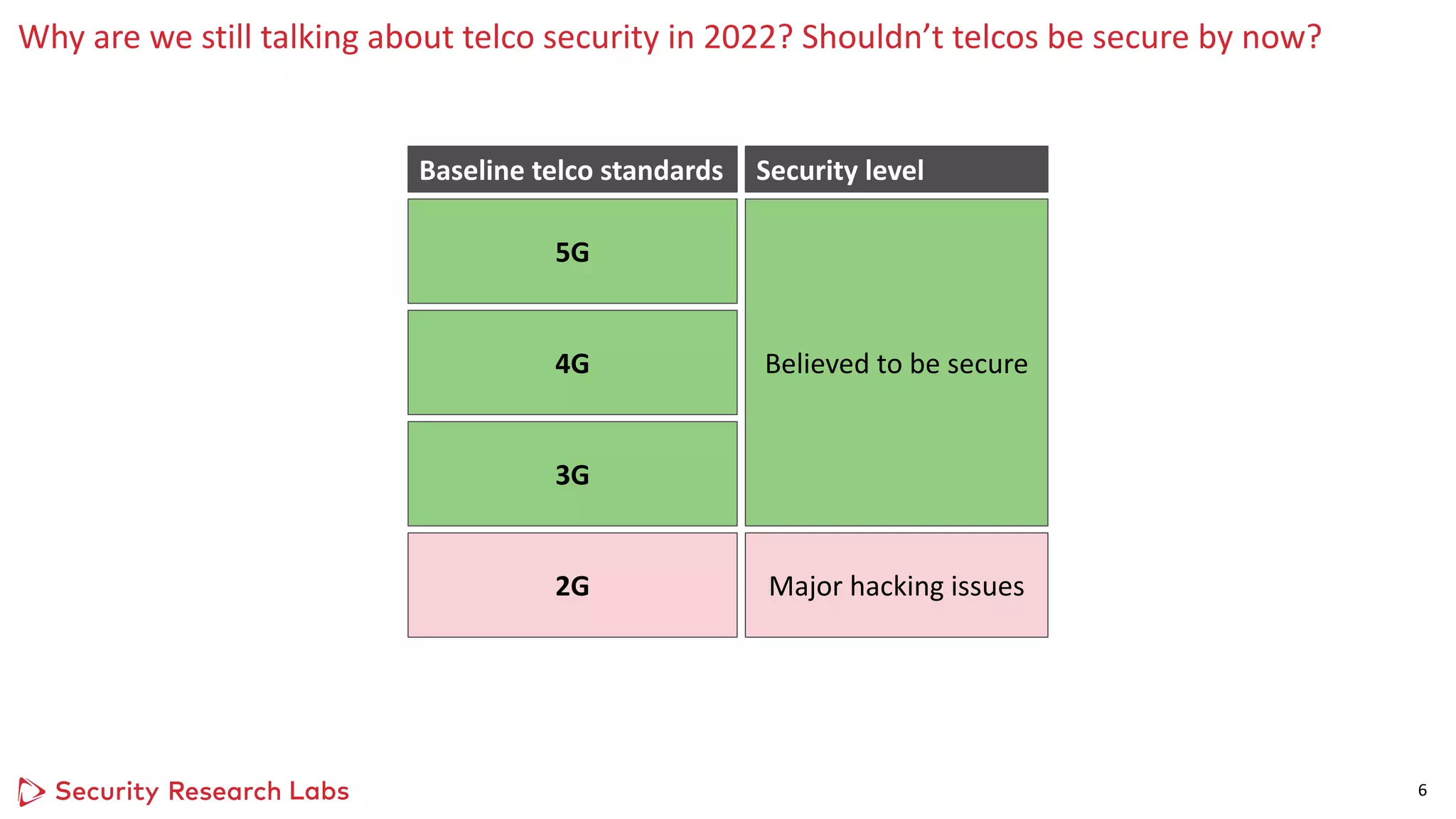
Why are we still talking about telco security in 2022? Shouldn’t telcos be secure by now?
6
Baseline telco standards
2G
3G
4G
5G
Believed to be secure
Major hacking issues
Security level
as Logo Horizontal
Pos / Neg
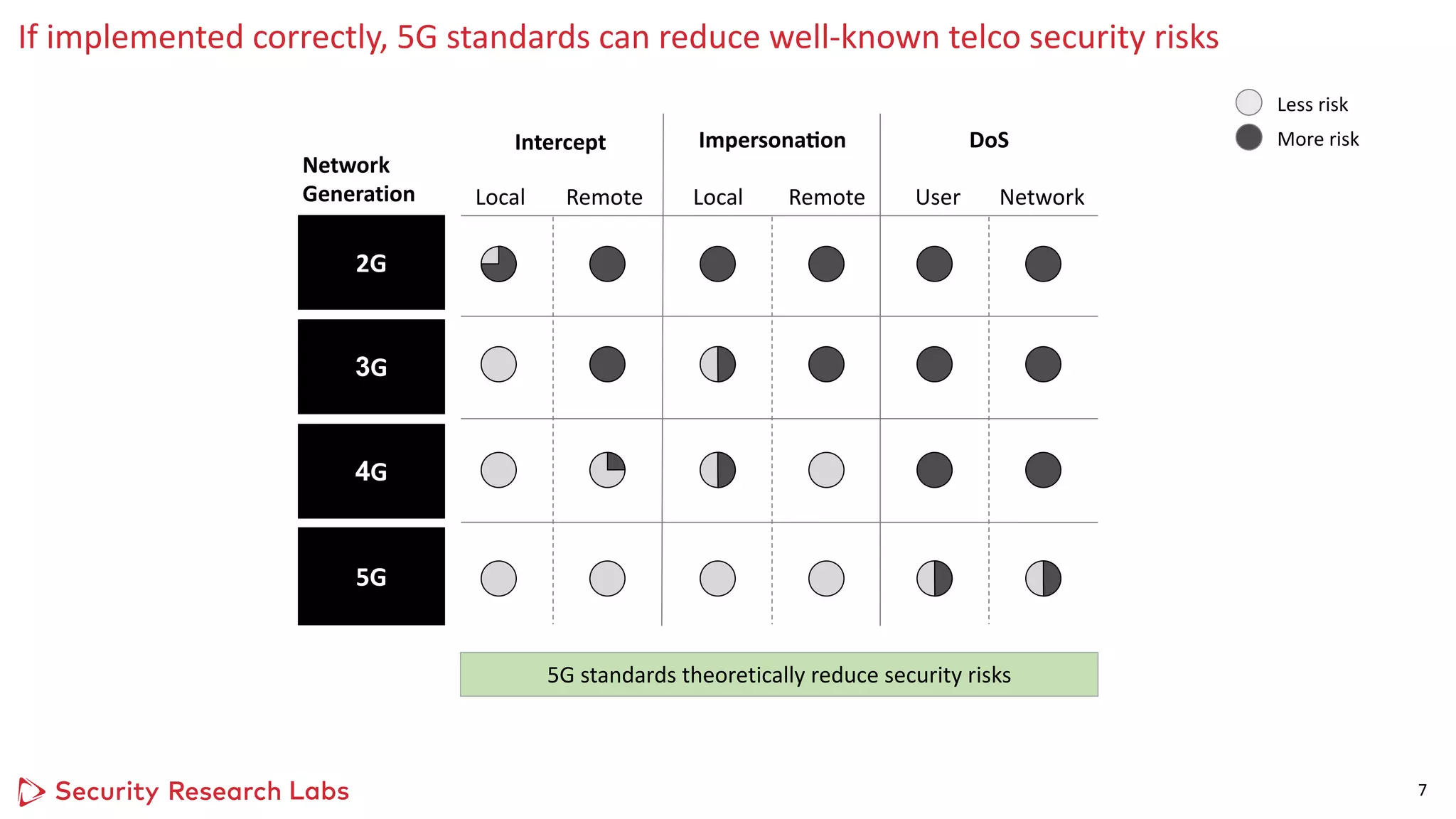
If implemented correctly, 5G standards can reduce well-known telco security risks
7
Local
Network
Generation
5G
2G
3G
4G
Intercept ImpersonaAon DoS
Remote Local Remote User Network
Less risk
More risk
5G standards theoretically reduce security risks
as Logo Horizontal
Pos / Neg
OS
Kubernetes
8
RU
RU
RU DU
DU
Cell sites RAN - Edge datacenters Core - Central datacenter
AMF
UPF
UDM
OS
Kubernetes
Software Defined
Network
NEF
SEPP
SMF NRF
Other
telcos
Private
network
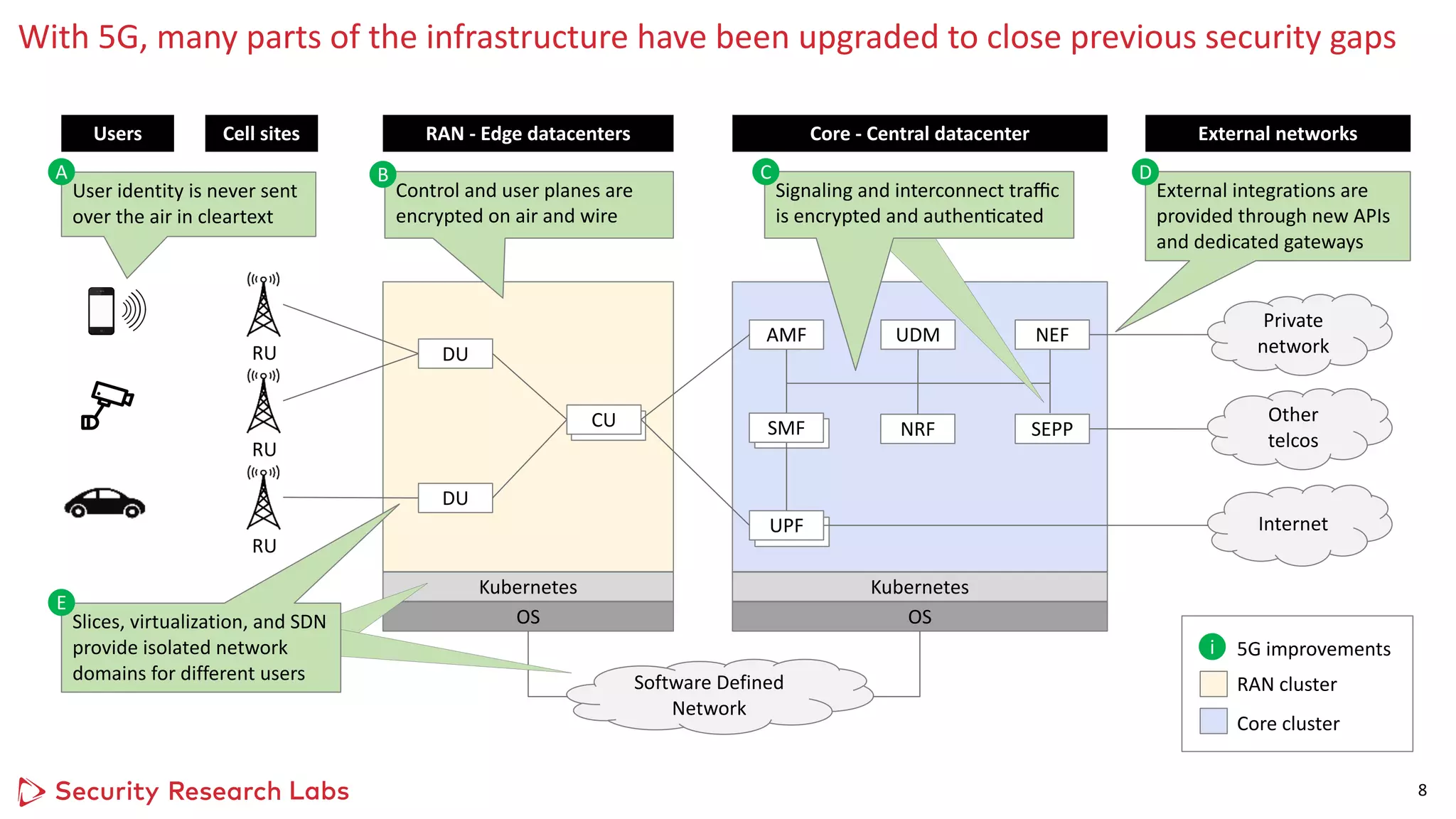
User identity is never sent
over the air in cleartext
Control and user planes are
encrypted on air and wire
A B
External integrations are
provided through new APIs
and dedicated gateways
D
UPF
SMF
Users External networks
Internet
CU
CU
Slices, virtualization, and SDN
provide isolated network
domains for different users
E
Signaling and interconnect traffic
is encrypted and authenLcated
C
With 5G, many parts of the infrastructure have been upgraded to close previous security gaps
i
Core cluster
RAN cluster
5G improvements
as Logo Horizontal
Pos / Neg
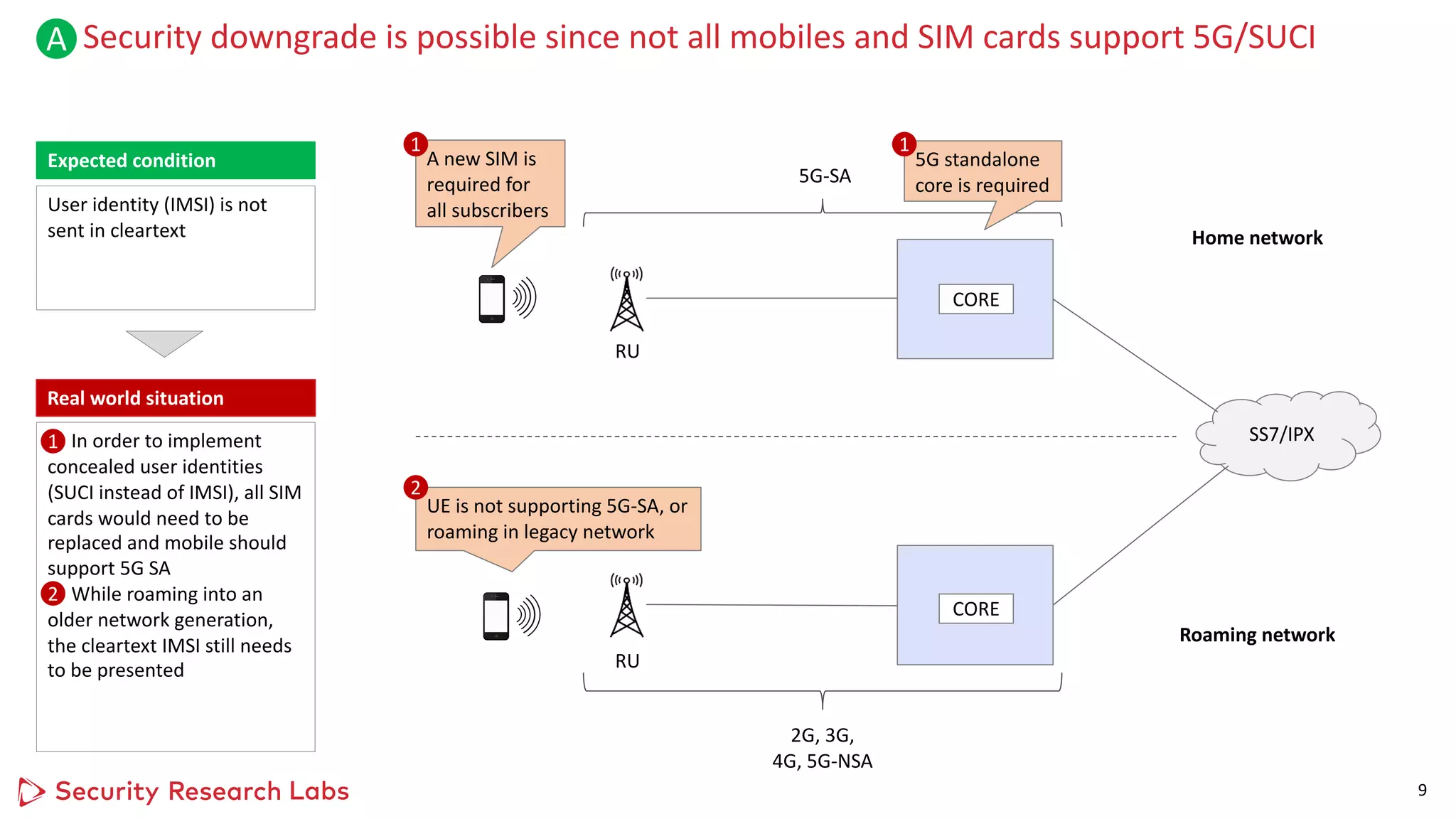
Security downgrade is possible since not all mobiles and SIM cards support 5G/SUCI
9
RU
RU
5G-SA
SS7/IPX
CORE
CORE
2G, 3G,
4G, 5G-NSA
A new SIM is
required for
all subscribers
UE is not supporting 5G-SA, or
roaming in legacy network
Home network
Roaming network
User identity (IMSI) is not
sent in cleartext
In order to implement
concealed user identities
(SUCI instead of IMSI), all SIM
cards would need to be
replaced and mobile should
support 5G SA
While roaming into an
older network generation,
the cleartext IMSI still needs
to be presented
Expected condition
Real world situation
A
1
2
1
2
5G standalone
core is required
1
as Logo Horizontal
Pos / Neg
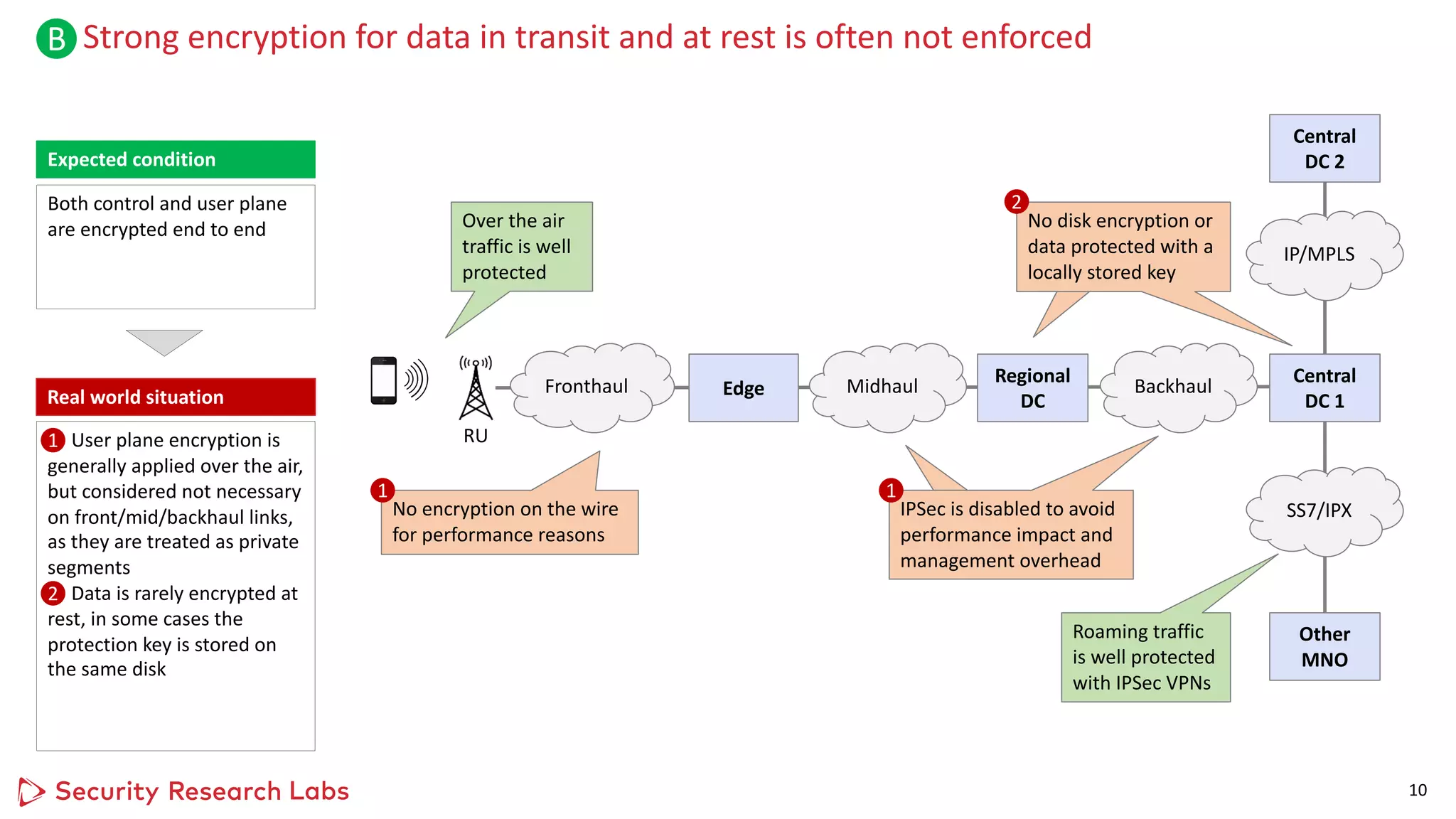
Strong encryption for data in transit and at rest is often not enforced
10
RU
Over the air
traffic is well
protected
Both control and user plane
are encrypted end to end
User plane encryption is
generally applied over the air,
but considered not necessary
on front/mid/backhaul links,
as they are treated as private
segments
Data is rarely encrypted at
rest, in some cases the
protection key is stored on
the same disk
Expected condition
Real world situation
1
2
Other
MNO
No disk encryption or
data protected with a
locally stored key
IPSec is disabled to avoid
performance impact and
management overhead
No encryption on the wire
for performance reasons
Central
DC 2
Roaming traffic
is well protected
with IPSec VPNs
Edge
Regional
DC
Backhaul
Midhaul
Fronthaul
SS7/IPX
IP/MPLS
Central
DC 1
1 1
2
B
as Logo Horizontal
Pos / Neg
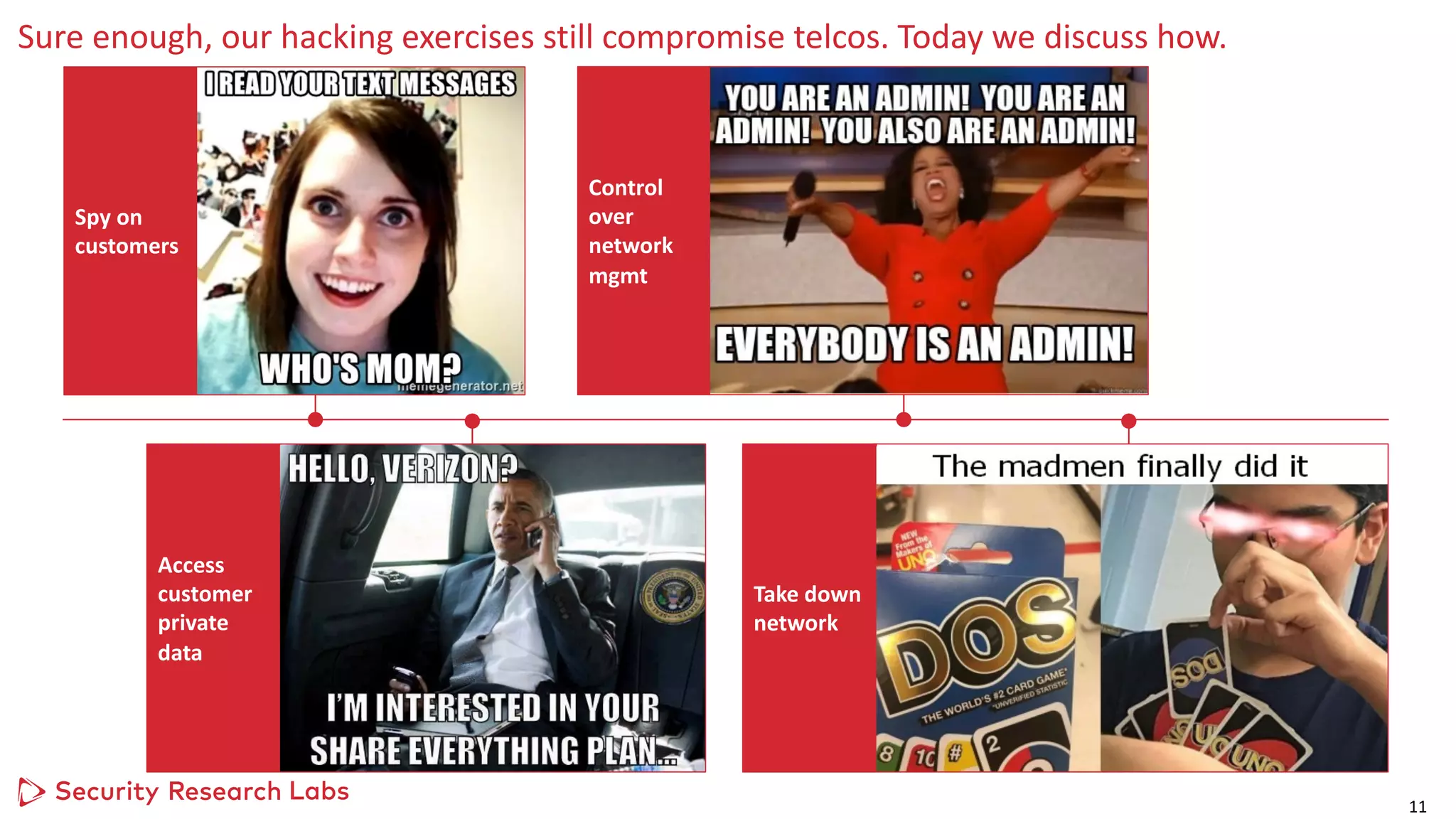
Sure enough, our hacking exercises still compromise telcos. Today we discuss how.
11
Spy on
customers
Control
over
network
mgmt
Take down
network
Access
customer
private
data
as Logo Horizontal
Pos / Neg
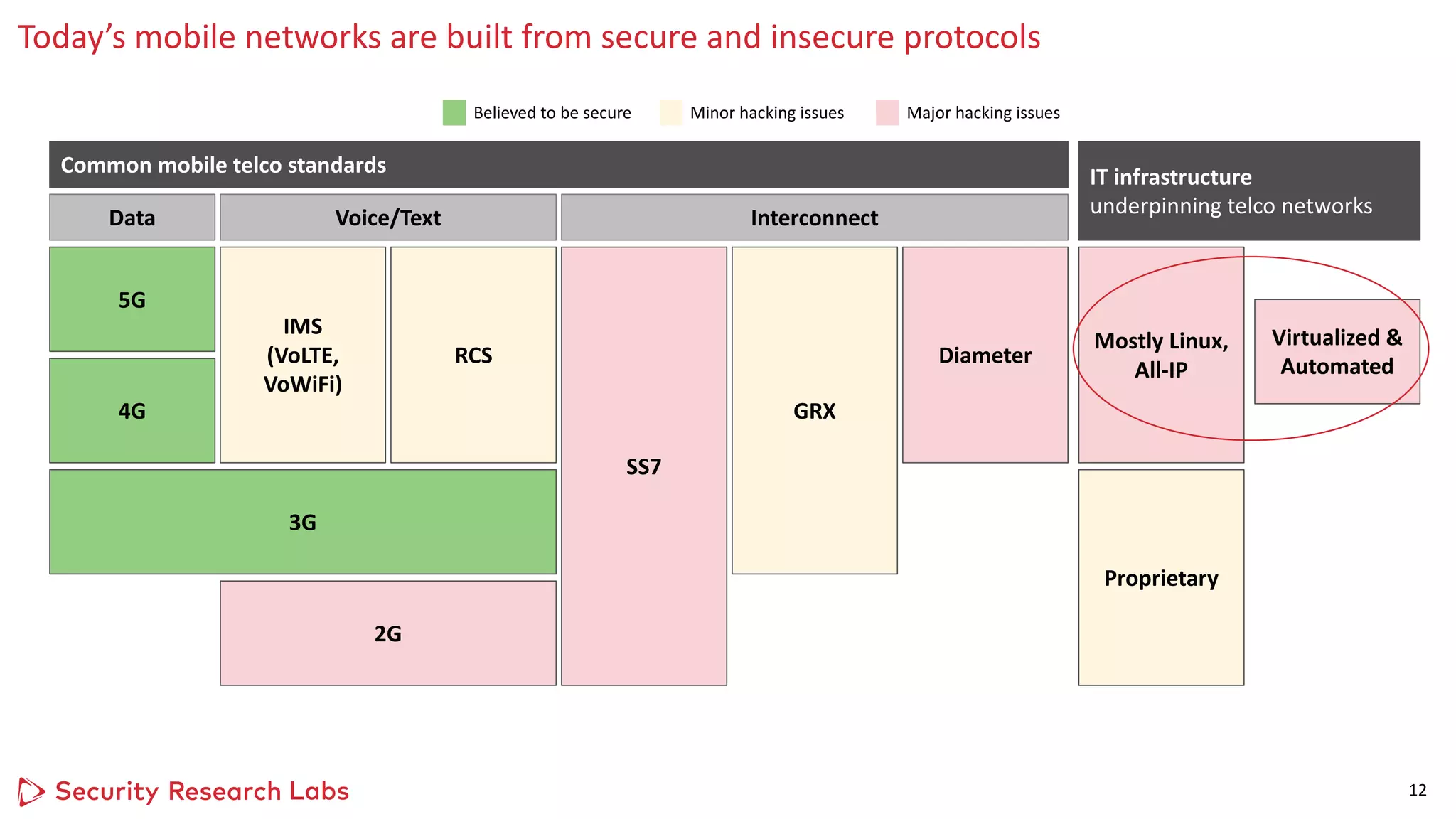
Today’s mobile networks are built from secure and insecure protocols
12
Minor hacking issues
Believed to be secure Major hacking issues
Common mobile telco standards
Data Voice/Text Interconnect
2G
SS7
3G
GRX
4G
IMS
(VoLTE,
VoWiFi)
RCS Diameter
5G
IT infrastructure
underpinning telco networks
Mostly Linux,
All-IP
Proprietary
Virtualized &
Automated
as Logo Horizontal
Pos / Neg
Agenda
13
§ Issues affecting all 5G deployment scenarios
§ Issues in legacy 5G networks (“NSA”)
§ Issues in modern 5G architectures
§ Solution challenges
as Logo Horizontal
Pos / Neg
Standard IT cyber assurance techniques uncover issues in upgraded legacy networks
14
Function Exposure scan Trace analysis OS check Config review Mgmt layer check
Mobility
mgmt
Misconfigured
firewalls allow
mobile users to
reach telco
nodes on
internal
network
• Radius is
protected
• OSPF is
protected
• SNMP is
protected
• 5GC traffic is
protected
• IPSec config
weak
• NTP is not
protected
• Missing OS
patches (2 years)
• No SELinux
• Shared
passwords across
nodes
• Shared private
keys across
nodes
• Many processes
running as root
• Auth forced on
attach
• Default cipher
is ZUC (EEA3) • Command
injection in
Web UI
• Lack of user
input validation
• Ineffective ACLs
to protect mgmt
interface
Session
mgmt
Separate APN for
CPE management
Data-
plane
router
Nodes
segregated into
VLANs for each
APN
User
directory
(not tested)
Missing OS patches
(3 years)
(not tested)
NE forces old Java
in clients
Billing
system
(not tested)
Missing OS patches
(3 years)
No issues found
§ In IT, it is standard practice to
conduct “pentest and
vulnerability analysis” (VAPT)
checks on IT infrastructures
at least once a year
§ The results of the VAPT
exercise are mitigated
through configuration
changes and process
adaptations (e.g. better
patching)
§ Knowledge on how to best
configure systems is further
collected in best practice
guides (e.g. CIS)
§ When applying the same
methodology to telco
infrastructures, a large best
practice gaps is uncovered
IT Security Assurance on
“Not-Stand-Alone” 5G core
(upgraded from 4G core)
Sanitized client example
as Logo Horizontal
Pos / Neg
Agenda
15
§ Issues affecting all 5G deployment scenarios
§ Issues in legacy 5G networks (“NSA”)
§ Issues in modern 5G architectures
§ Solution challenges
as Logo Horizontal
Pos / Neg
We are discussing how virtualization and automation change telco security
16
Our focus today
Virtualization /
Containers
Commodity hardware
(e.g., Open RAN)
Mobile networks
of the future
AutomaJon /
OrchestraJon
= + +
as Logo Horizontal
Pos / Neg
Future networks evolve continuously and thereby extend attack surface into
cloud infrastructure and software development
17
Production Operations Deployment
§ Telco networks become
more complex due to
new virtualization and
orchestration layers
§ Automation reduces
human errors in
operations, but creates
new possible error
sources in
development and
deployment
§ Telco networks evolve
constantly through
continuous
deployments
Today’s
mobile
networks
Operator
terminal
Periodic update
drops (1-2x per year)
Proprietary telco
equipment
Operator Vendor
Future
mobile
networks
Virtualization (Kubernetes)
Cloud server Operating bot Developer
Continuous
changes
Automated
real-time operations
Proprietary services on
commodity hardware
CI/CD
Main changes
as Logo Horizontal
Pos / Neg
Security question: Can a hacker break out of a hacked service and compromise other services?
18
§ Future telco networks, including
Open RAN, deploy dozens of
services from different vendors
§ Not all services can be secured to
the same level, and yet they often
run in shared environments
§ Note that this is the same
situation as in other cloud
deployments where tenants need
to be protected from one another
Can a hacker break out of one container to
compromise other containers or the
underlying infrastructure?
Kubernetes
Compromised
container
Other containers
Assumption The question we want to answer
as Logo Horizontal
Pos / Neg
A range of configuration choices can compromise Kubernetes cloud deployments
19
Further details and escalation examples: https://bishopfox.com/blog/kubernetes-pod-privilege-escalation
Security impact
Kubernetes capability Hacking vector Run code View/encrypt data Take down system
Privileged container
Full control of Kubernetes host
sys_admin
docker.sock mountable
hostPID Kill host process
hostPID sys_ptrace Inject into host process
read-only
Search for passwords and tokens in
config and history files ( ) ( ) (( )
hostPath mount
(file system access)
read/write Add SSH key
hostNetwork or net_admin
K8s API access (Even localhost! Auth?) ? ? ?
tcpdump host traffic ?
Observed for majority of live deployments
Observed for some live deployment
as Logo Horizontal
Pos / Neg
Automation side effect: Network control and data is possible from more places
20
A2ack path
§ Incautious developers leak
sensitive data on the internet
§ API information, user credentials
and other internal details can be
leveraged to access exposed
applications
§ Due to software bugs and
improper limitation of privileges,
hackers can move laterally and
elevate their privilege up to take
controls of telco nodes and other
critical systems
§ Red Team exercises regularly
show that telcos are hackable
because of these issues
§ Employee credentials
§ Session tokens
§ API information
§ Application source code
§ Internal IP addresses
§ Information about
internal endpoints
§ API Keys
§ Subscriber data
Public domain
§ Employee credentials
Phishing
GitHub
Pastebin / forums
§ Direct login to portals
§ Admin access via
guessable/shared
credentials
§ Direct code execution
§ Unauthenticated and
deprecated endpoints
§ Testing endpoints
interacting with core
§ Re-use of API keys
§ Further information
disclosure, sometimes
including credentials
Internet facing application
Management portal
Exposed API
§ Unprivileged access
to management API
§ RCE on vulnerable
application behind
management API
§ Core nodes access via
management portal
and exposed APIs
§ Node takeover via
image replacement
Telco infrastructure
§ Info leak and control
of support systems
§ SensiZve data
exfiltraZon
RAN & Core nodes
OSS & BSS nodes
as Logo Horizontal
Pos / Neg
Recap: A red team exercise simulates real-world hacking
21
Red Teaming
=
Free-style hacking:
An invitation to hack a company, any
way you chose, …
and help that company improve their
defenses based on what you find
as Logo Horizontal
Pos / Neg
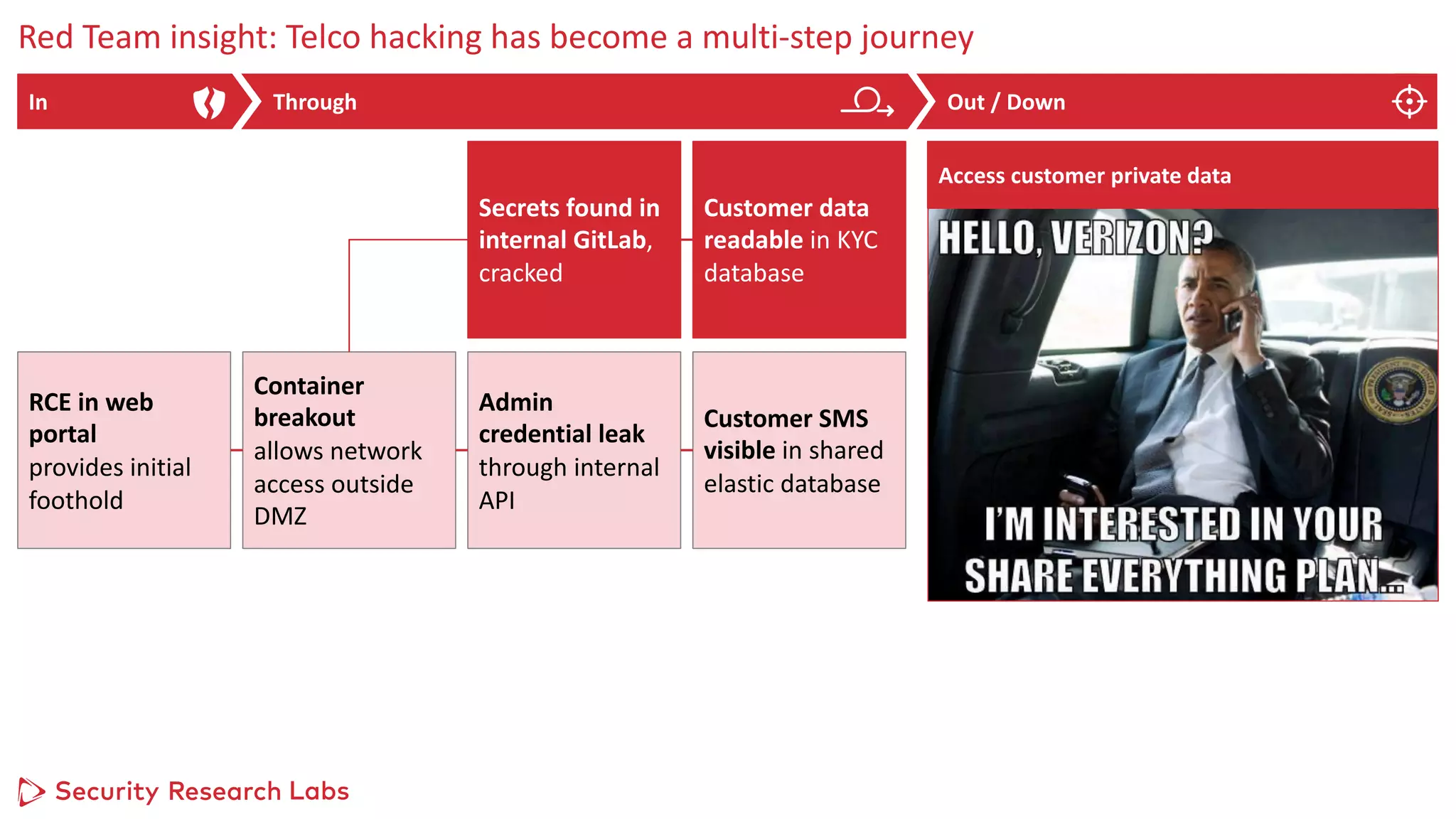
Red Team insight: Telco hacking has become a multi-step journey
Through Out / Down
In
RCE in web
portal
provides initial
foothold
Container
breakout
allows network
access outside
DMZ
Admin
credential leak
through internal
API
Customer SMS
visible in shared
elastic database
Spy on customers
as Logo Horizontal
Pos / Neg
Red Team insight: Telco hacking has become a multi-step journey
Through Out / Down
In
RCE in web
portal
provides initial
foothold
Container
breakout
allows network
access outside
DMZ
Admin
credential leak
through internal
API
Customer SMS
visible in shared
elastic database
Secrets found in
internal GitLab,
cracked
Customer data
readable in KYC
database
Access customer private data
as Logo Horizontal
Pos / Neg
Control over network mgmt
Red Team insight: Telco hacking has become a multi-step journey
Through Out / Down
In
RCE in web
portal
provides initial
foothold
Container
breakout
allows network
access outside
DMZ
Admin
credential leak
through internal
API
Customer SMS
visible in shared
elastic database
Automation API
details leaked in
publicly
accessible
GitHub
Access to RAN
intelligent
controller
Control over
RAN elements
after container
breakout into
RAN Kubernetes
Secrets found in
internal GitLab,
cracked
Customer data
readable in KYC
database
as Logo Horizontal
Pos / Neg
Red Team insight: Telco hacking has become a mulX-step journey
Through Out / Down
In
RCE in web
portal
provides initial
foothold
Container
breakout
allows network
access outside
DMZ
Admin
credential leak
through internal
API
Customer SMS
visible in shared
elastic database
AutomaEon API
details leaked in
publicly
accessible
GitHub
Access to RAN
intelligent
controller
Control over
RAN elements
after container
breakout into
RAN Kubernetes
Secrets found in
internal GitLab,
cracked
Customer data
readable in KYC
database
Take down network
as Logo Horizontal
Pos / Neg
Agenda
26
§ Issues affecOng all 5G deployment scenarios
§ Issues in legacy 5G networks (“NSA”)
§ Issues in modern 5G architectures
§ SoluJon challenges
as Logo Horizontal
Pos / Neg
Harden your containers by restricting and using controls at several levels
27
Container
config
Privileged
Containers
Shared Host
Resources
Capabilities
Service Account
Do not use pods that allow privileged containers. Do not use
pods which are running as root inside the container.
Restrict host resources as much as possible. (hostNetwork,
hostPID, hostPath, hostIPC)
Take capabilities away from pods: Drop all capabilities (--cap-
drop=all), then add only the required ones (cap-add=xyz)
Do not mount default service account
Syscall policies Make use of AppArmor / SELinux, Seccomp
OS image
Disable bash history, remove files from build/sandbox stage
Minimal OS
Network policies Deny all by default
Limit history
Use a minimal set of OS packages (if possible do not include a
shell)
Area Best practice
§ The security of
Kubernetes
environments
depends on
strong
configuration /
hardening of
pods,
containers, and
OS images
§ The hardening
setting should
be checked
automatically as
part of the build
/ CI/CD pipeline
Take away
as Logo Horizontal
Pos / Neg
Best practice Recommended initiative
Secure by design
§ Implement a centralized access management solution across the whole deployment
§ Follow Zero Trust principles when designing the applications and network infrastructure
§ Avoid legacy protocols and parameters when integrating new nodes
§ Design and implement service redundancy and define a backup process
Defense in depth
§ Define and keep network zones separate (on a macro scale) using firewalls, proxies, VRFs
§ Assign individual interface to user, control & mgmt. plane, and set appropriate host ACLs
§ Deploy container policies to reduce application and OS abuse inside clusters
§ Encrypt data at rest and in transit using well-known standards to avoid unintentional leaks
Least privilege rule
§ Define user roles with appropriate privileges for each application
§ Simplify and document the user management grant/revoke processes
§ Implement periodic automatic checks on user roles
Continuous testing
§ Automate checks for service exposure, hardening and missing patches
§ Periodically let 3rd parties run end-to-end attack simulations and penetration tests
§ Perform code and image analysis at every software release (via CI/CD triggers)
Minimize time to
response
§ Make sure all systems create meaningful logs (network, access, operational, failures)
§ Centrally collect and correlate all events according to common attack scenarios
§ Extend and validate SIEM rules to cover both IT and telco-specific attacks
§ Create documentation and integrate appliances for incident response
In theory, 5G deployments can be secured through five best practices
28
as Logo Horizontal
Pos / Neg
In practice, successful telco cyber defence is often hard as standard prevention and detection
controls are missing
Cyber risk areas Detection
Prevention
Defense best practices [examples]
System hacking
Abuse of insider
privileges
System hardening & patching
Privileged access management
1
2
Endpoint protection
3
Detailed on next slides
x
29
as Logo Horizontal
Pos / Neg
Needs hardening insights and regular
patches for proprietary systems
Adequate system maintenance is hard in both telco architectures, but for different reasons
Prevent system hacking
Objective
Harden & regularly patch critical systems
Best pracZce
+ Critical systems in Edge and Core are based on
standard Linux system for which knowledge and
tools for hardening and patching are readily
available
- However, vendors do not typically provide good
default settings or sufficient access for the telco to
execute hardening and patching activities, and do
not patch often enough themselves
Legacy/current telco networks
+ Systems are readily accessible as VMs or docker
containers, often already hardened
- The number of systems to harden and patch is
significantly higher due to micro virtualization and
container infrastructures
- Vendors often use proprietary (e.g. embedded
linux) systems for which hardening knowledge and
patching tools are rare
Future network (cloud-native, highly automated)
Complications
Ease of
implementations
Hard
Needs agreement with vendor on patch
responsibiliZes, system redundancy
Hard
1
30
as Logo Horizontal
Pos / Neg
Access to standard Linux telco nodes works
similarly to standard server access in IT
Standard PAM systems can protect core network nodes from rogue/hacked insiders
2
Prevent abuse of insider privileges
ObjecZve
Privileged access management
Best practice
+ Privileged Access Management (PAM) systems authenticate and monitor administrative access to servers, and can
be used for protecting network nodes
+ Most telco vendors prefer to use their proprietary EMS systems, but telcos should instead use well-established PAM
systems that are independent from the telco vendor
+ Since modern 5G nodes are Linux based and/or provide SSH authentication, PAM systems can readily be used
Constraints
Access to containers / VMs through SSH or
virtualization layer
Easy Easy
Future network (cloud-naZve, highly automated)
Legacy/current telco networks
Direct access Direct access
Ease of
implementation
PAM
Mgmt system PAM
Mgmt system
31
as Logo Horizontal
Pos / Neg
Standard Linux EDR software can be leveraged
Modern endpoint protection can be deployed easily on standard Linux, but not on
many VNFs in open network architectures
3
Detect system hacking
Objective
Modern endpoint protection (EDR*)
Best pracZce
+ Critical functions run on Linux and can be protected
from system hacking activity with standard EDR and/or
open source monitoring tools
- Possibly, a new vendor agreement is required to permit
the EDR installation and define incident response
procedures
Constraints
Ease of
implementation
Embedded systems / stripped down containers
require custom security tools
Easy Hard
*EDR: Endpoint Detection & Response
Future network (cloud-naZve, highly automated)
Legacy/current telco networks
- The proprietary distributions inside VNFs often do not
allow other software to be installed
+ At additional effort and with the help of the telco
vendor, open source security tools can be deployed
+ Once deployed, the virtualization infrastructure allows
for a high degree of automation
32
as Logo Horizontal
Pos / Neg
1
2
3
Take aways
Prevention
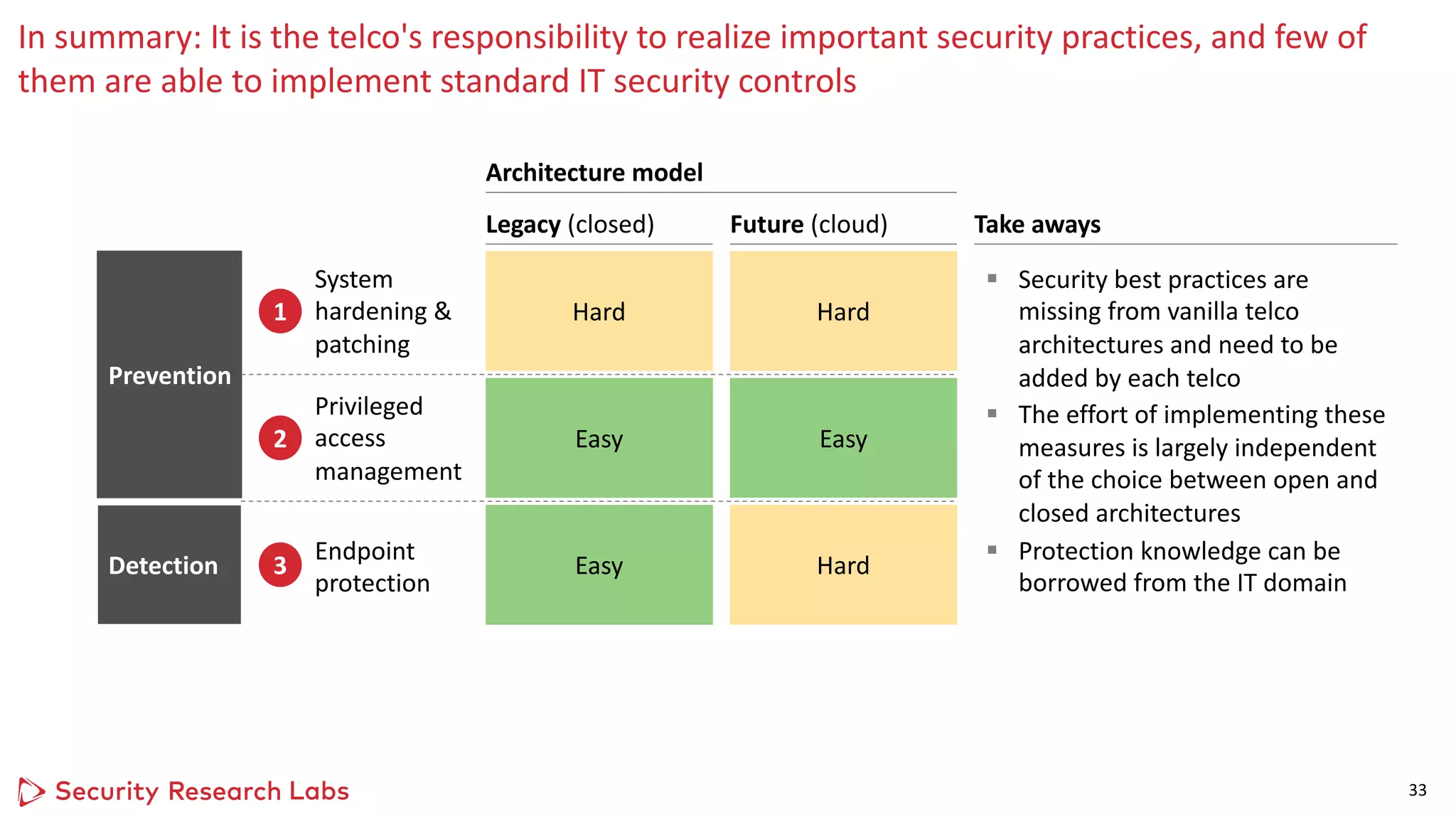
§ Security best practices are
missing from vanilla telco
architectures and need to be
added by each telco
§ The effort of implementing these
measures is largely independent
of the choice between open and
closed architectures
§ Protection knowledge can be
borrowed from the IT domain
Privileged
access
management
Detection
Legacy (closed) Future (cloud)
Hard Hard
Easy Easy
Easy
Architecture model
System
hardening &
patching
33
In summary: It is the telco's responsibility to realize important security practices, and few of
them are able to implement standard IT security controls
Hard
Endpoint
protection
as Logo Horizontal
Pos / Neg
Take aways
34
Questions?
Karsten Nohl <nohl@srlabs.de>
1
Mobile networks are becoming cloud
infrastructures – highly virtualized and
automated
2
The hacking surface moves and expands into
software development and virtualization
infrastructure
3
Hacking a mobile network realisEcally takes
several weeks, an effort many adversaries are
willing to invest

[cb22] Tales of 5G hacking by Karsten Nohl

  • 1.
    SRLabs Template v12 Talesof 5G Hacking Karsten Nohl <nohl@srlabs.de>
  • 2.
    as Logo Horizontal Pos/ Neg whoami – telco hacker and defender § Conducting hacking research in Berlin. We found systematic weaknesses in a range of technologies: GSM, SIM cards, SS7, DECT phones, payment protocols, … § Developed SRLabs into leading boutique consultancy for managing hacking risks § Jio – Largest and fastest growing start-up in history § Acquired 100 million telco customers in India in 6 months § Build a security team of 140 § Axiata – Telco group with 300 million subscribers across Asia § Started central security team Founder of SRLabs (2010-) Interim CISO at Jio (2014-2017), Interim CISO at Axiata (2017) 2 Karsten Nohl
  • 3.
    as Logo Horizontal Pos/ Neg We have been finding security issues in mobile networks for over a decade, and regularly help to fix them GSM SRLabs shows that phone calls can be intercepted and decrypted Our topic today: Hacking 5G networks A5/1 RAN SS7 Core RCS Cloud 5G RCS We show how hackers can still listen in on your phone calls Interconnect SRLabs demonstrated how attackers can track and eavesdrop phone calls remotely Fix weak radio configurations SRLabs helped clean up crypto configurations globally Telco network assurance Secured the rollout of large all-IP network against sophisticated attacks Cloud infrastructure assurance Hardening and validating new virtualized network The symbiosis of mobile network hacking research and risk management for mobile networks Luca Mele2e Lead Telco PracZce Linus Neumann Lead Consultant Telco security heros Jakob Lell Senior Hacker Sina Yazdanmehr Lead Assurance
  • 4.
    as Logo Horizontal Pos/ Neg There are 3 different types of 5G network deployment 4 Upgraded legacy 4G networks (“NSA”) NaCve 5G networks Open RAN 5G networks Single vendor Cloudified Chapter 2 Chapter 3 Chapter 1 – Common issues for all 5G deployment types 5G network architecture DisCnguishing factor What we discuss today
  • 5.
    as Logo Horizontal Pos/ Neg Agenda 5 § Issues affecting all 5G deployment scenarios § Issues in legacy 5G networks (“NSA”) § Issues in modern 5G architectures § Solution challenges
  • 6.
    as Logo Horizontal Pos/ Neg Why are we still talking about telco security in 2022? Shouldn’t telcos be secure by now? 6 Baseline telco standards 2G 3G 4G 5G Believed to be secure Major hacking issues Security level
  • 7.
    as Logo Horizontal Pos/ Neg If implemented correctly, 5G standards can reduce well-known telco security risks 7 Local Network Generation 5G 2G 3G 4G Intercept ImpersonaAon DoS Remote Local Remote User Network Less risk More risk 5G standards theoretically reduce security risks
  • 8.
    as Logo Horizontal Pos/ Neg OS Kubernetes 8 RU RU RU DU DU Cell sites RAN - Edge datacenters Core - Central datacenter AMF UPF UDM OS Kubernetes Software Defined Network NEF SEPP SMF NRF Other telcos Private network User identity is never sent over the air in cleartext Control and user planes are encrypted on air and wire A B External integrations are provided through new APIs and dedicated gateways D UPF SMF Users External networks Internet CU CU Slices, virtualization, and SDN provide isolated network domains for different users E Signaling and interconnect traffic is encrypted and authenLcated C With 5G, many parts of the infrastructure have been upgraded to close previous security gaps i Core cluster RAN cluster 5G improvements
  • 9.
    as Logo Horizontal Pos/ Neg Security downgrade is possible since not all mobiles and SIM cards support 5G/SUCI 9 RU RU 5G-SA SS7/IPX CORE CORE 2G, 3G, 4G, 5G-NSA A new SIM is required for all subscribers UE is not supporting 5G-SA, or roaming in legacy network Home network Roaming network User identity (IMSI) is not sent in cleartext In order to implement concealed user identities (SUCI instead of IMSI), all SIM cards would need to be replaced and mobile should support 5G SA While roaming into an older network generation, the cleartext IMSI still needs to be presented Expected condition Real world situation A 1 2 1 2 5G standalone core is required 1
  • 10.
    as Logo Horizontal Pos/ Neg Strong encryption for data in transit and at rest is often not enforced 10 RU Over the air traffic is well protected Both control and user plane are encrypted end to end User plane encryption is generally applied over the air, but considered not necessary on front/mid/backhaul links, as they are treated as private segments Data is rarely encrypted at rest, in some cases the protection key is stored on the same disk Expected condition Real world situation 1 2 Other MNO No disk encryption or data protected with a locally stored key IPSec is disabled to avoid performance impact and management overhead No encryption on the wire for performance reasons Central DC 2 Roaming traffic is well protected with IPSec VPNs Edge Regional DC Backhaul Midhaul Fronthaul SS7/IPX IP/MPLS Central DC 1 1 1 2 B
  • 11.
    as Logo Horizontal Pos/ Neg Sure enough, our hacking exercises still compromise telcos. Today we discuss how. 11 Spy on customers Control over network mgmt Take down network Access customer private data
  • 12.
    as Logo Horizontal Pos/ Neg Today’s mobile networks are built from secure and insecure protocols 12 Minor hacking issues Believed to be secure Major hacking issues Common mobile telco standards Data Voice/Text Interconnect 2G SS7 3G GRX 4G IMS (VoLTE, VoWiFi) RCS Diameter 5G IT infrastructure underpinning telco networks Mostly Linux, All-IP Proprietary Virtualized & Automated
  • 13.
    as Logo Horizontal Pos/ Neg Agenda 13 § Issues affecting all 5G deployment scenarios § Issues in legacy 5G networks (“NSA”) § Issues in modern 5G architectures § Solution challenges
  • 14.
    as Logo Horizontal Pos/ Neg Standard IT cyber assurance techniques uncover issues in upgraded legacy networks 14 Function Exposure scan Trace analysis OS check Config review Mgmt layer check Mobility mgmt Misconfigured firewalls allow mobile users to reach telco nodes on internal network • Radius is protected • OSPF is protected • SNMP is protected • 5GC traffic is protected • IPSec config weak • NTP is not protected • Missing OS patches (2 years) • No SELinux • Shared passwords across nodes • Shared private keys across nodes • Many processes running as root • Auth forced on attach • Default cipher is ZUC (EEA3) • Command injection in Web UI • Lack of user input validation • Ineffective ACLs to protect mgmt interface Session mgmt Separate APN for CPE management Data- plane router Nodes segregated into VLANs for each APN User directory (not tested) Missing OS patches (3 years) (not tested) NE forces old Java in clients Billing system (not tested) Missing OS patches (3 years) No issues found § In IT, it is standard practice to conduct “pentest and vulnerability analysis” (VAPT) checks on IT infrastructures at least once a year § The results of the VAPT exercise are mitigated through configuration changes and process adaptations (e.g. better patching) § Knowledge on how to best configure systems is further collected in best practice guides (e.g. CIS) § When applying the same methodology to telco infrastructures, a large best practice gaps is uncovered IT Security Assurance on “Not-Stand-Alone” 5G core (upgraded from 4G core) Sanitized client example
  • 15.
    as Logo Horizontal Pos/ Neg Agenda 15 § Issues affecting all 5G deployment scenarios § Issues in legacy 5G networks (“NSA”) § Issues in modern 5G architectures § Solution challenges
  • 16.
    as Logo Horizontal Pos/ Neg We are discussing how virtualization and automation change telco security 16 Our focus today Virtualization / Containers Commodity hardware (e.g., Open RAN) Mobile networks of the future AutomaJon / OrchestraJon = + +
  • 17.
    as Logo Horizontal Pos/ Neg Future networks evolve continuously and thereby extend attack surface into cloud infrastructure and software development 17 Production Operations Deployment § Telco networks become more complex due to new virtualization and orchestration layers § Automation reduces human errors in operations, but creates new possible error sources in development and deployment § Telco networks evolve constantly through continuous deployments Today’s mobile networks Operator terminal Periodic update drops (1-2x per year) Proprietary telco equipment Operator Vendor Future mobile networks Virtualization (Kubernetes) Cloud server Operating bot Developer Continuous changes Automated real-time operations Proprietary services on commodity hardware CI/CD Main changes
  • 18.
    as Logo Horizontal Pos/ Neg Security question: Can a hacker break out of a hacked service and compromise other services? 18 § Future telco networks, including Open RAN, deploy dozens of services from different vendors § Not all services can be secured to the same level, and yet they often run in shared environments § Note that this is the same situation as in other cloud deployments where tenants need to be protected from one another Can a hacker break out of one container to compromise other containers or the underlying infrastructure? Kubernetes Compromised container Other containers Assumption The question we want to answer
  • 19.
    as Logo Horizontal Pos/ Neg A range of configuration choices can compromise Kubernetes cloud deployments 19 Further details and escalation examples: https://bishopfox.com/blog/kubernetes-pod-privilege-escalation Security impact Kubernetes capability Hacking vector Run code View/encrypt data Take down system Privileged container Full control of Kubernetes host sys_admin docker.sock mountable hostPID Kill host process hostPID sys_ptrace Inject into host process read-only Search for passwords and tokens in config and history files ( ) ( ) (( ) hostPath mount (file system access) read/write Add SSH key hostNetwork or net_admin K8s API access (Even localhost! Auth?) ? ? ? tcpdump host traffic ? Observed for majority of live deployments Observed for some live deployment
  • 20.
    as Logo Horizontal Pos/ Neg Automation side effect: Network control and data is possible from more places 20 A2ack path § Incautious developers leak sensitive data on the internet § API information, user credentials and other internal details can be leveraged to access exposed applications § Due to software bugs and improper limitation of privileges, hackers can move laterally and elevate their privilege up to take controls of telco nodes and other critical systems § Red Team exercises regularly show that telcos are hackable because of these issues § Employee credentials § Session tokens § API information § Application source code § Internal IP addresses § Information about internal endpoints § API Keys § Subscriber data Public domain § Employee credentials Phishing GitHub Pastebin / forums § Direct login to portals § Admin access via guessable/shared credentials § Direct code execution § Unauthenticated and deprecated endpoints § Testing endpoints interacting with core § Re-use of API keys § Further information disclosure, sometimes including credentials Internet facing application Management portal Exposed API § Unprivileged access to management API § RCE on vulnerable application behind management API § Core nodes access via management portal and exposed APIs § Node takeover via image replacement Telco infrastructure § Info leak and control of support systems § SensiZve data exfiltraZon RAN & Core nodes OSS & BSS nodes
  • 21.
    as Logo Horizontal Pos/ Neg Recap: A red team exercise simulates real-world hacking 21 Red Teaming = Free-style hacking: An invitation to hack a company, any way you chose, … and help that company improve their defenses based on what you find
  • 22.
    as Logo Horizontal Pos/ Neg Red Team insight: Telco hacking has become a multi-step journey Through Out / Down In RCE in web portal provides initial foothold Container breakout allows network access outside DMZ Admin credential leak through internal API Customer SMS visible in shared elastic database Spy on customers
  • 23.
    as Logo Horizontal Pos/ Neg Red Team insight: Telco hacking has become a multi-step journey Through Out / Down In RCE in web portal provides initial foothold Container breakout allows network access outside DMZ Admin credential leak through internal API Customer SMS visible in shared elastic database Secrets found in internal GitLab, cracked Customer data readable in KYC database Access customer private data
  • 24.
    as Logo Horizontal Pos/ Neg Control over network mgmt Red Team insight: Telco hacking has become a multi-step journey Through Out / Down In RCE in web portal provides initial foothold Container breakout allows network access outside DMZ Admin credential leak through internal API Customer SMS visible in shared elastic database Automation API details leaked in publicly accessible GitHub Access to RAN intelligent controller Control over RAN elements after container breakout into RAN Kubernetes Secrets found in internal GitLab, cracked Customer data readable in KYC database
  • 25.
    as Logo Horizontal Pos/ Neg Red Team insight: Telco hacking has become a mulX-step journey Through Out / Down In RCE in web portal provides initial foothold Container breakout allows network access outside DMZ Admin credential leak through internal API Customer SMS visible in shared elastic database AutomaEon API details leaked in publicly accessible GitHub Access to RAN intelligent controller Control over RAN elements after container breakout into RAN Kubernetes Secrets found in internal GitLab, cracked Customer data readable in KYC database Take down network
  • 26.
    as Logo Horizontal Pos/ Neg Agenda 26 § Issues affecOng all 5G deployment scenarios § Issues in legacy 5G networks (“NSA”) § Issues in modern 5G architectures § SoluJon challenges
  • 27.
    as Logo Horizontal Pos/ Neg Harden your containers by restricting and using controls at several levels 27 Container config Privileged Containers Shared Host Resources Capabilities Service Account Do not use pods that allow privileged containers. Do not use pods which are running as root inside the container. Restrict host resources as much as possible. (hostNetwork, hostPID, hostPath, hostIPC) Take capabilities away from pods: Drop all capabilities (--cap- drop=all), then add only the required ones (cap-add=xyz) Do not mount default service account Syscall policies Make use of AppArmor / SELinux, Seccomp OS image Disable bash history, remove files from build/sandbox stage Minimal OS Network policies Deny all by default Limit history Use a minimal set of OS packages (if possible do not include a shell) Area Best practice § The security of Kubernetes environments depends on strong configuration / hardening of pods, containers, and OS images § The hardening setting should be checked automatically as part of the build / CI/CD pipeline Take away
  • 28.
    as Logo Horizontal Pos/ Neg Best practice Recommended initiative Secure by design § Implement a centralized access management solution across the whole deployment § Follow Zero Trust principles when designing the applications and network infrastructure § Avoid legacy protocols and parameters when integrating new nodes § Design and implement service redundancy and define a backup process Defense in depth § Define and keep network zones separate (on a macro scale) using firewalls, proxies, VRFs § Assign individual interface to user, control & mgmt. plane, and set appropriate host ACLs § Deploy container policies to reduce application and OS abuse inside clusters § Encrypt data at rest and in transit using well-known standards to avoid unintentional leaks Least privilege rule § Define user roles with appropriate privileges for each application § Simplify and document the user management grant/revoke processes § Implement periodic automatic checks on user roles Continuous testing § Automate checks for service exposure, hardening and missing patches § Periodically let 3rd parties run end-to-end attack simulations and penetration tests § Perform code and image analysis at every software release (via CI/CD triggers) Minimize time to response § Make sure all systems create meaningful logs (network, access, operational, failures) § Centrally collect and correlate all events according to common attack scenarios § Extend and validate SIEM rules to cover both IT and telco-specific attacks § Create documentation and integrate appliances for incident response In theory, 5G deployments can be secured through five best practices 28
  • 29.
    as Logo Horizontal Pos/ Neg In practice, successful telco cyber defence is often hard as standard prevention and detection controls are missing Cyber risk areas Detection Prevention Defense best practices [examples] System hacking Abuse of insider privileges System hardening & patching Privileged access management 1 2 Endpoint protection 3 Detailed on next slides x 29
  • 30.
    as Logo Horizontal Pos/ Neg Needs hardening insights and regular patches for proprietary systems Adequate system maintenance is hard in both telco architectures, but for different reasons Prevent system hacking Objective Harden & regularly patch critical systems Best pracZce + Critical systems in Edge and Core are based on standard Linux system for which knowledge and tools for hardening and patching are readily available - However, vendors do not typically provide good default settings or sufficient access for the telco to execute hardening and patching activities, and do not patch often enough themselves Legacy/current telco networks + Systems are readily accessible as VMs or docker containers, often already hardened - The number of systems to harden and patch is significantly higher due to micro virtualization and container infrastructures - Vendors often use proprietary (e.g. embedded linux) systems for which hardening knowledge and patching tools are rare Future network (cloud-native, highly automated) Complications Ease of implementations Hard Needs agreement with vendor on patch responsibiliZes, system redundancy Hard 1 30
  • 31.
    as Logo Horizontal Pos/ Neg Access to standard Linux telco nodes works similarly to standard server access in IT Standard PAM systems can protect core network nodes from rogue/hacked insiders 2 Prevent abuse of insider privileges ObjecZve Privileged access management Best practice + Privileged Access Management (PAM) systems authenticate and monitor administrative access to servers, and can be used for protecting network nodes + Most telco vendors prefer to use their proprietary EMS systems, but telcos should instead use well-established PAM systems that are independent from the telco vendor + Since modern 5G nodes are Linux based and/or provide SSH authentication, PAM systems can readily be used Constraints Access to containers / VMs through SSH or virtualization layer Easy Easy Future network (cloud-naZve, highly automated) Legacy/current telco networks Direct access Direct access Ease of implementation PAM Mgmt system PAM Mgmt system 31
  • 32.
    as Logo Horizontal Pos/ Neg Standard Linux EDR software can be leveraged Modern endpoint protection can be deployed easily on standard Linux, but not on many VNFs in open network architectures 3 Detect system hacking Objective Modern endpoint protection (EDR*) Best pracZce + Critical functions run on Linux and can be protected from system hacking activity with standard EDR and/or open source monitoring tools - Possibly, a new vendor agreement is required to permit the EDR installation and define incident response procedures Constraints Ease of implementation Embedded systems / stripped down containers require custom security tools Easy Hard *EDR: Endpoint Detection & Response Future network (cloud-naZve, highly automated) Legacy/current telco networks - The proprietary distributions inside VNFs often do not allow other software to be installed + At additional effort and with the help of the telco vendor, open source security tools can be deployed + Once deployed, the virtualization infrastructure allows for a high degree of automation 32
  • 33.
    as Logo Horizontal Pos/ Neg 1 2 3 Take aways Prevention § Security best practices are missing from vanilla telco architectures and need to be added by each telco § The effort of implementing these measures is largely independent of the choice between open and closed architectures § Protection knowledge can be borrowed from the IT domain Privileged access management Detection Legacy (closed) Future (cloud) Hard Hard Easy Easy Easy Architecture model System hardening & patching 33 In summary: It is the telco's responsibility to realize important security practices, and few of them are able to implement standard IT security controls Hard Endpoint protection
  • 34.
    as Logo Horizontal Pos/ Neg Take aways 34 Questions? Karsten Nohl <nohl@srlabs.de> 1 Mobile networks are becoming cloud infrastructures – highly virtualized and automated 2 The hacking surface moves and expands into software development and virtualization infrastructure 3 Hacking a mobile network realisEcally takes several weeks, an effort many adversaries are willing to invest