Slide 9.2


           Outline different methods of acquiring
            customers via electronic media
           Evaluate different buyer behaviour amongst
            online customers
           Describe techniques for retaining customers
            and cross-and up-selling using new media.


                                Dave Chaffey, E-Business and E-Commerce Management, 3rd Edition © Marketing Insights Ltd 2007
Slide 9.3


           What is the balance between online and offline
            investment for customer acquisition?
           What technologies can be used to build and
            maintain the online relationship?
           How do we deliver superior service quality to
            build and maintain relationships?


                                Dave Chaffey, E-Business and E-Commerce Management, 3rd Edition © Marketing Insights Ltd 2007
Slide 9.4


           You have a job interview for Centrica
            (AA, British Gas, Goldfish) working in the CRM
            team www.theaa.co.uk, www.house.co.uk
           How would you explain the terms:
            ◦ CRM
            ◦ e-CRM
           Why does Centrica have a CRM function?
            ◦ Why is CRM different?
            ◦ What are benefits of this approach?


                                   Dave Chaffey, E-Business and E-Commerce Management, 3rd Edition © Marketing Insights Ltd 2007
Slide 9.5


           E-CRM is:

           Applying –
                         Internet and other digital technology…
                         (web, e-mail, wireless, iTV, databases)

           To –
                         acquire and retain customers
                         (through a multi-channel buying process
                         and customer lifecycle)

           By –
                         Improving customer knowledge, targeting,
                         service delivery and satisfaction.


                                        Dave Chaffey, E-Business and E-Commerce Management, 3rd Edition © Marketing Insights Ltd 2007
Slide 9.6


           A CRM system supports the following marketing applications:
           Sales force automation (SFA). Sales representatives are supported
            in their account management through tools to arrange and record
            customer visits.
           Customer service management. Representatives in contact centres
            respond to customer requests for information by using an intranet
            to access databases containing information on the customer,
            products and previous queries.
           Managing the sales process. This can be achieved through e-
            commerce sites, or in a B2B context by supporting sales
            representatives by recording the sales process (SFA).
           Campaign management. Managing ad, direct mail, e-mail and
            other campaigns.
           Analysis. Through technologies such as data warehouses and
            approaches such as data mining, which are explained later in the
            chapter, customers’ characteristics, their purchase behaviour and
            campaigns can be analysed in order to optimize the marketing
            mix.


                                         Dave Chaffey, E-Business and E-Commerce Management, 3rd Edition © Marketing Insights Ltd 2007
Slide 9.7


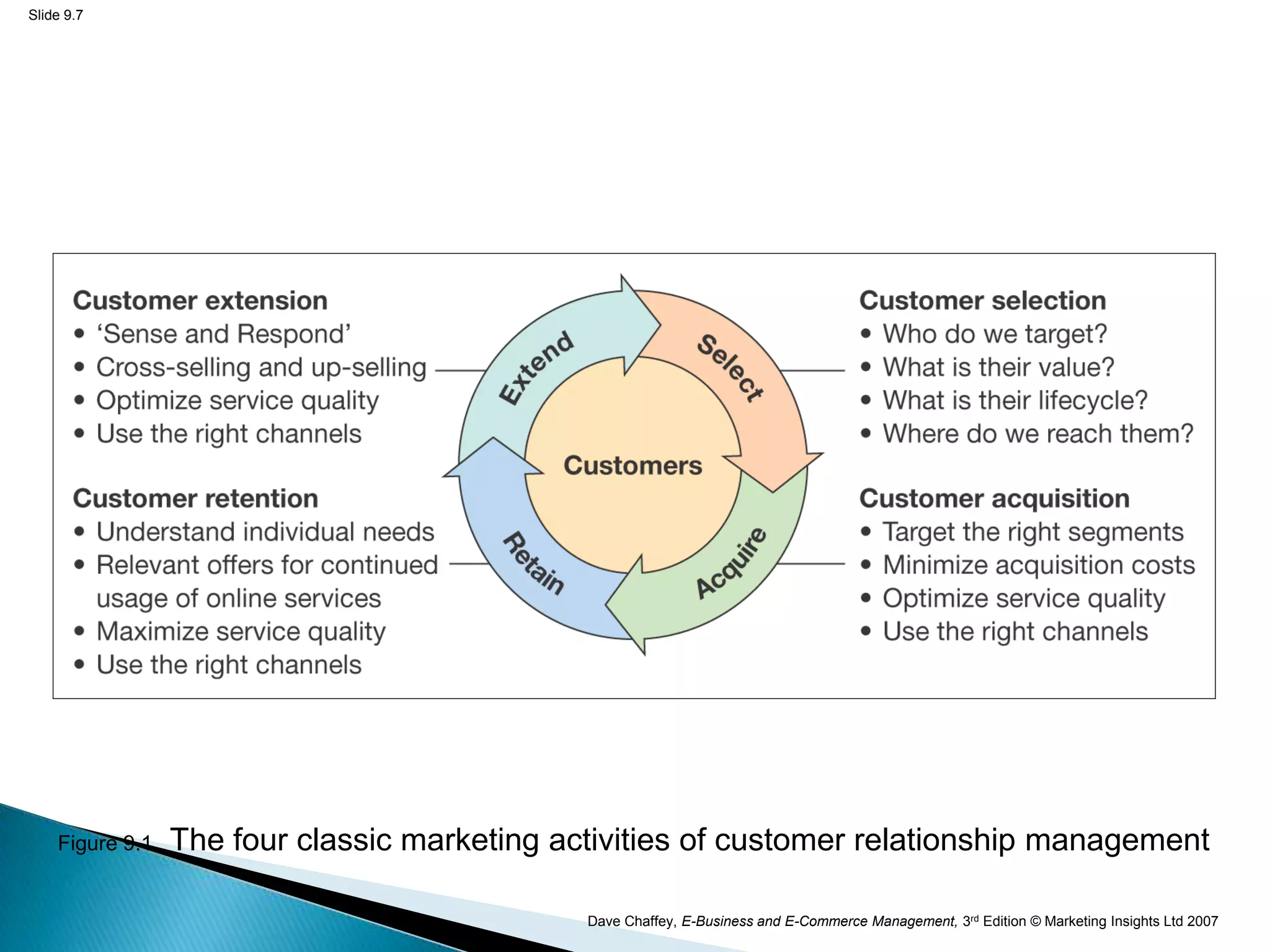
    Figure 9.1   The four classic marketing activities of customer relationship management

                                              Dave Chaffey, E-Business and E-Commerce Management, 3rd Edition © Marketing Insights Ltd 2007
Slide 9.8


    Figure 9.2   A summary of an effective process of online relationship building

                                               Dave Chaffey, E-Business and E-Commerce Management, 3rd Edition © Marketing Insights Ltd 2007
Slide 9.9


    Figure 9.3   Multi-channel conversion model

                                             Dave Chaffey, E-Business and E-Commerce Management, 3rd Edition © Marketing Insights Ltd 2007
Slide 9.10


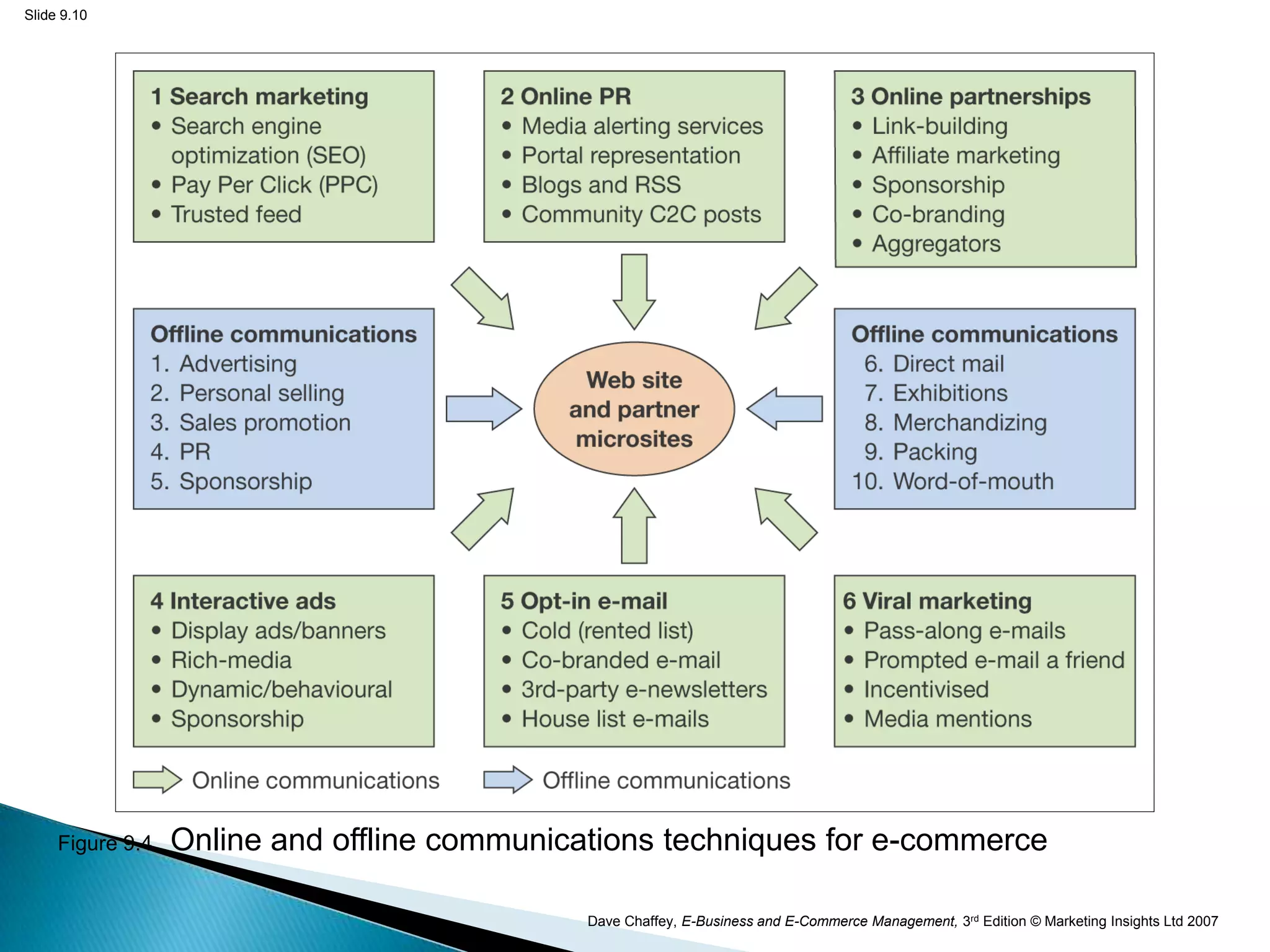
     Figure 9.4   Online and offline communications techniques for e-commerce

                                              Dave Chaffey, E-Business and E-Commerce Management, 3rd Edition © Marketing Insights Ltd 2007
Slide 9.11


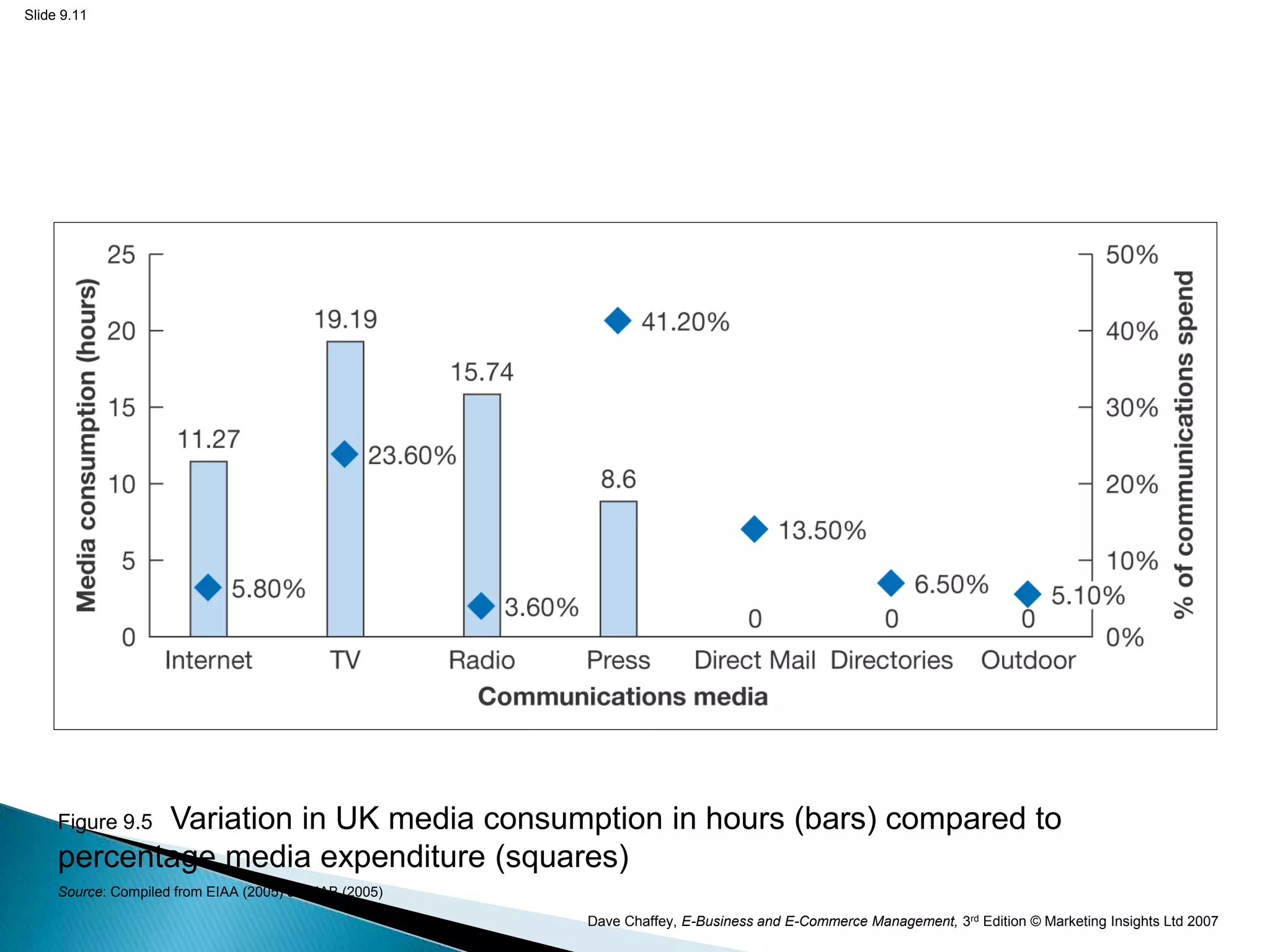
            Variation in UK media consumption in hours (bars) compared to
     Figure 9.5
     percentage media expenditure (squares)
     Source: Compiled from EIAA (2005) and IAB (2005)

                                                        Dave Chaffey, E-Business and E-Commerce Management, 3rd Edition © Marketing Insights Ltd 2007
Slide 9.12


            Measures used for setting campaign objectives or assessing campaign
     Figure 9.6
     success increasing in sophistication from bottom to top
                                        Dave Chaffey, E-Business and E-Commerce Management, 3rd Edition © Marketing Insights Ltd 2007
Slide 9.13


     Figure 9.7   An example of effectiveness measures for an online ad campaign

                                              Dave Chaffey, E-Business and E-Commerce Management, 3rd Edition © Marketing Insights Ltd 2007
Slide 9.14


            Percentage who consider the different information sources as important
     Figure 9.8
     when researching/considering a product or service
     Source: BrandNewWorld: AOL UK/Anne Molen (Cranfield School of Management)/Henley Centre, 2004

                                                                                Dave Chaffey, E-Business and E-Commerce Management, 3rd Edition © Marketing Insights Ltd 2007
Slide 9.15


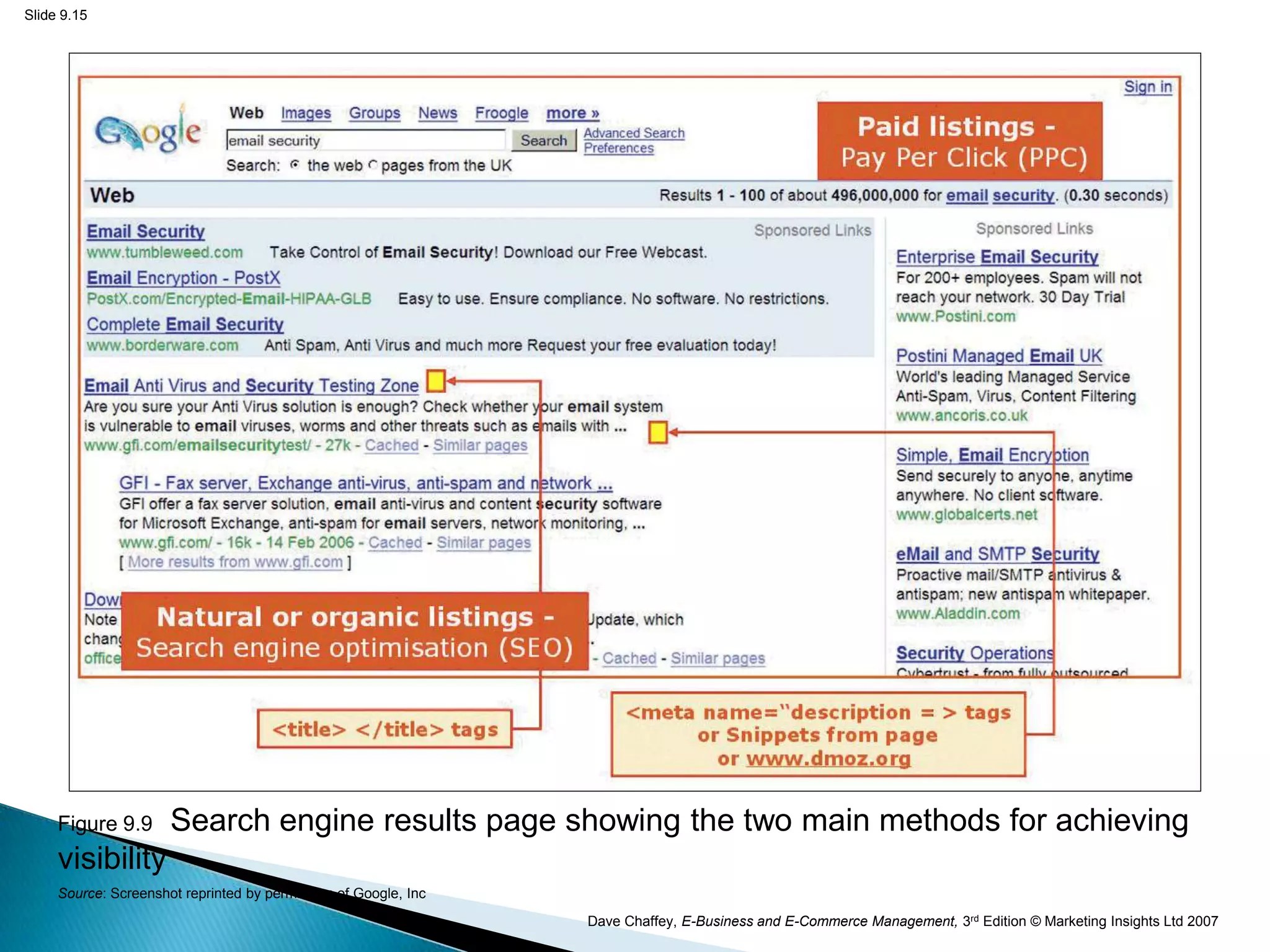
     Figure 9.9       Search engine results page showing the two main methods for achieving
     visibility
     Source: Screenshot reprinted by permission of Google, Inc
                                                                 Dave Chaffey, E-Business and E-Commerce Management, 3rd Edition © Marketing Insights Ltd 2007
Slide 9.16


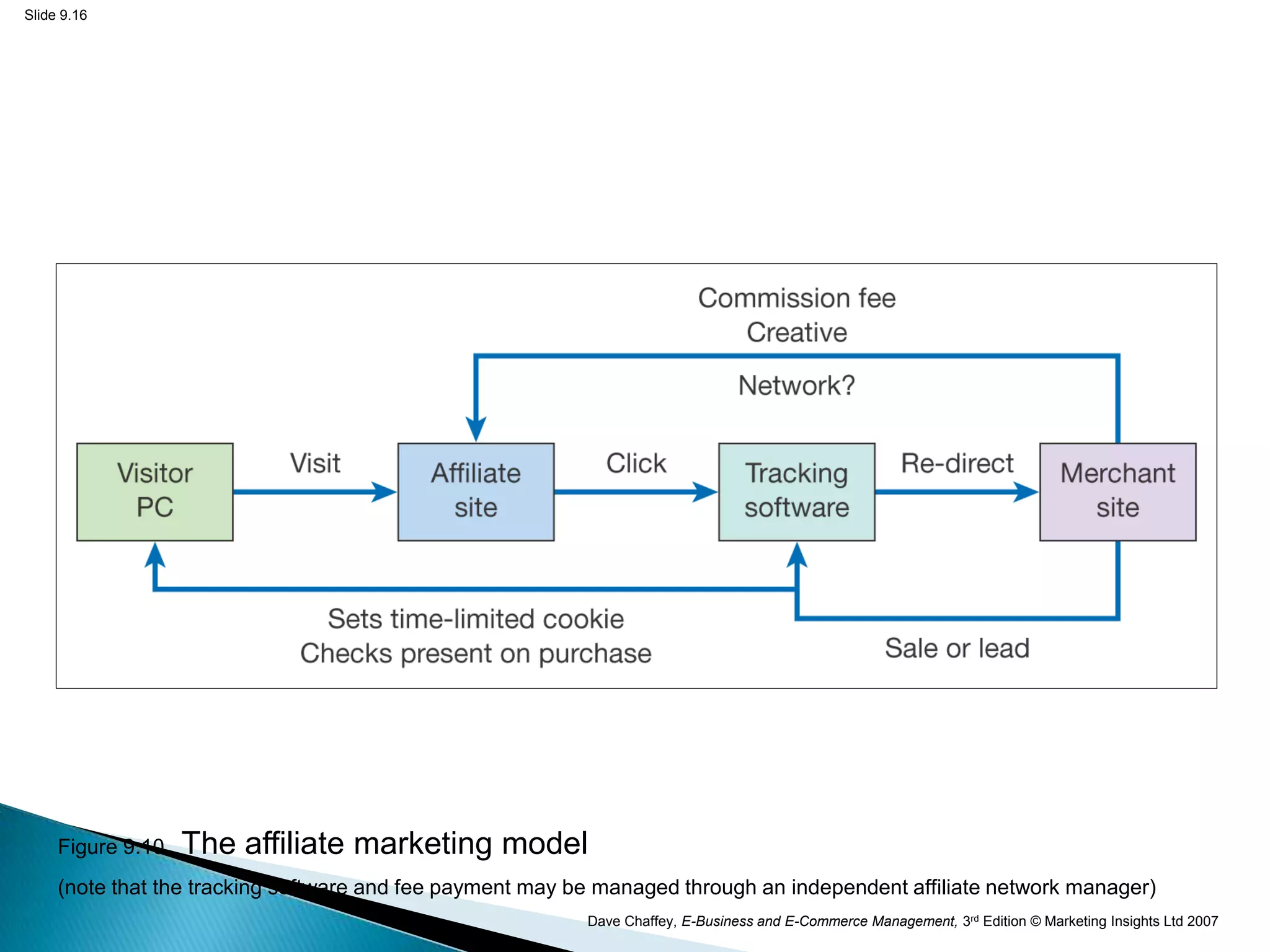
     Figure 9.10   The affiliate marketing model
     (note that the tracking software and fee payment may be managed through an independent affiliate network manager)
                                                           Dave Chaffey, E-Business and E-Commerce Management, 3rd Edition © Marketing Insights Ltd 2007
Slide 9.17


     Figure 9.11        E-mail response figures
     Source: Epsilon Interactive


                                                  Dave Chaffey, E-Business and E-Commerce Management, 3rd Edition © Marketing Insights Ltd 2007
Slide 9.18


     Figure 9.12        Schematic of the relationship between satisfaction and loyalty
     Source: Adapted and reprinted by permission of Harvard Business Review from graph on p. 167 from ‘Putting the service-profit chain to work,’ by Heskett, J., Jones, T., Loveman, G.,
     Sasser, W. and Schlesinger, E., in Harvard Business Review, March–April 1994. Copyright © 1994 by the Harvard Business School Publishing Corporation, all rights reserved

                                                                                        Dave Chaffey, E-Business and E-Commerce Management, 3rd Edition © Marketing Insights Ltd 2007
Slide 9.19


             Relationship between loyalty drivers and measures to assess their success
     Table 9.4
     at Dell Computer
     Source: Reprinted by permission of Harvard Business Review from information on pp. 105–13 from ‘Your secret weapon on the web’, by Reicheld, F. and Schefter, P., in Harvard
     Business Review, July–August 2000. Copyright © 2000 by the Harvard Business School Publishing Corporation, all rights reserved

                                                                                      Dave Chaffey, E-Business and E-Commerce Management, 3rd Edition © Marketing Insights Ltd 2007
Slide 9.20


     Figure 9.13   Activity segmentation of a site requiring registration

                                                 Dave Chaffey, E-Business and E-Commerce Management, 3rd Edition © Marketing Insights Ltd 2007
Slide 9.21


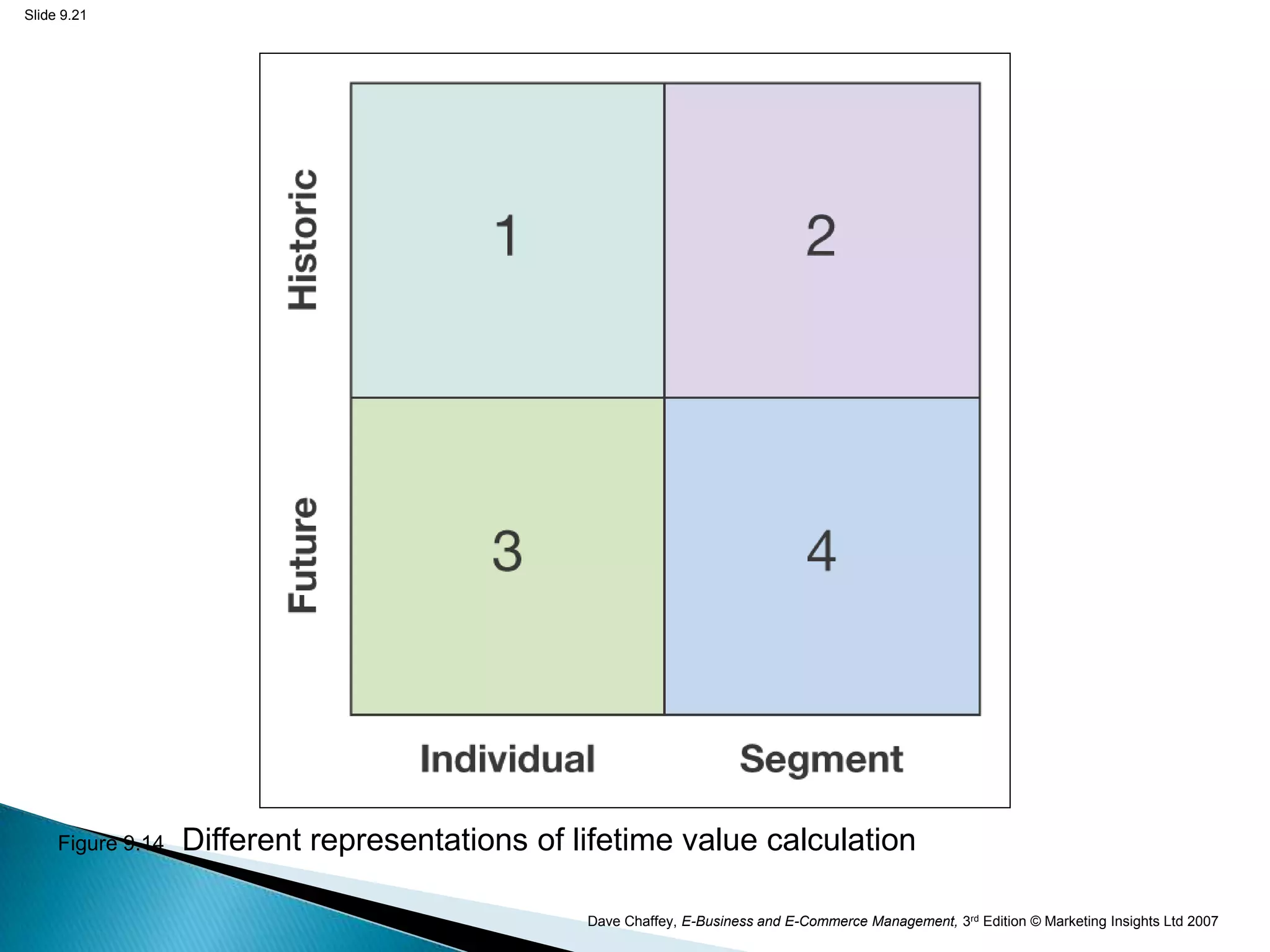
     Figure 9.14   Different representations of lifetime value calculation

                                                 Dave Chaffey, E-Business and E-Commerce Management, 3rd Edition © Marketing Insights Ltd 2007
Slide 9.22


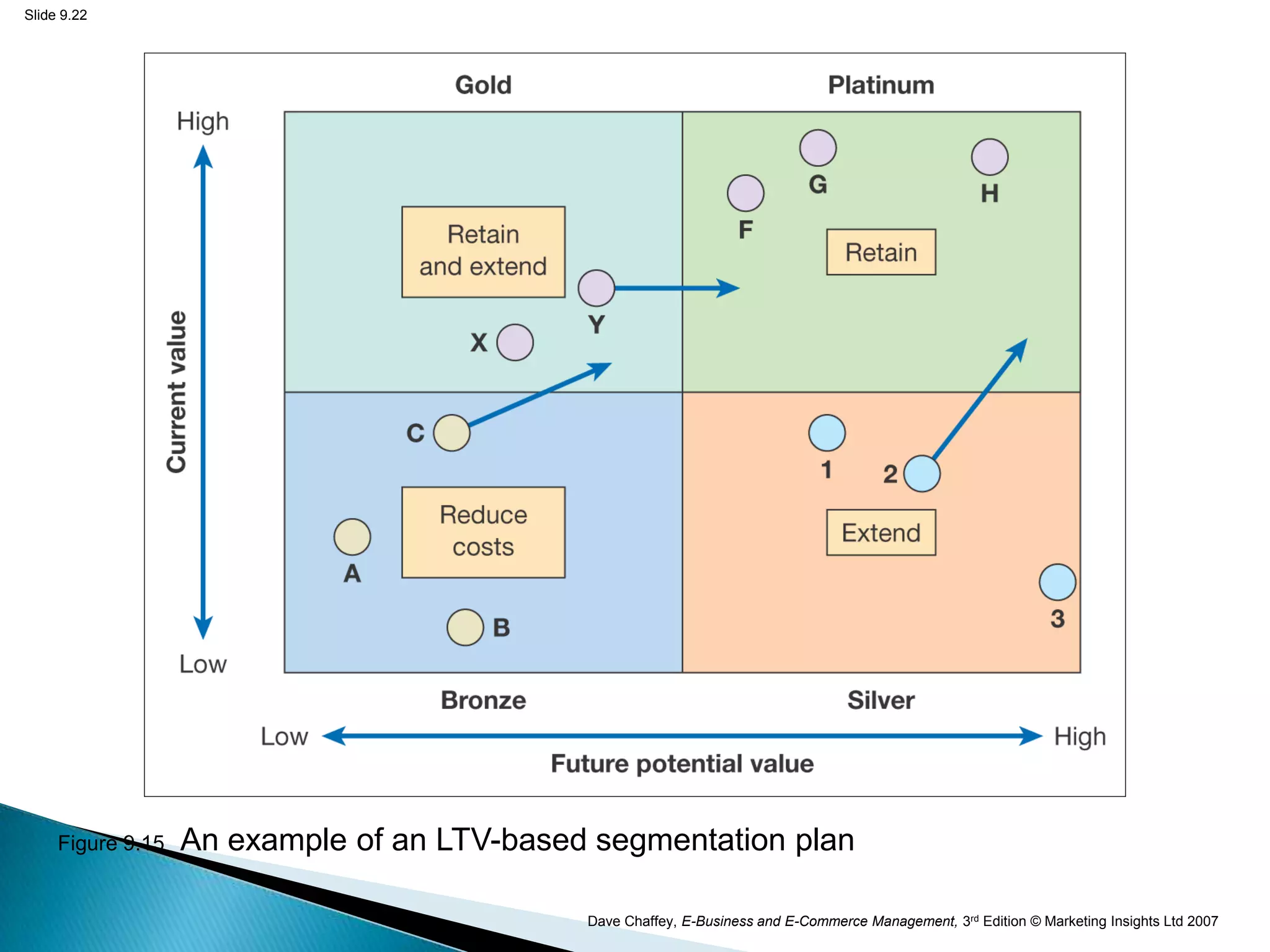
     Figure 9.15   An example of an LTV-based segmentation plan

                                             Dave Chaffey, E-Business and E-Commerce Management, 3rd Edition © Marketing Insights Ltd 2007
Slide 9.23


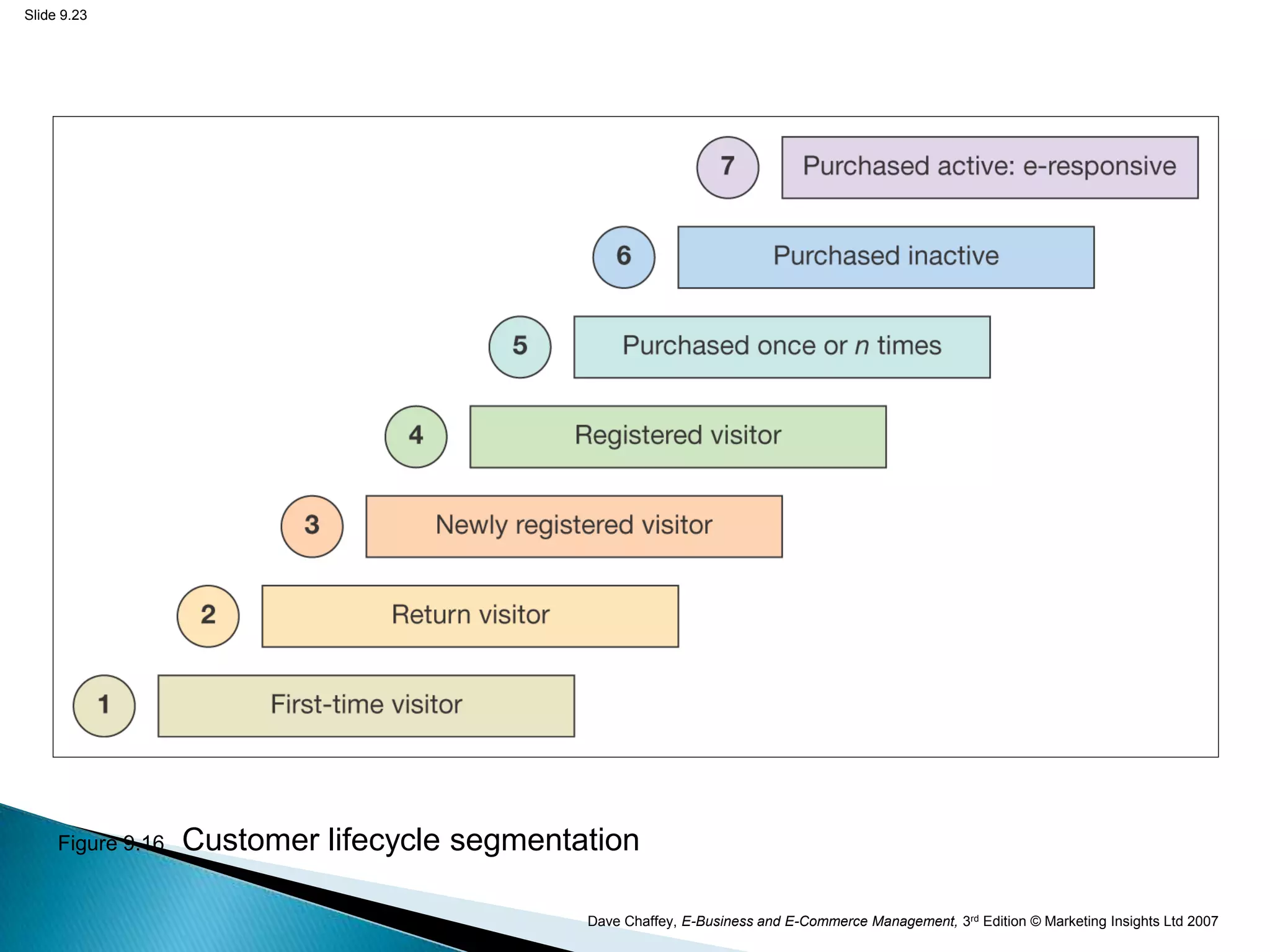
     Figure 9.16   Customer lifecycle segmentation

                                              Dave Chaffey, E-Business and E-Commerce Management, 3rd Edition © Marketing Insights Ltd 2007
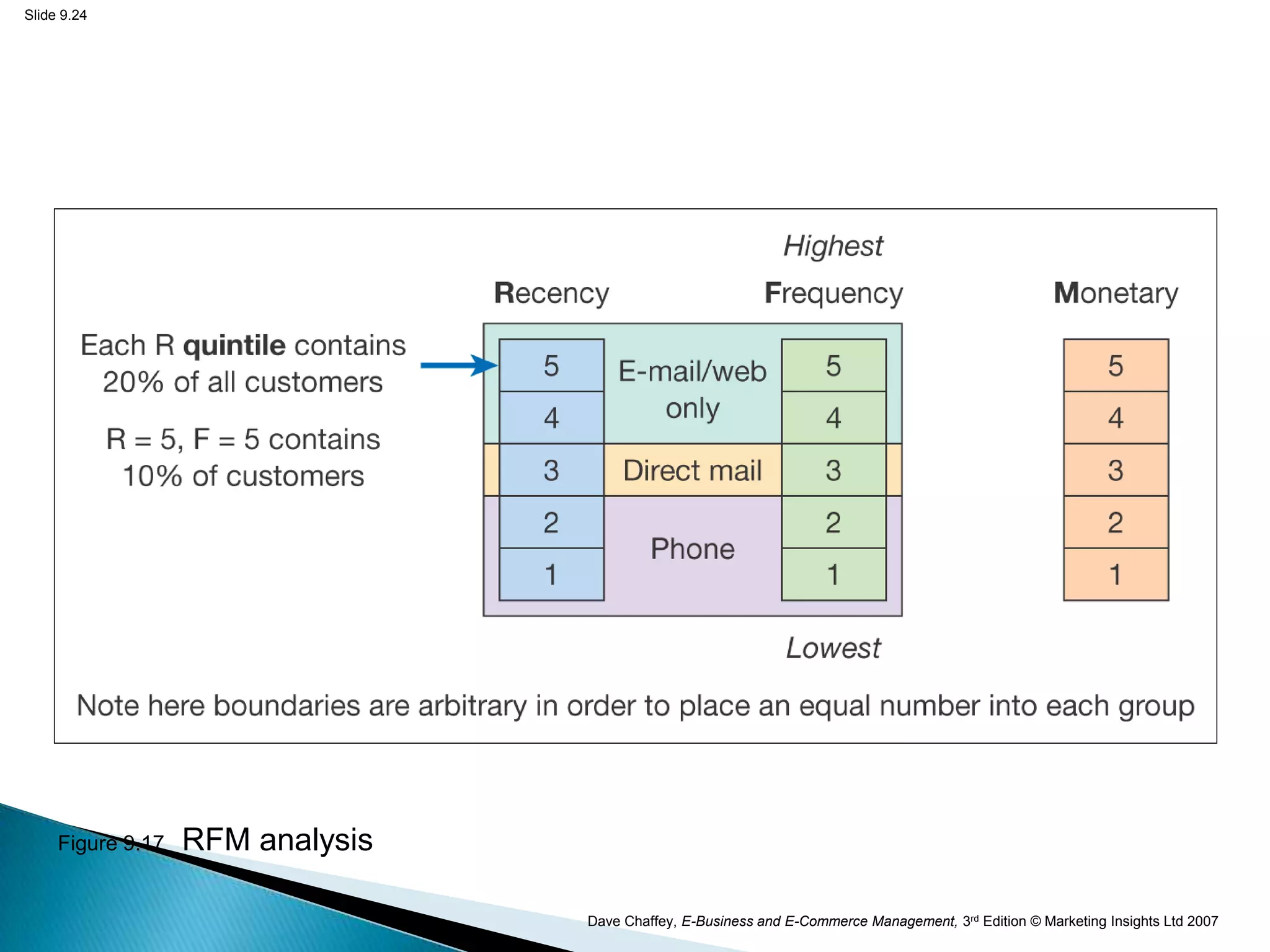
Slide 9.24


     Figure 9.17   RFM analysis

                                  Dave Chaffey, E-Business and E-Commerce Management, 3rd Edition © Marketing Insights Ltd 2007
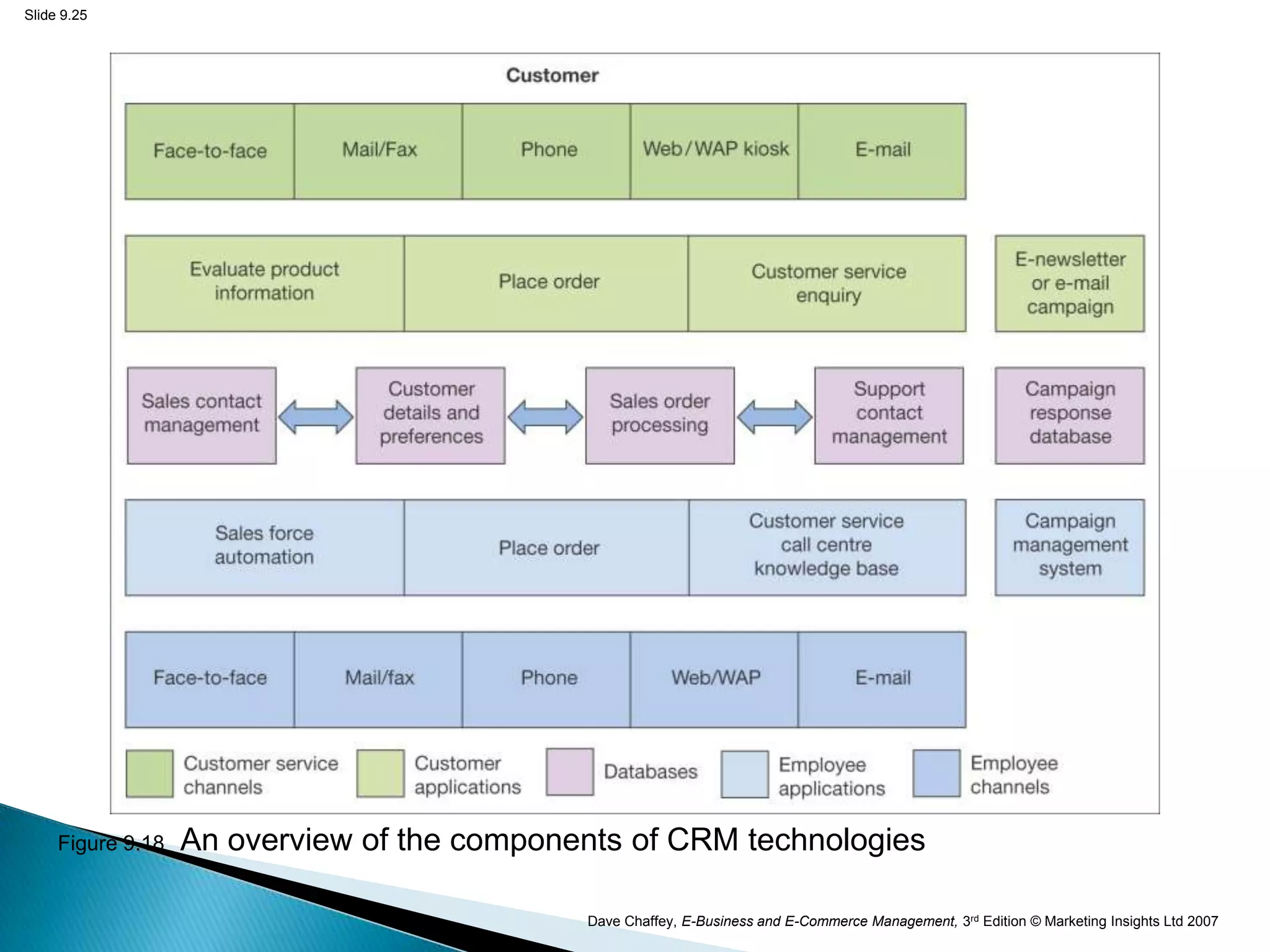
Slide 9.25


     Figure 9.18   An overview of the components of CRM technologies

                                             Dave Chaffey, E-Business and E-Commerce Management, 3rd Edition © Marketing Insights Ltd 2007

CRM [E-Bsiness]

  • 2.
    Slide 9.2  Outline different methods of acquiring customers via electronic media  Evaluate different buyer behaviour amongst online customers  Describe techniques for retaining customers and cross-and up-selling using new media. Dave Chaffey, E-Business and E-Commerce Management, 3rd Edition © Marketing Insights Ltd 2007
  • 3.
    Slide 9.3  What is the balance between online and offline investment for customer acquisition?  What technologies can be used to build and maintain the online relationship?  How do we deliver superior service quality to build and maintain relationships? Dave Chaffey, E-Business and E-Commerce Management, 3rd Edition © Marketing Insights Ltd 2007
  • 4.
    Slide 9.4  You have a job interview for Centrica (AA, British Gas, Goldfish) working in the CRM team www.theaa.co.uk, www.house.co.uk  How would you explain the terms: ◦ CRM ◦ e-CRM  Why does Centrica have a CRM function? ◦ Why is CRM different? ◦ What are benefits of this approach? Dave Chaffey, E-Business and E-Commerce Management, 3rd Edition © Marketing Insights Ltd 2007
  • 5.
    Slide 9.5  E-CRM is:  Applying – Internet and other digital technology… (web, e-mail, wireless, iTV, databases)  To – acquire and retain customers (through a multi-channel buying process and customer lifecycle)  By – Improving customer knowledge, targeting, service delivery and satisfaction. Dave Chaffey, E-Business and E-Commerce Management, 3rd Edition © Marketing Insights Ltd 2007
  • 6.
    Slide 9.6  A CRM system supports the following marketing applications:  Sales force automation (SFA). Sales representatives are supported in their account management through tools to arrange and record customer visits.  Customer service management. Representatives in contact centres respond to customer requests for information by using an intranet to access databases containing information on the customer, products and previous queries.  Managing the sales process. This can be achieved through e- commerce sites, or in a B2B context by supporting sales representatives by recording the sales process (SFA).  Campaign management. Managing ad, direct mail, e-mail and other campaigns.  Analysis. Through technologies such as data warehouses and approaches such as data mining, which are explained later in the chapter, customers’ characteristics, their purchase behaviour and campaigns can be analysed in order to optimize the marketing mix. Dave Chaffey, E-Business and E-Commerce Management, 3rd Edition © Marketing Insights Ltd 2007
  • 7.
    Slide 9.7 Figure 9.1 The four classic marketing activities of customer relationship management Dave Chaffey, E-Business and E-Commerce Management, 3rd Edition © Marketing Insights Ltd 2007
  • 8.
    Slide 9.8 Figure 9.2 A summary of an effective process of online relationship building Dave Chaffey, E-Business and E-Commerce Management, 3rd Edition © Marketing Insights Ltd 2007
  • 9.
    Slide 9.9 Figure 9.3 Multi-channel conversion model Dave Chaffey, E-Business and E-Commerce Management, 3rd Edition © Marketing Insights Ltd 2007
  • 10.
    Slide 9.10 Figure 9.4 Online and offline communications techniques for e-commerce Dave Chaffey, E-Business and E-Commerce Management, 3rd Edition © Marketing Insights Ltd 2007
  • 11.
    Slide 9.11 Variation in UK media consumption in hours (bars) compared to Figure 9.5 percentage media expenditure (squares) Source: Compiled from EIAA (2005) and IAB (2005) Dave Chaffey, E-Business and E-Commerce Management, 3rd Edition © Marketing Insights Ltd 2007
  • 12.
    Slide 9.12 Measures used for setting campaign objectives or assessing campaign Figure 9.6 success increasing in sophistication from bottom to top Dave Chaffey, E-Business and E-Commerce Management, 3rd Edition © Marketing Insights Ltd 2007
  • 13.
    Slide 9.13 Figure 9.7 An example of effectiveness measures for an online ad campaign Dave Chaffey, E-Business and E-Commerce Management, 3rd Edition © Marketing Insights Ltd 2007
  • 14.
    Slide 9.14 Percentage who consider the different information sources as important Figure 9.8 when researching/considering a product or service Source: BrandNewWorld: AOL UK/Anne Molen (Cranfield School of Management)/Henley Centre, 2004 Dave Chaffey, E-Business and E-Commerce Management, 3rd Edition © Marketing Insights Ltd 2007
  • 15.
    Slide 9.15 Figure 9.9 Search engine results page showing the two main methods for achieving visibility Source: Screenshot reprinted by permission of Google, Inc Dave Chaffey, E-Business and E-Commerce Management, 3rd Edition © Marketing Insights Ltd 2007
  • 16.
    Slide 9.16 Figure 9.10 The affiliate marketing model (note that the tracking software and fee payment may be managed through an independent affiliate network manager) Dave Chaffey, E-Business and E-Commerce Management, 3rd Edition © Marketing Insights Ltd 2007
  • 17.
    Slide 9.17 Figure 9.11 E-mail response figures Source: Epsilon Interactive Dave Chaffey, E-Business and E-Commerce Management, 3rd Edition © Marketing Insights Ltd 2007
  • 18.
    Slide 9.18 Figure 9.12 Schematic of the relationship between satisfaction and loyalty Source: Adapted and reprinted by permission of Harvard Business Review from graph on p. 167 from ‘Putting the service-profit chain to work,’ by Heskett, J., Jones, T., Loveman, G., Sasser, W. and Schlesinger, E., in Harvard Business Review, March–April 1994. Copyright © 1994 by the Harvard Business School Publishing Corporation, all rights reserved Dave Chaffey, E-Business and E-Commerce Management, 3rd Edition © Marketing Insights Ltd 2007
  • 19.
    Slide 9.19 Relationship between loyalty drivers and measures to assess their success Table 9.4 at Dell Computer Source: Reprinted by permission of Harvard Business Review from information on pp. 105–13 from ‘Your secret weapon on the web’, by Reicheld, F. and Schefter, P., in Harvard Business Review, July–August 2000. Copyright © 2000 by the Harvard Business School Publishing Corporation, all rights reserved Dave Chaffey, E-Business and E-Commerce Management, 3rd Edition © Marketing Insights Ltd 2007
  • 20.
    Slide 9.20 Figure 9.13 Activity segmentation of a site requiring registration Dave Chaffey, E-Business and E-Commerce Management, 3rd Edition © Marketing Insights Ltd 2007
  • 21.
    Slide 9.21 Figure 9.14 Different representations of lifetime value calculation Dave Chaffey, E-Business and E-Commerce Management, 3rd Edition © Marketing Insights Ltd 2007
  • 22.
    Slide 9.22 Figure 9.15 An example of an LTV-based segmentation plan Dave Chaffey, E-Business and E-Commerce Management, 3rd Edition © Marketing Insights Ltd 2007
  • 23.
    Slide 9.23 Figure 9.16 Customer lifecycle segmentation Dave Chaffey, E-Business and E-Commerce Management, 3rd Edition © Marketing Insights Ltd 2007
  • 24.
    Slide 9.24 Figure 9.17 RFM analysis Dave Chaffey, E-Business and E-Commerce Management, 3rd Edition © Marketing Insights Ltd 2007
  • 25.
    Slide 9.25 Figure 9.18 An overview of the components of CRM technologies Dave Chaffey, E-Business and E-Commerce Management, 3rd Edition © Marketing Insights Ltd 2007