HVDC AND LINKS
 BY:G.MOHAMMED MUSTAFA
EEE-THIRD-YEAR
DHAANISH AHMED OF COLLEGE
OF ENGG.
INTRODUCTION
HVDC Stands for High Voltage Direct Current and
is today a well-proven technology employed for
power transmission all over the world.
HVDC technology is used to transmit electricity
over long distances by overhead transmission
lines or submarine cables.
It is also used to interconnect separate power
systems,where traditional alternating current(AC)
connections can not be used.
Different Categories of HVDC Transmissions
Non-synchronous
Submarine cable
Long-distance
Overhead lines
Underground cable
HVDC System Configuration
HVDC links can be broadly classifield into:
Monopolar links
Bipolar links
Homopolar links
Monopolar Links
It uses one conductor
The return path is provided by
ground or water
Use of this system is mainly due
to cost considerations.
A Mettalic return may be used
where earth resistivity is too
high.
This configuration type is the
first step towards a bipolar link
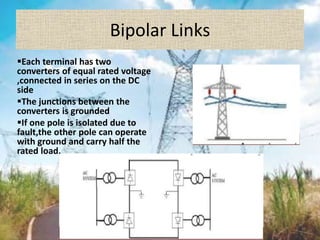
Bipolar Links
Each terminal has two
converters of equal rated voltage
,connected in series on the DC
side
The junctions between the
converters is grounded
If one pole is isolated due to
fault,the other pole can operate
with ground and carry half the
rated load.
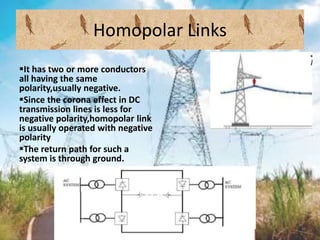
Homopolar Links
It has two or more conductors
all having the same
polarity,usually negative.
Since the corona effect in DC
transmission lines is less for
negative polarity,homopolar link
is usually operated with negative
polarity
The return path for such a
system is through ground.
Components of HVDC Transmission
Systems
Converters
Smoothing reactors
Harmonic filters
Reactive power supplies
Electrodes
DC lines
AC circuit breakers
Control of HVDC systems
Objectives of Control
• Efficient and stable operation .
• Maximum flexibility of power control without
compromising the safety of equipment.
• Principle of operation of various control
systems.
• Implementation and their performance during
normal and abnormal system conditions.
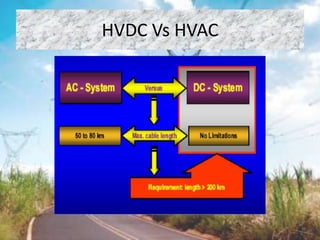
WHY TO PREFER HVDC THAN HVAC?
Long distance transmission
Five times more energy transmits than AC
Less losses(no inductance,capacitance)
Cost of transmission medium & land is low
Maintenance & operation cost is low
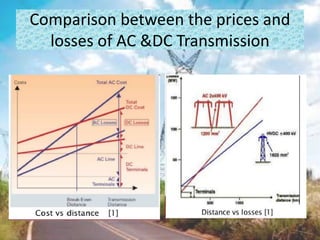
Intial cost is high but overall cost is low than
AC
HVDC Vs HVAC
Comparison between the prices and
losses of AC &DC Transmission
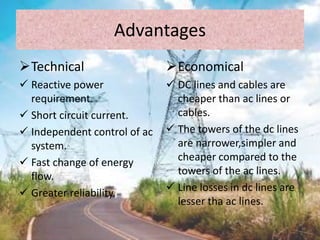
Advantages
Technical
 Reactive power
requirement.
 Short circuit current.
 Independent control of ac
system.
 Fast change of energy
flow.
 Greater reliability.
Economical
 DC lines and cables are
cheaper than ac lines or
cables.
 The towers of the dc lines
are narrower,simpler and
cheaper compared to the
towers of the ac lines.
 Line losses in dc lines are
lesser tha ac lines.
Disadvantages
The disadvantages of HVDC are in
conversion,switching and control.
Expensive inverters with limited overload
capacity.
Higher losses in static inverters at smaller
transmission distances .
The cost of the inverters may not be offset by
reductions in line construction cost and lower
line loss.
Conclusion
HVDC is very important issue in transmission
energy.
Problem of cascade blackout,can be reduced
by application of HVDC.
The data collected from 31 utilities says that
forced unavailability of energy due to the
converter station is 1.72percent.
The scheduled unavailability of energy is
about five percent.
QUERIES????
THANK YOU
PRESENTED BY:
G.MOHAMMEDMUSTAFA
EEE-THIRD-YEAR
DHAANISH AHMED COOLEGE OF ENGG.

MUSTAFA MASS HVDC PPT

  • 1.
    HVDC AND LINKS BY:G.MOHAMMED MUSTAFA EEE-THIRD-YEAR DHAANISH AHMED OF COLLEGE OF ENGG.
  • 2.
    INTRODUCTION HVDC Stands forHigh Voltage Direct Current and is today a well-proven technology employed for power transmission all over the world. HVDC technology is used to transmit electricity over long distances by overhead transmission lines or submarine cables. It is also used to interconnect separate power systems,where traditional alternating current(AC) connections can not be used.
  • 3.
    Different Categories ofHVDC Transmissions Non-synchronous Submarine cable Long-distance Overhead lines Underground cable
  • 4.
    HVDC System Configuration HVDClinks can be broadly classifield into: Monopolar links Bipolar links Homopolar links
  • 5.
    Monopolar Links It usesone conductor The return path is provided by ground or water Use of this system is mainly due to cost considerations. A Mettalic return may be used where earth resistivity is too high. This configuration type is the first step towards a bipolar link
  • 6.
    Bipolar Links Each terminalhas two converters of equal rated voltage ,connected in series on the DC side The junctions between the converters is grounded If one pole is isolated due to fault,the other pole can operate with ground and carry half the rated load.
  • 7.
    Homopolar Links It hastwo or more conductors all having the same polarity,usually negative. Since the corona effect in DC transmission lines is less for negative polarity,homopolar link is usually operated with negative polarity The return path for such a system is through ground.
  • 8.
    Components of HVDCTransmission Systems Converters Smoothing reactors Harmonic filters Reactive power supplies Electrodes DC lines AC circuit breakers
  • 9.
    Control of HVDCsystems Objectives of Control • Efficient and stable operation . • Maximum flexibility of power control without compromising the safety of equipment. • Principle of operation of various control systems. • Implementation and their performance during normal and abnormal system conditions.
  • 10.
    WHY TO PREFERHVDC THAN HVAC? Long distance transmission Five times more energy transmits than AC Less losses(no inductance,capacitance) Cost of transmission medium & land is low Maintenance & operation cost is low Intial cost is high but overall cost is low than AC
  • 11.
  • 12.
    Comparison between theprices and losses of AC &DC Transmission
  • 13.
    Advantages Technical  Reactive power requirement. Short circuit current.  Independent control of ac system.  Fast change of energy flow.  Greater reliability. Economical  DC lines and cables are cheaper than ac lines or cables.  The towers of the dc lines are narrower,simpler and cheaper compared to the towers of the ac lines.  Line losses in dc lines are lesser tha ac lines.
  • 14.
    Disadvantages The disadvantages ofHVDC are in conversion,switching and control. Expensive inverters with limited overload capacity. Higher losses in static inverters at smaller transmission distances . The cost of the inverters may not be offset by reductions in line construction cost and lower line loss.
  • 15.
    Conclusion HVDC is veryimportant issue in transmission energy. Problem of cascade blackout,can be reduced by application of HVDC. The data collected from 31 utilities says that forced unavailability of energy due to the converter station is 1.72percent. The scheduled unavailability of energy is about five percent.
  • 16.
  • 17.