JAGDHAMBHA COLLEGE
OF ENGINEERING &
TECHNOLOGY,
YAVATMAL
A
Seminar
On
“HVDC TRANSMISSION”
Guided By Presented By
Pro. V. D. CHIKATE SWAPNIL P. JAGTAP
(Electrical Engg. Dept.) (Electrical Final Year)
CONTENTS
• Introduction
• Why DC transmission ?
• Components of HVDC system
• HVDC system configuration
• Applications of HVDC in india
• Advantages
• Disadvantages
• Conclusion
• References
INTRODUCTION
• The HVDC (High Voltage Direct Current) is used to transmit
electricity over long distance.
• HVDC electric power transmission system also called a power
superhighway or an electrical superhighway.
• The modern form of HVDC transmission uses technology
developed extensively in the 1930s in Sweden and
in Germany.
• The first HVDC transmission link was designed in 1954
between Goltland and Mainland in Sweden .
• The longest HVDC link in the world is the Rio Madeira link
in Brazil (2385 km), which consists of two bipoles of
±600 kV,
3150 MW each.
Why DC Transmission..?
• Losses are less.
• Only two conductors are
required for DC with
negative & positive polarity.
• Less Expensive.
• Can be used for long distance.
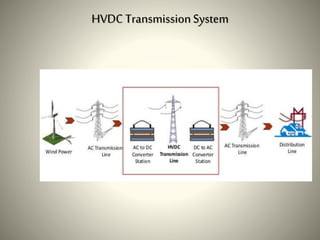
HVDC TransmissionSystem
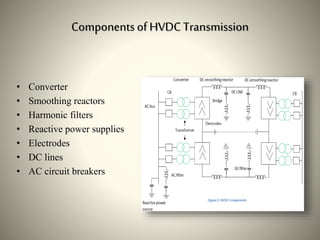
Components of HVDC Transmission
• Converter
• Smoothing reactors
• Harmonic filters
• Reactive power supplies
• Electrodes
• DC lines
• AC circuit breakers
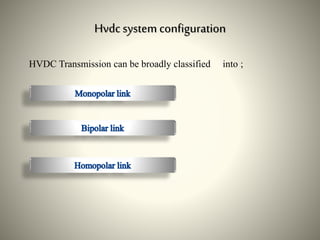
Hvdc system configuration
HVDC Transmission can be broadly classified into ;
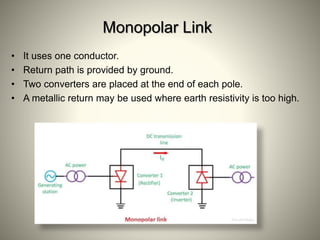
Monopolar Link
• It uses one conductor.
• Return path is provided by ground.
• Two converters are placed at the end of each pole.
• A metallic return may be used where earth resistivity is too high.
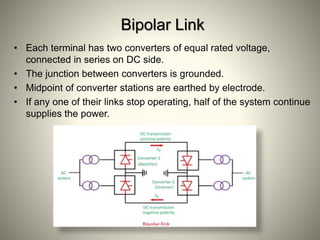
Bipolar Link
• Each terminal has two converters of equal rated voltage,
connected in series on DC side.
• The junction between converters is grounded.
• Midpoint of converter stations are earthed by electrode.
• If any one of their links stop operating, half of the system continue
supplies the power.
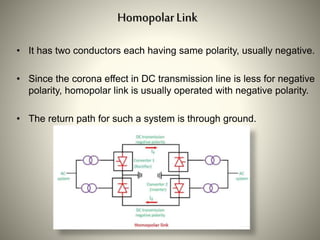
HomopolarLink
• It has two conductors each having same polarity, usually negative.
• Since the corona effect in DC transmission line is less for negative
polarity, homopolar link is usually operated with negative polarity.
• The return path for such a system is through ground.
Application of HVDC in India
• 1990: Rihand-Delhi is the first HVDC transmission line in India
which transmit 1500MW power over 814km and its
transmission voltage is 500kV.
• 2003: India’s 1450km long Talcher-Kolar transmission link is
the World’s fifth longest HVDC transmission line and has a
rated capacity of 2500MW.
• Raigarh-Pugalur 800kV, 1830km link will be among the
longest UHVDC transmission line in the world. It will transmit
6000MW power.
Disadvantages
• High cost converting and inverting equipments are required
for HVDC transmission.
• Converters control is quite complex.
• Expensive inverters with limited overload capacity.
• Circuit breakers are used in HVDC for circuit breaking, which is also
very expensive.
•
conclusion
Recent studies indicate that the HVDC system are
very reliable. HVDC offers powerful alternative to increase
stability of a power system as well as to improve system
operating flexibility and loss reduction. To keep the losses at
minimum level, control system shall be design to keep as high
voltage as possible.
references
• J. Dorn, H. Gambach, D. Retzmann (2012). HVDC
transmission transmission technology for sustainable power
supply. Internal Multi-Conference on System, Signals &
Devices.
https://dio.10.1109/ssd.2012.6198109
• T. J. Hammons, V. F. Lescale, K. Uecker, M. Haeusler (2012).
State of the Art in Ultrahigh-Voltage Transmission.
https://doi.org/10.1109/JPROC.2011.2152310
HVDC transmission

HVDC transmission

  • 1.
    JAGDHAMBHA COLLEGE OF ENGINEERING& TECHNOLOGY, YAVATMAL A Seminar On “HVDC TRANSMISSION” Guided By Presented By Pro. V. D. CHIKATE SWAPNIL P. JAGTAP (Electrical Engg. Dept.) (Electrical Final Year)
  • 2.
    CONTENTS • Introduction • WhyDC transmission ? • Components of HVDC system • HVDC system configuration • Applications of HVDC in india • Advantages • Disadvantages • Conclusion • References
  • 3.
    INTRODUCTION • The HVDC(High Voltage Direct Current) is used to transmit electricity over long distance. • HVDC electric power transmission system also called a power superhighway or an electrical superhighway. • The modern form of HVDC transmission uses technology developed extensively in the 1930s in Sweden and in Germany. • The first HVDC transmission link was designed in 1954 between Goltland and Mainland in Sweden . • The longest HVDC link in the world is the Rio Madeira link in Brazil (2385 km), which consists of two bipoles of ±600 kV, 3150 MW each.
  • 4.
    Why DC Transmission..? •Losses are less. • Only two conductors are required for DC with negative & positive polarity. • Less Expensive. • Can be used for long distance.
  • 5.
  • 6.
    Components of HVDCTransmission • Converter • Smoothing reactors • Harmonic filters • Reactive power supplies • Electrodes • DC lines • AC circuit breakers
  • 7.
    Hvdc system configuration HVDCTransmission can be broadly classified into ;
  • 8.
    Monopolar Link • Ituses one conductor. • Return path is provided by ground. • Two converters are placed at the end of each pole. • A metallic return may be used where earth resistivity is too high.
  • 9.
    Bipolar Link • Eachterminal has two converters of equal rated voltage, connected in series on DC side. • The junction between converters is grounded. • Midpoint of converter stations are earthed by electrode. • If any one of their links stop operating, half of the system continue supplies the power.
  • 10.
    HomopolarLink • It hastwo conductors each having same polarity, usually negative. • Since the corona effect in DC transmission line is less for negative polarity, homopolar link is usually operated with negative polarity. • The return path for such a system is through ground.
  • 11.
    Application of HVDCin India • 1990: Rihand-Delhi is the first HVDC transmission line in India which transmit 1500MW power over 814km and its transmission voltage is 500kV. • 2003: India’s 1450km long Talcher-Kolar transmission link is the World’s fifth longest HVDC transmission line and has a rated capacity of 2500MW. • Raigarh-Pugalur 800kV, 1830km link will be among the longest UHVDC transmission line in the world. It will transmit 6000MW power.
  • 12.
    Disadvantages • High costconverting and inverting equipments are required for HVDC transmission. • Converters control is quite complex. • Expensive inverters with limited overload capacity. • Circuit breakers are used in HVDC for circuit breaking, which is also very expensive. •
  • 13.
    conclusion Recent studies indicatethat the HVDC system are very reliable. HVDC offers powerful alternative to increase stability of a power system as well as to improve system operating flexibility and loss reduction. To keep the losses at minimum level, control system shall be design to keep as high voltage as possible.
  • 14.
    references • J. Dorn,H. Gambach, D. Retzmann (2012). HVDC transmission transmission technology for sustainable power supply. Internal Multi-Conference on System, Signals & Devices. https://dio.10.1109/ssd.2012.6198109 • T. J. Hammons, V. F. Lescale, K. Uecker, M. Haeusler (2012). State of the Art in Ultrahigh-Voltage Transmission. https://doi.org/10.1109/JPROC.2011.2152310