Working in an open and digital world
Helen Darlaston
Open Pedagogy and NCT
1
Delivered online:
• Futurelearn.
• Open Learn
• Tutorials via Adobe connect
2
MAODE
Masters in Online and Distance Learning
3
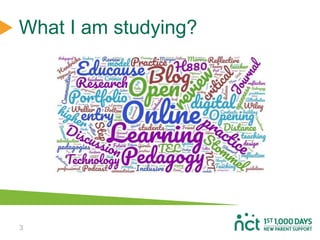
What I am studying?
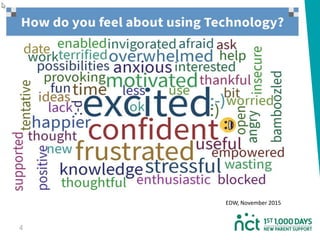
4
EDW, November 2015
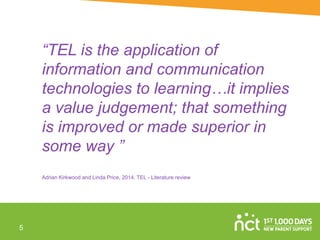
“TEL is the application of
information and communication
technologies to learning…it implies
a value judgement; that something
is improved or made superior in
some way ”
Adrian Kirkwood and Linda Price, 2014. TEL - Literature review
5
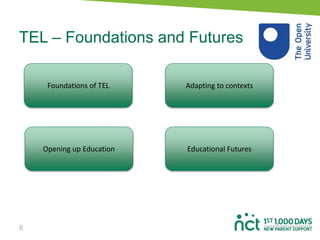
TEL – Foundations and Futures
6
Foundations of TEL Adapting to contexts
Opening up Education Educational Futures
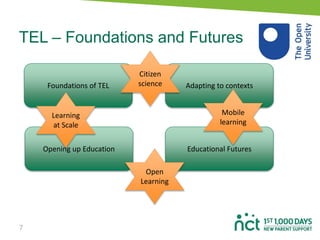
TEL – Foundations and Futures
7
Foundations of TEL Adapting to contexts
Opening up Education Educational Futures
Mobile
learning
Learning
at Scale
Citizen
science
Open
Learning
8
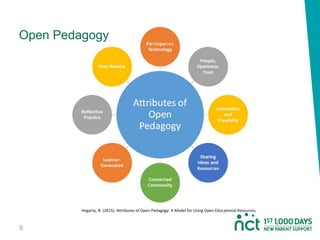
Open Pedagogy
Hegarty, B. (2015). Attributes of Open Pedagogy: A Model for Using Open Educational Resources.
9
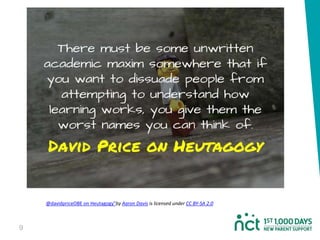
@davidpriceOBE on Heutagogy"by Aaron Davis is licensed under CC BY-SA 2.0
10
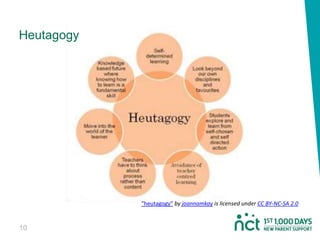
Heutagogy
"heutagogy" by joannamkay is licensed under CC BY-NC-SA 2.0
“In heutagogy, learning moves from self-
direction to self-determination. The role of the
teacher is to facilitate learning and students
take responsibility for creating their own
learning pathway by choosing what they want
to learn, setting learning goals and choosing
the most appropriate method of learning to
them. In doing so students develop the
capability to become autonomous and lifelong
learners.”
1111
Higher Education Academy (2017)
“By opening up education, making it
inclusive and accessible, and by
encouraging reflection and self-
determined learners we run the risk of
opening up challenging conversations,
between ourselves, and with our
students, as it could highlight innate
bias within our own practice”
Julie Fellmayer, 2018. Disruptive Pedagogy and the Practice of Freedom
1212
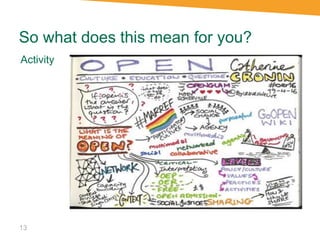
So what does this mean for you?
13
Activity
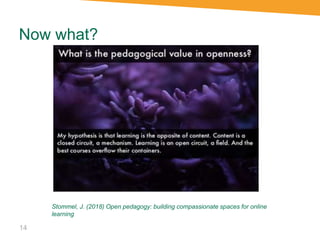
Now what?
14
Stommel, J. (2018) Open pedagogy: building compassionate spaces for online
learning
Now what?
15
Small things you can do to work more openly:
• Use Social media to disseminate.
• Write a Blog.
• Publish online.
• Trust students. Allow them to explore.
• Encourage students to work openly.
“It has never been more risky to
operate in the open and yet it has
never been more vital…”
Martin Weller (2016) The Paradoxes of Open Scholarship.
1616
17
References
Cronin, C. (2017) Open education – open questions, Educause review. Available from:
https://er.educause.edu/articles/2017/10/open-education-open-questions
Fellmayer, J. (2018) Disruptive pedagogy and the practice of freedom, Hybrid Pedagogy. Available
from: https://hybridpedagogy.org/disruptive-pedagogy-and-the-practice-of-freedom/
Higher Education Academy (2017) Available from: https://www.heacademy.ac.uk/knowledge-
hub/heutagogy
Hegarty, B (2015) Attributes of open pedagogy: A model for using open educational resources.
Available from: www.jstor.org/stable/44430383
Kirkwood, A. and Price, L. (2014) ‘Technology-enhanced learning and teaching in higher education:
what is 'enhanced' and how do we know? A critical literature review’, Learning, Media and
Technology. Routledge, 39(1), pp. 6–36. doi: 10.1080/17439884.2013.770404.
Stommel, J. (2018) Open pedagogy: building compassionate spaces for online learning, Slideshare.
Available from: https://www.slideshare.net/jessestommel/open-pedagogy-building-compassionate-
spaces-for-online-learning
Weller, M. (2016) The paradoxes of open scholarship. The Ed Techie, 12th December 2016 [Blog]
Available from: https://blog.edtechie.net/openness/the-paradoxes-of-open-scholarship/
Thank you
Helen Darlaston
Twitter: @CydrinHD
LinkedIn: Helen Darlaston
Blog: Analogue Brain in a Digital World.
https://analoguebrain353139835.wordpress.com
Des971-i
18 © NCT 2018. NCT is a trading name of The National Childbirth Trust. Limited company registered in England and Wales: 2370573.
Registered office: 30 Euston Square, Stephenson Way, London, England NW1 2FB. Registered charity in England and Wales: 801395 and Scotland: SC041592.

NCT Education and Practice weekend 2019

  • 1.
    Working in anopen and digital world Helen Darlaston Open Pedagogy and NCT 1
  • 2.
    Delivered online: • Futurelearn. •Open Learn • Tutorials via Adobe connect 2 MAODE Masters in Online and Distance Learning
  • 3.
    3 What I amstudying?
  • 4.
  • 5.
    “TEL is theapplication of information and communication technologies to learning…it implies a value judgement; that something is improved or made superior in some way ” Adrian Kirkwood and Linda Price, 2014. TEL - Literature review 5
  • 6.
    TEL – Foundationsand Futures 6 Foundations of TEL Adapting to contexts Opening up Education Educational Futures
  • 7.
    TEL – Foundationsand Futures 7 Foundations of TEL Adapting to contexts Opening up Education Educational Futures Mobile learning Learning at Scale Citizen science Open Learning
  • 8.
    8 Open Pedagogy Hegarty, B.(2015). Attributes of Open Pedagogy: A Model for Using Open Educational Resources.
  • 9.
    9 @davidpriceOBE on Heutagogy"byAaron Davis is licensed under CC BY-SA 2.0
  • 10.
    10 Heutagogy "heutagogy" by joannamkayis licensed under CC BY-NC-SA 2.0
  • 11.
    “In heutagogy, learningmoves from self- direction to self-determination. The role of the teacher is to facilitate learning and students take responsibility for creating their own learning pathway by choosing what they want to learn, setting learning goals and choosing the most appropriate method of learning to them. In doing so students develop the capability to become autonomous and lifelong learners.” 1111 Higher Education Academy (2017)
  • 12.
    “By opening upeducation, making it inclusive and accessible, and by encouraging reflection and self- determined learners we run the risk of opening up challenging conversations, between ourselves, and with our students, as it could highlight innate bias within our own practice” Julie Fellmayer, 2018. Disruptive Pedagogy and the Practice of Freedom 1212
  • 13.
    So what doesthis mean for you? 13 Activity
  • 14.
    Now what? 14 Stommel, J.(2018) Open pedagogy: building compassionate spaces for online learning
  • 15.
    Now what? 15 Small thingsyou can do to work more openly: • Use Social media to disseminate. • Write a Blog. • Publish online. • Trust students. Allow them to explore. • Encourage students to work openly.
  • 16.
    “It has neverbeen more risky to operate in the open and yet it has never been more vital…” Martin Weller (2016) The Paradoxes of Open Scholarship. 1616
  • 17.
    17 References Cronin, C. (2017)Open education – open questions, Educause review. Available from: https://er.educause.edu/articles/2017/10/open-education-open-questions Fellmayer, J. (2018) Disruptive pedagogy and the practice of freedom, Hybrid Pedagogy. Available from: https://hybridpedagogy.org/disruptive-pedagogy-and-the-practice-of-freedom/ Higher Education Academy (2017) Available from: https://www.heacademy.ac.uk/knowledge- hub/heutagogy Hegarty, B (2015) Attributes of open pedagogy: A model for using open educational resources. Available from: www.jstor.org/stable/44430383 Kirkwood, A. and Price, L. (2014) ‘Technology-enhanced learning and teaching in higher education: what is 'enhanced' and how do we know? A critical literature review’, Learning, Media and Technology. Routledge, 39(1), pp. 6–36. doi: 10.1080/17439884.2013.770404. Stommel, J. (2018) Open pedagogy: building compassionate spaces for online learning, Slideshare. Available from: https://www.slideshare.net/jessestommel/open-pedagogy-building-compassionate- spaces-for-online-learning Weller, M. (2016) The paradoxes of open scholarship. The Ed Techie, 12th December 2016 [Blog] Available from: https://blog.edtechie.net/openness/the-paradoxes-of-open-scholarship/
  • 18.
    Thank you Helen Darlaston Twitter:@CydrinHD LinkedIn: Helen Darlaston Blog: Analogue Brain in a Digital World. https://analoguebrain353139835.wordpress.com Des971-i 18 © NCT 2018. NCT is a trading name of The National Childbirth Trust. Limited company registered in England and Wales: 2370573. Registered office: 30 Euston Square, Stephenson Way, London, England NW1 2FB. Registered charity in England and Wales: 801395 and Scotland: SC041592.

Editor's Notes

  • #6 “Enhancing learning and teaching through the use of technology” (HEFCE, 2009)
  • #9 We do this a lot already at NCT. Everywhere I looked I saw parallels to my own practice as a tutor and as a practitioner. PT- I’ll come back to. POT – Open to new ideas, relationship building, developing trust confidence and openness. IOC – Encourage spontaneity and creativity, easier to be creative I an open atmosphere. That bit on the grids that asks for creative ideas. Renewable assessments (AN Pathway) ISR – sharing resources, adopting a CC approach, adapting and attributing resources. Sharing freely to disseminate knowledge. Innersource. Open access publishing. CC – networks for growth and sharing, participating in a community of practice, learning, profession. (What’s your own PLN?) LG – student driven, learner contributes to knowledge base, facilitation by tutors not teaching, RP – reflection and transparency, encourage RP for all, selecting and curating OER PR – both by students (peer to peer feedback, RPLS assessment), by educators, scholarship of teaching and learning, peer feedback is a powerful reflective tool. PT – aids openness. Social media, mobile apps, teachers and students networking
  • #11 Heutagogy. Self determined learning. Potentially scaffolded to begin with then set free. Builds onto OP attributes and values.
  • #12 Our students are already doing this. We know from conversations that our students are digitally literate....often more than we are. We need to look at ways we can facilitate their learning. To encourage critical thinking.
  • #13 Open as risky. Catherine Cronin talks about openness being complex, nuanced and continuous reflection. It’s not a one time solution. In open spaces….dissociative annominity, online disinhibition, global viral reach. Strategies for safe online practice. Academic and personal personas.
  • #14 In small groups think about the benefits and risks of working more openly?
  • #15 Cronin notes that connections for OL are “about recognizing the ubiquity of knowledge across networks, the importance of developing network as well as digital literacies, and the imperative of facilitating learning that fosters agency, empowerment, and civic participation” (2017).
  • #16 Things you can do…. Small changes to be more open. SM: Twitter, linkedin, Instagram, create an academic profile to keep things separate if that works better for you. Students… show there working out.