Cholera
Presented By
M.Asim Khan(12)
Saad Ahmed(15)
M.Jamshed (17)
M.Faizan Khattak(22)
Cholera is an acute diarrheal illness caused by infection
of the intestine with the bacteria Vibrio cholerae.
CHOLERA
BACKGROUND
• Cholera, is a Greek word, which means the gutter of
the roof. It is caused by bacteria: Vibrio cholerae, which
was discovered in 1883 by Robert Koch during a
diarrheal outbreak in Egypt.
• V. cholerae has 2 major biotypes: classical and El Tor,
which was first isolated in Egypt in 1905. Currently, El
Tor is the predominant cholera pathogen worldwide.
• Cholera was prevalent in the 1800s, but due to
proper treatment of sewage and drinking water,
has become rare in developed countries.
• Cholera is a fecal disease, meaning that it
spreads when the feces of an infected person
come into contact with food or water.
• Incidence: 1 in 100,000 worldwide.
• Over 1 million cases and nearly 10,000
fatalities.
EPIDEMIOLOGY
• Gram negative.
• Type of Gammaproteobacteria
• Distinguishing factors: Oxidase-
positive, motile via polar
flagellum, and both respiratory
and fermentative metabolism.
• Organism can multiply freely in
water
VIBRIO CHOLERAE
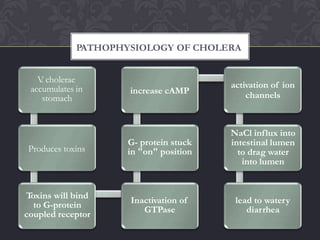
V. cholerae
accumulates in
stomach
Produces toxins
Toxins will bind
to G-protein
coupled receptor
Inactivation of
GTPase
G- protein stuck
in "on" position
increase cAMP
activation of ion
channels
NaCl influx into
intestinal lumen
to drag water
into lumen
lead to watery
diarrhea
PATHOPHYSIOLOGY OF CHOLERA
• The enterotoxin acts locally & does not invade the intestinal
wall. As a result few WBC & no RBC are found in the stool.
Most people remain asymptomatic. The symptoms of
cholera include :
SIGNS & SYMPTOMS
stomach
pains
leg cramps Mild fever
Vomiting Sunken eyes and
cheeks
Dry mucous
membranes
Decreased
urinary output
severe dehydration Shock Renal failure
Death
COMPLICATIONS
• Rare in developed countries
• Common in Asia, Africa, & Latin America
Poor sanitary
conditions
• Contaminated seafood, even in developed
countries.
• Especially shellfish.
• People with low levels of stomach acid
• Such as children, older adults, and some
medications.
Raw or
undercooked food
Hypochlorhydria
• Reasons aren't entirely clear
• Twice more likelyType O blood
RISK FACTORS
Drinking
contaminated water.
eating raw or
undercooked shellfish
CAUSES (TRANSMISSION MOOD)
DIAGNOSIS
• Organism can be seen in stool by
direct microscopy after gram stain and
dark field illumination is used to
demonstrates motility.
• Cholera can be cultured on special
alkaline media like triple sugar agar or
TCBS agar.
• Serologic tests are available to define
strains, but this is needed only during
epidemics to trace the source of
infection.
Traveling to affected areas and
eating shellfish
Other Lab Findings
• Dehydration leads to high blood urea & serum creatinine.
Hematocrit & WBC will also be high due to
hemoconcentration.
• Dehydration & bicarbonate loss in stool leads to metabolic
acidosis with wide-anion gap.
• Total body potassium is depleted, but serum level may be
normal due to effect of acidosis.
Traveling to affected areas and
eating shellfish
TREATMENT
• The primary goal of therapy is to replenish fluid
losses caused by diarrhea & vomiting.
• Fluid therapy is accomplished in 2 phases:
rehydration and maintenance.
• Rehydration should be completed in 4 hours &
maintenance fluids should replace ongoing losses &
provide daily requirement.
• Ringer lactate solution is preferred over normal saline
because it corrects the associated metabolic acidosis.
• IV fluids should be restricted to patients who purge
>10 ml/kg/h & for those with severe dehydration.
• The oral route is preferred for maintenance & the use
of ORS at a rate of 500-1000 ml/h is recommended.
FLUID THERAPY
DRUG THERAPY
• The goals of drug therapy are to eradicate infection,
reduce morbidity and prevent complications.
• The drugs used for adults include tetracycline,
doxycycline, cotrimoxazole & ciprofloxacin.
• For children erythromycin, cotrimoxazole and
furazolidone are the drugs of choice.
DRUG THERAPY/2
• Drug therapy reduces volume of stool & shortens
period of hospitalization. It is only needed for few days
(3-5 days).
• Drug resistance has been described in some areas &
the choice of antibiotic should be guided by the local
resistance patterns .
• Antibiotic should be started when cholera is suspected
without waiting for lab confirmation.
• Basic health education and hygiene
• Mass chemoprophylaxis
• Provision of safe water and sanitation
•Vaccination against cholera to
travellers to endemic countries &
during public gatherings
PREVENTION
• The old killed injectable vaccine is obsolete now because it is
not effective.
• Two new oral vaccines became available in 1997. A Killed & a
live attenuated types.
• Two new oral vaccines became available in 1997. A Killed & a
live attenuated types.
• Two new oral vaccines became available in 1997. A Killed & a
live attenuated types.
VACCINES
PROGNOSIS
The prognosis of cholera can range depending
on the severity of the dehydration and how
quickly the patient is given and responds to
treatments.
Death (mortality) rates in untreated cholera can
be as high as 50%-60% during large outbreaks
but can be reduced to about 1% if treatment
protocols are rapidly put into action.
Treatment
centers Set up treatment centers for prompt
treatment.
Sanitary
measures. food safety and animal health measures
Comprehensive
surveillance
data
(adapt to each situation) for a
comprehensive multidisciplinary approach.
CONTROLLING CHOLERA
THANK YOU

Cholera ppt

  • 1.
    Cholera Presented By M.Asim Khan(12) SaadAhmed(15) M.Jamshed (17) M.Faizan Khattak(22)
  • 2.
    Cholera is anacute diarrheal illness caused by infection of the intestine with the bacteria Vibrio cholerae. CHOLERA
  • 3.
    BACKGROUND • Cholera, isa Greek word, which means the gutter of the roof. It is caused by bacteria: Vibrio cholerae, which was discovered in 1883 by Robert Koch during a diarrheal outbreak in Egypt. • V. cholerae has 2 major biotypes: classical and El Tor, which was first isolated in Egypt in 1905. Currently, El Tor is the predominant cholera pathogen worldwide.
  • 4.
    • Cholera wasprevalent in the 1800s, but due to proper treatment of sewage and drinking water, has become rare in developed countries. • Cholera is a fecal disease, meaning that it spreads when the feces of an infected person come into contact with food or water. • Incidence: 1 in 100,000 worldwide. • Over 1 million cases and nearly 10,000 fatalities. EPIDEMIOLOGY
  • 5.
    • Gram negative. •Type of Gammaproteobacteria • Distinguishing factors: Oxidase- positive, motile via polar flagellum, and both respiratory and fermentative metabolism. • Organism can multiply freely in water VIBRIO CHOLERAE
  • 6.
    V. cholerae accumulates in stomach Producestoxins Toxins will bind to G-protein coupled receptor Inactivation of GTPase G- protein stuck in "on" position increase cAMP activation of ion channels NaCl influx into intestinal lumen to drag water into lumen lead to watery diarrhea PATHOPHYSIOLOGY OF CHOLERA
  • 7.
    • The enterotoxinacts locally & does not invade the intestinal wall. As a result few WBC & no RBC are found in the stool.
  • 8.
    Most people remainasymptomatic. The symptoms of cholera include : SIGNS & SYMPTOMS stomach pains leg cramps Mild fever Vomiting Sunken eyes and cheeks Dry mucous membranes Decreased urinary output
  • 9.
    severe dehydration ShockRenal failure Death COMPLICATIONS
  • 10.
    • Rare indeveloped countries • Common in Asia, Africa, & Latin America Poor sanitary conditions • Contaminated seafood, even in developed countries. • Especially shellfish. • People with low levels of stomach acid • Such as children, older adults, and some medications. Raw or undercooked food Hypochlorhydria • Reasons aren't entirely clear • Twice more likelyType O blood RISK FACTORS
  • 11.
    Drinking contaminated water. eating rawor undercooked shellfish CAUSES (TRANSMISSION MOOD)
  • 12.
    DIAGNOSIS • Organism canbe seen in stool by direct microscopy after gram stain and dark field illumination is used to demonstrates motility. • Cholera can be cultured on special alkaline media like triple sugar agar or TCBS agar. • Serologic tests are available to define strains, but this is needed only during epidemics to trace the source of infection. Traveling to affected areas and eating shellfish
  • 13.
    Other Lab Findings •Dehydration leads to high blood urea & serum creatinine. Hematocrit & WBC will also be high due to hemoconcentration. • Dehydration & bicarbonate loss in stool leads to metabolic acidosis with wide-anion gap. • Total body potassium is depleted, but serum level may be normal due to effect of acidosis. Traveling to affected areas and eating shellfish
  • 14.
    TREATMENT • The primarygoal of therapy is to replenish fluid losses caused by diarrhea & vomiting. • Fluid therapy is accomplished in 2 phases: rehydration and maintenance. • Rehydration should be completed in 4 hours & maintenance fluids should replace ongoing losses & provide daily requirement.
  • 15.
    • Ringer lactatesolution is preferred over normal saline because it corrects the associated metabolic acidosis. • IV fluids should be restricted to patients who purge >10 ml/kg/h & for those with severe dehydration. • The oral route is preferred for maintenance & the use of ORS at a rate of 500-1000 ml/h is recommended. FLUID THERAPY
  • 16.
    DRUG THERAPY • Thegoals of drug therapy are to eradicate infection, reduce morbidity and prevent complications. • The drugs used for adults include tetracycline, doxycycline, cotrimoxazole & ciprofloxacin. • For children erythromycin, cotrimoxazole and furazolidone are the drugs of choice.
  • 17.
    DRUG THERAPY/2 • Drugtherapy reduces volume of stool & shortens period of hospitalization. It is only needed for few days (3-5 days). • Drug resistance has been described in some areas & the choice of antibiotic should be guided by the local resistance patterns . • Antibiotic should be started when cholera is suspected without waiting for lab confirmation.
  • 18.
    • Basic healtheducation and hygiene • Mass chemoprophylaxis • Provision of safe water and sanitation •Vaccination against cholera to travellers to endemic countries & during public gatherings PREVENTION
  • 19.
    • The oldkilled injectable vaccine is obsolete now because it is not effective. • Two new oral vaccines became available in 1997. A Killed & a live attenuated types. • Two new oral vaccines became available in 1997. A Killed & a live attenuated types. • Two new oral vaccines became available in 1997. A Killed & a live attenuated types. VACCINES
  • 20.
    PROGNOSIS The prognosis ofcholera can range depending on the severity of the dehydration and how quickly the patient is given and responds to treatments. Death (mortality) rates in untreated cholera can be as high as 50%-60% during large outbreaks but can be reduced to about 1% if treatment protocols are rapidly put into action.
  • 21.
    Treatment centers Set uptreatment centers for prompt treatment. Sanitary measures. food safety and animal health measures Comprehensive surveillance data (adapt to each situation) for a comprehensive multidisciplinary approach. CONTROLLING CHOLERA
  • 22.