@hungvpham 
Intro to Lean Startup
@hungvpham 
Hung Pham 
Regional Workshop Leader - Lean Startup Machine 
Founder and Producer - Culture Summit 
Founder - Profile Gurus 
Email: hung@leanstartupmachine.com
@hungvpham 
What is Lean Startup?
Lean Startup is a method for developing 
businesses and products first proposed in 2011 
by Eric Ries. Ries claims that startups can 
shorten their product development cycles by 
adopting a combination of business-hypothesis-driven 
experimentation, iterative product 
releases, and what he calls “validated learning”. 
- Wikipedia 
@hungvpham
Lean Startup is a process for 
validating and invalidating your 
assumptions as quickly as possible to 
discover and deliver what people actually 
want while reducing waste. 
- Me 
@hungvpham
@hungvpham 
Lean Startup comes from Lean 
Manufacturing and Lean Thinking, which is 
derived from Toyota's factory production 
system, as they rose to prominence.
@hungvpham 
The fundamental principle of lean thinking is 
eliminating waste. Waste is any human activity 
which absorbs resources but creates no value. 
- Womak/Jones “Lean Thinking”
@hungvpham 
Type of Waste Definition 
Waste of Over Production Creating more than is 
needed 
Waste of Defects Errors, mistakes causing 
rework 
Waste of Inventory Holding more inventory 
than needed 
Waste of Over Processing Processing more than 
required 
Waste of Transportation Movement of items more 
than required 
Waste of Waiting Time loss by employees & 
customers from waiting 
Waste of Motion Movement of people that 
does not add value
In a start-up waste is defined as anything 
that keeps the team from learning about 
how to create value for the customer. 
- Eric Ries “Lean Startup” 
@hungvpham
@hungvpham 
It Starts With a Vision
@hungvpham 
It Starts With a Vision
@hungvpham 
It Starts With a Vision
@hungvpham 
Too Often Startups Build This
@hungvpham 
When the Customer Wants This
Lean Startup is a process for validating 
and invalidating your assumptions 
as quickly as possible to discover and 
deliver what people actually 
want while reducing waste. 
- Me 
@hungvpham
@hungvpham 
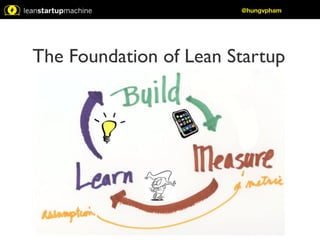
The Foundation of Lean Startup
@hungvpham 
The Foundation of Lean Startup
@hungvpham 
The Foundation of Lean Startup
@hungvpham 
The Foundation of Lean Startup
@hungvpham 
The Foundation of Lean Startup
@hungvpham 
The Foundation of Lean Startup
@hungvpham 
The Foundation of Lean Startup
@hungvpham 
The Lean Startup Process
Brainstorm here. When you’re ready, pull it over to the right to start your experiment. Experiments 
Start here. Brainstorm with stickies, pull it over to the right to start your experiment. Experiments 
@hungvpham 
1 2 3 4 To form a Customer/Problem Hypothesis: 
I believe my customer has a 
problem achieving this goal. 
Who is your customer? Time Limit: 5 Min 
Customer 
Problem 
What is the problem? Phrase it from your customer’s perspective. Time Limit: 5 Min 
Solution 
+LÄUL[OLZVS[PVUVUS`HM[LY`VOH]L]HSPKH[LKHWYVISLT^VY[OZVS]PUNTime Limit: 5 Min 
Riskiest 
Assumption 
List the assumptions that must hold true, for your hypothesis to be true. Time Limit: 10 Min 
Success 
Criterion 
Result  
Decision 
Learning 
1 2 3 4 5 
Who is your customer? 
What is the problem? Phrase it from your customer’s perspective. 
+LÄUL[OLZVS[PVUVUS`HM[LY`VOH]L]HSPKH[LKHWYVISLT^VY[OZVS]PUN 
What are the assumptions that must hold true, for your hypothesis to be true? 
Need help? Use these sentences to help construct your experiment. 
To form a Customer/Problem Hypothesis: 
I believe my customer has a 
problem achieving this goal. 
Need help? Use these sentences to help construct your experiment. 
To form your Assumptions: 
0UVYKLYMVY̸hypothesis to be 
true, assumption needs to 
be true. 
Determine how you will test it: 
The least expensive way to 
test my assumption is... 
To form a Problem/Solution Hypothesis: 
I believe this solution will result 
in XHU[PÄHISLV[JVTL. 
To identify your Riskiest Assumption: 
The assumption with the least 
amount of data, and core to the 
viability of my hypothesis is... 
Determine what success looks like: 
I will run experiment with # of 
customers and expect a strong 
signal from # of customers. 
Project Name: Team Leader Name: 
Riskiest 
Assumption 
GET OUT OF THE BUILDING! 
Start here. Brainstorm with stickies, pull it over to the right to start your experiment. Time Limit: 5 Min People 
buying 
Vespas on 
Craigslist 
People with 
KPMÄJS[ 
commute 
NYC 
Relying on 
products 
that use 
oil 
Understanding 
safety  time 
saving of 
Vespa 
People with 
KPMÄJS[ 
commute 
NYC 
Vespa too 
expensive 
for identity 
risk 
Vespa One- 
Pager + 
Trial 
Rent Vespa 
 Return It 
If Not Fit 
No friends 
Vespa 
Pay 
$250/month 
INTERVIEW: 
8/10 don’t 
have friend 
with Vespa 
SELL: 
15 email 
addresses 
in 2 hours 
Care about 
environment 
INTERVIEW: 
5/20 buying 
Vespa bc 
environment 
important 
Success 
Criterion 
0/20 
PIVOT! 
5/10 
PIVOT! 
50+ in 2 hours 
PERSEVERE! 
- Skinny Tie! 
- Buying for 
lifestyle 
- “I’m not a 
scooter 
person” 
- Lifestyle is 
a risk 
- People typing 
in ALL CAPS 
- Jumping out 
of seat to try 
Time Limit: 5 Min 
OZVS]PUNTime Limit: 5 Min 
List the assumptions that must hold true, for your hypothesis to be true. Time Limit: 10 Min 
Customer 
Problem 
Solution 
Result  
Decision 
To form your Assumptions: 
0UVYKLYMVY̸hypothesis to be 
true, assumption needs to 
be true. 
Determine how you will test it: 
To form a Problem/Solution Hypothesis: 
I believe this solution will result 
in XHU[PÄHISLV[JVTL. 
To identify your Riskiest Assumption: 
The assumption with the least 
amount of data, and core to the 
viability of my hypothesis is... 
Determine what success looks like: 
Project Name: GET OUT OF THE BUILDING!
STEP 1: 
@hungvpham 
Who is the customer? 
! 
Define Your Customer Hypothesis
CUSTOMER 
@hungvpham
STEP 2: 
@hungvpham 
What is her problem? 
! 
Define Your Problem Hypothesis
PROBLEM 
@hungvpham 
• Must be specific to the person! 
! 
INCORRECT: 
• “People are not recycling” is not a problem 
someone has 
! 
CORRECT: 
• “Forgets the day of the week for collection” 
• “Confused how to sort plastics” 
! 
• Two similar but different problems
SOLUTION 
@hungvpham 
Do not define until the problem is 
validated 
! 
Why? Because every problem 
has multiple solutions
@hungvpham
@hungvpham
STEP 3: 
@hungvpham 
What do you test? 
! 
Plan your Experiment (MVP)
@hungvpham 
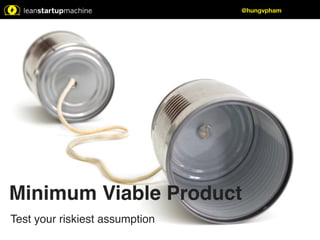
Minimum Viable Product! 
Test your riskiest assumption
@hungvpham 
MVP != Shitty Product 
The Minimum Viable Product (MVP) is that 
version of a new product which allows a team 
to collect the maximum validated amount of 
learning about customers with the least effort.
@hungvpham 
What must we learn? 
What are the Core Assumptions of 
our business? 
! 
Assumption: 
A behavior, mentality, or action that needs to 
happen in order for hypothesis to be true.
@hungvpham 
What must we learn? 
Prioritize: Which Assumption is 
the Riskiest? 
! 
The one that is most unknown, 
and crucial to the business
What do we build to test? 
1.Exploration - reproduce problem 
2.Pitch - collect currency 
3.Concierge - deliver customer 
expectation 
! 
(Methods increase in cost of testing) 
@hungvpham
@hungvpham 
How do we measure result? 
Decide on the weakest outcome 
you will accept as validation 
! 
Called the Minimum Success 
Criterion
@hungvpham 
SHOW ME THE MONEY! 
Examples of Customer Validation: 
5,000 Email Signups 
OR $1,000 in Cash 
OR 5 Contracts from Big Companies
STEP 4? 
@hungvpham
@hungvpham 
GET OUT 
OF THE 
BUILDING!
STEP 5: 
What did you learn? 
! 
Analyze Results 
@hungvpham
@hungvpham 
What happened? 
VALIDATED 
Brainstorm and test next RA 
(NOTE: if you validate with the wrong 
customers, it is not validated) 
! 
INVALIDATED 
Pivot the hypothesis

Intro to Lean Startup

  • 1.
    @hungvpham Intro toLean Startup
  • 2.
    @hungvpham Hung Pham Regional Workshop Leader - Lean Startup Machine Founder and Producer - Culture Summit Founder - Profile Gurus Email: hung@leanstartupmachine.com
  • 3.
    @hungvpham What isLean Startup?
  • 4.
    Lean Startup isa method for developing businesses and products first proposed in 2011 by Eric Ries. Ries claims that startups can shorten their product development cycles by adopting a combination of business-hypothesis-driven experimentation, iterative product releases, and what he calls “validated learning”. - Wikipedia @hungvpham
  • 5.
    Lean Startup isa process for validating and invalidating your assumptions as quickly as possible to discover and deliver what people actually want while reducing waste. - Me @hungvpham
  • 6.
    @hungvpham Lean Startupcomes from Lean Manufacturing and Lean Thinking, which is derived from Toyota's factory production system, as they rose to prominence.
  • 7.
    @hungvpham The fundamentalprinciple of lean thinking is eliminating waste. Waste is any human activity which absorbs resources but creates no value. - Womak/Jones “Lean Thinking”
  • 8.
    @hungvpham Type ofWaste Definition Waste of Over Production Creating more than is needed Waste of Defects Errors, mistakes causing rework Waste of Inventory Holding more inventory than needed Waste of Over Processing Processing more than required Waste of Transportation Movement of items more than required Waste of Waiting Time loss by employees & customers from waiting Waste of Motion Movement of people that does not add value
  • 9.
    In a start-upwaste is defined as anything that keeps the team from learning about how to create value for the customer. - Eric Ries “Lean Startup” @hungvpham
  • 10.
    @hungvpham It StartsWith a Vision
  • 11.
    @hungvpham It StartsWith a Vision
  • 12.
    @hungvpham It StartsWith a Vision
  • 13.
    @hungvpham Too OftenStartups Build This
  • 14.
    @hungvpham When theCustomer Wants This
  • 15.
    Lean Startup isa process for validating and invalidating your assumptions as quickly as possible to discover and deliver what people actually want while reducing waste. - Me @hungvpham
  • 16.
  • 17.
  • 18.
  • 19.
  • 20.
  • 21.
  • 22.
  • 23.
    @hungvpham The LeanStartup Process
  • 24.
    Brainstorm here. Whenyou’re ready, pull it over to the right to start your experiment. Experiments Start here. Brainstorm with stickies, pull it over to the right to start your experiment. Experiments @hungvpham 1 2 3 4 To form a Customer/Problem Hypothesis: I believe my customer has a problem achieving this goal. Who is your customer? Time Limit: 5 Min Customer Problem What is the problem? Phrase it from your customer’s perspective. Time Limit: 5 Min Solution +LÄUL[OLZVS[PVUVUS`HM[LY`VOH]L]HSPKH[LKHWYVISLT^VY[OZVS]PUNTime Limit: 5 Min Riskiest Assumption List the assumptions that must hold true, for your hypothesis to be true. Time Limit: 10 Min Success Criterion Result Decision Learning 1 2 3 4 5 Who is your customer? What is the problem? Phrase it from your customer’s perspective. +LÄUL[OLZVS[PVUVUS`HM[LY`VOH]L]HSPKH[LKHWYVISLT^VY[OZVS]PUN What are the assumptions that must hold true, for your hypothesis to be true? Need help? Use these sentences to help construct your experiment. To form a Customer/Problem Hypothesis: I believe my customer has a problem achieving this goal. Need help? Use these sentences to help construct your experiment. To form your Assumptions: 0UVYKLYMVY̸hypothesis to be true, assumption needs to be true. Determine how you will test it: The least expensive way to test my assumption is... To form a Problem/Solution Hypothesis: I believe this solution will result in XHU[PÄHISLV[JVTL. To identify your Riskiest Assumption: The assumption with the least amount of data, and core to the viability of my hypothesis is... Determine what success looks like: I will run experiment with # of customers and expect a strong signal from # of customers. Project Name: Team Leader Name: Riskiest Assumption GET OUT OF THE BUILDING! Start here. Brainstorm with stickies, pull it over to the right to start your experiment. Time Limit: 5 Min People buying Vespas on Craigslist People with KPMÄJS[ commute NYC Relying on products that use oil Understanding safety time saving of Vespa People with KPMÄJS[ commute NYC Vespa too expensive for identity risk Vespa One- Pager + Trial Rent Vespa Return It If Not Fit No friends Vespa Pay $250/month INTERVIEW: 8/10 don’t have friend with Vespa SELL: 15 email addresses in 2 hours Care about environment INTERVIEW: 5/20 buying Vespa bc environment important Success Criterion 0/20 PIVOT! 5/10 PIVOT! 50+ in 2 hours PERSEVERE! - Skinny Tie! - Buying for lifestyle - “I’m not a scooter person” - Lifestyle is a risk - People typing in ALL CAPS - Jumping out of seat to try Time Limit: 5 Min OZVS]PUNTime Limit: 5 Min List the assumptions that must hold true, for your hypothesis to be true. Time Limit: 10 Min Customer Problem Solution Result Decision To form your Assumptions: 0UVYKLYMVY̸hypothesis to be true, assumption needs to be true. Determine how you will test it: To form a Problem/Solution Hypothesis: I believe this solution will result in XHU[PÄHISLV[JVTL. To identify your Riskiest Assumption: The assumption with the least amount of data, and core to the viability of my hypothesis is... Determine what success looks like: Project Name: GET OUT OF THE BUILDING!
  • 25.
    STEP 1: @hungvpham Who is the customer? ! Define Your Customer Hypothesis
  • 26.
  • 27.
    STEP 2: @hungvpham What is her problem? ! Define Your Problem Hypothesis
  • 28.
    PROBLEM @hungvpham •Must be specific to the person! ! INCORRECT: • “People are not recycling” is not a problem someone has ! CORRECT: • “Forgets the day of the week for collection” • “Confused how to sort plastics” ! • Two similar but different problems
  • 29.
    SOLUTION @hungvpham Donot define until the problem is validated ! Why? Because every problem has multiple solutions
  • 30.
  • 31.
  • 32.
    STEP 3: @hungvpham What do you test? ! Plan your Experiment (MVP)
  • 33.
    @hungvpham Minimum ViableProduct! Test your riskiest assumption
  • 34.
    @hungvpham MVP !=Shitty Product The Minimum Viable Product (MVP) is that version of a new product which allows a team to collect the maximum validated amount of learning about customers with the least effort.
  • 35.
    @hungvpham What mustwe learn? What are the Core Assumptions of our business? ! Assumption: A behavior, mentality, or action that needs to happen in order for hypothesis to be true.
  • 36.
    @hungvpham What mustwe learn? Prioritize: Which Assumption is the Riskiest? ! The one that is most unknown, and crucial to the business
  • 37.
    What do webuild to test? 1.Exploration - reproduce problem 2.Pitch - collect currency 3.Concierge - deliver customer expectation ! (Methods increase in cost of testing) @hungvpham
  • 38.
    @hungvpham How dowe measure result? Decide on the weakest outcome you will accept as validation ! Called the Minimum Success Criterion
  • 39.
    @hungvpham SHOW METHE MONEY! Examples of Customer Validation: 5,000 Email Signups OR $1,000 in Cash OR 5 Contracts from Big Companies
  • 40.
  • 41.
    @hungvpham GET OUT OF THE BUILDING!
  • 42.
    STEP 5: Whatdid you learn? ! Analyze Results @hungvpham
  • 43.
    @hungvpham What happened? VALIDATED Brainstorm and test next RA (NOTE: if you validate with the wrong customers, it is not validated) ! INVALIDATED Pivot the hypothesis