1
MKT 344.11
Group Project
Children’s Influence
on Parents’ Buying
Behavior
April 10,
2017
4/10/2017
2
NORTH SOUTH UNIVERSITY
MKT 344
Consumer Behavior
Sec: 11
Final Group Project
Topic: Children’s Influence on Parents’ Buying Behavior
Submitted To:
Ms. Israt Jahan Linda (IJL)
Lecturer
Department of Marketing and International Business
School of Business & Economics (SBE)
Submitted By:
1. Abu Horaira Kamal ID: 1330504630
2. Navila Tabassum ID: 1410056030
3. Farhana Islam Diba ID: 1410212030
4. Lamia Anwar ID: 1510400030
5. Syeda Tahia Naziba ID: 1510922030
6. Marzia Hossain ID: 1510979030
---------- Submission Date: Monday, 10th
April, 2017
3
10 April 2017
Israt Jahan Linda
Lecturer
Department of Marketing and International Business
School of Business and Economics
North South University
Dhaka
Dear Miss,
Here is the report you have asked us to submit regarding children’s influence on parents’
purchase behavior as a requirement for the mkt 344 course, under the BBA program by North
South University.
In this report, we have tried to research about the selected topic and tried to collect data and
analyzed it.
We thank you for giving us the opportunity to have a chance to prepare the report under you. We
sincerely hope that you will find this report useful and appropriate as per the requirements. We
have tried to make the report as comprehensive as we possibly could but we would appreciate
you contacting us if you have any further queries.
Sincerely,
1. Abu Horaira Kamal - ID: 1330504630
2. Navila Tabassum - ID: 1410056030
3. Farhana Islam Diba - ID: 1410212030
4. Lamia Anwar - ID: 1510400030
5. Syeda Tahia Naziba - ID: 1510922030
6. Marzia Hossain - ID: 1510979030
4
TABLE OF CONTENTS
Executive Summary .......................................................................................................................................................5
Introduction...................................................................................................................................................................6
Literature Review ..........................................................................................................................................................7
Methodology .................................................................................................................................................................9
Data Collection ............................................................................................................................................................10
Data Interpretation......................................................................................................................................................11
Findings........................................................................................................................................................................20
Recommendation ........................................................................................................................................................28
Conclusion ...................................................................................................................................................................29
References...................................................................................................................................................................30
Appendix......................................................................................................................................................................31
5
EXECUTIVE SUMMARY
Children are very precious to their parents. When it comes to the children, parents always want
the best for their children. So essentially children have a great impact on parents’ purchasing
actions. In this report, the research was done to know more about children’s influence on
parents’ buying behavior.
At first, the data was collected from the primary and secondary sources. Then the quantitative
and qualitative data were interpreted and analyzed with various bars, graph and charts. After that,
the findings were described statistically.
The parents especially with the kids of 8-12 years children, are very much influenced by their
children. They listen to their children when buying product. Children’s opinion influence them in
buying foods, clothing, choosing restaurants, choosing restaurants, toys etc. The findings in
details are there in the Findings section.
Based on the findings, the recommendations are given to marketers. By using the information,
marketer can design their IMC campaign. The suggestions are given in the Recommendation
section.
Overall, the research shows that children actually have a great impact on their parents’
purchasing behavior and play a massive role in that.
6
INTRODUCTION
Human have unlimited needs. To satisfy those needs people have to purchase a lot of things.
Some of them are very necessary, some of them are not that much necessary. Though some
goods are not that much necessary, people purchase those as well. Some people are seen
purchasing goods by someone else’s influence. These influences are from various sides. Again,
sometimes the children also pressurize their parents to purchase of the goods. Sometimes the
parents agree to their children’s need and sometimes they do not. This means the children also
have some influence to manipulate their parents’ buying behavior. So, this is a subject to
investigate that if the children have influence or how much influence the children have to impact
on their parents’ buying behavior. Basically, this research is for determining that influence. In
this research, this is clearly shown that whether the children have any influence or how much
they can influence on their parents’ buying behavior. So that the research becomes effective, the
necessary information are collected from different sources. This has gone through both primary
and secondary research. Through the primary and the secondary research, the necessary
information are collected. Then the collected information are processed and represented clearly.
Next, those information are analyzed and interpreted from a critical point of view. Finally,
according to the findings, some recommendations are provided.
7
LITERATURE REVIEW
In reviewing previous research works on children’s influence on parents’ purchase behavior, the
results show that children’s influence may vary among the parents by various factors. In this
section of our research, the previous findings will be summarized and synthesized to find out the
factors of variation in children’s influence on their parents’ buying behavior.
According to BAR Network TV, more than US $86 million have been spent by the advertisers to
attract the children towards their products, a quite convincing statement of belief to demonstrate
children’s influence on their parents’ purchasing activities. (BAR Network TV, 1975). Most of
the research works have been supportive of that belief. Several studies show that, 75% of the
time parents complied with their children’s wishes when they asked for particular food items
such as snack food, candy etc. (Donohue, 1975; Howard, Hulbert and Lehmann, 1973; Mark
Clements Research, Inc., 1967). And when parents along with their children were observed
shopping in a supermarket, children successfully influenced their parents' purchase of cereal and
candy in 61% and 52% of the times they asked for them, respectively. (Wells and LoSciuto,
1966). In another study, mothers reported that they yielded to about half of such requests of their
children for food. (Ward and Wackman, 1972).
Several other studies have revealed some factors which affect parents’ likelihood of being or not
being influenced by children. The strength with which a child voices his wishes or request would
be expected to be related to his success of influencing while buying. One study concerned with
cereal purchase showed that there was no significant relationship between a child's assertiveness
and his parents’ purchase behavior. (Berey and Pollay, 1968). This finding was explained in
another study. According to that study, the child's teacher had measured his assertiveness, who
was probably more knowledgeable of his interaction with his peer groups than of his
assertiveness in the family. (Ward and Wackman, 1972).
Another factor is the child’s age. Older children do not attempt to influence their parents directly
while purchasing, but older children are also more successful with their attempts to do so.
8
(McNeal, 1969; Ward, 1972; Ward and Wackman, 1972; Wells, 1965). This study suggested that
parents are in fact more likely to look for the opinions of older children before making
purchases, so the opinions of older children are more likely to be considered by their parents
while buying than the younger ones.
With the increase in age, the girl child’s suggestions about the products related to family or
household as well as personal needs are given more priority, while those of boys remain
personally oriented. This sex difference is seen as a result of the mother’s role in most of the
family shopping, which imparts the traditional female role to her daughter. (McNeal, 1969).
The type of product requested by the child also plays as a role on the success of their request.
Food products are most often requested by children and bought by parents on their request.
(Ward and Wackman, 1972). For other items, such as toys, clothing etc. parents try to research
about the product a bit, but even so, they rely on the wishes and choices of their children almost
75% of the time in selecting toys which cost over five dollars. (Frideres, 1973). Even the time of
the year can make a difference in children’s successful influence on parents purchase. Parents
were considerably more influenced by their children's nagging for toys at festive time such as
Christmas time (87%) than in the summer vacation (58%). (Frideres, 1973).
Brand recall has been found to be another important factor in a child’s influence on his parents.
A parent’s brand recall of her child's favorite products was found to be significantly related to
her purchase of those products. (Berey and Pollay, 1968). However, a parent's recall of
commercial content does not influence them positively while buying products for their child,
whereas it increases the child’s request attempts to his parents for buying those products. (Ward
and Wackman, 1972)
Social positions and value orientations of parents and children are another basis for the
likelihood of children’s influence on parents’ purchase decisions. For example, upper-class
parents more often bought expensive toys for their children that they asked for than the middle-
class or lower-class parents. (Caron and Ward, 1975).
In the present studies, the main focus is on the parents of children of 8-12 years of age to
determine whether they are influenced by their children or not while purchasing.
9
METHODOLOGY
This research project needs a lot of information, which have to be collected from a particular
group of people. For gathering the necessary information both the primary and the secondary
research have been conducted.
a) Primary Research: To get the information directly from the target people, the primary
research has been run. This primary research has taken place through survey. In addition,
the survey has been done both online and offline. Between them, online one is conducted
through google form. A google form has been prepared and the hyperlink of this form has
been sent to some parents through the social media, Facebook. Unlike, the offline survey
has been done by visiting a coaching center and meeting the parents of its students. As
the topic has been selected for this project is related to the children and their parents, it is
assumed that parents should be the most appropriate group to focus on. Therefore, some
parents have been selected as the respondents for this survey. In the survey, each
questionnaire contains eighteen questions in total. Among them, three was regarding the
demographics. For generating a valid research, this survey has been conducted on 41
Information Sources
Primary Research
- Survey
Secondary Research
- Various previous research
works
10
respondents. Basically, analyzing the answers provided by the survey respondents this
report is prepared.
b) Secondary Research: This research requires a lot of information as mentioned before.
All of them should be valid. Again, some of the required information are found readily
available from some sources. Thus the research team has gone for the secondary research.
For an effective secondary research, a number of secondary sources have been used. Among
them, there are television report, books, articles, online journals etc. can be mentioned. For
instance, the secondary information are extracted from BAR Network TV, Donohue, Mark
Clements Research, Wells and LoSciuto, Ward and Wackman, Berey and Pollay, McNeal etc.
Details about the information found from these sources are clearly discussed latterly in the
report.
DATA COLLECTION
A questionnaire was made to know in depth about the children’s influence in parents’ purchase
decision. Some of the question was asked indirectly to know parents’ purchase behavior. The
questions basically were set to know more about these following things:
1. Demographic information: The questionnaire had questions about age, gender,
occupation and monthly income to know about the average parent’s.
2. Information about Children: There were questions about number of children they have
to know about the average number of children in a family. Also the question about the
age of children was asked to gather the target parents which was 8-12 years old kid’s
parents.
3. Information about Food Habits: Some of the questions were set to know how children
affect the food purchasing habit of the parents.
11
4. Information about Personal Purchase: There were questions to know the children’s
influence on parents’ personal buying behavior and how it affected them.
5. Information about Gadgets: Gadgets now a days are very important for all. There were
question to know how children influence their parents to have gadgets of their own.
DATA INTERPRETATION
In order to collect sufficient data about the “Children’s Influence on Parents’ Purchase
Behavior”, parents seems interest on this topic. We hosted a survey questioning on various
aspects on this topic. The question were completed by a group of parents over the internet
through “Google Forms” and social media like- Facebook and Viber and the data collected and
also analyzed in the following pages. And also we go personally in coaching center and kid’s
school for our survey.
1. How much of the parents’ income is spent on their children
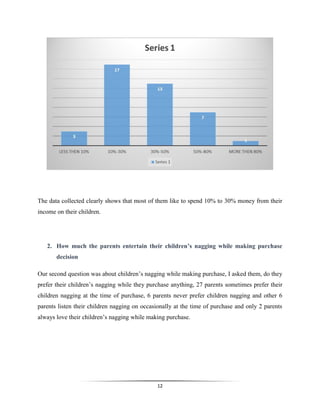
In my first question, I asked parents about spending money on their children, about 17 of them
said 10% to 30%, 13 out of 41 said 30% to 50%, 7 said 50% to 80%, 3 of them said less than
10% and only one parent said more than 80% income he spend on his children.
12
The data collected clearly shows that most of them like to spend 10% to 30% money from their
income on their children.
2. How much the parents entertain their children’s nagging while making purchase
decision
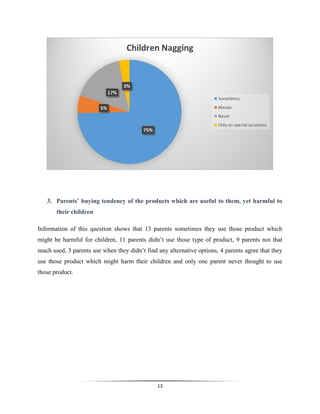
Our second question was about children’s nagging while making purchase, I asked them, do they
prefer their children’s nagging while they purchase anything, 27 parents sometimes prefer their
children nagging at the time of purchase, 6 parents never prefer children nagging and other 6
parents listen their children nagging on occasionally at the time of purchase and only 2 parents
always love their children’s nagging while making purchase.
13
3. Parents’ buying tendency of the products which are useful to them, yet harmful to
their children
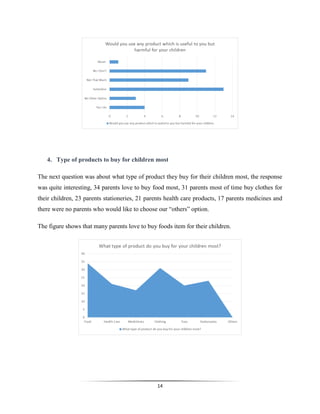
Information of this question shows that 13 parents sometimes they use those product which
might be harmful for children, 11 parents didn’t use those type of product, 9 parents not that
much used, 3 parents use when they didn’t find any alternative options, 4 parents agree that they
use those product which might harm their children and only one parent never thought to use
those product.
14
4. Type of products to buy for children most
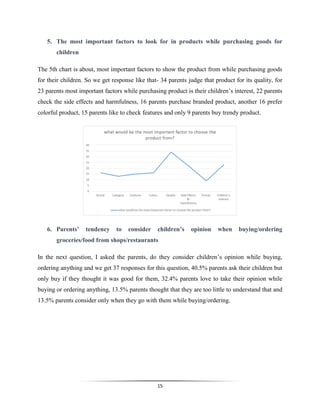
The next question was about what type of product they buy for their children most, the response
was quite interesting, 34 parents love to buy food most, 31 parents most of time buy clothes for
their children, 23 parents stationeries, 21 parents health care products, 17 parents medicines and
there were no parents who would like to choose our “others” option.
The figure shows that many parents love to buy foods item for their children.
15
5. The most important factors to look for in products while purchasing goods for
children
The 5th chart is about, most important factors to show the product from while purchasing goods
for their children. So we get response like that- 34 parents judge that product for its quality, for
23 parents most important factors while purchasing product is their children’s interest, 22 parents
check the side effects and harmfulness, 16 parents purchase branded product, another 16 prefer
colorful product, 15 parents like to check features and only 9 parents buy trendy product.
6. Parents’ tendency to consider children’s opinion when buying/ordering
groceries/food from shops/restaurants
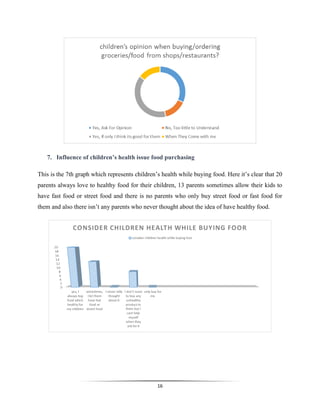
In the next question, I asked the parents, do they consider children’s opinion while buying,
ordering anything and we get 37 responses for this question, 40.5% parents ask their children but
only buy if they thought it was good for them, 32.4% parents love to take their opinion while
buying or ordering anything, 13.5% parents thought that they are too little to understand that and
13.5% parents consider only when they go with them while buying/ordering.
16
7. Influence of children’s health issue food purchasing
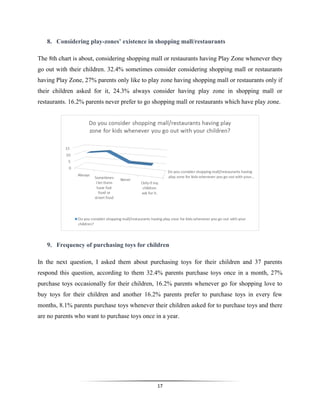
This is the 7th graph which represents children’s health while buying food. Here it’s clear that 20
parents always love to healthy food for their children, 13 parents sometimes allow their kids to
have fast food or street food and there is no parents who only buy street food or fast food for
them and also there isn’t any parents who never thought about the idea of have healthy food.
17
8. Considering play-zones’ existence in shopping mall/restaurants
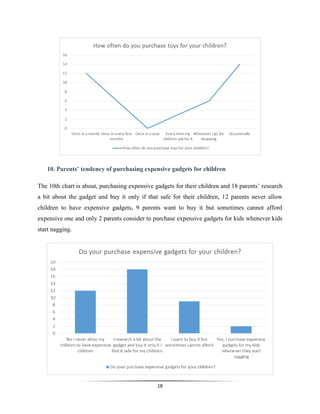
The 8th chart is about, considering shopping mall or restaurants having Play Zone whenever they
go out with their children. 32.4% sometimes consider considering shopping mall or restaurants
having Play Zone, 27% parents only like to play zone having shopping mall or restaurants only if
their children asked for it, 24.3% always consider having play zone in shopping mall or
restaurants. 16.2% parents never prefer to go shopping mall or restaurants which have play zone.
9. Frequency of purchasing toys for children
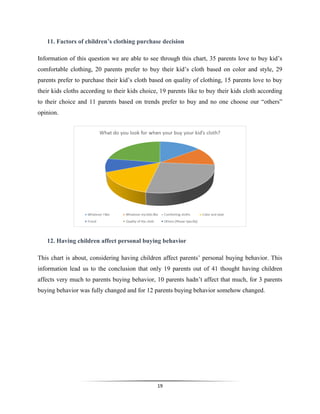
In the next question, I asked them about purchasing toys for their children and 37 parents
respond this question, according to them 32.4% parents purchase toys once in a month, 27%
purchase toys occasionally for their children, 16.2% parents whenever go for shopping love to
buy toys for their children and another 16.2% parents prefer to purchase toys in every few
months, 8.1% parents purchase toys whenever their children asked for to purchase toys and there
are no parents who want to purchase toys once in a year.
18
10. Parents’ tendency of purchasing expensive gadgets for children
The 10th chart is about, purchasing expensive gadgets for their children and 18 parents’ research
a bit about the gadget and buy it only if that safe for their children, 12 parents never allow
children to have expensive gadgets, 9 parents want to buy it but sometimes cannot afford
expensive one and only 2 parents consider to purchase expensive gadgets for kids whenever kids
start nagging.
19
11. Factors of children’s clothing purchase decision
Information of this question we are able to see through this chart, 35 parents love to buy kid’s
comfortable clothing, 20 parents prefer to buy their kid’s cloth based on color and style, 29
parents prefer to purchase their kid’s cloth based on quality of clothing, 15 parents love to buy
their kids cloths according to their kids choice, 19 parents like to buy their kids cloth according
to their choice and 11 parents based on trends prefer to buy and no one choose our “others”
opinion.
12. Having children affect personal buying behavior
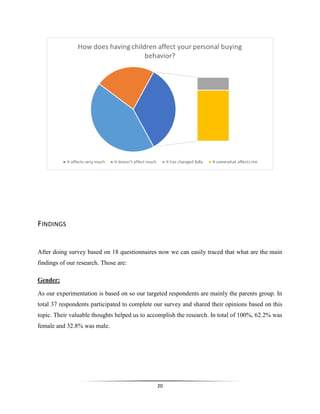
This chart is about, considering having children affect parents’ personal buying behavior. This
information lead us to the conclusion that only 19 parents out of 41 thought having children
affects very much to parents buying behavior, 10 parents hadn’t affect that much, for 3 parents
buying behavior was fully changed and for 12 parents buying behavior somehow changed.
20
FINDINGS
After doing survey based on 18 questionnaires now we can easily traced that what are the main
findings of our research. Those are:
Gender:
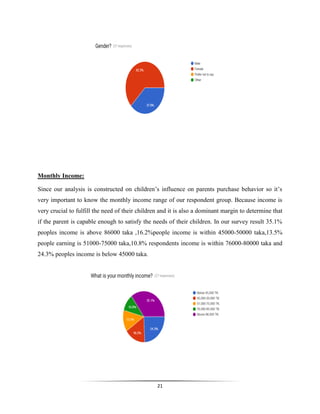
As our experimentation is based on so our targeted respondents are mainly the parents group. In
total 37 respondents participated to complete our survey and shared their opinions based on this
topic. Their valuable thoughts helped us to accomplish the research. In total of 100%, 62.2% was
female and 32.8% was male.
21
Monthly Income:
Since our analysis is constructed on children’s influence on parents purchase behavior so it’s
very important to know the monthly income range of our respondent group. Because income is
very crucial to fulfill the need of their children and it is also a dominant margin to determine that
if the parent is capable enough to satisfy the needs of their children. In our survey result 35.1%
peoples income is above 86000 taka ,16.2%people income is within 45000-50000 taka,13.5%
people earning is 51000-75000 taka,10.8% respondents income is within 76000-80000 taka and
24.3% peoples income is below 45000 taka.
22
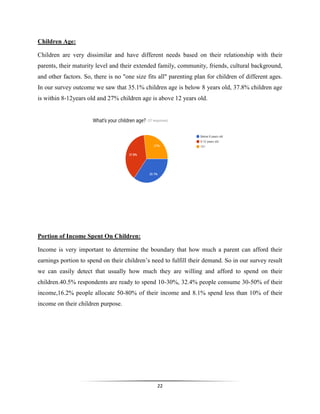
Children Age:
Children are very dissimilar and have different needs based on their relationship with their
parents, their maturity level and their extended family, community, friends, cultural background,
and other factors. So, there is no "one size fits all" parenting plan for children of different ages.
In our survey outcome we saw that 35.1% children age is below 8 years old, 37.8% children age
is within 8-12years old and 27% children age is above 12 years old.
Portion of Income Spent On Children:
Income is very important to determine the boundary that how much a parent can afford their
earnings portion to spend on their children’s need to fulfill their demand. So in our survey result
we can easily detect that usually how much they are willing and afford to spend on their
children.40.5% respondents are ready to spend 10-30%, 32.4% people consume 30-50% of their
income,16.2% people allocate 50-80% of their income and 8.1% spend less than 10% of their
income on their children purpose.
23
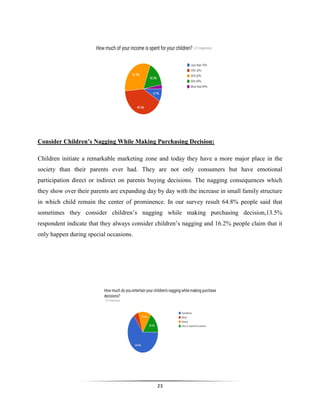
Consider Children’s Nagging While Making Purchasing Decision:
Children initiate a remarkable marketing zone and today they have a more major place in the
society than their parents ever had. They are not only consumers but have emotional
participation direct or indirect on parents buying decisions. The nagging consequences which
they show over their parents are expanding day by day with the increase in small family structure
in which child remain the center of prominence. In our survey result 64.8% people said that
sometimes they consider children’s nagging while making purchasing decision,13.5%
respondent indicate that they always consider children’s nagging and 16.2% people claim that it
only happen during special occasions.
24
Using Any Useful Product That Is Harmful For Children:
Some products are very necessary to deal with everyday routine. But those useful products can
cause harm to children. In this case how a parent will react to the situation that if they want to
use it carefully or don’t want to use it completely for the safety of their children. In our survey
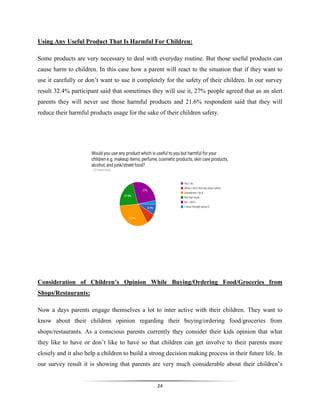
result 32.4% participant said that sometimes they will use it, 27% people agreed that as an alert
parents they will never use those harmful products and 21.6% respondent said that they will
reduce their harmful products usage for the sake of their children safety.
Consideration of Children’s Opinion While Buying/Ordering Food/Groceries from
Shops/Restaurants:
Now a days parents engage themselves a lot to inter active with their children. They want to
know about their children opinion regarding their buying/ordering food/groceries from
shops/restaurants. As a conscious parents currently they consider their kids opinion that what
they like to have or don’t like to have so that children can get involve to their parents more
closely and it also help a children to build a strong decision making process in their future life. In
our survey result it is showing that parents are very much considerable about their children’s
25
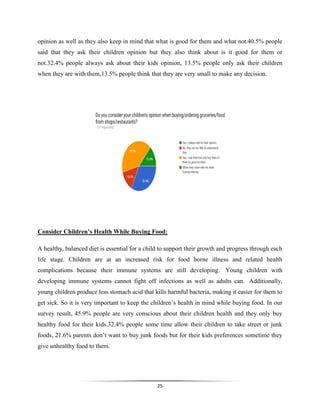
opinion as well as they also keep in mind that what is good for them and what not.40.5% people
said that they ask their children opinion but they also think about is it good for them or
not.32.4% people always ask about their kids opinion, 13.5% people only ask their children
when they are with them,13.5% people think that they are very small to make any decision.
Consider Children’s Health While Buying Food:
A healthy, balanced diet is essential for a child to support their growth and progress through each
life stage. Children are at an increased risk for food borne illness and related health
complications because their immune systems are still developing. Young children with
developing immune systems cannot fight off infections as well as adults can. Additionally,
young children produce less stomach acid that kills harmful bacteria, making it easier for them to
get sick. So it is very important to keep the children’s health in mind while buying food. In our
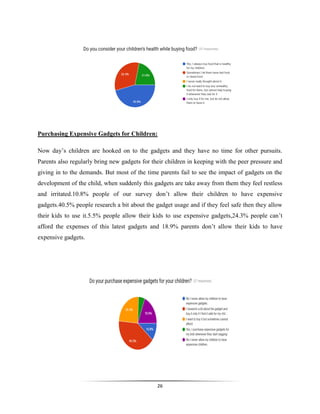
survey result, 45.9% people are very conscious about their children health and they only buy
healthy food for their kids.32.4% people some time allow their children to take street or junk
foods, 21.6% parents don’t want to buy junk foods but for their kids preferences sometime they
give unhealthy food to them.
26
Purchasing Expensive Gadgets for Children:
Now day’s children are hooked on to the gadgets and they have no time for other pursuits.
Parents also regularly bring new gadgets for their children in keeping with the peer pressure and
giving in to the demands. But most of the time parents fail to see the impact of gadgets on the
development of the child, when suddenly this gadgets are take away from them they feel restless
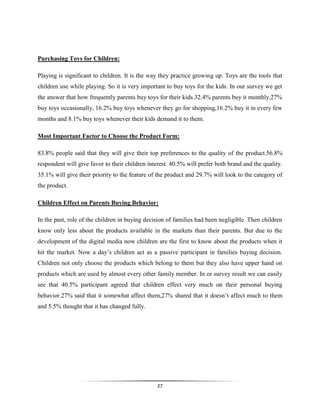
and irritated.10.8% people of our survey don’t allow their children to have expensive
gadgets.40.5% people research a bit about the gadget usage and if they feel safe then they allow
their kids to use it.5.5% people allow their kids to use expensive gadgets,24.3% people can’t
afford the expenses of this latest gadgets and 18.9% parents don’t allow their kids to have
expensive gadgets.
27
Purchasing Toys for Children:
Playing is significant to children. It is the way they practice growing up. Toys are the tools that
children use while playing. So it is very important to buy toys for the kids. In our survey we get
the answer that how frequently parents buy toys for their kids.32.4% parents buy it monthly,27%
buy toys occasionally, 16.2% buy toys whenever they go for shopping,16.2% buy it in every few
months and 8.1% buy toys whenever their kids demand it to them.
Most Important Factor to Choose the Product Form:
83.8% people said that they will give their top preferences to the quality of the product.56.8%
respondent will give favor to their children interest. 40.5% will prefer both brand and the quality.
35.1% will give their priority to the feature of the product and 29.7% will look to the category of
the product.
Children Effect on Parents Buying Behavior:
In the past, role of the children in buying decision of families had been negligible. Then children
know only less about the products available in the markets than their parents. But due to the
development of the digital media now children are the first to know about the products when it
hit the market. Now a day’s children act as a passive participant in families buying decision.
Children not only choose the products which belong to them but they also have upper hand on
products which are used by almost every other family member. In or survey result we can easily
see that 40.5% participant agreed that children effect very much on their personal buying
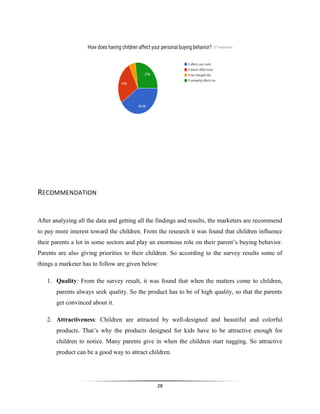
behavior.27% said that it somewhat affect them,27% shared that it doesn’t affect much to them
and 5.5% thought that it has changed fully.
28
RECOMMENDATION
After analyzing all the data and getting all the findings and results, the marketers are recommend
to pay more interest toward the children. From the research it was found that children influence
their parents a lot in some sectors and play an enormous role on their parent’s buying behavior.
Parents are also giving priorities to their children. So according to the survey results some of
things a marketer has to follow are given below:
1. Quality: From the survey result, it was found that when the matters come to children,
parents always seek quality. So the product has to be of high quality, so that the parents
get convinced about it.
2. Attractiveness: Children are attracted by well-designed and beautiful and colorful
products. That’s why the products designed for kids have to be attractive enough for
children to notice. Many parents give in when the children start nagging. So attractive
product can be a good way to attract children.
29
3. Packaging: Children love colorful product be it toys, food or anything. That’s why the
packaging should be very bright and interesting, so that whenever the children see it, they
get attracted to it.
4. Gadgets: It was found from the research that many parents allow their children to have
gadgets if they find it safe for children. So if the gadget is child-friendly and it has
children features, chances are that the parents will allow their children to have it.
5. Advertisement: A common media for both the children and parents are TV. So, the
advertisement should be done on TV mostly so that parents and children both get exposed
to the product.
CONCLUSION
In conclusion, children definitely have some influences over their parents’ purchase behavior.
These influences varies in terms of product, income of parents etc. When it comes to food items,
parents try to find healthy food, but in terms of clothing they also take children’s opinion. They
sometimes allow their children to have junk food, gadgets. But when it comes to safety of the
children, they restrain themselves mostly from using harmful product. Sometimes the parents
give in to their children’s wish, sometimes they do what they think is necessary for their
children. But generally children play a massive role in parents’ buying behavior.
30
REFERENCES
1. Berey, A and Pollay, R. (1968, February 5). The Influencing Role of the Child in Family
Decision Making. Journal of Marketing Research
2. Donohue, T. (1975, December 15). Effect of Commercials on Black Children. Journal of
Advertising Research
3. Frideres, J. (1973, Feruary 13). Advertising, Buying Patterns and Children. Journal of
Advertising Research
4. Howard, J. Hulbert, J. and Lehmann, D. (1973) An Exploratory Analysis of the Effect of
Television Advertising on Children in Proceedings, American Marketing Association
5. Caron, A. and Ward, S. (1975, August 15). Gift Decisions by Kids and Parents Journal of
Advertising Research
6. McNeal, J. (n.d.) An Exploratory Study of the Consumer Behavior of Children in James
U. McNeal (Ed.), Dimensions of Consumer Behavior (New York: Appleton-Century-
Crofts, 1969)
7. Ward, S. and Wackman, D. (1972, August 9). Children's Purchase Influence Attempts
and Parental Yielding Journal of Marketing Research
8. Wells, W. and LoSciuto, L. (1966, August 3). Direct Observation of Purchasing Behavior
Journal of Marketing Research
31
APPENDIX
The survey that was done for the research purpose is given below:
Survey about “Children’s Influence on
Parents’ Purchase Behavior”
This following survey contains questions about children’s influence on parents’ purchase
behavior. The findings gathered form this survey will be used in a research paper of marketing
course in North South University. We will appreciate your hones answers to the questions. Be
assured that all answers you provide will be kept in secret confidentiality. Thank you for your
valuable time.
1. Name: _________
2. Gender
 Male
 Female
 Prefer not to say
3. Age group?
 23-30
 31-35
 35-40
 40+
4. Occupation? __________
5. What is your monthly income?
 Below 45,000 TK.
 45.000 TK. - 50,000 TK
 51,000 TK. – 75.000 TK
 76,000 TK. – 85,000 TK.
 Above 86,000 TK.
6. How many children do you have?
 1
 2
 3
 4
 More than 4
32
7. What’s your children age?
 Below 8
 8-12
 12+
8. How much of your income is spent for your children?
 Less than 10%
 10% - 30%
 30% - 50%
 50% - 80%
 More than 80%
9. How much do you entertain your children’s nagging?
 Sometimes
 Always
 Never
 Only on special occasions
10. Would you use any product which is useful to you but harmful for your children e.g.
makeup items, perfume, cosmetic products, skin care products, alcohol, and junk/street
food?
 Yes I do.
 When I don’t find any other option
 Sometimes I do it.
 Not that much
 No, I don’t
 I never thought about it.
11. What type of product do you buy for your children most? [Choose All That Applied]
 Food
 Health Care Products
 Medicines
 Clothing
 Toys
 Stationaries
 Others (Please Specify) _________
12. While purchasing goods for your children, what would be the most important factor to
choose the product from? [Choose all that applied]
 Brand
 Category
 Features
 Colors
 Quality
 Side Effects & Harmfulness
 Trends
 Children’s interest
33
13. Do you consider your children’s opinion when buying/ordering groceries/food from
shops/restaurants?
 Yes, I always ask for their opinion
 No they are too little to understand that
 Yes, I ask them but only buy them if I think it’s good for them
 When they come with me while buying/ordering
14. Do you consider your children’s health while buying food?
 Yes, I always buy food that is healthy for my children.
 Sometimes I let them have fast food or street food.
 I never really thought about it.
 I do not want to buy any unhealthy food for them, but cannot help buying it whenever
they ask for it.
 I only buy it for me, but do not allow them to have it.
15. Do you consider shopping mall/restaurants having play zone for kids whenever you go
out with your children?
 Always
 Sometimes
 Never
 Only if my children ask for it.
16. How often do you purchase toys for your children?
 Once in a month
 Once in every few months
 Once in a year
 Every time my children ask for it
 Whenever I go for shopping
 Occasionally
17. Do your purchase expensive gadgets for your children?
 No I never allow my children to have expensive children.
 I research a bit about the gadget and buy it only it I find it safe for my children.
 I want to buy it but sometimes cannot afford.
 Yes, I purchase expensive gadgets for my kids whenever they start nagging.
 No I never allow my children to have expensive gadgets.
18. What do you look for when your buy your kid’s cloth? [Choose all that applied]
 Whatever I like
 Whatever my kids like
 Comforting cloths
 Color and style
 Trend
 Quality of the cloth
 Others (Please Specify) _______
19. How does having children affect your personal buying behavior?
 It affects very much
 It doesn’t affect much
34
 It has changed fully
 It somewhat affects me

Children’s Influence on Parents’ Buying Behavior

  • 1.
    1 MKT 344.11 Group Project Children’sInfluence on Parents’ Buying Behavior April 10, 2017 4/10/2017
  • 2.
    2 NORTH SOUTH UNIVERSITY MKT344 Consumer Behavior Sec: 11 Final Group Project Topic: Children’s Influence on Parents’ Buying Behavior Submitted To: Ms. Israt Jahan Linda (IJL) Lecturer Department of Marketing and International Business School of Business & Economics (SBE) Submitted By: 1. Abu Horaira Kamal ID: 1330504630 2. Navila Tabassum ID: 1410056030 3. Farhana Islam Diba ID: 1410212030 4. Lamia Anwar ID: 1510400030 5. Syeda Tahia Naziba ID: 1510922030 6. Marzia Hossain ID: 1510979030 ---------- Submission Date: Monday, 10th April, 2017
  • 3.
    3 10 April 2017 IsratJahan Linda Lecturer Department of Marketing and International Business School of Business and Economics North South University Dhaka Dear Miss, Here is the report you have asked us to submit regarding children’s influence on parents’ purchase behavior as a requirement for the mkt 344 course, under the BBA program by North South University. In this report, we have tried to research about the selected topic and tried to collect data and analyzed it. We thank you for giving us the opportunity to have a chance to prepare the report under you. We sincerely hope that you will find this report useful and appropriate as per the requirements. We have tried to make the report as comprehensive as we possibly could but we would appreciate you contacting us if you have any further queries. Sincerely, 1. Abu Horaira Kamal - ID: 1330504630 2. Navila Tabassum - ID: 1410056030 3. Farhana Islam Diba - ID: 1410212030 4. Lamia Anwar - ID: 1510400030 5. Syeda Tahia Naziba - ID: 1510922030 6. Marzia Hossain - ID: 1510979030
  • 4.
    4 TABLE OF CONTENTS ExecutiveSummary .......................................................................................................................................................5 Introduction...................................................................................................................................................................6 Literature Review ..........................................................................................................................................................7 Methodology .................................................................................................................................................................9 Data Collection ............................................................................................................................................................10 Data Interpretation......................................................................................................................................................11 Findings........................................................................................................................................................................20 Recommendation ........................................................................................................................................................28 Conclusion ...................................................................................................................................................................29 References...................................................................................................................................................................30 Appendix......................................................................................................................................................................31
  • 5.
    5 EXECUTIVE SUMMARY Children arevery precious to their parents. When it comes to the children, parents always want the best for their children. So essentially children have a great impact on parents’ purchasing actions. In this report, the research was done to know more about children’s influence on parents’ buying behavior. At first, the data was collected from the primary and secondary sources. Then the quantitative and qualitative data were interpreted and analyzed with various bars, graph and charts. After that, the findings were described statistically. The parents especially with the kids of 8-12 years children, are very much influenced by their children. They listen to their children when buying product. Children’s opinion influence them in buying foods, clothing, choosing restaurants, choosing restaurants, toys etc. The findings in details are there in the Findings section. Based on the findings, the recommendations are given to marketers. By using the information, marketer can design their IMC campaign. The suggestions are given in the Recommendation section. Overall, the research shows that children actually have a great impact on their parents’ purchasing behavior and play a massive role in that.
  • 6.
    6 INTRODUCTION Human have unlimitedneeds. To satisfy those needs people have to purchase a lot of things. Some of them are very necessary, some of them are not that much necessary. Though some goods are not that much necessary, people purchase those as well. Some people are seen purchasing goods by someone else’s influence. These influences are from various sides. Again, sometimes the children also pressurize their parents to purchase of the goods. Sometimes the parents agree to their children’s need and sometimes they do not. This means the children also have some influence to manipulate their parents’ buying behavior. So, this is a subject to investigate that if the children have influence or how much influence the children have to impact on their parents’ buying behavior. Basically, this research is for determining that influence. In this research, this is clearly shown that whether the children have any influence or how much they can influence on their parents’ buying behavior. So that the research becomes effective, the necessary information are collected from different sources. This has gone through both primary and secondary research. Through the primary and the secondary research, the necessary information are collected. Then the collected information are processed and represented clearly. Next, those information are analyzed and interpreted from a critical point of view. Finally, according to the findings, some recommendations are provided.
  • 7.
    7 LITERATURE REVIEW In reviewingprevious research works on children’s influence on parents’ purchase behavior, the results show that children’s influence may vary among the parents by various factors. In this section of our research, the previous findings will be summarized and synthesized to find out the factors of variation in children’s influence on their parents’ buying behavior. According to BAR Network TV, more than US $86 million have been spent by the advertisers to attract the children towards their products, a quite convincing statement of belief to demonstrate children’s influence on their parents’ purchasing activities. (BAR Network TV, 1975). Most of the research works have been supportive of that belief. Several studies show that, 75% of the time parents complied with their children’s wishes when they asked for particular food items such as snack food, candy etc. (Donohue, 1975; Howard, Hulbert and Lehmann, 1973; Mark Clements Research, Inc., 1967). And when parents along with their children were observed shopping in a supermarket, children successfully influenced their parents' purchase of cereal and candy in 61% and 52% of the times they asked for them, respectively. (Wells and LoSciuto, 1966). In another study, mothers reported that they yielded to about half of such requests of their children for food. (Ward and Wackman, 1972). Several other studies have revealed some factors which affect parents’ likelihood of being or not being influenced by children. The strength with which a child voices his wishes or request would be expected to be related to his success of influencing while buying. One study concerned with cereal purchase showed that there was no significant relationship between a child's assertiveness and his parents’ purchase behavior. (Berey and Pollay, 1968). This finding was explained in another study. According to that study, the child's teacher had measured his assertiveness, who was probably more knowledgeable of his interaction with his peer groups than of his assertiveness in the family. (Ward and Wackman, 1972). Another factor is the child’s age. Older children do not attempt to influence their parents directly while purchasing, but older children are also more successful with their attempts to do so.
  • 8.
    8 (McNeal, 1969; Ward,1972; Ward and Wackman, 1972; Wells, 1965). This study suggested that parents are in fact more likely to look for the opinions of older children before making purchases, so the opinions of older children are more likely to be considered by their parents while buying than the younger ones. With the increase in age, the girl child’s suggestions about the products related to family or household as well as personal needs are given more priority, while those of boys remain personally oriented. This sex difference is seen as a result of the mother’s role in most of the family shopping, which imparts the traditional female role to her daughter. (McNeal, 1969). The type of product requested by the child also plays as a role on the success of their request. Food products are most often requested by children and bought by parents on their request. (Ward and Wackman, 1972). For other items, such as toys, clothing etc. parents try to research about the product a bit, but even so, they rely on the wishes and choices of their children almost 75% of the time in selecting toys which cost over five dollars. (Frideres, 1973). Even the time of the year can make a difference in children’s successful influence on parents purchase. Parents were considerably more influenced by their children's nagging for toys at festive time such as Christmas time (87%) than in the summer vacation (58%). (Frideres, 1973). Brand recall has been found to be another important factor in a child’s influence on his parents. A parent’s brand recall of her child's favorite products was found to be significantly related to her purchase of those products. (Berey and Pollay, 1968). However, a parent's recall of commercial content does not influence them positively while buying products for their child, whereas it increases the child’s request attempts to his parents for buying those products. (Ward and Wackman, 1972) Social positions and value orientations of parents and children are another basis for the likelihood of children’s influence on parents’ purchase decisions. For example, upper-class parents more often bought expensive toys for their children that they asked for than the middle- class or lower-class parents. (Caron and Ward, 1975). In the present studies, the main focus is on the parents of children of 8-12 years of age to determine whether they are influenced by their children or not while purchasing.
  • 9.
    9 METHODOLOGY This research projectneeds a lot of information, which have to be collected from a particular group of people. For gathering the necessary information both the primary and the secondary research have been conducted. a) Primary Research: To get the information directly from the target people, the primary research has been run. This primary research has taken place through survey. In addition, the survey has been done both online and offline. Between them, online one is conducted through google form. A google form has been prepared and the hyperlink of this form has been sent to some parents through the social media, Facebook. Unlike, the offline survey has been done by visiting a coaching center and meeting the parents of its students. As the topic has been selected for this project is related to the children and their parents, it is assumed that parents should be the most appropriate group to focus on. Therefore, some parents have been selected as the respondents for this survey. In the survey, each questionnaire contains eighteen questions in total. Among them, three was regarding the demographics. For generating a valid research, this survey has been conducted on 41 Information Sources Primary Research - Survey Secondary Research - Various previous research works
  • 10.
    10 respondents. Basically, analyzingthe answers provided by the survey respondents this report is prepared. b) Secondary Research: This research requires a lot of information as mentioned before. All of them should be valid. Again, some of the required information are found readily available from some sources. Thus the research team has gone for the secondary research. For an effective secondary research, a number of secondary sources have been used. Among them, there are television report, books, articles, online journals etc. can be mentioned. For instance, the secondary information are extracted from BAR Network TV, Donohue, Mark Clements Research, Wells and LoSciuto, Ward and Wackman, Berey and Pollay, McNeal etc. Details about the information found from these sources are clearly discussed latterly in the report. DATA COLLECTION A questionnaire was made to know in depth about the children’s influence in parents’ purchase decision. Some of the question was asked indirectly to know parents’ purchase behavior. The questions basically were set to know more about these following things: 1. Demographic information: The questionnaire had questions about age, gender, occupation and monthly income to know about the average parent’s. 2. Information about Children: There were questions about number of children they have to know about the average number of children in a family. Also the question about the age of children was asked to gather the target parents which was 8-12 years old kid’s parents. 3. Information about Food Habits: Some of the questions were set to know how children affect the food purchasing habit of the parents.
  • 11.
    11 4. Information aboutPersonal Purchase: There were questions to know the children’s influence on parents’ personal buying behavior and how it affected them. 5. Information about Gadgets: Gadgets now a days are very important for all. There were question to know how children influence their parents to have gadgets of their own. DATA INTERPRETATION In order to collect sufficient data about the “Children’s Influence on Parents’ Purchase Behavior”, parents seems interest on this topic. We hosted a survey questioning on various aspects on this topic. The question were completed by a group of parents over the internet through “Google Forms” and social media like- Facebook and Viber and the data collected and also analyzed in the following pages. And also we go personally in coaching center and kid’s school for our survey. 1. How much of the parents’ income is spent on their children In my first question, I asked parents about spending money on their children, about 17 of them said 10% to 30%, 13 out of 41 said 30% to 50%, 7 said 50% to 80%, 3 of them said less than 10% and only one parent said more than 80% income he spend on his children.
  • 12.
    12 The data collectedclearly shows that most of them like to spend 10% to 30% money from their income on their children. 2. How much the parents entertain their children’s nagging while making purchase decision Our second question was about children’s nagging while making purchase, I asked them, do they prefer their children’s nagging while they purchase anything, 27 parents sometimes prefer their children nagging at the time of purchase, 6 parents never prefer children nagging and other 6 parents listen their children nagging on occasionally at the time of purchase and only 2 parents always love their children’s nagging while making purchase.
  • 13.
    13 3. Parents’ buyingtendency of the products which are useful to them, yet harmful to their children Information of this question shows that 13 parents sometimes they use those product which might be harmful for children, 11 parents didn’t use those type of product, 9 parents not that much used, 3 parents use when they didn’t find any alternative options, 4 parents agree that they use those product which might harm their children and only one parent never thought to use those product.
  • 14.
    14 4. Type ofproducts to buy for children most The next question was about what type of product they buy for their children most, the response was quite interesting, 34 parents love to buy food most, 31 parents most of time buy clothes for their children, 23 parents stationeries, 21 parents health care products, 17 parents medicines and there were no parents who would like to choose our “others” option. The figure shows that many parents love to buy foods item for their children.
  • 15.
    15 5. The mostimportant factors to look for in products while purchasing goods for children The 5th chart is about, most important factors to show the product from while purchasing goods for their children. So we get response like that- 34 parents judge that product for its quality, for 23 parents most important factors while purchasing product is their children’s interest, 22 parents check the side effects and harmfulness, 16 parents purchase branded product, another 16 prefer colorful product, 15 parents like to check features and only 9 parents buy trendy product. 6. Parents’ tendency to consider children’s opinion when buying/ordering groceries/food from shops/restaurants In the next question, I asked the parents, do they consider children’s opinion while buying, ordering anything and we get 37 responses for this question, 40.5% parents ask their children but only buy if they thought it was good for them, 32.4% parents love to take their opinion while buying or ordering anything, 13.5% parents thought that they are too little to understand that and 13.5% parents consider only when they go with them while buying/ordering.
  • 16.
    16 7. Influence ofchildren’s health issue food purchasing This is the 7th graph which represents children’s health while buying food. Here it’s clear that 20 parents always love to healthy food for their children, 13 parents sometimes allow their kids to have fast food or street food and there is no parents who only buy street food or fast food for them and also there isn’t any parents who never thought about the idea of have healthy food.
  • 17.
    17 8. Considering play-zones’existence in shopping mall/restaurants The 8th chart is about, considering shopping mall or restaurants having Play Zone whenever they go out with their children. 32.4% sometimes consider considering shopping mall or restaurants having Play Zone, 27% parents only like to play zone having shopping mall or restaurants only if their children asked for it, 24.3% always consider having play zone in shopping mall or restaurants. 16.2% parents never prefer to go shopping mall or restaurants which have play zone. 9. Frequency of purchasing toys for children In the next question, I asked them about purchasing toys for their children and 37 parents respond this question, according to them 32.4% parents purchase toys once in a month, 27% purchase toys occasionally for their children, 16.2% parents whenever go for shopping love to buy toys for their children and another 16.2% parents prefer to purchase toys in every few months, 8.1% parents purchase toys whenever their children asked for to purchase toys and there are no parents who want to purchase toys once in a year.
  • 18.
    18 10. Parents’ tendencyof purchasing expensive gadgets for children The 10th chart is about, purchasing expensive gadgets for their children and 18 parents’ research a bit about the gadget and buy it only if that safe for their children, 12 parents never allow children to have expensive gadgets, 9 parents want to buy it but sometimes cannot afford expensive one and only 2 parents consider to purchase expensive gadgets for kids whenever kids start nagging.
  • 19.
    19 11. Factors ofchildren’s clothing purchase decision Information of this question we are able to see through this chart, 35 parents love to buy kid’s comfortable clothing, 20 parents prefer to buy their kid’s cloth based on color and style, 29 parents prefer to purchase their kid’s cloth based on quality of clothing, 15 parents love to buy their kids cloths according to their kids choice, 19 parents like to buy their kids cloth according to their choice and 11 parents based on trends prefer to buy and no one choose our “others” opinion. 12. Having children affect personal buying behavior This chart is about, considering having children affect parents’ personal buying behavior. This information lead us to the conclusion that only 19 parents out of 41 thought having children affects very much to parents buying behavior, 10 parents hadn’t affect that much, for 3 parents buying behavior was fully changed and for 12 parents buying behavior somehow changed.
  • 20.
    20 FINDINGS After doing surveybased on 18 questionnaires now we can easily traced that what are the main findings of our research. Those are: Gender: As our experimentation is based on so our targeted respondents are mainly the parents group. In total 37 respondents participated to complete our survey and shared their opinions based on this topic. Their valuable thoughts helped us to accomplish the research. In total of 100%, 62.2% was female and 32.8% was male.
  • 21.
    21 Monthly Income: Since ouranalysis is constructed on children’s influence on parents purchase behavior so it’s very important to know the monthly income range of our respondent group. Because income is very crucial to fulfill the need of their children and it is also a dominant margin to determine that if the parent is capable enough to satisfy the needs of their children. In our survey result 35.1% peoples income is above 86000 taka ,16.2%people income is within 45000-50000 taka,13.5% people earning is 51000-75000 taka,10.8% respondents income is within 76000-80000 taka and 24.3% peoples income is below 45000 taka.
  • 22.
    22 Children Age: Children arevery dissimilar and have different needs based on their relationship with their parents, their maturity level and their extended family, community, friends, cultural background, and other factors. So, there is no "one size fits all" parenting plan for children of different ages. In our survey outcome we saw that 35.1% children age is below 8 years old, 37.8% children age is within 8-12years old and 27% children age is above 12 years old. Portion of Income Spent On Children: Income is very important to determine the boundary that how much a parent can afford their earnings portion to spend on their children’s need to fulfill their demand. So in our survey result we can easily detect that usually how much they are willing and afford to spend on their children.40.5% respondents are ready to spend 10-30%, 32.4% people consume 30-50% of their income,16.2% people allocate 50-80% of their income and 8.1% spend less than 10% of their income on their children purpose.
  • 23.
    23 Consider Children’s NaggingWhile Making Purchasing Decision: Children initiate a remarkable marketing zone and today they have a more major place in the society than their parents ever had. They are not only consumers but have emotional participation direct or indirect on parents buying decisions. The nagging consequences which they show over their parents are expanding day by day with the increase in small family structure in which child remain the center of prominence. In our survey result 64.8% people said that sometimes they consider children’s nagging while making purchasing decision,13.5% respondent indicate that they always consider children’s nagging and 16.2% people claim that it only happen during special occasions.
  • 24.
    24 Using Any UsefulProduct That Is Harmful For Children: Some products are very necessary to deal with everyday routine. But those useful products can cause harm to children. In this case how a parent will react to the situation that if they want to use it carefully or don’t want to use it completely for the safety of their children. In our survey result 32.4% participant said that sometimes they will use it, 27% people agreed that as an alert parents they will never use those harmful products and 21.6% respondent said that they will reduce their harmful products usage for the sake of their children safety. Consideration of Children’s Opinion While Buying/Ordering Food/Groceries from Shops/Restaurants: Now a days parents engage themselves a lot to inter active with their children. They want to know about their children opinion regarding their buying/ordering food/groceries from shops/restaurants. As a conscious parents currently they consider their kids opinion that what they like to have or don’t like to have so that children can get involve to their parents more closely and it also help a children to build a strong decision making process in their future life. In our survey result it is showing that parents are very much considerable about their children’s
  • 25.
    25 opinion as wellas they also keep in mind that what is good for them and what not.40.5% people said that they ask their children opinion but they also think about is it good for them or not.32.4% people always ask about their kids opinion, 13.5% people only ask their children when they are with them,13.5% people think that they are very small to make any decision. Consider Children’s Health While Buying Food: A healthy, balanced diet is essential for a child to support their growth and progress through each life stage. Children are at an increased risk for food borne illness and related health complications because their immune systems are still developing. Young children with developing immune systems cannot fight off infections as well as adults can. Additionally, young children produce less stomach acid that kills harmful bacteria, making it easier for them to get sick. So it is very important to keep the children’s health in mind while buying food. In our survey result, 45.9% people are very conscious about their children health and they only buy healthy food for their kids.32.4% people some time allow their children to take street or junk foods, 21.6% parents don’t want to buy junk foods but for their kids preferences sometime they give unhealthy food to them.
  • 26.
    26 Purchasing Expensive Gadgetsfor Children: Now day’s children are hooked on to the gadgets and they have no time for other pursuits. Parents also regularly bring new gadgets for their children in keeping with the peer pressure and giving in to the demands. But most of the time parents fail to see the impact of gadgets on the development of the child, when suddenly this gadgets are take away from them they feel restless and irritated.10.8% people of our survey don’t allow their children to have expensive gadgets.40.5% people research a bit about the gadget usage and if they feel safe then they allow their kids to use it.5.5% people allow their kids to use expensive gadgets,24.3% people can’t afford the expenses of this latest gadgets and 18.9% parents don’t allow their kids to have expensive gadgets.
  • 27.
    27 Purchasing Toys forChildren: Playing is significant to children. It is the way they practice growing up. Toys are the tools that children use while playing. So it is very important to buy toys for the kids. In our survey we get the answer that how frequently parents buy toys for their kids.32.4% parents buy it monthly,27% buy toys occasionally, 16.2% buy toys whenever they go for shopping,16.2% buy it in every few months and 8.1% buy toys whenever their kids demand it to them. Most Important Factor to Choose the Product Form: 83.8% people said that they will give their top preferences to the quality of the product.56.8% respondent will give favor to their children interest. 40.5% will prefer both brand and the quality. 35.1% will give their priority to the feature of the product and 29.7% will look to the category of the product. Children Effect on Parents Buying Behavior: In the past, role of the children in buying decision of families had been negligible. Then children know only less about the products available in the markets than their parents. But due to the development of the digital media now children are the first to know about the products when it hit the market. Now a day’s children act as a passive participant in families buying decision. Children not only choose the products which belong to them but they also have upper hand on products which are used by almost every other family member. In or survey result we can easily see that 40.5% participant agreed that children effect very much on their personal buying behavior.27% said that it somewhat affect them,27% shared that it doesn’t affect much to them and 5.5% thought that it has changed fully.
  • 28.
    28 RECOMMENDATION After analyzing allthe data and getting all the findings and results, the marketers are recommend to pay more interest toward the children. From the research it was found that children influence their parents a lot in some sectors and play an enormous role on their parent’s buying behavior. Parents are also giving priorities to their children. So according to the survey results some of things a marketer has to follow are given below: 1. Quality: From the survey result, it was found that when the matters come to children, parents always seek quality. So the product has to be of high quality, so that the parents get convinced about it. 2. Attractiveness: Children are attracted by well-designed and beautiful and colorful products. That’s why the products designed for kids have to be attractive enough for children to notice. Many parents give in when the children start nagging. So attractive product can be a good way to attract children.
  • 29.
    29 3. Packaging: Childrenlove colorful product be it toys, food or anything. That’s why the packaging should be very bright and interesting, so that whenever the children see it, they get attracted to it. 4. Gadgets: It was found from the research that many parents allow their children to have gadgets if they find it safe for children. So if the gadget is child-friendly and it has children features, chances are that the parents will allow their children to have it. 5. Advertisement: A common media for both the children and parents are TV. So, the advertisement should be done on TV mostly so that parents and children both get exposed to the product. CONCLUSION In conclusion, children definitely have some influences over their parents’ purchase behavior. These influences varies in terms of product, income of parents etc. When it comes to food items, parents try to find healthy food, but in terms of clothing they also take children’s opinion. They sometimes allow their children to have junk food, gadgets. But when it comes to safety of the children, they restrain themselves mostly from using harmful product. Sometimes the parents give in to their children’s wish, sometimes they do what they think is necessary for their children. But generally children play a massive role in parents’ buying behavior.
  • 30.
    30 REFERENCES 1. Berey, Aand Pollay, R. (1968, February 5). The Influencing Role of the Child in Family Decision Making. Journal of Marketing Research 2. Donohue, T. (1975, December 15). Effect of Commercials on Black Children. Journal of Advertising Research 3. Frideres, J. (1973, Feruary 13). Advertising, Buying Patterns and Children. Journal of Advertising Research 4. Howard, J. Hulbert, J. and Lehmann, D. (1973) An Exploratory Analysis of the Effect of Television Advertising on Children in Proceedings, American Marketing Association 5. Caron, A. and Ward, S. (1975, August 15). Gift Decisions by Kids and Parents Journal of Advertising Research 6. McNeal, J. (n.d.) An Exploratory Study of the Consumer Behavior of Children in James U. McNeal (Ed.), Dimensions of Consumer Behavior (New York: Appleton-Century- Crofts, 1969) 7. Ward, S. and Wackman, D. (1972, August 9). Children's Purchase Influence Attempts and Parental Yielding Journal of Marketing Research 8. Wells, W. and LoSciuto, L. (1966, August 3). Direct Observation of Purchasing Behavior Journal of Marketing Research
  • 31.
    31 APPENDIX The survey thatwas done for the research purpose is given below: Survey about “Children’s Influence on Parents’ Purchase Behavior” This following survey contains questions about children’s influence on parents’ purchase behavior. The findings gathered form this survey will be used in a research paper of marketing course in North South University. We will appreciate your hones answers to the questions. Be assured that all answers you provide will be kept in secret confidentiality. Thank you for your valuable time. 1. Name: _________ 2. Gender  Male  Female  Prefer not to say 3. Age group?  23-30  31-35  35-40  40+ 4. Occupation? __________ 5. What is your monthly income?  Below 45,000 TK.  45.000 TK. - 50,000 TK  51,000 TK. – 75.000 TK  76,000 TK. – 85,000 TK.  Above 86,000 TK. 6. How many children do you have?  1  2  3  4  More than 4
  • 32.
    32 7. What’s yourchildren age?  Below 8  8-12  12+ 8. How much of your income is spent for your children?  Less than 10%  10% - 30%  30% - 50%  50% - 80%  More than 80% 9. How much do you entertain your children’s nagging?  Sometimes  Always  Never  Only on special occasions 10. Would you use any product which is useful to you but harmful for your children e.g. makeup items, perfume, cosmetic products, skin care products, alcohol, and junk/street food?  Yes I do.  When I don’t find any other option  Sometimes I do it.  Not that much  No, I don’t  I never thought about it. 11. What type of product do you buy for your children most? [Choose All That Applied]  Food  Health Care Products  Medicines  Clothing  Toys  Stationaries  Others (Please Specify) _________ 12. While purchasing goods for your children, what would be the most important factor to choose the product from? [Choose all that applied]  Brand  Category  Features  Colors  Quality  Side Effects & Harmfulness  Trends  Children’s interest
  • 33.
    33 13. Do youconsider your children’s opinion when buying/ordering groceries/food from shops/restaurants?  Yes, I always ask for their opinion  No they are too little to understand that  Yes, I ask them but only buy them if I think it’s good for them  When they come with me while buying/ordering 14. Do you consider your children’s health while buying food?  Yes, I always buy food that is healthy for my children.  Sometimes I let them have fast food or street food.  I never really thought about it.  I do not want to buy any unhealthy food for them, but cannot help buying it whenever they ask for it.  I only buy it for me, but do not allow them to have it. 15. Do you consider shopping mall/restaurants having play zone for kids whenever you go out with your children?  Always  Sometimes  Never  Only if my children ask for it. 16. How often do you purchase toys for your children?  Once in a month  Once in every few months  Once in a year  Every time my children ask for it  Whenever I go for shopping  Occasionally 17. Do your purchase expensive gadgets for your children?  No I never allow my children to have expensive children.  I research a bit about the gadget and buy it only it I find it safe for my children.  I want to buy it but sometimes cannot afford.  Yes, I purchase expensive gadgets for my kids whenever they start nagging.  No I never allow my children to have expensive gadgets. 18. What do you look for when your buy your kid’s cloth? [Choose all that applied]  Whatever I like  Whatever my kids like  Comforting cloths  Color and style  Trend  Quality of the cloth  Others (Please Specify) _______ 19. How does having children affect your personal buying behavior?  It affects very much  It doesn’t affect much
  • 34.
    34  It haschanged fully  It somewhat affects me