Normal Growth And Factors
Affecting Growth
Dr. B.MANOHAR
Professor of pediatrics
Definitions
• Growth: Net increase in the size or mass of tissues which is
largely due to multiplication of cells and increase in the
intracellular substance.
• Development: Maturation of functions associated with
maturation and myelination of nervous system.
Growth : Significance
• Essential feature that distinguishes a child from an adult.
• Indicates overall well‐being of a child.
• Reflects the nation’s economic status and public health
system.
Factors affecting growth
Prenatal period
• Fetal
• Placental
• Maternal
Postnatal period
• Genetic
• Environmental
Factors affecting prenatal growth
A. Genetic Potential
• Parental trait
– Tall parents have tall children
– Head size related to parents
• Sex ‐ Boys larger than girls
• Race‐ Growth differs in different races
Factors affecting prenatal growth
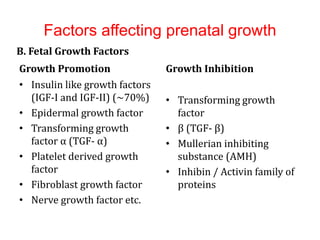
Growth Promotion
• Insulin like growth factors
(IGF‐I and IGF‐II) (~70%)
• Epidermal growth factor
• Transforming growth
factor α (TGF‐ α)
• Platelet derived growth
factor
• Fibroblast growth factor
• Nerve growth factor etc.
Growth Inhibition
• Transforming growth
factor
• β (TGF‐ β)
• Mullerian inhibiting
substance (AMH)
• Inhibin / Activin family of
proteins
B. Fetal Growth Factors
Factors affecting prenatal growth
C. Fetal hormones
• Have predominant role in late gestation
• Insulin and Thyroxine : Important for accretion and
differentiation of tissues
• Glucocorticoids : Required for maturation of organs like
lungs, liver and GI tract
• Note : Influence of Growth hormone on fetal growth is
minimal.
Factors affecting prenatal growth
D. Placental factors
• Placenta is essential for nutrition of fetus
• Fetal nutrition is enhanced by
• Increased villous surface area
• Decreased diffusion distance
• Increased dilatation of fetal capillaries
• Decreased resistance of vasculature
Factors affecting prenatal growth
E. Maternal factors
• Poor nutrition
• Anemia
• Recent pregnancy
• High parity
• Tobacco, drug, alcohol intake
• Pregnancy Induced Hypertension
• Multiple pregnancy
• Chronic systemic diseases
• TORCH infections
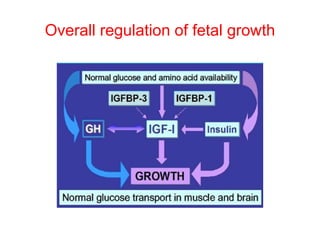
Overall regulation of fetal growth
Factors affecting postnatal growth
A. Sex
• Boys have greater growth potential than girls
• Girls have early pubertal height spurt than boys
• Pubertal height gain is more in boys
Factors affecting postnatal growth
B. Genetic
• Chromosome defect
• Short stature: Down syndrome, Turner syndrome
• Tall stature: Klinefelter syndrome
• Gene mutation
• short stature: Prader‐Willi syndrome, Noonan syndrome
• Tall stature: Marfan syndrome
Factors affecting postnatal growth
C. Environmental
• Nutrition
– PEM, Micronutrient deficiency (Fe, Io, Ca, Zn, VitA, VitD)
• Infections
– Diarrhea, recurrent RTI, TB, HIV, Malaria, Kala‐azar,
Chronic giardiasis
• Toxins
– Food, environment.
Factors affecting postnatal growth
D. Hormonal
• Growth hormone deficiency
• Hypothyroidism
• Growth hormone resistance
Factors affecting postnatal growth
E. Social factors
• Low socio economic status: Poor diet, infections
• Hot and humid climate
• Poor emotional support: Broken family, orphans
• Cultural factors: Religious taboos
• Low parental education: Poor health promotion, poor
nutrition.
Late consequences of poor fetal growth
(nutrition)
Fetal origin hypothesis (Barker’s hypothesis)
• Alterations in fetal nutrition and endocrine status lead to
programming
• Permanent changes in structure, physiology and
metabolism
• IUGR infants have increased risk of diabetes mellitus,
hypertension, hyperlipidemia and coronary artery disease
Laws of growth (I)
• Growth is a continuous and an orderly process.
• The rate of growth is not uniform – There are periods of
acceleration, deceleration and steadiness.
Phases of growth acceleration,
deceleration and steadiness
• Accelerationv (fvast) ‐1st Half of gestation, 1st year of life,
Puberty
• Deceleration‐ 2nd year
• Steady rate‐ 6‐9 years of age
Dotted
line:Weight
Solid
line:Height
ICP model for postnatal growth (karlberg)
height attainment during each phase
• Infancy: Starts before birth and falls off
by age 3 to 4 years. Average total height
gain is 45%.
• Childhood: Begins at the end of the first
year of life and continues to mature
height. Average total height gain is 47%.
• Puberty: This phase starts with initiation
of puberty.
• Average height gain is 8%
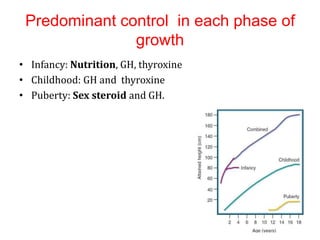
Predominant control in each phase of
growth
• Infancy: Nutrition, GH, thyroxine
• Childhood: GH and thyroxine
• Puberty: Sex steroid and GH.
Laws of growth (II)
• Growth pattern of every individual is unique.
– Cephalocaudal
– Distal to proximal
Laws of growth (III)
• Different tissues of the body grow at different rates
• General growth: Rapid during fetal life, first 1‐2 y and at
puberty
• Brain and head: Rapid during late fetal and early postnatal
life
• At birth 70%, at 2 y 90% of adult.
Laws of growth (ii)
• Lymphoid – maximum growth during mid‐ childhood
(4‐8y) Large tonsils and lymph nodes
• Gonads – grow at pubescence only
1 0 0
%
B r a i n G r o w t h S o m a n i c
G r o w t h
1 0 0
%
y e a r
s
a g e
1 0 0
%
L y m p h o i d G r o w t h G o n a d s
G r o w t h
1 0 0
%
y e a r
s
a g e
Periods of growth
Prenatal period
• Ovum : 0‐1w
• Embryo : 2‐8w
• Fetus : 9w ‐birth
• Perinatal period : 22wk of
gestation to 7days after
birth.
Postnatal period
• Newborn: Birth to 28 days
• Infancy: First year
• Toddler: 2‐3y
• Preschool: 4‐6y
• School age: 7‐12y
• Adolescence:10‐18y
Prenatal growth
Embryonic period
• 2wk: Bi‐laminar embryo
• 3wk: Tri‐laminar embryo,
Heart pumping begins
• 4wk: 4cms, human shape,
arm‐leg buds
• 5‐8wk: Major organ
system development
• 9wk: 9g, 5cm. Fetal period
begins.
Fetal period
• 10wk: External genitalia
distinguishable
• 20wk: 460gm, 19cms, lower
limit of viability
• 24w – Primitive alveoli,
surfactant production
• 25wk: 900gm, 25cm, 3rd
trimester begins
• 38wk: Term, weight triples,
length doubles from that of
25 w of gestation
Parameters of growth
• Weight.
• Length <2 y or Height >2 y.
• Head circumference (HC), Chest circumference (CC).
• Upper segment to lower segment (U:L) ratio.
• Arm span (AS).
Average growth parameters at birth
• Weight: 3 Kg
• Length: 50 cm
• U/L ratio: 1.7
• HC: 35 cm
• CC: 33 cm
Postnatal growth : weight
Age group Weight gain
0‐3 m 25‐30g/day
4m‐1 yr. 400g/month
2yr – Pubertal growth spurt*
2‐3 Kg/y
or
[Wt. in Kg = (Age in years +4) X 2] Weight doubles at 5m,
triples at 1 y, quadruples at 2y
• Boys 12 y, girls 10 y.
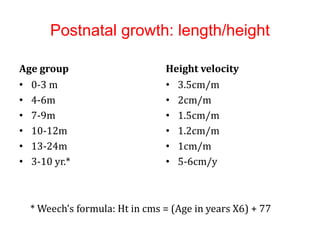
Postnatal growth: length/height
Age group
• 0‐3 m
• 4‐6m
• 7‐9m
• 10‐12m
• 13‐24m
• 3‐10 yr.*
Height velocity
• 3.5cm/m
• 2cm/m
• 1.5cm/m
• 1.2cm/m
• 1cm/m
• 5‐6cm/y
* Weech’s formula: Ht in cms = (Age in years X6) + 77
Postnatal growth: adolescence
• * Sex maturity rating
• Mean pubertal height gain : Boys‐27 cm, girls‐25 cm Mean
pubertal weight gain : Boys 29kg, girls 24 kg
Parameter Early Middle Late
Age (years) 9-13 14-16 17-20
Weight gain/year 2kg 3.5kg 1kg
Height gain/year 6-8cms 8-10 cm 2-3 cm
SMR* stages 1,2 3,4 5
Postnatal growth
Upper segment to lower segment ratio
• >6m age U/L ratio = 1.6 (Age in years X0.1)
Age Ratio
Birth 1.7
6m 1.6
2yr 1.4
3yr 1.3
4yr 1.2
6yr 1.1
10yr 1.0
Adults 0.9
Postnatal growth
head circumference (HC)
Age
• Birth‐3m
• 4m‐6m
• 7m‐12m
• 2nd y
• >2y
• By 12 y
Rate of increment
• 2cm/m
• 1cm/m
• 0.5cm/m
• 1cm/y
• 0.5cm/y
• 52 cm
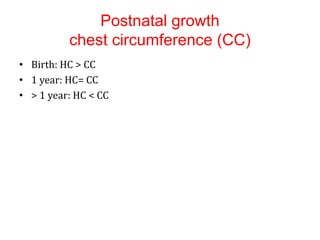
Postnatal growth
chest circumference (CC)
• Birth: HC > CC
• 1 year: HC= CC
• > 1 year: HC < CC
Postnatal growth: arm span (as)
• Birth – 5 years Ht 2 cm > arm spam
• 5 – 10 years Ht 1 cm > arm spam
• 10 years Ht = arm spam
• Adults Ht 2 cm < arm spam
Postnatal growth: skeletal maturation
• Steady in childhood, accelerates at puberty
• Closely correlates with sexual maturation
• Maturity indicated by epiphyseal closure
• Complete in boys at 22 y, girls at 18 y
• Preferred areas for bone age estimation by radiography
• Birth‐3m Knee and ankle
• 3‐9 m Shoulder
• 1‐13 y Hands and wrists
• 12‐14 y Elbow and hip
Postnatal growth – dentition
Primary teeth (20) Age at eruption
Central incisors 5m to 8m
Lateral incisors 7m to 11m
Canines 16m to 20m
I Molar 10m to 16m
II Molar 20m to 30m
• Approximate assessment
• Expected number of teeth = Age in months ‐ 6
Postnatal growth – dentition
Permanent teeth (32) Age at eruption
• I molars 6 to 7 y
• Incisors 6 to 8 y
• Canines 9 to 12 y
• Premolars 9 to 12 y
• II Molar 12 y
• III Molar ≥ 18 y
Growth standards
• Norms of growth represented as tables or charts
• Derived from large cohort of healthy children by cross
sectional or longitudinal studies
• Tables are useful as easy ready references
Growth charts
• Superior to tables to
diagnose early deviations in
growth
• Distance growth charts
reveal the growth acquired
till the date of last evaluation
Height velocity charts
• Height velocity: Rate of
height increment per unit
time and
• Indicates periods of
acceleration, deceleration
and steadiness
• Most useful for early
identification of growth
faltering
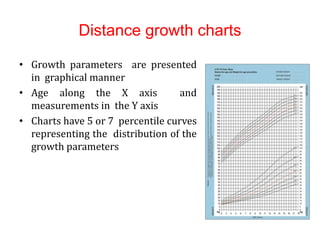
Distance growth charts
• Growth parameters are presented
in graphical manner
• Age along the X axis and
measurements in the Y axis
• Charts have 5 or 7 percentile curves
representing the distribution of the
growth parameters
Growth parameters in growth charts
• Weight for age
• Height/length for age
• Head circumference for age
• Weight for length/height
• Body mass index
• Each parameter separate for boys (Blue) & girls (pink)
Plotting height on a growth chart
• 8 years old boy,
• Height: 120 cm,
• Draw an imaginary line along the
X‐axis till the age (8y) of the child.
• Then extend the imaginary line
along the Y‐axis till the height (116
cm) of the child
• Mark the point
Recommended growth charts
WHO, derived from MGRS
study 0‐5 years
• Height, weight, HC for 0‐5
y Weight for height for 0‐5
y
Revised IAP Growth charts,
2015
• Height, weight, BMI for
5‐18 y
WHO growth charts ‐ 2006
• Ideal growth charts that provide data on how children
should grow
• Internationally usable standard growth charts
• Multi‐center Growth Reference Study (MGRS) from 5
Continents.
• Study sites – US, Brazil, Ghana, Oman, Norway, India.
WHO growth charts ‐ 2006
• Derived from children raised under optimal conditions for
growth such as:
• Exclusive breast feeding
• Healthy environment
• Minimal infection
• Nonsmoking mothers
Statistics used in describing growth
• Normal: Healthy.
• Median: Value above and below which 50% of
observations lie.
• Mode: Value having highest number of observations
• Mean: The average value of observations.
• Standard deviation or Z score: The extent to which
observed values cluster near the mean.
Normal distribution (gaussian) curve
• Symmetrical bell shaped curve in which 50% of the
observations lie above & 50% below a central line which is
the 50th percentile or median
• Values below 3rd (‐2SD) and above 97th (+2SD) percentile
are abnormal.
Understanding of percentiles
• 8 years old boy,
• Height: 120 cm,
• 10th percentile for his age and sex
• 10% of boys aged 8y in the
reference populations are shorter
and 90% are taller than the index
child
Thank you

Normal-growth.pptx

  • 1.
    Normal Growth AndFactors Affecting Growth Dr. B.MANOHAR Professor of pediatrics
  • 2.
    Definitions • Growth: Netincrease in the size or mass of tissues which is largely due to multiplication of cells and increase in the intracellular substance. • Development: Maturation of functions associated with maturation and myelination of nervous system.
  • 3.
    Growth : Significance •Essential feature that distinguishes a child from an adult. • Indicates overall well‐being of a child. • Reflects the nation’s economic status and public health system.
  • 4.
    Factors affecting growth Prenatalperiod • Fetal • Placental • Maternal Postnatal period • Genetic • Environmental
  • 5.
    Factors affecting prenatalgrowth A. Genetic Potential • Parental trait – Tall parents have tall children – Head size related to parents • Sex ‐ Boys larger than girls • Race‐ Growth differs in different races
  • 6.
    Factors affecting prenatalgrowth Growth Promotion • Insulin like growth factors (IGF‐I and IGF‐II) (~70%) • Epidermal growth factor • Transforming growth factor α (TGF‐ α) • Platelet derived growth factor • Fibroblast growth factor • Nerve growth factor etc. Growth Inhibition • Transforming growth factor • β (TGF‐ β) • Mullerian inhibiting substance (AMH) • Inhibin / Activin family of proteins B. Fetal Growth Factors
  • 7.
    Factors affecting prenatalgrowth C. Fetal hormones • Have predominant role in late gestation • Insulin and Thyroxine : Important for accretion and differentiation of tissues • Glucocorticoids : Required for maturation of organs like lungs, liver and GI tract • Note : Influence of Growth hormone on fetal growth is minimal.
  • 8.
    Factors affecting prenatalgrowth D. Placental factors • Placenta is essential for nutrition of fetus • Fetal nutrition is enhanced by • Increased villous surface area • Decreased diffusion distance • Increased dilatation of fetal capillaries • Decreased resistance of vasculature
  • 9.
    Factors affecting prenatalgrowth E. Maternal factors • Poor nutrition • Anemia • Recent pregnancy • High parity • Tobacco, drug, alcohol intake • Pregnancy Induced Hypertension • Multiple pregnancy • Chronic systemic diseases • TORCH infections
  • 10.
  • 11.
    Factors affecting postnatalgrowth A. Sex • Boys have greater growth potential than girls • Girls have early pubertal height spurt than boys • Pubertal height gain is more in boys
  • 12.
    Factors affecting postnatalgrowth B. Genetic • Chromosome defect • Short stature: Down syndrome, Turner syndrome • Tall stature: Klinefelter syndrome • Gene mutation • short stature: Prader‐Willi syndrome, Noonan syndrome • Tall stature: Marfan syndrome
  • 13.
    Factors affecting postnatalgrowth C. Environmental • Nutrition – PEM, Micronutrient deficiency (Fe, Io, Ca, Zn, VitA, VitD) • Infections – Diarrhea, recurrent RTI, TB, HIV, Malaria, Kala‐azar, Chronic giardiasis • Toxins – Food, environment.
  • 14.
    Factors affecting postnatalgrowth D. Hormonal • Growth hormone deficiency • Hypothyroidism • Growth hormone resistance
  • 15.
    Factors affecting postnatalgrowth E. Social factors • Low socio economic status: Poor diet, infections • Hot and humid climate • Poor emotional support: Broken family, orphans • Cultural factors: Religious taboos • Low parental education: Poor health promotion, poor nutrition.
  • 16.
    Late consequences ofpoor fetal growth (nutrition) Fetal origin hypothesis (Barker’s hypothesis) • Alterations in fetal nutrition and endocrine status lead to programming • Permanent changes in structure, physiology and metabolism • IUGR infants have increased risk of diabetes mellitus, hypertension, hyperlipidemia and coronary artery disease
  • 17.
    Laws of growth(I) • Growth is a continuous and an orderly process. • The rate of growth is not uniform – There are periods of acceleration, deceleration and steadiness.
  • 18.
    Phases of growthacceleration, deceleration and steadiness • Accelerationv (fvast) ‐1st Half of gestation, 1st year of life, Puberty • Deceleration‐ 2nd year • Steady rate‐ 6‐9 years of age Dotted line:Weight Solid line:Height
  • 19.
    ICP model forpostnatal growth (karlberg) height attainment during each phase • Infancy: Starts before birth and falls off by age 3 to 4 years. Average total height gain is 45%. • Childhood: Begins at the end of the first year of life and continues to mature height. Average total height gain is 47%. • Puberty: This phase starts with initiation of puberty. • Average height gain is 8%
  • 20.
    Predominant control ineach phase of growth • Infancy: Nutrition, GH, thyroxine • Childhood: GH and thyroxine • Puberty: Sex steroid and GH.
  • 21.
    Laws of growth(II) • Growth pattern of every individual is unique. – Cephalocaudal – Distal to proximal
  • 22.
    Laws of growth(III) • Different tissues of the body grow at different rates • General growth: Rapid during fetal life, first 1‐2 y and at puberty • Brain and head: Rapid during late fetal and early postnatal life • At birth 70%, at 2 y 90% of adult.
  • 23.
    Laws of growth(ii) • Lymphoid – maximum growth during mid‐ childhood (4‐8y) Large tonsils and lymph nodes • Gonads – grow at pubescence only 1 0 0 % B r a i n G r o w t h S o m a n i c G r o w t h 1 0 0 % y e a r s a g e 1 0 0 % L y m p h o i d G r o w t h G o n a d s G r o w t h 1 0 0 % y e a r s a g e
  • 24.
    Periods of growth Prenatalperiod • Ovum : 0‐1w • Embryo : 2‐8w • Fetus : 9w ‐birth • Perinatal period : 22wk of gestation to 7days after birth. Postnatal period • Newborn: Birth to 28 days • Infancy: First year • Toddler: 2‐3y • Preschool: 4‐6y • School age: 7‐12y • Adolescence:10‐18y
  • 25.
    Prenatal growth Embryonic period •2wk: Bi‐laminar embryo • 3wk: Tri‐laminar embryo, Heart pumping begins • 4wk: 4cms, human shape, arm‐leg buds • 5‐8wk: Major organ system development • 9wk: 9g, 5cm. Fetal period begins. Fetal period • 10wk: External genitalia distinguishable • 20wk: 460gm, 19cms, lower limit of viability • 24w – Primitive alveoli, surfactant production • 25wk: 900gm, 25cm, 3rd trimester begins • 38wk: Term, weight triples, length doubles from that of 25 w of gestation
  • 26.
    Parameters of growth •Weight. • Length <2 y or Height >2 y. • Head circumference (HC), Chest circumference (CC). • Upper segment to lower segment (U:L) ratio. • Arm span (AS).
  • 27.
    Average growth parametersat birth • Weight: 3 Kg • Length: 50 cm • U/L ratio: 1.7 • HC: 35 cm • CC: 33 cm
  • 28.
    Postnatal growth :weight Age group Weight gain 0‐3 m 25‐30g/day 4m‐1 yr. 400g/month 2yr – Pubertal growth spurt* 2‐3 Kg/y or [Wt. in Kg = (Age in years +4) X 2] Weight doubles at 5m, triples at 1 y, quadruples at 2y • Boys 12 y, girls 10 y.
  • 29.
    Postnatal growth: length/height Agegroup • 0‐3 m • 4‐6m • 7‐9m • 10‐12m • 13‐24m • 3‐10 yr.* Height velocity • 3.5cm/m • 2cm/m • 1.5cm/m • 1.2cm/m • 1cm/m • 5‐6cm/y * Weech’s formula: Ht in cms = (Age in years X6) + 77
  • 30.
    Postnatal growth: adolescence •* Sex maturity rating • Mean pubertal height gain : Boys‐27 cm, girls‐25 cm Mean pubertal weight gain : Boys 29kg, girls 24 kg Parameter Early Middle Late Age (years) 9-13 14-16 17-20 Weight gain/year 2kg 3.5kg 1kg Height gain/year 6-8cms 8-10 cm 2-3 cm SMR* stages 1,2 3,4 5
  • 31.
    Postnatal growth Upper segmentto lower segment ratio • >6m age U/L ratio = 1.6 (Age in years X0.1) Age Ratio Birth 1.7 6m 1.6 2yr 1.4 3yr 1.3 4yr 1.2 6yr 1.1 10yr 1.0 Adults 0.9
  • 32.
    Postnatal growth head circumference(HC) Age • Birth‐3m • 4m‐6m • 7m‐12m • 2nd y • >2y • By 12 y Rate of increment • 2cm/m • 1cm/m • 0.5cm/m • 1cm/y • 0.5cm/y • 52 cm
  • 33.
    Postnatal growth chest circumference(CC) • Birth: HC > CC • 1 year: HC= CC • > 1 year: HC < CC
  • 34.
    Postnatal growth: armspan (as) • Birth – 5 years Ht 2 cm > arm spam • 5 – 10 years Ht 1 cm > arm spam • 10 years Ht = arm spam • Adults Ht 2 cm < arm spam
  • 35.
    Postnatal growth: skeletalmaturation • Steady in childhood, accelerates at puberty • Closely correlates with sexual maturation • Maturity indicated by epiphyseal closure • Complete in boys at 22 y, girls at 18 y • Preferred areas for bone age estimation by radiography • Birth‐3m Knee and ankle • 3‐9 m Shoulder • 1‐13 y Hands and wrists • 12‐14 y Elbow and hip
  • 36.
    Postnatal growth –dentition Primary teeth (20) Age at eruption Central incisors 5m to 8m Lateral incisors 7m to 11m Canines 16m to 20m I Molar 10m to 16m II Molar 20m to 30m • Approximate assessment • Expected number of teeth = Age in months ‐ 6
  • 37.
    Postnatal growth –dentition Permanent teeth (32) Age at eruption • I molars 6 to 7 y • Incisors 6 to 8 y • Canines 9 to 12 y • Premolars 9 to 12 y • II Molar 12 y • III Molar ≥ 18 y
  • 38.
    Growth standards • Normsof growth represented as tables or charts • Derived from large cohort of healthy children by cross sectional or longitudinal studies • Tables are useful as easy ready references
  • 39.
    Growth charts • Superiorto tables to diagnose early deviations in growth • Distance growth charts reveal the growth acquired till the date of last evaluation
  • 40.
    Height velocity charts •Height velocity: Rate of height increment per unit time and • Indicates periods of acceleration, deceleration and steadiness • Most useful for early identification of growth faltering
  • 41.
    Distance growth charts •Growth parameters are presented in graphical manner • Age along the X axis and measurements in the Y axis • Charts have 5 or 7 percentile curves representing the distribution of the growth parameters
  • 42.
    Growth parameters ingrowth charts • Weight for age • Height/length for age • Head circumference for age • Weight for length/height • Body mass index • Each parameter separate for boys (Blue) & girls (pink)
  • 43.
    Plotting height ona growth chart • 8 years old boy, • Height: 120 cm, • Draw an imaginary line along the X‐axis till the age (8y) of the child. • Then extend the imaginary line along the Y‐axis till the height (116 cm) of the child • Mark the point
  • 44.
    Recommended growth charts WHO,derived from MGRS study 0‐5 years • Height, weight, HC for 0‐5 y Weight for height for 0‐5 y Revised IAP Growth charts, 2015 • Height, weight, BMI for 5‐18 y
  • 45.
    WHO growth charts‐ 2006 • Ideal growth charts that provide data on how children should grow • Internationally usable standard growth charts • Multi‐center Growth Reference Study (MGRS) from 5 Continents. • Study sites – US, Brazil, Ghana, Oman, Norway, India.
  • 46.
    WHO growth charts‐ 2006 • Derived from children raised under optimal conditions for growth such as: • Exclusive breast feeding • Healthy environment • Minimal infection • Nonsmoking mothers
  • 47.
    Statistics used indescribing growth • Normal: Healthy. • Median: Value above and below which 50% of observations lie. • Mode: Value having highest number of observations • Mean: The average value of observations. • Standard deviation or Z score: The extent to which observed values cluster near the mean.
  • 48.
    Normal distribution (gaussian)curve • Symmetrical bell shaped curve in which 50% of the observations lie above & 50% below a central line which is the 50th percentile or median • Values below 3rd (‐2SD) and above 97th (+2SD) percentile are abnormal.
  • 49.
    Understanding of percentiles •8 years old boy, • Height: 120 cm, • 10th percentile for his age and sex • 10% of boys aged 8y in the reference populations are shorter and 90% are taller than the index child
  • 50.