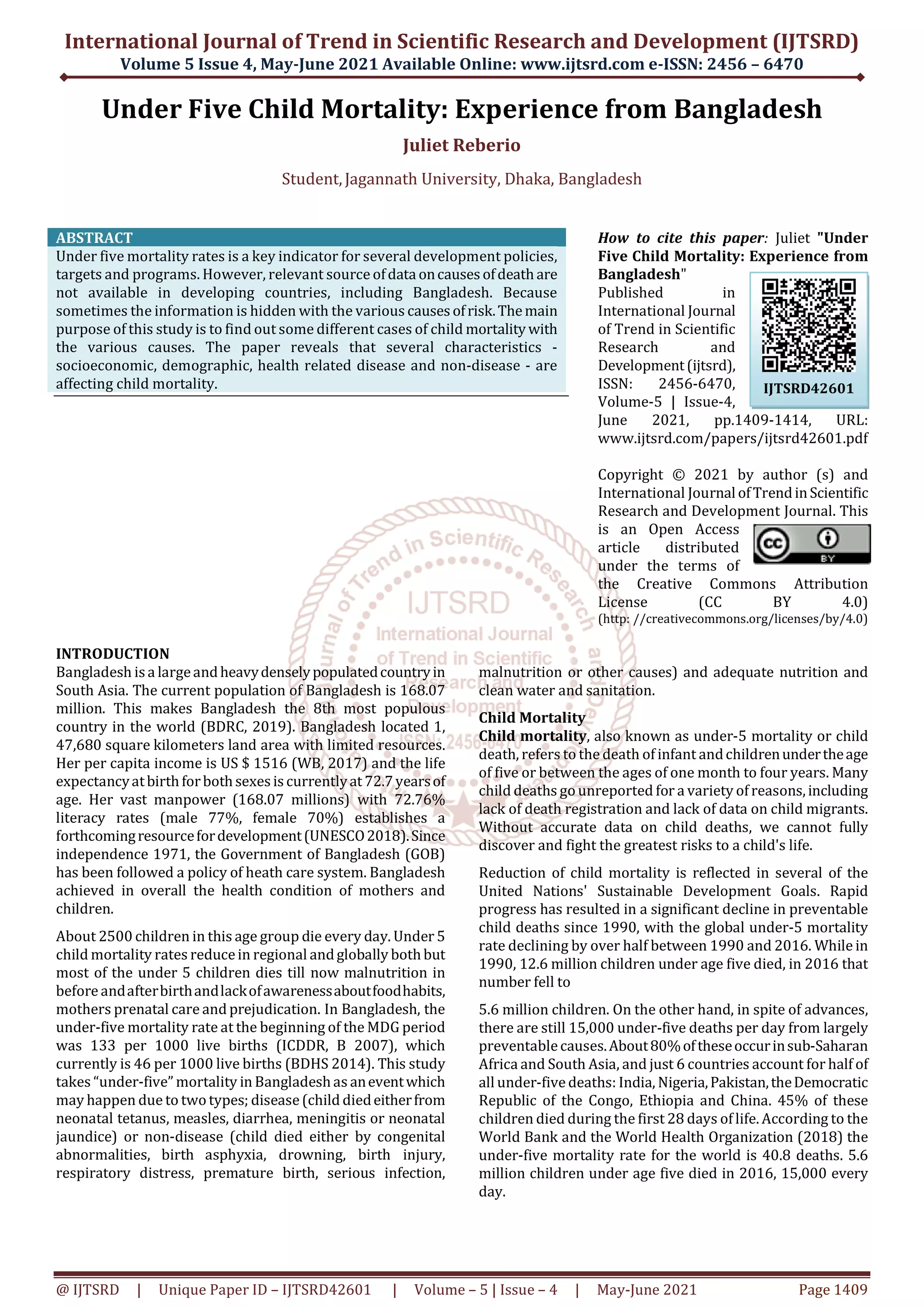
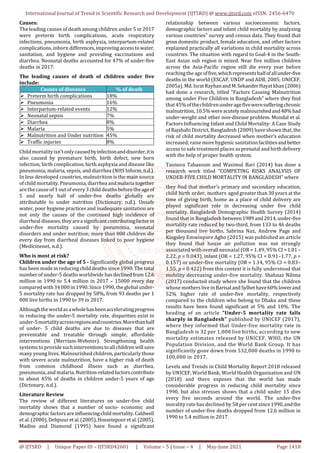
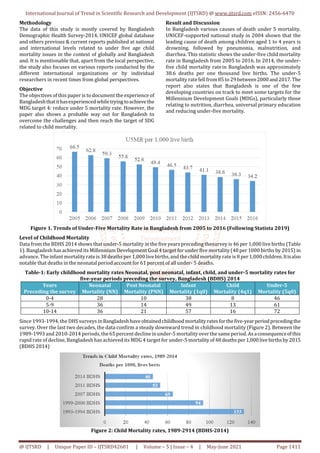
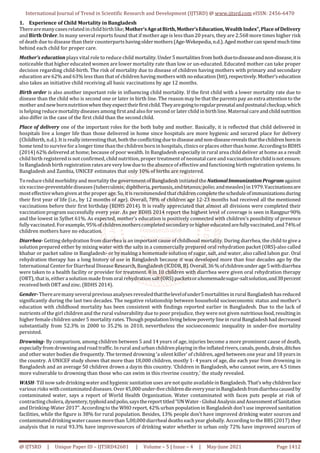
International Journal of Trend in Scientific Research and Development (IJTSRD)
Volume 5 Issue 4, May-June 2021 Available Online: www.ijtsrd.com e-ISSN: 2456 – 6470
@ IJTSRD | Unique Paper ID – IJTSRD42601 | Volume – 5 | Issue – 4 | May-June 2021 Page 1409
Under Five Child Mortality: Experience from Bangladesh
Juliet Reberio
Student,Jagannath University, Dhaka, Bangladesh
ABSTRACT
Under five mortality rates is a key indicator for several development policies,
targets and programs. However, relevant source ofdata oncauses ofdeathare
not available in developing countries, including Bangladesh. Because
sometimes the information is hidden with the various causes ofrisk.Themain
purpose of this study is to find out some different cases of child mortality with
the various causes. The paper reveals that several characteristics -
socioeconomic, demographic, health related disease and non-disease - are
affecting child mortality.
How to cite this paper: Juliet "Under
Five Child Mortality: Experience from
Bangladesh"
Published in
International Journal
of Trend in Scientific
Research and
Development(ijtsrd),
ISSN: 2456-6470,
Volume-5 | Issue-4,
June 2021, pp.1409-1414, URL:
www.ijtsrd.com/papers/ijtsrd42601.pdf
Copyright © 2021 by author (s) and
International Journal ofTrendinScientific
Research and Development Journal. This
is an Open Access
article distributed
under the terms of
the Creative Commons Attribution
License (CC BY 4.0)
(http: //creativecommons.org/licenses/by/4.0)
INTRODUCTION
Bangladesh is a largeandheavydenselypopulatedcountryin
South Asia. The current population of Bangladesh is 168.07
million. This makes Bangladesh the 8th most populous
country in the world (BDRC, 2019). Bangladesh located 1,
47,680 square kilometers land area with limited resources.
Her per capita income is US $ 1516 (WB, 2017) and the life
expectancyatbirth forbothsexes is currentlyat 72.7yearsof
age. Her vast manpower (168.07 millions) with 72.76%
literacy rates (male 77%, female 70%) establishes a
forthcomingresourcefordevelopment(UNESCO2018).Since
independence 1971, the Government of Bangladesh (GOB)
has been followed a policy of heath care system. Bangladesh
achieved in overall the health condition of mothers and
children.
About 2500 children in this age group die every day. Under 5
child mortality rates reducein regional andglobally bothbut
most of the under 5 children dies till now malnutrition in
before andafterbirthandlackofawarenessaboutfoodhabits,
mothers prenatal care and prejudication. In Bangladesh, the
under-five mortality rate at the beginning of the MDG period
was 133 per 1000 live births (ICDDR, B 2007), which
currently is 46 per 1000 live births (BDHS 2014). This study
takes “under-five” mortality in Bangladeshas aneventwhich
may happen due to two types; disease(child diedeitherfrom
neonatal tetanus, measles, diarrhea, meningitis or neonatal
jaundice) or non-disease (child died either by congenital
abnormalities, birth asphyxia, drowning, birth injury,
respiratory distress, premature birth, serious infection,
malnutrition or other causes) and adequate nutrition and
clean water and sanitation.
Child Mortality
Child mortality, also known as under-5 mortality or child
death, refers to the death of infant andchildrenundertheage
of five or between the ages of one month to four years. Many
child deaths go unreported for a variety of reasons, including
lack of death registration and lack of data on child migrants.
Without accurate data on child deaths, we cannot fully
discover and fight the greatest risks to a child's life.
Reduction of child mortality is reflected in several of the
United Nations' Sustainable Development Goals. Rapid
progress has resulted in a significant decline in preventable
child deaths since 1990, with the global under-5 mortality
rate declining by over half between 1990 and 2016. While in
1990, 12.6 million children under age five died, in 2016 that
number fell to
5.6 million children. On the other hand, in spite of advances,
there are still 15,000 under-five deaths per day from largely
preventablecauses.About80%oftheseoccurinsub-Saharan
Africa and South Asia, and just 6 countries account for half of
all under-five deaths: India, Nigeria,Pakistan,theDemocratic
Republic of the Congo, Ethiopia and China. 45% of these
children died during the first 28 days of life. According to the
World Bank and the World Health Organization (2018) the
under-five mortality rate for the world is 40.8 deaths. 5.6
million children under age five died in 2016, 15,000 every
day.
IJTSRD42601
International Journal of Trend in Scientific Research and Development (IJTSRD) @ www.ijtsrd.com eISSN: 2456-6470
@ IJTSRD | Unique Paper ID – IJTSRD42601 | Volume – 5 | Issue – 4 | May-June 2021 Page 1410
Causes:
The leading causes of death among children under 5 in 2017
were preterm birth complications, acute respiratory
infections, pneumonia, birth asphyxia, interpartum-related
complications, inborn differences,improvingaccesstowater,
sanitation, and hygiene and providing vaccinations and
diarrhea. Neonatal deaths accounted for 47% of under-five
deaths in 2017.
The leading causes of death of children under five
include:
Causes of diseases % of death
 Preterm birth complications 18%
 Pneumonia 16%
 Interpartum-related events 12%
 Neonatal sepsis 7%
 Diarrhea 8%
 Malaria 5%
 Malnutrition and Under nutrition 45%
 Traffic injuries 8%
Childmortalityisn’tonlycausedbyinfectionanddisorder,itis
also caused by premature birth, birth defect, new born
infection, birth complication, birth asphyxia and disease like
pneumonia, malaria, sepsis, and diarrhea (NHS Inform, n.d.).
In less developed countries, malnutrition is the main source
of child mortality. Pneumonia, diarrhea andmalariatogether
arethe cause of 1 out of every3 child deaths beforetheageof
5 and nearly half of under-five deaths globally are
attributable to under nutrition (Dictionary, n.d.). Unsafe
water, poor hygiene practices and inadequate sanitation are
not only the causes of the continued high incidence of
diarrheal diseases,theyareasignificantcontributingfactorin
under-five mortality caused by pneumonia, neonatal
disorders and under nutrition; more than 800 children die
every day from diarrheal diseases linked to poor hygiene
(Medicinenet, n.d.).
Who is most at risk?
Children under the age of 5 - Significantly global progress
has been made in reducing child deaths since 1990. The total
number of under-5 deaths worldwide has declinedfrom12.6
million in 1990 to 5.4 million in 2017 – 15000 every day
comparedwith34000in1990.Since 1990, the global under-
5 mortality rate has dropped by 58%, from 93 deaths per 1
000 live births in 1990 to 39 in 2017.
Althoughtheworldasawholehasbeenacceleratingprogress
in reducing the under-5 mortality rate, disparities exist in
under-5mortalityacrossregionsandcountries.Morethanhalf
of under- 5 child deaths are due to diseases that are
preventable and treatable through simple, affordable
interventions (Merriam-Webster). Strengthening health
systems to providesuchinterventionstoallchildrenwillsave
many young lives. Malnourished children, particularly those
with severe acute malnutrition, have a higher risk of death
from common childhood illness such as diarrhea,
pneumonia, and malaria. Nutrition-relatedfactorscontribute
to about 45% of deaths in children under-5 years of age
(Dictonary, n.d.).
Literature Review
The review of different literatures on under-five child
mortality shows that a number of socio- economic and
demographic factors areinfluencingchildmortality.Caldwell
et al.(2000), Debpuur etal.(2005),Hosseinpooretal.(2005),
Madise and Diamond (1995) have found a significant
relationship between various socioeconomic factors,
demographic factors and infant child mortality by analyzing
various countries‟ survey and census data. They found that
gross domestic product, female education, and other factors
explained practically all variations in child mortality across
countries. The situation with regard to Goal-4 in the South-
East Asian sub region is mixed. Near five million children
across the Asia-Pacific region still die every year before
reachingtheageoffive,whichrepresentshalfofallunder-five
deaths in the world (ESCAP, UNDP and ADB, 2005; UNICEF,
2005a). Md.Israt RayhanandM.SekanderHayatkhan(2006)
had done a research, titled “Factors Causing Malnutrition
among under Five Children in Bangladesh” where they find
that45%ofthechildrenunderagefiveweresufferingchronic
malnutrition,10.5%wereacutelymalnourishedand48%had
under-weight and other non-disease problem. Mondal et al.
Factors Influencing Infant and Child Mortality: A Case Study
of Rajshahi District, Bangladesh (2009) have shown that, the
risk of child mortality decreased when mother’s education
increased; raise more hygienic sanitationfacilitiesandbetter
access to safe treatment places as prenatal and birthdelivery
with the help of proper health system.
Tasnuva Tabassum and Wasimul Bari (2014) has done a
research work titled “COMPETING RISKS ANALYSIS OF
UNDER-FIVE CHILD MORTALITY IN BANGLADESH” where
they find that mother’s primary and secondary education,
child birth order, mothers aged greater than 30 years at the
time of giving birth, home as a place of child delivery are
played significant role in decreasing under five child
mortality. Bangladesh Demographic Health Survey (2014)
found that in Bangladesh between1989and2014,under-five
mortality rate reduced by two-third, from 133 to 46 deaths
per thousand live births. Sabrina Naz, Andrew Page and
Kingsley Emwinyore Agho (2015) was published an article
they found that house air pollution was not strongly
associated with overall neonatal (OR = 1.49, 95% CI =1.01–
2.22, p = 0.043), infant (OR = 1.27, 95% CI = 0.91–1.77, p =
0.157) or under-five mortality (OR = 1.14, 95% CI = 0.83–
1.55, p = 0.422) from this context it is fully understood that
mobility decreasing under-five mortality. Shahnaz Nilima
(2017) conducted study where she found that the children
whose mothers live in BarisalandSylhethave60%lowerand
52% higher rate of under-five mortality, respectively
compared to the children who belong to Dhaka and these
results have been found significant at 5% and 10%. The
heading of an article “Under-5 mortality rate falls
sharply in Bangladesh” published by UNICEF (2017),
where they informed that Under-five mortality rate in
Bangladesh is 32 per 1,000 live births, according to new
mortality estimates released by UNICEF, WHO, the UN
Population Division, and the World Bank Group. It has
significantly gone down from 532,000 deaths in 1990 to
100,000 in 2017.
Levels and Trends in Child Mortality Report 2018 released
by UNICEF, World Bank, World Health Organization and UN
(2018) and there exposes that the world has made
considerable progress in reducing child mortality since
1990, but also stresses shows that a child under 15 dies
every five seconds around the world. The under-five
morality rate has declined by 58 per cent since1990,andthe
number of under-five deaths dropped from 12.6 million in
1990 to 5.4 million in 2017.
International Journal of Trend in Scientific Research and Development (IJTSRD) @ www.ijtsrd.com eISSN: 2456-6470
@ IJTSRD | Unique Paper ID – IJTSRD42601 | Volume – 5 | Issue – 4 | May-June 2021 Page 1411
Methodology
The data of this study is mostly covered by Bangladesh
Demographic Health Survey-2014, UNICEF global database
and others previous & current reports published at national
and international levels related to under five age child
mortality issues in the context of globally and Bangladesh
and. It is mentionable that, apart from the local perspective,
the study also focuses on various reports conducted by the
different international organizations or by individual
researchers in recent times from global perspectives.
Objective
The objectives of this paper is to document the experience of
Bangladeshthatithasexperiencedwhiletryingtoachievethe
MDG target 4: reduce under 5 mortality rate. However, the
paper also shows a probable way out for Bangladesh to
overcome the challenges and then reach the target of SDG
related to child mortality.
Result and Discussion
In Bangladesh various causes of death under 5 mortality.
UNICEF-supported national study in 2004 shown that the
leading cause of death among children aged 1 to 4 years is
drowning, followed by pneumonia, malnutrition, and
diarrhea. This statistic shows the under-five child mortality
rate in Bangladesh from 2005 to 2016. In 2014, the under-
five child mortality ratein Bangladesh was approximately
38.6 deaths per one thousand live births. The under-5
mortality ratefellfrom85 to 29between2000and2017.The
report also states that Bangladesh is one of the few
developing countries on track to meet some targets for the
Millennium Development Goals (MDGs), particularly those
relating to nutrition, diarrhea, universal primary education
and reducing under-five mortality.
Figure 1. Trends of Under-Five Mortality Rate in Bangladesh from 2005 to 2016 (Following Statista 2019)
Level of Childhood Mortality
Data from the BDHS 2014 shows that under-5 mortality in the five years preceding thesurvey is 46 per 1,000 live births (Table
1). Bangladesh has achieved its Millennium Development Goal 4 target forunder five mortality (48 per 1000 births by 2015) in
advance. The infant mortality rate is 38 deaths per 1,000live births,and thechild mortality rate is 8 per 1,000children.Itisalso
notable that deaths in the neonatal period account for 61 percent of all under- 5 deaths.
Table-1: Early childhood mortality rates Neonatal, post neonatal, infant, child, and under-5 mortality rates for
five-year periods preceding the survey, Bangladesh (BDHS) 2014
Years
Preceding the survey
Neonatal
Mortality (NN)
Post Neonatal
Mortality (PNN)
Infant
Mortality (1q0)
Child
Mortality (4q1)
Under-5
Mortality (5q0)
0-4 28 10 38 8 46
5-9 36 14 49 13 61
10-14 36 21 57 16 72
Since 1993-1994, the DHS surveys inBangladeshhaveobtainedchildhood mortalityrates forthefive-yearperiodprecedingthe
survey. Over the last two decades, the data confirm a steady downward trend in childhood mortality (Figure 2). Between the
1989-1993 and 2010-2014 periods,the65percent decline inunder-5 mortalityoverthesameperiod.Asaconsequenceofthis
rapid rate of decline, Bangladesh has achieved its MDG 4 target for under-5 mortality of48deaths per1,000live births by2015
(BDHS 2014)
Figure 2: Child Mortality rates, 1989-2914 (BDHS-2014)
International Journal of Trend in Scientific Research and Development (IJTSRD) @ www.ijtsrd.com eISSN: 2456-6470
@ IJTSRD | Unique Paper ID – IJTSRD42601 | Volume – 5 | Issue – 4 | May-June 2021 Page 1412
1. Experience of Child Mortality in Bangladesh
Therearemanycasesrelatedinchildbirthlike;Mother’sAgeatBirth,Mother’sEducation,Wealth Index”,Place ofDelivery
and Birth Order. In many several reports found that if mother age is less than 20 years, they are 2.568 more times higher risk
of death due to disease than their counterparts havingoldermothers (Age-Wekepedia, n.d.).Agedmothercanspendmuchtime
behind each child for proper care.
Mother’s education plays vital role to reduce child mortality.Under5mortalities from bothduetodiseaseandnon-disease,itis
noticeable that higher educated women are lower mortality rate than low or un-educated. Educated mother can take proper
decision regarding child-birth. The risk of mortality due to disease of children having mothers with primary and secondary
education are 62% and 63% less than that of children having mothers withno education(htt),respectively.Mother’s education
also takes an initiative child receiving all basic vaccinations by age 12 months.
Birth order is also another important role in influencing child mortality. If the first child with a lower mortality rate due to
disease than the child who is second one or later in birth line. The reason may be that the parents pay an extra attention to the
motherandnewbornnutritionwhentheyexpecttheirfirstchild.Theyaregoingtoregularprenatalandpostnatalcheckup,which
is helping reducemortality diseases among first and also for second or later child in birthline. Maternal careandchildnutrition
also differ in the case of the first child than the second child.
Place of delivery one of the important roles for the both baby and mother. Basically, it is reflected that child delivered in
hospitals live a longer life than those delivered in home since hospitals are more hygienic and secured place for delivery
(Childbirth, n.d.). It is really interesting that, both the conflicting due to diseaseandnon-diseaserevealsthatthechildrenbornin
home tend to survivefor a longer time than the children bornin hospitals, clinics or places other than home.AccordingtoBDHS
(2014) 62% delivered at home; because of poor wealth. In Bangladesh especially in rural area child deliver at home as a result
child birth registered is not confirmed, child nutrition, proper treatment of neonatal care and vaccinationforchildisnotensure.
InBangladesh birthregistrationratesareverylowdueto theabsenceof effective and functioning birth registration systems. In
Bangladesh and Zambia, UNICEF estimates that only 10% of births are registered.
To reduce child morbidity and mortality the government of Bangladesh initiated theNationalImmunizationProgramagainst
six vaccine-preventable diseases (tuberculosis; diphtheria, pertussis,andtetanus;polio;andmeasles)in1979.Vaccinationsare
mosteffectivewhengiven at the properage. So, it isrecommended thatchildrencompletethescheduleofimmunizationsduring
their first year of life (i.e., by 12 months of age). Overall, 78% of children age 12-23 months had received all the mentioned
vaccinations before their first birthday (BDHS 2014). It is really appreciated that almost all divisions were completed their
vaccination program successfully every year. As per BDHS 2014 report the highest level of coverage is seen inRangpur90%
and the lowest in Sylhet 61%. As expected, mother’s education is positively connected with children’s possibility of presence
fully vaccinated. For example,95%ofchildrenmotherscompletedsecondaryorhighereducatedarefullyvaccinated,and74%of
children mothers have no education.
Diarrhea- Getting dehydration from diarrhea is an important cause of childhood mortality. During diarrhea, the child to givea
solution prepared either by mixing water with the salts in a commercially prepared oral rehydration packet (ORS)-also called
khabar or packet saline in Bangladesh- or by making a homemade solution of sugar, salt, and water, also called labon gur. Oral
rehydration therapy has a long history of use in Bangladesh because it was developed more than four decades ago by the
International Center for Diarrheal Disease Research, Bangladesh (ICDDR,B).Overall,36%ofchildrenunderage5withdiarrhea
were taken to a health facility or provider for treatment. 8 in 10 children with diarrhea were given oral rehydration therapy
(ORT), that is, either a solution made from oral rehydrationsalt(ORS)packetsorahomemadesugar-saltsolution,and38percent
receivedboth ORTandzinc. (BDHS 2014).
Gender-Therearemanyseveralpreviousanalysesrevealedthatthelevelofunder5mortalities inruralBangladeshhas reduced
significantly during the last two decades. The negative relationship between household socioeconomic status and mother’s
education with childhood mortality has been consistent with findings reported earlier in Bangladesh. Due to the lack of
nutrients of the girl children and the rural vulnerability due to poor prejudice, they were not given nutritious food, resulting in
higher female children under 5 mortality rates. Though populationliving belowpoverty lineinrural Bangladeshhad decreased
substantially from 52.3% in 2000 to 35.2% in 2010, nevertheless the socioeconomic inequality in under-five mortality
persisted.
Drowning- By comparison, among children between 5 and 14 years of age, injuries become a more prominent cause of death,
especially from drowning and road traffic. In rural and urban children playing in the inflatedrivers,canals,ponds,drain,ditches
and other water bodies die frequently. The termed drowning ‘a silent killer’ of children, aged between one year and 18 years in
the country. A UNICEF study shows that more than 18,000 children, mostly 1- 4 years of age, die each year from drowning in
Bangladesh and an average 50 children drown a dayin this country. ‘Children in Bangladesh, who cannot swim, are 4.5 times
more vulnerable to drowning than those who can swim in this riverine country,’ the study revealed.
WASH- Till now safe drinkingwater and hygienic sanitation uses are not quite availablein Bangladesh.That’swhychildrenface
various risks with contaminated diseases. Over45,000under-fivechildrendieeveryyearinBangladeshfromdiarrheacausedby
contaminated water, says a report of World Health Organization. Water contaminated with faces puts people at risk of
contractingcholera, dysentery,typhoidandpolio,saysthereporttitled“UNWater-GlobalAnalysisandAssessmentofSanitation
and Drinking-Water 2017”. According to the WHO report, 42% urban population in Bangladesh don't use improved sanitation
facilities, while the figure is 38% for rural population. Besides, 13% people don't have improved drinking water sources and
contaminateddrinkingwatercauses morethan 5,00,000diarrhealdeaths eachyear globally. According to the BBS (2017) they
analysis that in rural 93.3% have improvesources of drinking water whether in urban only 72% have improved sources of
International Journal of Trend in Scientific Research and Development (IJTSRD) @ www.ijtsrd.com eISSN: 2456-6470
@ IJTSRD | Unique Paper ID – IJTSRD42601 | Volume – 5 | Issue – 4 | May-June 2021 Page 1413
drinkingwater(Table- 2).InTable-3sanitationfacilityinruralisverypooronly65.9%and4%whohavenosanitationfacility.In
urban 86.1% have sanitation facility.
Table-2: Percentage Distribution of Household by source of Drinking Water by Locality (BBS-2017)
Year Locality Tap Tube well Well Pond Canal/River Others
2016
Rural 3.9 93.3 0.7 1.3 0.2 0.6
Urban 27.1 72.0 0.3 0.0 0.1 0.5
Table-3:Percentage Distribution ofHouseholdbyToiletFacility andLocality(BBS-2017)
Year Locality Sanitary Others None
2016
Rural 65.9 30.2 4.0
Urban 86.1 12.8 1.1
Mobile Phone reduce child mortality -As the lack of knowledge, information and health services is considered one of the
underlying causes of child mortality (under five and infantmortality)(UNICEF,2009:15),accesstothemobilephonecanplayan
essential role in reducing child mortality. In Bangladesh, mobilebirth notification system "mobiles forhealth"waslaunchedfor
the purpose of contacting health units tocall for midwivesincaseworkingladiesneedthem.Applyingthissystemresultedinthe
fact that the number of births under the supervision of specialists reached about 89%. Beforehand,about 90% of births usedto
take place outside hospitals (Brownlee, 2012). From this result imply that mobile phone is an important contributor and can
reduce child mortality an emergency.
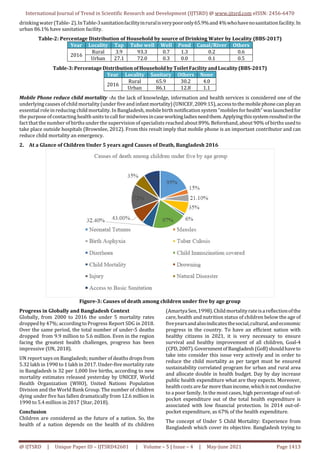
2. At a Glance of Children Under 5 years aged Causes of Death, Bangladesh 2016
Figure-3: Causes of death among children under five by age group
Progress in Globally and Bangladesh Context
Globally, from 2000 to 2016 the under 5 mortality rates
dropped by 47%;accordingto Progress Report SDG in 2018.
Over the same period, the total number of under-5 deaths
dropped from 9.9 million to 5.6 million. Even in the region
facing the greatest health challenges, progress has been
impressive (UN, 2018).
UN report says on Bangladesh; number of deaths drops from
5.32 lakh in 1990 to 1 lakh in 2017. Under-five mortality rate
in Bangladesh is 32 per 1,000 live births, according to new
mortality estimates released yesterday by UNICEF, World
Health Organization (WHO), United Nations Population
Division and the World Bank Group. The number of children
dying under five has fallen dramatically from 12.6 million in
1990 to 5.4million in 2017 (Star,2018).
Conclusion
Children are considered as the future of a nation. So, the
health of a nation depends on the health of its children
(AmartyaSen,1998).Childmortalityrateisareflectionofthe
care, health and nutrition status of children below the age of
fiveyearsandalsoindicatesthesocial,cultural, andeconomic
progress in the country. To have an efficient nation with
healthy citizens in 2021, it is very necessary to ensure
survival and healthy improvement of all children, Goal-4
(CPD,2007).GovernmentofBangladesh(GoB)shouldhaveto
take into consider this issue very actively and in order to
reduce the child mortality as per target must be ensured
sustainability correlated program for urban and rural area
and allocate double in health budget. Day by day increase
public health expenditure what are they expects. Moreover,
healthcosts are far more thanincome,whichisnotconducive
to a poor family. In the most cases, high percentage ofout-of-
pocket expenditure out of the total health expenditure is
associated with low financial protection. In 2014 out-of-
pocket expenditure, as 67% of the health expenditure.
The concept of Under 5 Child Mortality: Experience from
Bangladesh which cover its objective. Bangladesh trying to
International Journal of Trend in Scientific Research and Development (IJTSRD) @ www.ijtsrd.com eISSN: 2456-6470
@ IJTSRD | Unique Paper ID – IJTSRD42601 | Volume – 5 | Issue – 4 | May-June 2021 Page 1414
achieve the MDG target 4: reduce under 5 mortality rates
smoothly. Bangladesh alsoprogressvariouschallengescause
of child mortality. But day by day she has to overcome all the
challenges to reduced child mortality.
Recommendation
Discussion of the above results proves that there has been a
gradual decline in many cases of infant mortality which has
been epidemic in size over the last four decades; Diarrhea,
malaria, etc. However, Bangladesh needs to take various
steps to protect children from death. Challenges and future
priorities despite significant improvements in Bangladesh,
some key challenges remain. In order to accelerate further
progress, below necessary steps should be taken:
1. Food security confirmation;
2. Focus on mainstreaming nutrition interventions to
reduce malnutrition;
3. Reduce early marriages and pregnancies;
4. Increase access to quality healthcare through
immunization, empowerment of health workers, health
care delivery, awareness campaigns;
5. Supportforequitabledistributionofhealthsystemsand
services, especially for the low- income population and
the marginalized;
6. Improve coverage of effective neonatal health
interventions;
7. Ensuring efficient birth attendance and convenience
delivery to reduce MMR;
8. Ensuring effective family and social protectionas well as
how swimming training can reduce the risk of death in
children;
9. Improved access to water, sanitation, and hygiene.
Reference
[1] Mondal, M. N. I, Hossain, M. K. and Ali, M. K. (2009)
“Factors InfluencingInfantandChildMortality:A Case
Study of Rajshahi District, Bangladesh.” Journal of
Human Ecology 26(1): 31-39.
[2] CPD. (2007) “Bangladesh Vision 2021.” Prepared
under the initiative of Nagorik Committee 2006.
Dhaka
[3] Bangladesh Bureau of Statistics (2017) Statistical
Yearbook of Bangladesh, Planning Division, Ministry
of Planning, Government of the People's Republic of
Bangladesh.
[4] Tasnuva and Wasimul B. (2014) COMPETING RISKS
ANALYSIS OF UNDER-FIVE CHILD MORTALITY IN
BANGLADESH.
[5] Hosseinpoor, A. R., et al. (2005) “Socioeconomic
inequality in infant mortality in Iran and across its
provinces.” Bulletin of the World Health Organization
83(11): 837-844.
[6] Shams El A, Tasnima A. Hafizur R. C, Kazi M. R, Enayet
K. C, Nurul A, D M Emdadul H, Abdullah H B, CAUSES
OF DEATH IN CHILDREN UNDER FIVE YEARSOF AGE
[7] BANGLADESHDEMOGRAPHICANDHEALTHSURVEY
(2014), National Institute of PopulationResearchand
Training (NIPORT)
[8] Debpuur C, Wontuo, P, AkaziliJ.andNyarko,P.(2005)
“Measuring Health Equity in Small Areas; from
Demographic Surveillance Systems,” Population
ResearchReview, Ghana 20: 45-65
[9] 2017 Health SDG Profile: Bangladesh
[10] Caldwell, B and Khuda, B. E. (2000) “The first
generation to control family size: micro study of the
causes of fertility decline in a rural area of
Bangladesh.” Studies in Family Planning 31(3):165-
198.
[11] Madise, N.J, and Diamond I. (1995) “Determinants of
infant mortality in Malawi: An analysis to control for
death clustering within families.” Journal of Biosocial
Sciences 27(1): 95106.
[12] Levels and Trends in Child Mortality Report 2018,
United Nation
[13] UNICEF: Under-5 mortality rate falls sharply in
Bangladesh, Dhaka Tribune; Published: September
21st, 2018
[14] Drowning major cause of children’s death in
Bangladesh: experts,Newage Bangladesh; Published:
March 18, 2017
[15] Azza M. H. S. (2016), Mobile phone and child
mortality: the case of developing countries
[16] Sen, A. (1998) “Mortality as an Indicator of Economic
Success and Failure.” Economic Journal 108: 1-25
[17] Progress report SDG, 2018
[18] Child Mortality- Wikipedia
[19] The under-five mortality rate: The indispensable
gauge of child health
[20] Children: reducing mortality- WHO (2018)
[21] Shams El A. (2008) Child Health and Mortality
[22] World Vision (2016) Child mortality:Topcauses,best
solutions.

Under Five Child Mortality Experience from Bangladesh

  • 1.
    International Journal ofTrend in Scientific Research and Development (IJTSRD) Volume 5 Issue 4, May-June 2021 Available Online: www.ijtsrd.com e-ISSN: 2456 – 6470 @ IJTSRD | Unique Paper ID – IJTSRD42601 | Volume – 5 | Issue – 4 | May-June 2021 Page 1409 Under Five Child Mortality: Experience from Bangladesh Juliet Reberio Student,Jagannath University, Dhaka, Bangladesh ABSTRACT Under five mortality rates is a key indicator for several development policies, targets and programs. However, relevant source ofdata oncauses ofdeathare not available in developing countries, including Bangladesh. Because sometimes the information is hidden with the various causes ofrisk.Themain purpose of this study is to find out some different cases of child mortality with the various causes. The paper reveals that several characteristics - socioeconomic, demographic, health related disease and non-disease - are affecting child mortality. How to cite this paper: Juliet "Under Five Child Mortality: Experience from Bangladesh" Published in International Journal of Trend in Scientific Research and Development(ijtsrd), ISSN: 2456-6470, Volume-5 | Issue-4, June 2021, pp.1409-1414, URL: www.ijtsrd.com/papers/ijtsrd42601.pdf Copyright © 2021 by author (s) and International Journal ofTrendinScientific Research and Development Journal. This is an Open Access article distributed under the terms of the Creative Commons Attribution License (CC BY 4.0) (http: //creativecommons.org/licenses/by/4.0) INTRODUCTION Bangladesh is a largeandheavydenselypopulatedcountryin South Asia. The current population of Bangladesh is 168.07 million. This makes Bangladesh the 8th most populous country in the world (BDRC, 2019). Bangladesh located 1, 47,680 square kilometers land area with limited resources. Her per capita income is US $ 1516 (WB, 2017) and the life expectancyatbirth forbothsexes is currentlyat 72.7yearsof age. Her vast manpower (168.07 millions) with 72.76% literacy rates (male 77%, female 70%) establishes a forthcomingresourcefordevelopment(UNESCO2018).Since independence 1971, the Government of Bangladesh (GOB) has been followed a policy of heath care system. Bangladesh achieved in overall the health condition of mothers and children. About 2500 children in this age group die every day. Under 5 child mortality rates reducein regional andglobally bothbut most of the under 5 children dies till now malnutrition in before andafterbirthandlackofawarenessaboutfoodhabits, mothers prenatal care and prejudication. In Bangladesh, the under-five mortality rate at the beginning of the MDG period was 133 per 1000 live births (ICDDR, B 2007), which currently is 46 per 1000 live births (BDHS 2014). This study takes “under-five” mortality in Bangladeshas aneventwhich may happen due to two types; disease(child diedeitherfrom neonatal tetanus, measles, diarrhea, meningitis or neonatal jaundice) or non-disease (child died either by congenital abnormalities, birth asphyxia, drowning, birth injury, respiratory distress, premature birth, serious infection, malnutrition or other causes) and adequate nutrition and clean water and sanitation. Child Mortality Child mortality, also known as under-5 mortality or child death, refers to the death of infant andchildrenundertheage of five or between the ages of one month to four years. Many child deaths go unreported for a variety of reasons, including lack of death registration and lack of data on child migrants. Without accurate data on child deaths, we cannot fully discover and fight the greatest risks to a child's life. Reduction of child mortality is reflected in several of the United Nations' Sustainable Development Goals. Rapid progress has resulted in a significant decline in preventable child deaths since 1990, with the global under-5 mortality rate declining by over half between 1990 and 2016. While in 1990, 12.6 million children under age five died, in 2016 that number fell to 5.6 million children. On the other hand, in spite of advances, there are still 15,000 under-five deaths per day from largely preventablecauses.About80%oftheseoccurinsub-Saharan Africa and South Asia, and just 6 countries account for half of all under-five deaths: India, Nigeria,Pakistan,theDemocratic Republic of the Congo, Ethiopia and China. 45% of these children died during the first 28 days of life. According to the World Bank and the World Health Organization (2018) the under-five mortality rate for the world is 40.8 deaths. 5.6 million children under age five died in 2016, 15,000 every day. IJTSRD42601
  • 2.
    International Journal ofTrend in Scientific Research and Development (IJTSRD) @ www.ijtsrd.com eISSN: 2456-6470 @ IJTSRD | Unique Paper ID – IJTSRD42601 | Volume – 5 | Issue – 4 | May-June 2021 Page 1410 Causes: The leading causes of death among children under 5 in 2017 were preterm birth complications, acute respiratory infections, pneumonia, birth asphyxia, interpartum-related complications, inborn differences,improvingaccesstowater, sanitation, and hygiene and providing vaccinations and diarrhea. Neonatal deaths accounted for 47% of under-five deaths in 2017. The leading causes of death of children under five include: Causes of diseases % of death  Preterm birth complications 18%  Pneumonia 16%  Interpartum-related events 12%  Neonatal sepsis 7%  Diarrhea 8%  Malaria 5%  Malnutrition and Under nutrition 45%  Traffic injuries 8% Childmortalityisn’tonlycausedbyinfectionanddisorder,itis also caused by premature birth, birth defect, new born infection, birth complication, birth asphyxia and disease like pneumonia, malaria, sepsis, and diarrhea (NHS Inform, n.d.). In less developed countries, malnutrition is the main source of child mortality. Pneumonia, diarrhea andmalariatogether arethe cause of 1 out of every3 child deaths beforetheageof 5 and nearly half of under-five deaths globally are attributable to under nutrition (Dictionary, n.d.). Unsafe water, poor hygiene practices and inadequate sanitation are not only the causes of the continued high incidence of diarrheal diseases,theyareasignificantcontributingfactorin under-five mortality caused by pneumonia, neonatal disorders and under nutrition; more than 800 children die every day from diarrheal diseases linked to poor hygiene (Medicinenet, n.d.). Who is most at risk? Children under the age of 5 - Significantly global progress has been made in reducing child deaths since 1990. The total number of under-5 deaths worldwide has declinedfrom12.6 million in 1990 to 5.4 million in 2017 – 15000 every day comparedwith34000in1990.Since 1990, the global under- 5 mortality rate has dropped by 58%, from 93 deaths per 1 000 live births in 1990 to 39 in 2017. Althoughtheworldasawholehasbeenacceleratingprogress in reducing the under-5 mortality rate, disparities exist in under-5mortalityacrossregionsandcountries.Morethanhalf of under- 5 child deaths are due to diseases that are preventable and treatable through simple, affordable interventions (Merriam-Webster). Strengthening health systems to providesuchinterventionstoallchildrenwillsave many young lives. Malnourished children, particularly those with severe acute malnutrition, have a higher risk of death from common childhood illness such as diarrhea, pneumonia, and malaria. Nutrition-relatedfactorscontribute to about 45% of deaths in children under-5 years of age (Dictonary, n.d.). Literature Review The review of different literatures on under-five child mortality shows that a number of socio- economic and demographic factors areinfluencingchildmortality.Caldwell et al.(2000), Debpuur etal.(2005),Hosseinpooretal.(2005), Madise and Diamond (1995) have found a significant relationship between various socioeconomic factors, demographic factors and infant child mortality by analyzing various countries‟ survey and census data. They found that gross domestic product, female education, and other factors explained practically all variations in child mortality across countries. The situation with regard to Goal-4 in the South- East Asian sub region is mixed. Near five million children across the Asia-Pacific region still die every year before reachingtheageoffive,whichrepresentshalfofallunder-five deaths in the world (ESCAP, UNDP and ADB, 2005; UNICEF, 2005a). Md.Israt RayhanandM.SekanderHayatkhan(2006) had done a research, titled “Factors Causing Malnutrition among under Five Children in Bangladesh” where they find that45%ofthechildrenunderagefiveweresufferingchronic malnutrition,10.5%wereacutelymalnourishedand48%had under-weight and other non-disease problem. Mondal et al. Factors Influencing Infant and Child Mortality: A Case Study of Rajshahi District, Bangladesh (2009) have shown that, the risk of child mortality decreased when mother’s education increased; raise more hygienic sanitationfacilitiesandbetter access to safe treatment places as prenatal and birthdelivery with the help of proper health system. Tasnuva Tabassum and Wasimul Bari (2014) has done a research work titled “COMPETING RISKS ANALYSIS OF UNDER-FIVE CHILD MORTALITY IN BANGLADESH” where they find that mother’s primary and secondary education, child birth order, mothers aged greater than 30 years at the time of giving birth, home as a place of child delivery are played significant role in decreasing under five child mortality. Bangladesh Demographic Health Survey (2014) found that in Bangladesh between1989and2014,under-five mortality rate reduced by two-third, from 133 to 46 deaths per thousand live births. Sabrina Naz, Andrew Page and Kingsley Emwinyore Agho (2015) was published an article they found that house air pollution was not strongly associated with overall neonatal (OR = 1.49, 95% CI =1.01– 2.22, p = 0.043), infant (OR = 1.27, 95% CI = 0.91–1.77, p = 0.157) or under-five mortality (OR = 1.14, 95% CI = 0.83– 1.55, p = 0.422) from this context it is fully understood that mobility decreasing under-five mortality. Shahnaz Nilima (2017) conducted study where she found that the children whose mothers live in BarisalandSylhethave60%lowerand 52% higher rate of under-five mortality, respectively compared to the children who belong to Dhaka and these results have been found significant at 5% and 10%. The heading of an article “Under-5 mortality rate falls sharply in Bangladesh” published by UNICEF (2017), where they informed that Under-five mortality rate in Bangladesh is 32 per 1,000 live births, according to new mortality estimates released by UNICEF, WHO, the UN Population Division, and the World Bank Group. It has significantly gone down from 532,000 deaths in 1990 to 100,000 in 2017. Levels and Trends in Child Mortality Report 2018 released by UNICEF, World Bank, World Health Organization and UN (2018) and there exposes that the world has made considerable progress in reducing child mortality since 1990, but also stresses shows that a child under 15 dies every five seconds around the world. The under-five morality rate has declined by 58 per cent since1990,andthe number of under-five deaths dropped from 12.6 million in 1990 to 5.4 million in 2017.
  • 3.
    International Journal ofTrend in Scientific Research and Development (IJTSRD) @ www.ijtsrd.com eISSN: 2456-6470 @ IJTSRD | Unique Paper ID – IJTSRD42601 | Volume – 5 | Issue – 4 | May-June 2021 Page 1411 Methodology The data of this study is mostly covered by Bangladesh Demographic Health Survey-2014, UNICEF global database and others previous & current reports published at national and international levels related to under five age child mortality issues in the context of globally and Bangladesh and. It is mentionable that, apart from the local perspective, the study also focuses on various reports conducted by the different international organizations or by individual researchers in recent times from global perspectives. Objective The objectives of this paper is to document the experience of Bangladeshthatithasexperiencedwhiletryingtoachievethe MDG target 4: reduce under 5 mortality rate. However, the paper also shows a probable way out for Bangladesh to overcome the challenges and then reach the target of SDG related to child mortality. Result and Discussion In Bangladesh various causes of death under 5 mortality. UNICEF-supported national study in 2004 shown that the leading cause of death among children aged 1 to 4 years is drowning, followed by pneumonia, malnutrition, and diarrhea. This statistic shows the under-five child mortality rate in Bangladesh from 2005 to 2016. In 2014, the under- five child mortality ratein Bangladesh was approximately 38.6 deaths per one thousand live births. The under-5 mortality ratefellfrom85 to 29between2000and2017.The report also states that Bangladesh is one of the few developing countries on track to meet some targets for the Millennium Development Goals (MDGs), particularly those relating to nutrition, diarrhea, universal primary education and reducing under-five mortality. Figure 1. Trends of Under-Five Mortality Rate in Bangladesh from 2005 to 2016 (Following Statista 2019) Level of Childhood Mortality Data from the BDHS 2014 shows that under-5 mortality in the five years preceding thesurvey is 46 per 1,000 live births (Table 1). Bangladesh has achieved its Millennium Development Goal 4 target forunder five mortality (48 per 1000 births by 2015) in advance. The infant mortality rate is 38 deaths per 1,000live births,and thechild mortality rate is 8 per 1,000children.Itisalso notable that deaths in the neonatal period account for 61 percent of all under- 5 deaths. Table-1: Early childhood mortality rates Neonatal, post neonatal, infant, child, and under-5 mortality rates for five-year periods preceding the survey, Bangladesh (BDHS) 2014 Years Preceding the survey Neonatal Mortality (NN) Post Neonatal Mortality (PNN) Infant Mortality (1q0) Child Mortality (4q1) Under-5 Mortality (5q0) 0-4 28 10 38 8 46 5-9 36 14 49 13 61 10-14 36 21 57 16 72 Since 1993-1994, the DHS surveys inBangladeshhaveobtainedchildhood mortalityrates forthefive-yearperiodprecedingthe survey. Over the last two decades, the data confirm a steady downward trend in childhood mortality (Figure 2). Between the 1989-1993 and 2010-2014 periods,the65percent decline inunder-5 mortalityoverthesameperiod.Asaconsequenceofthis rapid rate of decline, Bangladesh has achieved its MDG 4 target for under-5 mortality of48deaths per1,000live births by2015 (BDHS 2014) Figure 2: Child Mortality rates, 1989-2914 (BDHS-2014)
  • 4.
    International Journal ofTrend in Scientific Research and Development (IJTSRD) @ www.ijtsrd.com eISSN: 2456-6470 @ IJTSRD | Unique Paper ID – IJTSRD42601 | Volume – 5 | Issue – 4 | May-June 2021 Page 1412 1. Experience of Child Mortality in Bangladesh Therearemanycasesrelatedinchildbirthlike;Mother’sAgeatBirth,Mother’sEducation,Wealth Index”,Place ofDelivery and Birth Order. In many several reports found that if mother age is less than 20 years, they are 2.568 more times higher risk of death due to disease than their counterparts havingoldermothers (Age-Wekepedia, n.d.).Agedmothercanspendmuchtime behind each child for proper care. Mother’s education plays vital role to reduce child mortality.Under5mortalities from bothduetodiseaseandnon-disease,itis noticeable that higher educated women are lower mortality rate than low or un-educated. Educated mother can take proper decision regarding child-birth. The risk of mortality due to disease of children having mothers with primary and secondary education are 62% and 63% less than that of children having mothers withno education(htt),respectively.Mother’s education also takes an initiative child receiving all basic vaccinations by age 12 months. Birth order is also another important role in influencing child mortality. If the first child with a lower mortality rate due to disease than the child who is second one or later in birth line. The reason may be that the parents pay an extra attention to the motherandnewbornnutritionwhentheyexpecttheirfirstchild.Theyaregoingtoregularprenatalandpostnatalcheckup,which is helping reducemortality diseases among first and also for second or later child in birthline. Maternal careandchildnutrition also differ in the case of the first child than the second child. Place of delivery one of the important roles for the both baby and mother. Basically, it is reflected that child delivered in hospitals live a longer life than those delivered in home since hospitals are more hygienic and secured place for delivery (Childbirth, n.d.). It is really interesting that, both the conflicting due to diseaseandnon-diseaserevealsthatthechildrenbornin home tend to survivefor a longer time than the children bornin hospitals, clinics or places other than home.AccordingtoBDHS (2014) 62% delivered at home; because of poor wealth. In Bangladesh especially in rural area child deliver at home as a result child birth registered is not confirmed, child nutrition, proper treatment of neonatal care and vaccinationforchildisnotensure. InBangladesh birthregistrationratesareverylowdueto theabsenceof effective and functioning birth registration systems. In Bangladesh and Zambia, UNICEF estimates that only 10% of births are registered. To reduce child morbidity and mortality the government of Bangladesh initiated theNationalImmunizationProgramagainst six vaccine-preventable diseases (tuberculosis; diphtheria, pertussis,andtetanus;polio;andmeasles)in1979.Vaccinationsare mosteffectivewhengiven at the properage. So, it isrecommended thatchildrencompletethescheduleofimmunizationsduring their first year of life (i.e., by 12 months of age). Overall, 78% of children age 12-23 months had received all the mentioned vaccinations before their first birthday (BDHS 2014). It is really appreciated that almost all divisions were completed their vaccination program successfully every year. As per BDHS 2014 report the highest level of coverage is seen inRangpur90% and the lowest in Sylhet 61%. As expected, mother’s education is positively connected with children’s possibility of presence fully vaccinated. For example,95%ofchildrenmotherscompletedsecondaryorhighereducatedarefullyvaccinated,and74%of children mothers have no education. Diarrhea- Getting dehydration from diarrhea is an important cause of childhood mortality. During diarrhea, the child to givea solution prepared either by mixing water with the salts in a commercially prepared oral rehydration packet (ORS)-also called khabar or packet saline in Bangladesh- or by making a homemade solution of sugar, salt, and water, also called labon gur. Oral rehydration therapy has a long history of use in Bangladesh because it was developed more than four decades ago by the International Center for Diarrheal Disease Research, Bangladesh (ICDDR,B).Overall,36%ofchildrenunderage5withdiarrhea were taken to a health facility or provider for treatment. 8 in 10 children with diarrhea were given oral rehydration therapy (ORT), that is, either a solution made from oral rehydrationsalt(ORS)packetsorahomemadesugar-saltsolution,and38percent receivedboth ORTandzinc. (BDHS 2014). Gender-Therearemanyseveralpreviousanalysesrevealedthatthelevelofunder5mortalities inruralBangladeshhas reduced significantly during the last two decades. The negative relationship between household socioeconomic status and mother’s education with childhood mortality has been consistent with findings reported earlier in Bangladesh. Due to the lack of nutrients of the girl children and the rural vulnerability due to poor prejudice, they were not given nutritious food, resulting in higher female children under 5 mortality rates. Though populationliving belowpoverty lineinrural Bangladeshhad decreased substantially from 52.3% in 2000 to 35.2% in 2010, nevertheless the socioeconomic inequality in under-five mortality persisted. Drowning- By comparison, among children between 5 and 14 years of age, injuries become a more prominent cause of death, especially from drowning and road traffic. In rural and urban children playing in the inflatedrivers,canals,ponds,drain,ditches and other water bodies die frequently. The termed drowning ‘a silent killer’ of children, aged between one year and 18 years in the country. A UNICEF study shows that more than 18,000 children, mostly 1- 4 years of age, die each year from drowning in Bangladesh and an average 50 children drown a dayin this country. ‘Children in Bangladesh, who cannot swim, are 4.5 times more vulnerable to drowning than those who can swim in this riverine country,’ the study revealed. WASH- Till now safe drinkingwater and hygienic sanitation uses are not quite availablein Bangladesh.That’swhychildrenface various risks with contaminated diseases. Over45,000under-fivechildrendieeveryyearinBangladeshfromdiarrheacausedby contaminated water, says a report of World Health Organization. Water contaminated with faces puts people at risk of contractingcholera, dysentery,typhoidandpolio,saysthereporttitled“UNWater-GlobalAnalysisandAssessmentofSanitation and Drinking-Water 2017”. According to the WHO report, 42% urban population in Bangladesh don't use improved sanitation facilities, while the figure is 38% for rural population. Besides, 13% people don't have improved drinking water sources and contaminateddrinkingwatercauses morethan 5,00,000diarrhealdeaths eachyear globally. According to the BBS (2017) they analysis that in rural 93.3% have improvesources of drinking water whether in urban only 72% have improved sources of
  • 5.
    International Journal ofTrend in Scientific Research and Development (IJTSRD) @ www.ijtsrd.com eISSN: 2456-6470 @ IJTSRD | Unique Paper ID – IJTSRD42601 | Volume – 5 | Issue – 4 | May-June 2021 Page 1413 drinkingwater(Table- 2).InTable-3sanitationfacilityinruralisverypooronly65.9%and4%whohavenosanitationfacility.In urban 86.1% have sanitation facility. Table-2: Percentage Distribution of Household by source of Drinking Water by Locality (BBS-2017) Year Locality Tap Tube well Well Pond Canal/River Others 2016 Rural 3.9 93.3 0.7 1.3 0.2 0.6 Urban 27.1 72.0 0.3 0.0 0.1 0.5 Table-3:Percentage Distribution ofHouseholdbyToiletFacility andLocality(BBS-2017) Year Locality Sanitary Others None 2016 Rural 65.9 30.2 4.0 Urban 86.1 12.8 1.1 Mobile Phone reduce child mortality -As the lack of knowledge, information and health services is considered one of the underlying causes of child mortality (under five and infantmortality)(UNICEF,2009:15),accesstothemobilephonecanplayan essential role in reducing child mortality. In Bangladesh, mobilebirth notification system "mobiles forhealth"waslaunchedfor the purpose of contacting health units tocall for midwivesincaseworkingladiesneedthem.Applyingthissystemresultedinthe fact that the number of births under the supervision of specialists reached about 89%. Beforehand,about 90% of births usedto take place outside hospitals (Brownlee, 2012). From this result imply that mobile phone is an important contributor and can reduce child mortality an emergency. 2. At a Glance of Children Under 5 years aged Causes of Death, Bangladesh 2016 Figure-3: Causes of death among children under five by age group Progress in Globally and Bangladesh Context Globally, from 2000 to 2016 the under 5 mortality rates dropped by 47%;accordingto Progress Report SDG in 2018. Over the same period, the total number of under-5 deaths dropped from 9.9 million to 5.6 million. Even in the region facing the greatest health challenges, progress has been impressive (UN, 2018). UN report says on Bangladesh; number of deaths drops from 5.32 lakh in 1990 to 1 lakh in 2017. Under-five mortality rate in Bangladesh is 32 per 1,000 live births, according to new mortality estimates released yesterday by UNICEF, World Health Organization (WHO), United Nations Population Division and the World Bank Group. The number of children dying under five has fallen dramatically from 12.6 million in 1990 to 5.4million in 2017 (Star,2018). Conclusion Children are considered as the future of a nation. So, the health of a nation depends on the health of its children (AmartyaSen,1998).Childmortalityrateisareflectionofthe care, health and nutrition status of children below the age of fiveyearsandalsoindicatesthesocial,cultural, andeconomic progress in the country. To have an efficient nation with healthy citizens in 2021, it is very necessary to ensure survival and healthy improvement of all children, Goal-4 (CPD,2007).GovernmentofBangladesh(GoB)shouldhaveto take into consider this issue very actively and in order to reduce the child mortality as per target must be ensured sustainability correlated program for urban and rural area and allocate double in health budget. Day by day increase public health expenditure what are they expects. Moreover, healthcosts are far more thanincome,whichisnotconducive to a poor family. In the most cases, high percentage ofout-of- pocket expenditure out of the total health expenditure is associated with low financial protection. In 2014 out-of- pocket expenditure, as 67% of the health expenditure. The concept of Under 5 Child Mortality: Experience from Bangladesh which cover its objective. Bangladesh trying to
  • 6.
    International Journal ofTrend in Scientific Research and Development (IJTSRD) @ www.ijtsrd.com eISSN: 2456-6470 @ IJTSRD | Unique Paper ID – IJTSRD42601 | Volume – 5 | Issue – 4 | May-June 2021 Page 1414 achieve the MDG target 4: reduce under 5 mortality rates smoothly. Bangladesh alsoprogressvariouschallengescause of child mortality. But day by day she has to overcome all the challenges to reduced child mortality. Recommendation Discussion of the above results proves that there has been a gradual decline in many cases of infant mortality which has been epidemic in size over the last four decades; Diarrhea, malaria, etc. However, Bangladesh needs to take various steps to protect children from death. Challenges and future priorities despite significant improvements in Bangladesh, some key challenges remain. In order to accelerate further progress, below necessary steps should be taken: 1. Food security confirmation; 2. Focus on mainstreaming nutrition interventions to reduce malnutrition; 3. Reduce early marriages and pregnancies; 4. Increase access to quality healthcare through immunization, empowerment of health workers, health care delivery, awareness campaigns; 5. Supportforequitabledistributionofhealthsystemsand services, especially for the low- income population and the marginalized; 6. Improve coverage of effective neonatal health interventions; 7. Ensuring efficient birth attendance and convenience delivery to reduce MMR; 8. Ensuring effective family and social protectionas well as how swimming training can reduce the risk of death in children; 9. Improved access to water, sanitation, and hygiene. Reference [1] Mondal, M. N. I, Hossain, M. K. and Ali, M. K. (2009) “Factors InfluencingInfantandChildMortality:A Case Study of Rajshahi District, Bangladesh.” Journal of Human Ecology 26(1): 31-39. [2] CPD. (2007) “Bangladesh Vision 2021.” Prepared under the initiative of Nagorik Committee 2006. Dhaka [3] Bangladesh Bureau of Statistics (2017) Statistical Yearbook of Bangladesh, Planning Division, Ministry of Planning, Government of the People's Republic of Bangladesh. [4] Tasnuva and Wasimul B. (2014) COMPETING RISKS ANALYSIS OF UNDER-FIVE CHILD MORTALITY IN BANGLADESH. [5] Hosseinpoor, A. R., et al. (2005) “Socioeconomic inequality in infant mortality in Iran and across its provinces.” Bulletin of the World Health Organization 83(11): 837-844. [6] Shams El A, Tasnima A. Hafizur R. C, Kazi M. R, Enayet K. C, Nurul A, D M Emdadul H, Abdullah H B, CAUSES OF DEATH IN CHILDREN UNDER FIVE YEARSOF AGE [7] BANGLADESHDEMOGRAPHICANDHEALTHSURVEY (2014), National Institute of PopulationResearchand Training (NIPORT) [8] Debpuur C, Wontuo, P, AkaziliJ.andNyarko,P.(2005) “Measuring Health Equity in Small Areas; from Demographic Surveillance Systems,” Population ResearchReview, Ghana 20: 45-65 [9] 2017 Health SDG Profile: Bangladesh [10] Caldwell, B and Khuda, B. E. (2000) “The first generation to control family size: micro study of the causes of fertility decline in a rural area of Bangladesh.” Studies in Family Planning 31(3):165- 198. [11] Madise, N.J, and Diamond I. (1995) “Determinants of infant mortality in Malawi: An analysis to control for death clustering within families.” Journal of Biosocial Sciences 27(1): 95106. [12] Levels and Trends in Child Mortality Report 2018, United Nation [13] UNICEF: Under-5 mortality rate falls sharply in Bangladesh, Dhaka Tribune; Published: September 21st, 2018 [14] Drowning major cause of children’s death in Bangladesh: experts,Newage Bangladesh; Published: March 18, 2017 [15] Azza M. H. S. (2016), Mobile phone and child mortality: the case of developing countries [16] Sen, A. (1998) “Mortality as an Indicator of Economic Success and Failure.” Economic Journal 108: 1-25 [17] Progress report SDG, 2018 [18] Child Mortality- Wikipedia [19] The under-five mortality rate: The indispensable gauge of child health [20] Children: reducing mortality- WHO (2018) [21] Shams El A. (2008) Child Health and Mortality [22] World Vision (2016) Child mortality:Topcauses,best solutions.