Welcome To My Study Room
Today’s presentation topic
“Childhood Mortality and
Morbidity”
Introduction
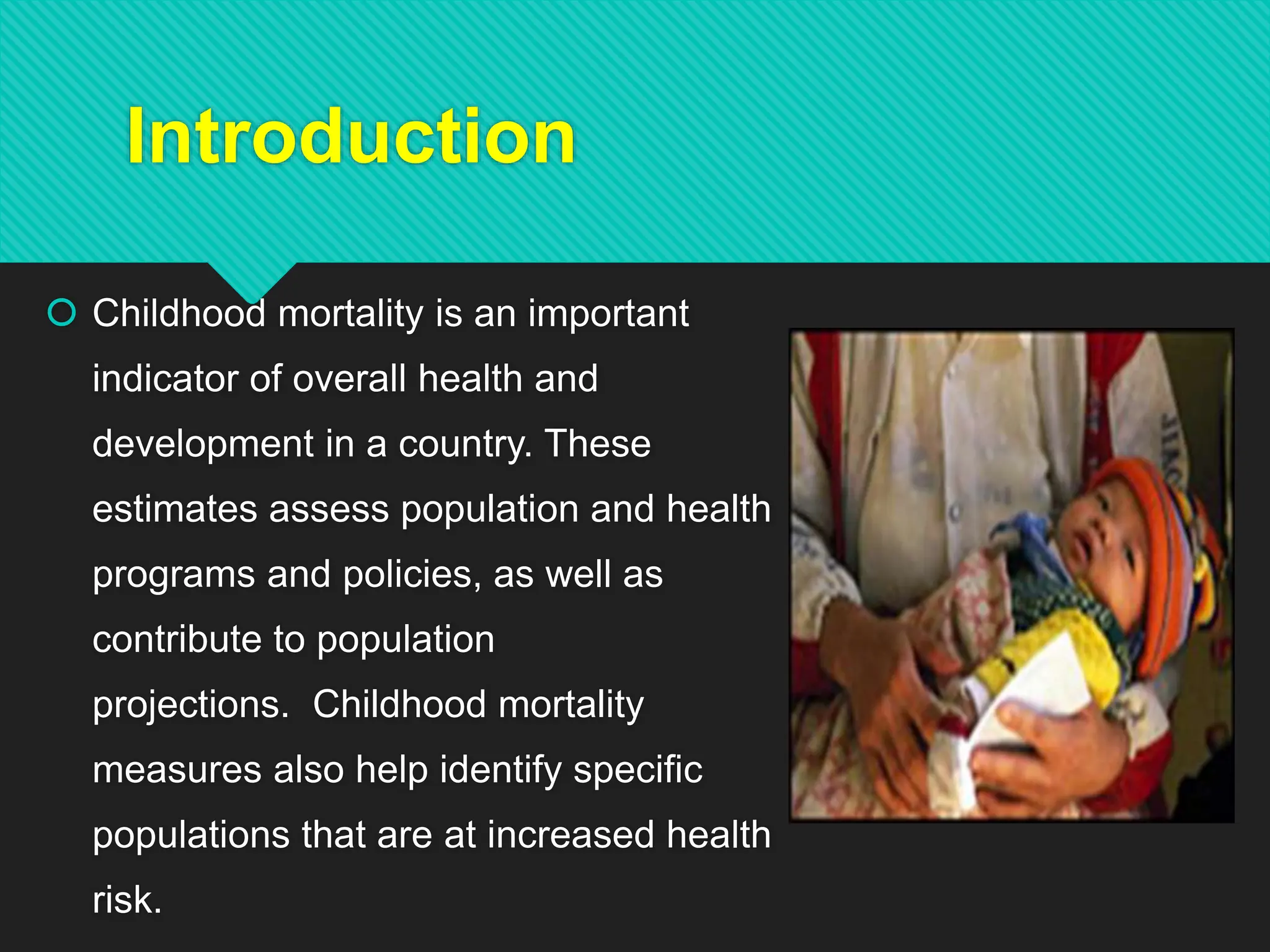
 Childhood mortality is an important
indicator of overall health and
development in a country. These
estimates assess population and health
programs and policies, as well as
contribute to population
projections. Childhood mortality
measures also help identify specific
populations that are at increased health
risk.
Measures of childhood mortality
 Neonatal mortality- the probability of dying within the
1st month of life
 Infant mortality- the probability of dying before the 1st
birthday
 Child mortality- the probability of dying between the 1st
and 5th birthdays
 Under-five mortality- the probability of dying before the
fifth birthday
The Millennium Development Goals
Goal 4 Reduce child mortality
 Reduce by two thirds, between 1990 and 2015, the
under-five mortality rate.
 Big gains have been made in child survival, but efforts
must be redoubled to meet the global target.
Childhood mortality Globally
 Since 1990, the child mortality rate has dropped by 47
per cent;
 17,000 fewer children are dying each day.
 Still, 6.6 million children under age five died in 2012—
mostly from preventable diseases.
 In sub-Saharan Africa, one in ten children die before age
five, more than 15 times the average for developed
regions.
Cont…
 99% of all under-five deaths occur in developing countries.
 About three-quarters of all child deaths happen in two WHO regions (Africa
and South-east Asia) where childhood mortality continues to be very high.
 More than 50% of these deaths are clustered in only six countries: China,
Democratic Republic of the Congo, Ethiopia, India, Nigeria, and Pakistan.
 Under-five mortality is higher in rural areas and among poorer and less
educated communities.
 Three-quarters of all child deaths are mainly due to preventable causes:
neonatal conditions, pneumonia, diarrhoea, malaria, and measles. Many of
these deaths could be averted by known, affordable, low-technology
interventions.
Cont…
 Appropriate infant and young child feeding and the prevention and
management of diarrhea, pneumonia, malaria and HIV infection can save the
lives of millions of under-five children.
 Coverage of key child health interventions is low and unequally distributed
between and within countries.
 Strengthening the health system and integrating the interventions into
packages of care that can be delivered at all levels – from home to hospital –
during pregnancy, childbirth, neonatal period, and childhood will be key to
increasing the coverage of health interventions and saving the lives of under-
five children.
 Good quality information for evidence-based decisions and planning is
lacking.
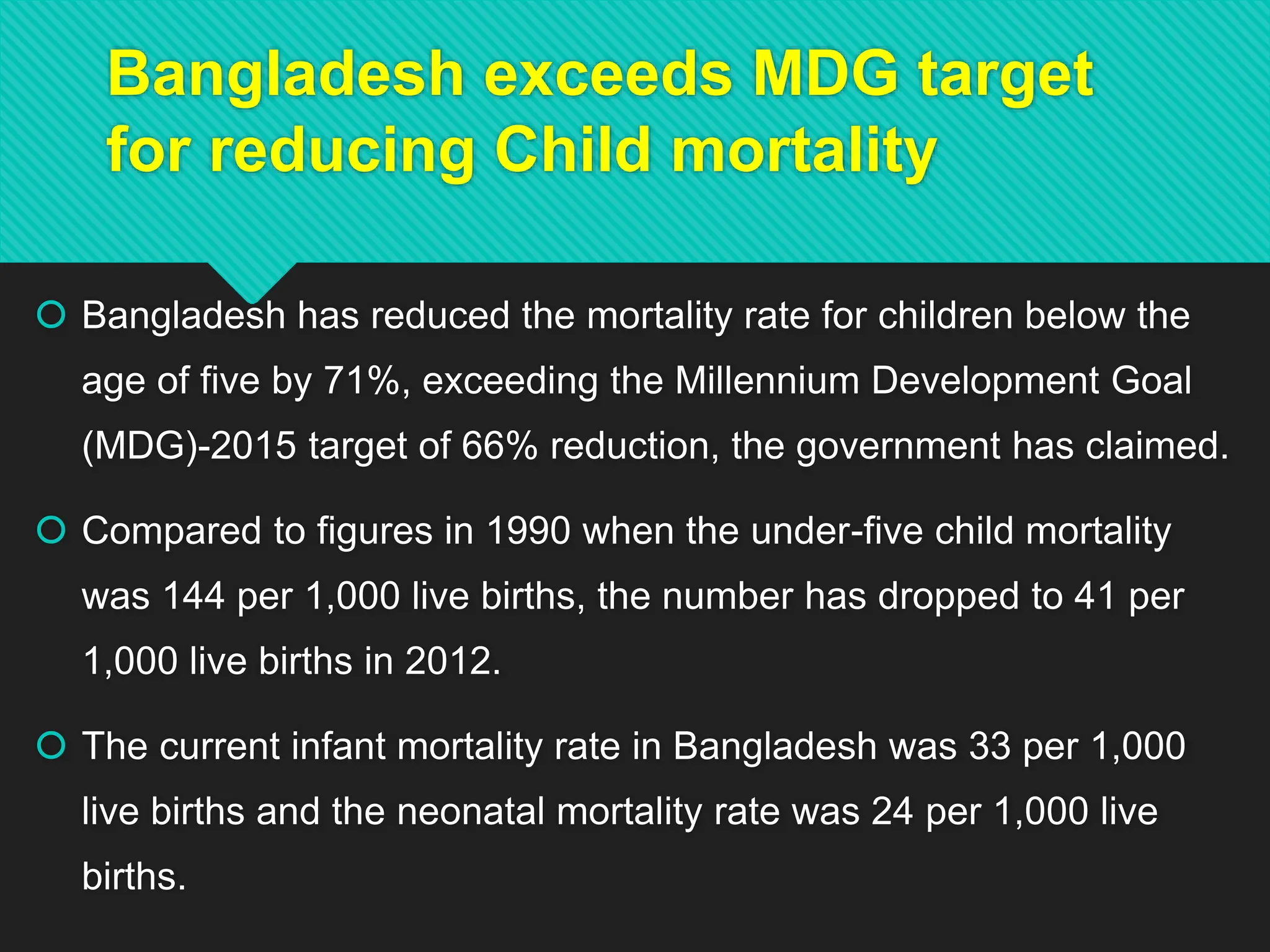
Bangladesh exceeds MDG target
for reducing Child mortality
 Bangladesh has reduced the mortality rate for children below the
age of five by 71%, exceeding the Millennium Development Goal
(MDG)-2015 target of 66% reduction, the government has claimed.
 Compared to figures in 1990 when the under-five child mortality
was 144 per 1,000 live births, the number has dropped to 41 per
1,000 live births in 2012.
 The current infant mortality rate in Bangladesh was 33 per 1,000
live births and the neonatal mortality rate was 24 per 1,000 live
births.
Cont…
 Neonatal mortality rate made up 59% of the under-five mortality rate and
80% of the infant mortality rate.
 Bangladesh has pledged to prevent an additional 108,000 deaths
annually to reduce the national under-five mortality rate to 20 per 1,000
live births by 2015.
 One of the important indicators of MDG-4 was ensuring universal health
coverage of measles vaccination among one-year-old children by 2015.
Bangladesh is also reportedly on track of reaching the indicator, as the
current coverage of measles vaccination was 86%.
Under Five mortality in Bangladesh
 Bangladesh’s under-five mortality rate down to 46 from 139 in two decades
(UNICEF report)
 NEW YORK, 13 September 2012 – Countries across the world are making rapid
progress in reducing child deaths, demonstrating that it is possible to radically reduce
child mortality over the span of two decades, a UNICEF report says today.
 The 2012 Progress Report on Committing to Child Survival: A Promise Renewed
examines trends in child mortality estimates since 1990, and shows that major
reductions have been made in under-five mortality rates in all regions and diverse
countries. This has translated into a sharp drop in the estimated number of under-five
deaths worldwide. Data released today by UNICEF and the UN Inter-agency Group for
Child Mortality Estimation show that the number of children under the age of five dying
globally fell from nearly 12 million in 1990 to an estimated 6.9 million in 2011. For
instance, the Under-Five Mortality Rate (U5MR) for Bangladesh in 1990 was 139,
while in 2011 it decreased to 46 only.
Five major causes of child
deaths in Bangladesh
 Diarrhoea
 ARI (mainly pneumonia)
 Malnutrition
 Infections
 Birth asphyxia
 Prematurity
 Drowning (Non-Medical cause)
Prevention of deaths among
children aged one to five years
 For some of the most deadly childhood diseases, such as
measles, vaccines are available and timely completion of
immunization protects a child from this illness and death.
 Acute respiratory illnesses, such as pneumonia, are the largest
single cause of death in children under five. Addressing the
major risk factors for the illness - malnutrition and indoor air
pollution - is essential to prevention, along with vaccination. Once
children have a serious respiratory illness, they need appropriate
care by a trained health provider, including access to antibiotics
and oxygen.
Cont…
 Diarrhoea can be prevented with exclusive breastfeeding
and good hygiene and sanitary practices. When a child with
diarrhoea becomes dehydrated, rapid treatment is
necessary with Oral Rehydration Salts (ORS) and zinc
supplements.
 Malaria can be prevented by the use of protective nets
treated with insecticide that prevent mosquitoes from biting
a child. If a child is bitten and has malaria, rapid and
appropriate care is essential.
Cont...
 Over 90% of children with HIV are infected through mother-to-child
transmission, which is preventable with the use of anti-retrovirals, as well as
safer delivery and feeding practices. Anti-retroviral therapy for HIV-infected
children greatly improves survival rates and quality of life. Without
interventions, over half of all HIV-infected children die before their second
birthday.
 About 20 million young children worldwide are severely malnourished, which
leaves them more vulnerable to illness and early death. Mothers and other
caretakers need to know how to feed their child correctly to prevent
nutritional problems. If a child becomes malnourished appropriate care is
essential.
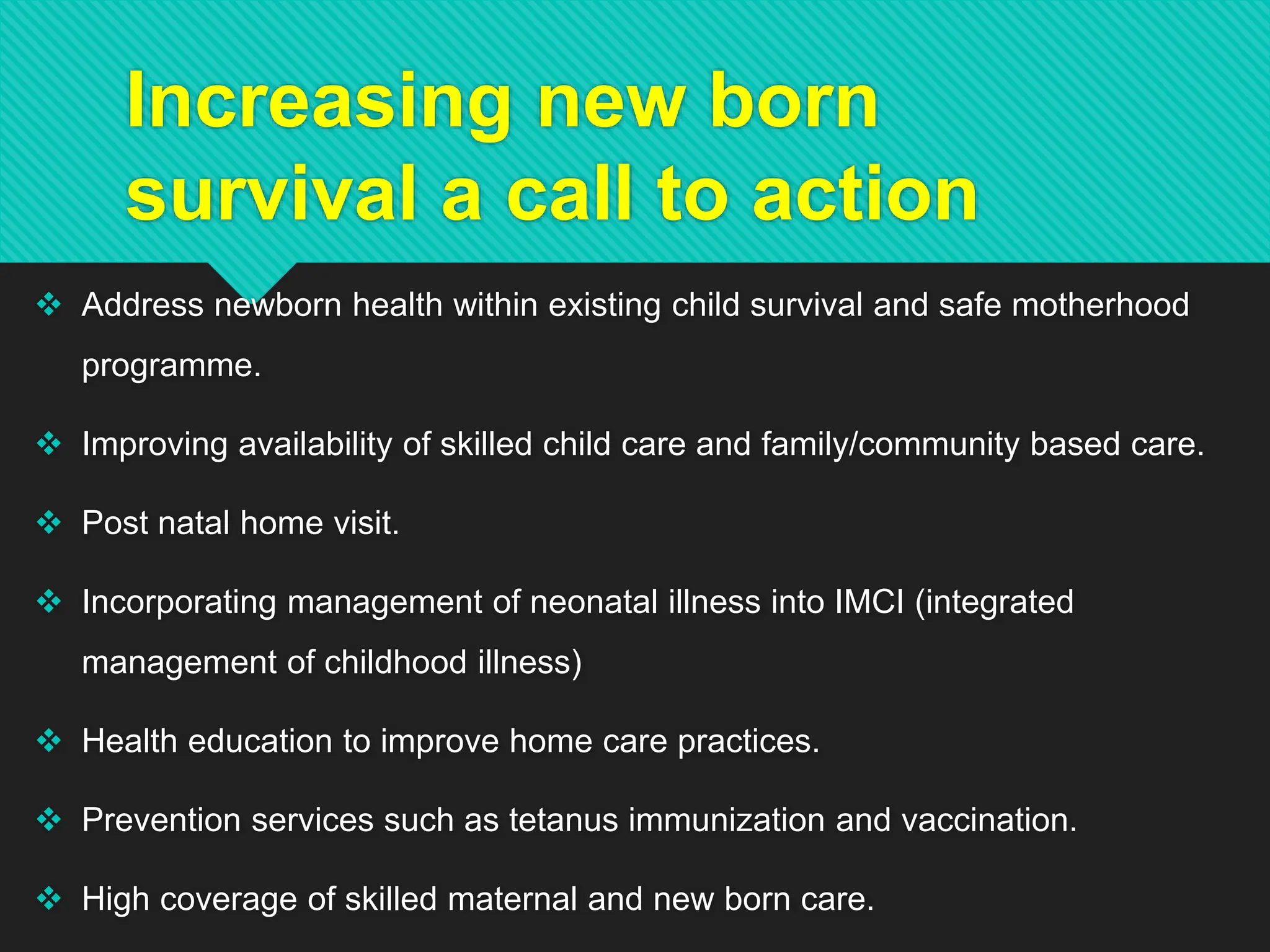
Increasing new born
survival a call to action
 Address newborn health within existing child survival and safe motherhood
programme.
 Improving availability of skilled child care and family/community based care.
 Post natal home visit.
 Incorporating management of neonatal illness into IMCI (integrated
management of childhood illness)
 Health education to improve home care practices.
 Prevention services such as tetanus immunization and vaccination.
 High coverage of skilled maternal and new born care.

Childhood Mortality and Morbidity Presentation Slide.ppt

  • 1.
    Welcome To MyStudy Room Today’s presentation topic “Childhood Mortality and Morbidity”
  • 2.
    Introduction  Childhood mortalityis an important indicator of overall health and development in a country. These estimates assess population and health programs and policies, as well as contribute to population projections. Childhood mortality measures also help identify specific populations that are at increased health risk.
  • 3.
    Measures of childhoodmortality  Neonatal mortality- the probability of dying within the 1st month of life  Infant mortality- the probability of dying before the 1st birthday  Child mortality- the probability of dying between the 1st and 5th birthdays  Under-five mortality- the probability of dying before the fifth birthday
  • 4.
    The Millennium DevelopmentGoals Goal 4 Reduce child mortality  Reduce by two thirds, between 1990 and 2015, the under-five mortality rate.  Big gains have been made in child survival, but efforts must be redoubled to meet the global target.
  • 5.
    Childhood mortality Globally Since 1990, the child mortality rate has dropped by 47 per cent;  17,000 fewer children are dying each day.  Still, 6.6 million children under age five died in 2012— mostly from preventable diseases.  In sub-Saharan Africa, one in ten children die before age five, more than 15 times the average for developed regions.
  • 6.
    Cont…  99% ofall under-five deaths occur in developing countries.  About three-quarters of all child deaths happen in two WHO regions (Africa and South-east Asia) where childhood mortality continues to be very high.  More than 50% of these deaths are clustered in only six countries: China, Democratic Republic of the Congo, Ethiopia, India, Nigeria, and Pakistan.  Under-five mortality is higher in rural areas and among poorer and less educated communities.  Three-quarters of all child deaths are mainly due to preventable causes: neonatal conditions, pneumonia, diarrhoea, malaria, and measles. Many of these deaths could be averted by known, affordable, low-technology interventions.
  • 7.
    Cont…  Appropriate infantand young child feeding and the prevention and management of diarrhea, pneumonia, malaria and HIV infection can save the lives of millions of under-five children.  Coverage of key child health interventions is low and unequally distributed between and within countries.  Strengthening the health system and integrating the interventions into packages of care that can be delivered at all levels – from home to hospital – during pregnancy, childbirth, neonatal period, and childhood will be key to increasing the coverage of health interventions and saving the lives of under- five children.  Good quality information for evidence-based decisions and planning is lacking.
  • 8.
    Bangladesh exceeds MDGtarget for reducing Child mortality  Bangladesh has reduced the mortality rate for children below the age of five by 71%, exceeding the Millennium Development Goal (MDG)-2015 target of 66% reduction, the government has claimed.  Compared to figures in 1990 when the under-five child mortality was 144 per 1,000 live births, the number has dropped to 41 per 1,000 live births in 2012.  The current infant mortality rate in Bangladesh was 33 per 1,000 live births and the neonatal mortality rate was 24 per 1,000 live births.
  • 9.
    Cont…  Neonatal mortalityrate made up 59% of the under-five mortality rate and 80% of the infant mortality rate.  Bangladesh has pledged to prevent an additional 108,000 deaths annually to reduce the national under-five mortality rate to 20 per 1,000 live births by 2015.  One of the important indicators of MDG-4 was ensuring universal health coverage of measles vaccination among one-year-old children by 2015. Bangladesh is also reportedly on track of reaching the indicator, as the current coverage of measles vaccination was 86%.
  • 10.
    Under Five mortalityin Bangladesh  Bangladesh’s under-five mortality rate down to 46 from 139 in two decades (UNICEF report)  NEW YORK, 13 September 2012 – Countries across the world are making rapid progress in reducing child deaths, demonstrating that it is possible to radically reduce child mortality over the span of two decades, a UNICEF report says today.  The 2012 Progress Report on Committing to Child Survival: A Promise Renewed examines trends in child mortality estimates since 1990, and shows that major reductions have been made in under-five mortality rates in all regions and diverse countries. This has translated into a sharp drop in the estimated number of under-five deaths worldwide. Data released today by UNICEF and the UN Inter-agency Group for Child Mortality Estimation show that the number of children under the age of five dying globally fell from nearly 12 million in 1990 to an estimated 6.9 million in 2011. For instance, the Under-Five Mortality Rate (U5MR) for Bangladesh in 1990 was 139, while in 2011 it decreased to 46 only.
  • 11.
    Five major causesof child deaths in Bangladesh  Diarrhoea  ARI (mainly pneumonia)  Malnutrition  Infections  Birth asphyxia  Prematurity  Drowning (Non-Medical cause)
  • 12.
    Prevention of deathsamong children aged one to five years  For some of the most deadly childhood diseases, such as measles, vaccines are available and timely completion of immunization protects a child from this illness and death.  Acute respiratory illnesses, such as pneumonia, are the largest single cause of death in children under five. Addressing the major risk factors for the illness - malnutrition and indoor air pollution - is essential to prevention, along with vaccination. Once children have a serious respiratory illness, they need appropriate care by a trained health provider, including access to antibiotics and oxygen.
  • 13.
    Cont…  Diarrhoea canbe prevented with exclusive breastfeeding and good hygiene and sanitary practices. When a child with diarrhoea becomes dehydrated, rapid treatment is necessary with Oral Rehydration Salts (ORS) and zinc supplements.  Malaria can be prevented by the use of protective nets treated with insecticide that prevent mosquitoes from biting a child. If a child is bitten and has malaria, rapid and appropriate care is essential.
  • 14.
    Cont...  Over 90%of children with HIV are infected through mother-to-child transmission, which is preventable with the use of anti-retrovirals, as well as safer delivery and feeding practices. Anti-retroviral therapy for HIV-infected children greatly improves survival rates and quality of life. Without interventions, over half of all HIV-infected children die before their second birthday.  About 20 million young children worldwide are severely malnourished, which leaves them more vulnerable to illness and early death. Mothers and other caretakers need to know how to feed their child correctly to prevent nutritional problems. If a child becomes malnourished appropriate care is essential.
  • 15.
    Increasing new born survivala call to action  Address newborn health within existing child survival and safe motherhood programme.  Improving availability of skilled child care and family/community based care.  Post natal home visit.  Incorporating management of neonatal illness into IMCI (integrated management of childhood illness)  Health education to improve home care practices.  Prevention services such as tetanus immunization and vaccination.  High coverage of skilled maternal and new born care.