ESSAY
Contents
 Introduction
 Facts about child labour
 Child labour in India
 Causes for child labour
 Solutions to child labour
 Child labour laws and regulations
 Conclusion
Introduction
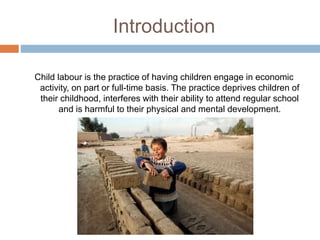
Child labour is the practice of having children engage in economic
activity, on part or full-time basis. The practice deprives children of
their childhood, interferes with their ability to attend regular school
and is harmful to their physical and mental development.
Facts about Child Labour
Child labour is practiced in many countries even after being a big
crime.
Child labour has been an international concern because it damages,
spoils and destroys the future of children. It is a great social
problem. Children are the hope and future of a nation yet there are
millions of deprived children forced into this menace.
Immorality and severe health problem for the young generations are
two major outcomes of child labour.
This is how Child Labour affects any
nation
Poor wages and
inadequate
education
Deterioratin
g labour
standards
Adult
unemploymen
t
Low level of
unionization
Family Poverty
Exploitative
child labour
in India
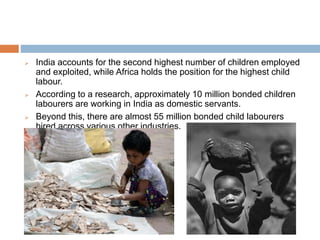
 India accounts for the second highest number of children employed
and exploited, while Africa holds the position for the highest child
labour.
 According to a research, approximately 10 million bonded children
labourers are working in India as domestic servants.
 Beyond this, there are almost 55 million bonded child labourers
hired across various other industries.
Why does Child Labour exist?
 Poverty and Economic Disadvantage - To increase the income of a
poor family.
22.15% of the country’s total population is leading life below the poverty-line as
per a survey conducted in 2010-11. People are deprived of basic necessities of
life like clothing, shelter, food, education and medication. The children then
have no option left other than to work for their survivals.
 To reduce the labour cost in a production organization.
 Lack of basic requirements for children by the government, ex: good
schools.
 Inadequate social control gives rise to the child labor in the agriculture
or domestic work.
Solutions to Child Labour
 Child labour laws need to be strictly enforced and put into practice.
 The general public needs to be made aware of the severe
consequences of child labour.
 An increase in employment opportunity for adults so as to have an
increase in family income.
 Government should ensure that every child gets education and the
opportunity to go to school, which will help children learn skills that will
help them earn a living.
 Family control of fertility so that families are not burdened by children.
Steps undertaken to uproot Child
Labour
In May 1997, to mark the 50th year of Indian Independence, the Union
Government decided to make elementary education to children in
the 6-14 age group a fundamental right. The Constitution is
proposed to be amended for the purpose.
This is a step in the right direction with respect to elimination of child
labour. But it is to be seen when and how this scheme will be
implemented.
Regulations to curb Child
Labour
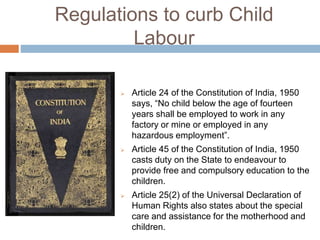
 Article 24 of the Constitution of India, 1950
says, “No child below the age of fourteen
years shall be employed to work in any
factory or mine or employed in any
hazardous employment”.
 Article 45 of the Constitution of India, 1950
casts duty on the State to endeavour to
provide free and compulsory education to the
children.
 Article 25(2) of the Universal Declaration of
Human Rights also states about the special
care and assistance for the motherhood and
children.
Non-governmental
organizations
 Many NGOs like Bachpan Bachao Andolan,
CARE India, Child Rights and You, Global
march against child labour, RIDE India etc have
been working to eradicate child labour in India.
 Pratham is India’s largest non-governmental
organization with the mission: Every child in
school and learning well. Founded in 1994,
Pratham has aimed to reduce child labour and
offer schooling to children irrespective of their
gender, religion and social background. It has
grown by introducing low cost education models
that are sustainable and reproductive.
Conclusion
 Child labour is economically unsound, psychologically disastrous
and ethically wrong. It should be strictly banned.
 To Eradicate poverty and the resultant child labour, India needs to
invest on a massive scale in education, adult employment and
industrialization. Unless the root cause of poverty is not
addressed and social insecurity prevails, child labour cannot be
checked, let alone its eradication.
 The social malady of child labour can also be brought under
control if each individual takes responsibility of reporting about
anyone employing a child below the age of 14 years.
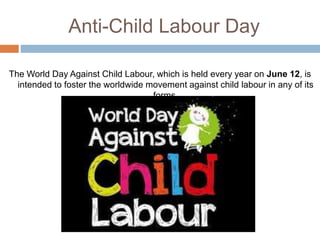
Anti-Child Labour Day
The World Day Against Child Labour, which is held every year on June 12, is
intended to foster the worldwide movement against child labour in any of its
forms.
Child Labour Essay

Child Labour Essay

  • 1.
  • 2.
    Contents  Introduction  Factsabout child labour  Child labour in India  Causes for child labour  Solutions to child labour  Child labour laws and regulations  Conclusion
  • 3.
    Introduction Child labour isthe practice of having children engage in economic activity, on part or full-time basis. The practice deprives children of their childhood, interferes with their ability to attend regular school and is harmful to their physical and mental development.
  • 4.
    Facts about ChildLabour Child labour is practiced in many countries even after being a big crime. Child labour has been an international concern because it damages, spoils and destroys the future of children. It is a great social problem. Children are the hope and future of a nation yet there are millions of deprived children forced into this menace. Immorality and severe health problem for the young generations are two major outcomes of child labour.
  • 5.
    This is howChild Labour affects any nation Poor wages and inadequate education Deterioratin g labour standards Adult unemploymen t Low level of unionization Family Poverty Exploitative child labour
  • 6.
  • 7.
     India accountsfor the second highest number of children employed and exploited, while Africa holds the position for the highest child labour.  According to a research, approximately 10 million bonded children labourers are working in India as domestic servants.  Beyond this, there are almost 55 million bonded child labourers hired across various other industries.
  • 8.
    Why does ChildLabour exist?  Poverty and Economic Disadvantage - To increase the income of a poor family. 22.15% of the country’s total population is leading life below the poverty-line as per a survey conducted in 2010-11. People are deprived of basic necessities of life like clothing, shelter, food, education and medication. The children then have no option left other than to work for their survivals.  To reduce the labour cost in a production organization.  Lack of basic requirements for children by the government, ex: good schools.  Inadequate social control gives rise to the child labor in the agriculture or domestic work.
  • 9.
    Solutions to ChildLabour  Child labour laws need to be strictly enforced and put into practice.  The general public needs to be made aware of the severe consequences of child labour.  An increase in employment opportunity for adults so as to have an increase in family income.  Government should ensure that every child gets education and the opportunity to go to school, which will help children learn skills that will help them earn a living.  Family control of fertility so that families are not burdened by children.
  • 10.
    Steps undertaken touproot Child Labour In May 1997, to mark the 50th year of Indian Independence, the Union Government decided to make elementary education to children in the 6-14 age group a fundamental right. The Constitution is proposed to be amended for the purpose. This is a step in the right direction with respect to elimination of child labour. But it is to be seen when and how this scheme will be implemented.
  • 11.
    Regulations to curbChild Labour  Article 24 of the Constitution of India, 1950 says, “No child below the age of fourteen years shall be employed to work in any factory or mine or employed in any hazardous employment”.  Article 45 of the Constitution of India, 1950 casts duty on the State to endeavour to provide free and compulsory education to the children.  Article 25(2) of the Universal Declaration of Human Rights also states about the special care and assistance for the motherhood and children.
  • 12.
    Non-governmental organizations  Many NGOslike Bachpan Bachao Andolan, CARE India, Child Rights and You, Global march against child labour, RIDE India etc have been working to eradicate child labour in India.  Pratham is India’s largest non-governmental organization with the mission: Every child in school and learning well. Founded in 1994, Pratham has aimed to reduce child labour and offer schooling to children irrespective of their gender, religion and social background. It has grown by introducing low cost education models that are sustainable and reproductive.
  • 13.
    Conclusion  Child labouris economically unsound, psychologically disastrous and ethically wrong. It should be strictly banned.  To Eradicate poverty and the resultant child labour, India needs to invest on a massive scale in education, adult employment and industrialization. Unless the root cause of poverty is not addressed and social insecurity prevails, child labour cannot be checked, let alone its eradication.  The social malady of child labour can also be brought under control if each individual takes responsibility of reporting about anyone employing a child below the age of 14 years.
  • 14.
    Anti-Child Labour Day TheWorld Day Against Child Labour, which is held every year on June 12, is intended to foster the worldwide movement against child labour in any of its forms.