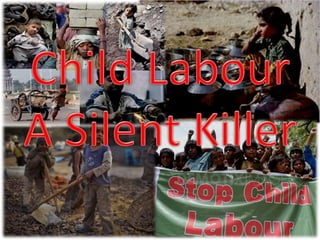
Child labour is a serious crime all
over the world.
Child Labour is the employment of
children for work below the age of
18.
Child Labour is the work for
children that harms them or
exploits them in some way
(physically, mentally, morally or
blocking access to education).
Child labour
Cruelty or necessity?
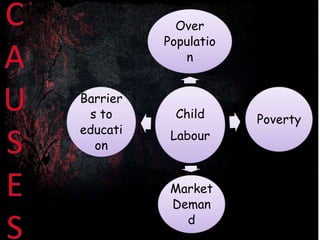
Child
Labour
Over
Populatio
n
Poverty
Market
Deman
d
Barrier
s to
educati
on
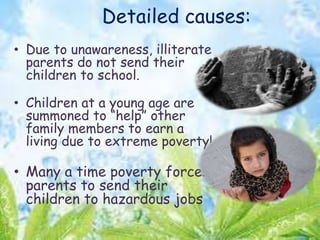
Detailed causes:
• Due to unawareness, illiterate
parents do not send their
children to school.
• Children at a young age are
summoned to “help” other
family members to earn a
living due to extreme poverty!
• Many a time poverty forces
parents to send their
children to hazardous jobs
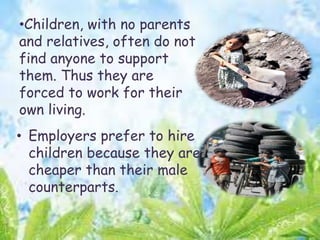
•Children, with no parents
and relatives, often do not
find anyone to support
them. Thus they are
forced to work for their
own living.
• Employers prefer to hire
children because they are
cheaper than their male
counterparts.
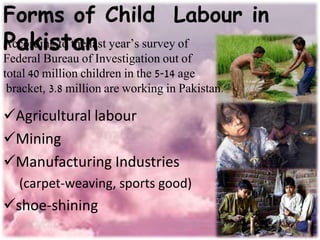
Agricultural labour
Mining
Manufacturing Industries
(carpet-weaving, sports good)
shoe-shining
According to the last year’s survey of
Federal Bureau of Investigation out of
total 40 million children in the 5-14 age
bracket, 3.8 million are working in Pakistan.
Forms of Child Labour in
Pakistan
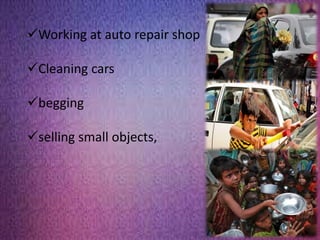
Working at auto repair shop
Cleaning cars
begging
selling small objects,
C
O
N
S
E
Q
U
E
N
C
E
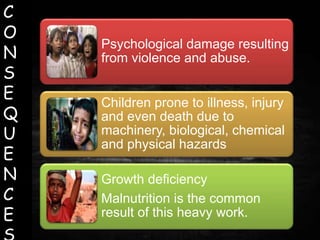
Psychological damage resulting
from violence and abuse.
Children prone to illness, injury
and even death due to
machinery, biological, chemical
and physical hazards
Growth deficiency
Malnutrition is the common
result of this heavy work.
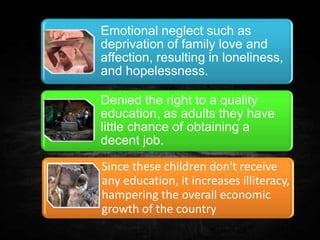
Emotional neglect such as
deprivation of family love and
affection, resulting in loneliness,
and hopelessness.
Denied the right to a quality
education, as adults they have
little chance of obtaining a
decent job.
Since these children don't receive
any education, it increases illiteracy,
hampering the overall economic
growth of the country
Efforts to reduce Child Labour
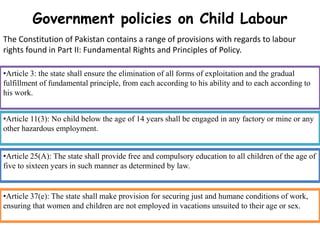
Government policies on Child Labour
•Article 3: the state shall ensure the elimination of all forms of exploitation and the gradual
fulfillment of fundamental principle, from each according to his ability and to each according to
his work.
•Article 11(3): No child below the age of 14 years shall be engaged in any factory or mine or any
other hazardous employment.
•Article 25(A): The state shall provide free and compulsory education to all children of the age of
five to sixteen years in such manner as determined by law.
•Article 37(e): The state shall make provision for securing just and humane conditions of work,
ensuring that women and children are not employed in vacations unsuited to their age or sex.
The Constitution of Pakistan contains a range of provisions with regards to labour
rights found in Part II: Fundamental Rights and Principles of Policy.
Efforts of NGO’s
• SPARC :
SPARC is a NGO which has conducted
research that goes into producing its
publications, including three major
books on child labor, juvenile justice
and child rights.
•Azad Foundation
Azad Foundation exists to help street
children in grave circumstances. It aims
to provide protection and rehabilitation
to children who are in conditions of
need.
• Child Care Foundation of Pakistan (CCF)
CCF is a non-profit, non governmental organization set up in
October 1996, under the Societies Act 1860 with public-
private partnership for charitable and education purposes.
Other NGOs that has worked on the issue of child labor in
Pakistan includes organization such as :
 UNICEF
 NCCWD
 ROZAN
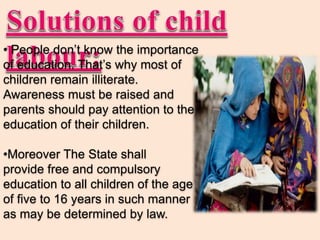
• People don’t know the importance
of education. That’s why most of
children remain illiterate.
Awareness must be raised and
parents should pay attention to the
education of their children.
•Moreover The State shall
provide free and compulsory
education to all children of the age
of five to 16 years in such manner
as may be determined by law.
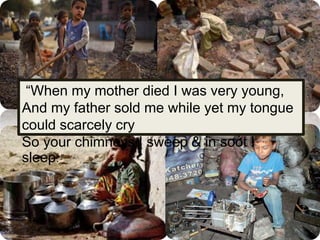
“When my mother died I was very young,
And my father sold me while yet my tongue
could scarcely cry
So your chimneys I sweep & in soot I
sleep.”
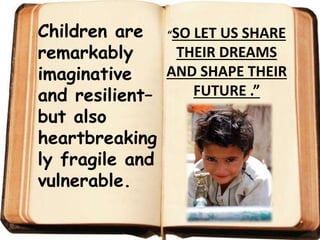
Children are
remarkably
imaginative
and resilient–
but also
heartbreaking
ly fragile and
vulnerable.
“SO LET US SHARE
THEIR DREAMS
AND SHAPE THEIR
FUTURE .”
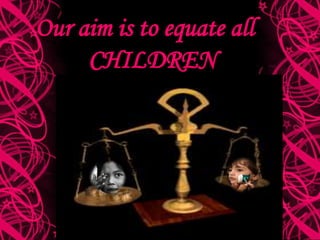
Our aim is to equate all
CHILDREN

CHILD LABOUR

  • 2.
    Child labour isa serious crime all over the world. Child Labour is the employment of children for work below the age of 18. Child Labour is the work for children that harms them or exploits them in some way (physically, mentally, morally or blocking access to education). Child labour Cruelty or necessity?
  • 3.
  • 4.
    Detailed causes: • Dueto unawareness, illiterate parents do not send their children to school. • Children at a young age are summoned to “help” other family members to earn a living due to extreme poverty! • Many a time poverty forces parents to send their children to hazardous jobs
  • 5.
    •Children, with noparents and relatives, often do not find anyone to support them. Thus they are forced to work for their own living. • Employers prefer to hire children because they are cheaper than their male counterparts.
  • 6.
    Agricultural labour Mining Manufacturing Industries (carpet-weaving,sports good) shoe-shining According to the last year’s survey of Federal Bureau of Investigation out of total 40 million children in the 5-14 age bracket, 3.8 million are working in Pakistan. Forms of Child Labour in Pakistan
  • 7.
    Working at autorepair shop Cleaning cars begging selling small objects,
  • 8.
    C O N S E Q U E N C E Psychological damage resulting fromviolence and abuse. Children prone to illness, injury and even death due to machinery, biological, chemical and physical hazards Growth deficiency Malnutrition is the common result of this heavy work.
  • 9.
    Emotional neglect suchas deprivation of family love and affection, resulting in loneliness, and hopelessness. Denied the right to a quality education, as adults they have little chance of obtaining a decent job. Since these children don't receive any education, it increases illiteracy, hampering the overall economic growth of the country
  • 10.
    Efforts to reduceChild Labour
  • 11.
    Government policies onChild Labour •Article 3: the state shall ensure the elimination of all forms of exploitation and the gradual fulfillment of fundamental principle, from each according to his ability and to each according to his work. •Article 11(3): No child below the age of 14 years shall be engaged in any factory or mine or any other hazardous employment. •Article 25(A): The state shall provide free and compulsory education to all children of the age of five to sixteen years in such manner as determined by law. •Article 37(e): The state shall make provision for securing just and humane conditions of work, ensuring that women and children are not employed in vacations unsuited to their age or sex. The Constitution of Pakistan contains a range of provisions with regards to labour rights found in Part II: Fundamental Rights and Principles of Policy.
  • 12.
    Efforts of NGO’s •SPARC : SPARC is a NGO which has conducted research that goes into producing its publications, including three major books on child labor, juvenile justice and child rights. •Azad Foundation Azad Foundation exists to help street children in grave circumstances. It aims to provide protection and rehabilitation to children who are in conditions of need.
  • 13.
    • Child CareFoundation of Pakistan (CCF) CCF is a non-profit, non governmental organization set up in October 1996, under the Societies Act 1860 with public- private partnership for charitable and education purposes. Other NGOs that has worked on the issue of child labor in Pakistan includes organization such as :  UNICEF  NCCWD  ROZAN
  • 14.
    • People don’tknow the importance of education. That’s why most of children remain illiterate. Awareness must be raised and parents should pay attention to the education of their children. •Moreover The State shall provide free and compulsory education to all children of the age of five to 16 years in such manner as may be determined by law.
  • 17.
    “When my motherdied I was very young, And my father sold me while yet my tongue could scarcely cry So your chimneys I sweep & in soot I sleep.”
  • 18.
    Children are remarkably imaginative and resilient– butalso heartbreaking ly fragile and vulnerable. “SO LET US SHARE THEIR DREAMS AND SHAPE THEIR FUTURE .”
  • 19.
    Our aim isto equate all CHILDREN