Child labour
“Tiny ShoulderS huge
reSponSibiliTieS”
SWEAT BLOOD TEARS
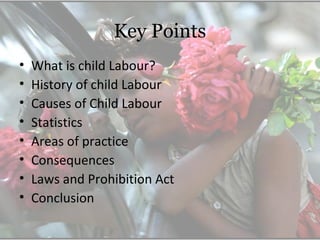
Key Points
• What is child Labour?
• History of child Labour
• Causes of Child Labour
• Statistics
• Areas of practice
• Consequences
• Laws and Prohibition Act
• Conclusion
Child Labour
• The term Child Labour is used for employment
of children below a certain age.
• Which is considered illegal by law and
custom.
• The stipulated age varies from country to
country and government to government.
• Its 14-15 years tentatively.
HISTORY
• Child Labour appeared in early ages in
agriculture.
• Later on it was practiced in Industries.
• It also occurred in coal-mining to carry the
coal.
• First time it was noticed while Industrial
Revolution in 18th
century.
• It was the biggest scandal of the 19th
century,
spreading to other countries as they
industrialized.
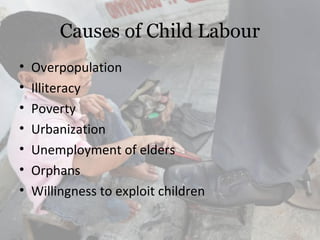
Causes of Child Labour
• Overpopulation
• Illiteracy
• Poverty
• Urbanization
• Unemployment of elders
• Orphans
• Willingness to exploit children
Statistics (World)
Statistics(India)
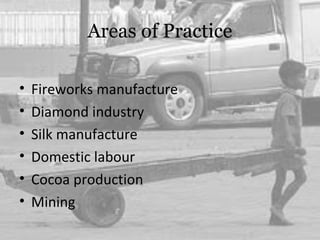
Areas of Practice
• Fireworks manufacture
• Diamond industry
• Silk manufacture
• Domestic labour
• Cocoa production
• Mining
Consequences of Child Labour
• Stunted growth of future generation
• Increased illiteracy
• Perpetuation of poverty
• Inability to contribute to development
• Depreciation in wages
• Increased abuse of children
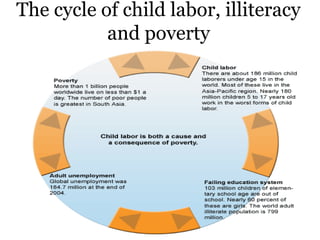
The cycle of child labor, illiteracy
and poverty
Prohibitions
• By Government:-
1. The factories act of 1948
2.The mines act of 1952
3.The child labour act of 1986
4.The juvenile justice of children act of 2000
5.The right of children to free and compulsory
education act 0f 2009
6.A toll free helpline(1098), 73 states
Contd…
• By Non-Government Organizations
1.Bachpan bachao Andolan
2.Care India
3.Child rights and you
4.“PRATHAM & it’s Rescue
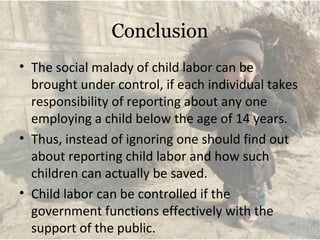
Conclusion
• The social malady of child labor can be
brought under control, if each individual takes
responsibility of reporting about any one
employing a child below the age of 14 years.
• Thus, instead of ignoring one should find out
about reporting child labor and how such
children can actually be saved.
• Child labor can be controlled if the
government functions effectively with the
support of the public.
“The change starts with each one of us, and
ends only when all children are free
to be children.”
-Craig Kielburger
By- Group-3
Sharath Chandra.S
Priyanka Singh
Rajendra.Ch
Nicy John
Atul Kumar.S
Harinath Reddy.Y
Videept Sharma

Child labour

  • 1.
    Child labour “Tiny ShoulderShuge reSponSibiliTieS” SWEAT BLOOD TEARS
  • 2.
    Key Points • Whatis child Labour? • History of child Labour • Causes of Child Labour • Statistics • Areas of practice • Consequences • Laws and Prohibition Act • Conclusion
  • 3.
    Child Labour • Theterm Child Labour is used for employment of children below a certain age. • Which is considered illegal by law and custom. • The stipulated age varies from country to country and government to government. • Its 14-15 years tentatively.
  • 4.
    HISTORY • Child Labourappeared in early ages in agriculture. • Later on it was practiced in Industries. • It also occurred in coal-mining to carry the coal. • First time it was noticed while Industrial Revolution in 18th century. • It was the biggest scandal of the 19th century, spreading to other countries as they industrialized.
  • 5.
    Causes of ChildLabour • Overpopulation • Illiteracy • Poverty • Urbanization • Unemployment of elders • Orphans • Willingness to exploit children
  • 6.
  • 7.
  • 8.
    Areas of Practice •Fireworks manufacture • Diamond industry • Silk manufacture • Domestic labour • Cocoa production • Mining
  • 9.
    Consequences of ChildLabour • Stunted growth of future generation • Increased illiteracy • Perpetuation of poverty • Inability to contribute to development • Depreciation in wages • Increased abuse of children
  • 10.
    The cycle ofchild labor, illiteracy and poverty
  • 11.
    Prohibitions • By Government:- 1.The factories act of 1948 2.The mines act of 1952 3.The child labour act of 1986 4.The juvenile justice of children act of 2000 5.The right of children to free and compulsory education act 0f 2009 6.A toll free helpline(1098), 73 states
  • 12.
    Contd… • By Non-GovernmentOrganizations 1.Bachpan bachao Andolan 2.Care India 3.Child rights and you 4.“PRATHAM & it’s Rescue
  • 13.
    Conclusion • The socialmalady of child labor can be brought under control, if each individual takes responsibility of reporting about any one employing a child below the age of 14 years. • Thus, instead of ignoring one should find out about reporting child labor and how such children can actually be saved. • Child labor can be controlled if the government functions effectively with the support of the public.
  • 14.
    “The change startswith each one of us, and ends only when all children are free to be children.” -Craig Kielburger By- Group-3 Sharath Chandra.S Priyanka Singh Rajendra.Ch Nicy John Atul Kumar.S Harinath Reddy.Y Videept Sharma