 Submit to:
 Topic title:
 Created by:
 Date:
 Class:
 Center:
Sir Nawaz
Child labour in
Gwadar
Roohan G.M
21/5/2014
Computer
DHORIA English Language
And Computer Center
Gwadar
Content
Title Page
 Introduction 1
 History 2
 Causes 4
 Effect 6
 Rights of children 7
 Ranking 9
 Spread of child 10
labour in world
Introduction
Child labour refers to the employment of
children in any work that finish children of their
childhood, interferes with their ability to attend
regular school, and that is mentally, physically,
socially or morally dangerous and harmful. by
many International organization. Child labour
is crime in most of countries. These laws do
not consider that all work by children are child
labour; these work done by child are
considered child labour
artists, supervised training, certain categories of
work such as those by Amish children, and
others.
History (con)
Child labour was employed to varying extents
through most of history. Before 1940,
numerous children aged 5–14 worked in
Europe, the United States and various
colonies of European powers. These children
worked in agriculture, home-based assembly
operations, factories, mining and in services.
Some worked night shifts lasting 12 hours
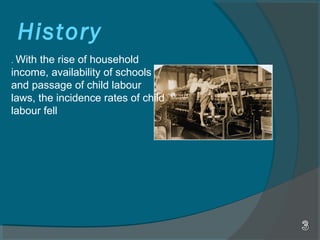
History
. With the rise of household
income, availability of schools
and passage of child labour
laws, the incidence rates of child
labour fell
Causes (con)
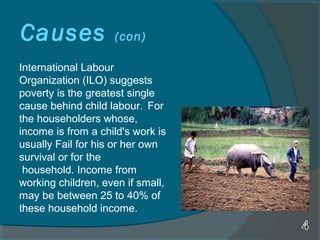
International Labour
Organization (ILO) suggests
poverty is the greatest single
cause behind child labour. For
the householders whose,
income is from a child's work is
usually Fail for his or her own
survival or for the
household. Income from
working children, even if small,
may be between 25 to 40% of
these household income.
Causes
Other scholars
such as Harsch on
African child
labour, and
Edmonds and
Pavcnik on global
child labour have
reached the same
conclusion
Effect
 Child labour damages the childhood of a child.
 He suffers physical and mental torture.
 He becomes mentally and emotially mature too fast
which is a dangerous sign.
 Child labour creates and never finish poverty.
 It can the skill of a child in his life.
 Ultimately this leads to child labour with each
generation of poor children .
Rights Of Children
(con)
 The child must be given its normal
development, both materially and religiously .
 The child that is hungry must be fed, the child
that is sick must be treated, the child that is
backward must be helped, the crime a child
does must be reclaimed, and the orphan must
be sheltered and succored.
 The child must be the first to receive relief in
times of distress.
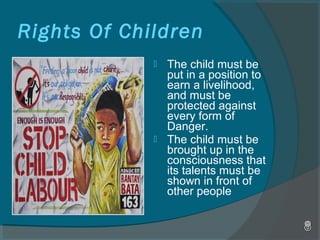
 The child must be
put in a position to
earn a livelihood,
and must be
protected against
every form of
Danger.
 The child must be
brought up in the
consciousness that
its talents must be
shown in front of
other people
Rights Of Children
Ranking
Child Labour
Child Labour

Child Labour

  • 3.
     Submit to: Topic title:  Created by:  Date:  Class:  Center: Sir Nawaz Child labour in Gwadar Roohan G.M 21/5/2014 Computer DHORIA English Language And Computer Center Gwadar
  • 5.
    Content Title Page  Introduction1  History 2  Causes 4  Effect 6  Rights of children 7  Ranking 9  Spread of child 10 labour in world
  • 6.
    Introduction Child labour refersto the employment of children in any work that finish children of their childhood, interferes with their ability to attend regular school, and that is mentally, physically, socially or morally dangerous and harmful. by many International organization. Child labour is crime in most of countries. These laws do not consider that all work by children are child labour; these work done by child are considered child labour artists, supervised training, certain categories of work such as those by Amish children, and others.
  • 7.
    History (con) Child labourwas employed to varying extents through most of history. Before 1940, numerous children aged 5–14 worked in Europe, the United States and various colonies of European powers. These children worked in agriculture, home-based assembly operations, factories, mining and in services. Some worked night shifts lasting 12 hours
  • 8.
    History . With therise of household income, availability of schools and passage of child labour laws, the incidence rates of child labour fell
  • 9.
    Causes (con) International Labour Organization(ILO) suggests poverty is the greatest single cause behind child labour. For the householders whose, income is from a child's work is usually Fail for his or her own survival or for the household. Income from working children, even if small, may be between 25 to 40% of these household income.
  • 10.
    Causes Other scholars such asHarsch on African child labour, and Edmonds and Pavcnik on global child labour have reached the same conclusion
  • 11.
    Effect  Child labourdamages the childhood of a child.  He suffers physical and mental torture.  He becomes mentally and emotially mature too fast which is a dangerous sign.  Child labour creates and never finish poverty.  It can the skill of a child in his life.  Ultimately this leads to child labour with each generation of poor children .
  • 12.
    Rights Of Children (con) The child must be given its normal development, both materially and religiously .  The child that is hungry must be fed, the child that is sick must be treated, the child that is backward must be helped, the crime a child does must be reclaimed, and the orphan must be sheltered and succored.  The child must be the first to receive relief in times of distress.
  • 13.
     The childmust be put in a position to earn a livelihood, and must be protected against every form of Danger.  The child must be brought up in the consciousness that its talents must be shown in front of other people Rights Of Children
  • 14.