CHILD LABOUR
GROUP MEMBERS
• DOLLY MAINI (Roll no 30)
• NIHARIKA KUMAR (Roll no 66)
• VANI WALIA (Roll no 270)
CONTENTS
• Child labour
• Macro-economics causes
• Consequences
• Statistics
• Economic perspective on reducing child labour
• Conclusion
• Current Scenario
• Conclusion
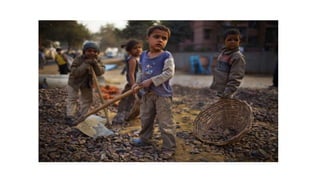
Child labour refers to the employment of children in any work that
deprives children of their childhood, interferes with their ability to
attend regular school, and that is mentally, physically, socially or
morally dangerous and harmful.
MACRO-ECONOMICS CAUSES
Biggeri and Mehrotra have studied the macroeconomic factors that
encourage child labour. They focus their study on five Asian nations including
India, Pakistan, Indonesia, Thailand and Philippines. They suggestthat child
labour is a serious problem in all five, but it is not a new problem.
Macroeconomic causes encouraged widespread child labour across the
world, over most of human history. They suggest that the causes for child
labour include both the demand and the supply side.
While poverty and unavailability of good schools explain the child labour
supply side, they suggest that the growth of low paying informal economy
rather than higher paying formal economy is amongst the causes of the
demand side. Other scholars too suggest that inflexible labour market, size of
informal economy, inability of industries to scale up and lack of modern
manufacturing technologies are major macroeconomic factors affecting
demand and acceptability of child labour.
CONSEQUENCES
• The presence of a large number of child labourers is regarded as a
serious issue in terms of economic welfare. Children who work fail to
get necessary education. They do not get the opportunity to develop
physically, intellectually, emotionally and psychologically. In terms of
the physical condition of children, children are not ready for long
monotonous work because they become exhausted more quickly
than adults. This reduces their physical conditions and makes the
children more vulnerable to disease. Children in hazardous working
conditions are even in worse condition. Children who work, instead of
going to school, will remain illiterate which limits their ability to
contribute to their own well being as well as to community they live
in. Child labour has long term adverse effects for India.
To keep an economy prospering, a vital criteria is to have an educated
workforce equipped with relevant skills for the needs of the industries.
The young labourers today, will be part of India’s human capital
tomorrow. Child labour undoubtedly results in a trade-off with human
capital accumulation.
Also, According to the International Labour Organisation (ILO), there
are tremendous economic benefits for developing nations by sending
children to school instead of work. Without education, children do not
gain the necessary skills such as English literacy and technical aptitude
that will increase their productivity to enable them to secure higher-
skilled jobs in future with higher wages that will lift them out of
poverty.
STATISTICS
• Child labour is found in agricultural sector, including in hybrid seed
production.
• It is recorded that 2,00,000 children have been employed in Andhra
Pradesh alone. Also, in 2009, 6-8years old children were found
working in mines in Jharkhand and Bihar which were extracting mica
for export to the global cosmetics industry.
ECONOMIC PERSPECTIVE
ON
REDUCING CHILD LABOUR
• Legislative action : It is the most common approach to eliminate child
labour. From the economic perspective, there are several major
problems concerning enactment and enforcement of such legislation.
First, usually there are no interest groups to support it. For instance,
the employers of children are hostile to such legislation. Also, the
legislative action in form of child labour ban is usually poorly
enforced.
Second, as it was already mentioned national laws of the most
countries are based on the faulty economic logic of virtuous circle that
outlawing child labour leads to the loss of income for families and the
economy, leading to the fall of labour supply that consequently drives
up the wages of adults.
• International Initiatives : It aimed to reduce child labour in
developing world are one of the most discussed methods used to
tackle this issue. The general attentiveness and interest in child
labourers has increased as a result of globalization of the world.
Trade sanctions seem to be a reasonable tool to express a
disagreement of citizens of developed countries with the child labour
situation. Trade sanctions are more likely to harm children as they are
to improve their conditions. According to statistics, the vast majority of
working children is employed in non-trade sectors like agriculture. Only
5% are employed in export industries (knotting carpets, sewing
garments etc.) Moreover, children in export sectors are usually much
better off in terms of payment and working conditions than children in
other sectors.
Compulsory schooling and education : It is another effective method
to fight child labour.
CURRENT SCENARIO
• To ban employment of children below 14 years in any occupation, a
bill will be presented before the cabinet soon.
• A bill currently in the Indian Parliament on child labour totally will be
a “test” of the new government on how they take the issues of the
most exploited children in their political priority, says child rights
campaigner and noble Laureate Kailash Satyarthi.
• 17 children have been rescued and 13 women arrested in a raid
carried out by anti-human trafficking cell and child line members from
a lodge on railway station road.
CONCLUSION
• Child labour refers to the employment of children in any work.
• Child labour includes both demand and supply side.
• Serious issue in terms of economic welfare.
• Most of the children are laboured in the agricultural sector.
• Reducing child labour : (i) Legislative action (ii) International Initiative
(iii) Compulsory school and education
THANK YOU

Child labour

  • 1.
  • 2.
    GROUP MEMBERS • DOLLYMAINI (Roll no 30) • NIHARIKA KUMAR (Roll no 66) • VANI WALIA (Roll no 270)
  • 3.
    CONTENTS • Child labour •Macro-economics causes • Consequences • Statistics • Economic perspective on reducing child labour • Conclusion • Current Scenario • Conclusion
  • 4.
    Child labour refersto the employment of children in any work that deprives children of their childhood, interferes with their ability to attend regular school, and that is mentally, physically, socially or morally dangerous and harmful.
  • 6.
    MACRO-ECONOMICS CAUSES Biggeri andMehrotra have studied the macroeconomic factors that encourage child labour. They focus their study on five Asian nations including India, Pakistan, Indonesia, Thailand and Philippines. They suggestthat child labour is a serious problem in all five, but it is not a new problem. Macroeconomic causes encouraged widespread child labour across the world, over most of human history. They suggest that the causes for child labour include both the demand and the supply side. While poverty and unavailability of good schools explain the child labour supply side, they suggest that the growth of low paying informal economy rather than higher paying formal economy is amongst the causes of the demand side. Other scholars too suggest that inflexible labour market, size of informal economy, inability of industries to scale up and lack of modern manufacturing technologies are major macroeconomic factors affecting demand and acceptability of child labour.
  • 7.
    CONSEQUENCES • The presenceof a large number of child labourers is regarded as a serious issue in terms of economic welfare. Children who work fail to get necessary education. They do not get the opportunity to develop physically, intellectually, emotionally and psychologically. In terms of the physical condition of children, children are not ready for long monotonous work because they become exhausted more quickly than adults. This reduces their physical conditions and makes the children more vulnerable to disease. Children in hazardous working conditions are even in worse condition. Children who work, instead of going to school, will remain illiterate which limits their ability to contribute to their own well being as well as to community they live in. Child labour has long term adverse effects for India.
  • 8.
    To keep aneconomy prospering, a vital criteria is to have an educated workforce equipped with relevant skills for the needs of the industries. The young labourers today, will be part of India’s human capital tomorrow. Child labour undoubtedly results in a trade-off with human capital accumulation. Also, According to the International Labour Organisation (ILO), there are tremendous economic benefits for developing nations by sending children to school instead of work. Without education, children do not gain the necessary skills such as English literacy and technical aptitude that will increase their productivity to enable them to secure higher- skilled jobs in future with higher wages that will lift them out of poverty.
  • 9.
    STATISTICS • Child labouris found in agricultural sector, including in hybrid seed production. • It is recorded that 2,00,000 children have been employed in Andhra Pradesh alone. Also, in 2009, 6-8years old children were found working in mines in Jharkhand and Bihar which were extracting mica for export to the global cosmetics industry.
  • 11.
    ECONOMIC PERSPECTIVE ON REDUCING CHILDLABOUR • Legislative action : It is the most common approach to eliminate child labour. From the economic perspective, there are several major problems concerning enactment and enforcement of such legislation. First, usually there are no interest groups to support it. For instance, the employers of children are hostile to such legislation. Also, the legislative action in form of child labour ban is usually poorly enforced. Second, as it was already mentioned national laws of the most countries are based on the faulty economic logic of virtuous circle that outlawing child labour leads to the loss of income for families and the economy, leading to the fall of labour supply that consequently drives up the wages of adults.
  • 12.
    • International Initiatives: It aimed to reduce child labour in developing world are one of the most discussed methods used to tackle this issue. The general attentiveness and interest in child labourers has increased as a result of globalization of the world. Trade sanctions seem to be a reasonable tool to express a disagreement of citizens of developed countries with the child labour situation. Trade sanctions are more likely to harm children as they are to improve their conditions. According to statistics, the vast majority of working children is employed in non-trade sectors like agriculture. Only 5% are employed in export industries (knotting carpets, sewing garments etc.) Moreover, children in export sectors are usually much better off in terms of payment and working conditions than children in other sectors. Compulsory schooling and education : It is another effective method to fight child labour.
  • 14.
    CURRENT SCENARIO • Toban employment of children below 14 years in any occupation, a bill will be presented before the cabinet soon. • A bill currently in the Indian Parliament on child labour totally will be a “test” of the new government on how they take the issues of the most exploited children in their political priority, says child rights campaigner and noble Laureate Kailash Satyarthi. • 17 children have been rescued and 13 women arrested in a raid carried out by anti-human trafficking cell and child line members from a lodge on railway station road.
  • 15.
    CONCLUSION • Child labourrefers to the employment of children in any work. • Child labour includes both demand and supply side. • Serious issue in terms of economic welfare. • Most of the children are laboured in the agricultural sector. • Reducing child labour : (i) Legislative action (ii) International Initiative (iii) Compulsory school and education
  • 16.