CONTENTS
 Introduction
 Categories of child labour
 Child labour in India
 Basic reasons for child labour
 Consequences of child labour
 Some facts about child labour
 Child labour in Statistics
 Child labour laws in India
(legal)
 Child labour: STILL A BIG
CHALLENGE
 Conclusion
INTRODUCTION
Child labour is the practice of having children engage in
economic activity, on part or full-time basis. The practice deprives
children of their childhood, and is harmful to their physical and
mental development. Poverty, lack of good schools and growth of
informal economy are considered as the important causes of child
labour in India.
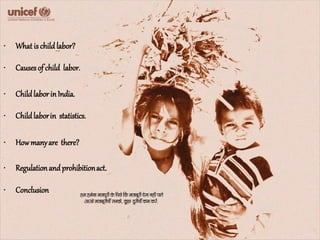
• What is childlabor?
• Causes of child labor.
• Howmanyare there?
• Childlaborin statistics.
• ChildlaborinIndia.
• Regulationandprohibitionact.
• Conclusion
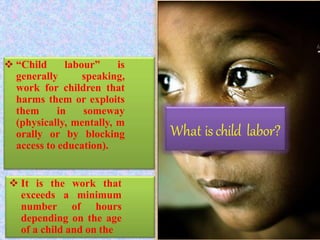
What ischild labor?
 “Child labour” is
generally speaking,
work for children that
harms them or exploits
them in someway
(physically, mentally, m
orally or by blocking
access to education).
 It is the work that
exceeds a minimum
number of hours
depending on the age
of a child and on the
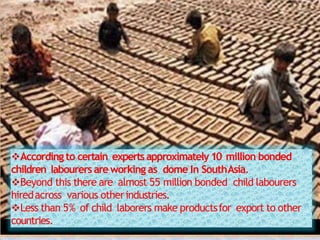
According to certain expertsapproximately10 million bonded
children labourers areworking as dome In SouthAsia.
Beyond this there are almost 55 million bonded child labourers
hiredacross various otherindustries.
Less than 5% of child laborers make productsfor export to other
countries.
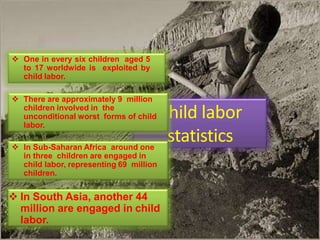
Child labor
statistics
 In South Asia, another 44
million are engaged in child
labor.
 One in every six children aged 5
to 17 worldwide is exploited by
child labor.
 There are approximately 9 million
children involved in the
unconditional worst forms of child
labor.
 In Sub-Saharan Africa around one
in three children are engaged in
child labor, representing 69 million
children.
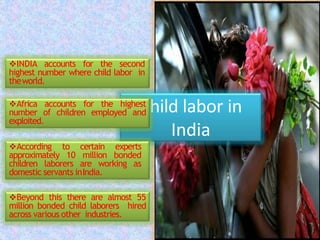
Child labor in
India
INDIA accounts for the second
highest number where child labor in
theworld.
Africa accounts for the highest
number of children employed and
exploited.
According to certain experts
approximately 10 million bonded
children laborers are working as
domestic servants inIndia.
Beyond this there are almost 55
million bonded child laborers hired
across various other industries.
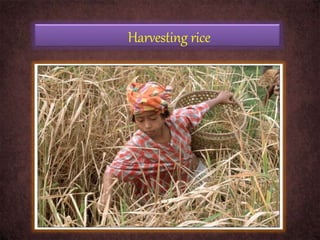
Harvesting rice
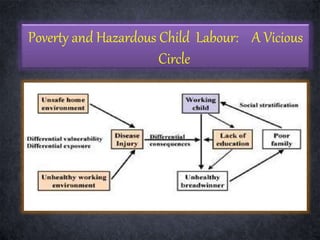
Poverty and Hazardous Child Labour: A Vicious
Circle
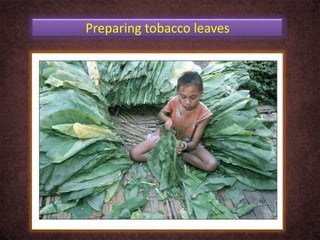
Preparing tobacco leaves
CHILD LABOUR IN INDIA
According to the Census 2001 figures there are 1.26 crore working children in the age
group of 5-14 as compared to the total child population of 25.2 crore.There are
approximately 12 lacs children working in the hazardous occupations / processes which
are covered under the Child Labour (Prohibition & Regulation) Act i.e. 18 occupations
and 65 processes. However, as per survey conducted by National Sample Survey
Organization (NSSO) in 2004-05, the number of working children is estimated at 90.75
lakh. It shows that the efforts of the Government have borne the desired fruits.
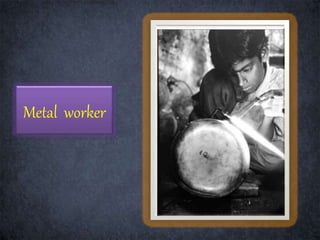
Metal worker
CAUSES
 PRIMARY CAUSES
 CULTURAL CAUSES
 MACROECONOMIC CAUSES
PRIMARY CAUSES
International Labour Organization (ILO) suggests poverty is the greatest
single cause behind child labour. For impoverished households, income
from a child's work is usually crucial for his or her own survival or for that
of the household. Income from working children, even if small, may be
between 25 to 40% of these household income. Other scholars such as
Harsch on African child labour, and Edmonds and Pavcnik on global
child labour have reached the same conclusion.
CULTURAL CAUSES
In European history when child labour was common, as well as in contemporary child labour of
modern world, certain cultural beliefs have rationalized child labour and thereby encouraged it.
Some view that work is good for the character-building and skill development of children. In
many cultures, particular where informal economy and small household businesses thrive, the
cultural tradition is that children follow in their parents' footsteps; child labour then is a means to
learn and practice that trade from a very early age. Similarly, in many cultures the education of
girls is less valued or girls are simply not expected to need formal schooling, and these girls
pushed into child labour such as providing domesticservices.
MACROECONOMIC CAUSES
Biggeri and Mehrotra have studied the macroeconomic factors that encourage child labour. They focus their
study on five Asian nations including India, Pakistan, Indonesia, Thailand and Philippines. They suggest
that child labour is a serious problem in all five, but it is not a new problem. Macroeconomic causes
encouraged widespread child labour across the world, over most of human history. They suggest that the
causes for child labour include both the demand and the supply side. While poverty and unavailability of
good schools explain the child labour supply side, they suggest that the growth of low paying informal
economy rather than higher paying formal economy is amongst the causes of the demand side. Other
scholars too suggest that inflexible labour market, size of informal economy, inability of industries to scale
up and lack of modern manufacturing technologies are major macroeconomic factors affecting demand
and acceptability of child labour.
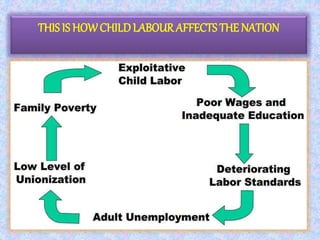
THIS IS HOWCHILDLABOURAFFECTS THE NATION
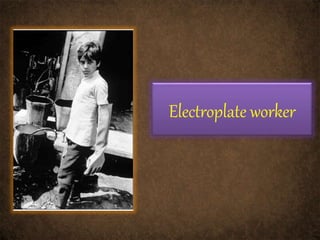
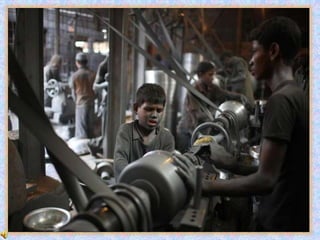
Electroplate worker
Consequences of child labour
The presence of a large number of child laborers is regarded as a serious issue in terms of economic
welfare. Children who work fail to get necessary education. They do not get the opportunity to
develop physically, intellectually, emotionally and psychologically. In terms of the physical condition
of children, children are not ready for long monotous work because they become exhausted more
quickly than adults. This reduces their physical conditions and makes the children more vulnerable
to disease. Children in hazardous working conditions are even in worse condition. Children who
work, instead of going to school, will remain illiterate which limits their ability to contribute to their
own well being as well as to community they live in. Child labour has long term adverse effects for
India.
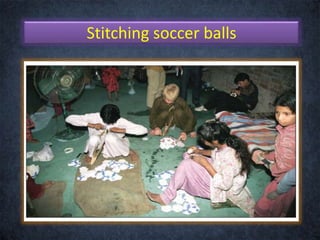
Stitching soccer balls
SOME FACTS ABOUT CHILD LABOUR
Accordingto the Indiancensusof 1991,thereare11.28million working
childrenunderthe ageiffourteenyearsin India.
Over85%of thischildlabourisin thecountry’sruralareas,workingin agriculturalactivitiessuchasfarming,livestock,
rearing,forestry and fisheries.
Theworld’s highest number of working children is in India. ILO estimates that 218 million children were involved in
childlabourin 2004, ofwhich126million wereengagedin hazardouswork.
TheHindibelt,includingBihar,MadhyaPradesh,RajasthanandUttar Pradesh,accountfor 1.27croreworkingchildrenin
the country,engagedin both hazardousandnon-hazardousoccupationsandprocesses.
Over19lakhchildren labourersin the 5-14agegrouparein Uttar Pradesh.Rajasthanaccountsfor over12.6lakhworkers
followedbyBihar with over11lakhandMadhyaPradeshwith10.6lakh.
However,accordingto the2001census,AndhraPradeshwith 13.6lakh childlabourstandssecondinthenationallustafter
UP.
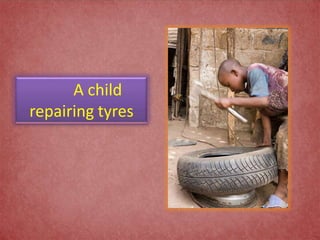
A child
repairing tyres
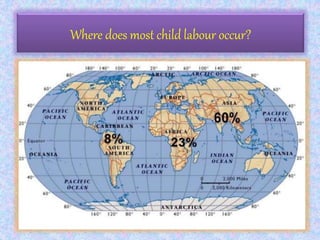
Where does most child labour occur?
Child labour laws & initiatives
After its independence from colonial rule, India has passed a number of constitutional
protections and laws on child labour. TheConstitution of India in theFundamental Rights
and the Directive of State Policy prohibits child labour below the age of 14 years in any
factory ormine orcastle orengaged in any otherhazardous employment (Article 24). The
constitution also envisioned that India shall, by 1960, provideinfrastructure and resources
forfreeand compulsory education toall children of theage six to14 years. (Article21-A and
Article45).
The major national legislative developments include the following:
TheFactoriesActof1948:TheActprohibitsthe employmentof childrenbelowthe ageof 14yearsinanyfactory.Thelawalsoplacedrulesonwho,when
andhowlong canpre-adultsaged15–18yearsbeemployedinanyfactory.
TheMinesActof1952:TheActprohibitsthe employmentof childrenbelow18 yearsof ageinamine.
The Child Labour(Prohibition and Regulation) Act of 1986: The Act prohibits the employment of children below the age of 14 years in hazardous
occupations identifiedinalist bythelaw.Thelist wasexpandedin2006,andagainin2008.
TheJuvenileJustice(CareandProtection)ofChildrenActof2000:Thislawmadeit acrime,punishablewith aprisonterm,for anyoneto procureoremploy
achildin anyhazardousemploymentor inbondage.
TheRightofChildrentoFreeandCompulsoryEducationActof2009:Thelaw mandatesfreeandcompulsoryeducationto allchildrenaged6to 14years.This
legislationalsomandatedthat 25percentof seatsin everyprivateschoolmustbe allocatedfor children from disadvantagedgroupsandphysically
challengedchildren.
• In 1979, the Indian government formed the
• Gurupadswamy Committee to find about child labour and means to tackle it.
The Child Labour Prohibition and Regulation Act was not enacted based on the
recommendations of the committee in 1986.[citation needed] A National Policy
on Child Labour was formulated in 1987 to focus on rehabilitating children
working in hazardous occupations.[73] The Ministry of Labour and Employment
had implemented around 100 industry-specific National Child Labour Projects to
rehabilitate the child workers since 1988.
Initiatives against child labour
Non-governmental organizations
Many NGOs like Bachpan Bachao Andolan, CARE India, Child Rights and You, Global march against
child labour, RIDE India etc. have been working to eradicate child labour in India.
Pratham is India's largest non-governmental organization with the mission 'every child in school and
learning well.' Founded in 1994, Pratham has aimed to reduce child labour and offer schooling to
children irrespective of their gender, religion and social background. It has grown by introducing low
cost education models that are sustainable and reproducible.
Child labour has also been a subject of public interest litigations in Indian courts.
CHILD LABOUR: STILL ABIG
CHALLENGE
Despite a law in force in India, prohibiting child labour, millions of children to be
employed in homes, at roadside restaurants and in factories across the country. These
young kids are also subjected to exploitation in various other ways, including sexual
and mental abuse.
With June 12 being observed as anti- child labour day,activists alleged that lackof
enforcement of the Child Labour Act and no rehabilitation has been fueling child
labour.
Forward Steps :
The ideal scenario on Child Welfare would be when every child enjoys the fullness of childhood through education,
recreation andadequatehealth facilities. It isimpossibleto attain thesefacilities bythe child labour.All the children
wereabletoenjoythecompletenessofchildhoodonly:
Whenthetrueconscienceofthenationisawakened.
Whenallthe policymakersandthe bureaucratstakethe issueof child labourseriouslyandcommit themselvesto the
causeof the holistic developmentof everychildinIndia.
Whenthe employeeswould not evencontemplate the ideaof employing achild for anywork which might denythe
childof anormal childhood.
WhenallPolicieslaiddownbythe GovernmentundervariousPlansand Lawswereimplementedproperly.
What ‘We’ can do as a person to stop child labour?
•To donate funds in NGOs working for the rehabilitation of street
children.
•To contact NGOs and make them aware about child labour happening in our society.
• To make the rural people aware about the benefits of education.
• To provide free education for the orphans.
• To start campaign against child labour.
• To help the government to stop child labour.
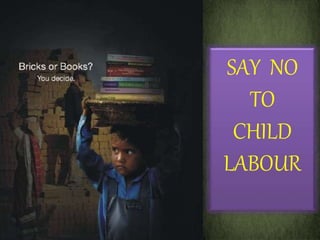
SAY NO
TO
CHILD
LABOUR
Conclusion
The problem of child labour continues to pose a challenge before the nation. Government has been taking
various pro-active measures to tackle this problem. However, considering the magnitude and extent of the
problem and that it is essentially a socio-economic problem inextricably linked to poverty and illiteracy, it
requires concerted efforts from all society to make a dent in the problem.
The social evil of child labour can be brought under control, if each individual takes responsibility of
prevailing child labour. Each and every citizen should be aware of their responsibilities and should take
corrective measures to stop child labour, so that we can have a better and developed India. Child labour
can be controlled if the government functions effectively with the support of the public.
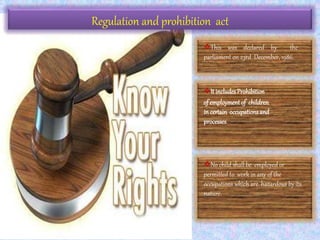
Regulation and prohibition act
This was declared by the
parliament on 23rd December, 1986.
It includesProhibition
of employment of children
in certain occupationsand
processes.
No child shall be employed or
permitted to work in any of the
occupations which are hazardous by its
nature.
T H A N K
Y O U
! ! !

Child labour

  • 2.
    CONTENTS  Introduction  Categoriesof child labour  Child labour in India  Basic reasons for child labour  Consequences of child labour  Some facts about child labour  Child labour in Statistics  Child labour laws in India (legal)  Child labour: STILL A BIG CHALLENGE  Conclusion
  • 3.
    INTRODUCTION Child labour isthe practice of having children engage in economic activity, on part or full-time basis. The practice deprives children of their childhood, and is harmful to their physical and mental development. Poverty, lack of good schools and growth of informal economy are considered as the important causes of child labour in India.
  • 4.
    • What ischildlabor? • Causes of child labor. • Howmanyare there? • Childlaborin statistics. • ChildlaborinIndia. • Regulationandprohibitionact. • Conclusion
  • 5.
    What ischild labor? “Child labour” is generally speaking, work for children that harms them or exploits them in someway (physically, mentally, m orally or by blocking access to education).  It is the work that exceeds a minimum number of hours depending on the age of a child and on the
  • 6.
    According to certainexpertsapproximately10 million bonded children labourers areworking as dome In SouthAsia. Beyond this there are almost 55 million bonded child labourers hiredacross various otherindustries. Less than 5% of child laborers make productsfor export to other countries.
  • 7.
    Child labor statistics  InSouth Asia, another 44 million are engaged in child labor.  One in every six children aged 5 to 17 worldwide is exploited by child labor.  There are approximately 9 million children involved in the unconditional worst forms of child labor.  In Sub-Saharan Africa around one in three children are engaged in child labor, representing 69 million children.
  • 8.
    Child labor in India INDIAaccounts for the second highest number where child labor in theworld. Africa accounts for the highest number of children employed and exploited. According to certain experts approximately 10 million bonded children laborers are working as domestic servants inIndia. Beyond this there are almost 55 million bonded child laborers hired across various other industries.
  • 9.
  • 10.
    Poverty and HazardousChild Labour: A Vicious Circle
  • 11.
  • 12.
    CHILD LABOUR ININDIA According to the Census 2001 figures there are 1.26 crore working children in the age group of 5-14 as compared to the total child population of 25.2 crore.There are approximately 12 lacs children working in the hazardous occupations / processes which are covered under the Child Labour (Prohibition & Regulation) Act i.e. 18 occupations and 65 processes. However, as per survey conducted by National Sample Survey Organization (NSSO) in 2004-05, the number of working children is estimated at 90.75 lakh. It shows that the efforts of the Government have borne the desired fruits.
  • 13.
  • 14.
    CAUSES  PRIMARY CAUSES CULTURAL CAUSES  MACROECONOMIC CAUSES
  • 15.
    PRIMARY CAUSES International LabourOrganization (ILO) suggests poverty is the greatest single cause behind child labour. For impoverished households, income from a child's work is usually crucial for his or her own survival or for that of the household. Income from working children, even if small, may be between 25 to 40% of these household income. Other scholars such as Harsch on African child labour, and Edmonds and Pavcnik on global child labour have reached the same conclusion.
  • 16.
    CULTURAL CAUSES In Europeanhistory when child labour was common, as well as in contemporary child labour of modern world, certain cultural beliefs have rationalized child labour and thereby encouraged it. Some view that work is good for the character-building and skill development of children. In many cultures, particular where informal economy and small household businesses thrive, the cultural tradition is that children follow in their parents' footsteps; child labour then is a means to learn and practice that trade from a very early age. Similarly, in many cultures the education of girls is less valued or girls are simply not expected to need formal schooling, and these girls pushed into child labour such as providing domesticservices.
  • 17.
    MACROECONOMIC CAUSES Biggeri andMehrotra have studied the macroeconomic factors that encourage child labour. They focus their study on five Asian nations including India, Pakistan, Indonesia, Thailand and Philippines. They suggest that child labour is a serious problem in all five, but it is not a new problem. Macroeconomic causes encouraged widespread child labour across the world, over most of human history. They suggest that the causes for child labour include both the demand and the supply side. While poverty and unavailability of good schools explain the child labour supply side, they suggest that the growth of low paying informal economy rather than higher paying formal economy is amongst the causes of the demand side. Other scholars too suggest that inflexible labour market, size of informal economy, inability of industries to scale up and lack of modern manufacturing technologies are major macroeconomic factors affecting demand and acceptability of child labour.
  • 18.
  • 19.
  • 20.
    Consequences of childlabour The presence of a large number of child laborers is regarded as a serious issue in terms of economic welfare. Children who work fail to get necessary education. They do not get the opportunity to develop physically, intellectually, emotionally and psychologically. In terms of the physical condition of children, children are not ready for long monotous work because they become exhausted more quickly than adults. This reduces their physical conditions and makes the children more vulnerable to disease. Children in hazardous working conditions are even in worse condition. Children who work, instead of going to school, will remain illiterate which limits their ability to contribute to their own well being as well as to community they live in. Child labour has long term adverse effects for India.
  • 21.
  • 22.
    SOME FACTS ABOUTCHILD LABOUR Accordingto the Indiancensusof 1991,thereare11.28million working childrenunderthe ageiffourteenyearsin India. Over85%of thischildlabourisin thecountry’sruralareas,workingin agriculturalactivitiessuchasfarming,livestock, rearing,forestry and fisheries. Theworld’s highest number of working children is in India. ILO estimates that 218 million children were involved in childlabourin 2004, ofwhich126million wereengagedin hazardouswork. TheHindibelt,includingBihar,MadhyaPradesh,RajasthanandUttar Pradesh,accountfor 1.27croreworkingchildrenin the country,engagedin both hazardousandnon-hazardousoccupationsandprocesses. Over19lakhchildren labourersin the 5-14agegrouparein Uttar Pradesh.Rajasthanaccountsfor over12.6lakhworkers followedbyBihar with over11lakhandMadhyaPradeshwith10.6lakh. However,accordingto the2001census,AndhraPradeshwith 13.6lakh childlabourstandssecondinthenationallustafter UP.
  • 23.
  • 24.
    Where does mostchild labour occur?
  • 25.
    Child labour laws& initiatives After its independence from colonial rule, India has passed a number of constitutional protections and laws on child labour. TheConstitution of India in theFundamental Rights and the Directive of State Policy prohibits child labour below the age of 14 years in any factory ormine orcastle orengaged in any otherhazardous employment (Article 24). The constitution also envisioned that India shall, by 1960, provideinfrastructure and resources forfreeand compulsory education toall children of theage six to14 years. (Article21-A and Article45).
  • 26.
    The major nationallegislative developments include the following: TheFactoriesActof1948:TheActprohibitsthe employmentof childrenbelowthe ageof 14yearsinanyfactory.Thelawalsoplacedrulesonwho,when andhowlong canpre-adultsaged15–18yearsbeemployedinanyfactory. TheMinesActof1952:TheActprohibitsthe employmentof childrenbelow18 yearsof ageinamine. The Child Labour(Prohibition and Regulation) Act of 1986: The Act prohibits the employment of children below the age of 14 years in hazardous occupations identifiedinalist bythelaw.Thelist wasexpandedin2006,andagainin2008. TheJuvenileJustice(CareandProtection)ofChildrenActof2000:Thislawmadeit acrime,punishablewith aprisonterm,for anyoneto procureoremploy achildin anyhazardousemploymentor inbondage. TheRightofChildrentoFreeandCompulsoryEducationActof2009:Thelaw mandatesfreeandcompulsoryeducationto allchildrenaged6to 14years.This legislationalsomandatedthat 25percentof seatsin everyprivateschoolmustbe allocatedfor children from disadvantagedgroupsandphysically challengedchildren.
  • 28.
    • In 1979,the Indian government formed the • Gurupadswamy Committee to find about child labour and means to tackle it. The Child Labour Prohibition and Regulation Act was not enacted based on the recommendations of the committee in 1986.[citation needed] A National Policy on Child Labour was formulated in 1987 to focus on rehabilitating children working in hazardous occupations.[73] The Ministry of Labour and Employment had implemented around 100 industry-specific National Child Labour Projects to rehabilitate the child workers since 1988. Initiatives against child labour
  • 30.
    Non-governmental organizations Many NGOslike Bachpan Bachao Andolan, CARE India, Child Rights and You, Global march against child labour, RIDE India etc. have been working to eradicate child labour in India. Pratham is India's largest non-governmental organization with the mission 'every child in school and learning well.' Founded in 1994, Pratham has aimed to reduce child labour and offer schooling to children irrespective of their gender, religion and social background. It has grown by introducing low cost education models that are sustainable and reproducible. Child labour has also been a subject of public interest litigations in Indian courts.
  • 31.
    CHILD LABOUR: STILLABIG CHALLENGE Despite a law in force in India, prohibiting child labour, millions of children to be employed in homes, at roadside restaurants and in factories across the country. These young kids are also subjected to exploitation in various other ways, including sexual and mental abuse. With June 12 being observed as anti- child labour day,activists alleged that lackof enforcement of the Child Labour Act and no rehabilitation has been fueling child labour.
  • 32.
    Forward Steps : Theideal scenario on Child Welfare would be when every child enjoys the fullness of childhood through education, recreation andadequatehealth facilities. It isimpossibleto attain thesefacilities bythe child labour.All the children wereabletoenjoythecompletenessofchildhoodonly: Whenthetrueconscienceofthenationisawakened. Whenallthe policymakersandthe bureaucratstakethe issueof child labourseriouslyandcommit themselvesto the causeof the holistic developmentof everychildinIndia. Whenthe employeeswould not evencontemplate the ideaof employing achild for anywork which might denythe childof anormal childhood. WhenallPolicieslaiddownbythe GovernmentundervariousPlansand Lawswereimplementedproperly.
  • 33.
    What ‘We’ cando as a person to stop child labour? •To donate funds in NGOs working for the rehabilitation of street children. •To contact NGOs and make them aware about child labour happening in our society. • To make the rural people aware about the benefits of education. • To provide free education for the orphans. • To start campaign against child labour. • To help the government to stop child labour.
  • 34.
  • 35.
    Conclusion The problem ofchild labour continues to pose a challenge before the nation. Government has been taking various pro-active measures to tackle this problem. However, considering the magnitude and extent of the problem and that it is essentially a socio-economic problem inextricably linked to poverty and illiteracy, it requires concerted efforts from all society to make a dent in the problem. The social evil of child labour can be brought under control, if each individual takes responsibility of prevailing child labour. Each and every citizen should be aware of their responsibilities and should take corrective measures to stop child labour, so that we can have a better and developed India. Child labour can be controlled if the government functions effectively with the support of the public.
  • 36.
    Regulation and prohibitionact This was declared by the parliament on 23rd December, 1986. It includesProhibition of employment of children in certain occupationsand processes. No child shall be employed or permitted to work in any of the occupations which are hazardous by its nature.
  • 38.
    T H AN K Y O U ! ! !