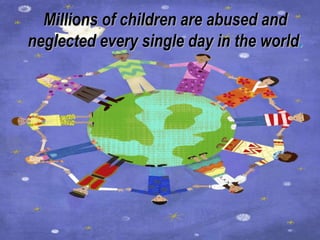


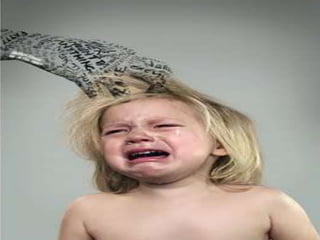
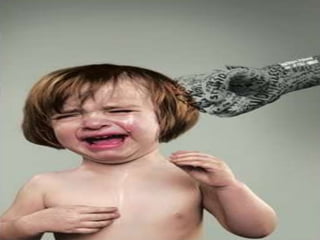
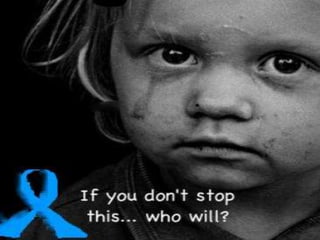
Millions of children are abused and
neglected every single day in the world.
"There is no more fundamental
test of a society than how it
treats its children."
By:
--Ronald Reagan
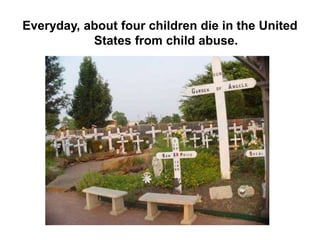
Everyday, about four children die in the United
States from child abuse.
Legal Definitions – “Child”
Child: any person who is under age 18 or who is
reasonably presumed to be under age 18.
For purposes of the Tennessee mandatory reporting
law, University students who are under age 18 are
not excluded from the definition of “child.”
Source: Tennessee Code Annotated § 37-1-102
Legal Definitions – “Abuse”
Abuse: exists when a person under age 18 is
suffering from, has sustained, or may be in
immediate danger of suffering from or sustaining a
wound, injury, disability, or physical or mental
condition caused by brutality, neglect, or other
actions or inactions of a parent, relative, guardian,
or caregiver.
Source: Tennessee Code Annotated § 37-1-102
Definition:
child abuse
All forms of physical, emotional , sexual
injury to a child or failure to prevent such
injury to a child (neglect).
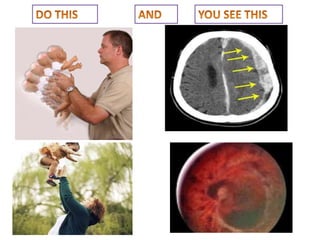
Shaken baby syndrome (SBS)
Can be a fatal form of child abuse . Characterized by
intracranial hemorrhage ,retinal hemorrhage and loss
of consciousness due to vigorous shaking of the
infant .
Facts about SBS:
-shaking is more likely to be done by a male, fathers
make up 76% of all shakers .
-If the shaker is female it’s more likely to be the
babysitter.
-About 70 % of the victims are killed , other 30 % live
with severe permanent injuries.
-One in four babies die as a result of SBS.
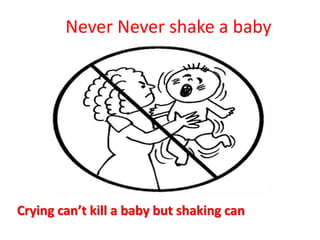
Never Never shake a baby
Crying can’t kill a baby but shaking can
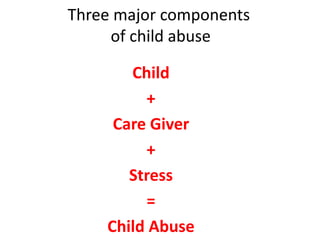
Three major components
of child abuse
Child
+
Care Giver
+
Stress
=
Child Abuse
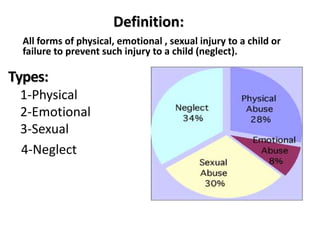
Definition:
All forms of physical, emotional , sexual injury to a child or
failure to prevent such injury to a child (neglect).
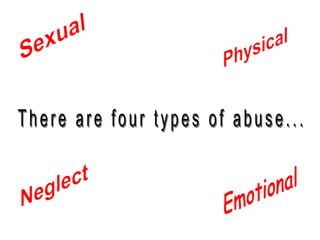
Types:
1-Physical
2-Emotional
3-Sexual
4-Neglect
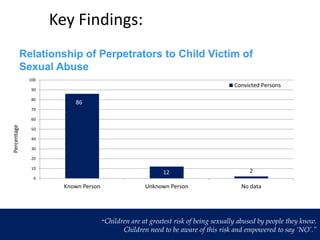
Key Findings: Characteristics of
Perpetrators
14
86
12 2
0
10
20
30
40
50
60
70
80
90
100
Known Person Unknown Person No data
Percentage
Convicted Persons
Relationship of Perpetrators to Child Victim of
Sexual Abuse
“Children are at greatest risk of being sexually abused by people they know.
Children need to be aware of this risk and empowered to say ‘NO’.”
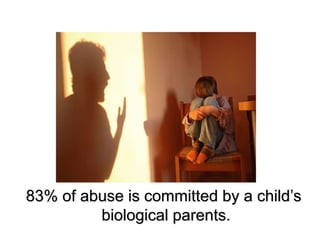
83% of abuse is committed by a child’s
biological parents.
Diagnosis
1-Age of the child: Infants can be of any age, but
the majority are under 2 years. It’s more likely to be
male than female, unwanted or illegitimate child.
2-Social class: Any social class can be involved , but
the lower middle classes are the most at risk.
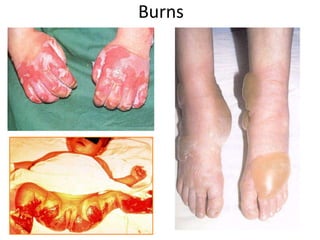
3-Clinical findings: more common in the skin and the
skeleton, Either:
- evidence of injury as old or recent bruises,
fractures, burns, scalds, bites, kicking, slapping..
-Or evidence of neglect i.e. the child may be starved
and dehydrated.
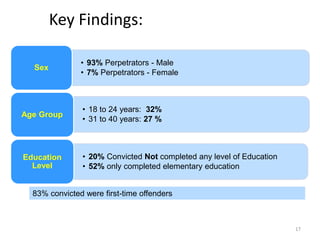
Key Findings: Characteristics of
Perpetrators
17
• 93% Perpetrators - Male
• 7% Perpetrators - Female
Sex
• 18 to 24 years: 32%
• 31 to 40 years: 27 %
Age Group
• 20% Convicted Not completed any level of Education
• 52% only completed elementary education
Education
Level
83% convicted were first-time offenders
Azmat Fatima
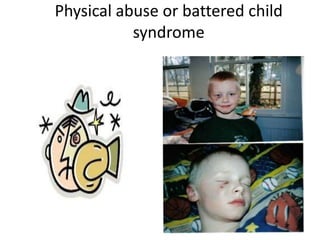
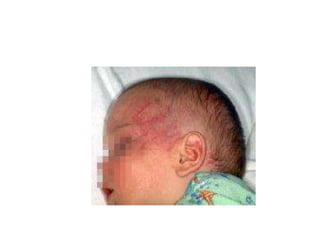
Physical abuse or battered child
syndrome
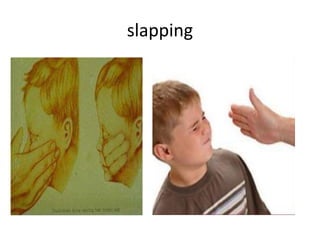
slapping
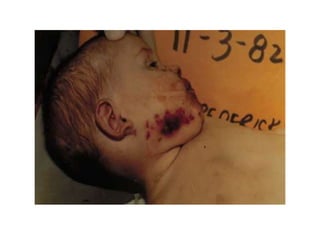
Burns
Emotional Abuse
Definition: intentional verbal or
behavioral acts that result in adverse
emotional consequences as rejection,
isolation, constant criticism … .
Physical indicators:
-speech disorders
-lags in physical development
behavioral indicators:
-conduct disorders (withdrawal,
destructiveness)
-behavioral extremes (aggressive or
passive)
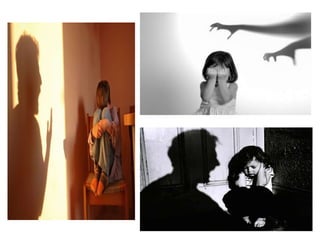
Child Abuse
Sexual abuse
Definition: inappropriate sexual exposure or touch by an
adult to a child or an older child to younger one.
Physical indicators:
-difficulty in walking or sitting
-torn, stained or bloody underclothing
-pain or itching in the genital area
-bruises or bleeding in rectal / genital area
Behavioral indicators:
-age- inappropriate sexual knowledge
-changes in the personality
-sleep disturbances
-drop in school performance
Examples:
fondling, indecent exposure, incest, actual intercourse,
child prostitution.
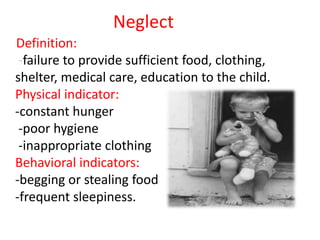
Neglect
Definition:
-failure to provide sufficient food, clothing,
shelter, medical care, education to the child.
Physical indicator:
-constant hunger
-poor hygiene
-inappropriate clothing
Behavioral indicators:
-begging or stealing food
-frequent sleepiness.
Najaf ali
Presidential Degree no. 603
“Child and Youth Welfare Code”
Article 3 – Rights of a Child
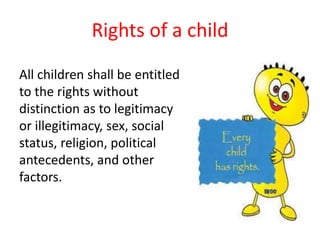
Rights of a child
All children shall be entitled
to the rights without
distinction as to legitimacy
or illegitimacy, sex, social
status, religion, political
antecedents, and other
factors.
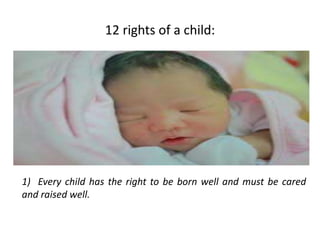
12 rights of a child:
1) Every child has the right to be born well and must be cared
and raised well.
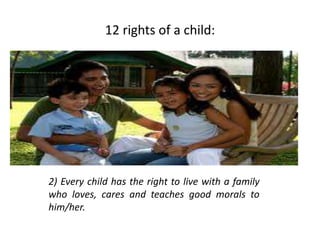
12 rights of a child:
2) Every child has the right to live with a family
who loves, cares and teaches good morals to
him/her.
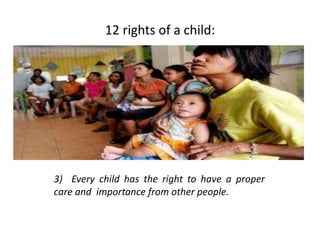
12 rights of a child:
3) Every child has the right to have a proper
care and importance from other people.
12 rights of a child:
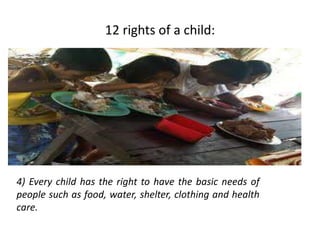
4) Every child has the right to have the basic needs of
people such as food, water, shelter, clothing and health
care.
12 rights of a child:
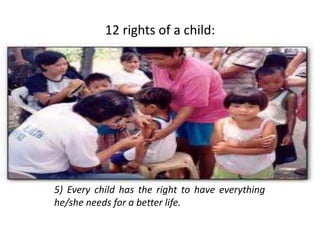
5) Every child has the right to have everything
he/she needs for a better life.
12 rights of a child:
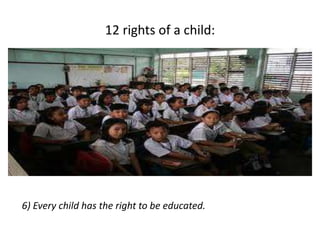
6) Every child has the right to be educated.
12 rights of a child:
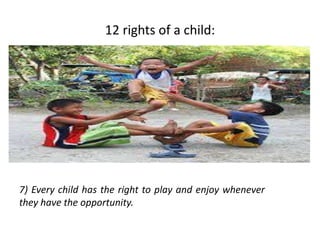
7) Every child has the right to play and enjoy whenever
they have the opportunity.
12 rights of a child:
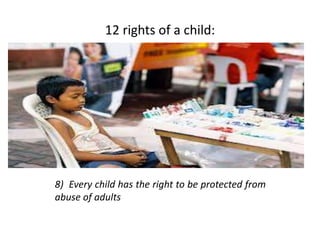
8) Every child has the right to be protected from
abuse of adults
12 rights of a child:
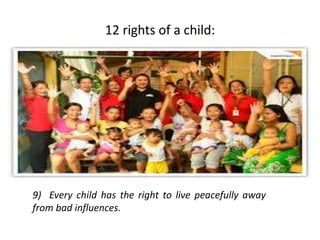
9) Every child has the right to live peacefully away
from bad influences.
12 rights of a child:
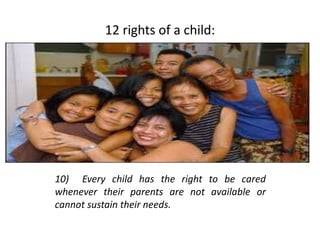
10) Every child has the right to be cared
whenever their parents are not available or
cannot sustain their needs.
12 rights of a child:
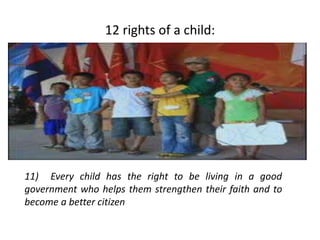
11) Every child has the right to be living in a good
government who helps them strengthen their faith and to
become a better citizen
12 rights of a child:
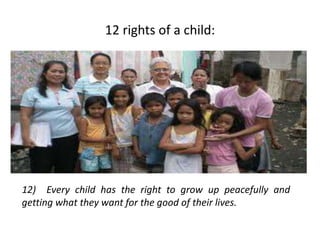
12) Every child has the right to grow up peacefully and
getting what they want for the good of their lives.
Zaeem Mujahid
Consequences of child abuse
• Death or disability in severe cases.
• Affective and behavior disorders.
• Developmental delay and learning difficulties.
• Failure to thrive and growth retardation.
• Predisposition to adult psychiatric disorders.
• An increased risk of the abused becoming an
abuser Abuse Cycle
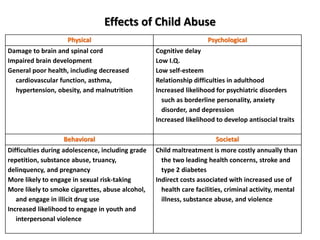
Effects of Child Abuse
Child abuse & child sexual abuse can have lasting
physical, psychological, behavioral, and societal
consequences.
Effects of Child Abuse
Physical Psychological
Damage to brain and spinal cord
Impaired brain development
General poor health, including decreased
cardiovascular function, asthma,
hypertension, obesity, and malnutrition
Cognitive delay
Low I.Q.
Low self-esteem
Relationship difficulties in adulthood
Increased likelihood for psychiatric disorders
such as borderline personality, anxiety
disorder, and depression
Increased likelihood to develop antisocial traits
Behavioral Societal
Difficulties during adolescence, including grade
repetition, substance abuse, truancy,
delinquency, and pregnancy
More likely to engage in sexual risk-taking
More likely to smoke cigarettes, abuse alcohol,
and engage in illicit drug use
Increased likelihood to engage in youth and
interpersonal violence
Child maltreatment is more costly annually than
the two leading health concerns, stroke and
type 2 diabetes
Indirect costs associated with increased use of
health care facilities, criminal activity, mental
illness, substance abuse, and violence
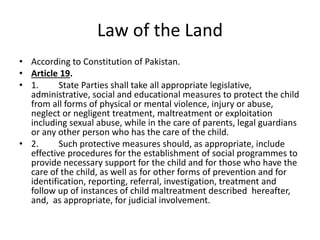
Law of the Land
• According to Constitution of Pakistan.
• Article 19.
• 1. State Parties shall take all appropriate legislative,
administrative, social and educational measures to protect the child
from all forms of physical or mental violence, injury or abuse,
neglect or negligent treatment, maltreatment or exploitation
including sexual abuse, while in the care of parents, legal guardians
or any other person who has the care of the child.
• 2. Such protective measures should, as appropriate, include
effective procedures for the establishment of social programmes to
provide necessary support for the child and for those who have the
care of the child, as well as for other forms of prevention and for
identification, reporting, referral, investigation, treatment and
follow up of instances of child maltreatment described hereafter,
and, as appropriate, for judicial involvement.
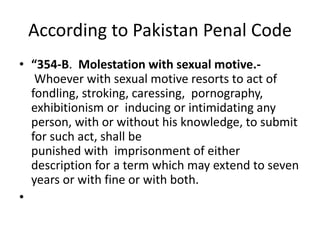
According to Pakistan Penal Code
• “354-B. Molestation with sexual motive.-
Whoever with sexual motive resorts to act of
fondling, stroking, caressing, pornography,
exhibitionism or inducing or intimidating any
person, with or without his knowledge, to submit
for such act, shall be
punished with imprisonment of either
description for a term which may extend to seven
years or with fine or with both.
•
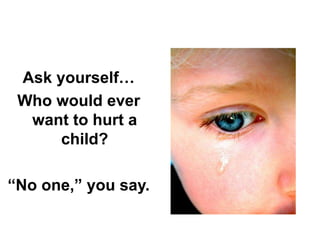
Ask yourself…
Who would ever
want to hurt a
child?
“No one,” you say.
Shayyan Malik
Recommendations
57
• Law should be implemented In later
and sprit.
• Parents should let their kids know what
is sexual abuse and how to handle,
when someone approaches you.
• In order to curb this evil, those involved
should be given exemplary
punishments.
• If a child, that will be an adult someday
is physically and psychologically strong
at peace then he could productively
participate in the development of
society.
• Schools, NGOs all the social agencies
that are contributing in society should
run seminars and conferences in order
to educate the people concerned,
specially parents.

Child abuse

  • 2.
    Millions of childrenare abused and neglected every single day in the world.
  • 3.
    "There is nomore fundamental test of a society than how it treats its children." By: --Ronald Reagan
  • 4.
    Everyday, about fourchildren die in the United States from child abuse.
  • 5.
    Legal Definitions –“Child” Child: any person who is under age 18 or who is reasonably presumed to be under age 18. For purposes of the Tennessee mandatory reporting law, University students who are under age 18 are not excluded from the definition of “child.” Source: Tennessee Code Annotated § 37-1-102
  • 6.
    Legal Definitions –“Abuse” Abuse: exists when a person under age 18 is suffering from, has sustained, or may be in immediate danger of suffering from or sustaining a wound, injury, disability, or physical or mental condition caused by brutality, neglect, or other actions or inactions of a parent, relative, guardian, or caregiver. Source: Tennessee Code Annotated § 37-1-102
  • 7.
    Definition: child abuse All formsof physical, emotional , sexual injury to a child or failure to prevent such injury to a child (neglect).
  • 8.
    Shaken baby syndrome(SBS) Can be a fatal form of child abuse . Characterized by intracranial hemorrhage ,retinal hemorrhage and loss of consciousness due to vigorous shaking of the infant . Facts about SBS: -shaking is more likely to be done by a male, fathers make up 76% of all shakers . -If the shaker is female it’s more likely to be the babysitter. -About 70 % of the victims are killed , other 30 % live with severe permanent injuries. -One in four babies die as a result of SBS.
  • 10.
    Never Never shakea baby Crying can’t kill a baby but shaking can
  • 11.
    Three major components ofchild abuse Child + Care Giver + Stress = Child Abuse
  • 13.
    Definition: All forms ofphysical, emotional , sexual injury to a child or failure to prevent such injury to a child (neglect). Types: 1-Physical 2-Emotional 3-Sexual 4-Neglect
  • 14.
    Key Findings: Characteristicsof Perpetrators 14 86 12 2 0 10 20 30 40 50 60 70 80 90 100 Known Person Unknown Person No data Percentage Convicted Persons Relationship of Perpetrators to Child Victim of Sexual Abuse “Children are at greatest risk of being sexually abused by people they know. Children need to be aware of this risk and empowered to say ‘NO’.”
  • 15.
    83% of abuseis committed by a child’s biological parents.
  • 16.
    Diagnosis 1-Age of thechild: Infants can be of any age, but the majority are under 2 years. It’s more likely to be male than female, unwanted or illegitimate child. 2-Social class: Any social class can be involved , but the lower middle classes are the most at risk. 3-Clinical findings: more common in the skin and the skeleton, Either: - evidence of injury as old or recent bruises, fractures, burns, scalds, bites, kicking, slapping.. -Or evidence of neglect i.e. the child may be starved and dehydrated.
  • 17.
    Key Findings: Characteristicsof Perpetrators 17 • 93% Perpetrators - Male • 7% Perpetrators - Female Sex • 18 to 24 years: 32% • 31 to 40 years: 27 % Age Group • 20% Convicted Not completed any level of Education • 52% only completed elementary education Education Level 83% convicted were first-time offenders
  • 18.
  • 19.
    Physical abuse orbattered child syndrome
  • 21.
  • 23.
  • 24.
    Emotional Abuse Definition: intentionalverbal or behavioral acts that result in adverse emotional consequences as rejection, isolation, constant criticism … . Physical indicators: -speech disorders -lags in physical development behavioral indicators: -conduct disorders (withdrawal, destructiveness) -behavioral extremes (aggressive or passive)
  • 25.
  • 26.
    Sexual abuse Definition: inappropriatesexual exposure or touch by an adult to a child or an older child to younger one. Physical indicators: -difficulty in walking or sitting -torn, stained or bloody underclothing -pain or itching in the genital area -bruises or bleeding in rectal / genital area Behavioral indicators: -age- inappropriate sexual knowledge -changes in the personality -sleep disturbances -drop in school performance Examples: fondling, indecent exposure, incest, actual intercourse, child prostitution.
  • 27.
    Neglect Definition: -failure to providesufficient food, clothing, shelter, medical care, education to the child. Physical indicator: -constant hunger -poor hygiene -inappropriate clothing Behavioral indicators: -begging or stealing food -frequent sleepiness.
  • 28.
  • 29.
    Presidential Degree no.603 “Child and Youth Welfare Code” Article 3 – Rights of a Child
  • 30.
    Rights of achild All children shall be entitled to the rights without distinction as to legitimacy or illegitimacy, sex, social status, religion, political antecedents, and other factors.
  • 31.
    12 rights ofa child: 1) Every child has the right to be born well and must be cared and raised well.
  • 32.
    12 rights ofa child: 2) Every child has the right to live with a family who loves, cares and teaches good morals to him/her.
  • 33.
    12 rights ofa child: 3) Every child has the right to have a proper care and importance from other people.
  • 34.
    12 rights ofa child: 4) Every child has the right to have the basic needs of people such as food, water, shelter, clothing and health care.
  • 35.
    12 rights ofa child: 5) Every child has the right to have everything he/she needs for a better life.
  • 36.
    12 rights ofa child: 6) Every child has the right to be educated.
  • 37.
    12 rights ofa child: 7) Every child has the right to play and enjoy whenever they have the opportunity.
  • 38.
    12 rights ofa child: 8) Every child has the right to be protected from abuse of adults
  • 39.
    12 rights ofa child: 9) Every child has the right to live peacefully away from bad influences.
  • 40.
    12 rights ofa child: 10) Every child has the right to be cared whenever their parents are not available or cannot sustain their needs.
  • 41.
    12 rights ofa child: 11) Every child has the right to be living in a good government who helps them strengthen their faith and to become a better citizen
  • 42.
    12 rights ofa child: 12) Every child has the right to grow up peacefully and getting what they want for the good of their lives.
  • 43.
  • 44.
    Consequences of childabuse • Death or disability in severe cases. • Affective and behavior disorders. • Developmental delay and learning difficulties. • Failure to thrive and growth retardation. • Predisposition to adult psychiatric disorders. • An increased risk of the abused becoming an abuser Abuse Cycle
  • 45.
    Effects of ChildAbuse Child abuse & child sexual abuse can have lasting physical, psychological, behavioral, and societal consequences.
  • 47.
    Effects of ChildAbuse Physical Psychological Damage to brain and spinal cord Impaired brain development General poor health, including decreased cardiovascular function, asthma, hypertension, obesity, and malnutrition Cognitive delay Low I.Q. Low self-esteem Relationship difficulties in adulthood Increased likelihood for psychiatric disorders such as borderline personality, anxiety disorder, and depression Increased likelihood to develop antisocial traits Behavioral Societal Difficulties during adolescence, including grade repetition, substance abuse, truancy, delinquency, and pregnancy More likely to engage in sexual risk-taking More likely to smoke cigarettes, abuse alcohol, and engage in illicit drug use Increased likelihood to engage in youth and interpersonal violence Child maltreatment is more costly annually than the two leading health concerns, stroke and type 2 diabetes Indirect costs associated with increased use of health care facilities, criminal activity, mental illness, substance abuse, and violence
  • 48.
    Law of theLand • According to Constitution of Pakistan. • Article 19. • 1. State Parties shall take all appropriate legislative, administrative, social and educational measures to protect the child from all forms of physical or mental violence, injury or abuse, neglect or negligent treatment, maltreatment or exploitation including sexual abuse, while in the care of parents, legal guardians or any other person who has the care of the child. • 2. Such protective measures should, as appropriate, include effective procedures for the establishment of social programmes to provide necessary support for the child and for those who have the care of the child, as well as for other forms of prevention and for identification, reporting, referral, investigation, treatment and follow up of instances of child maltreatment described hereafter, and, as appropriate, for judicial involvement.
  • 49.
    According to PakistanPenal Code • “354-B. Molestation with sexual motive.- Whoever with sexual motive resorts to act of fondling, stroking, caressing, pornography, exhibitionism or inducing or intimidating any person, with or without his knowledge, to submit for such act, shall be punished with imprisonment of either description for a term which may extend to seven years or with fine or with both. •
  • 50.
    Ask yourself… Who wouldever want to hurt a child? “No one,” you say.
  • 56.
  • 57.
  • 58.
    • Law shouldbe implemented In later and sprit. • Parents should let their kids know what is sexual abuse and how to handle, when someone approaches you. • In order to curb this evil, those involved should be given exemplary punishments.
  • 59.
    • If achild, that will be an adult someday is physically and psychologically strong at peace then he could productively participate in the development of society.
  • 60.
    • Schools, NGOsall the social agencies that are contributing in society should run seminars and conferences in order to educate the people concerned, specially parents.