Topic: Child Abuse
Introduction:
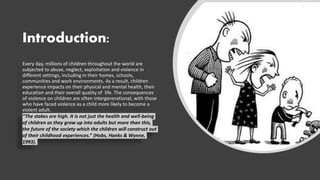
Every day, millions of children throughout the world are
subjected to abuse, neglect, exploitation and violence in
different settings, including in their homes, schools,
communities and work environments. As a result, children
experience impacts on their physical and mental health, their
education and their overall quality of life. The consequences
of violence on children are often intergenerational, with those
who have faced violence as a child more likely to become a
violent adult.
“The stakes are high. It is not just the health and well-being
of children as they grow up into adults but more than this,
the future of the society which the children will construct out
of their childhood experiences.” (Hobs, Hanks & Wynne,
1993).
Child: Who is a
child?
A young human being below
the age of puberty or below
the legal age of majority.
What is Child
Abuse:
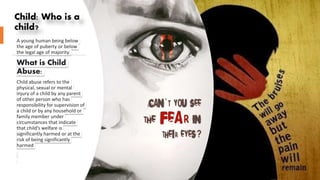
Child abuse refers to the
physical, sexual or mental
injury of a child by any parent
of other person who has
responsibility for supervision of
a child or by any household or
family member under
circumstances that indicate
that child’s welfare is
significantly harmed or at the
risk of being significantly
harmed
Different theories
about Child Abuse:
• Social Learning Theory
• Attachment Theory
• Ecological Theory
• Family Systems Theory
• Self Efficacy
• Resilience Theory
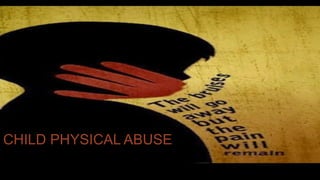
CHILD PHYSICAL ABUSE
CONTENTS
• DEFINATION.
• SIGNS OF CHILD PHYSICAL
ABUSE.
• IMPACT OF CHILD ABUSE.
• TYPES OF PUNISHMENTS.
• PREVENTION.
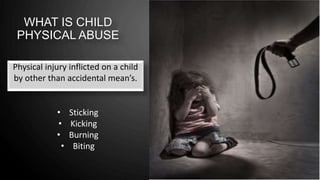
WHAT IS CHILD
PHYSICAL ABUSE
Physical injury inflicted on a child
by other than accidental mean’s.
• Sticking
• Kicking
• Burning
• Biting
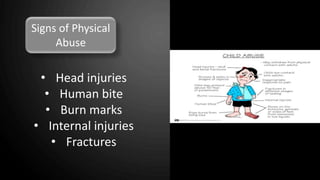
Signs of Physical
Abuse
• Head injuries
• Human bite
• Burn marks
• Internal injuries
• Fractures
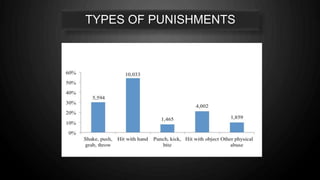
TYPES OF PUNISHMENTS
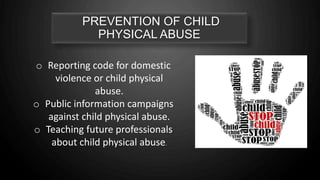
PREVENTION OF CHILD
PHYSICAL ABUSE
o Reporting code for domestic
violence or child physical
abuse.
o Public information campaigns
against child physical abuse.
o Teaching future professionals
about child physical abuse.
Child Sexual
Abuse
Outline
Definition
Effects
Cases
Prevention
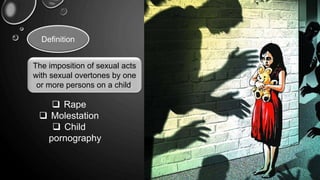
The imposition of sexual acts
with sexual overtones by one
or more persons on a child.
Definition
 Rape
 Molestation
 Child
pornography
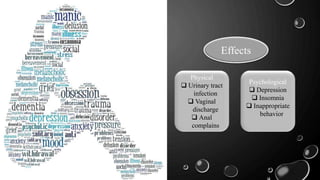
Physical
 Urinary tract
infection
 Vaginal
discharge
 Anal
complains
Psychological
 Depression
 Insomnia
 Inappropriate
behavior
Effects
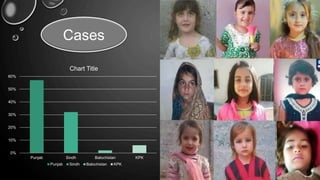
0%
10%
20%
30%
40%
50%
60%
Punjab Sindh Balochistan KPK
Chart Title
Punjab Sindh Balochistan KPK
Cases
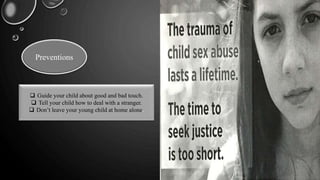
Preventions
 Guide your child about good and bad touch.
 Tell your child how to deal with a stranger.
 Don’t leave your young child at home alone.
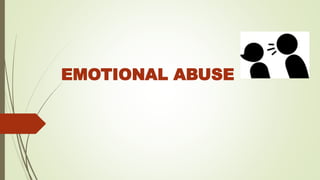
EMOTIONAL ABUSE
OUTLINE:
DEFINITION
SIGNS AND SYMPTOMS
EFFECTS
FACTS AND FIGURES
PREVENTION
What is Emotional Abuse?
DEFINITION:
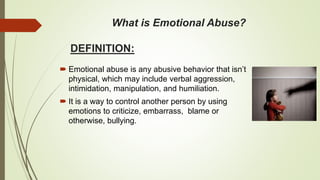
 Emotional abuse is any abusive behavior that isn’t
physical, which may include verbal aggression,
intimidation, manipulation, and humiliation.
 It is a way to control another person by using
emotions to criticize, embarrass, blame or
otherwise, bullying.
SIGNS AND SYMPTOMS:
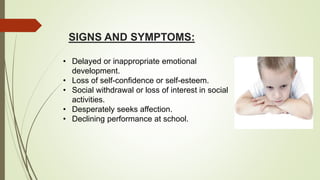
• Delayed or inappropriate emotional
development.
• Loss of self-confidence or self-esteem.
• Social withdrawal or loss of interest in social
activities.
• Desperately seeks affection.
• Declining performance at school.
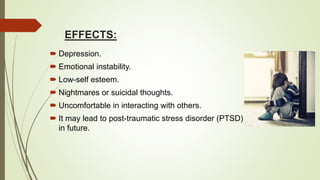
EFFECTS:
 Depression.
 Emotional instability.
 Low-self esteem.
 Nightmares or suicidal thoughts.
 Uncomfortable in interacting with others.
 It may lead to post-traumatic stress disorder (PTSD)
in future.
FACTS AND FIGURES:
 Nearly 3 in 4 children – or 300 million children – aged 2
– 4 years are regularly suffer emotional abuse at the
hands of parents and caregivers.
 84% Pakistani children face emotional violence by their
parents in various ways.
 Globally, up to 1 billion children aged 2 – 17 years have
experienced emotional violence in the past year.
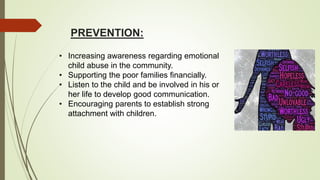
PREVENTION:
• Increasing awareness regarding emotional
child abuse in the community.
• Supporting the poor families financially.
• Listen to the child and be involved in his or
her life to develop good communication.
• Encouraging parents to establish strong
attachment with children.
CHILD NEGLECT
FOURTH TYPE OF CHILD ABUSE
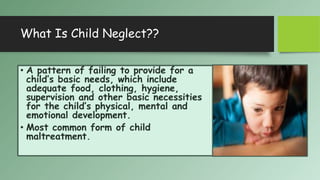
What Is Child Neglect??
• A pattern of failing to provide for a
child’s basic needs, which include
adequate food, clothing, hygiene,
supervision and other basic necessities
for the child’s physical, mental and
emotional development.
• Most common form of child
maltreatment.
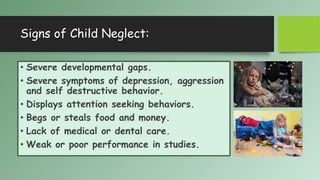
Signs of Child Neglect:
• Severe developmental gaps.
• Severe symptoms of depression, aggression
and self destructive behavior.
• Displays attention seeking behaviors.
• Begs or steals food and money.
• Lack of medical or dental care.
• Weak or poor performance in studies.
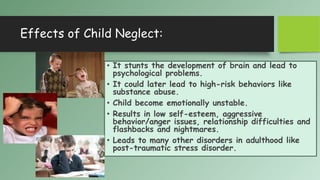
Effects of Child Neglect:
• It stunts the development of brain and lead to
psychological problems.
• It could later lead to high-risk behaviors like
substance abuse.
• Child become emotionally unstable.
• Results in low self-esteem, aggressive
behavior/anger issues, relationship difficulties and
flashbacks and nightmares.
• Leads to many other disorders in adulthood like
post-traumatic stress disorder.
How to prevent??
• Enhance parenting skills.
• Provide quality care and education early in life.
• Arrange public engagement and education
campaigns.
• Support the families who are financially weak.
• Promote family environments.
FACTS AND FIGURES:
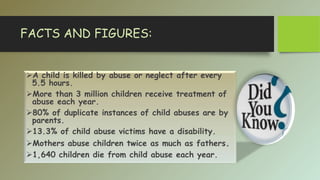
A child is killed by abuse or neglect after every
5.5 hours.
More than 3 million children receive treatment of
abuse each year.
80% of duplicate instances of child abuses are by
parents.
13.3% of child abuse victims have a disability.
Mothers abuse children twice as much as fathers.
1,640 children die from child abuse each year.
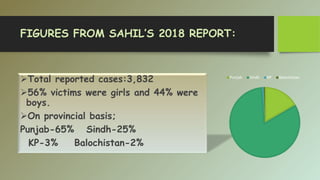
FIGURES FROM SAHIL’S 2018 REPORT:
Total reported cases:3,832
56% victims were girls and 44% were
boys.
On provincial basis;
Punjab-65% Sindh-25%
KP-3% Balochistan-2%
Punjab Sindh KP Balochistan
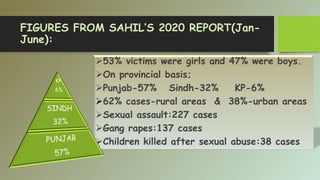
FIGURES FROM SAHIL’S 2020 REPORT(Jan-
June):
53% victims were girls and 47% were boys.
On provincial basis;
Punjab-57% Sindh-32% KP-6%
62% cases-rural areas & 38%-urban areas
Sexual assault:227 cases
Gang rapes:137 cases
Children killed after sexual abuse:38 cases
Any kind of abuse can have long-lasting
negative on a child’s development. After school
activities, parent education classes, mentoring
programs and respite care are some ways to
keep children safe from harm. Be a voice
support of these efforts in your community.
Teach children their rights.
Conclusions
Child abuse

Child abuse

  • 1.
  • 2.
    Introduction: Every day, millionsof children throughout the world are subjected to abuse, neglect, exploitation and violence in different settings, including in their homes, schools, communities and work environments. As a result, children experience impacts on their physical and mental health, their education and their overall quality of life. The consequences of violence on children are often intergenerational, with those who have faced violence as a child more likely to become a violent adult. “The stakes are high. It is not just the health and well-being of children as they grow up into adults but more than this, the future of the society which the children will construct out of their childhood experiences.” (Hobs, Hanks & Wynne, 1993).
  • 3.
    Child: Who isa child? A young human being below the age of puberty or below the legal age of majority. What is Child Abuse: Child abuse refers to the physical, sexual or mental injury of a child by any parent of other person who has responsibility for supervision of a child or by any household or family member under circumstances that indicate that child’s welfare is significantly harmed or at the risk of being significantly harmed
  • 4.
    Different theories about ChildAbuse: • Social Learning Theory • Attachment Theory • Ecological Theory • Family Systems Theory • Self Efficacy • Resilience Theory
  • 5.
  • 6.
    CONTENTS • DEFINATION. • SIGNSOF CHILD PHYSICAL ABUSE. • IMPACT OF CHILD ABUSE. • TYPES OF PUNISHMENTS. • PREVENTION.
  • 7.
    WHAT IS CHILD PHYSICALABUSE Physical injury inflicted on a child by other than accidental mean’s. • Sticking • Kicking • Burning • Biting
  • 8.
    Signs of Physical Abuse •Head injuries • Human bite • Burn marks • Internal injuries • Fractures
  • 9.
  • 10.
    PREVENTION OF CHILD PHYSICALABUSE o Reporting code for domestic violence or child physical abuse. o Public information campaigns against child physical abuse. o Teaching future professionals about child physical abuse.
  • 11.
  • 12.
  • 13.
    The imposition ofsexual acts with sexual overtones by one or more persons on a child. Definition  Rape  Molestation  Child pornography
  • 14.
    Physical  Urinary tract infection Vaginal discharge  Anal complains Psychological  Depression  Insomnia  Inappropriate behavior Effects
  • 15.
    0% 10% 20% 30% 40% 50% 60% Punjab Sindh BalochistanKPK Chart Title Punjab Sindh Balochistan KPK Cases
  • 16.
    Preventions  Guide yourchild about good and bad touch.  Tell your child how to deal with a stranger.  Don’t leave your young child at home alone.
  • 17.
  • 18.
  • 19.
    What is EmotionalAbuse? DEFINITION:  Emotional abuse is any abusive behavior that isn’t physical, which may include verbal aggression, intimidation, manipulation, and humiliation.  It is a way to control another person by using emotions to criticize, embarrass, blame or otherwise, bullying.
  • 20.
    SIGNS AND SYMPTOMS: •Delayed or inappropriate emotional development. • Loss of self-confidence or self-esteem. • Social withdrawal or loss of interest in social activities. • Desperately seeks affection. • Declining performance at school.
  • 21.
    EFFECTS:  Depression.  Emotionalinstability.  Low-self esteem.  Nightmares or suicidal thoughts.  Uncomfortable in interacting with others.  It may lead to post-traumatic stress disorder (PTSD) in future.
  • 22.
    FACTS AND FIGURES: Nearly 3 in 4 children – or 300 million children – aged 2 – 4 years are regularly suffer emotional abuse at the hands of parents and caregivers.  84% Pakistani children face emotional violence by their parents in various ways.  Globally, up to 1 billion children aged 2 – 17 years have experienced emotional violence in the past year.
  • 23.
    PREVENTION: • Increasing awarenessregarding emotional child abuse in the community. • Supporting the poor families financially. • Listen to the child and be involved in his or her life to develop good communication. • Encouraging parents to establish strong attachment with children.
  • 24.
  • 25.
    What Is ChildNeglect?? • A pattern of failing to provide for a child’s basic needs, which include adequate food, clothing, hygiene, supervision and other basic necessities for the child’s physical, mental and emotional development. • Most common form of child maltreatment.
  • 26.
    Signs of ChildNeglect: • Severe developmental gaps. • Severe symptoms of depression, aggression and self destructive behavior. • Displays attention seeking behaviors. • Begs or steals food and money. • Lack of medical or dental care. • Weak or poor performance in studies.
  • 27.
    Effects of ChildNeglect: • It stunts the development of brain and lead to psychological problems. • It could later lead to high-risk behaviors like substance abuse. • Child become emotionally unstable. • Results in low self-esteem, aggressive behavior/anger issues, relationship difficulties and flashbacks and nightmares. • Leads to many other disorders in adulthood like post-traumatic stress disorder.
  • 28.
    How to prevent?? •Enhance parenting skills. • Provide quality care and education early in life. • Arrange public engagement and education campaigns. • Support the families who are financially weak. • Promote family environments.
  • 29.
    FACTS AND FIGURES: Achild is killed by abuse or neglect after every 5.5 hours. More than 3 million children receive treatment of abuse each year. 80% of duplicate instances of child abuses are by parents. 13.3% of child abuse victims have a disability. Mothers abuse children twice as much as fathers. 1,640 children die from child abuse each year.
  • 30.
    FIGURES FROM SAHIL’S2018 REPORT: Total reported cases:3,832 56% victims were girls and 44% were boys. On provincial basis; Punjab-65% Sindh-25% KP-3% Balochistan-2% Punjab Sindh KP Balochistan
  • 31.
    FIGURES FROM SAHIL’S2020 REPORT(Jan- June): 53% victims were girls and 47% were boys. On provincial basis; Punjab-57% Sindh-32% KP-6% 62% cases-rural areas & 38%-urban areas Sexual assault:227 cases Gang rapes:137 cases Children killed after sexual abuse:38 cases
  • 32.
    Any kind ofabuse can have long-lasting negative on a child’s development. After school activities, parent education classes, mentoring programs and respite care are some ways to keep children safe from harm. Be a voice support of these efforts in your community. Teach children their rights. Conclusions