An Overview on Child Abuse
Kunj Thaker
4th Year BAMS
Bapuji Ayurvedic Medical College
Shimoga, Karnataka
Mo. +91 7990183413
Email. Kunj.vguj@gmail.com
Presenter:-
Dr. Shubha K.
HOD, department of Kaumarbhrutya
Bapuji Ayurvedic Medical College
Shimoga, Karnataka
Guided By:-
Introduction :-
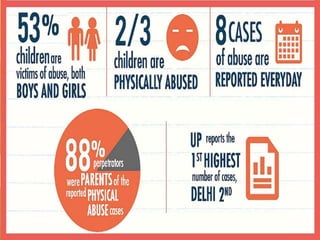
 In present days the cases of child abuse are increasing
day by day globally.
 In India, many misconceptions are going on in society
from olden days only, which moreover promoting the
child abuse. For example, child marriage, discrimination
against the girl child etc.
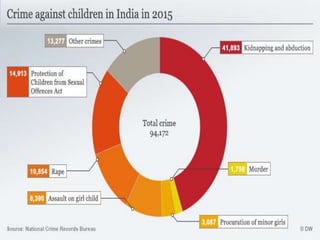
 according to “National Crime Records Bureau”, 19% of
world’s children live in India. And 40% of them suffer
from child abuse.
 The state of Uttar Pradesh, Andhra Pradesh, Assam,
Bihar and Delhi have almost consistently reported higher
rates of abuse in all forms as compared to other states
by “Ministry of Women and Child Development,
Government of India”.
 According to a report by National Human Rights
Commission of India, 40,000 children are abducted from
human trafficking each year, leaving 11,000 untraced.
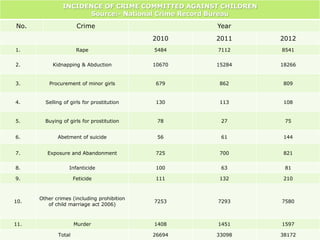
INCIDENCE OF CRIME COMMITTED AGAINST CHILDREN
Source:- National Crime Record Bureau
No. Crime Year
2010 2011 2012
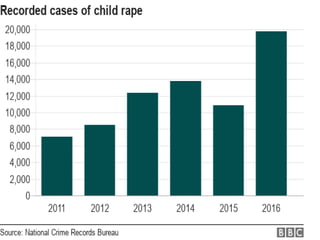
1. Rape 5484 7112 8541
2. Kidnapping & Abduction 10670 15284 18266
3. Procurement of minor girls 679 862 809
4. Selling of girls for prostitution 130 113 108
5. Buying of girls for prostitution 78 27 75
6. Abetment of suicide 56 61 144
7. Exposure and Abandonment 725 700 821
8. Infanticide 100 63 81
9. Feticide 111 132 210
10.
Other crimes (including prohibition
of child marriage act 2006)
7253 7293 7580
11. Murder 1408 1451 1597
Total 26694 33098 38172
 So, there are large number of children
living in India and many of them suffering
with child abuse and exploitation.
 Above mentioned data is just for reported
crimes, but there are number of cases
which are being unreported.
 The main reason being lack of knowledge
about child abuse. Hence, in present era
knowledge about child abuse is need of
the hour.
Definition
Child abuse can be defined as
causing or permitting of any
harmful or offensive contact to
a child’s body and/or any
communication or transaction
which humiliates, shames, or
frightens the child.
ref. forensic medicine and toxicology, Gautam Biswas.
According to WHO,
 Child abuse or maltreatment constitutes
all forms of physical and/or emotional ill-
treatment, sexual abuse, neglect or
negligent treatment or commercial or
other exploitation, resulting in actual or
potential harm to the child’s health,
survival, development or dignity in the
context of the relationship of
responsibility, trust or power.
Types of child abuse
1.Physical Abuse
2.Sexual Abuse
3.Emotional Abuse
4.Neglect
Physical Abuse
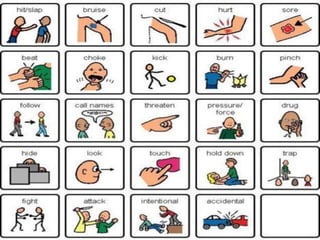
 Physical Abuse of children includes any non-accidental
physical injury caused by the child’s caretaker.
 It can be beating, punching, kicking, biting, burning,
shaking or battering.
 Next to neglect it is the second most frequently reported
form of child abuse, accounting for25% of all cases of
child abuse.
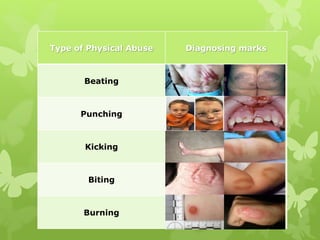
Type of Physical Abuse Diagnosing marks
Beating
Punching
Kicking
Biting
Burning
Clinical Findings
 Bruises
 Marks
 Burns
 Lacerations and Abrasions
 Fractures and Dislocations
 Mutilation injuries
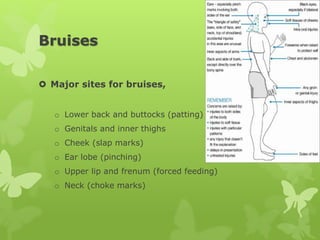
Bruises
 Major sites for bruises,
o Lower back and buttocks (patting)
o Genitals and inner thighs
o Cheek (slap marks)
o Ear lobe (pinching)
o Upper lip and frenum (forced feeding)
o Neck (choke marks)
Cultural Bruising
 The folk remedies which are performed in various places
and in various cultures which are basically harmful to
the child but because of their superstitions people
follows it and unknowingly performs the child abuse. The
bruises produced by these practices are known as
cultural bruise. Some examples are as follow,
o Cupping (circular hemorrhagic lesion: a large, perfectly
round bruise.)
o Coining (long hemorrhagic bruises)
o Spooning (long bruises)
Marks
 Clear marks will be present on the body of child
according to the instrument or objects used to beat or
tie. Some examples are,
o Human hand marks (hand)
o Strap marks (belt)
o Lash marks (tree branch or stick)
o Loop marks (lamp cord, rope or fan-belt)
o Gag marks (abrasion near corner of mouth)
o Circumferential tie marks (narrow rope/cord, wide cloth)
o Bizarre marks (blunt instrument)
o Bite marks (teeth)
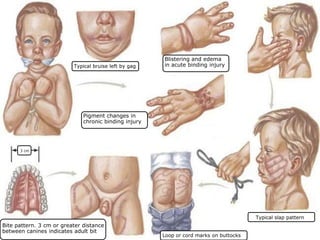
Typical bruise left by gag
Pigment changes in
chronic binding injury
Typical slap pattern
Loop or cord marks on buttocks
Blistering and edema
in acute binding injury
Bite pattern. 3 cm or greater distance
between canines indicates adult bit
3 cm
Burns
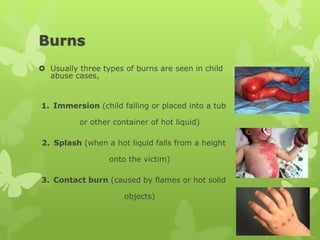
 Usually three types of burns are seen in child
abuse cases,
1. Immersion (child falling or placed into a tub
or other container of hot liquid)
2. Splash (when a hot liquid falls from a height
onto the victim)
3. Contact burn (caused by flames or hot solid
objects)
Fractures
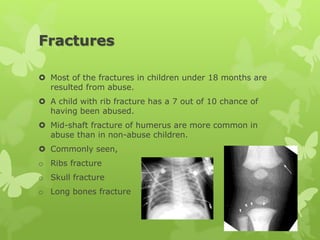
 Most of the fractures in children under 18 months are
resulted from abuse.
 A child with rib fracture has a 7 out of 10 chance of
having been abused.
 Mid-shaft fracture of humerus are more common in
abuse than in non-abuse children.
 Commonly seen,
o Ribs fracture
o Skull fracture
o Long bones fracture
Sexual Abuse
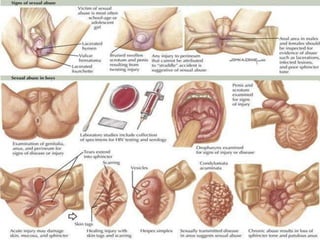
 Sexual Abuse refers to inappropriate sexual
behavior with a child. It includes fondling a
child’s genitals, making the child fondle the
adult’s genitals, intercourse, incest, rape,
sodomy, exhibitionism, indecent exposure and
commercial exploitation through prostitution
or the production of pornographic material.
 Prevalence had increased dramatically but
reporting is very less because of cultural
morals mainly.
Victim
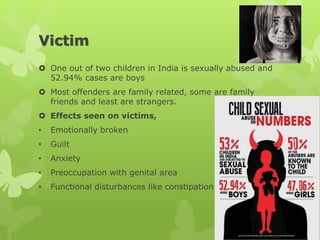
 One out of two children in India is sexually abused and
52.94% cases are boys
 Most offenders are family related, some are family
friends and least are strangers.
 Effects seen on victims,
• Emotionally broken
• Guilt
• Anxiety
• Preoccupation with genital area
• Functional disturbances like constipation
Emotional Abuse
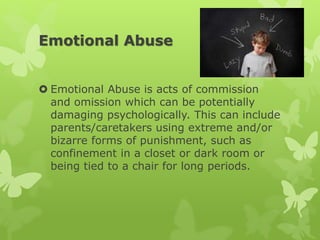
 Emotional Abuse is acts of commission
and omission which can be potentially
damaging psychologically. This can include
parents/caretakers using extreme and/or
bizarre forms of punishment, such as
confinement in a closet or dark room or
being tied to a chair for long periods.
Emotional abuse effects
Psychopathologic symptoms are
more likely to develop in
emotionally abused children.
Lifelong pattern of depression,
estrangement, anxiety, low self-
esteem, lack of empathy.
Neglect
Neglect is the failure to provide for
the child’s basic needs.
It can be physical, educational or
emotional.
In general, neglect is an act of
omission.
Laws against child abuse in India
 The parliament of India passed the
‘Protection of Children Against Sexual
Offence Bill 2011’ regarding child sexual
abuse, on 22nd may 2012 into an Act.
 I.PC. (1860) 375- Rape
 I.P.C. (1860) 354- Outraging the modesty
of a woman
 I.P.C. (1860) 377- Unnatural offences
 Termination of pregnancy act, 1971
 However, the I.P.C. could not effectively protect the child
due to various loopholes like,
• IPC 375 doesn’t protect the male victims or anyone from
sexual acts of penetration other than “traditional” peno-
veginal intercourse
• IPC 354 lacks a statutory definition of “modesty”. It
carries a weak penalty and is a compoundable offence.
Further, it does not protect the “modesty” of male child.
• In IPC 377, the term “Unnatural Offence” is not defined.
It only applies to victims penetrated by their attacker’s
sex act, and is not designed to criminalize sexual abuse
of children.
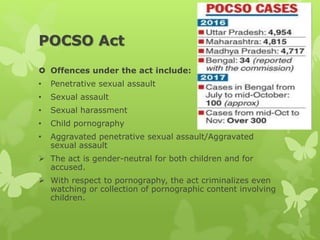
POCSO Act
 Offences under the act include:
• Penetrative sexual assault
• Sexual assault
• Sexual harassment
• Child pornography
• Aggravated penetrative sexual assault/Aggravated
sexual assault
 The act is gender-neutral for both children and for
accused.
 With respect to pornography, the act criminalizes even
watching or collection of pornographic content involving
children.
THANK
YOU

An overview on child abuse

  • 1.
    An Overview onChild Abuse Kunj Thaker 4th Year BAMS Bapuji Ayurvedic Medical College Shimoga, Karnataka Mo. +91 7990183413 Email. Kunj.vguj@gmail.com Presenter:- Dr. Shubha K. HOD, department of Kaumarbhrutya Bapuji Ayurvedic Medical College Shimoga, Karnataka Guided By:-
  • 2.
    Introduction :-  Inpresent days the cases of child abuse are increasing day by day globally.  In India, many misconceptions are going on in society from olden days only, which moreover promoting the child abuse. For example, child marriage, discrimination against the girl child etc.  according to “National Crime Records Bureau”, 19% of world’s children live in India. And 40% of them suffer from child abuse.  The state of Uttar Pradesh, Andhra Pradesh, Assam, Bihar and Delhi have almost consistently reported higher rates of abuse in all forms as compared to other states by “Ministry of Women and Child Development, Government of India”.
  • 3.
     According toa report by National Human Rights Commission of India, 40,000 children are abducted from human trafficking each year, leaving 11,000 untraced. INCIDENCE OF CRIME COMMITTED AGAINST CHILDREN Source:- National Crime Record Bureau No. Crime Year 2010 2011 2012 1. Rape 5484 7112 8541 2. Kidnapping & Abduction 10670 15284 18266 3. Procurement of minor girls 679 862 809 4. Selling of girls for prostitution 130 113 108 5. Buying of girls for prostitution 78 27 75 6. Abetment of suicide 56 61 144 7. Exposure and Abandonment 725 700 821 8. Infanticide 100 63 81 9. Feticide 111 132 210 10. Other crimes (including prohibition of child marriage act 2006) 7253 7293 7580 11. Murder 1408 1451 1597 Total 26694 33098 38172
  • 6.
     So, thereare large number of children living in India and many of them suffering with child abuse and exploitation.  Above mentioned data is just for reported crimes, but there are number of cases which are being unreported.  The main reason being lack of knowledge about child abuse. Hence, in present era knowledge about child abuse is need of the hour.
  • 7.
    Definition Child abuse canbe defined as causing or permitting of any harmful or offensive contact to a child’s body and/or any communication or transaction which humiliates, shames, or frightens the child. ref. forensic medicine and toxicology, Gautam Biswas.
  • 8.
    According to WHO, Child abuse or maltreatment constitutes all forms of physical and/or emotional ill- treatment, sexual abuse, neglect or negligent treatment or commercial or other exploitation, resulting in actual or potential harm to the child’s health, survival, development or dignity in the context of the relationship of responsibility, trust or power.
  • 9.
    Types of childabuse 1.Physical Abuse 2.Sexual Abuse 3.Emotional Abuse 4.Neglect
  • 10.
    Physical Abuse  PhysicalAbuse of children includes any non-accidental physical injury caused by the child’s caretaker.  It can be beating, punching, kicking, biting, burning, shaking or battering.  Next to neglect it is the second most frequently reported form of child abuse, accounting for25% of all cases of child abuse.
  • 12.
    Type of PhysicalAbuse Diagnosing marks Beating Punching Kicking Biting Burning
  • 13.
    Clinical Findings  Bruises Marks  Burns  Lacerations and Abrasions  Fractures and Dislocations  Mutilation injuries
  • 14.
    Bruises  Major sitesfor bruises, o Lower back and buttocks (patting) o Genitals and inner thighs o Cheek (slap marks) o Ear lobe (pinching) o Upper lip and frenum (forced feeding) o Neck (choke marks)
  • 15.
    Cultural Bruising  Thefolk remedies which are performed in various places and in various cultures which are basically harmful to the child but because of their superstitions people follows it and unknowingly performs the child abuse. The bruises produced by these practices are known as cultural bruise. Some examples are as follow, o Cupping (circular hemorrhagic lesion: a large, perfectly round bruise.) o Coining (long hemorrhagic bruises) o Spooning (long bruises)
  • 16.
    Marks  Clear markswill be present on the body of child according to the instrument or objects used to beat or tie. Some examples are, o Human hand marks (hand) o Strap marks (belt) o Lash marks (tree branch or stick) o Loop marks (lamp cord, rope or fan-belt) o Gag marks (abrasion near corner of mouth) o Circumferential tie marks (narrow rope/cord, wide cloth) o Bizarre marks (blunt instrument) o Bite marks (teeth)
  • 17.
    Typical bruise leftby gag Pigment changes in chronic binding injury Typical slap pattern Loop or cord marks on buttocks Blistering and edema in acute binding injury Bite pattern. 3 cm or greater distance between canines indicates adult bit 3 cm
  • 18.
    Burns  Usually threetypes of burns are seen in child abuse cases, 1. Immersion (child falling or placed into a tub or other container of hot liquid) 2. Splash (when a hot liquid falls from a height onto the victim) 3. Contact burn (caused by flames or hot solid objects)
  • 19.
    Fractures  Most ofthe fractures in children under 18 months are resulted from abuse.  A child with rib fracture has a 7 out of 10 chance of having been abused.  Mid-shaft fracture of humerus are more common in abuse than in non-abuse children.  Commonly seen, o Ribs fracture o Skull fracture o Long bones fracture
  • 20.
    Sexual Abuse  SexualAbuse refers to inappropriate sexual behavior with a child. It includes fondling a child’s genitals, making the child fondle the adult’s genitals, intercourse, incest, rape, sodomy, exhibitionism, indecent exposure and commercial exploitation through prostitution or the production of pornographic material.  Prevalence had increased dramatically but reporting is very less because of cultural morals mainly.
  • 21.
    Victim  One outof two children in India is sexually abused and 52.94% cases are boys  Most offenders are family related, some are family friends and least are strangers.  Effects seen on victims, • Emotionally broken • Guilt • Anxiety • Preoccupation with genital area • Functional disturbances like constipation
  • 24.
    Emotional Abuse  EmotionalAbuse is acts of commission and omission which can be potentially damaging psychologically. This can include parents/caretakers using extreme and/or bizarre forms of punishment, such as confinement in a closet or dark room or being tied to a chair for long periods.
  • 25.
    Emotional abuse effects Psychopathologicsymptoms are more likely to develop in emotionally abused children. Lifelong pattern of depression, estrangement, anxiety, low self- esteem, lack of empathy.
  • 26.
    Neglect Neglect is thefailure to provide for the child’s basic needs. It can be physical, educational or emotional. In general, neglect is an act of omission.
  • 27.
    Laws against childabuse in India  The parliament of India passed the ‘Protection of Children Against Sexual Offence Bill 2011’ regarding child sexual abuse, on 22nd may 2012 into an Act.  I.PC. (1860) 375- Rape  I.P.C. (1860) 354- Outraging the modesty of a woman  I.P.C. (1860) 377- Unnatural offences  Termination of pregnancy act, 1971
  • 28.
     However, theI.P.C. could not effectively protect the child due to various loopholes like, • IPC 375 doesn’t protect the male victims or anyone from sexual acts of penetration other than “traditional” peno- veginal intercourse • IPC 354 lacks a statutory definition of “modesty”. It carries a weak penalty and is a compoundable offence. Further, it does not protect the “modesty” of male child. • In IPC 377, the term “Unnatural Offence” is not defined. It only applies to victims penetrated by their attacker’s sex act, and is not designed to criminalize sexual abuse of children.
  • 29.
    POCSO Act  Offencesunder the act include: • Penetrative sexual assault • Sexual assault • Sexual harassment • Child pornography • Aggravated penetrative sexual assault/Aggravated sexual assault  The act is gender-neutral for both children and for accused.  With respect to pornography, the act criminalizes even watching or collection of pornographic content involving children.
  • 33.