By Dr Anindita Mallik
1st yr PG student
EMBROYOGESESIS AND PRE
NATAL FACE FORMATION
Genetics
Early embryonic development
Phases of development
Preimplantation period
Embroyonic period
• Presomite
• Somite
• Postsomite
Fetal period
Anomalies of development
Development of facial structures
INTRODUCTION
 Is the process by which the embryo forms and
develops
 starts with the fertilization of the egg cell (ovum) by
a sperm cell, (spermatozoon)
GENETICS
 Concept of gene as a unit of recombination refer as
DNA nucleiotide base pair
 Embryologically gene as a unit of function is a
sequence of hundreds or thousands of nucleotides that
specify the sequence of aa [makes up the primary
structure of polypeptide]
 Genome refers to the array of genes, haploid expressed
as a functional genotype in development
Physical and behavioral traits of an organism
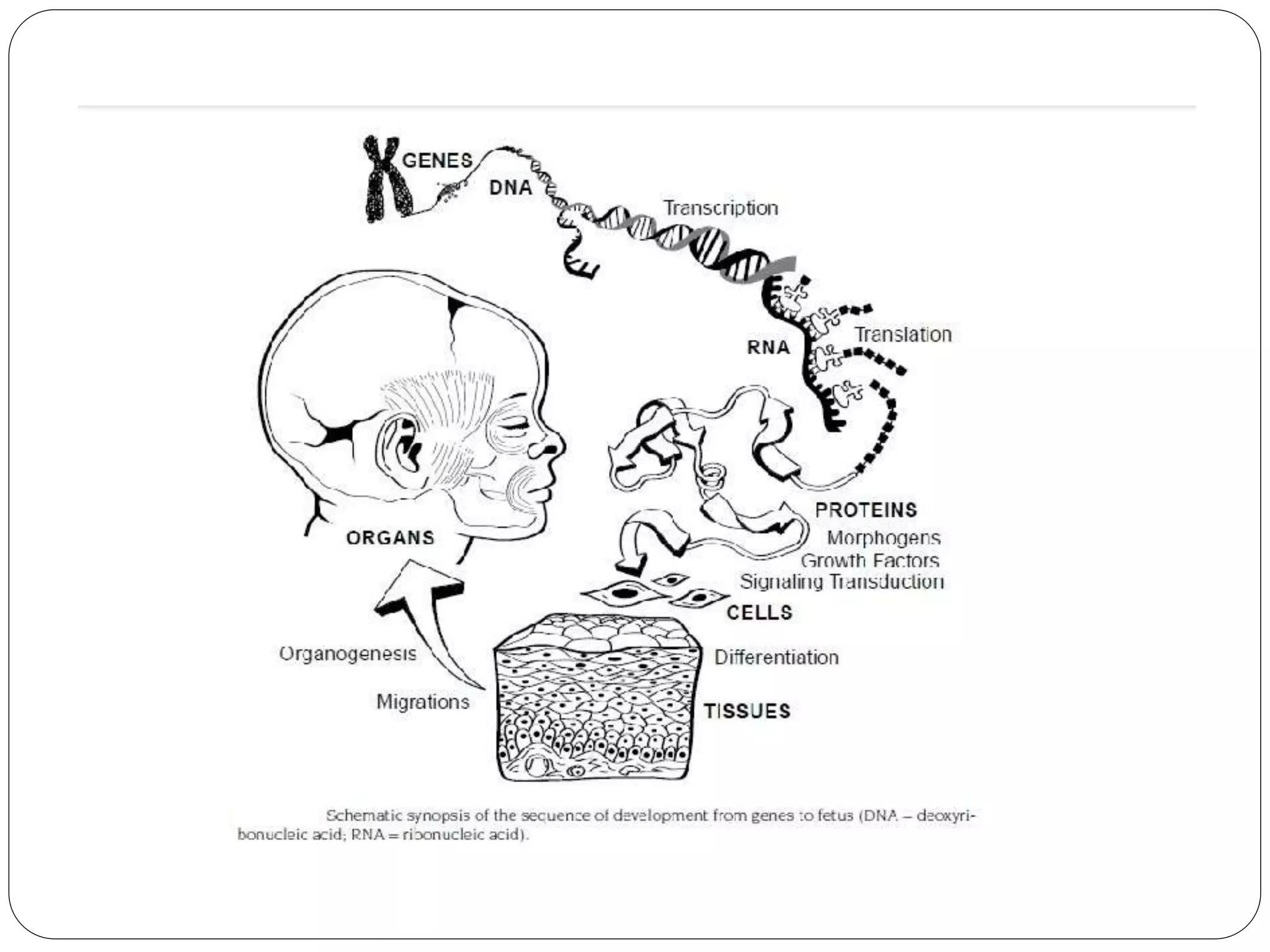
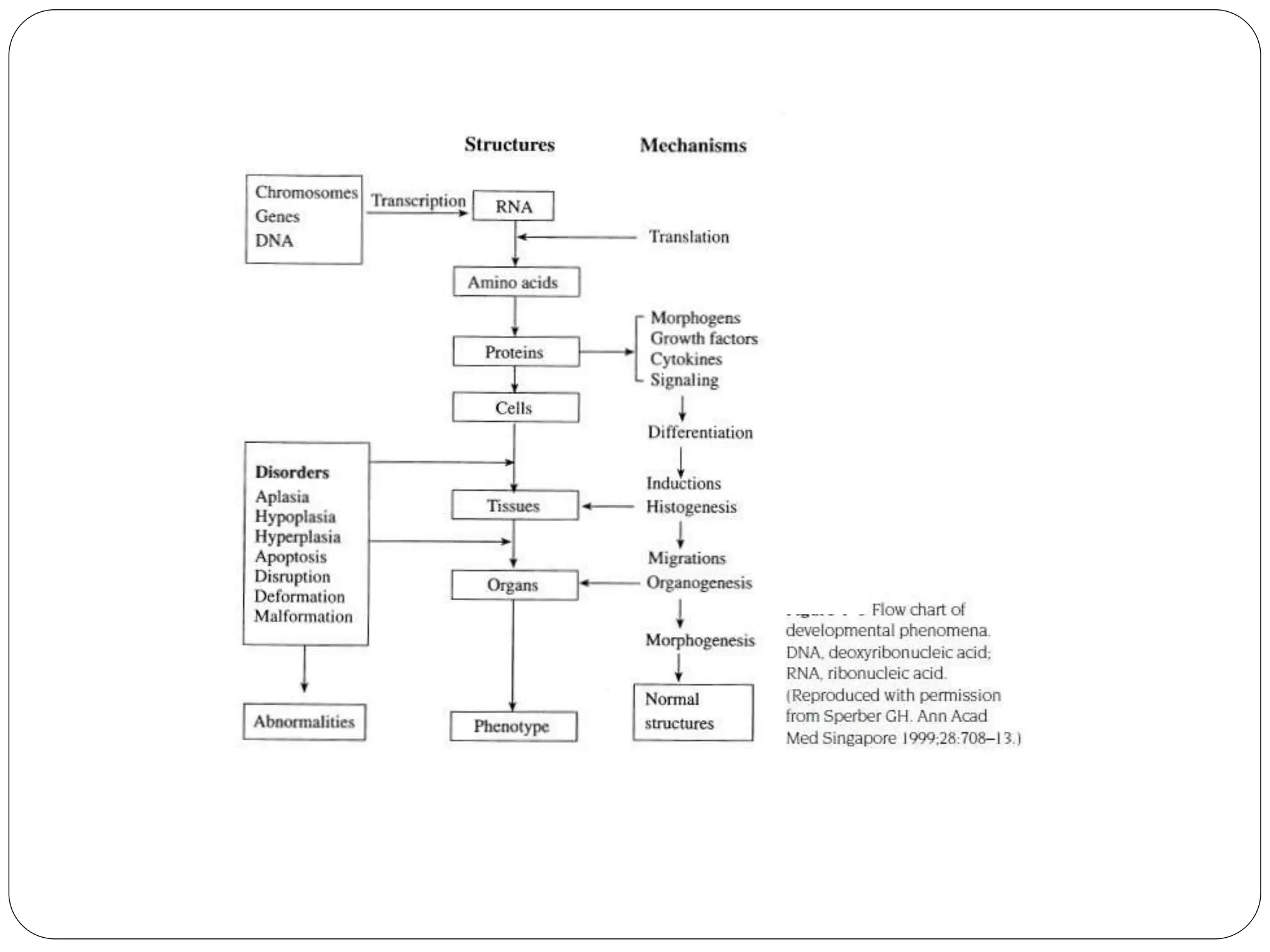
 Gene controls the synthesis of protein formation
 The longivity and proliferation of differentiated cells is
also genetically determined by
• continuous mitotics [short life spans]
• Intermittent mitotics
• Post mitotics [long life span]
SIGNAL TRANSDUCTION
 Transcription regulate the identity and patterning of
embryonic structures and development of individual
organs
 A signaling center or node (eg, Hensen’s node) [cell
group that regulates the behavior of surrounding cells by
producing positive and negative intercellular signaling
molecules]
 Growth factors stimulate cell proliferation and
differentiation by acting through specific receptors on
responsive cells
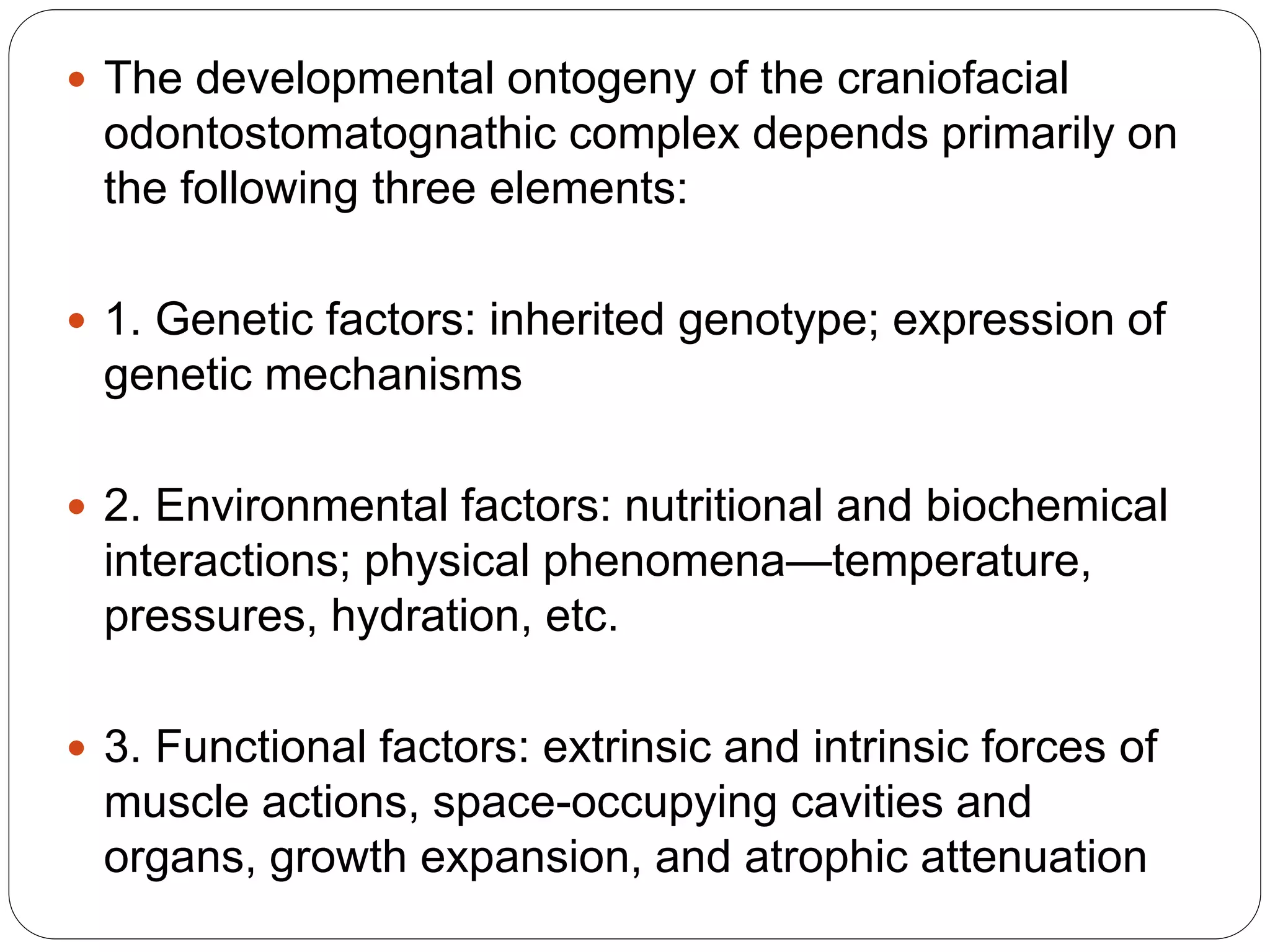
 The developmental ontogeny of the craniofacial
odontostomatognathic complex depends primarily on
the following three elements:
 1. Genetic factors: inherited genotype; expression of
genetic mechanisms
 2. Environmental factors: nutritional and biochemical
interactions; physical phenomena—temperature,
pressures, hydration, etc.
 3. Functional factors: extrinsic and intrinsic forces of
muscle actions, space-occupying cavities and
organs, growth expansion, and atrophic attenuation
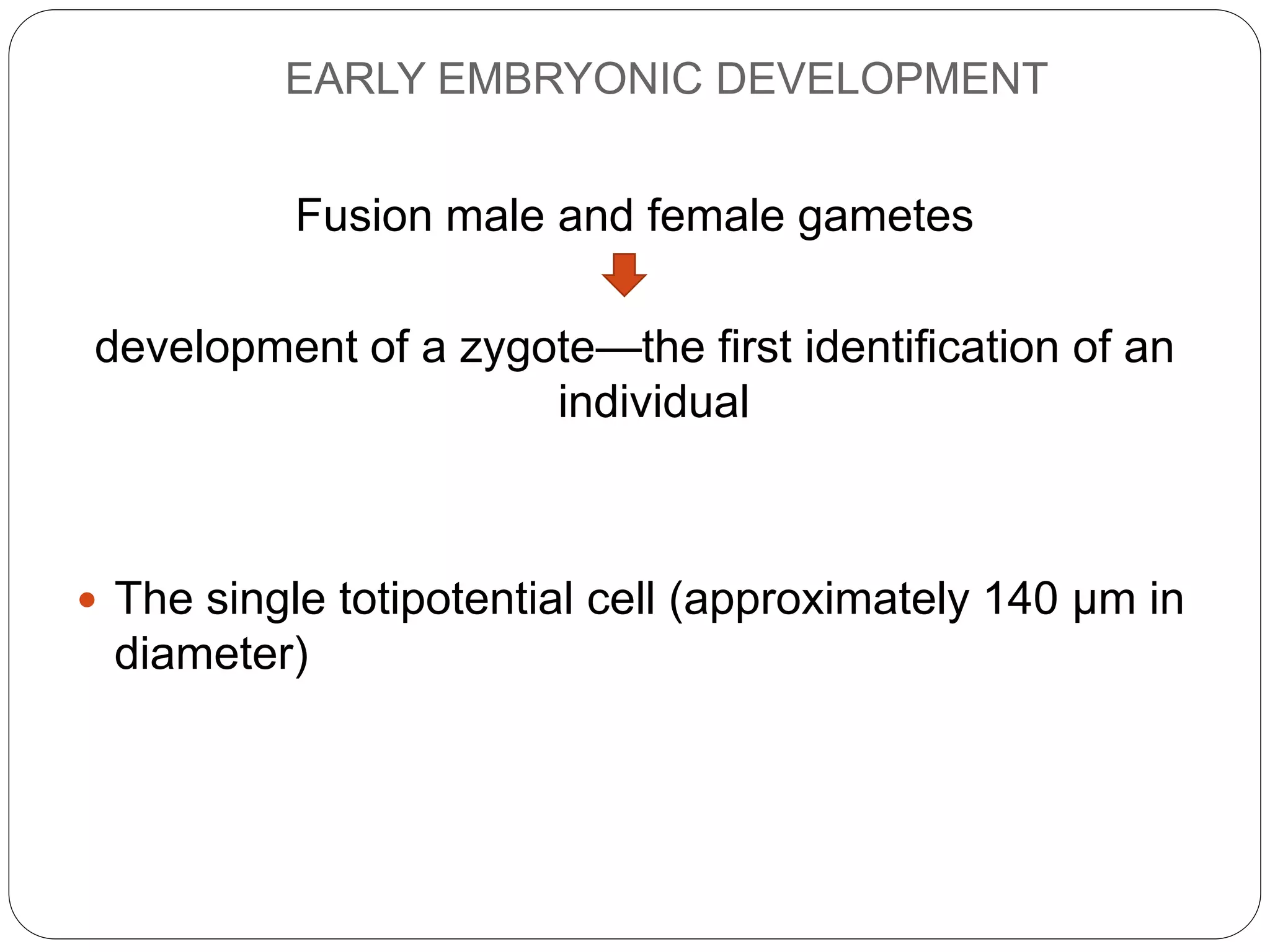
EARLY EMBRYONIC DEVELOPMENT
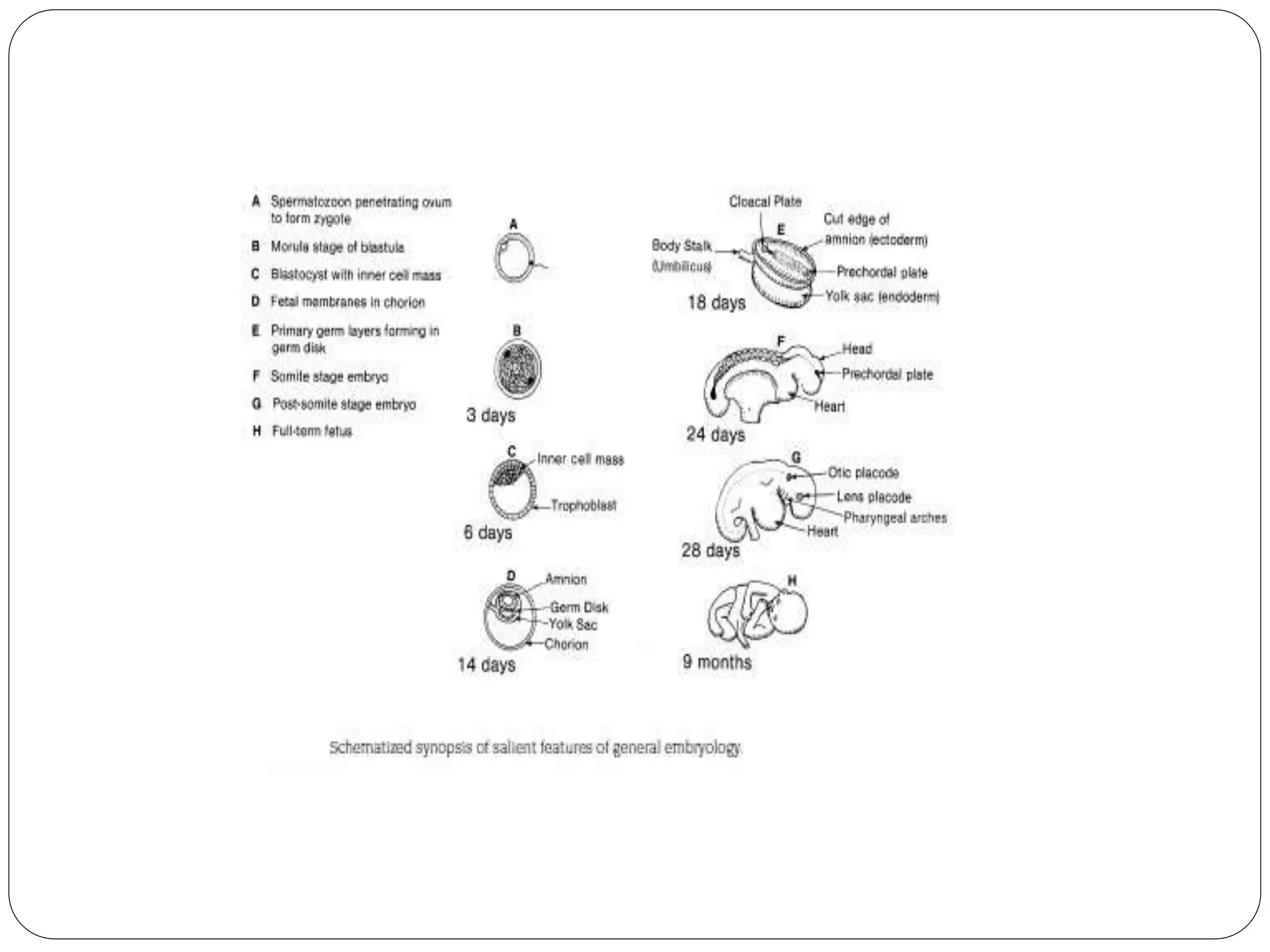
Fusion male and female gametes
development of a zygote—the first identification of an
individual
 The single totipotential cell (approximately 140 μm in
diameter)
EMBRYOGENESIS
Phases
Preimplantation
period
[first 7 days]
Fetal
period
[ the next
7
calendar
months]
Embroyoni
c period
[the next 7
weeks]
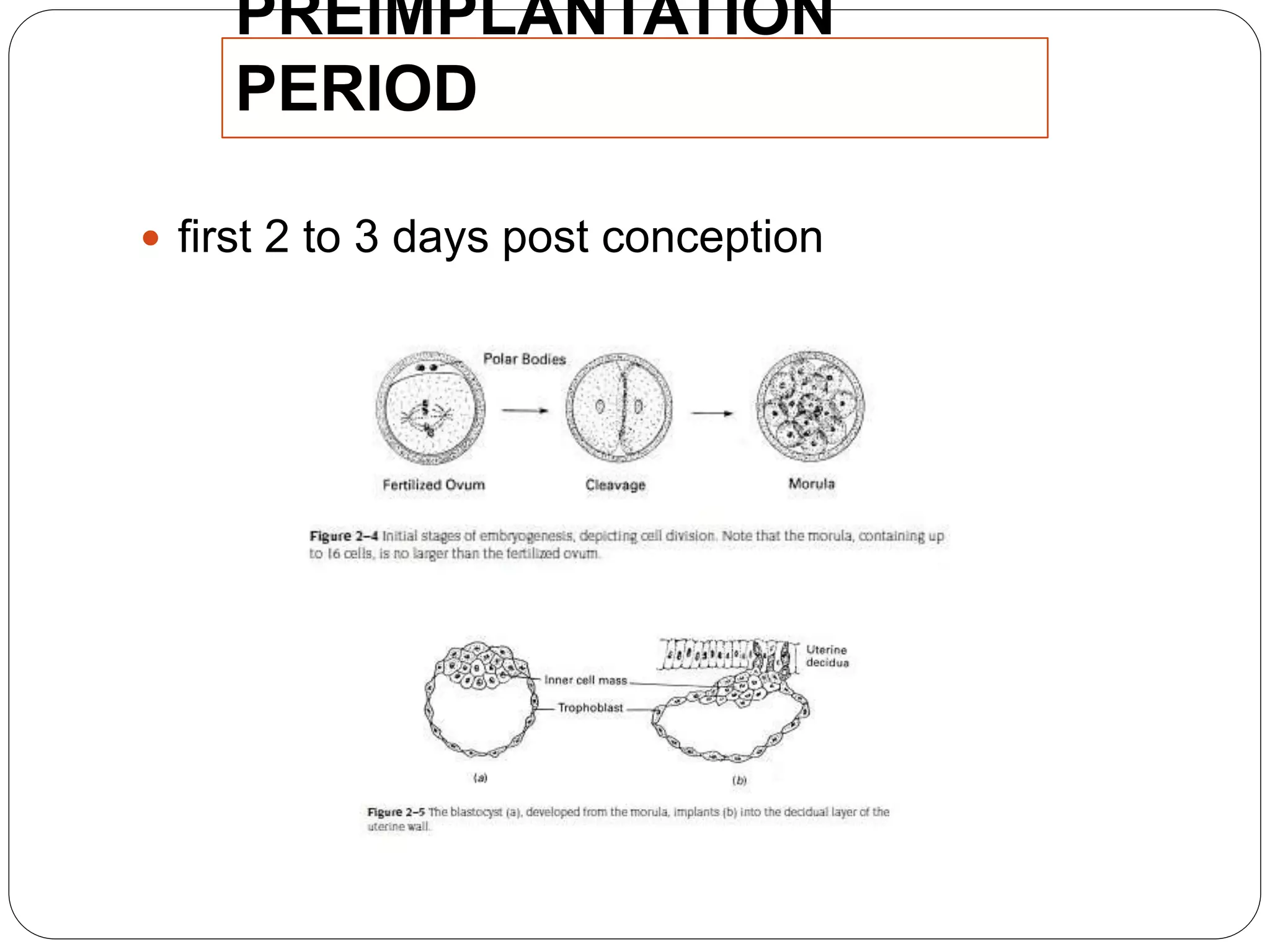
PREIMPLANTATION
PERIOD
 first 2 to 3 days post conception
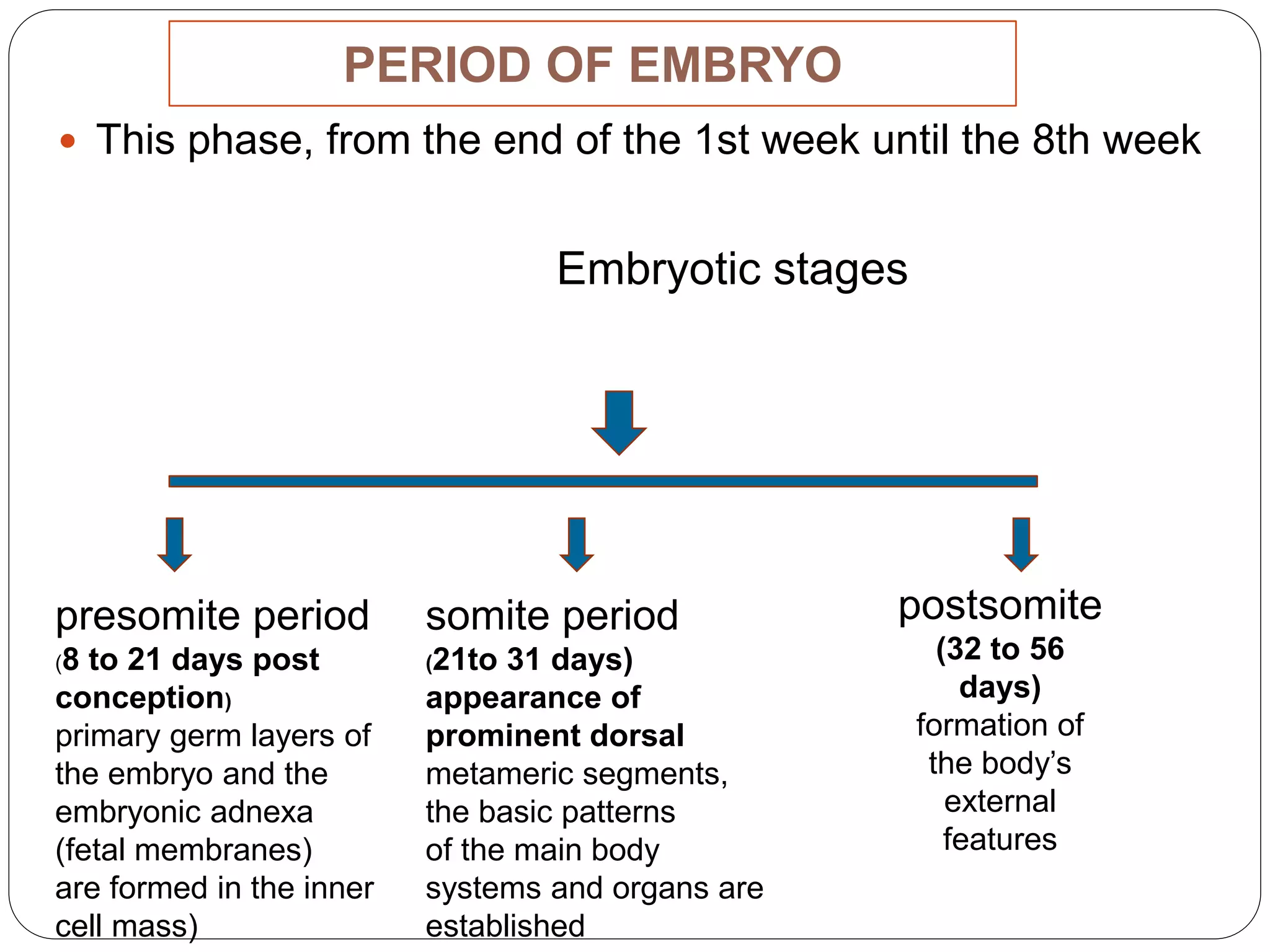
PERIOD OF EMBRYO
 This phase, from the end of the 1st week until the 8th week
Embryotic stages
presomite period
(8 to 21 days post
conception)
primary germ layers of
the embryo and the
embryonic adnexa
(fetal membranes)
are formed in the inner
cell mass)
somite period
(21to 31 days)
appearance of
prominent dorsal
metameric segments,
the basic patterns
of the main body
systems and organs are
established
postsomite
(32 to 56
days)
formation of
the body’s
external
features
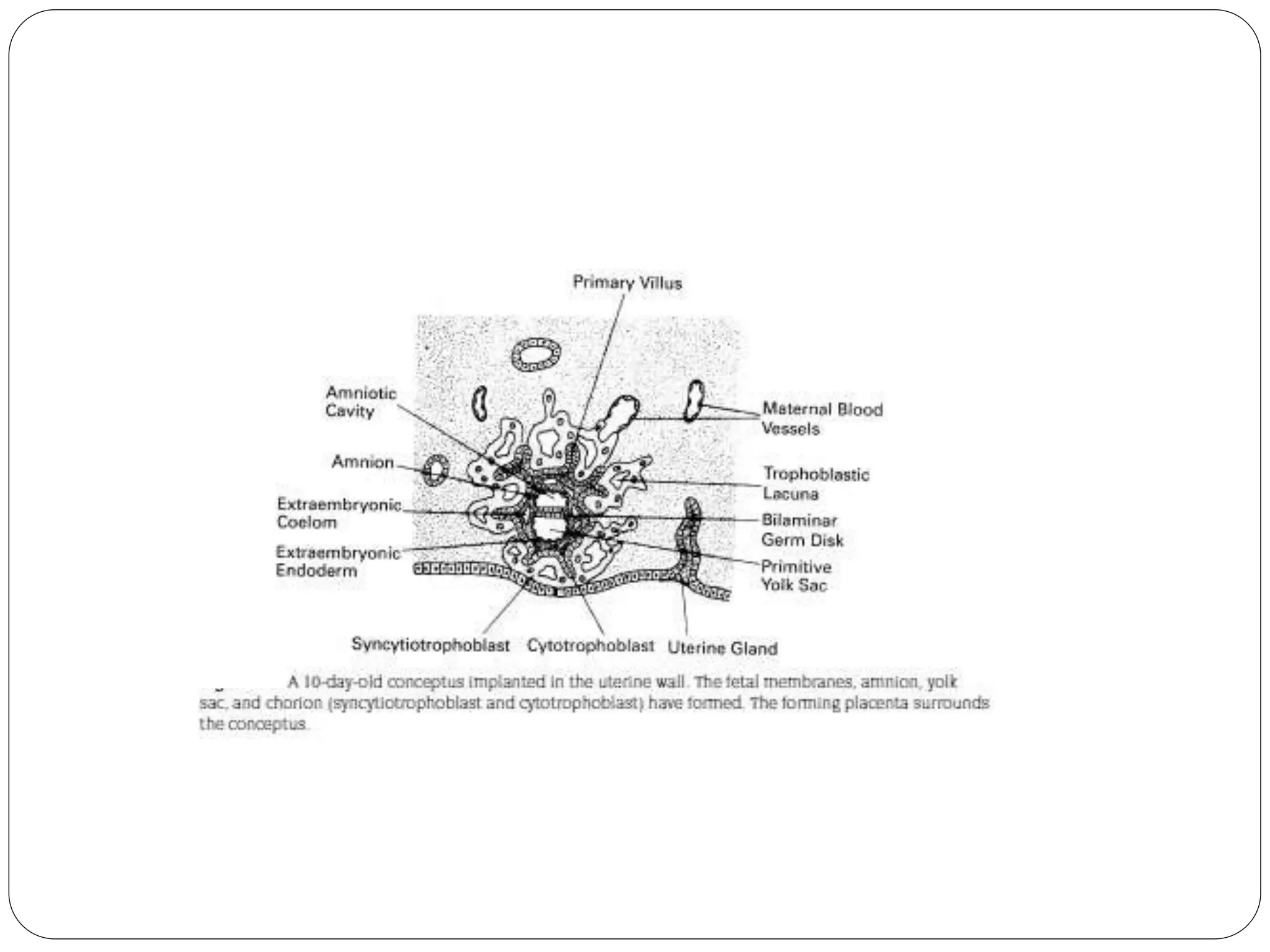
PRESOMITE PERIOD
Development of Endoderm and Ectoderm
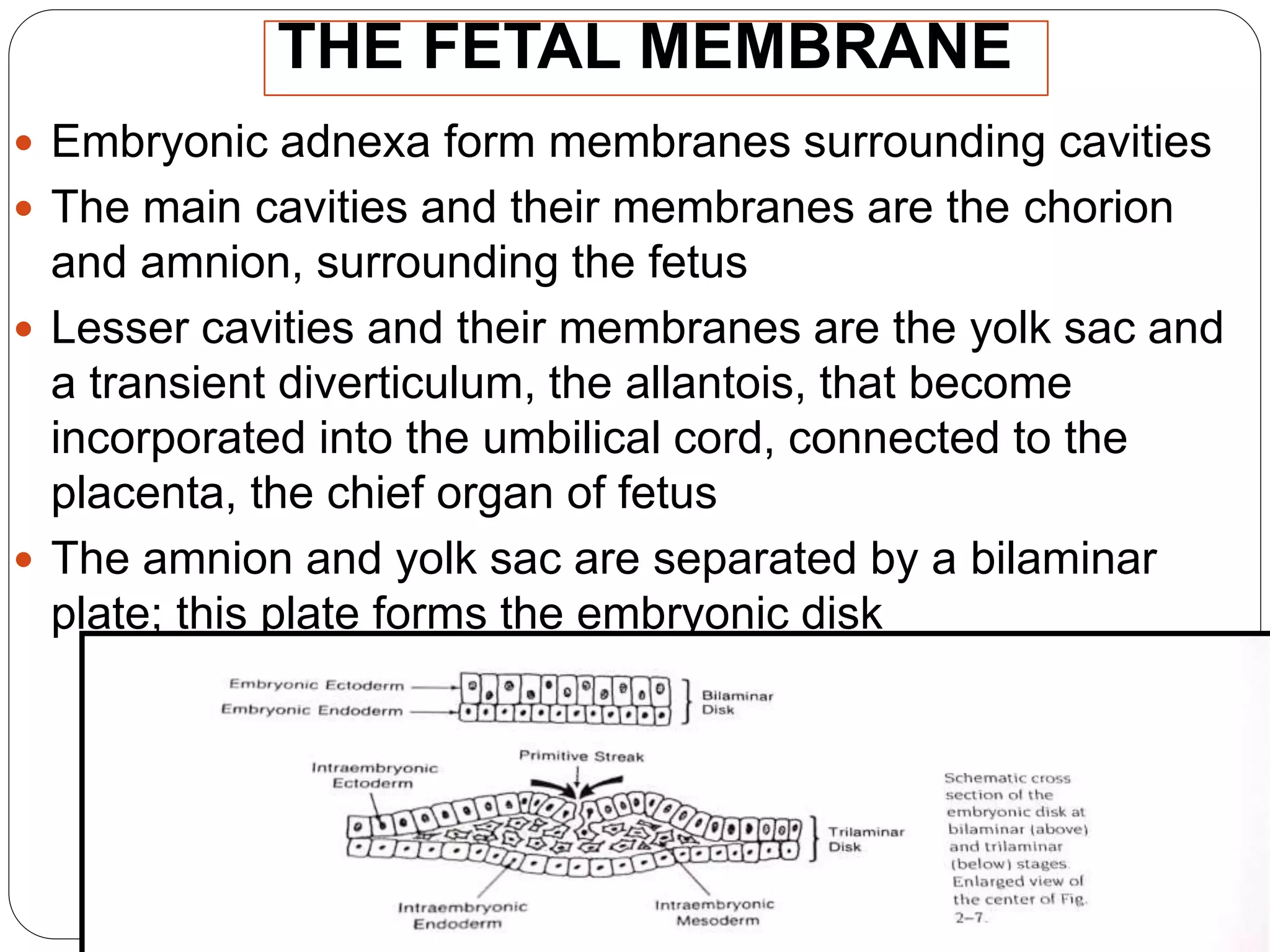
The primordial embryonic germ disk is composed of
two primary germ layers:
• The Ectoderm floor of the amniotic cavity
• Endoderm roof of the yolk sac
 14th day endodermal thickening, the prechordal plate,
appears in the future midcephalic region [head-
organizing function]
THE FETAL MEMBRANE
 Embryonic adnexa form membranes surrounding cavities
 The main cavities and their membranes are the chorion
and amnion, surrounding the fetus
 Lesser cavities and their membranes are the yolk sac and
a transient diverticulum, the allantois, that become
incorporated into the umbilical cord, connected to the
placenta, the chief organ of fetus
 The amnion and yolk sac are separated by a bilaminar
plate; this plate forms the embryonic disk
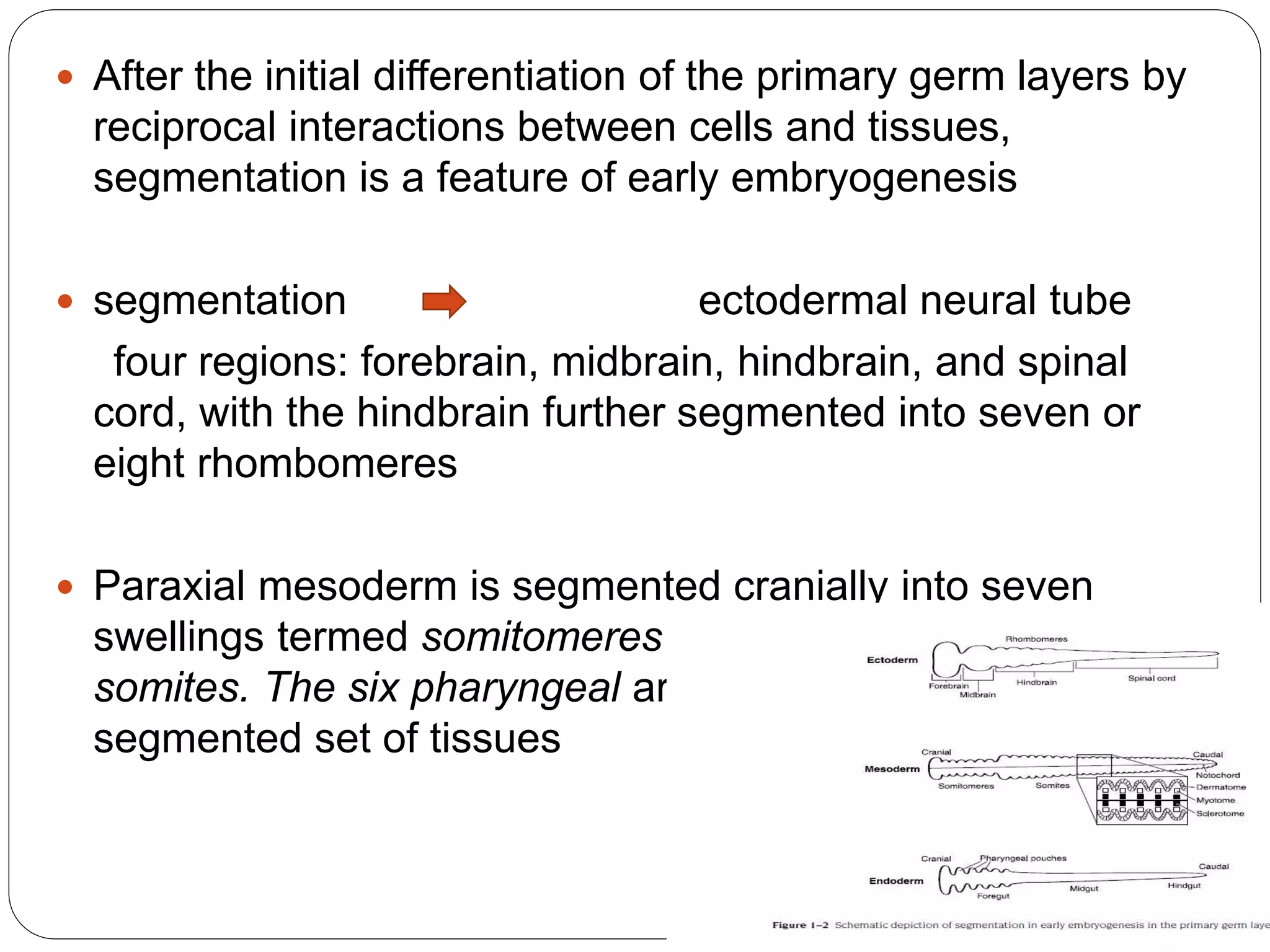
 After the initial differentiation of the primary germ layers by
reciprocal interactions between cells and tissues,
segmentation is a feature of early embryogenesis
 segmentation ectodermal neural tube
four regions: forebrain, midbrain, hindbrain, and spinal
cord, with the hindbrain further segmented into seven or
eight rhombomeres
 Paraxial mesoderm is segmented cranially into seven
swellings termed somitomeres and caudally into 38 to 42
somites. The six pharyngeal arches are a third visibly
segmented set of tissues
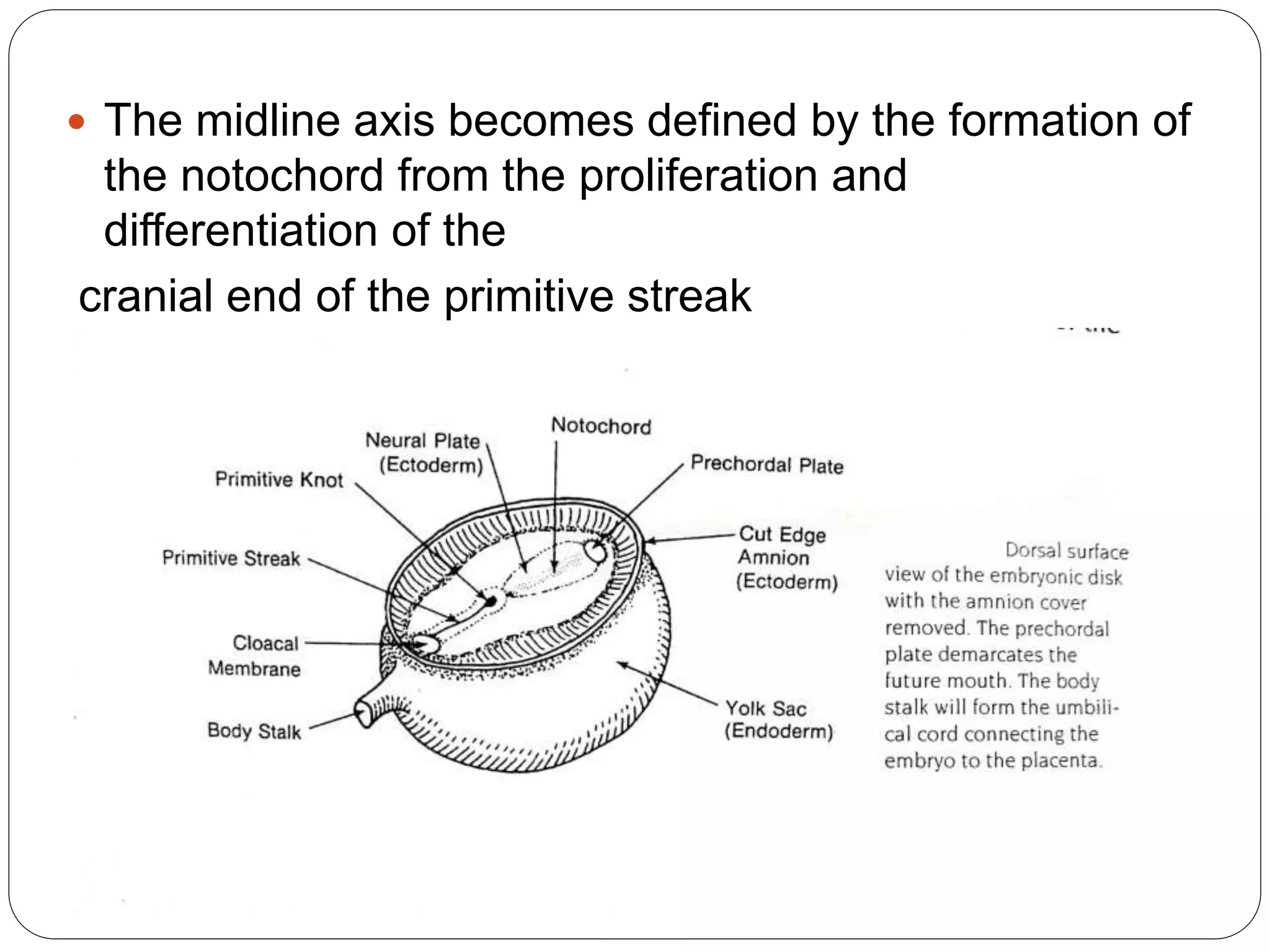
 The midline axis becomes defined by the formation of
the notochord from the proliferation and
differentiation of the
cranial end of the primitive streak
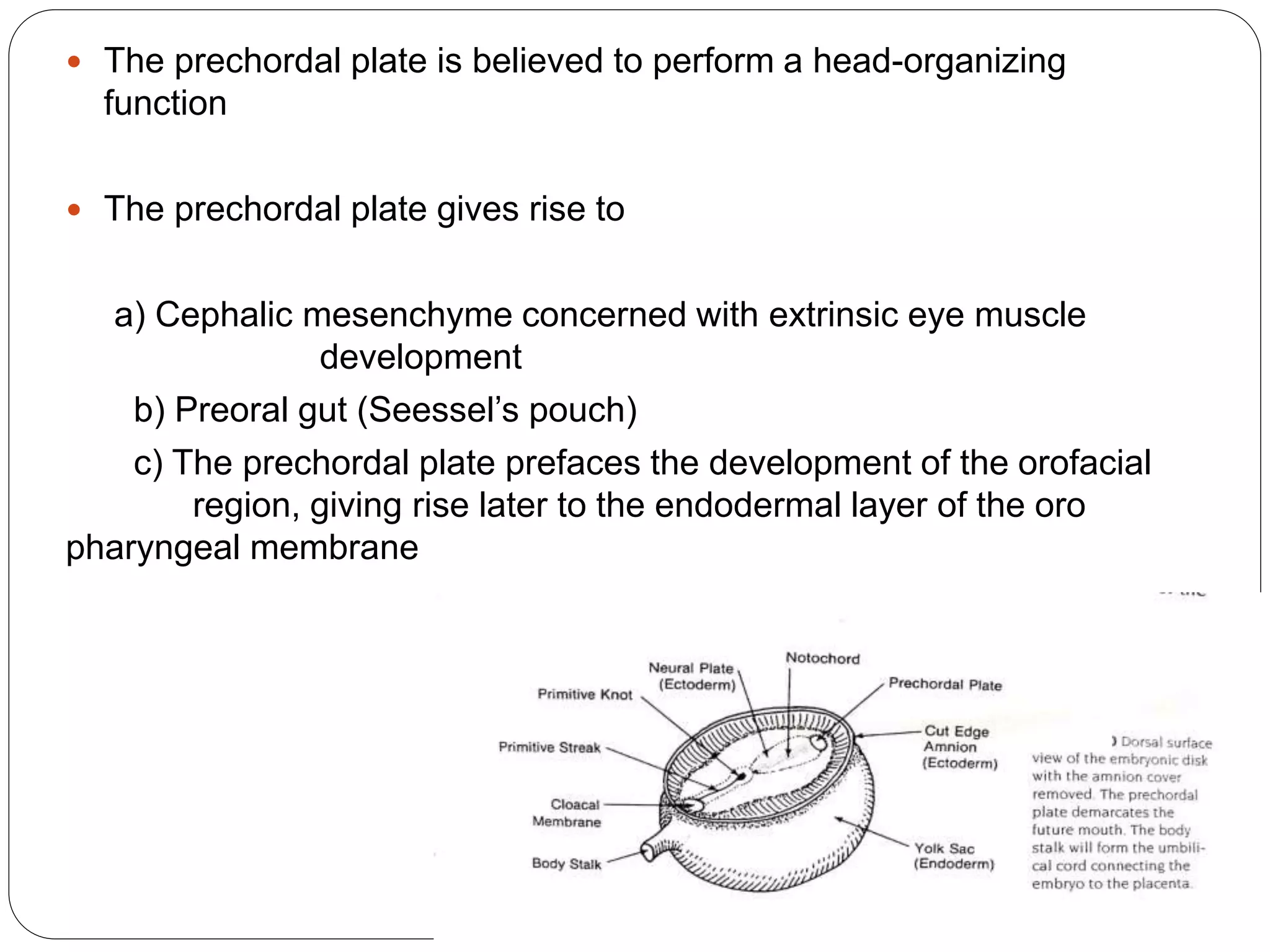
 The prechordal plate is believed to perform a head-organizing
function
 The prechordal plate gives rise to
a) Cephalic mesenchyme concerned with extrinsic eye muscle
development
b) Preoral gut (Seessel’s pouch)
c) The prechordal plate prefaces the development of the orofacial
region, giving rise later to the endodermal layer of the oro
pharyngeal membrane
PRIMARY GERM LAYERS
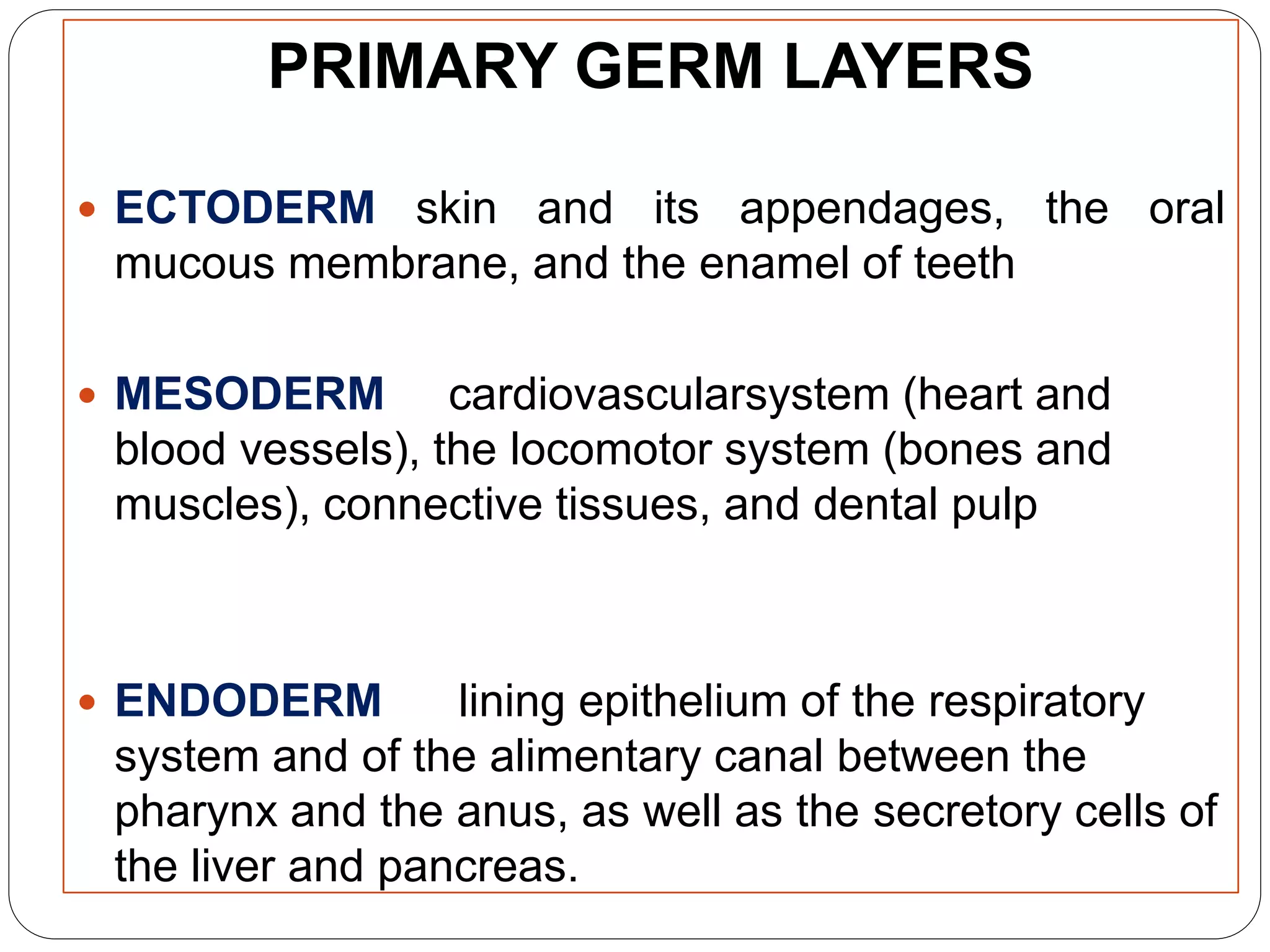
 ECTODERM skin and its appendages, the oral
mucous membrane, and the enamel of teeth
 MESODERM cardiovascularsystem (heart and
blood vessels), the locomotor system (bones and
muscles), connective tissues, and dental pulp
 ENDODERM lining epithelium of the respiratory
system and of the alimentary canal between the
pharynx and the anus, as well as the secretory cells of
the liver and pancreas.
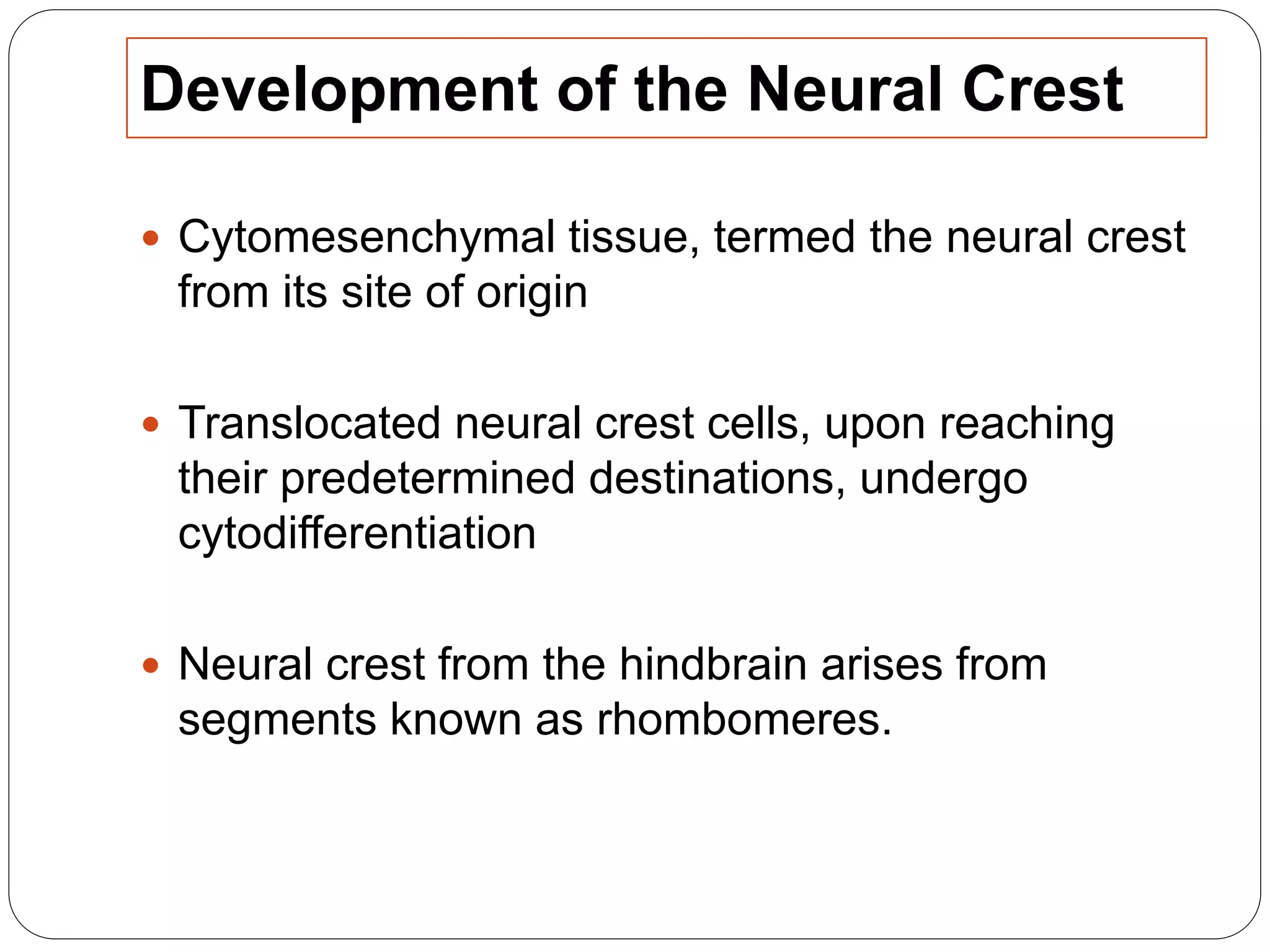
Development of the Neural Crest
 Cytomesenchymal tissue, termed the neural crest
from its site of origin
 Translocated neural crest cells, upon reaching
their predetermined destinations, undergo
cytodifferentiation
 Neural crest from the hindbrain arises from
segments known as rhombomeres.
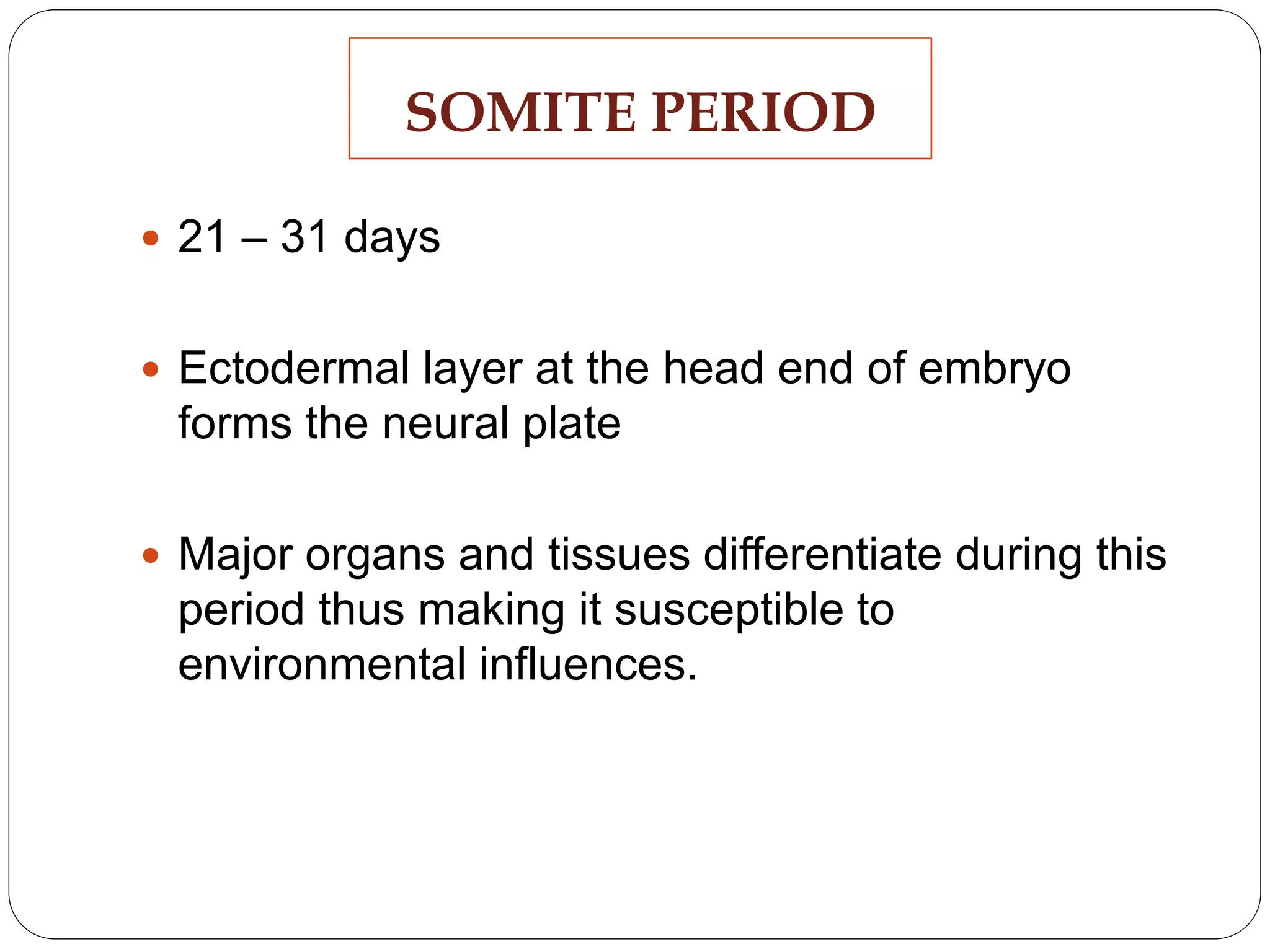
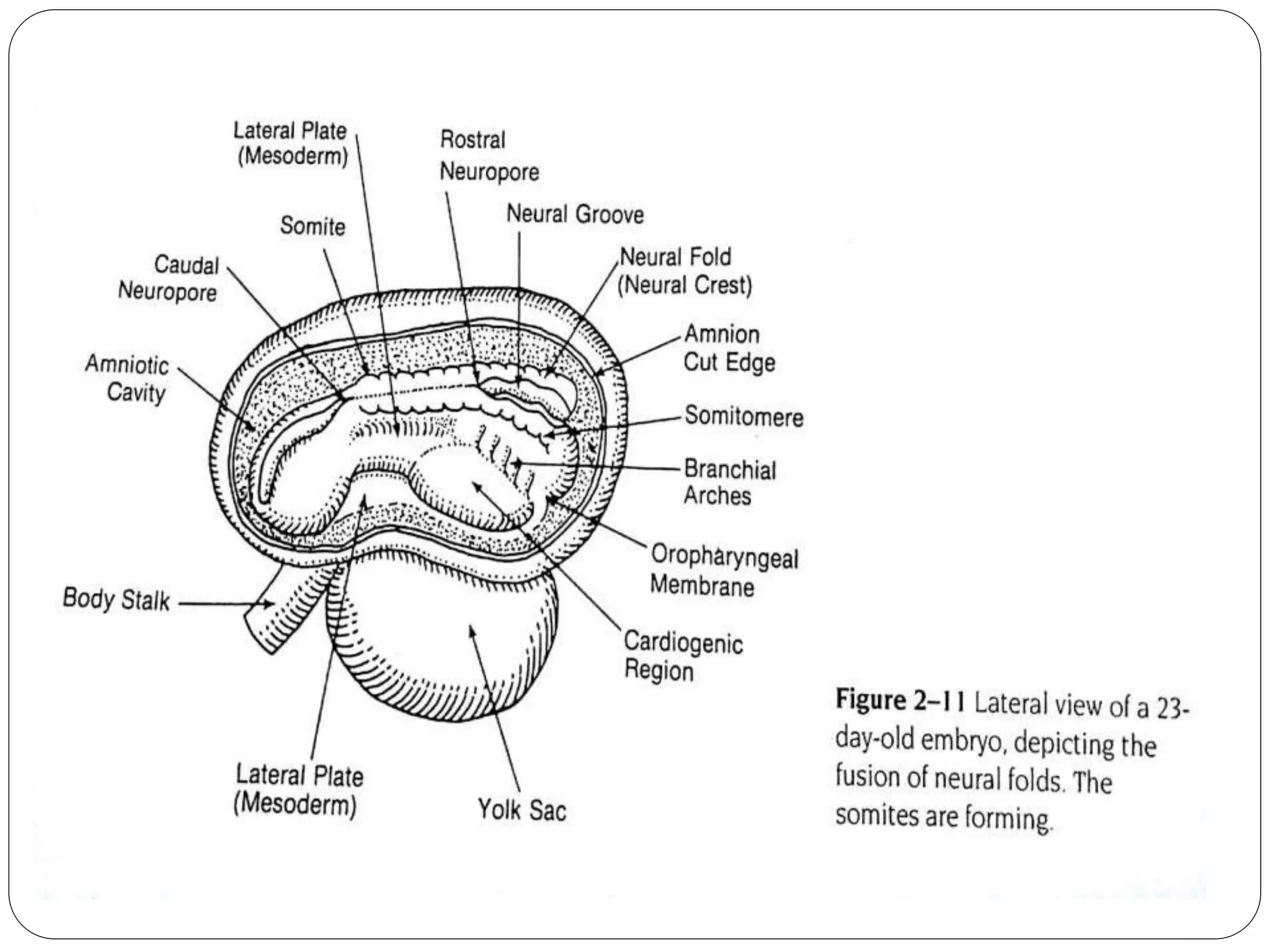
 21 – 31 days
 Ectodermal layer at the head end of embryo
forms the neural plate
 Major organs and tissues differentiate during this
period thus making it susceptible to
environmental influences.
SOMITE PERIOD
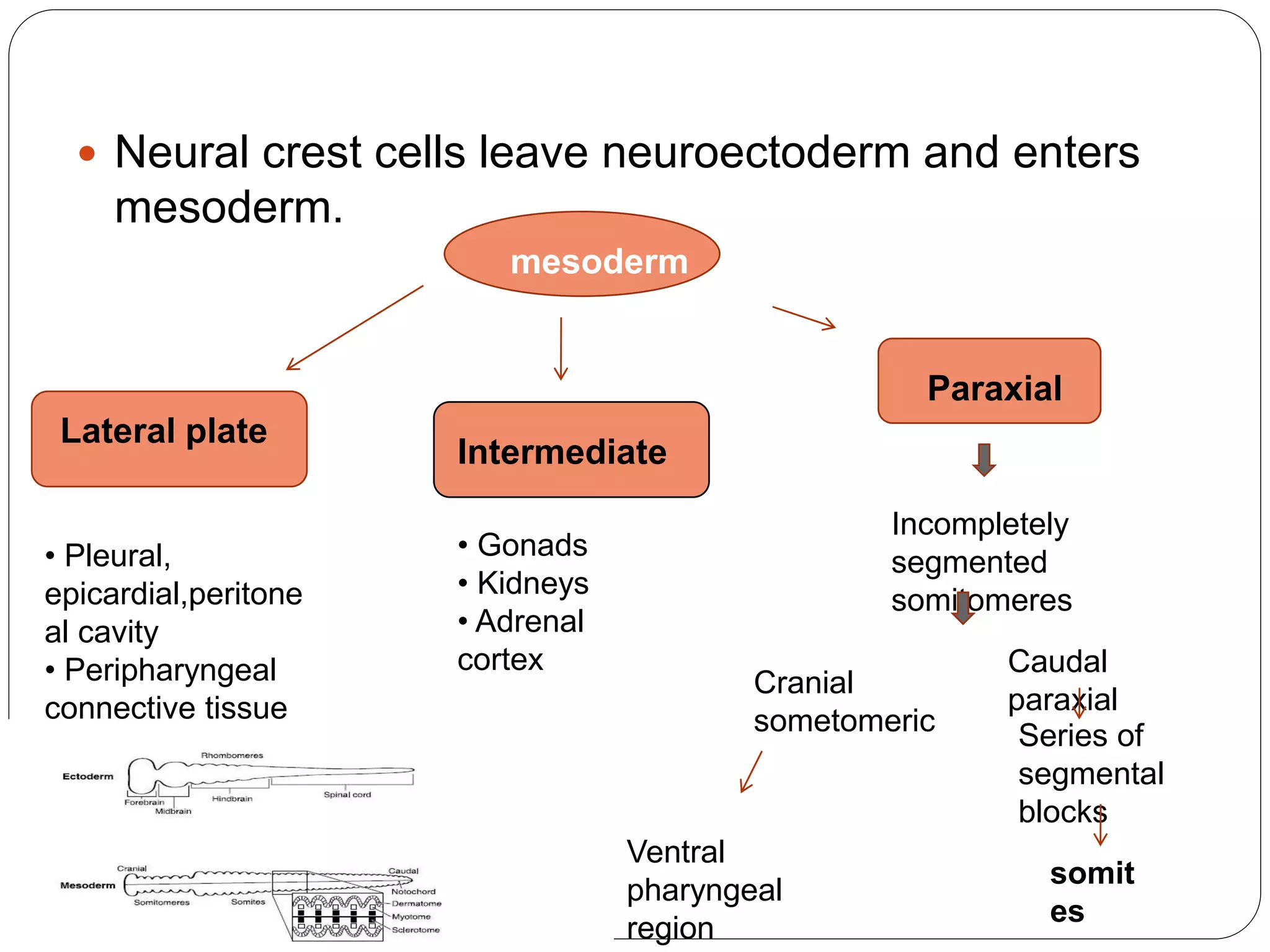
 Neural crest cells leave neuroectoderm and enters
mesoderm.
mesoderm
Lateral plate
Intermediate
Paraxial
• Pleural,
epicardial,peritone
al cavity
• Peripharyngeal
connective tissue
• Gonads
• Kidneys
• Adrenal
cortex
Incompletely
segmented
somitomeres
Cranial
sometomeric
Ventral
pharyngeal
region
Caudal
paraxial
Series of
segmental
blocks
somit
es
SOMITE
Ventromedial part
[Sclerotome]
Lateral
aspect
[Dermatome]
Intermediate
portion
[Myotome]
Vertebral
column
(segmental
nature),
occipital bone
(fusion)
Dermis of
skin
Muscles
orofacial
region,
trunks,limb
s
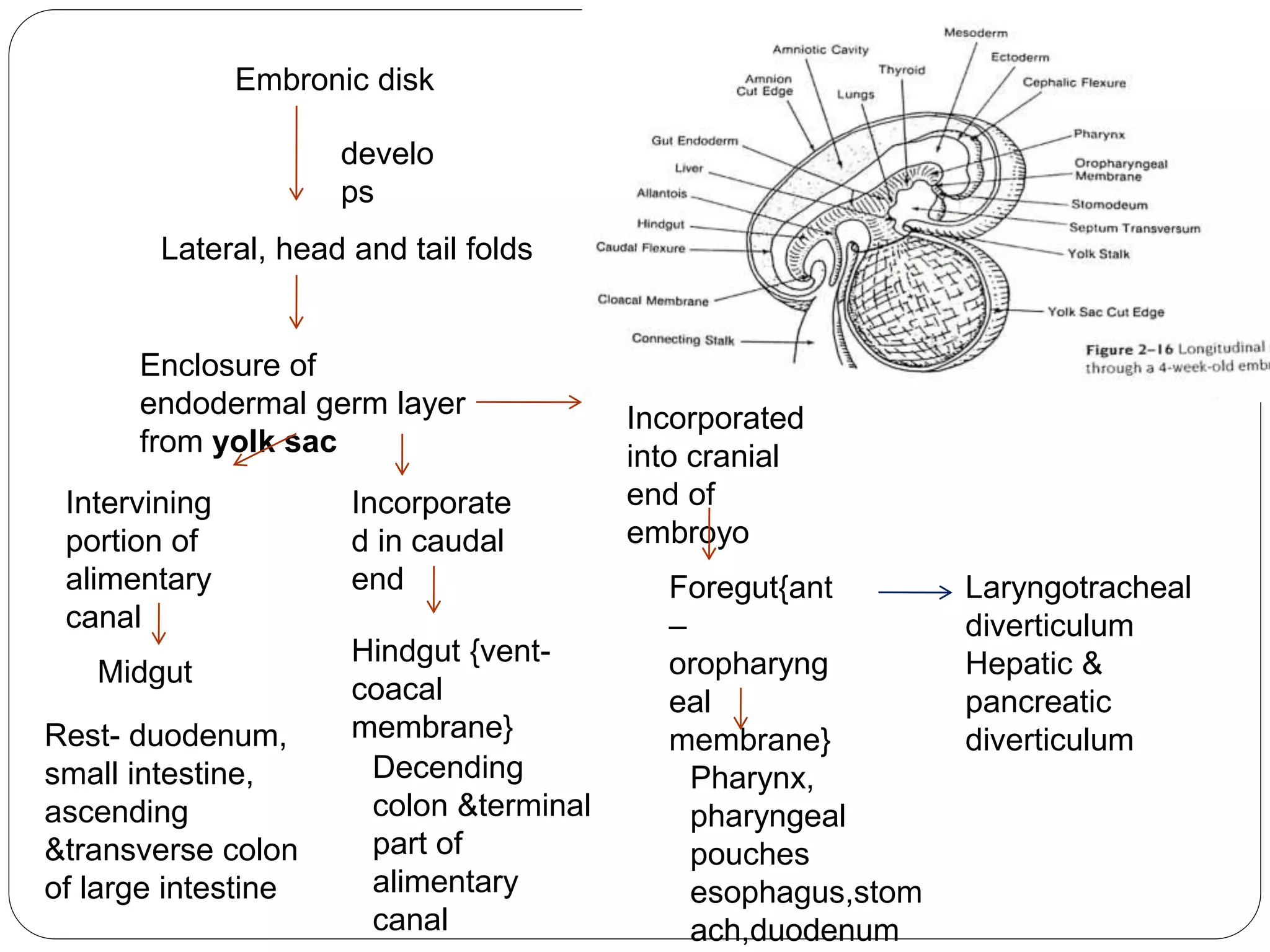
Embronic disk
develo
ps
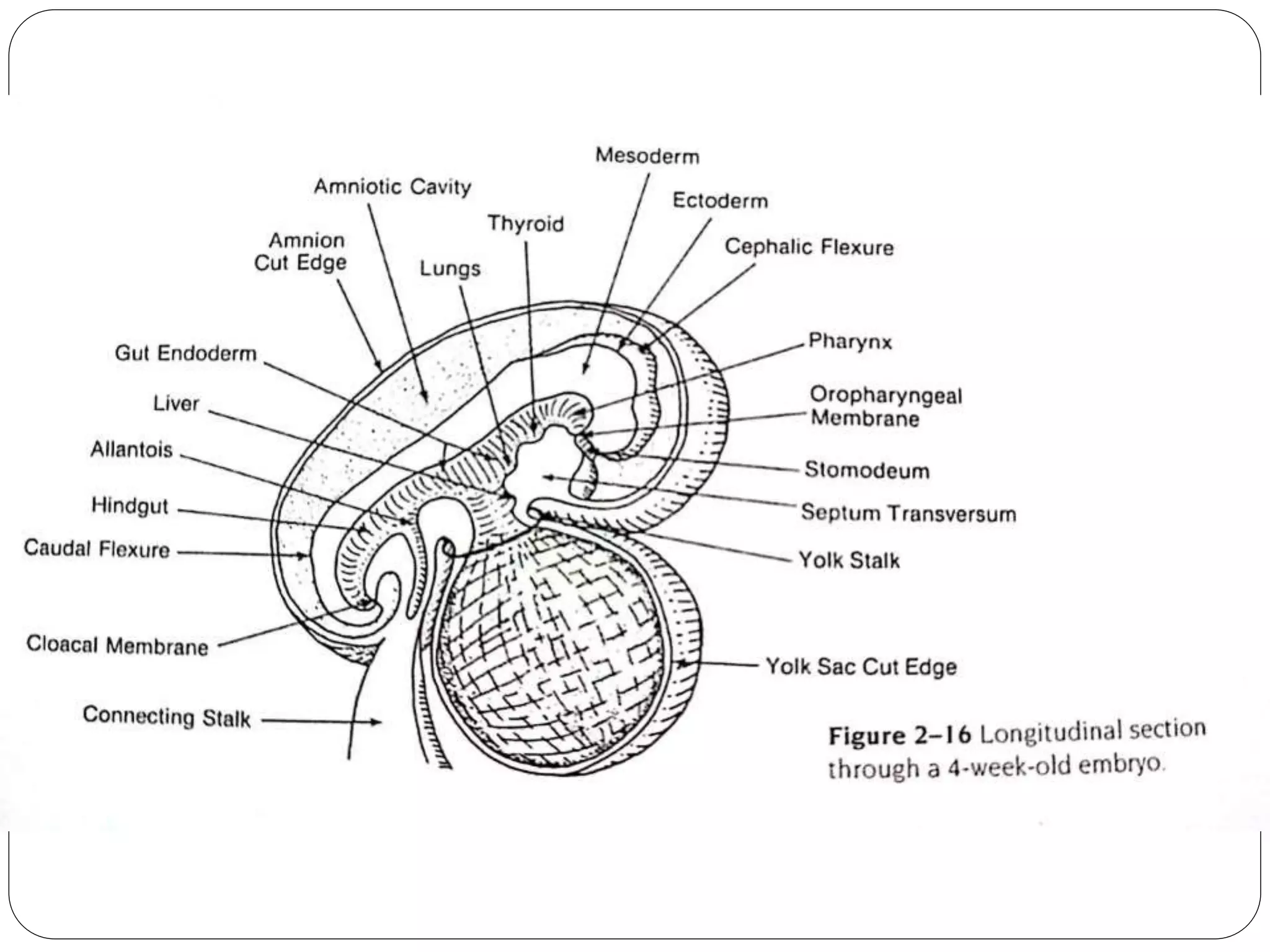
Lateral, head and tail folds
Enclosure of
endodermal germ layer
from yolk sac
Incorporated
into cranial
end of
embroyo
Foregut{ant
–
oropharyng
eal
membrane}
Incorporate
d in caudal
end
Hindgut {vent-
coacal
membrane}
Intervining
portion of
alimentary
canal
Midgut
Laryngotracheal
diverticulum
Hepatic &
pancreatic
diverticulum
Pharynx,
pharyngeal
pouches
esophagus,stom
ach,duodenum
Decending
colon &terminal
part of
alimentary
canal
Rest- duodenum,
small intestine,
ascending
&transverse colon
of large intestine
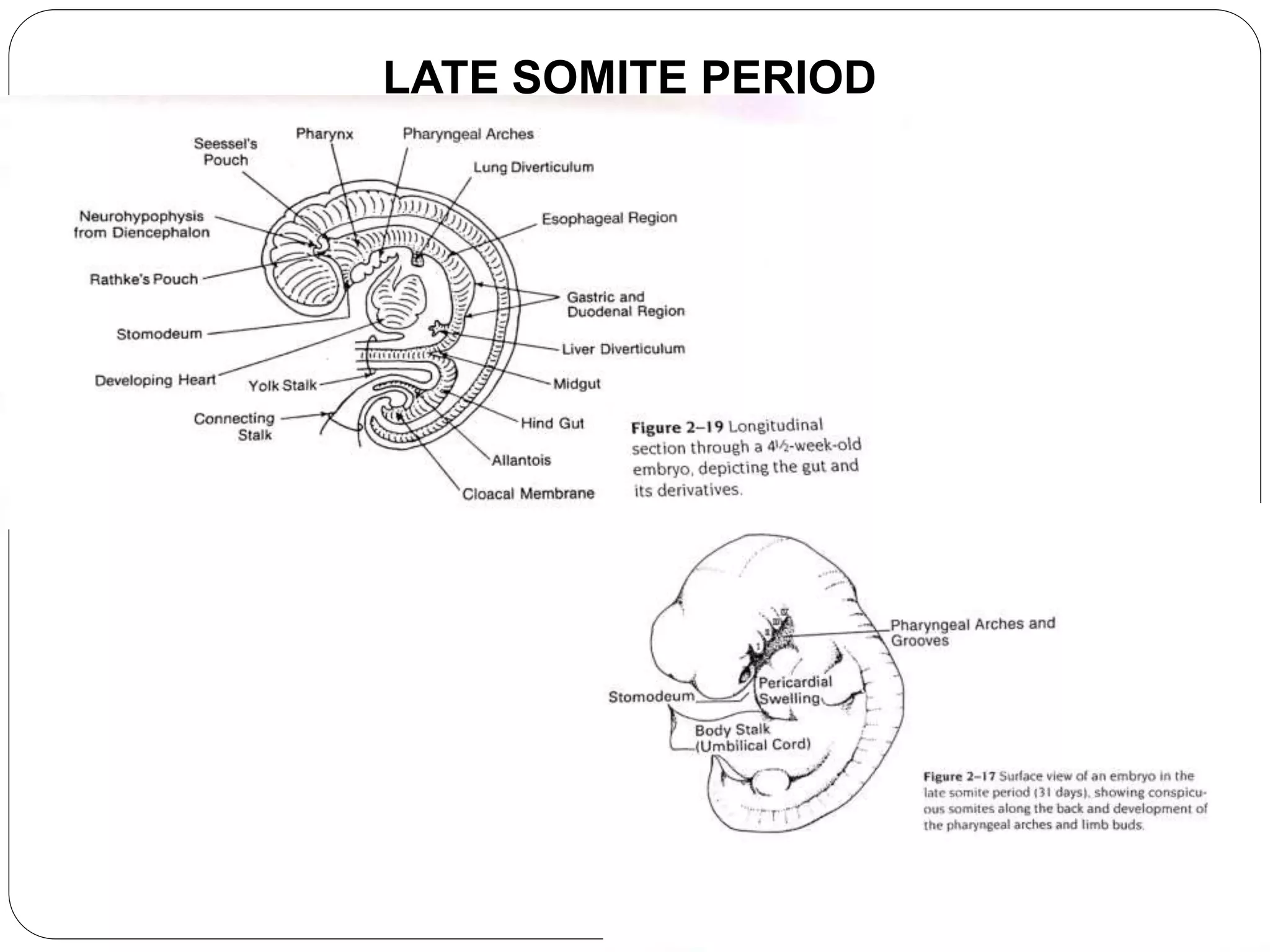
LATE SOMITE PERIOD
 Characterised by most of the formation of organ
• Cardiovascular
• Alimentary
• Respiratory
• Genitourinary
• Nervous system
• Primordia of eye and inner ear
 Complex and rapid organogenesis during 10th day
somite period suceptibility increases
 32 – 56 DAYS
 Characterized by formation of external features and
digit formation
 Thoracic region swells heart is joined by growing liver,
regression of tail
 Facial features become recognizable
 End of this phase - Embryo is now called fetus
POST SOMITE PERIOD
 defined neck due to its elongation and by
sheathing of pharyngeal arches
 Last 7 months
 Rapid growth
 first appearance of ossification centers and by the
earliest movements by the fetus
 Head size is reduced
 Human face – 4th month
PERIOD OF FETUS
 Increase in weight mainly occurs in last 2 months
 Active sebacious glands -7th and 8th month-
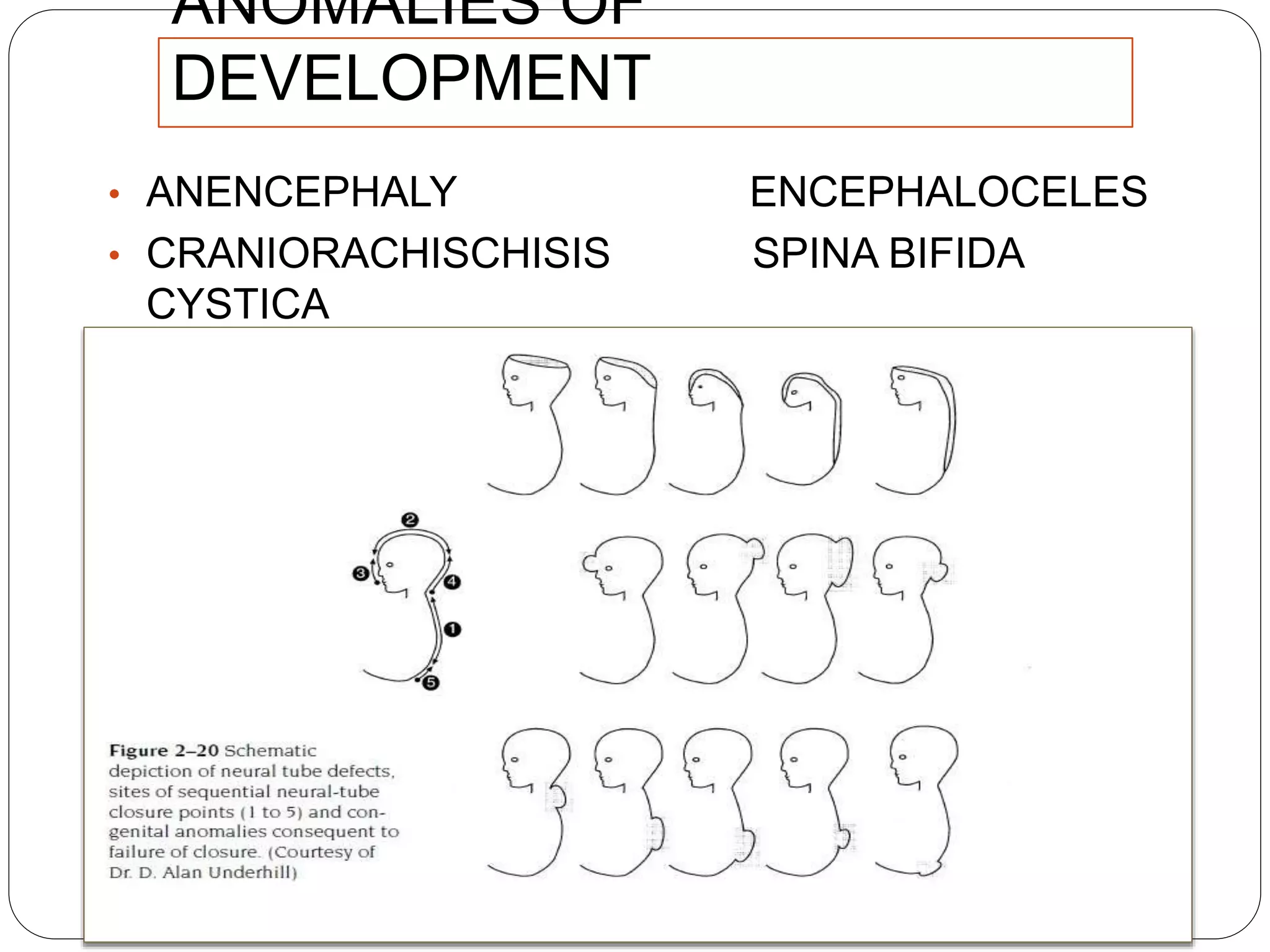
ANOMALIES OF
DEVELOPMENT
• ANENCEPHALY ENCEPHALOCELES
• CRANIORACHISCHISIS SPINA BIFIDA
CYSTICA
Development of face
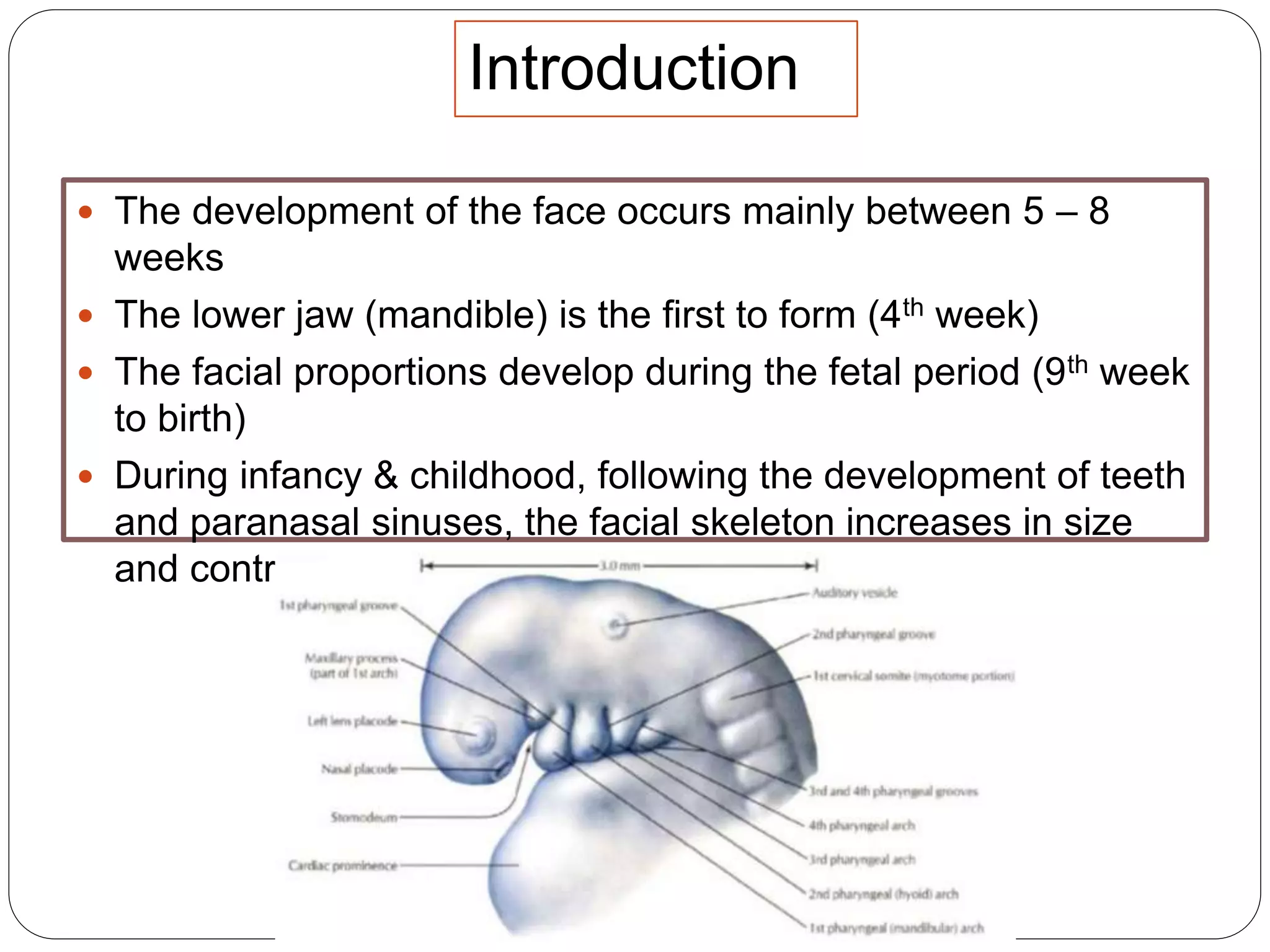
 The most typical feature in the development of the head and neck is
formed by the pharyngeal or branchial arches.
 These arches appear in the 4th and 5th weeks of development and
contribute to the characteristic external appearance of the embryo.
 Initially there are bars of mesenchymal tissue separated by deep
clefts known as pharyngeal or branchial clefts .
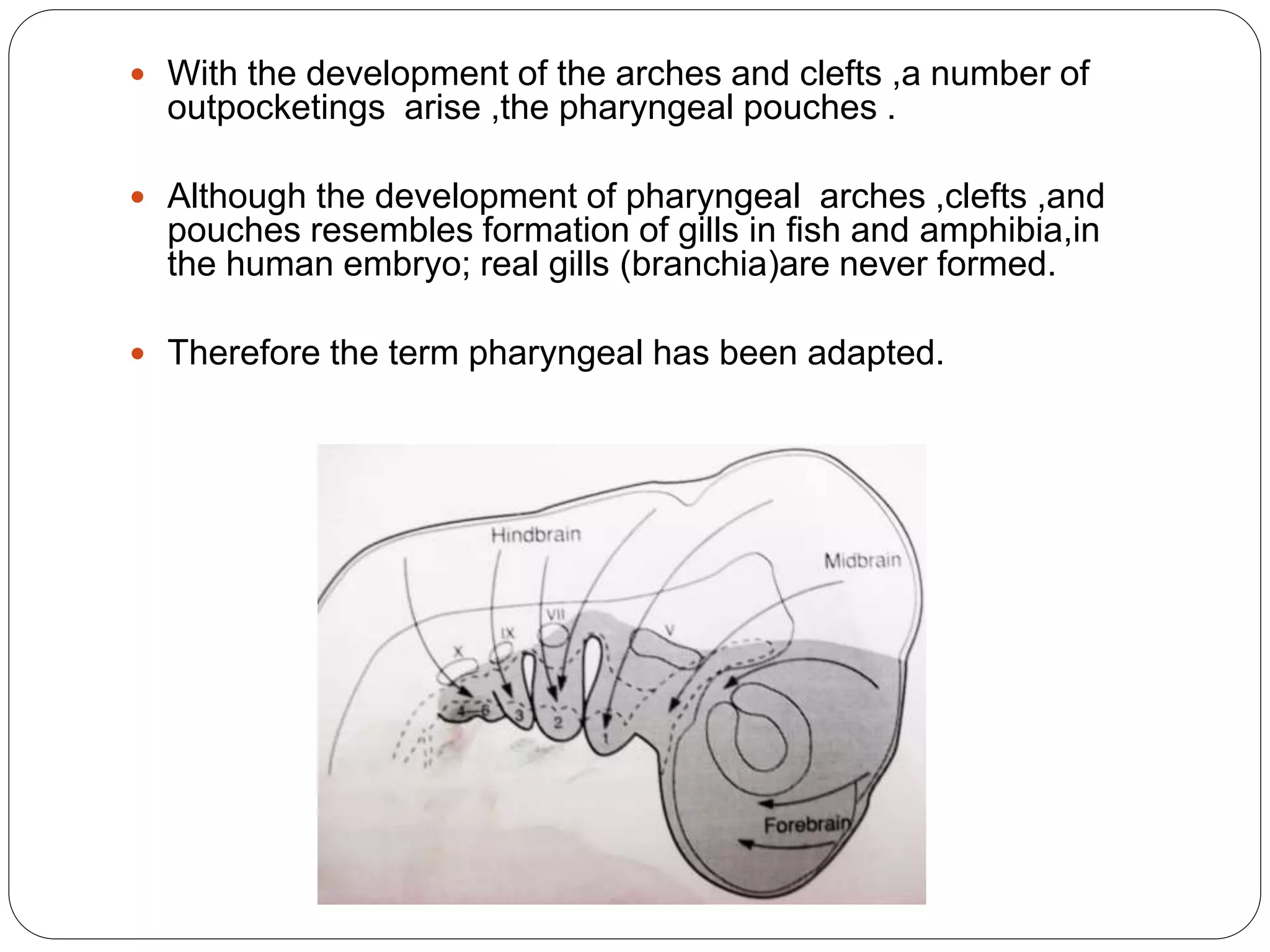
 With the development of the arches and clefts ,a number of
outpocketings arise ,the pharyngeal pouches .
 Although the development of pharyngeal arches ,clefts ,and
pouches resembles formation of gills in fish and amphibia,in
the human embryo; real gills (branchia)are never formed.
 Therefore the term pharyngeal has been adapted.
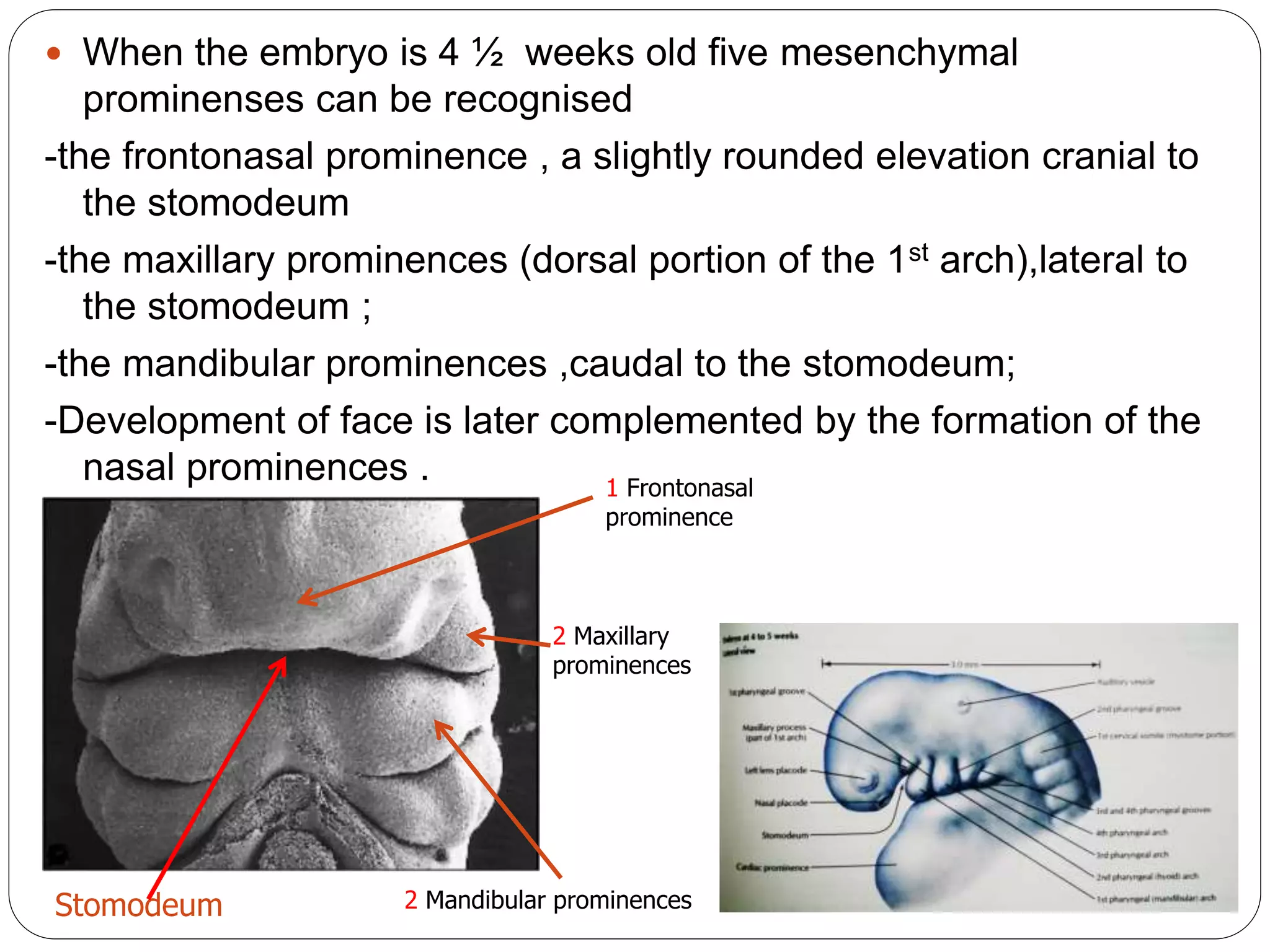
 When the embryo is 4 ½ weeks old five mesenchymal
prominenses can be recognised
-the frontonasal prominence , a slightly rounded elevation cranial to
the stomodeum
-the maxillary prominences (dorsal portion of the 1st arch),lateral to
the stomodeum ;
-the mandibular prominences ,caudal to the stomodeum;
-Development of face is later complemented by the formation of the
nasal prominences .
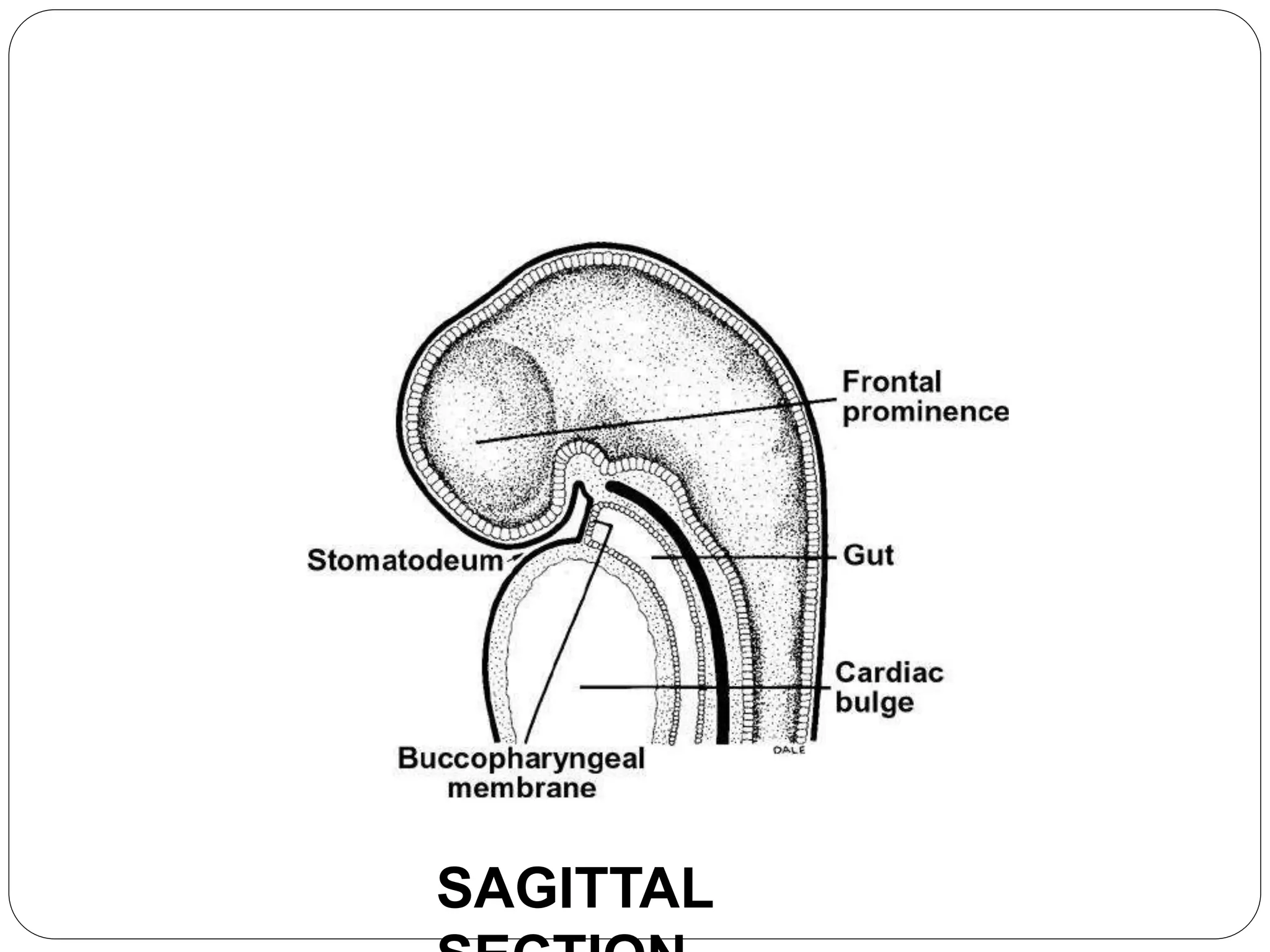
Stomodeum
1 Frontonasal
prominence
2 Maxillary
prominences
2 Mandibular prominences
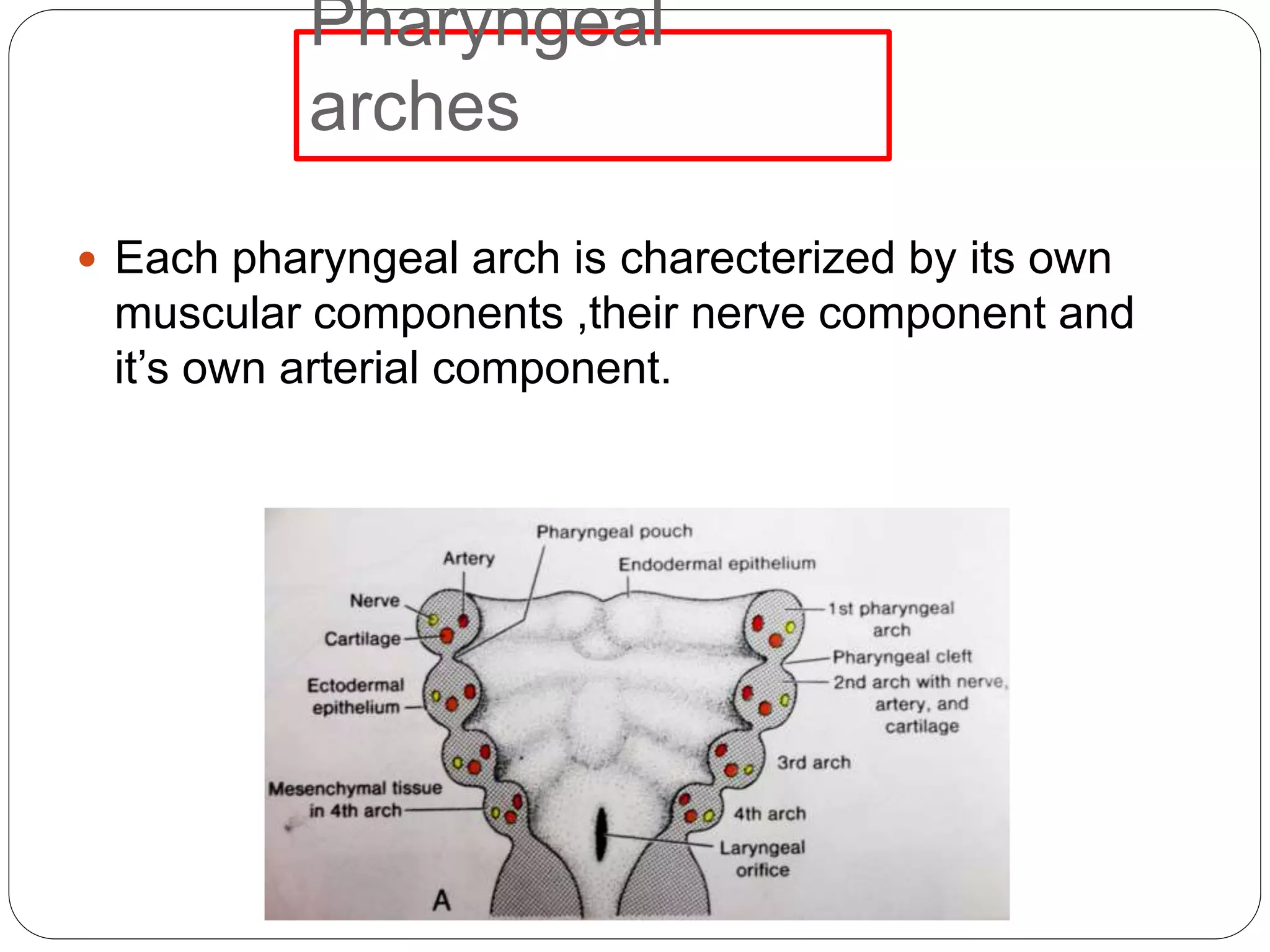
Pharyngeal
arches
 Each pharyngeal arch is charecterized by its own
muscular components ,their nerve component and
it’s own arterial component.
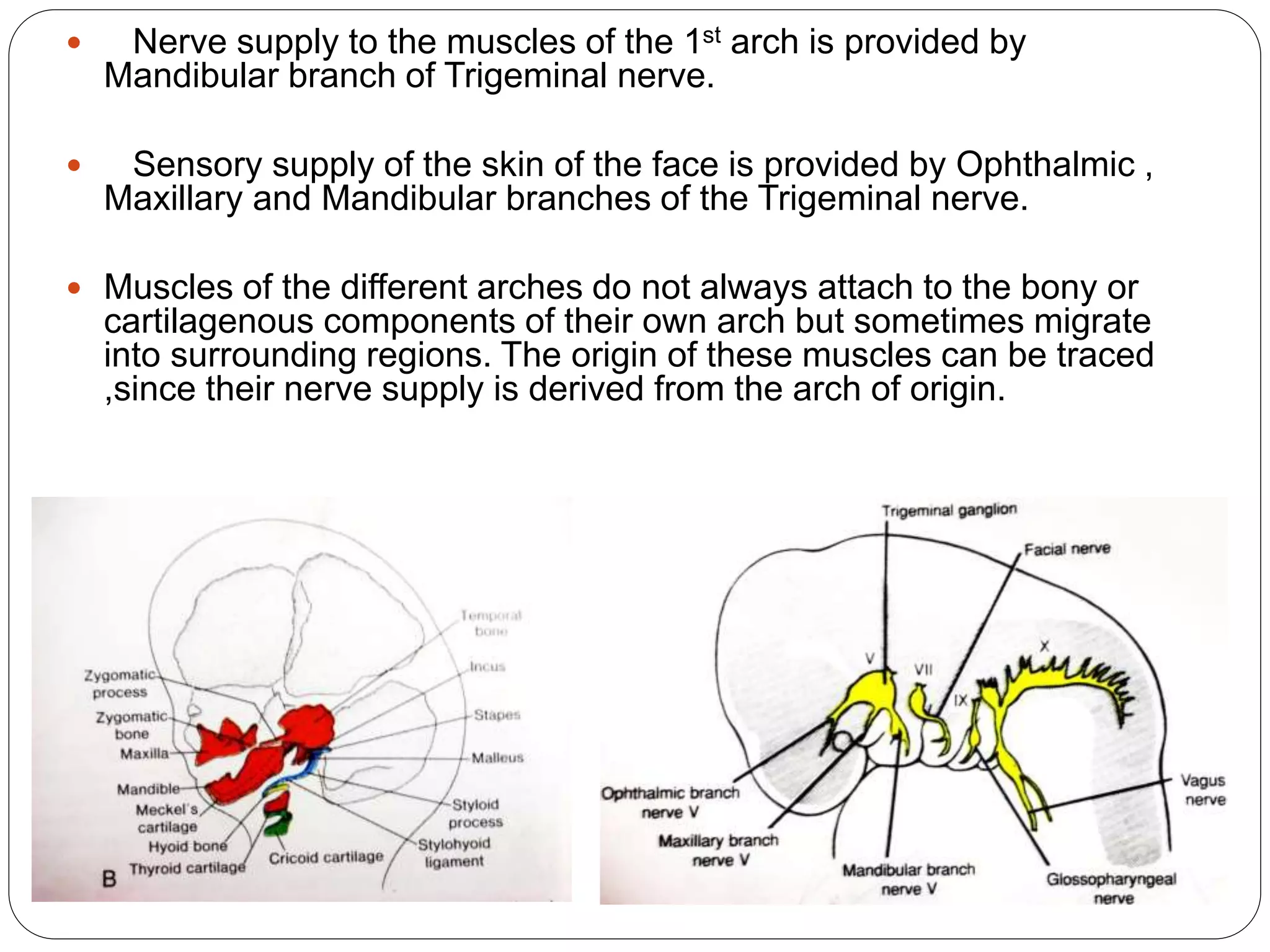
 Nerve supply to the muscles of the 1st arch is provided by
Mandibular branch of Trigeminal nerve.
 Sensory supply of the skin of the face is provided by Ophthalmic ,
Maxillary and Mandibular branches of the Trigeminal nerve.
 Muscles of the different arches do not always attach to the bony or
cartilagenous components of their own arch but sometimes migrate
into surrounding regions. The origin of these muscles can be traced
,since their nerve supply is derived from the arch of origin.
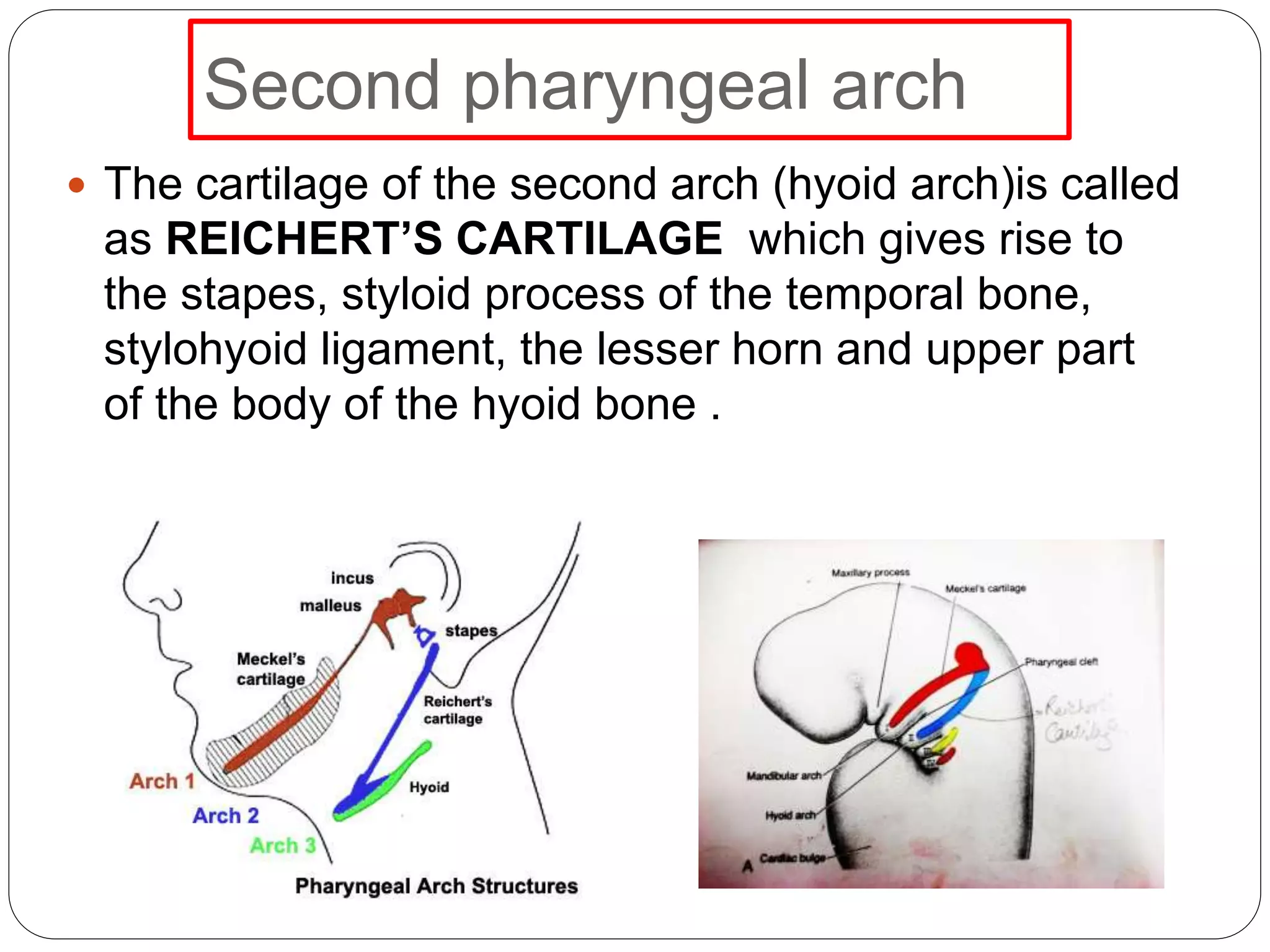
Second pharyngeal arch
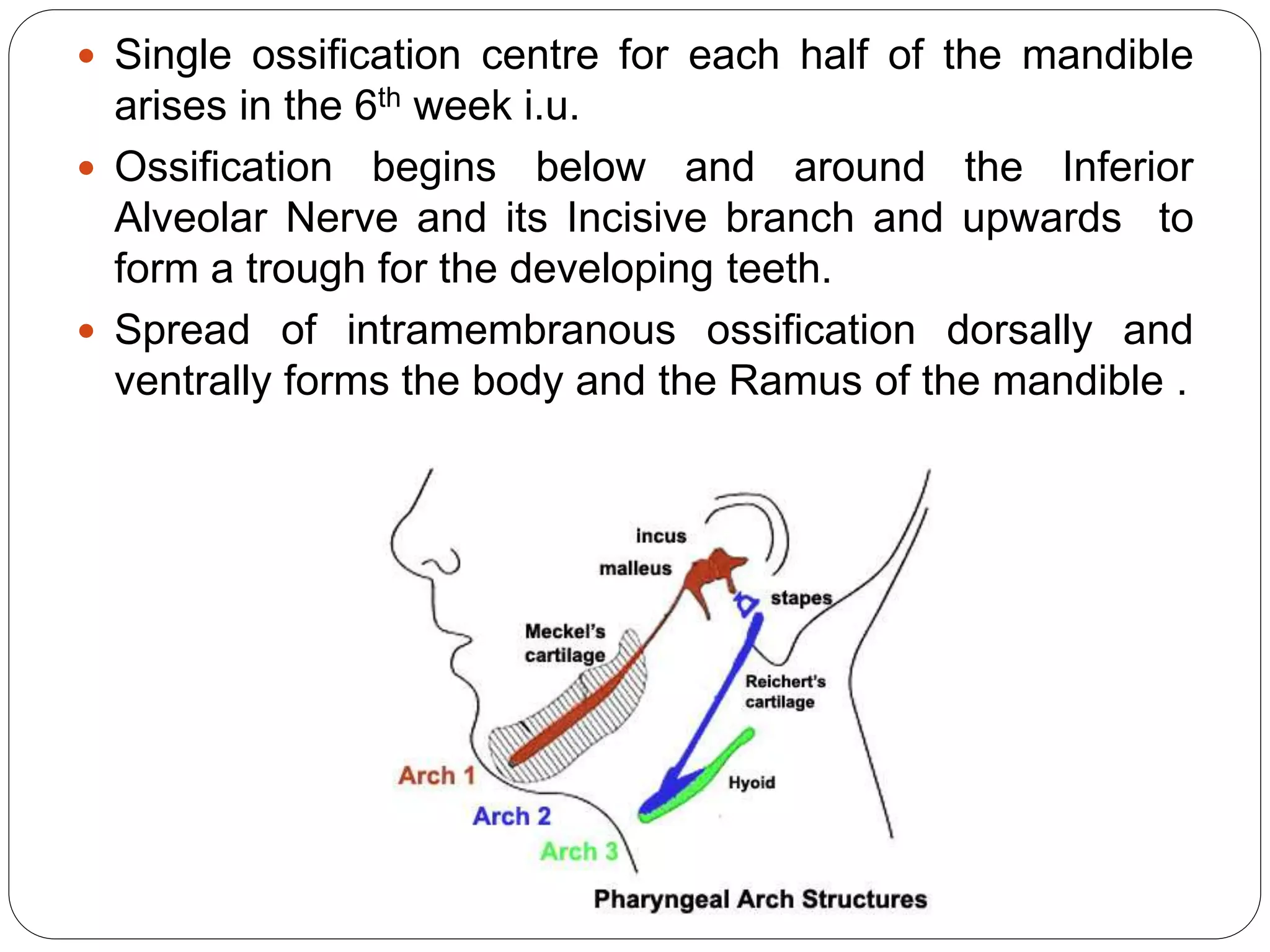
 The cartilage of the second arch (hyoid arch)is called
as REICHERT’S CARTILAGE which gives rise to
the stapes, styloid process of the temporal bone,
stylohyoid ligament, the lesser horn and upper part
of the body of the hyoid bone .
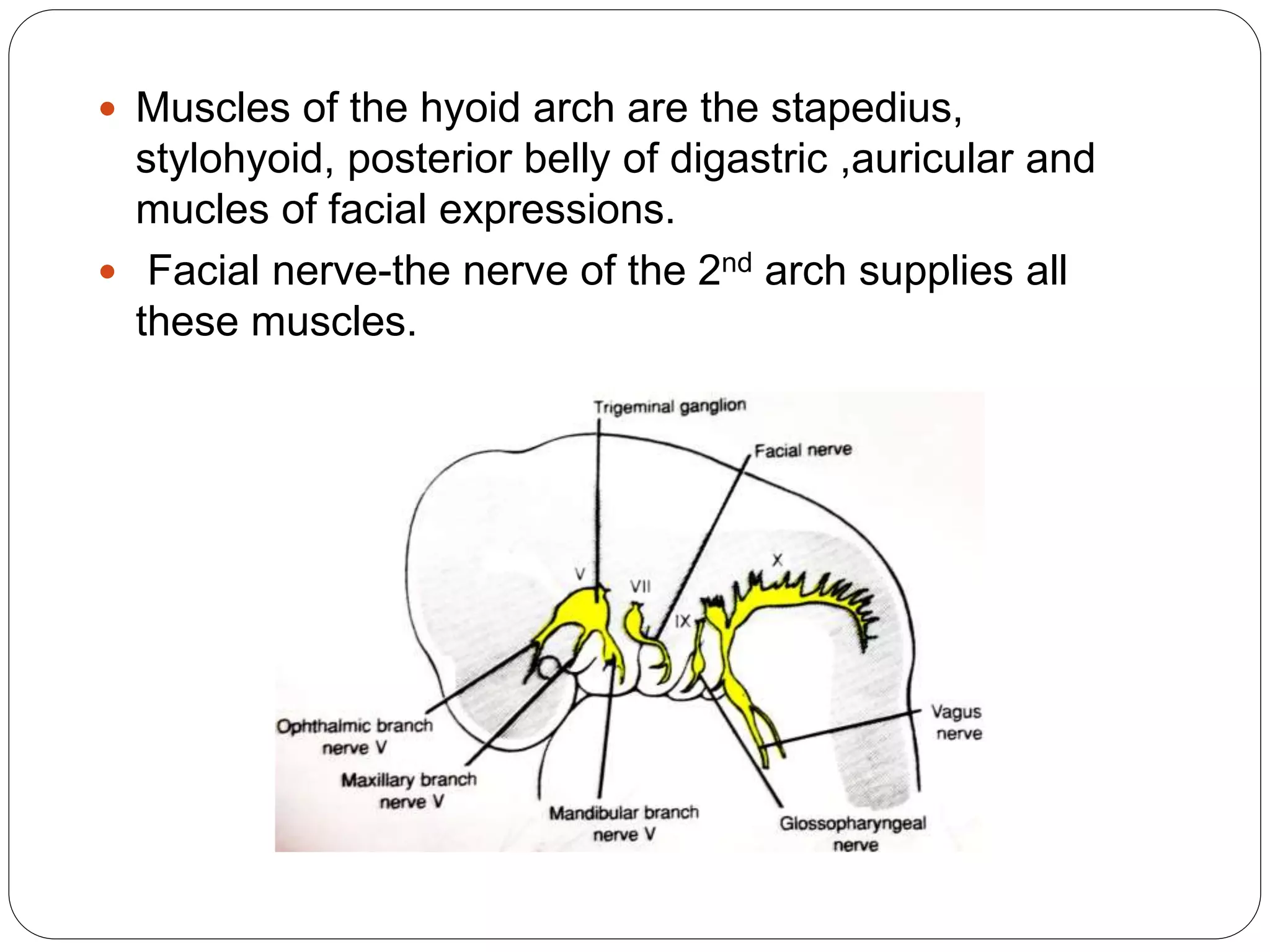
 Muscles of the hyoid arch are the stapedius,
stylohyoid, posterior belly of digastric ,auricular and
mucles of facial expressions.
 Facial nerve-the nerve of the 2nd arch supplies all
these muscles.
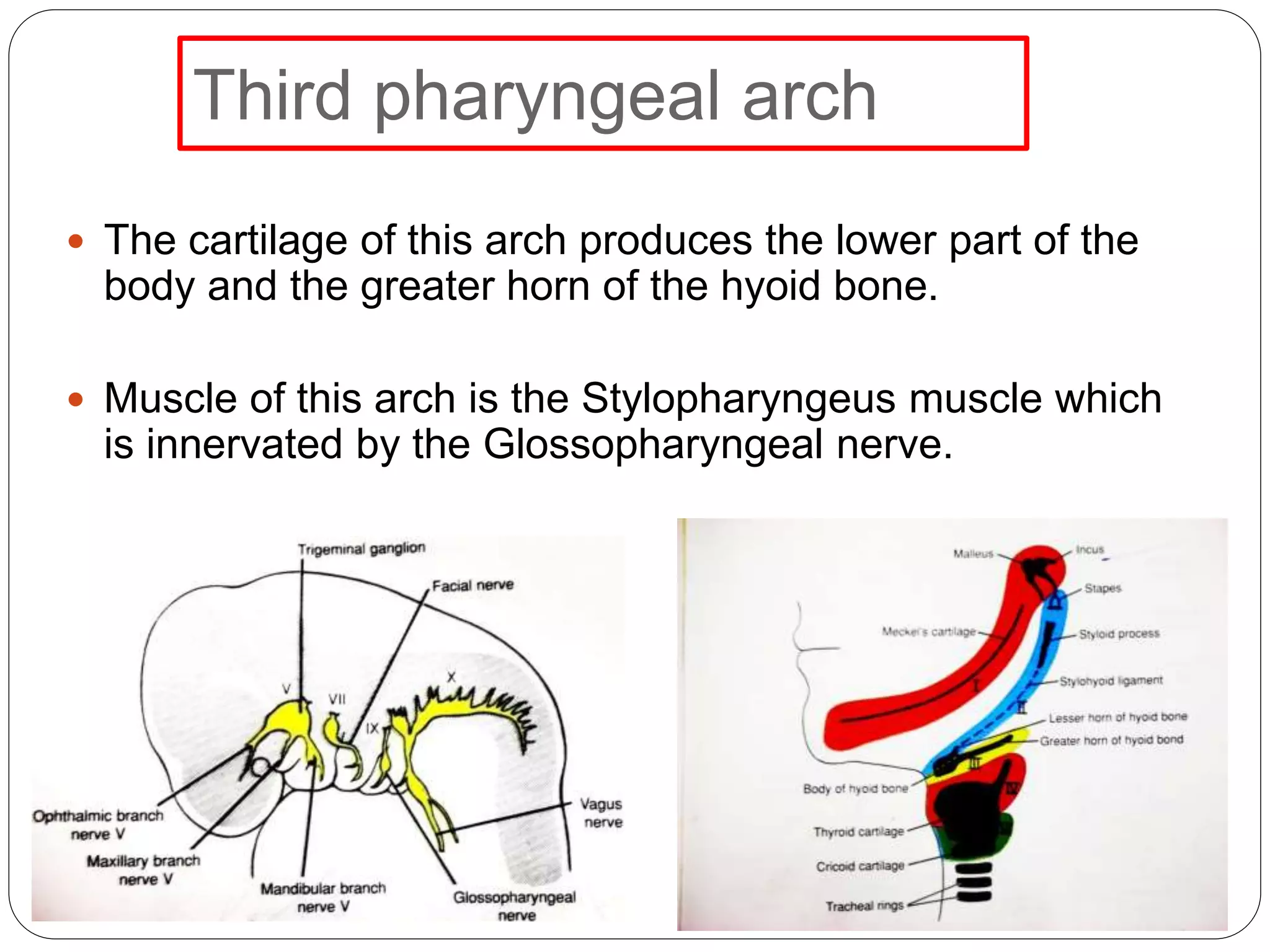
Third pharyngeal arch
 The cartilage of this arch produces the lower part of the
body and the greater horn of the hyoid bone.
 Muscle of this arch is the Stylopharyngeus muscle which
is innervated by the Glossopharyngeal nerve.
Fourth and Sixth pharyngeal arches
 Cartilagenuos components of the 4th and 6th pharyngeal
arches fuse to form the thyroid, cricoid , arytenoid ,
corniculate and cuneiform cartilages of the larynx.
 Muscles of the fourth arch are supplied by the Superior
laryngeal branch of the Vagus nerve and the intrinsic
muscles of the larynx are supplied by Recurrent laryngeal
branch of Vagus nerve
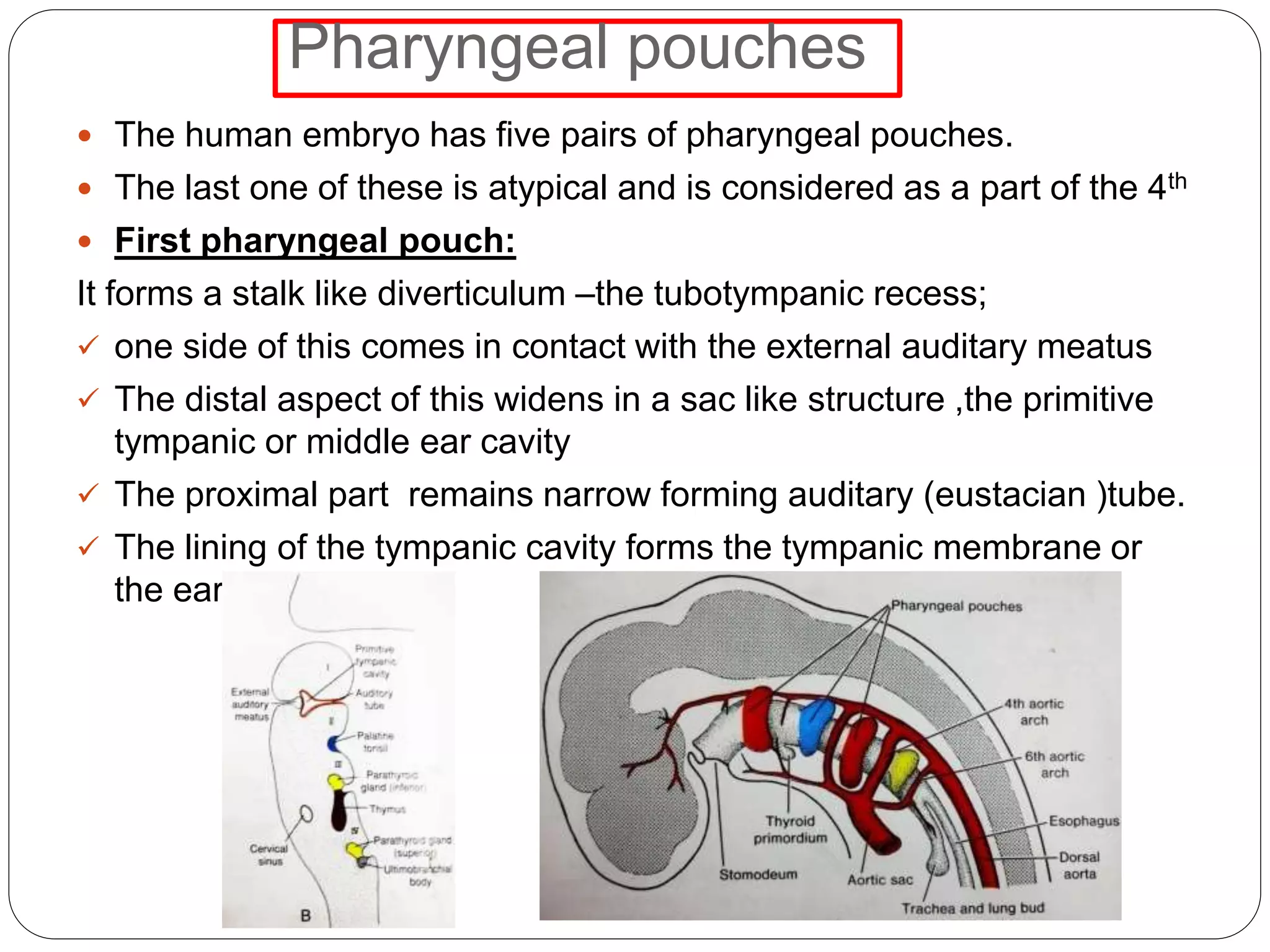
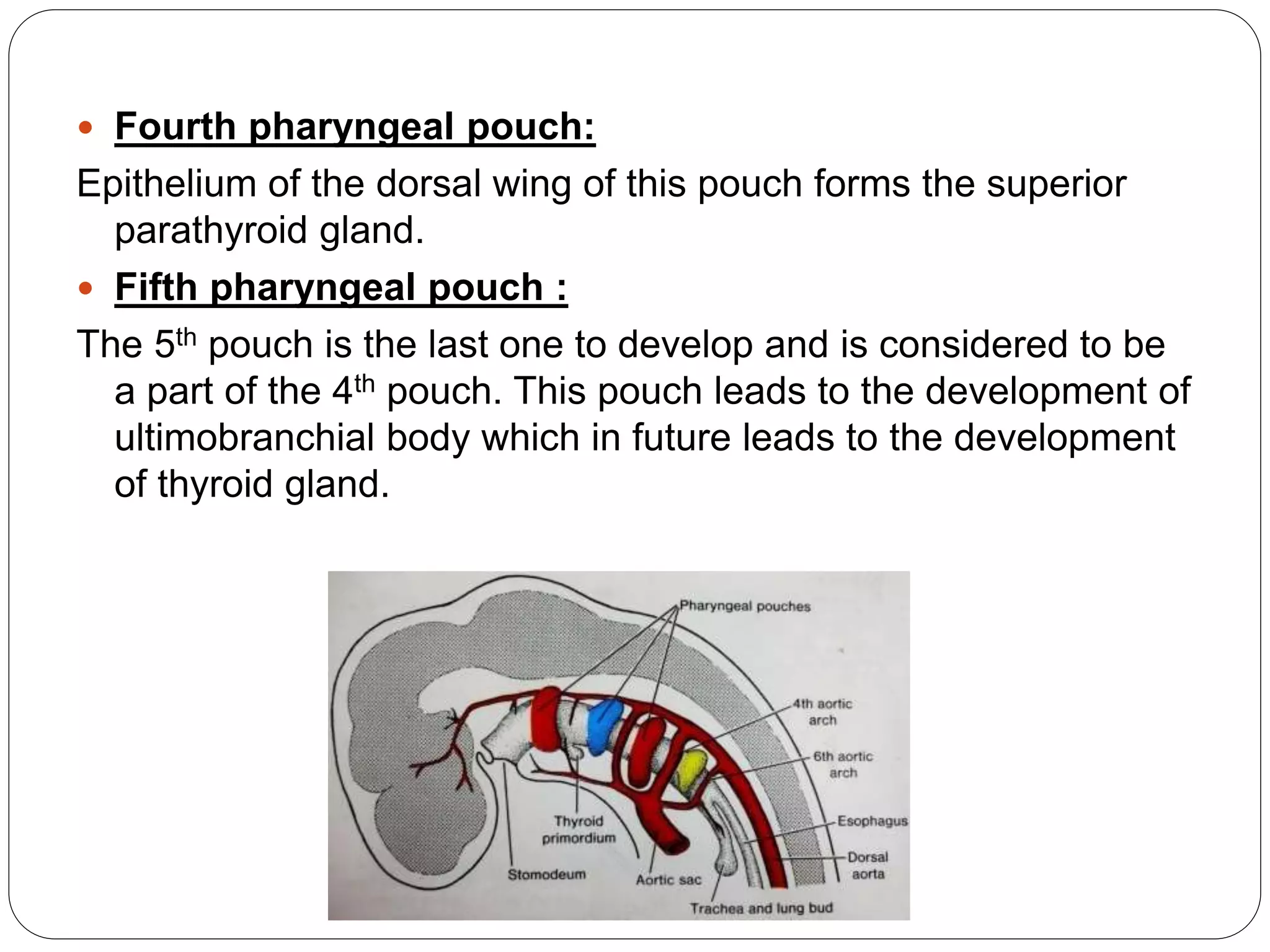
Pharyngeal pouches
 The human embryo has five pairs of pharyngeal pouches.
 The last one of these is atypical and is considered as a part of the 4th
 First pharyngeal pouch:
It forms a stalk like diverticulum –the tubotympanic recess;
 one side of this comes in contact with the external auditary meatus
 The distal aspect of this widens in a sac like structure ,the primitive
tympanic or middle ear cavity
 The proximal part remains narrow forming auditary (eustacian )tube.
 The lining of the tympanic cavity forms the tympanic membrane or
the eardrum
 Second pharyngeal pouch:
The epithelial lining forms the primordium of the palatine
tonsil.
 Third pharyngeal pouch:
It is characterized by a dorsal and a ventral wing .The
dorsal wing proliferates to form the inferior parathyroid
gland and the ventral wing forms the thymus
 Fourth pharyngeal pouch:
Epithelium of the dorsal wing of this pouch forms the superior
parathyroid gland.
 Fifth pharyngeal pouch :
The 5th pouch is the last one to develop and is considered to be
a part of the 4th pouch. This pouch leads to the development of
ultimobranchial body which in future leads to the development
of thyroid gland.
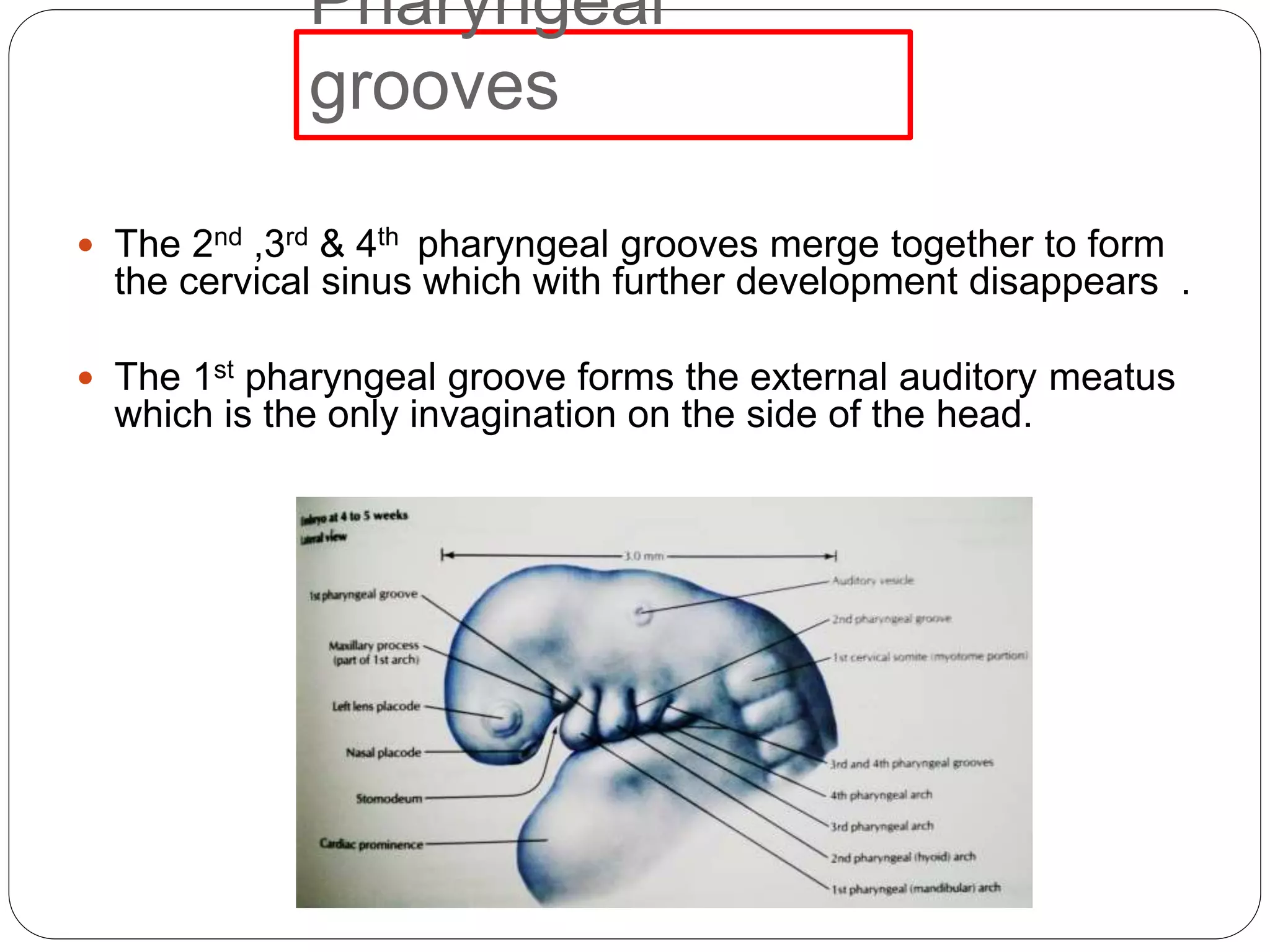
Pharyngeal
grooves
 The 2nd ,3rd & 4th pharyngeal grooves merge together to form
the cervical sinus which with further development disappears .
 The 1st pharyngeal groove forms the external auditory meatus
which is the only invagination on the side of the head.
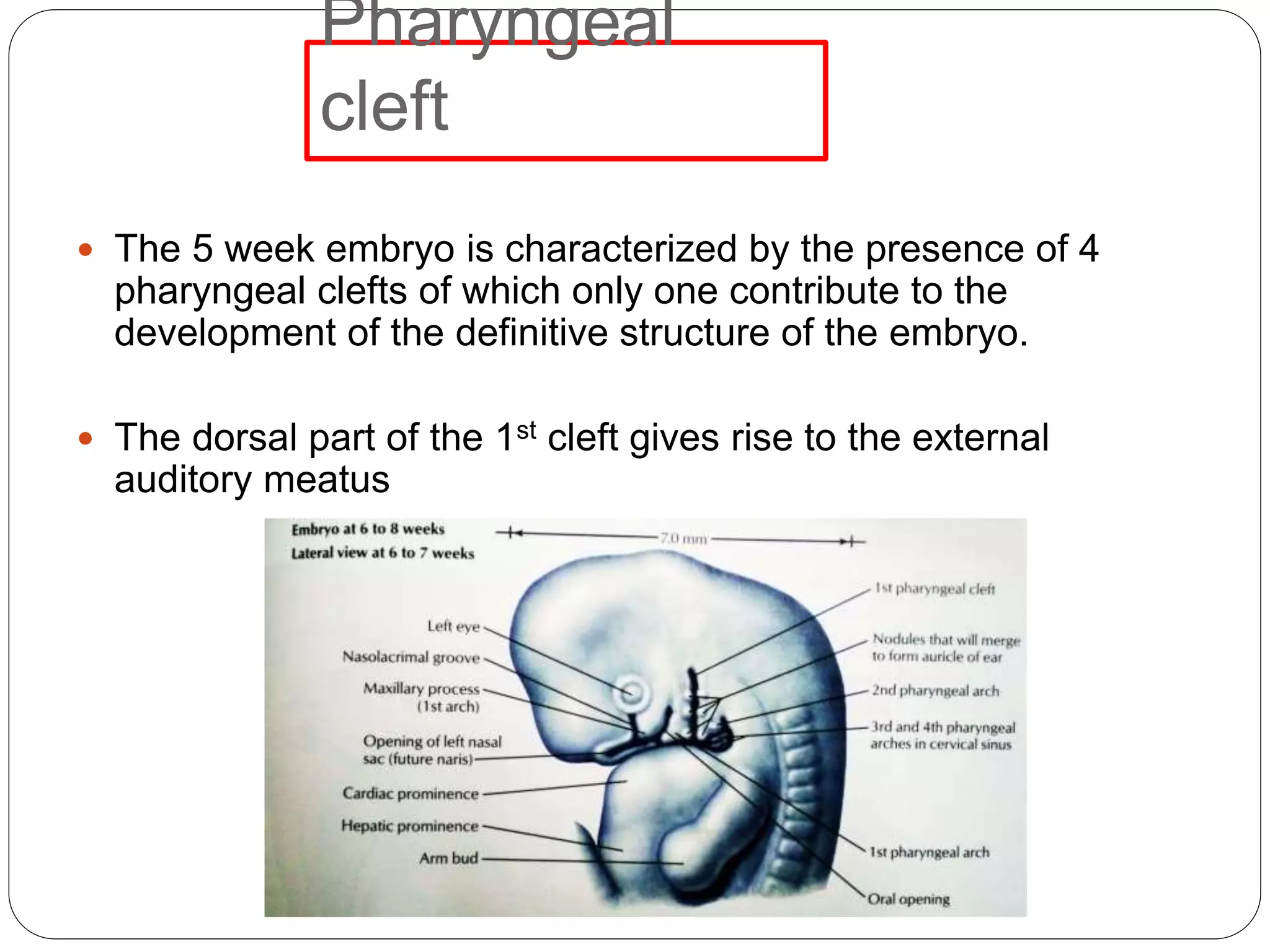
Pharyngeal
cleft
 The 5 week embryo is characterized by the presence of 4
pharyngeal clefts of which only one contribute to the
development of the definitive structure of the embryo.
 The dorsal part of the 1st cleft gives rise to the external
auditory meatus
Introduction
 The development of the face occurs mainly between 5 – 8
weeks
 The lower jaw (mandible) is the first to form (4th week)
 The facial proportions develop during the fetal period (9th week
to birth)
 During infancy & childhood, following the development of teeth
and paranasal sinuses, the facial skeleton increases in size
and contribute to the definitive shape of the face
SAGITTAL
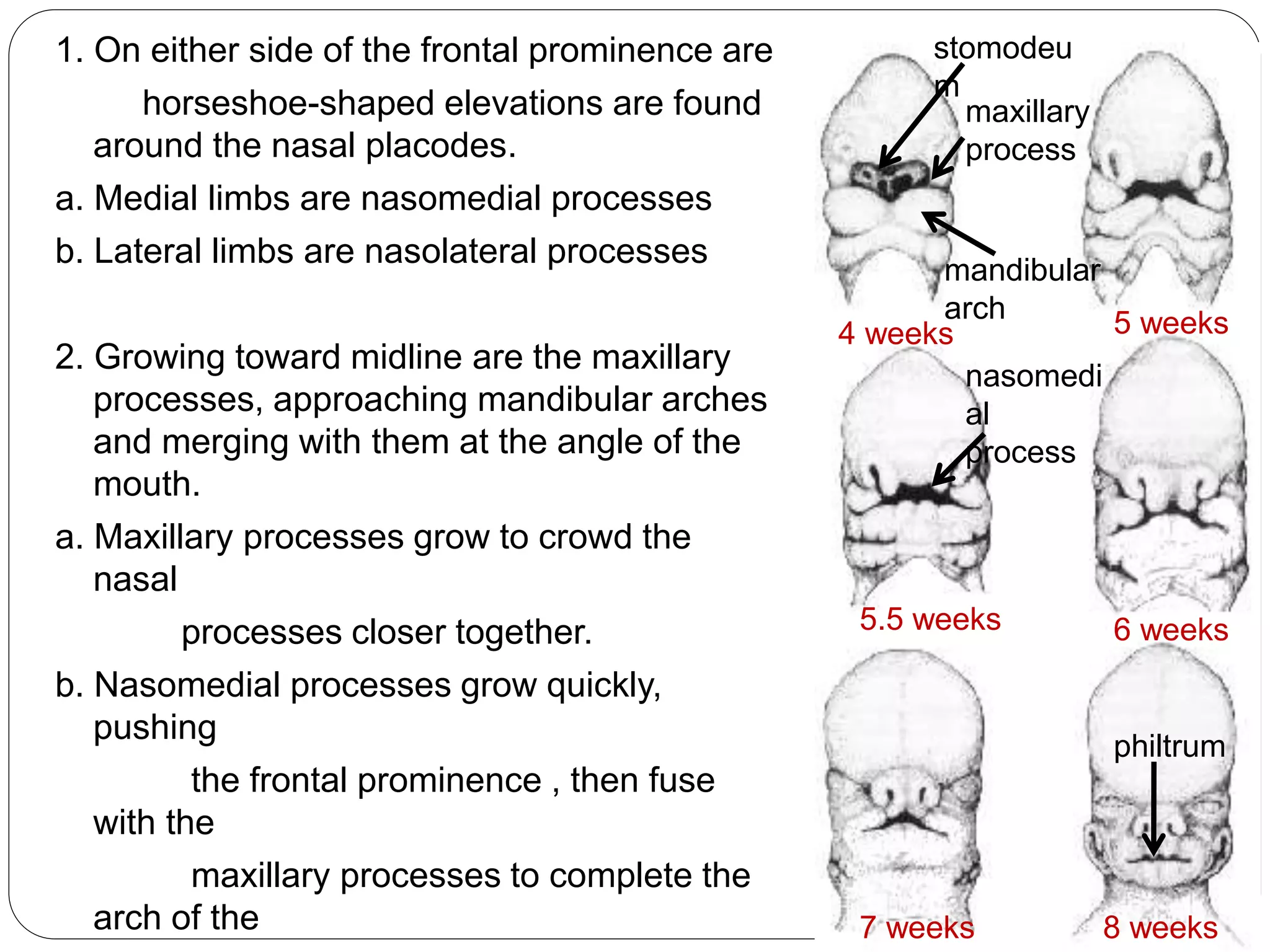
1. On either side of the frontal prominence are
horseshoe-shaped elevations are found
around the nasal placodes.
a. Medial limbs are nasomedial processes
b. Lateral limbs are nasolateral processes
2. Growing toward midline are the maxillary
processes, approaching mandibular arches
and merging with them at the angle of the
mouth.
a. Maxillary processes grow to crowd the
nasal
processes closer together.
b. Nasomedial processes grow quickly,
pushing
the frontal prominence , then fuse
with the
maxillary processes to complete the
arch of the
stomodeu
m
4 weeks
5.5 weeks
5 weeks
6 weeks
7 weeks 8 weeks
maxillary
process
mandibular
arch
nasomedi
al
process
philtrum
stomodeu
m
4 weeks
5.5 weeks
5 weeks
6 weeks
7 weeks 8 weeks
maxillary
process
mandibular
arch
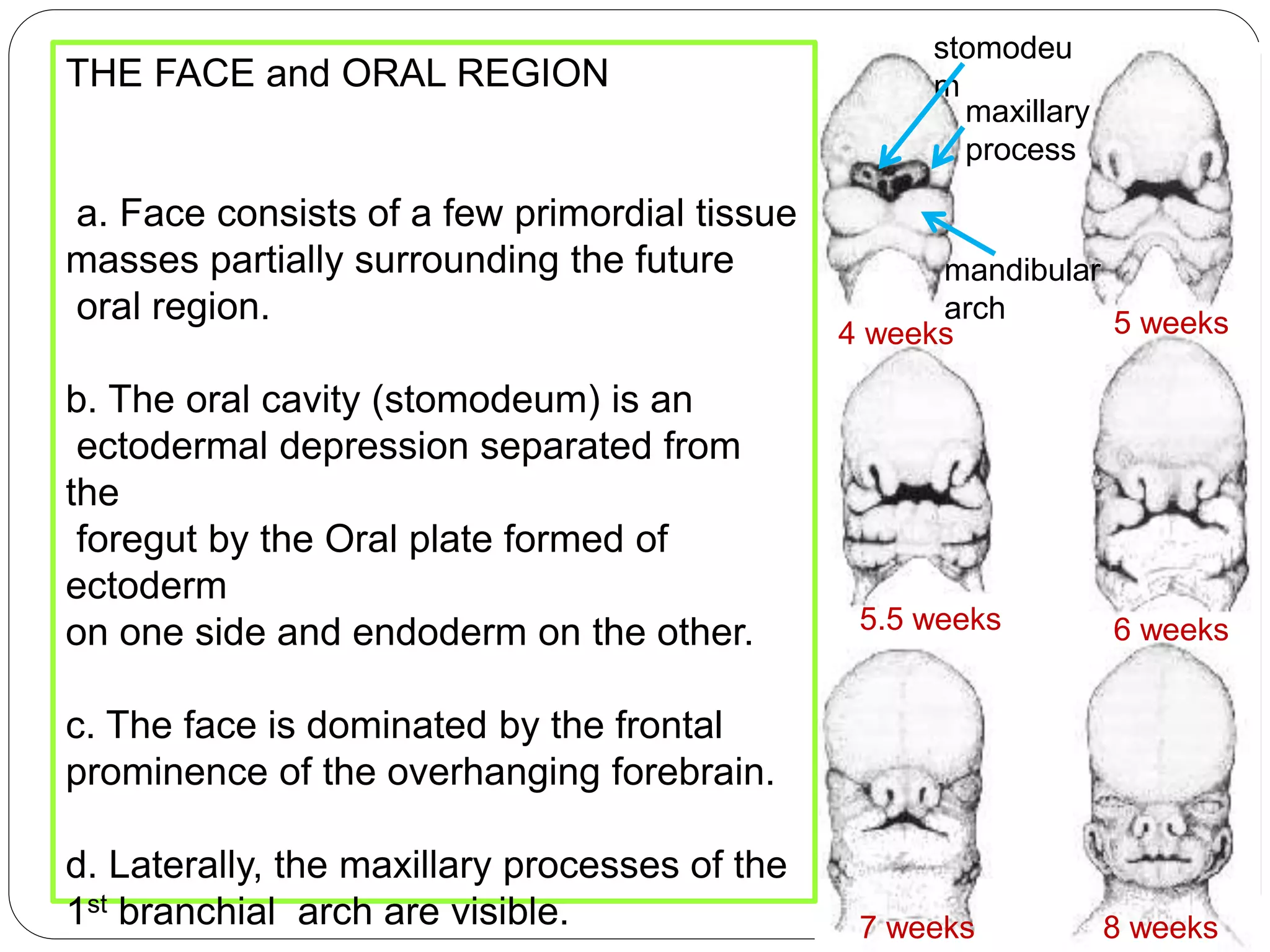
THE FACE and ORAL REGION
a. Face consists of a few primordial tissue
masses partially surrounding the future
oral region.
b. The oral cavity (stomodeum) is an
ectodermal depression separated from
the
foregut by the Oral plate formed of
ectoderm
on one side and endoderm on the other.
c. The face is dominated by the frontal
prominence of the overhanging forebrain.
d. Laterally, the maxillary processes of the
1st branchial arch are visible.
The frontonasal prominence forms the:
 Forehead and the bridge of the nose
 Frontal and nasal bones
The maxillary prominences form the:
 Upper cheek regions and most of the upper lip
 Maxilla, zygomatic bone, secondary palate
Derivatives of Facial Components
The mandibular processes fuse and form the:
 Chin, lower lip, and lower cheek regions
 Mandible
The lateral nasal prominences form the ala of the
nose
The medial nasal prominences fuse and form the
intermaxillary segment
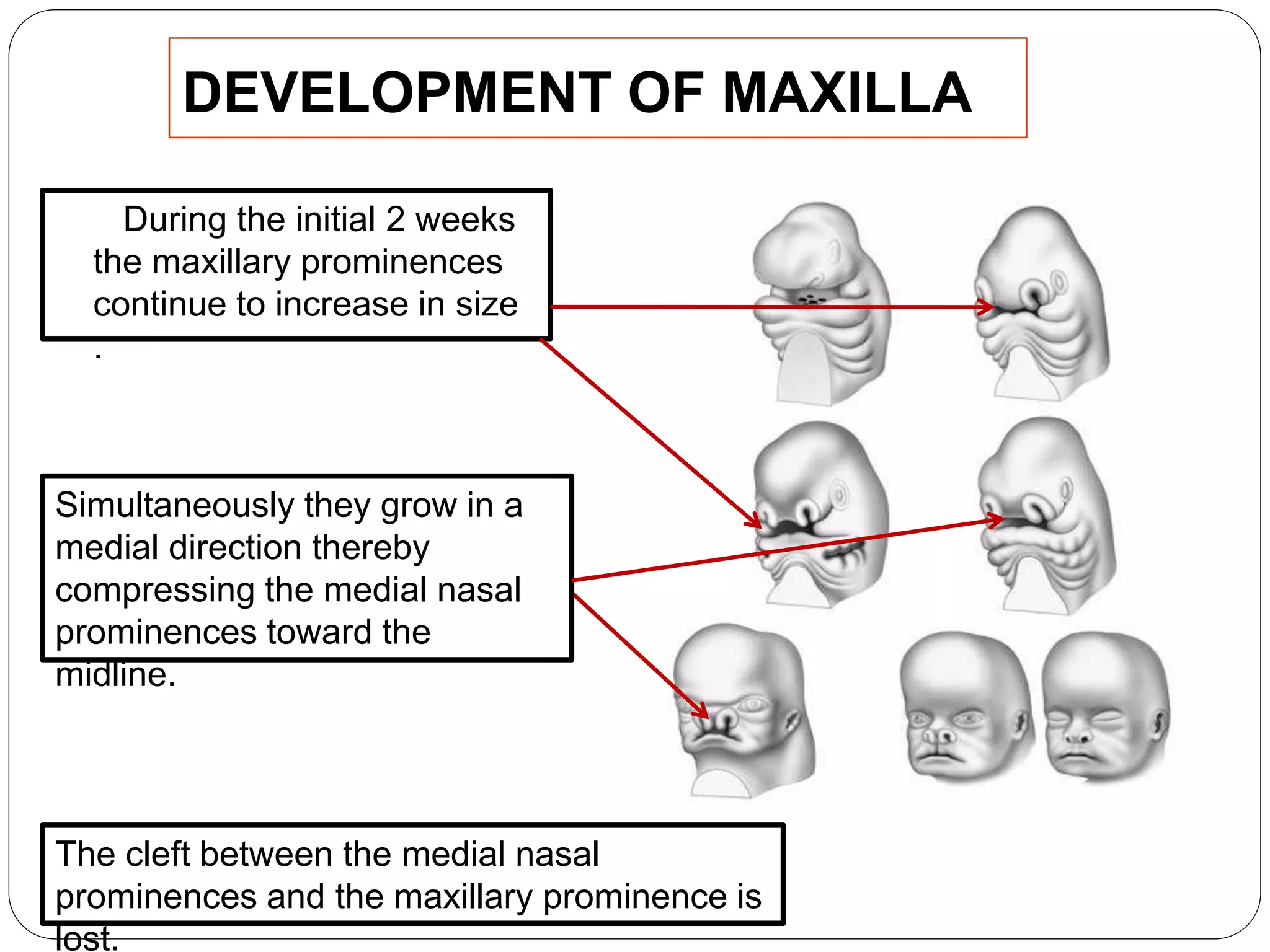
DEVELOPMENT OF MAXILLA
During the initial 2 weeks
the maxillary prominences
continue to increase in size
.
The cleft between the medial nasal
prominences and the maxillary prominence is
lost.
Simultaneously they grow in a
medial direction thereby
compressing the medial nasal
prominences toward the
midline.
 Initially the maxillary and the lateral nasal
prominences are separated by a deep furrow ,the
nasolacrimal groove.
 The nasolacrimal duct then runs from the medial
corner of the eye to the inferior meatus of the nasal
cavity.
 The maxillary prominence then enlarge to form the
cheek and maxillae .
DEVELOPMENT OF
MANDIBLE
• The first structure to develop in the region of the lower
jaw is the mandibular division of the trigeminal nerve.
• The prior presence of the nerve has been postulated as
requisite for inducing osteogenesis by the production of
neurotropic hormones.
• MECKEL’S CARTILAGE , of the first branchial arch is
responsible for the formation of mandible.
 Single ossification centre for each half of the mandible
arises in the 6th week i.u.
 Ossification begins below and around the Inferior
Alveolar Nerve and its Incisive branch and upwards to
form a trough for the developing teeth.
 Spread of intramembranous ossification dorsally and
ventrally forms the body and the Ramus of the mandible .
 The ascending ramus of the neonatal mandible is
low and wide; the coronoid process is relatively large
and projects well above the condyle , the body is
merely an open shell containing the buds of the
deciduous teeth.
 The initial separation of the right and left bodies of
the mandible at the midline SYMPHYSIS MENTI is
gradually eliminated between the 4th and 12th
months postnatally.
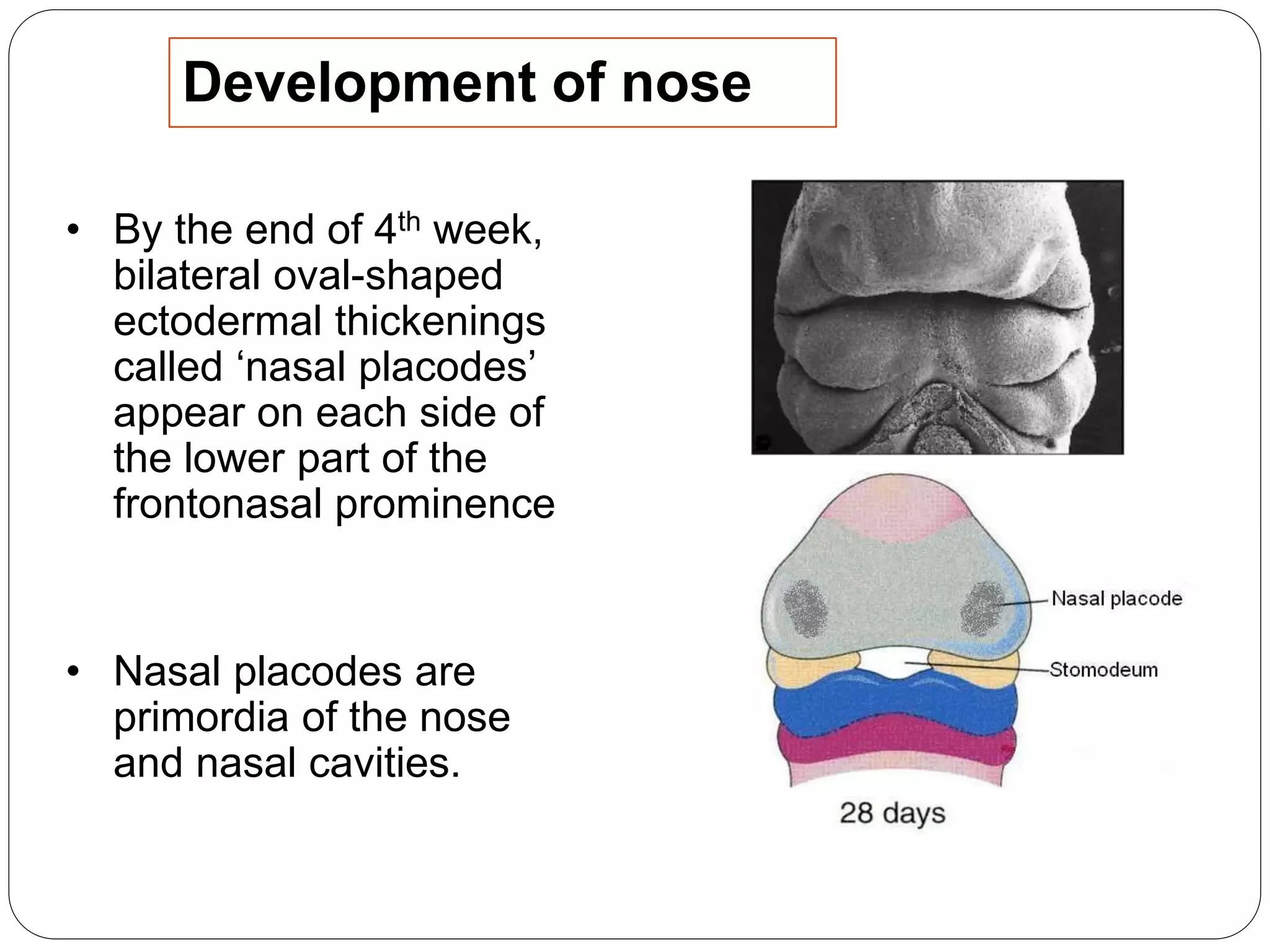
Development of nose
• By the end of 4th week,
bilateral oval-shaped
ectodermal thickenings
called ‘nasal placodes’
appear on each side of
the lower part of the
frontonasal prominence
• Nasal placodes are
primordia of the nose
and nasal cavities.
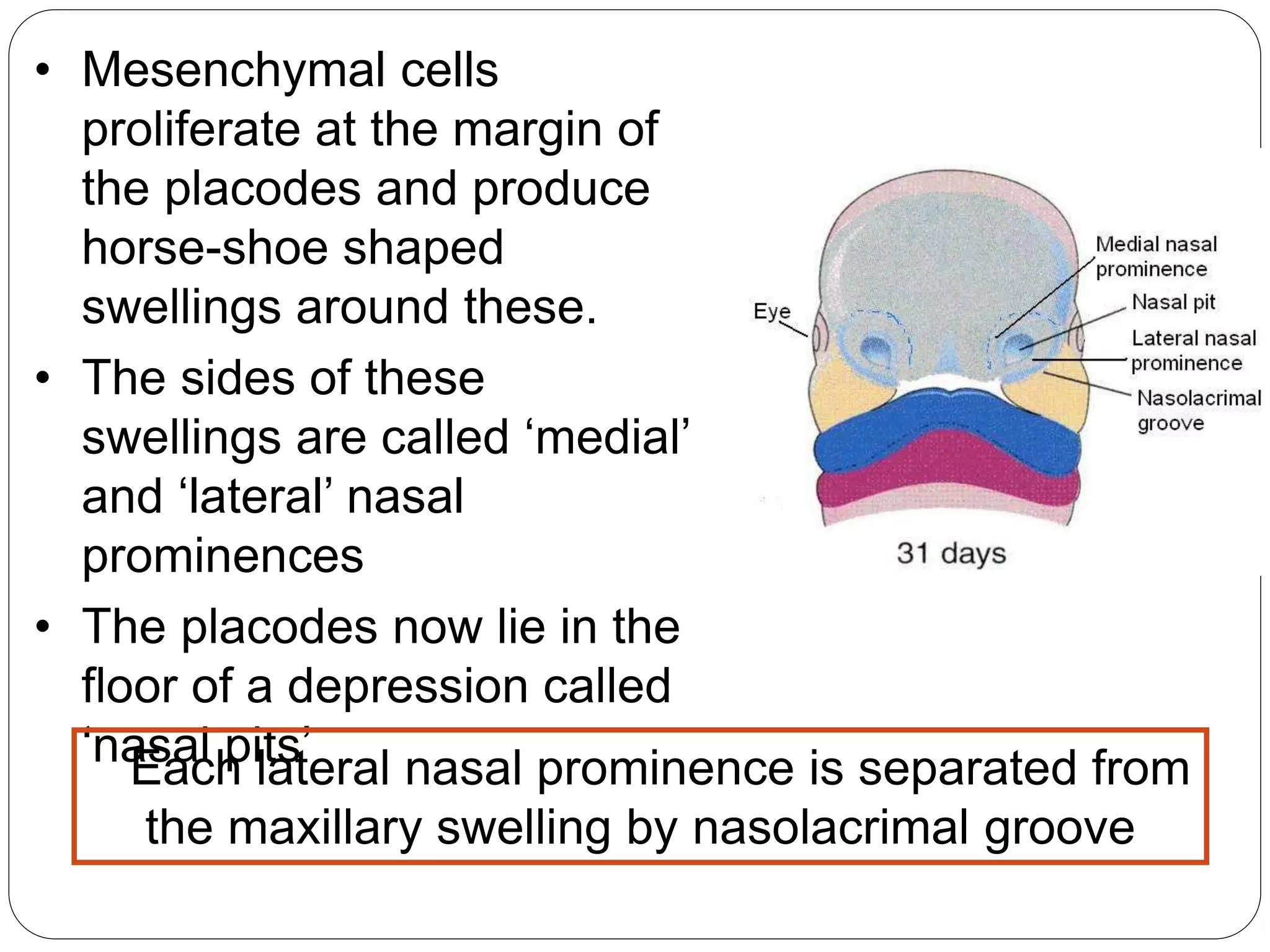
• Mesenchymal cells
proliferate at the margin of
the placodes and produce
horse-shoe shaped
swellings around these.
• The sides of these
swellings are called ‘medial’
and ‘lateral’ nasal
prominences
• The placodes now lie in the
floor of a depression called
‘nasal pits’Each lateral nasal prominence is separated from
the maxillary swelling by nasolacrimal groove
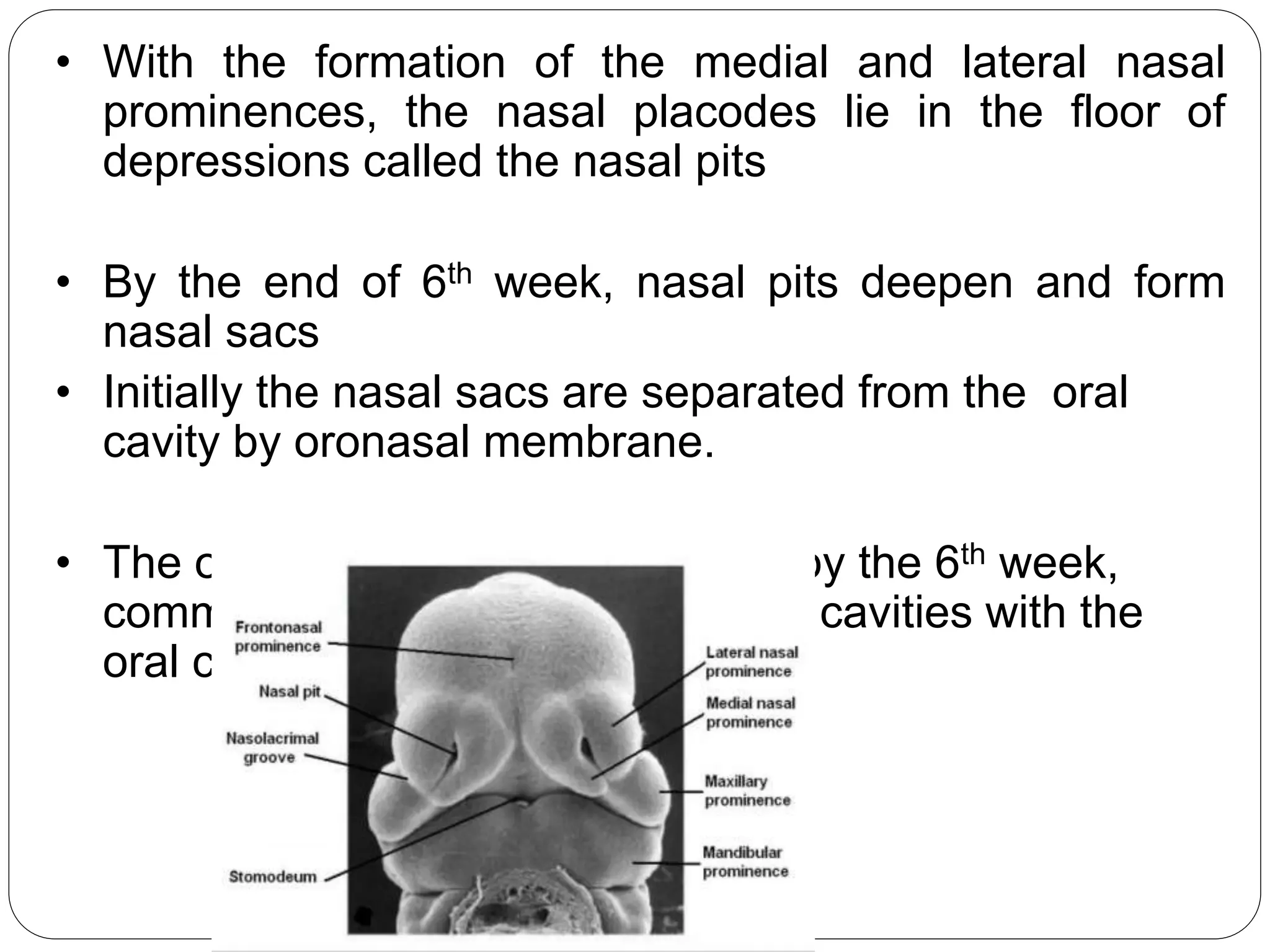
• With the formation of the medial and lateral nasal
prominences, the nasal placodes lie in the floor of
depressions called the nasal pits
• By the end of 6th week, nasal pits deepen and form
nasal sacs
• Initially the nasal sacs are separated from the oral
cavity by oronasal membrane.
• The oronasal membrane ruptures by the 6th week,
communicating the primitive nasal cavities with the
oral cavity
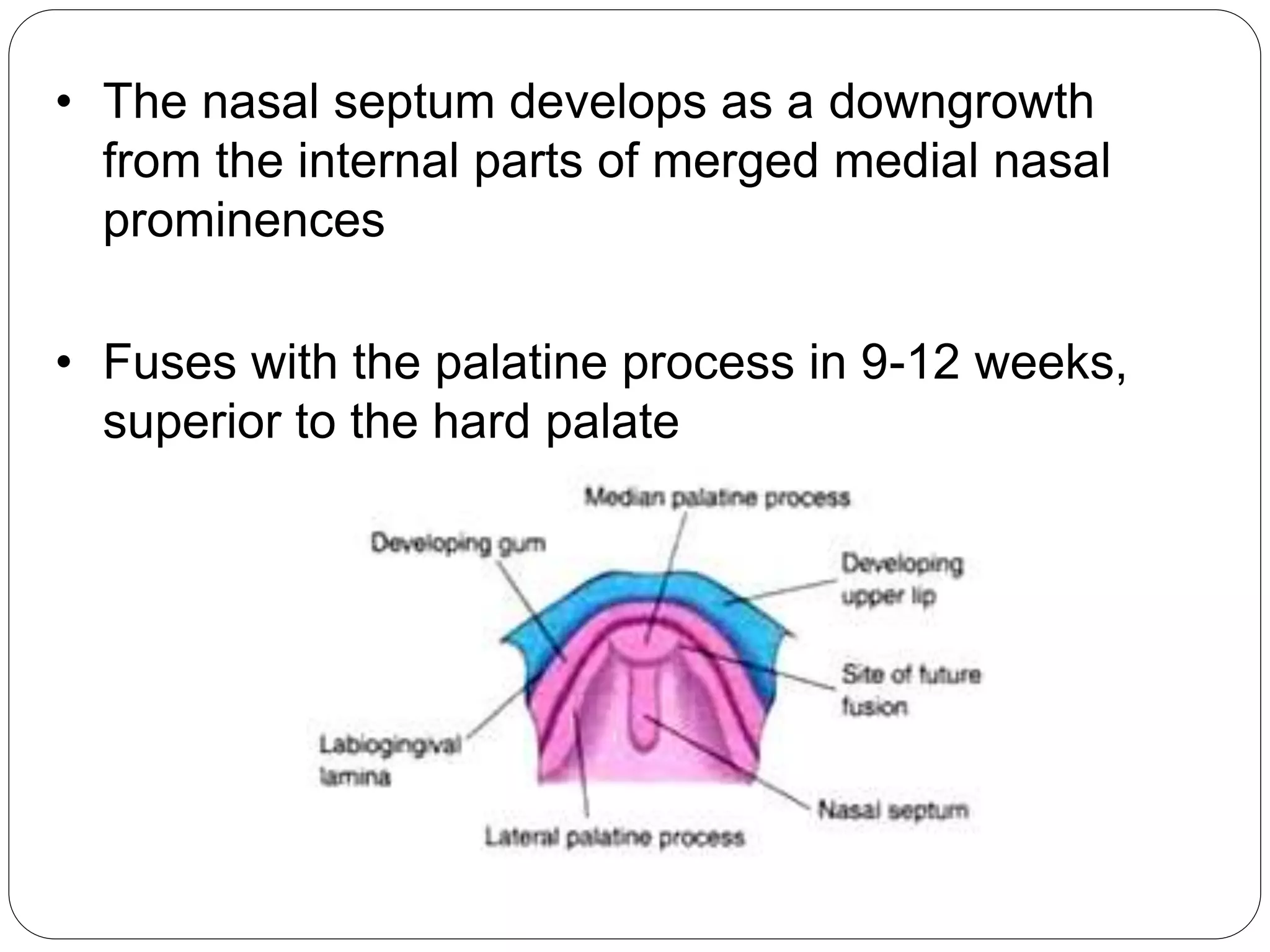
• The nasal septum develops as a downgrowth
from the internal parts of merged medial nasal
prominences
• Fuses with the palatine process in 9-12 weeks,
superior to the hard palate
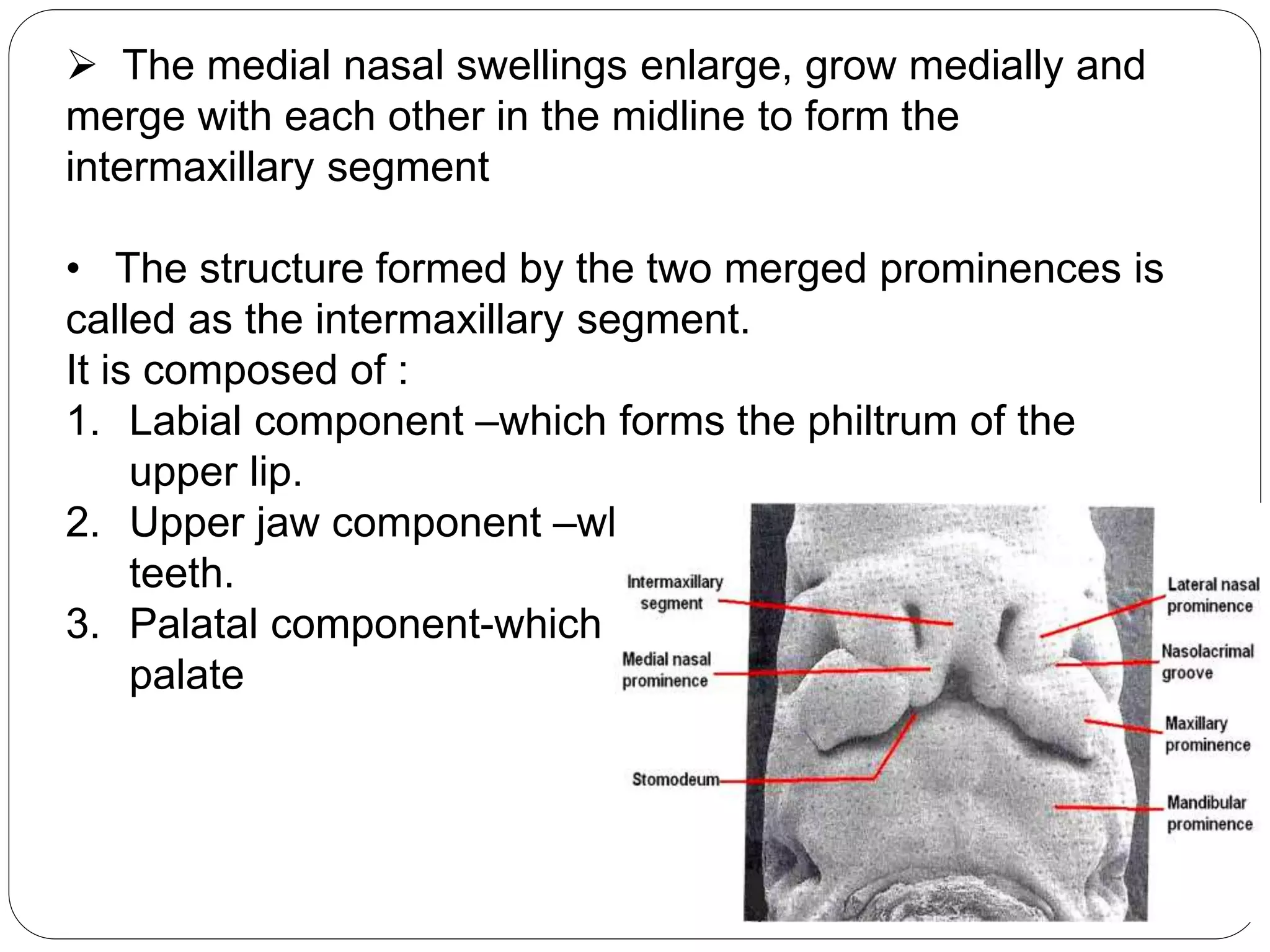
 The medial nasal swellings enlarge, grow medially and
merge with each other in the midline to form the
intermaxillary segment
• The structure formed by the two merged prominences is
called as the intermaxillary segment.
It is composed of :
1. Labial component –which forms the philtrum of the
upper lip.
2. Upper jaw component –which carries the four incisor
teeth.
3. Palatal component-which forms the triangular primary
palate
Development of lips
 Lower lip :The mandibular processes of the two sides
grow towards each other and fuse in the midline ,they
form the lower margin of the stomatodeum .
 Upper lip :Each maxillary process now grows medially
and fuses, first with the lateral nasal process and the with
the medial nasal process.
Development of
Ear
 The three parts of the ear-
-External
-Middle and
-Internal ,arise from separate ,diverse embryonic origins
 The external ear forms around the first branchial groove
which deepens to become the external acuostic meatus .
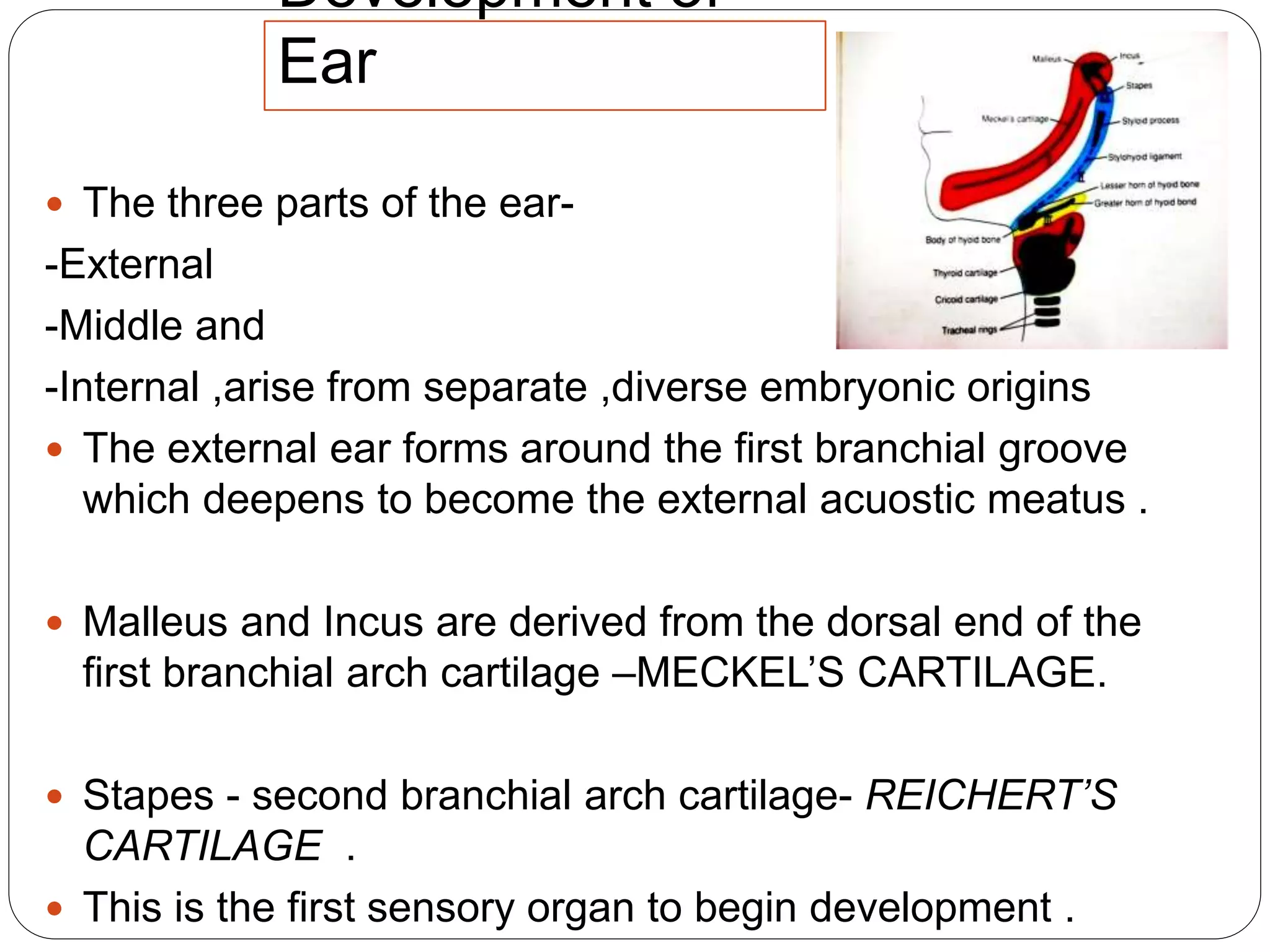
 Malleus and Incus are derived from the dorsal end of the
first branchial arch cartilage –MECKEL’S CARTILAGE.
 Stapes - second branchial arch cartilage- REICHERT’S
CARTILAGE .
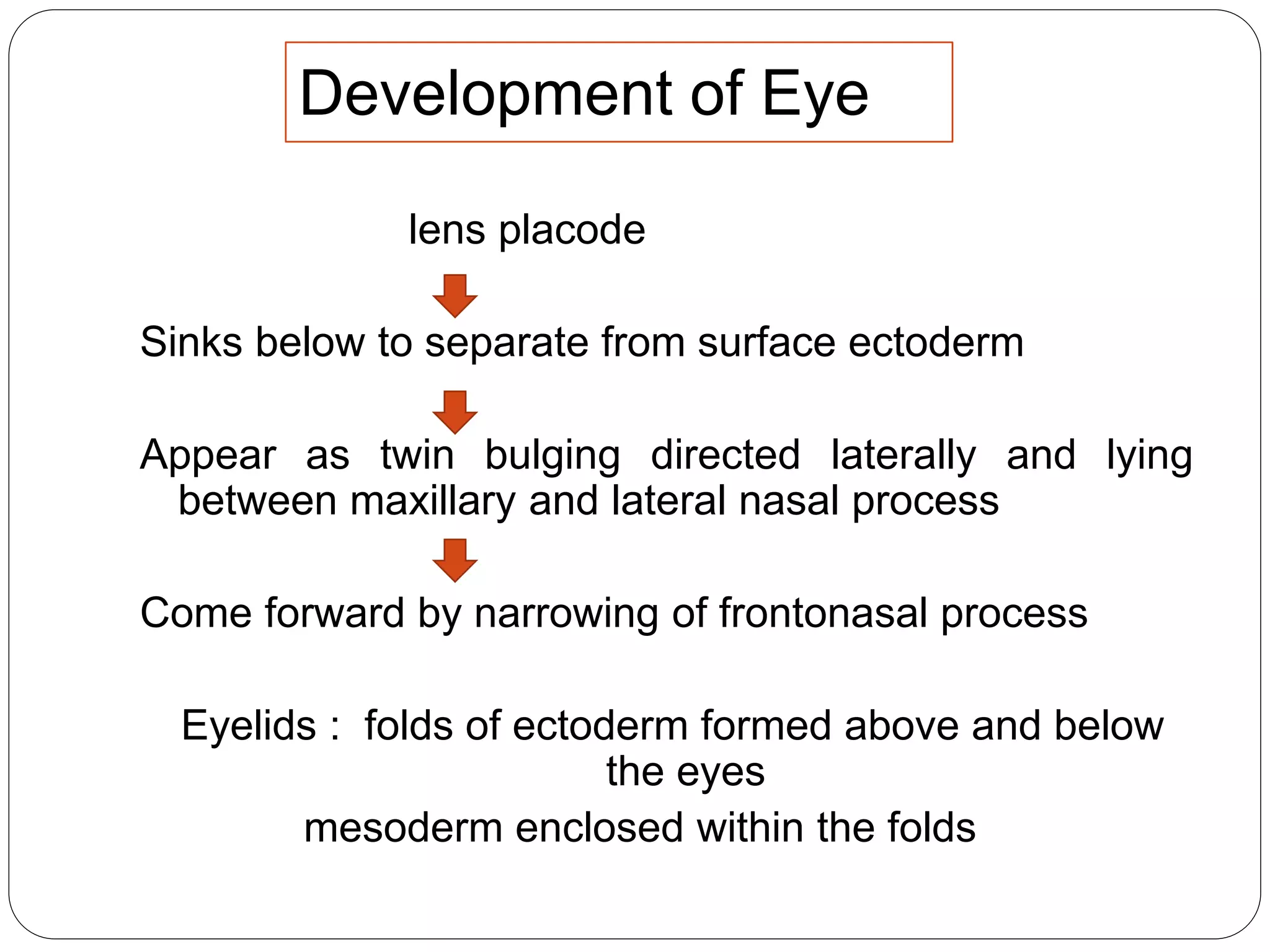
 This is the first sensory organ to begin development .
lens placode
Sinks below to separate from surface ectoderm
Appear as twin bulging directed laterally and lying
between maxillary and lateral nasal process
Come forward by narrowing of frontonasal process
Eyelids : folds of ectoderm formed above and below
the eyes
mesoderm enclosed within the folds
Development of Eye
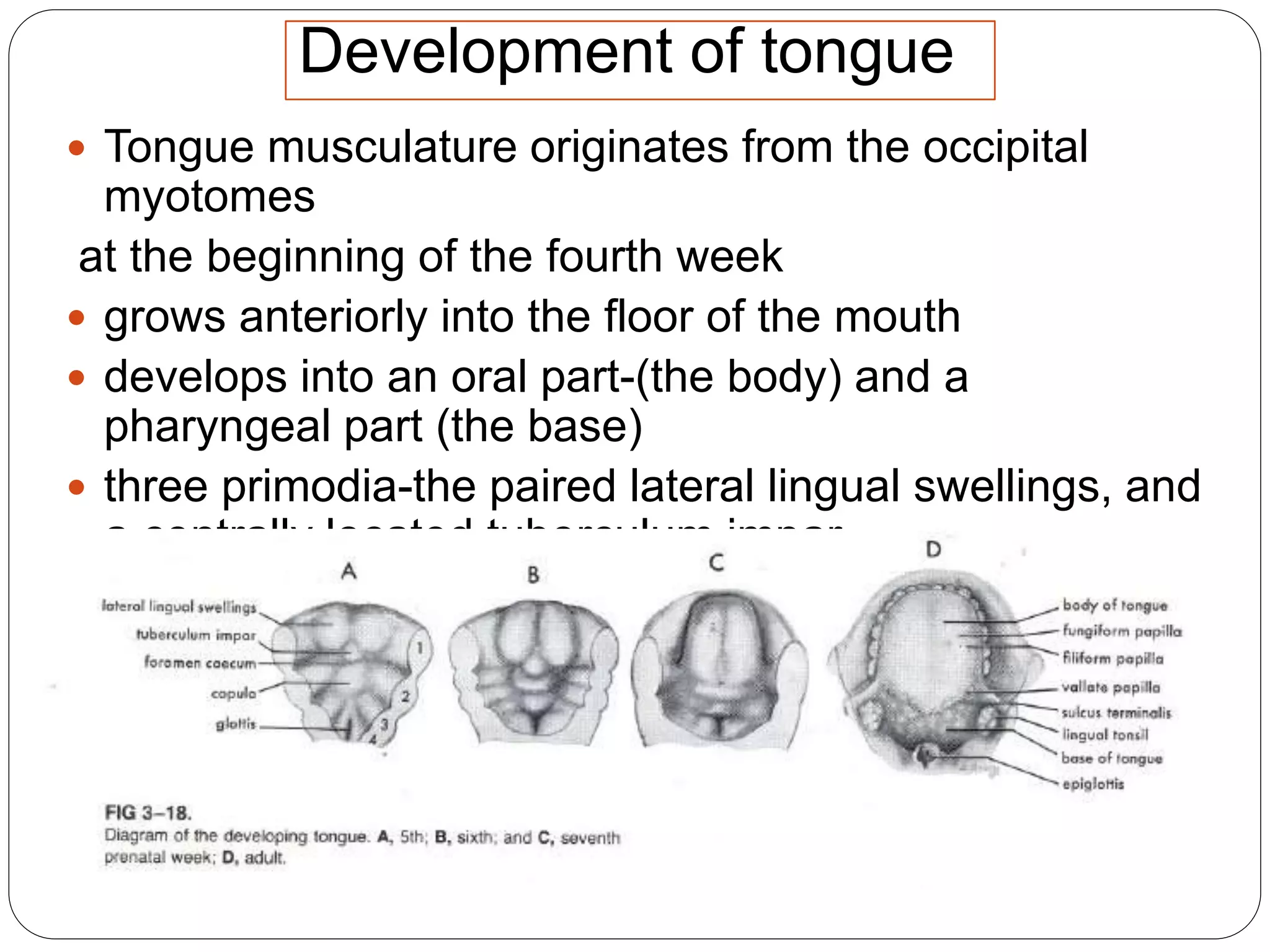
 Tongue musculature originates from the occipital
myotomes
at the beginning of the fourth week
 grows anteriorly into the floor of the mouth
 develops into an oral part-(the body) and a
pharyngeal part (the base)
 three primodia-the paired lateral lingual swellings, and
a centrally located tuberculum impar
Development of tongue
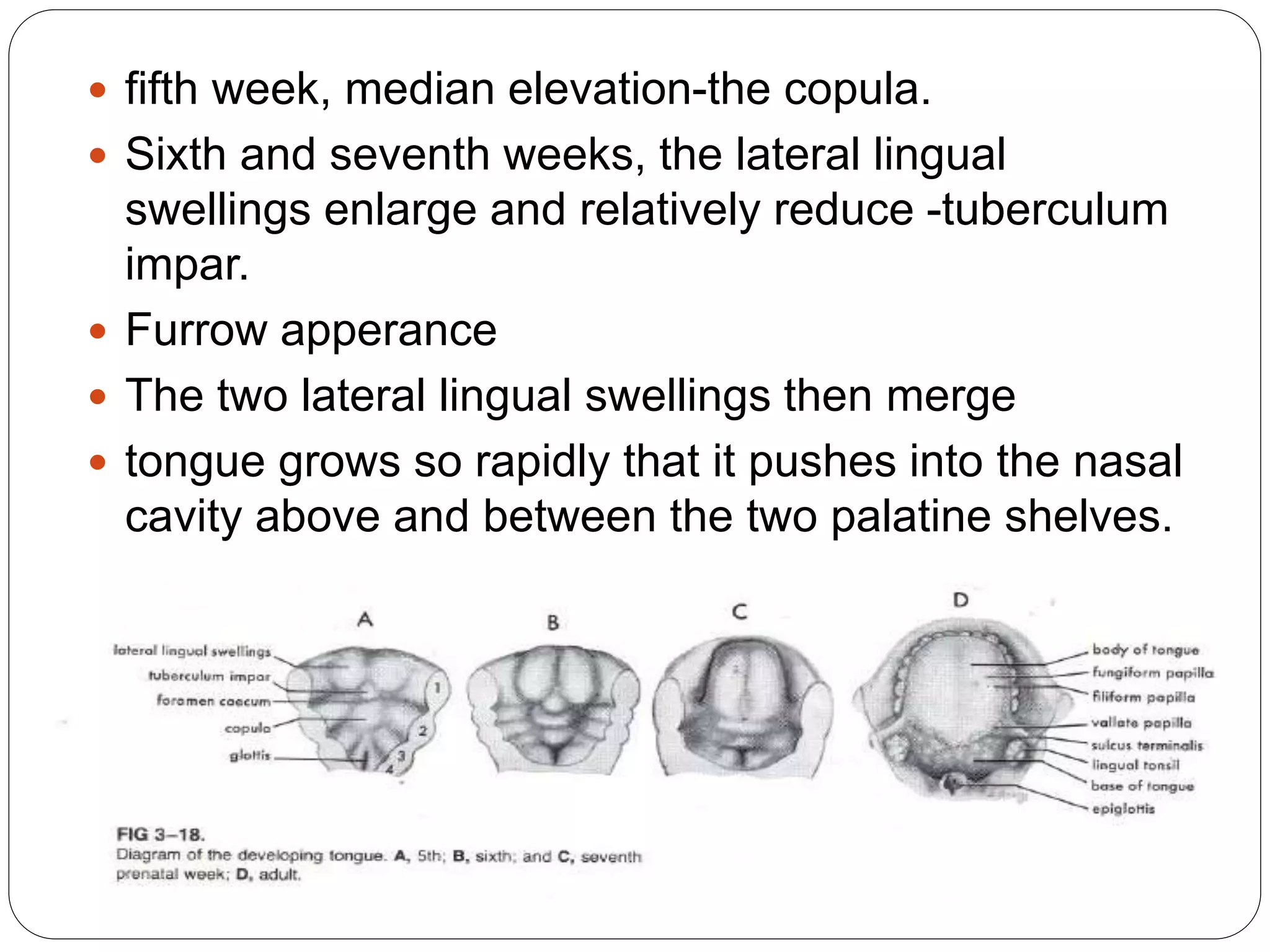
 fifth week, median elevation-the copula.
 Sixth and seventh weeks, the lateral lingual
swellings enlarge and relatively reduce -tuberculum
impar.
 Furrow apperance
 The two lateral lingual swellings then merge
 tongue grows so rapidly that it pushes into the nasal
cavity above and between the two palatine shelves.
 At the junction of the anterior 2/3rd and the
posterior 1/3rd is a groove called as the SULCUS
TERMINALIS.
 Sensory innervation-2/3rd - Mandibular
branch of
Trigeminal
nerve
 Sensory innervation-1/3rd -
Glossopharyngeal nerve .
 Motor innervation Hypoglossal
nerve
 Special sensory innervation - Chorda tympani
branch of Facial nerve
Development of
palate
• Begins at the end of the 5th week
• Gets completed by the end of the 12th week
• The most critical period for the development of
palate is from the end of 6th week to the beginning of
9th week
• Palate develops from two primordia-
 -the primary palate
 -the secondary palate
The Primary Palate
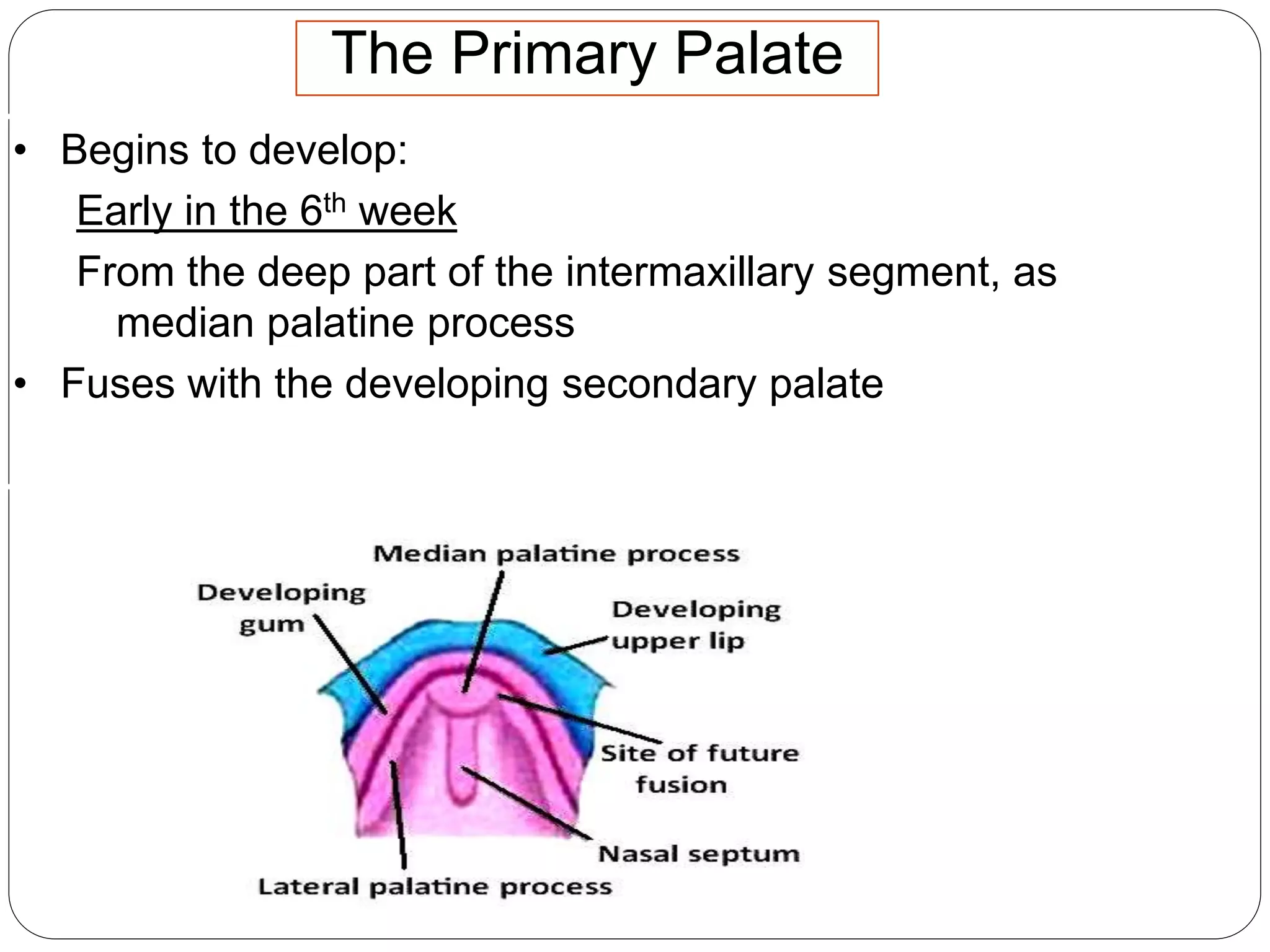
• Begins to develop:
Early in the 6th week
From the deep part of the intermaxillary segment, as
median palatine process
• Fuses with the developing secondary palate
The Secondary
Palate
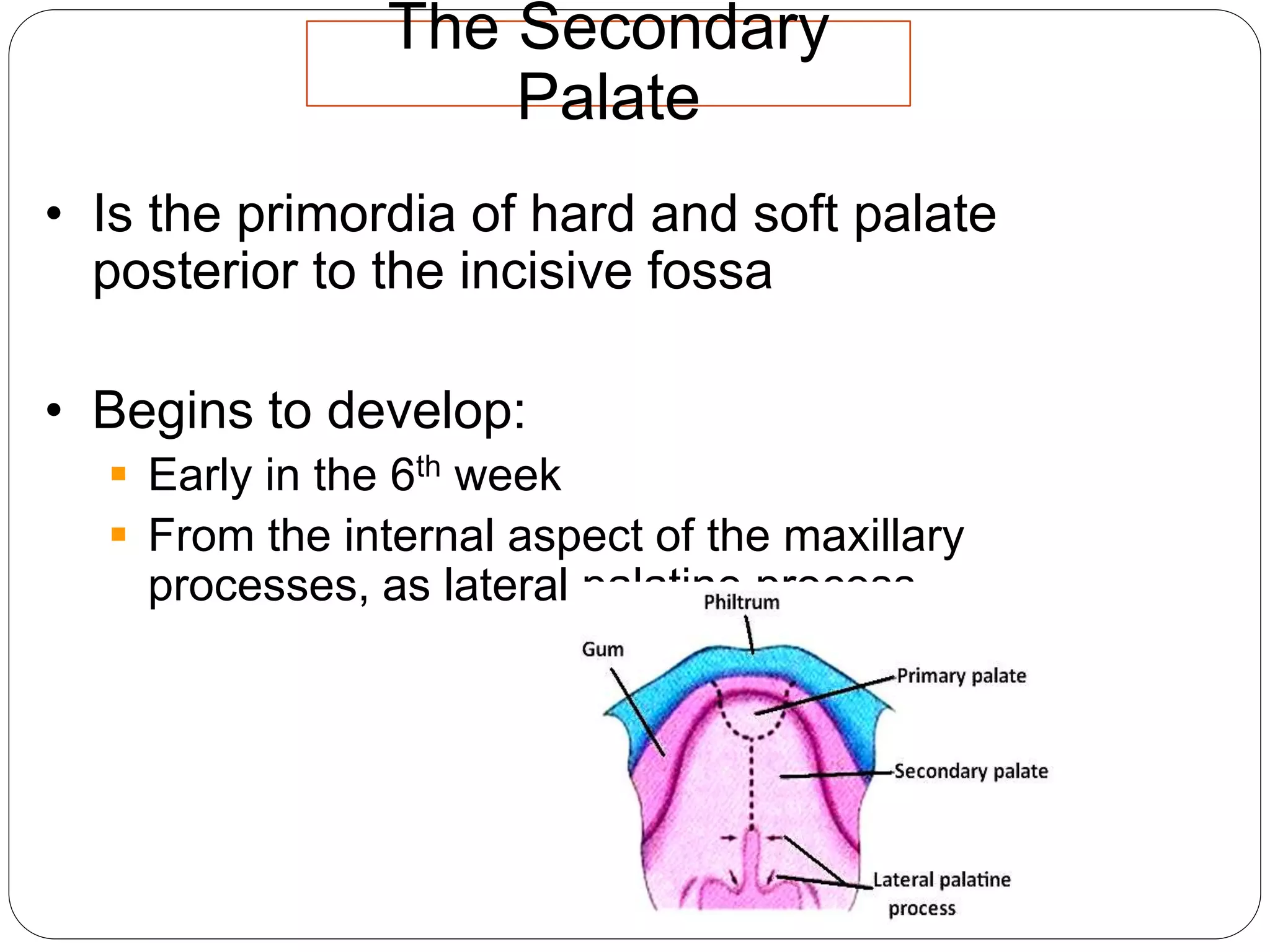
• Is the primordia of hard and soft palate
posterior to the incisive fossa
• Begins to develop:
 Early in the 6th week
 From the internal aspect of the maxillary
processes, as lateral palatine process
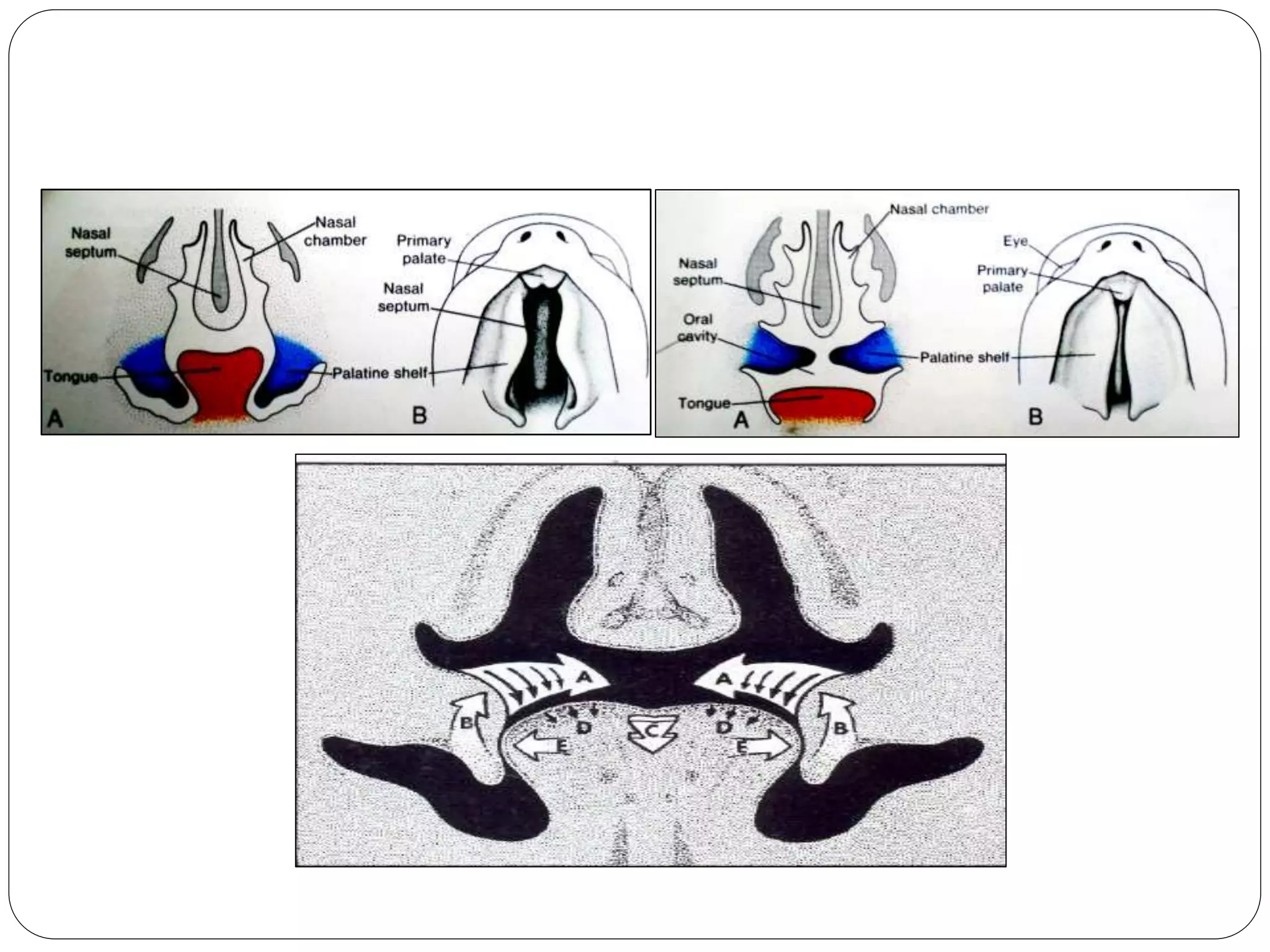
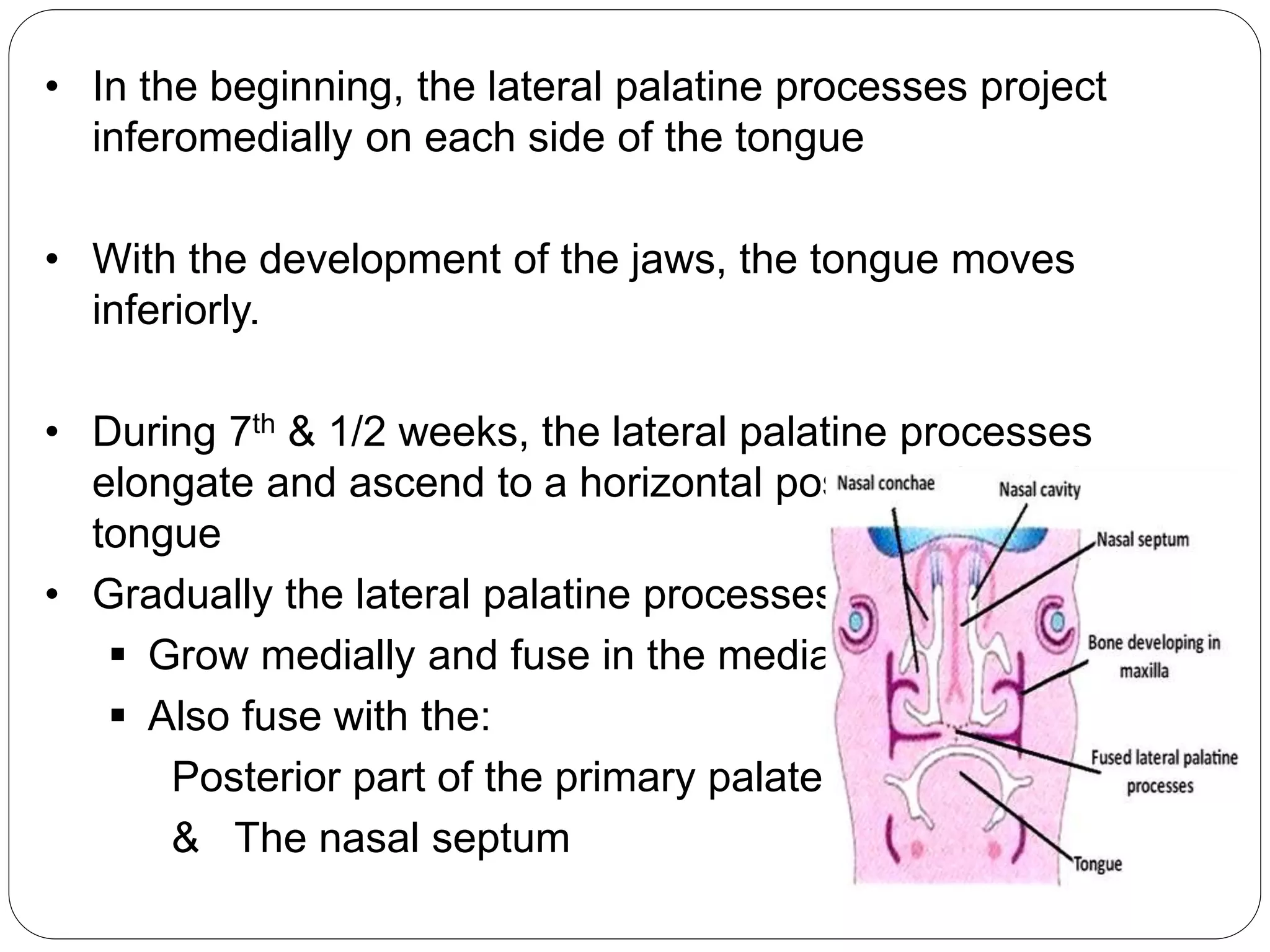
• In the beginning, the lateral palatine processes project
inferomedially on each side of the tongue
• With the development of the jaws, the tongue moves
inferiorly.
• During 7th & 1/2 weeks, the lateral palatine processes
elongate and ascend to a horizontal position above the
tongue
• Gradually the lateral palatine processes:
 Grow medially and fuse in the median plane
 Also fuse with the:
Posterior part of the primary palate
& The nasal septum
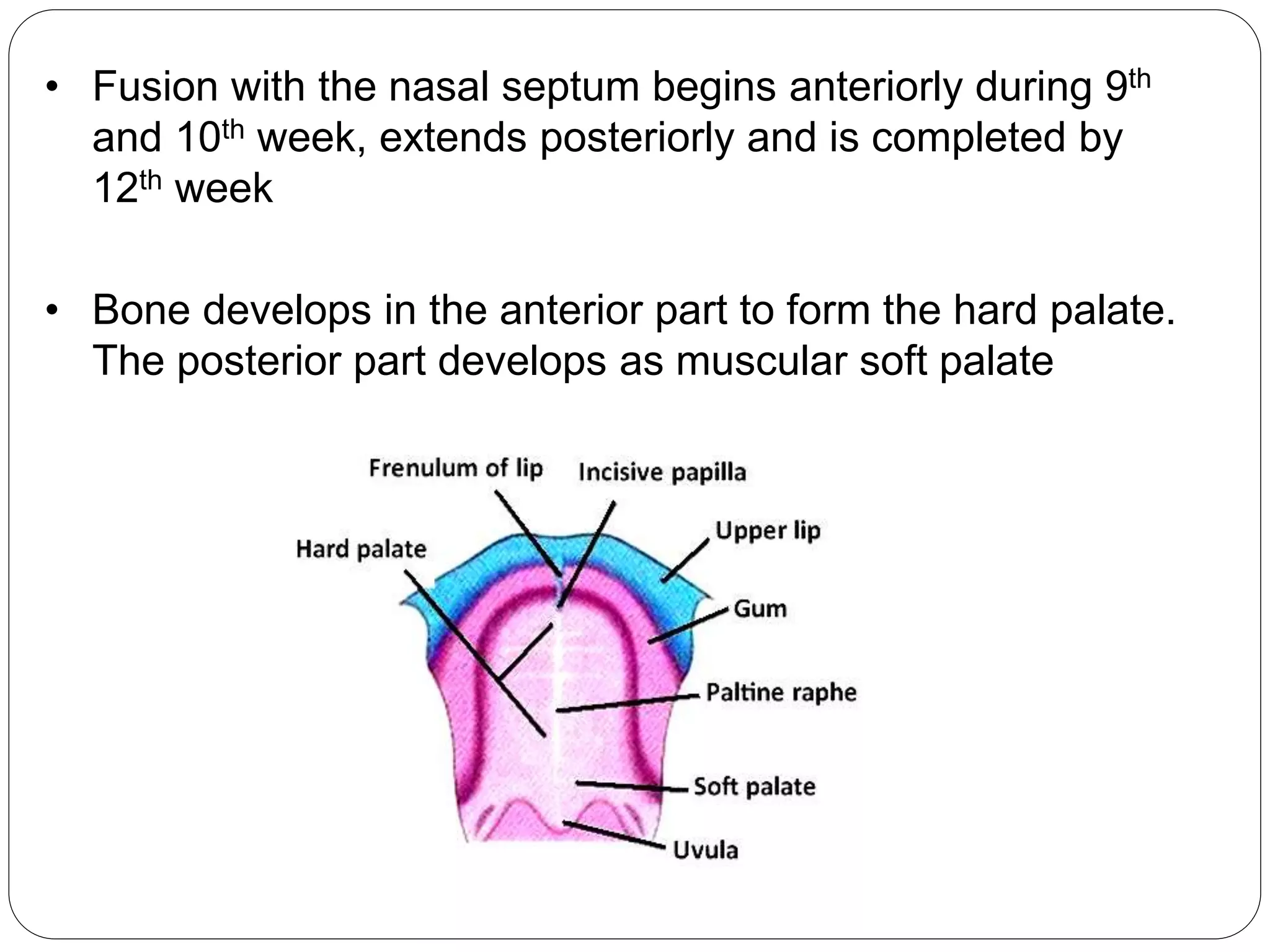
• Fusion with the nasal septum begins anteriorly during 9th
and 10th week, extends posteriorly and is completed by
12th week
• Bone develops in the anterior part to form the hard palate.
The posterior part develops as muscular soft palate
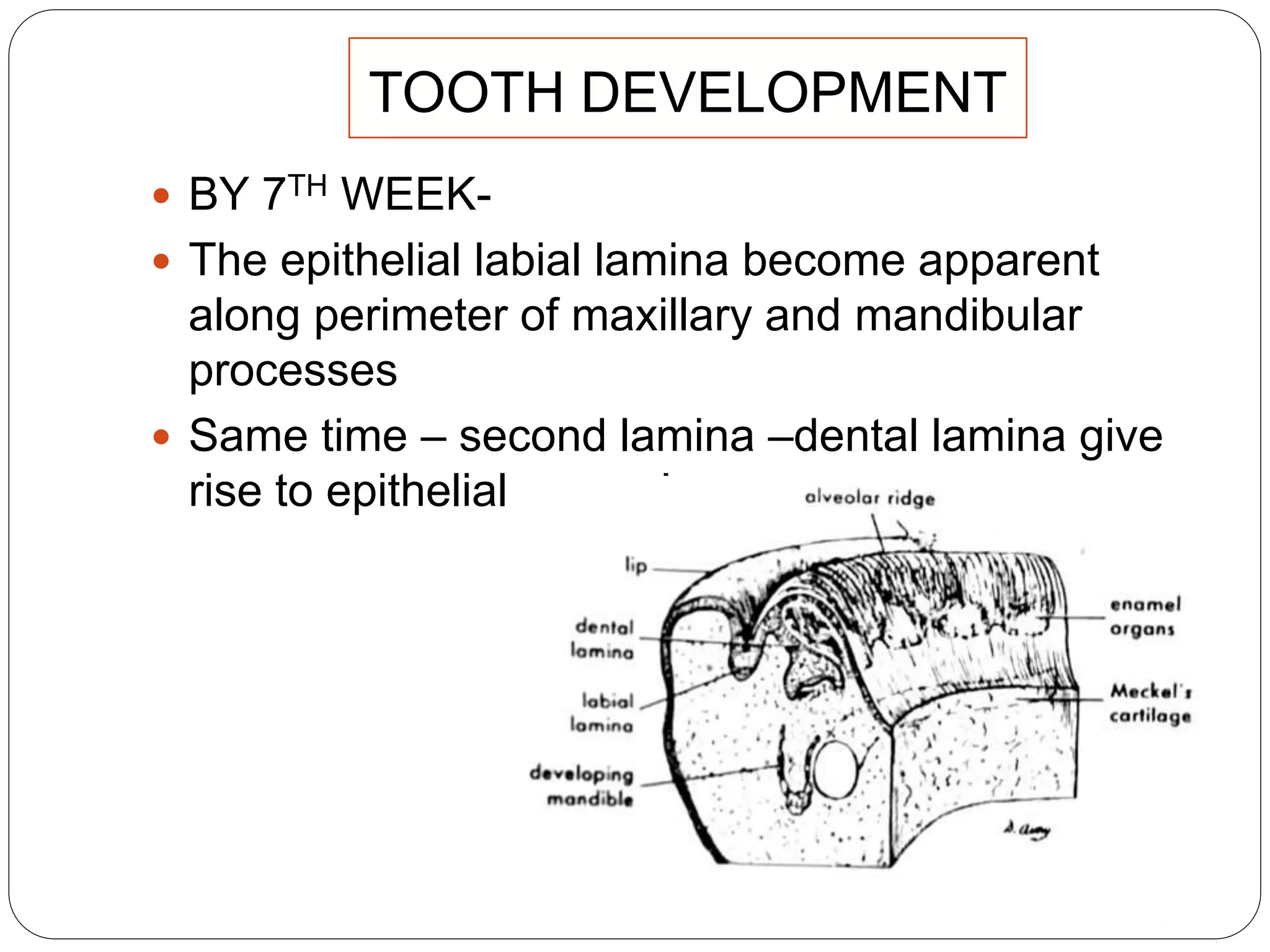
TOOTH DEVELOPMENT
 BY 7TH WEEK-
 The epithelial labial lamina become apparent
along perimeter of maxillary and mandibular
processes
 Same time – second lamina –dental lamina give
rise to epithelial enamel organ
Summary
 The external human face develops between the
4th and 6th weeks of embryonic development.
 Facial swellings arise on the frontonasal process
(2 medial nasal and 2 lateral nasal processes)
and the first pharyngeal arch (2 mandibular and 2
maxillary processes).
 By a process of merging and some localized
fusion these processes come together to form the
continuous surfaces of the external face.
 The primary palate is formed in this period by
fusion/merging of the medial nasal and maxillary
processes.
 Subsequently, between 6th and 12th
embryonic/fetal weeks, the secondary palate is
formed as the result of fusion between palatal
processes growing from the oral surfaces of the
maxillary processes. Each merging and fusion
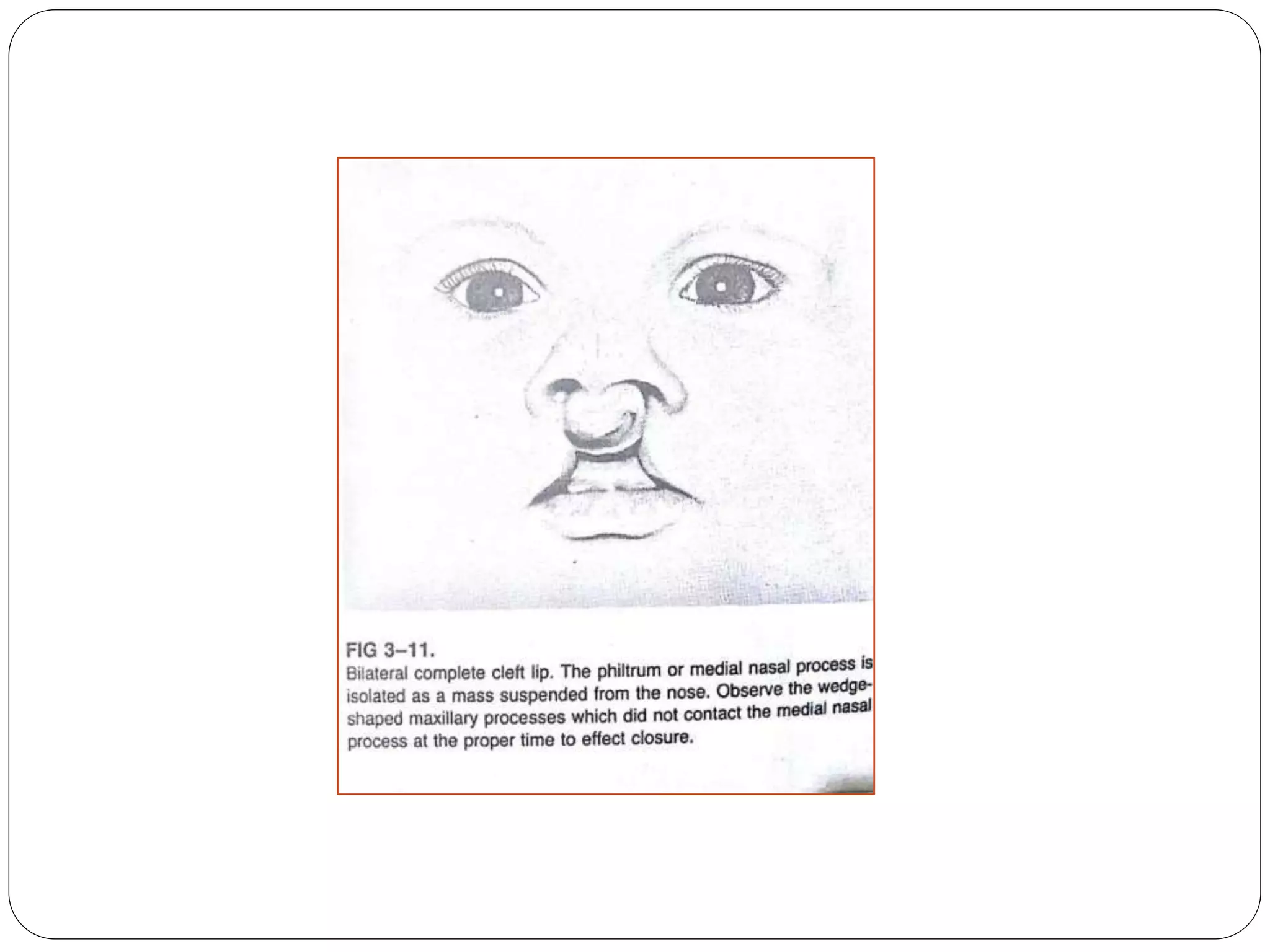
site is also the site of a potential facial or palatal
cleft.
THANK YOU

growth and development of face

  • 1.
    By Dr AninditaMallik 1st yr PG student EMBROYOGESESIS AND PRE NATAL FACE FORMATION
  • 2.
    Genetics Early embryonic development Phasesof development Preimplantation period Embroyonic period • Presomite • Somite • Postsomite Fetal period Anomalies of development Development of facial structures
  • 3.
    INTRODUCTION  Is theprocess by which the embryo forms and develops  starts with the fertilization of the egg cell (ovum) by a sperm cell, (spermatozoon)
  • 4.
    GENETICS  Concept ofgene as a unit of recombination refer as DNA nucleiotide base pair  Embryologically gene as a unit of function is a sequence of hundreds or thousands of nucleotides that specify the sequence of aa [makes up the primary structure of polypeptide]  Genome refers to the array of genes, haploid expressed as a functional genotype in development Physical and behavioral traits of an organism
  • 6.
     Gene controlsthe synthesis of protein formation  The longivity and proliferation of differentiated cells is also genetically determined by • continuous mitotics [short life spans] • Intermittent mitotics • Post mitotics [long life span]
  • 7.
    SIGNAL TRANSDUCTION  Transcriptionregulate the identity and patterning of embryonic structures and development of individual organs  A signaling center or node (eg, Hensen’s node) [cell group that regulates the behavior of surrounding cells by producing positive and negative intercellular signaling molecules]  Growth factors stimulate cell proliferation and differentiation by acting through specific receptors on responsive cells
  • 9.
     The developmentalontogeny of the craniofacial odontostomatognathic complex depends primarily on the following three elements:  1. Genetic factors: inherited genotype; expression of genetic mechanisms  2. Environmental factors: nutritional and biochemical interactions; physical phenomena—temperature, pressures, hydration, etc.  3. Functional factors: extrinsic and intrinsic forces of muscle actions, space-occupying cavities and organs, growth expansion, and atrophic attenuation
  • 10.
    EARLY EMBRYONIC DEVELOPMENT Fusionmale and female gametes development of a zygote—the first identification of an individual  The single totipotential cell (approximately 140 μm in diameter)
  • 12.
    EMBRYOGENESIS Phases Preimplantation period [first 7 days] Fetal period [the next 7 calendar months] Embroyoni c period [the next 7 weeks]
  • 13.
    PREIMPLANTATION PERIOD  first 2to 3 days post conception
  • 15.
    PERIOD OF EMBRYO This phase, from the end of the 1st week until the 8th week Embryotic stages presomite period (8 to 21 days post conception) primary germ layers of the embryo and the embryonic adnexa (fetal membranes) are formed in the inner cell mass) somite period (21to 31 days) appearance of prominent dorsal metameric segments, the basic patterns of the main body systems and organs are established postsomite (32 to 56 days) formation of the body’s external features
  • 16.
    PRESOMITE PERIOD Development ofEndoderm and Ectoderm The primordial embryonic germ disk is composed of two primary germ layers: • The Ectoderm floor of the amniotic cavity • Endoderm roof of the yolk sac  14th day endodermal thickening, the prechordal plate, appears in the future midcephalic region [head- organizing function]
  • 17.
    THE FETAL MEMBRANE Embryonic adnexa form membranes surrounding cavities  The main cavities and their membranes are the chorion and amnion, surrounding the fetus  Lesser cavities and their membranes are the yolk sac and a transient diverticulum, the allantois, that become incorporated into the umbilical cord, connected to the placenta, the chief organ of fetus  The amnion and yolk sac are separated by a bilaminar plate; this plate forms the embryonic disk
  • 18.
     After theinitial differentiation of the primary germ layers by reciprocal interactions between cells and tissues, segmentation is a feature of early embryogenesis  segmentation ectodermal neural tube four regions: forebrain, midbrain, hindbrain, and spinal cord, with the hindbrain further segmented into seven or eight rhombomeres  Paraxial mesoderm is segmented cranially into seven swellings termed somitomeres and caudally into 38 to 42 somites. The six pharyngeal arches are a third visibly segmented set of tissues
  • 19.
     The midlineaxis becomes defined by the formation of the notochord from the proliferation and differentiation of the cranial end of the primitive streak
  • 20.
     The prechordalplate is believed to perform a head-organizing function  The prechordal plate gives rise to a) Cephalic mesenchyme concerned with extrinsic eye muscle development b) Preoral gut (Seessel’s pouch) c) The prechordal plate prefaces the development of the orofacial region, giving rise later to the endodermal layer of the oro pharyngeal membrane
  • 21.
    PRIMARY GERM LAYERS ECTODERM skin and its appendages, the oral mucous membrane, and the enamel of teeth  MESODERM cardiovascularsystem (heart and blood vessels), the locomotor system (bones and muscles), connective tissues, and dental pulp  ENDODERM lining epithelium of the respiratory system and of the alimentary canal between the pharynx and the anus, as well as the secretory cells of the liver and pancreas.
  • 22.
    Development of theNeural Crest  Cytomesenchymal tissue, termed the neural crest from its site of origin  Translocated neural crest cells, upon reaching their predetermined destinations, undergo cytodifferentiation  Neural crest from the hindbrain arises from segments known as rhombomeres.
  • 23.
     21 –31 days  Ectodermal layer at the head end of embryo forms the neural plate  Major organs and tissues differentiate during this period thus making it susceptible to environmental influences. SOMITE PERIOD
  • 24.
     Neural crestcells leave neuroectoderm and enters mesoderm. mesoderm Lateral plate Intermediate Paraxial • Pleural, epicardial,peritone al cavity • Peripharyngeal connective tissue • Gonads • Kidneys • Adrenal cortex Incompletely segmented somitomeres Cranial sometomeric Ventral pharyngeal region Caudal paraxial Series of segmental blocks somit es
  • 26.
  • 27.
    Embronic disk develo ps Lateral, headand tail folds Enclosure of endodermal germ layer from yolk sac Incorporated into cranial end of embroyo Foregut{ant – oropharyng eal membrane} Incorporate d in caudal end Hindgut {vent- coacal membrane} Intervining portion of alimentary canal Midgut Laryngotracheal diverticulum Hepatic & pancreatic diverticulum Pharynx, pharyngeal pouches esophagus,stom ach,duodenum Decending colon &terminal part of alimentary canal Rest- duodenum, small intestine, ascending &transverse colon of large intestine
  • 29.
  • 30.
     Characterised bymost of the formation of organ • Cardiovascular • Alimentary • Respiratory • Genitourinary • Nervous system • Primordia of eye and inner ear  Complex and rapid organogenesis during 10th day somite period suceptibility increases
  • 31.
     32 –56 DAYS  Characterized by formation of external features and digit formation  Thoracic region swells heart is joined by growing liver, regression of tail  Facial features become recognizable  End of this phase - Embryo is now called fetus POST SOMITE PERIOD
  • 32.
     defined neckdue to its elongation and by sheathing of pharyngeal arches
  • 33.
     Last 7months  Rapid growth  first appearance of ossification centers and by the earliest movements by the fetus  Head size is reduced  Human face – 4th month PERIOD OF FETUS
  • 34.
     Increase inweight mainly occurs in last 2 months  Active sebacious glands -7th and 8th month-
  • 35.
    ANOMALIES OF DEVELOPMENT • ANENCEPHALYENCEPHALOCELES • CRANIORACHISCHISIS SPINA BIFIDA CYSTICA
  • 36.
    Development of face The most typical feature in the development of the head and neck is formed by the pharyngeal or branchial arches.  These arches appear in the 4th and 5th weeks of development and contribute to the characteristic external appearance of the embryo.  Initially there are bars of mesenchymal tissue separated by deep clefts known as pharyngeal or branchial clefts .
  • 37.
     With thedevelopment of the arches and clefts ,a number of outpocketings arise ,the pharyngeal pouches .  Although the development of pharyngeal arches ,clefts ,and pouches resembles formation of gills in fish and amphibia,in the human embryo; real gills (branchia)are never formed.  Therefore the term pharyngeal has been adapted.
  • 38.
     When theembryo is 4 ½ weeks old five mesenchymal prominenses can be recognised -the frontonasal prominence , a slightly rounded elevation cranial to the stomodeum -the maxillary prominences (dorsal portion of the 1st arch),lateral to the stomodeum ; -the mandibular prominences ,caudal to the stomodeum; -Development of face is later complemented by the formation of the nasal prominences . Stomodeum 1 Frontonasal prominence 2 Maxillary prominences 2 Mandibular prominences
  • 39.
    Pharyngeal arches  Each pharyngealarch is charecterized by its own muscular components ,their nerve component and it’s own arterial component.
  • 40.
     Nerve supplyto the muscles of the 1st arch is provided by Mandibular branch of Trigeminal nerve.  Sensory supply of the skin of the face is provided by Ophthalmic , Maxillary and Mandibular branches of the Trigeminal nerve.  Muscles of the different arches do not always attach to the bony or cartilagenous components of their own arch but sometimes migrate into surrounding regions. The origin of these muscles can be traced ,since their nerve supply is derived from the arch of origin.
  • 41.
    Second pharyngeal arch The cartilage of the second arch (hyoid arch)is called as REICHERT’S CARTILAGE which gives rise to the stapes, styloid process of the temporal bone, stylohyoid ligament, the lesser horn and upper part of the body of the hyoid bone .
  • 42.
     Muscles ofthe hyoid arch are the stapedius, stylohyoid, posterior belly of digastric ,auricular and mucles of facial expressions.  Facial nerve-the nerve of the 2nd arch supplies all these muscles.
  • 43.
    Third pharyngeal arch The cartilage of this arch produces the lower part of the body and the greater horn of the hyoid bone.  Muscle of this arch is the Stylopharyngeus muscle which is innervated by the Glossopharyngeal nerve.
  • 44.
    Fourth and Sixthpharyngeal arches  Cartilagenuos components of the 4th and 6th pharyngeal arches fuse to form the thyroid, cricoid , arytenoid , corniculate and cuneiform cartilages of the larynx.  Muscles of the fourth arch are supplied by the Superior laryngeal branch of the Vagus nerve and the intrinsic muscles of the larynx are supplied by Recurrent laryngeal branch of Vagus nerve
  • 45.
    Pharyngeal pouches  Thehuman embryo has five pairs of pharyngeal pouches.  The last one of these is atypical and is considered as a part of the 4th  First pharyngeal pouch: It forms a stalk like diverticulum –the tubotympanic recess;  one side of this comes in contact with the external auditary meatus  The distal aspect of this widens in a sac like structure ,the primitive tympanic or middle ear cavity  The proximal part remains narrow forming auditary (eustacian )tube.  The lining of the tympanic cavity forms the tympanic membrane or the eardrum
  • 46.
     Second pharyngealpouch: The epithelial lining forms the primordium of the palatine tonsil.  Third pharyngeal pouch: It is characterized by a dorsal and a ventral wing .The dorsal wing proliferates to form the inferior parathyroid gland and the ventral wing forms the thymus
  • 47.
     Fourth pharyngealpouch: Epithelium of the dorsal wing of this pouch forms the superior parathyroid gland.  Fifth pharyngeal pouch : The 5th pouch is the last one to develop and is considered to be a part of the 4th pouch. This pouch leads to the development of ultimobranchial body which in future leads to the development of thyroid gland.
  • 48.
    Pharyngeal grooves  The 2nd,3rd & 4th pharyngeal grooves merge together to form the cervical sinus which with further development disappears .  The 1st pharyngeal groove forms the external auditory meatus which is the only invagination on the side of the head.
  • 49.
    Pharyngeal cleft  The 5week embryo is characterized by the presence of 4 pharyngeal clefts of which only one contribute to the development of the definitive structure of the embryo.  The dorsal part of the 1st cleft gives rise to the external auditory meatus
  • 51.
    Introduction  The developmentof the face occurs mainly between 5 – 8 weeks  The lower jaw (mandible) is the first to form (4th week)  The facial proportions develop during the fetal period (9th week to birth)  During infancy & childhood, following the development of teeth and paranasal sinuses, the facial skeleton increases in size and contribute to the definitive shape of the face
  • 52.
  • 53.
    1. On eitherside of the frontal prominence are horseshoe-shaped elevations are found around the nasal placodes. a. Medial limbs are nasomedial processes b. Lateral limbs are nasolateral processes 2. Growing toward midline are the maxillary processes, approaching mandibular arches and merging with them at the angle of the mouth. a. Maxillary processes grow to crowd the nasal processes closer together. b. Nasomedial processes grow quickly, pushing the frontal prominence , then fuse with the maxillary processes to complete the arch of the stomodeu m 4 weeks 5.5 weeks 5 weeks 6 weeks 7 weeks 8 weeks maxillary process mandibular arch nasomedi al process philtrum
  • 54.
    stomodeu m 4 weeks 5.5 weeks 5weeks 6 weeks 7 weeks 8 weeks maxillary process mandibular arch THE FACE and ORAL REGION a. Face consists of a few primordial tissue masses partially surrounding the future oral region. b. The oral cavity (stomodeum) is an ectodermal depression separated from the foregut by the Oral plate formed of ectoderm on one side and endoderm on the other. c. The face is dominated by the frontal prominence of the overhanging forebrain. d. Laterally, the maxillary processes of the 1st branchial arch are visible.
  • 55.
    The frontonasal prominenceforms the:  Forehead and the bridge of the nose  Frontal and nasal bones The maxillary prominences form the:  Upper cheek regions and most of the upper lip  Maxilla, zygomatic bone, secondary palate Derivatives of Facial Components
  • 56.
    The mandibular processesfuse and form the:  Chin, lower lip, and lower cheek regions  Mandible The lateral nasal prominences form the ala of the nose The medial nasal prominences fuse and form the intermaxillary segment
  • 57.
    DEVELOPMENT OF MAXILLA Duringthe initial 2 weeks the maxillary prominences continue to increase in size . The cleft between the medial nasal prominences and the maxillary prominence is lost. Simultaneously they grow in a medial direction thereby compressing the medial nasal prominences toward the midline.
  • 58.
     Initially themaxillary and the lateral nasal prominences are separated by a deep furrow ,the nasolacrimal groove.  The nasolacrimal duct then runs from the medial corner of the eye to the inferior meatus of the nasal cavity.  The maxillary prominence then enlarge to form the cheek and maxillae .
  • 60.
    DEVELOPMENT OF MANDIBLE • Thefirst structure to develop in the region of the lower jaw is the mandibular division of the trigeminal nerve. • The prior presence of the nerve has been postulated as requisite for inducing osteogenesis by the production of neurotropic hormones. • MECKEL’S CARTILAGE , of the first branchial arch is responsible for the formation of mandible.
  • 61.
     Single ossificationcentre for each half of the mandible arises in the 6th week i.u.  Ossification begins below and around the Inferior Alveolar Nerve and its Incisive branch and upwards to form a trough for the developing teeth.  Spread of intramembranous ossification dorsally and ventrally forms the body and the Ramus of the mandible .
  • 62.
     The ascendingramus of the neonatal mandible is low and wide; the coronoid process is relatively large and projects well above the condyle , the body is merely an open shell containing the buds of the deciduous teeth.  The initial separation of the right and left bodies of the mandible at the midline SYMPHYSIS MENTI is gradually eliminated between the 4th and 12th months postnatally.
  • 64.
    Development of nose •By the end of 4th week, bilateral oval-shaped ectodermal thickenings called ‘nasal placodes’ appear on each side of the lower part of the frontonasal prominence • Nasal placodes are primordia of the nose and nasal cavities.
  • 65.
    • Mesenchymal cells proliferateat the margin of the placodes and produce horse-shoe shaped swellings around these. • The sides of these swellings are called ‘medial’ and ‘lateral’ nasal prominences • The placodes now lie in the floor of a depression called ‘nasal pits’Each lateral nasal prominence is separated from the maxillary swelling by nasolacrimal groove
  • 66.
    • With theformation of the medial and lateral nasal prominences, the nasal placodes lie in the floor of depressions called the nasal pits • By the end of 6th week, nasal pits deepen and form nasal sacs • Initially the nasal sacs are separated from the oral cavity by oronasal membrane. • The oronasal membrane ruptures by the 6th week, communicating the primitive nasal cavities with the oral cavity
  • 67.
    • The nasalseptum develops as a downgrowth from the internal parts of merged medial nasal prominences • Fuses with the palatine process in 9-12 weeks, superior to the hard palate
  • 68.
     The medialnasal swellings enlarge, grow medially and merge with each other in the midline to form the intermaxillary segment • The structure formed by the two merged prominences is called as the intermaxillary segment. It is composed of : 1. Labial component –which forms the philtrum of the upper lip. 2. Upper jaw component –which carries the four incisor teeth. 3. Palatal component-which forms the triangular primary palate
  • 69.
    Development of lips Lower lip :The mandibular processes of the two sides grow towards each other and fuse in the midline ,they form the lower margin of the stomatodeum .  Upper lip :Each maxillary process now grows medially and fuses, first with the lateral nasal process and the with the medial nasal process.
  • 70.
    Development of Ear  Thethree parts of the ear- -External -Middle and -Internal ,arise from separate ,diverse embryonic origins  The external ear forms around the first branchial groove which deepens to become the external acuostic meatus .  Malleus and Incus are derived from the dorsal end of the first branchial arch cartilage –MECKEL’S CARTILAGE.  Stapes - second branchial arch cartilage- REICHERT’S CARTILAGE .  This is the first sensory organ to begin development .
  • 71.
    lens placode Sinks belowto separate from surface ectoderm Appear as twin bulging directed laterally and lying between maxillary and lateral nasal process Come forward by narrowing of frontonasal process Eyelids : folds of ectoderm formed above and below the eyes mesoderm enclosed within the folds Development of Eye
  • 72.
     Tongue musculatureoriginates from the occipital myotomes at the beginning of the fourth week  grows anteriorly into the floor of the mouth  develops into an oral part-(the body) and a pharyngeal part (the base)  three primodia-the paired lateral lingual swellings, and a centrally located tuberculum impar Development of tongue
  • 73.
     fifth week,median elevation-the copula.  Sixth and seventh weeks, the lateral lingual swellings enlarge and relatively reduce -tuberculum impar.  Furrow apperance  The two lateral lingual swellings then merge  tongue grows so rapidly that it pushes into the nasal cavity above and between the two palatine shelves.
  • 75.
     At thejunction of the anterior 2/3rd and the posterior 1/3rd is a groove called as the SULCUS TERMINALIS.  Sensory innervation-2/3rd - Mandibular branch of Trigeminal nerve  Sensory innervation-1/3rd - Glossopharyngeal nerve .  Motor innervation Hypoglossal nerve  Special sensory innervation - Chorda tympani branch of Facial nerve
  • 76.
    Development of palate • Beginsat the end of the 5th week • Gets completed by the end of the 12th week • The most critical period for the development of palate is from the end of 6th week to the beginning of 9th week • Palate develops from two primordia-  -the primary palate  -the secondary palate
  • 77.
    The Primary Palate •Begins to develop: Early in the 6th week From the deep part of the intermaxillary segment, as median palatine process • Fuses with the developing secondary palate
  • 78.
    The Secondary Palate • Isthe primordia of hard and soft palate posterior to the incisive fossa • Begins to develop:  Early in the 6th week  From the internal aspect of the maxillary processes, as lateral palatine process
  • 79.
    • In thebeginning, the lateral palatine processes project inferomedially on each side of the tongue • With the development of the jaws, the tongue moves inferiorly. • During 7th & 1/2 weeks, the lateral palatine processes elongate and ascend to a horizontal position above the tongue • Gradually the lateral palatine processes:  Grow medially and fuse in the median plane  Also fuse with the: Posterior part of the primary palate & The nasal septum
  • 80.
    • Fusion withthe nasal septum begins anteriorly during 9th and 10th week, extends posteriorly and is completed by 12th week • Bone develops in the anterior part to form the hard palate. The posterior part develops as muscular soft palate
  • 81.
    TOOTH DEVELOPMENT  BY7TH WEEK-  The epithelial labial lamina become apparent along perimeter of maxillary and mandibular processes  Same time – second lamina –dental lamina give rise to epithelial enamel organ
  • 82.
    Summary  The externalhuman face develops between the 4th and 6th weeks of embryonic development.  Facial swellings arise on the frontonasal process (2 medial nasal and 2 lateral nasal processes) and the first pharyngeal arch (2 mandibular and 2 maxillary processes).  By a process of merging and some localized fusion these processes come together to form the continuous surfaces of the external face.
  • 83.
     The primarypalate is formed in this period by fusion/merging of the medial nasal and maxillary processes.  Subsequently, between 6th and 12th embryonic/fetal weeks, the secondary palate is formed as the result of fusion between palatal processes growing from the oral surfaces of the maxillary processes. Each merging and fusion site is also the site of a potential facial or palatal cleft.
  • 84.