Case conference  “Heart Failure”   From clinical to Basic Research 96/4/6  R 林軒名  / VS  陳業鵬
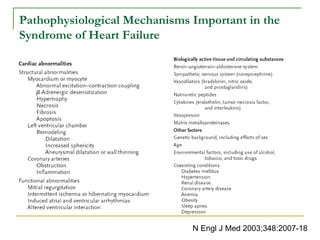
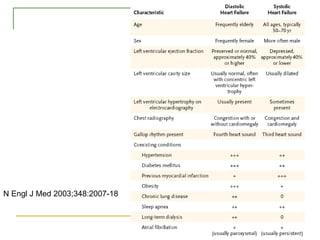
Pathophysiological Mechanisms Important in the Syndrome of Heart Failure  N Engl J Med 2003;348:2007-18
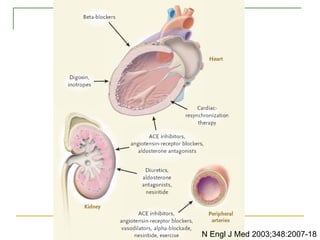
N Engl J Med 2003;348:2007-18
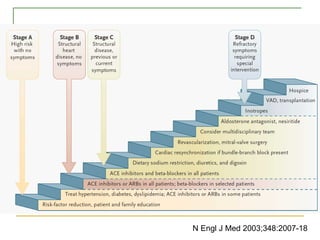
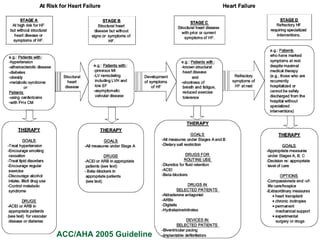
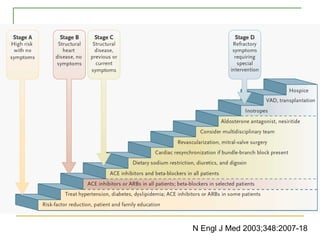
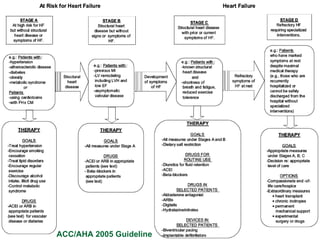
ACC/AHA 2005 Guideline
N Engl J Med 2003;348:2007-18
Heart failure  imbalance of energy and load
Ischemia Infarction Myopathy Hypertension Vulvular disease Myopathy Failing Heart Neurohormonal activation: Renin-Angioensin system, Adrenergic system, cytokine, etc. Peripheral alteration kidney, lung, muscel… Peripheral vascular resistence Journal of physiology  2003:055 Energy matabolism in heart failure Energy Loading
Medical Progress The Failing heart : An engine out of fuel N Engl J Med 2003;348:2007-18
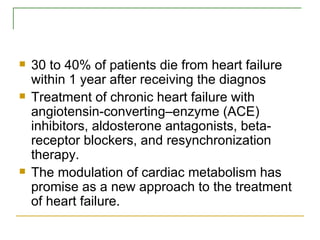
30 to 40% of patients die from heart failure within 1 year after receiving the diagnos Treatment of chronic heart failure with angiotensin-converting–enzyme (ACE) inhibitors, aldosterone antagonists, beta-receptor blockers, and resynchronization therapy. The modulation of cardiac metabolism has promise as a new approach to the treatment of heart failure.
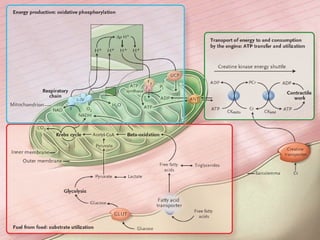
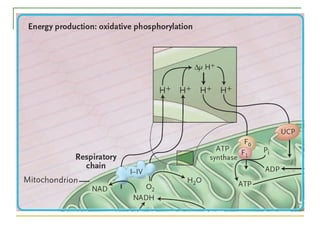
Cardiac energy metabolism Fuel form food: substrate utilization Glucose or free fatty acid breakdown Beta-oxidation and glycolysis, Kerb’s cycle. Mainly energy is from  Energy production: Oxidative phosphorylation. Mitochondria respiratory chain Transport of energy and consumption by the engine: ATP transfer and utilization.
 
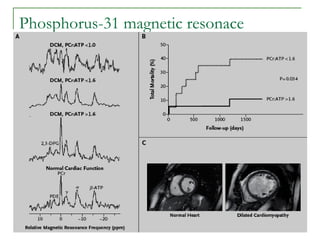
Assesment of cardiac energy system Phosphorus-31 magnetic resonace In vivo turnover rate of glucose and free fatty acid  Rate of oxidative phosphorylation and ATP transfer.
Phosphorus-31 magnetic resonace
Derangement of  “Substrate Utilization”  Free fatty acid:  unchange or sligh ▲ uptake   in early HF, ▼  uptake in advanced HF. Glucose ▲  uptake   in early HF ▼  uptake in advanced HF: insulin resistance develops in the myocardium In late HF, substantial increases in the concentrations of plasma free fatty acids, glucose, and insulin that are common.
 
Derangement of  “Oxidative phosphorylation” Cardiac mitochondria have  structural abnormalitie  and are probably increased in number. The activity of  electron transport–chain complexes  and  ATP synthase capacity  are reduced The regulation of  oxidative phosphorylation  by the phosphate acceptors ADP, AMP, and creatine is impaired The levels of  uncoupling proteins  may be increased. Result in a substantial reduction of oxygen consumption and energy production in the failing myocardium.
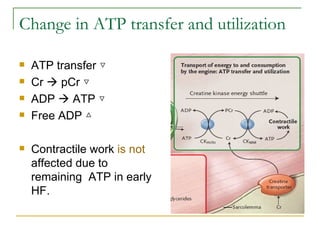
Change in ATP transfer and utilization ATP transfer ▽ Cr    pCr ▽ ADP    ATP ▽ Free ADP △ Contractile work  is not  affected due to remaining  ATP in early HF.
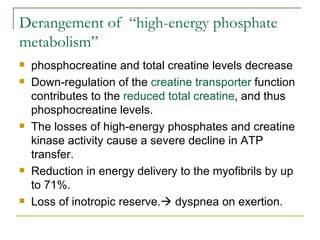
Derangement of  “high-energy phosphate metabolism” phosphocreatine and total creatine levels decrease Down-regulation of the  creatine transporter  function contributes to the  reduced total creatine , and thus phosphocreatine levels. The losses of high-energy phosphates and creatine kinase activity cause a severe decline in ATP transfer. Reduction in energy delivery to the myofibrils by up to 71%.  Loss of inotropic reserve.   dyspnea on exertion.
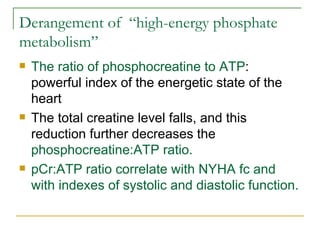
Derangement of  “high-energy phosphate metabolism” The ratio of phosphocreatine to ATP : powerful index of the energetic state of the heart The total creatine level falls, and this reduction further decreases the  phosphocreatine:ATP ratio.   pCr:ATP ratio correlate with NYHA fc and with indexes of systolic and diastolic function.
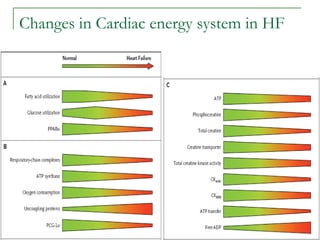
Changes in Cardiac energy system in HF
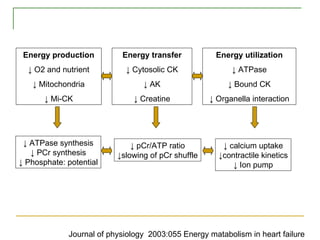
Energy production ↓ O2 and nutrient  ↓ Mitochondria ↓ Mi-CK Energy transfer ↓ Cytosolic CK ↓ AK ↓ Creatine Energy utilization ↓  ATPase ↓  Bound CK ↓  Organella interaction ↓  ATPase synthesis ↓  PCr synthesis ↓  Phosphate: potential ↓  pCr/ATP ratio ↓ slowing of pCr shuffle ↓ calcium uptake ↓contractile kinetics ↓ Ion pump Journal of physiology  2003:055 Energy matabolism in heart failure
Molecular Regulators of Energy Metabolism Proliferator–activated receptor (PPAR) :  PARα PPARβ PPARγ( PGC-1 ) Also see  Insulin-Resistant Heart Exhibits a Mitochondrial Biogenic Response Driven by the Peroxisome Proliferator-Activated Receptor-/PGC-1 Gene Regulatory Pathway Circulation . 2007;115:909-917.
PPARα PPARα controls the expression of enzymes directly involved in  fatty acid oxidation In cardiac Hypertrophy, the expression of  PPARα is decreased  in proportion to the depression of fatty acid utilization. The  down-regulation of PPARα  is thought to be the  main mechanism underlying the switch in substrate utilization from fatty acids to glucose.  This switch is typical of the hypertrophied heart.
PPARγ PPARγ coactivator-1 (also known as  PCG-1α ),  is a master regulator of metabolic function in mitochondria. Activates multiple genes : PPARα  and  PPARβ  and nuclear respiratory factors 1,2 For fatty acid uptake and oxidation and for oxidative phosphorylation. Inhibition of PCG-1α probably as a direct consequence of high plasma catecholamine levels, leads to down-regulation of mitochondrial gene expression.
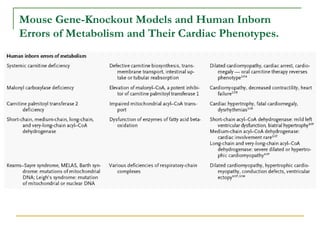
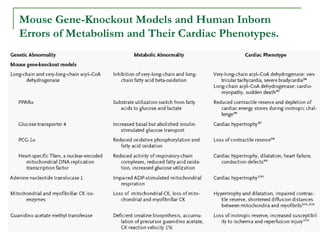
Mouse Gene-Knockout Models and Human Inborn Errors of Metabolism and Their Cardiac Phenotypes.
Modulation of Substrate Utilization Hint: intracoronary infusion of pyruvate glucagon-like peptide 1 transgenic overexpression of glucose transporter 1 Partial inhibition of fatty acid oxidation:  trimetazidine, perhexiline Carnitine palmitoyl transferase 1 inhibitor:  etoxomir
Modulation of Oxidative Phosphorylation Direct stimulation of oxidative phosphorylation is  not available Possible way : increasing PCG-1α activity as a means of up-regulating oxidative phosphorylation enzymes
Manipulation of High-Energy Phosphate Metabolites Creatine and phosphocreatine levels can be augmented by increasing the creatine transporter function ( not effective) Improve the myofibrillar efficiency of ATP utilization with new calcium-sensitizing or myosin activator compounds.
What is the big picture ? Truth of cardiac energy metabolism? Metabolic therapy of heart failure? Energy metabolism of other organ?
N Engl J Med 2003;348:2007-18
ACC/AHA 2005 Guideline

CHF What The Big Picture

  • 1.
    Case conference “Heart Failure” From clinical to Basic Research 96/4/6 R 林軒名 / VS 陳業鵬
  • 2.
    Pathophysiological Mechanisms Importantin the Syndrome of Heart Failure N Engl J Med 2003;348:2007-18
  • 3.
    N Engl JMed 2003;348:2007-18
  • 4.
    N Engl JMed 2003;348:2007-18
  • 5.
  • 6.
    N Engl JMed 2003;348:2007-18
  • 7.
    Heart failure imbalance of energy and load
  • 8.
    Ischemia Infarction MyopathyHypertension Vulvular disease Myopathy Failing Heart Neurohormonal activation: Renin-Angioensin system, Adrenergic system, cytokine, etc. Peripheral alteration kidney, lung, muscel… Peripheral vascular resistence Journal of physiology 2003:055 Energy matabolism in heart failure Energy Loading
  • 9.
    Medical Progress TheFailing heart : An engine out of fuel N Engl J Med 2003;348:2007-18
  • 10.
    30 to 40%of patients die from heart failure within 1 year after receiving the diagnos Treatment of chronic heart failure with angiotensin-converting–enzyme (ACE) inhibitors, aldosterone antagonists, beta-receptor blockers, and resynchronization therapy. The modulation of cardiac metabolism has promise as a new approach to the treatment of heart failure.
  • 11.
    Cardiac energy metabolismFuel form food: substrate utilization Glucose or free fatty acid breakdown Beta-oxidation and glycolysis, Kerb’s cycle. Mainly energy is from Energy production: Oxidative phosphorylation. Mitochondria respiratory chain Transport of energy and consumption by the engine: ATP transfer and utilization.
  • 12.
  • 13.
    Assesment of cardiacenergy system Phosphorus-31 magnetic resonace In vivo turnover rate of glucose and free fatty acid Rate of oxidative phosphorylation and ATP transfer.
  • 14.
  • 15.
    Derangement of “Substrate Utilization” Free fatty acid: unchange or sligh ▲ uptake in early HF, ▼ uptake in advanced HF. Glucose ▲ uptake in early HF ▼ uptake in advanced HF: insulin resistance develops in the myocardium In late HF, substantial increases in the concentrations of plasma free fatty acids, glucose, and insulin that are common.
  • 16.
  • 17.
    Derangement of “Oxidative phosphorylation” Cardiac mitochondria have structural abnormalitie and are probably increased in number. The activity of electron transport–chain complexes and ATP synthase capacity are reduced The regulation of oxidative phosphorylation by the phosphate acceptors ADP, AMP, and creatine is impaired The levels of uncoupling proteins may be increased. Result in a substantial reduction of oxygen consumption and energy production in the failing myocardium.
  • 18.
    Change in ATPtransfer and utilization ATP transfer ▽ Cr  pCr ▽ ADP  ATP ▽ Free ADP △ Contractile work is not affected due to remaining ATP in early HF.
  • 19.
    Derangement of “high-energy phosphate metabolism” phosphocreatine and total creatine levels decrease Down-regulation of the creatine transporter function contributes to the reduced total creatine , and thus phosphocreatine levels. The losses of high-energy phosphates and creatine kinase activity cause a severe decline in ATP transfer. Reduction in energy delivery to the myofibrils by up to 71%. Loss of inotropic reserve.  dyspnea on exertion.
  • 20.
    Derangement of “high-energy phosphate metabolism” The ratio of phosphocreatine to ATP : powerful index of the energetic state of the heart The total creatine level falls, and this reduction further decreases the phosphocreatine:ATP ratio. pCr:ATP ratio correlate with NYHA fc and with indexes of systolic and diastolic function.
  • 21.
    Changes in Cardiacenergy system in HF
  • 22.
    Energy production ↓O2 and nutrient ↓ Mitochondria ↓ Mi-CK Energy transfer ↓ Cytosolic CK ↓ AK ↓ Creatine Energy utilization ↓ ATPase ↓ Bound CK ↓ Organella interaction ↓ ATPase synthesis ↓ PCr synthesis ↓ Phosphate: potential ↓ pCr/ATP ratio ↓ slowing of pCr shuffle ↓ calcium uptake ↓contractile kinetics ↓ Ion pump Journal of physiology 2003:055 Energy matabolism in heart failure
  • 23.
    Molecular Regulators ofEnergy Metabolism Proliferator–activated receptor (PPAR) : PARα PPARβ PPARγ( PGC-1 ) Also see Insulin-Resistant Heart Exhibits a Mitochondrial Biogenic Response Driven by the Peroxisome Proliferator-Activated Receptor-/PGC-1 Gene Regulatory Pathway Circulation . 2007;115:909-917.
  • 24.
    PPARα PPARα controlsthe expression of enzymes directly involved in fatty acid oxidation In cardiac Hypertrophy, the expression of PPARα is decreased in proportion to the depression of fatty acid utilization. The down-regulation of PPARα is thought to be the main mechanism underlying the switch in substrate utilization from fatty acids to glucose. This switch is typical of the hypertrophied heart.
  • 25.
    PPARγ PPARγ coactivator-1(also known as PCG-1α ), is a master regulator of metabolic function in mitochondria. Activates multiple genes : PPARα and PPARβ and nuclear respiratory factors 1,2 For fatty acid uptake and oxidation and for oxidative phosphorylation. Inhibition of PCG-1α probably as a direct consequence of high plasma catecholamine levels, leads to down-regulation of mitochondrial gene expression.
  • 26.
    Mouse Gene-Knockout Modelsand Human Inborn Errors of Metabolism and Their Cardiac Phenotypes.
  • 27.
    Mouse Gene-Knockout Modelsand Human Inborn Errors of Metabolism and Their Cardiac Phenotypes.
  • 28.
    Modulation of SubstrateUtilization Hint: intracoronary infusion of pyruvate glucagon-like peptide 1 transgenic overexpression of glucose transporter 1 Partial inhibition of fatty acid oxidation: trimetazidine, perhexiline Carnitine palmitoyl transferase 1 inhibitor: etoxomir
  • 29.
    Modulation of OxidativePhosphorylation Direct stimulation of oxidative phosphorylation is not available Possible way : increasing PCG-1α activity as a means of up-regulating oxidative phosphorylation enzymes
  • 30.
    Manipulation of High-EnergyPhosphate Metabolites Creatine and phosphocreatine levels can be augmented by increasing the creatine transporter function ( not effective) Improve the myofibrillar efficiency of ATP utilization with new calcium-sensitizing or myosin activator compounds.
  • 31.
    What is thebig picture ? Truth of cardiac energy metabolism? Metabolic therapy of heart failure? Energy metabolism of other organ?
  • 32.
    N Engl JMed 2003;348:2007-18
  • 33.