Recent Advances in Congestive Cardiac Failure
Presenter-
Dr Nikita Ingale
JR3,
Pharmacology GMCH Nagpur
Guide-
Dr Vijay Motghare
Professor and Head,
Pharmacology GMCH Nagpur
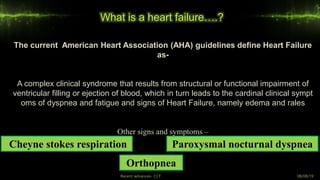
What is a heart failure….?
Recent advances- CCF 08/08/19
The current American Heart Association (AHA) guidelines define Heart Failure
as-
A complex clinical syndrome that results from structural or functional impairment of
ventricular filling or ejection of blood, which in turn leads to the cardinal clinical sympt
oms of dyspnea and fatigue and signs of Heart Failure, namely edema and rales
Other signs and symptoms –
Orthopnea
Paroxysmal nocturnal dyspneaCheyne stokes respiration
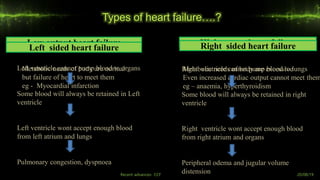
Types of heart failure….?
Recent advances- CCF 20/08/19
High output heart failureLow output heart failure
Metabolic needs of body are normal
but failure of heart to meet them
eg - Myocardial infarction
Metabolic needs of body are excessive
Even increased cardiac output cannot meet them
eg – anaemia, hyperthyroidism
Right sided heart failureLeft sided heart failure
Left ventricle cannot pump blood to organs
Some blood will always be retained in Left
ventricle
Left ventricle wont accept enough blood
from left atrium and lungs
Pulmonary congestion, dyspnoea
Right ventricle cannot pump blood to lungs
Some blood will always be retained in right
ventricle
Right ventricle wont accept enough blood
from right atrium and organs
Peripheral odema and jugular volume
distension
Newyork Heart Association Classification
Class 1 Patients with cardiac disease but without resulting limitation of physical activity.
Ordinary physical activity does not cause undue fatigue, palpitations, dyspnea or
anginal pain.
Class 2 Patients with cardiac disease resulting in slight limitation of physical activity. They
are comfortable at rest. Ordinary physical activity results in fatigue, palpitation,
dyspnea or anginal pain.
Class 3 Patients with cardiac disease resulting in marked limitation of physical activity.
They are comfortable at rest. Less than ordinary activity causes fatigue, palpitation
dyspnea or anginal pain.
Class 4 Patients with cardiac disease resulting in inability to carry on any physical activity
without discomfort. Symptoms of heart failure or the anginal syndrome may be
present even at rest. If any physical activity is undertaken, discomfort is increased.
Recent advances- CCF 20/08/19
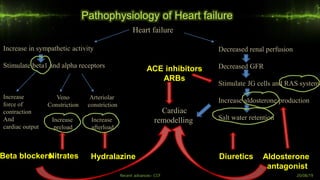
Pathophysiology of Heart failure
Heart failure
Increase in sympathetic activity
Stimulate beta1 and alpha receptors
Increase
force of
contraction
And
cardiac output
Veno
Constriction
Increase
preload
Arteriolar
constriction
Increase
afterload
Decreased renal perfusion
Decreased GFR
Stimulate JG cells and RAS system
Increase aldosterone production
Salt water retention
Nitrates HydralazineBeta blockers
ACE inhibitors
ARBs
Diuretics Aldosterone
antagonist
Cardiac
remodelling
Recent advances- CCF 20/08/19
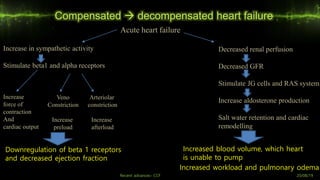
Compensated  decompensated heart failure
Acute heart failure
Increase in sympathetic activity
Stimulate beta1 and alpha receptors
Increase
force of
contraction
And
cardiac output
Veno
Constriction
Increase
preload
Arteriolar
constriction
Increase
afterload
Decreased renal perfusion
Decreased GFR
Stimulate JG cells and RAS system
Increase aldosterone production
Salt water retention and cardiac
remodelling
Downregulation of beta 1 receptors
and decreased ejection fraction
Increased blood volume, which heart
is unable to pump
Increased workload and pulmonary odema
Recent advances- CCF 20/08/19
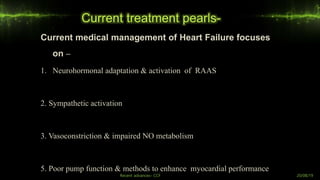
Current treatment pearls-
Current medical management of Heart Failure focuses
on –
1. Neurohormonal adaptation & activation of RAAS
2. Sympathetic activation
3. Vasoconstriction & impaired NO metabolism
5. Poor pump function & methods to enhance myocardial performance
Recent advances- CCF 20/08/19
Why new therapies?
• Available drugs treat only symptomatically, few of them don’t
even control symptoms effectively
• Associated side effects are more
• Needed life long treatment
• Heart Failure is associated with high morbidity and mortality
Recent advances- CCF 20/08/19
New drug therapies in heart failure-
Nesiritide [synthetic BNP analogue]
Angiotensin receptor neprilysin inhibitor(ARNI)
Levosimendan, pimobendan [myofibril calcium sensitizers]
Recent advances- CCF 20/08/19
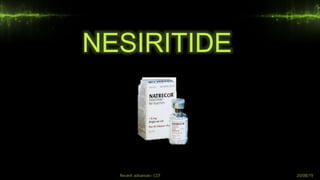
NESIRITIDE
Recent advances- CCF 20/08/19
Nesiritide -
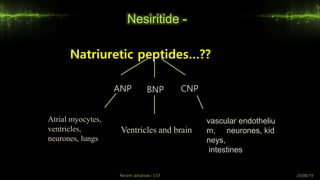
Natriuretic peptides…??
ANP BNP CNP
Atrial myocytes,
ventricles,
neurones, lungs
vascular endotheliu
m, neurones, kid
neys,
intestines
Ventricles and brain
Recent advances- CCF 20/08/19
Brain Natriuretic Peptide -
Recent advances- CCF 20/08/19
- Normally, ANP and BNP are expressed in the atria and released on increased preload (stretch).
- During heart failure, ANP and BNP are also produced by the ventricles, such that plasma level
are elevated. [BNP is used as a biomarker of heart failure]
- ANP and BNP stimulate the plasma membrane guanylyl cyclase
Brain Natriuretic Peptide -
Kidney – increased cGMP has diuretic effects
Vessels – increased cGMP has vasodilatory effects
- Heart – increased cGMP has antihypertrophic, antifibrotic effects
Recent advances- CCF 20/08/19
Nesiritide -
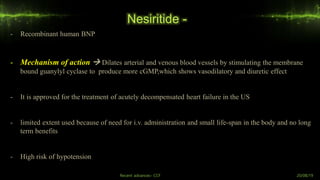
- Recombinant human BNP
- Mechanism of action  Dilates arterial and venous blood vessels by stimulating the membrane
bound guanylyl cyclase to produce more cGMP,which shows vasodilatory and diuretic effect
- It is approved for the treatment of acutely decompensated heart failure in the US
- limited extent used because of need for i.v. administration and small life-span in the body and no long
term benefits
- High risk of hypotension
Recent advances- CCF 20/08/19
New drug therapies in heart failure-
Nesiritide [synthetic BNP analogue]
Angiotensin receptor neprilysin inhibitor(ARNI)
Levosimendan, pimobendan [myofibril calcium sensitizers]
Recent advances- CCF 20/08/19
SACUBITRIL
&
VALSARTAN
Recent advances- CCF 20/08/19
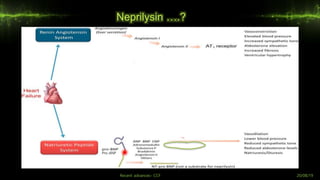
Neprilysin ….?
Pro-ANP
Recent advances- CCF 20/08/19
Sacubitril - valsartan
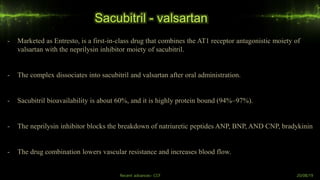
- Marketed as Entresto, is a first-in-class drug that combines the AT1 receptor antagonistic moiety of
valsartan with the neprilysin inhibitor moiety of sacubitril.
- The complex dissociates into sacubitril and valsartan after oral administration.
- Sacubitril bioavailability is about 60%, and it is highly protein bound (94%–97%).
- The neprilysin inhibitor blocks the breakdown of natriuretic peptides ANP, BNP, AND CNP, bradykinin
- The drug combination lowers vascular resistance and increases blood flow.
Recent advances- CCF 20/08/19
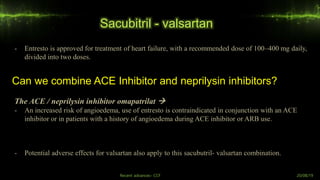
- Entresto is approved for treatment of heart failure, with a recommended dose of 100–400 mg daily,
divided into two doses.
The ACE / neprilysin inhibitor omapatrilat 
- An increased risk of angioedema, use of entresto is contraindicated in conjunction with an ACE
inhibitor or in patients with a history of angioedema during ACE inhibitor or ARB use.
- Potential adverse effects for valsartan also apply to this sacubutril- valsartan combination.
Sacubitril - valsartan
Recent advances- CCF 20/08/19
Can we combine ACE Inhibitor and neprilysin inhibitors?
New drug therapies in heart failure-
Nesiritide [synthetic BNP analogue]
Angiotensin receptor neprilysin inhibitor(ARNI)
Levosimendan, pimobendan [myofibril calcium sensitizers]
Recent advances- CCF 20/08/19
LEVOSIMENDAN
Recent advances- CCF 20/08/19
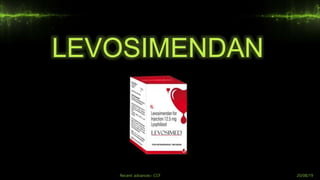
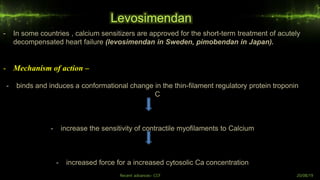
Levosimendan
- In some countries , calcium sensitizers are approved for the short-term treatment of acutely
decompensated heart failure (levosimendan in Sweden, pimobendan in Japan).
- Mechanism of action –
- binds and induces a conformational change in the thin-filament regulatory protein troponin
C
- increase the sensitivity of contractile myofilaments to Calcium
- increased force for a increased cytosolic Ca concentration
Recent advances- CCF 20/08/19
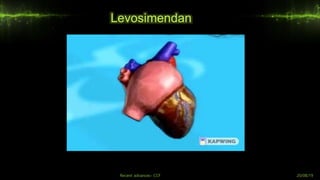
Levosimendan
Recent advances- CCF 20/08/19
Levosimendan
- Other actions –
- 1] inhibiting PDE3
- 2] It also opens ATP-sensitive K' channels in vascular smooth muscle cells to cause vasodilatation
- Infused i.v.  primarily indicated for short-term treatment of acutely decompensated severe chronic
heart failure
- Though it relieved symptoms of heart failure, but survival rate was not improved.
- Side effects
- The most common side effect is hypotension which may last for few days due to its active
metabolite that has long t1⁄2
Recent advances- CCF 20/08/19
IVABRADINE
Recent advances- CCF 20/08/19
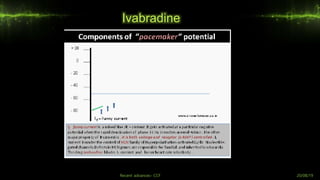
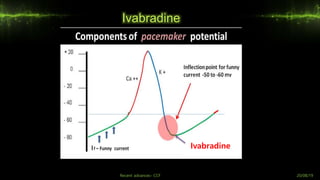
What so funny about the funny currents..?
Funny currents [If]
Recent advances- CCF 20/08/19
Ivabradine
Recent advances- CCF 20/08/19
Ivabradine
Ivabradine
Recent advances- CCF 20/08/19
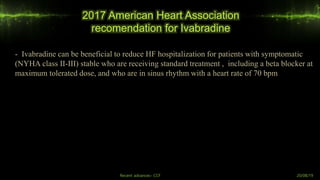
2017 American Heart Association
recomendation for Ivabradine
Recent advances- CCF 20/08/19
- Ivabradine can be beneficial to reduce HF hospitalization for patients with symptomatic
(NYHA class II-III) stable who are receiving standard treatment , including a beta blocker at
maximum tolerated dose, and who are in sinus rhythm with a heart rate of 70 bpm
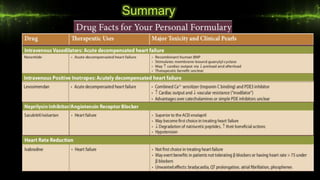
Summary
Recent advances- CCF 08/0819
References -
1] O’Connor CM, et al. Effect of nesiritide in patients with acute decompensated heart failure. N Engl J Med, 2011, 365:32
2]Lakatta EG, DiFrancesco D. What keeps us ticking: a funny current, a calcium clock, or both? J Mol Cell Cardiol, 2009,
47:157–170
3] Schober T, et al. Myofilament Ca sensitization increases cytosolic Ca binding affinity, alters intracellular Ca
homeostasis, and causes pause- dependent Ca-triggered arrhythmia. Circ Res, 2012, 111:170–179.
4] Teerlink JR, et al. Serelaxin, recombinant human relaxin-2, for treatment of acute heart failure (RELAX-AHF): a
randomised, placebo-controlled trial. Lancet, 2013, 381:29–39
5] McMurray JJ, et al. Angiotensin-neprilysin inhibition versus enalapril in heart failure. N Engl J Med, 2014, 371:993–10
References -
6]Mebazaa A, et al. Levosimendan for patients with acute decompensated heart failure: the SURVIVE Random
ized Trial. JAMA, 2007, 297:1883–1891
7] Goodman, L., Gilman, A. and Brunton, L. 13th edition, Goodman & Gilman's manual of pharmacology and
therapeutics. Management of heart failure, New York: McGraw-Hill Medical. P1023-47
8] HL Sharma & KK Sharma. Heart failure, sharma and sharma’s principles of pharmacology.3rd edition.
hyderabad, Paras Medical Publisher;2017.p699-847
9] 2017 Focused Update of American Heart Association Guidelines for the Management of Heart Failure
Next PG Activity-
Journal reporting
Dr Anisha
21/08/19
Recent advances- CCF 08/0819
C
Recent advances- CCF 08/0819

Recent advances in congestive cardiac failure

  • 1.
    Recent Advances inCongestive Cardiac Failure Presenter- Dr Nikita Ingale JR3, Pharmacology GMCH Nagpur Guide- Dr Vijay Motghare Professor and Head, Pharmacology GMCH Nagpur
  • 2.
    What is aheart failure….? Recent advances- CCF 08/08/19 The current American Heart Association (AHA) guidelines define Heart Failure as- A complex clinical syndrome that results from structural or functional impairment of ventricular filling or ejection of blood, which in turn leads to the cardinal clinical sympt oms of dyspnea and fatigue and signs of Heart Failure, namely edema and rales Other signs and symptoms – Orthopnea Paroxysmal nocturnal dyspneaCheyne stokes respiration
  • 3.
    Types of heartfailure….? Recent advances- CCF 20/08/19 High output heart failureLow output heart failure Metabolic needs of body are normal but failure of heart to meet them eg - Myocardial infarction Metabolic needs of body are excessive Even increased cardiac output cannot meet them eg – anaemia, hyperthyroidism Right sided heart failureLeft sided heart failure Left ventricle cannot pump blood to organs Some blood will always be retained in Left ventricle Left ventricle wont accept enough blood from left atrium and lungs Pulmonary congestion, dyspnoea Right ventricle cannot pump blood to lungs Some blood will always be retained in right ventricle Right ventricle wont accept enough blood from right atrium and organs Peripheral odema and jugular volume distension
  • 4.
    Newyork Heart AssociationClassification Class 1 Patients with cardiac disease but without resulting limitation of physical activity. Ordinary physical activity does not cause undue fatigue, palpitations, dyspnea or anginal pain. Class 2 Patients with cardiac disease resulting in slight limitation of physical activity. They are comfortable at rest. Ordinary physical activity results in fatigue, palpitation, dyspnea or anginal pain. Class 3 Patients with cardiac disease resulting in marked limitation of physical activity. They are comfortable at rest. Less than ordinary activity causes fatigue, palpitation dyspnea or anginal pain. Class 4 Patients with cardiac disease resulting in inability to carry on any physical activity without discomfort. Symptoms of heart failure or the anginal syndrome may be present even at rest. If any physical activity is undertaken, discomfort is increased. Recent advances- CCF 20/08/19
  • 5.
    Pathophysiology of Heartfailure Heart failure Increase in sympathetic activity Stimulate beta1 and alpha receptors Increase force of contraction And cardiac output Veno Constriction Increase preload Arteriolar constriction Increase afterload Decreased renal perfusion Decreased GFR Stimulate JG cells and RAS system Increase aldosterone production Salt water retention Nitrates HydralazineBeta blockers ACE inhibitors ARBs Diuretics Aldosterone antagonist Cardiac remodelling Recent advances- CCF 20/08/19
  • 6.
    Compensated  decompensatedheart failure Acute heart failure Increase in sympathetic activity Stimulate beta1 and alpha receptors Increase force of contraction And cardiac output Veno Constriction Increase preload Arteriolar constriction Increase afterload Decreased renal perfusion Decreased GFR Stimulate JG cells and RAS system Increase aldosterone production Salt water retention and cardiac remodelling Downregulation of beta 1 receptors and decreased ejection fraction Increased blood volume, which heart is unable to pump Increased workload and pulmonary odema Recent advances- CCF 20/08/19
  • 7.
    Current treatment pearls- Currentmedical management of Heart Failure focuses on – 1. Neurohormonal adaptation & activation of RAAS 2. Sympathetic activation 3. Vasoconstriction & impaired NO metabolism 5. Poor pump function & methods to enhance myocardial performance Recent advances- CCF 20/08/19
  • 8.
    Why new therapies? •Available drugs treat only symptomatically, few of them don’t even control symptoms effectively • Associated side effects are more • Needed life long treatment • Heart Failure is associated with high morbidity and mortality Recent advances- CCF 20/08/19
  • 9.
    New drug therapiesin heart failure- Nesiritide [synthetic BNP analogue] Angiotensin receptor neprilysin inhibitor(ARNI) Levosimendan, pimobendan [myofibril calcium sensitizers] Recent advances- CCF 20/08/19
  • 10.
  • 11.
    Nesiritide - Natriuretic peptides…?? ANPBNP CNP Atrial myocytes, ventricles, neurones, lungs vascular endotheliu m, neurones, kid neys, intestines Ventricles and brain Recent advances- CCF 20/08/19
  • 12.
    Brain Natriuretic Peptide- Recent advances- CCF 20/08/19
  • 13.
    - Normally, ANPand BNP are expressed in the atria and released on increased preload (stretch). - During heart failure, ANP and BNP are also produced by the ventricles, such that plasma level are elevated. [BNP is used as a biomarker of heart failure] - ANP and BNP stimulate the plasma membrane guanylyl cyclase Brain Natriuretic Peptide - Kidney – increased cGMP has diuretic effects Vessels – increased cGMP has vasodilatory effects - Heart – increased cGMP has antihypertrophic, antifibrotic effects Recent advances- CCF 20/08/19
  • 14.
    Nesiritide - - Recombinanthuman BNP - Mechanism of action  Dilates arterial and venous blood vessels by stimulating the membrane bound guanylyl cyclase to produce more cGMP,which shows vasodilatory and diuretic effect - It is approved for the treatment of acutely decompensated heart failure in the US - limited extent used because of need for i.v. administration and small life-span in the body and no long term benefits - High risk of hypotension Recent advances- CCF 20/08/19
  • 15.
    New drug therapiesin heart failure- Nesiritide [synthetic BNP analogue] Angiotensin receptor neprilysin inhibitor(ARNI) Levosimendan, pimobendan [myofibril calcium sensitizers] Recent advances- CCF 20/08/19
  • 16.
  • 17.
  • 18.
    Sacubitril - valsartan -Marketed as Entresto, is a first-in-class drug that combines the AT1 receptor antagonistic moiety of valsartan with the neprilysin inhibitor moiety of sacubitril. - The complex dissociates into sacubitril and valsartan after oral administration. - Sacubitril bioavailability is about 60%, and it is highly protein bound (94%–97%). - The neprilysin inhibitor blocks the breakdown of natriuretic peptides ANP, BNP, AND CNP, bradykinin - The drug combination lowers vascular resistance and increases blood flow. Recent advances- CCF 20/08/19
  • 19.
    - Entresto isapproved for treatment of heart failure, with a recommended dose of 100–400 mg daily, divided into two doses. The ACE / neprilysin inhibitor omapatrilat  - An increased risk of angioedema, use of entresto is contraindicated in conjunction with an ACE inhibitor or in patients with a history of angioedema during ACE inhibitor or ARB use. - Potential adverse effects for valsartan also apply to this sacubutril- valsartan combination. Sacubitril - valsartan Recent advances- CCF 20/08/19 Can we combine ACE Inhibitor and neprilysin inhibitors?
  • 20.
    New drug therapiesin heart failure- Nesiritide [synthetic BNP analogue] Angiotensin receptor neprilysin inhibitor(ARNI) Levosimendan, pimobendan [myofibril calcium sensitizers] Recent advances- CCF 20/08/19
  • 21.
  • 22.
    Levosimendan - In somecountries , calcium sensitizers are approved for the short-term treatment of acutely decompensated heart failure (levosimendan in Sweden, pimobendan in Japan). - Mechanism of action – - binds and induces a conformational change in the thin-filament regulatory protein troponin C - increase the sensitivity of contractile myofilaments to Calcium - increased force for a increased cytosolic Ca concentration Recent advances- CCF 20/08/19
  • 23.
  • 24.
    Levosimendan - Other actions– - 1] inhibiting PDE3 - 2] It also opens ATP-sensitive K' channels in vascular smooth muscle cells to cause vasodilatation - Infused i.v.  primarily indicated for short-term treatment of acutely decompensated severe chronic heart failure - Though it relieved symptoms of heart failure, but survival rate was not improved. - Side effects - The most common side effect is hypotension which may last for few days due to its active metabolite that has long t1⁄2 Recent advances- CCF 20/08/19
  • 25.
  • 26.
    What so funnyabout the funny currents..? Funny currents [If] Recent advances- CCF 20/08/19
  • 27.
  • 28.
  • 29.
    2017 American HeartAssociation recomendation for Ivabradine Recent advances- CCF 20/08/19 - Ivabradine can be beneficial to reduce HF hospitalization for patients with symptomatic (NYHA class II-III) stable who are receiving standard treatment , including a beta blocker at maximum tolerated dose, and who are in sinus rhythm with a heart rate of 70 bpm
  • 30.
  • 31.
    References - 1] O’ConnorCM, et al. Effect of nesiritide in patients with acute decompensated heart failure. N Engl J Med, 2011, 365:32 2]Lakatta EG, DiFrancesco D. What keeps us ticking: a funny current, a calcium clock, or both? J Mol Cell Cardiol, 2009, 47:157–170 3] Schober T, et al. Myofilament Ca sensitization increases cytosolic Ca binding affinity, alters intracellular Ca homeostasis, and causes pause- dependent Ca-triggered arrhythmia. Circ Res, 2012, 111:170–179. 4] Teerlink JR, et al. Serelaxin, recombinant human relaxin-2, for treatment of acute heart failure (RELAX-AHF): a randomised, placebo-controlled trial. Lancet, 2013, 381:29–39 5] McMurray JJ, et al. Angiotensin-neprilysin inhibition versus enalapril in heart failure. N Engl J Med, 2014, 371:993–10
  • 32.
    References - 6]Mebazaa A,et al. Levosimendan for patients with acute decompensated heart failure: the SURVIVE Random ized Trial. JAMA, 2007, 297:1883–1891 7] Goodman, L., Gilman, A. and Brunton, L. 13th edition, Goodman & Gilman's manual of pharmacology and therapeutics. Management of heart failure, New York: McGraw-Hill Medical. P1023-47 8] HL Sharma & KK Sharma. Heart failure, sharma and sharma’s principles of pharmacology.3rd edition. hyderabad, Paras Medical Publisher;2017.p699-847 9] 2017 Focused Update of American Heart Association Guidelines for the Management of Heart Failure
  • 33.
    Next PG Activity- Journalreporting Dr Anisha 21/08/19
  • 34.
  • 35.