Chest X-Ray is one of the most frequently requested
hospital investigations.
It is readily available and inexpensive in comparison
to other imaging studies.
The basic interpretation is of utmost importance in
answering several clinical questions at hand.
It is an important tool to complement both history
and initial clinical examination.
A. Patient details
 Name of the patient
 Age
 Date
B. Quality
• Image quality influences interpretation
• Quality is influenced by radiographic technique
and patient factors.
• Check the image for – Projection, rotation,
inspiration, penetration and artefacts.
1. Projection
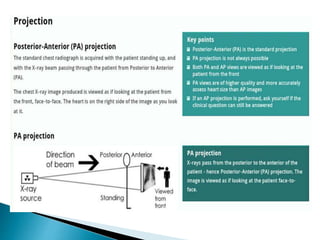
 Look to see if the film is antero-posterior (AP) or
postero-anterior (PA) view
 With an AP view the X-ray beam is in front the
patient and the X-Ray placed at the back, and the
other way round for PA.
 The standard CXR is PA but many emergency CXRs
are AP.
 The CXR projection has an important bearing on
the interpretation of the structures.
2. Orientation
 Identify the left/right markings
 Identify the anatomical structures, erect/supine.
 Do not always assume that the heart will always be
on the left because certain pathologies can result
with mediastinal shift, dextrocardia can also be a
possibility.
 You do not have to solely rely on just the CXR
markings.
3. Rotation
 Identify the medial ends of the clavicles and select
one of the thoracic vertebra spinous processes that
falls between them.
 The medial ends of the clavicles should be
equidistant from the spinous process, if that’s not
the case then the X-Ray is rotated.
4. Inspiration (Degree of inspiration)
 To judge the degree of inspiration, count the number of
ribs above the diaphragm.
 The midpoint of the right hemi-diaphragm should be
between the 5th and 7th ribs anteriorly.
 The anterior end of the 6th rib should be above the
diaphragm as should the posterior end of the 10th rib.
 If more ribs are visible the patient is hyperinflated
 If fewer it indicates inadequate inspiration
 Poor inspiration will make the heart look larger, give
appearance of basal shadowing and cause the trachea to
appear deviated to the right
5. Penetration
• To check the penetration, look at the lower part of the
cardiac shadow
• The vertebral bodies should be barely visible through
the cardiac shadow at this point.
• If they are clearly visible then the film is over penetrated
and you may miss low density lesion.
• If you cannot see them at all then the film is under
penetrated and the lung fields will appear falsely opaque
(white).
• The left hemidiaphragm should be visible to the edge of
the spine
• When comparing X-Rays first determine if the level of
penetration is similar.
1. TRACHEA
 It should be central or slightly deviated to the right.
- In case of deviation decide if is due to rotation or
pathology
 View the carina, angle should be between 60 –100
degrees.
 Because it contains air, it appears darker
(blacker/radiolucent).
 Trachea normally narrows at(T3/T4)
2. HILAR STRUCTURES
• Also called lung root, consists of the major
bronchi and pulmonary vessels (veins/arteries).
• The hila are not symmetrical but consist of the
same basic structures.
• The lymph nodes are also present but no visible
unless abnormal.
3. LUNGS
• The lungs occupies the largest portion of the thoracic
cavity.
• The lungs are assessed and described by dividing them
into upper, middle and lower zones.
• The lung zones do not equate to lung lobes e.g. The
lower zone on the right consists of middle and lower
lobes.
• Compare left with right.
• Compare an area of abnormality with the rest of the lung
on the same side.
• If there is any asymmetry decide which side is abnormal
4. PLEURA AND PLEURAL SPACES
• The pleura are only visible when there is an
abnormality present.
• This can be due to pleural thickening and fluid
or air accumulating in the pleural spaces.
• Lung markings should reach the thoracic wall
5. COSTOPHRENIC ANGLE AND RECESS
• The costophrenic recesses are formed by
hemidiaphragms and chest wall.
• They contain the rim of the lung bases which lie
over the dome of each hemidiaphragm.
• These angles are known as the costophrenic
angles.
• Costophrenic angles should form acute angles
that are sharp to the point.
6. HEMIDIAPHRAGM
7. HEART
• The heart lies more to the left of the thoracic cavity.
• The heart is assessed by means of the cardio-
thoracic ratio (CTR).
• CTR = Cardiac width : Thoracic width
• CTR > 50% is abnormal – PA view only
• The left hemidiaphragm should be visible behind the
heart.
• The hemidiaphrams do not represent the lowest
point of the lungs.
8. THE MEDIASTINUM
• The mediastinum contains the heart and great vessels (Middle
mediatinum) and potential spaces in front of the heart (anterior
mediastinum), behind the heart (Posterior mediastinum) and
above the heart (superior mediastinum).
• These potential spaces are not defined on a normal CXR, but their
awareness can help in describing location of disease processes.
• There are several structures in the superior mediastinum that
should always be checked. These include aortic knuckle, aorto-
pulmonary window and the right para-tracheal stripe.
9. SOFT TISSUE
• Normal fat planes are clearly defined in the soft
tissues.
• They appear as smooth layers of low density (black),
between layers of relatively dense (whiter) muscles.
• Irregular low density within soft tissues may be as a
result of tracking air as a result of injury to the
airways or pleura.
• This is known as surgical emphysema and produces
the distinctive clinical sign of palpable subcutaneous
‘bubble wrap’.
10. BONES
• The most dense tissue visible on CXR.
• Look for fractures, dislocation, subluxation,
osteoblastic or osteolytic lesions etc.
 AP supine view is a further alternative frontal
projection technique often used in trauma
patients, or patients who can't sit up
 The supine position results in physiological
widening of the cardiomediastinal outline
including superior mediastinum, as well as
congestion of the pulmonary veins with upper
lobe venous diversion
 the lateral view of the chest is performed
erect left lateral and labeled with the side
closest to the cassette
 It allows for localization of suspected chest
pathology when assessed in conjunction with
a PA view
 Examines the retrosternal and retrocardiac
spaces
 Allows assessment of the posterior
costophrenic recesses
 salient points
◦ gastric bubble is under the left hemidiaphragm; left
hemidiaphragm is less distinct anteriorly due to the
cardiac silhouette
◦ right hemidiaphragm appears higher and more
complete (as the right is closer to the beam)
◦ the radiation dose from a lateral chest radiograph is
substantially higher than that of a PA projection and
should probably not be routinely performed for this
reason
 lateral decubitus
◦ the patient is laying either left lateral or right lateral
on a trolley on top of a radiolucent sponge.
◦ the detector is placed landscape posterior to the
patient running parallel with the long axis of the
thorax.
◦ the patient’s hands should be raised to avoid
superimposing on the region of interest, legs may
be flexed for balance.
◦ problem-solving film, used to differentiate
pneumothorax vs. pleural effusion.
◦ air trapping due to inhaled foreign bodies and
showing and quantifying pleural effusions
 Expiration view
◦ for pneumothorax and air trapping due to inhaled
foreign bodies
 Lordotic view
◦ demonstrates areas of the lung apices that appear
obscured on the PA/AP chest radiographic views
 Right anterior oblique (RAO)/Left anterior
oblique (LAO) view
◦ for rib fractures and intrathoracic lesions (RAO also
used routinely used in barium esophagography)
a. The CXR is an important tool to complement both
history and initial clinical examination.
b. Low density structures appear
dark(black/radiolucent) and high density are
whitish (opaque).
c. Abnormalities need to be described in detail.
d. Identify the most striking abnormality first.
However, once you are done with this, it is vital to
check the rest of the image.
Describing abnormalities
 The barium swallow study, also known as a
barium esophagogram or esophagram, is a
contrast-enhanced radiographic study commonly
used to assess structural characteristics of the
entire esophagus.
 It may be used for the diagnosis of a wide range
of pathologies including esophageal motility
disorders, strictures, and perforations.
 It may also be used to characterize more distal
pathology such as a hiatal hernia or gastric
volvulus.
 Computed tomography (CT) of the chest uses
special x-ray equipment to examine
abnormalities found with other imaging tests and
to help diagnose the cause of unexplained
cough, shortness of breath, chest pain, fever, and
other chest symptoms.
 CT scanning is fast, painless, noninvasive, and
accurate. Because it can detect very small
nodules in the lung
 chest CT is especially effective for diagnosing
lung cancer at its earliest, most curable stage.
 examine abnormalities found on chest x-rays.
 detect and evaluate the extent of tumors that arise in the chest,
or tumors that have spread there from other parts of the body.
 assess whether tumors are responding to treatment.
 help plan radiation therapy.
 evaluate injury to the chest, including the heart, blood vessels,
lungs, ribs and spine.
 Chest CT can demonstrate various lung disorders, such as:
 benign and malignant tumors
 pneumonia
 tuberculosis
 bronchiectasis, cystic fibrosis
 inflammation or other diseases of the pleura (the covering of the
lungs)
 interstitial and chronic lung disease
 congenital abnormalities
 Computed tomography angiography (CTA)
uses an injection of contrast material into
your blood vessels and
 CT scanning to help diagnose and evaluate
blood vessel disease or related conditions,
such as aneurysms or blockages.
 it checks the arteries supplying blood to the
heart, and can be used to diagnose
conditions such as coronary artery disease
(CAD).
1. Radiology masterclass.[Online] Accessed [30
May 15]. Available
from:http://www.radiologymasterclass.co.uk
2. Corne J, Pointon K. Chest X-Ray Made Easy 3rd
Ed. Churchill Livingstone. 2010

chest-x-ray.pptx

  • 2.
    Chest X-Ray isone of the most frequently requested hospital investigations. It is readily available and inexpensive in comparison to other imaging studies. The basic interpretation is of utmost importance in answering several clinical questions at hand. It is an important tool to complement both history and initial clinical examination.
  • 3.
    A. Patient details Name of the patient  Age  Date
  • 4.
    B. Quality • Imagequality influences interpretation • Quality is influenced by radiographic technique and patient factors. • Check the image for – Projection, rotation, inspiration, penetration and artefacts.
  • 5.
    1. Projection  Lookto see if the film is antero-posterior (AP) or postero-anterior (PA) view  With an AP view the X-ray beam is in front the patient and the X-Ray placed at the back, and the other way round for PA.  The standard CXR is PA but many emergency CXRs are AP.  The CXR projection has an important bearing on the interpretation of the structures.
  • 9.
    2. Orientation  Identifythe left/right markings  Identify the anatomical structures, erect/supine.  Do not always assume that the heart will always be on the left because certain pathologies can result with mediastinal shift, dextrocardia can also be a possibility.  You do not have to solely rely on just the CXR markings.
  • 10.
    3. Rotation  Identifythe medial ends of the clavicles and select one of the thoracic vertebra spinous processes that falls between them.  The medial ends of the clavicles should be equidistant from the spinous process, if that’s not the case then the X-Ray is rotated.
  • 12.
    4. Inspiration (Degreeof inspiration)  To judge the degree of inspiration, count the number of ribs above the diaphragm.  The midpoint of the right hemi-diaphragm should be between the 5th and 7th ribs anteriorly.  The anterior end of the 6th rib should be above the diaphragm as should the posterior end of the 10th rib.  If more ribs are visible the patient is hyperinflated  If fewer it indicates inadequate inspiration  Poor inspiration will make the heart look larger, give appearance of basal shadowing and cause the trachea to appear deviated to the right
  • 16.
    5. Penetration • Tocheck the penetration, look at the lower part of the cardiac shadow • The vertebral bodies should be barely visible through the cardiac shadow at this point. • If they are clearly visible then the film is over penetrated and you may miss low density lesion. • If you cannot see them at all then the film is under penetrated and the lung fields will appear falsely opaque (white). • The left hemidiaphragm should be visible to the edge of the spine • When comparing X-Rays first determine if the level of penetration is similar.
  • 19.
    1. TRACHEA  Itshould be central or slightly deviated to the right. - In case of deviation decide if is due to rotation or pathology  View the carina, angle should be between 60 –100 degrees.  Because it contains air, it appears darker (blacker/radiolucent).  Trachea normally narrows at(T3/T4)
  • 20.
    2. HILAR STRUCTURES •Also called lung root, consists of the major bronchi and pulmonary vessels (veins/arteries). • The hila are not symmetrical but consist of the same basic structures. • The lymph nodes are also present but no visible unless abnormal.
  • 22.
    3. LUNGS • Thelungs occupies the largest portion of the thoracic cavity. • The lungs are assessed and described by dividing them into upper, middle and lower zones. • The lung zones do not equate to lung lobes e.g. The lower zone on the right consists of middle and lower lobes. • Compare left with right. • Compare an area of abnormality with the rest of the lung on the same side. • If there is any asymmetry decide which side is abnormal
  • 23.
    4. PLEURA ANDPLEURAL SPACES • The pleura are only visible when there is an abnormality present. • This can be due to pleural thickening and fluid or air accumulating in the pleural spaces. • Lung markings should reach the thoracic wall
  • 25.
    5. COSTOPHRENIC ANGLEAND RECESS • The costophrenic recesses are formed by hemidiaphragms and chest wall. • They contain the rim of the lung bases which lie over the dome of each hemidiaphragm. • These angles are known as the costophrenic angles. • Costophrenic angles should form acute angles that are sharp to the point.
  • 27.
  • 29.
    7. HEART • Theheart lies more to the left of the thoracic cavity. • The heart is assessed by means of the cardio- thoracic ratio (CTR). • CTR = Cardiac width : Thoracic width • CTR > 50% is abnormal – PA view only • The left hemidiaphragm should be visible behind the heart. • The hemidiaphrams do not represent the lowest point of the lungs.
  • 32.
    8. THE MEDIASTINUM •The mediastinum contains the heart and great vessels (Middle mediatinum) and potential spaces in front of the heart (anterior mediastinum), behind the heart (Posterior mediastinum) and above the heart (superior mediastinum). • These potential spaces are not defined on a normal CXR, but their awareness can help in describing location of disease processes. • There are several structures in the superior mediastinum that should always be checked. These include aortic knuckle, aorto- pulmonary window and the right para-tracheal stripe.
  • 36.
    9. SOFT TISSUE •Normal fat planes are clearly defined in the soft tissues. • They appear as smooth layers of low density (black), between layers of relatively dense (whiter) muscles. • Irregular low density within soft tissues may be as a result of tracking air as a result of injury to the airways or pleura. • This is known as surgical emphysema and produces the distinctive clinical sign of palpable subcutaneous ‘bubble wrap’.
  • 38.
    10. BONES • Themost dense tissue visible on CXR. • Look for fractures, dislocation, subluxation, osteoblastic or osteolytic lesions etc.
  • 39.
     AP supineview is a further alternative frontal projection technique often used in trauma patients, or patients who can't sit up  The supine position results in physiological widening of the cardiomediastinal outline including superior mediastinum, as well as congestion of the pulmonary veins with upper lobe venous diversion
  • 41.
     the lateralview of the chest is performed erect left lateral and labeled with the side closest to the cassette  It allows for localization of suspected chest pathology when assessed in conjunction with a PA view  Examines the retrosternal and retrocardiac spaces  Allows assessment of the posterior costophrenic recesses
  • 43.
     salient points ◦gastric bubble is under the left hemidiaphragm; left hemidiaphragm is less distinct anteriorly due to the cardiac silhouette ◦ right hemidiaphragm appears higher and more complete (as the right is closer to the beam) ◦ the radiation dose from a lateral chest radiograph is substantially higher than that of a PA projection and should probably not be routinely performed for this reason
  • 44.
     lateral decubitus ◦the patient is laying either left lateral or right lateral on a trolley on top of a radiolucent sponge. ◦ the detector is placed landscape posterior to the patient running parallel with the long axis of the thorax. ◦ the patient’s hands should be raised to avoid superimposing on the region of interest, legs may be flexed for balance. ◦ problem-solving film, used to differentiate pneumothorax vs. pleural effusion. ◦ air trapping due to inhaled foreign bodies and showing and quantifying pleural effusions
  • 46.
     Expiration view ◦for pneumothorax and air trapping due to inhaled foreign bodies  Lordotic view ◦ demonstrates areas of the lung apices that appear obscured on the PA/AP chest radiographic views  Right anterior oblique (RAO)/Left anterior oblique (LAO) view ◦ for rib fractures and intrathoracic lesions (RAO also used routinely used in barium esophagography)
  • 48.
    a. The CXRis an important tool to complement both history and initial clinical examination. b. Low density structures appear dark(black/radiolucent) and high density are whitish (opaque). c. Abnormalities need to be described in detail. d. Identify the most striking abnormality first. However, once you are done with this, it is vital to check the rest of the image.
  • 49.
  • 55.
     The bariumswallow study, also known as a barium esophagogram or esophagram, is a contrast-enhanced radiographic study commonly used to assess structural characteristics of the entire esophagus.  It may be used for the diagnosis of a wide range of pathologies including esophageal motility disorders, strictures, and perforations.  It may also be used to characterize more distal pathology such as a hiatal hernia or gastric volvulus.
  • 57.
     Computed tomography(CT) of the chest uses special x-ray equipment to examine abnormalities found with other imaging tests and to help diagnose the cause of unexplained cough, shortness of breath, chest pain, fever, and other chest symptoms.  CT scanning is fast, painless, noninvasive, and accurate. Because it can detect very small nodules in the lung  chest CT is especially effective for diagnosing lung cancer at its earliest, most curable stage.
  • 58.
     examine abnormalitiesfound on chest x-rays.  detect and evaluate the extent of tumors that arise in the chest, or tumors that have spread there from other parts of the body.  assess whether tumors are responding to treatment.  help plan radiation therapy.  evaluate injury to the chest, including the heart, blood vessels, lungs, ribs and spine.  Chest CT can demonstrate various lung disorders, such as:  benign and malignant tumors  pneumonia  tuberculosis  bronchiectasis, cystic fibrosis  inflammation or other diseases of the pleura (the covering of the lungs)  interstitial and chronic lung disease  congenital abnormalities
  • 59.
     Computed tomographyangiography (CTA) uses an injection of contrast material into your blood vessels and  CT scanning to help diagnose and evaluate blood vessel disease or related conditions, such as aneurysms or blockages.  it checks the arteries supplying blood to the heart, and can be used to diagnose conditions such as coronary artery disease (CAD).
  • 61.
    1. Radiology masterclass.[Online]Accessed [30 May 15]. Available from:http://www.radiologymasterclass.co.uk 2. Corne J, Pointon K. Chest X-Ray Made Easy 3rd Ed. Churchill Livingstone. 2010