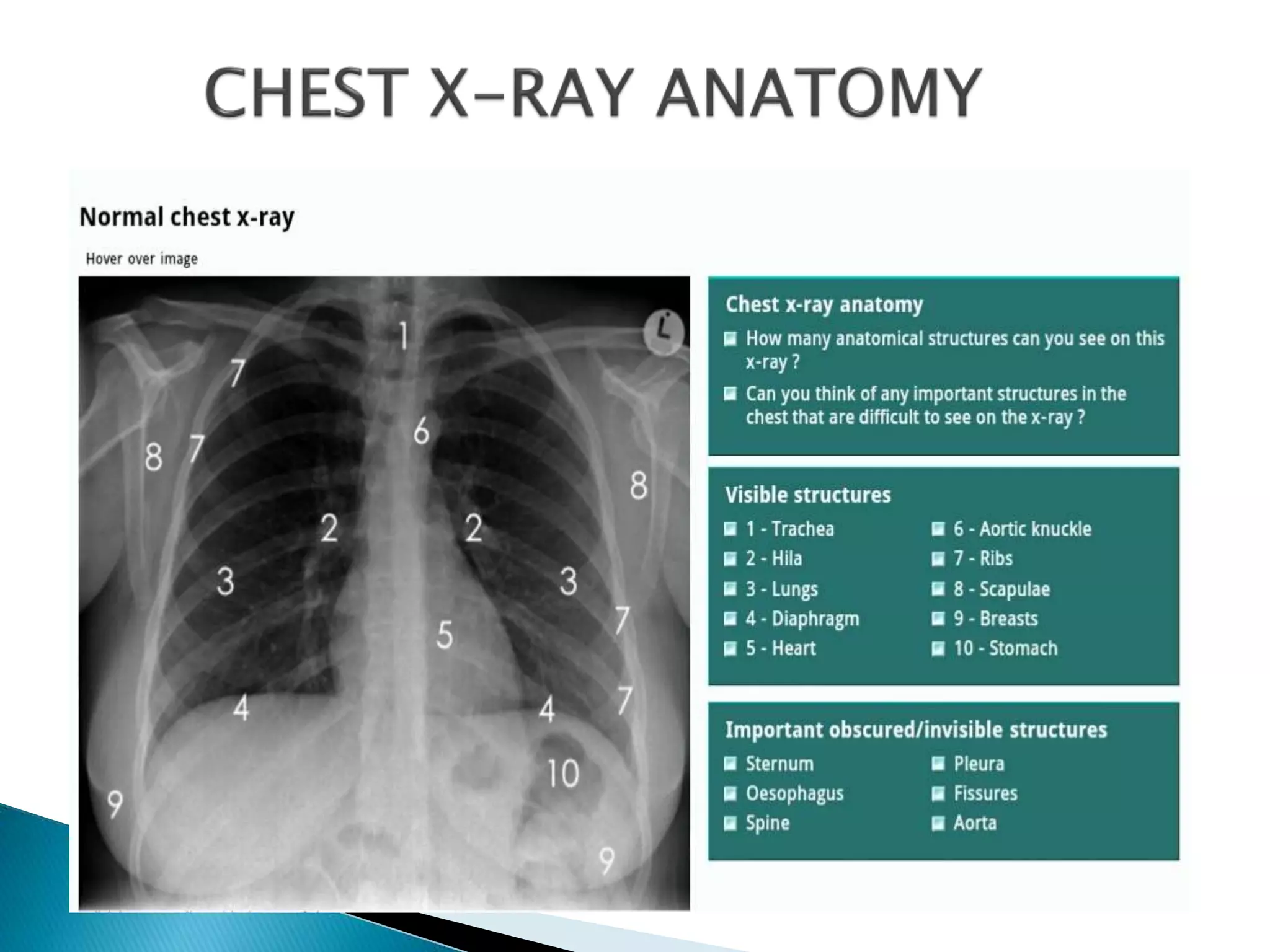
This document discusses the importance and process of systematically interpreting chest x-rays. It begins by noting that chest x-rays are a commonly used and cost-effective imaging tool. It then outlines steps for evaluating the quality of a chest x-ray, including checking the projection, orientation, inspiration, penetration, and for any artifacts. Key anatomical structures are described such as the trachea, lungs, heart, diaphragm, and bones. Abnormalities should be carefully described. The overall goal of interpretation is to answer the clinical question at hand.




![1. Radiology masterclass.[Online] Accessed [30
May 15]. Available
from:http://www.radiologymasterclass.co.uk
2. Corne J, Pointon K. Chest X-Ray Made Easy 3rd
Ed. Churchill Livingstone. 2010](https://image.slidesharecdn.com/chest-x-ray-211010173521/75/Chest-x-ray-zp162335-1-48-2048.jpg)


![Radiological_diagnosis_of_TB_ECHO_MOH[1].pptx](https://cdn.slidesharecdn.com/ss_thumbnails/radiologicaldiagnosisoftbechomoh1-240905083452-eb26e5f9-thumbnail.jpg?width=640&height=640&fit=bounds)


