Chest Tube Insertion Made easy (Step by step)<br />http://jacknaimsnotes.blogspot.com/2010/01/chest-tube-insertion.html<br />Indication<br />Pneumothorax
Massive pleural effusion
Empyema
Traumatic Haemopneumothorax
Post operative procedure.Preparation<br />Trolley with dressing pack, chest tube set and suture set.
20mL 1% lidocaine
Scalpel (N15)
Chest drain (10-14 F, 0r 28-30F for trauma case)
Underwater drainage bottle
Connecting tubes
Suture materials.Location (Safety triangle)<br />4th to 6th intercostals space
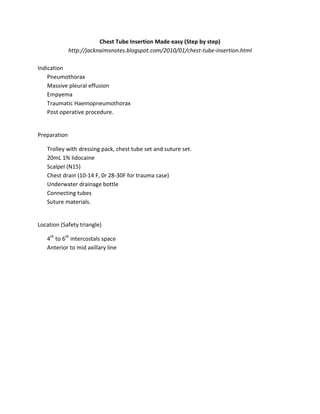
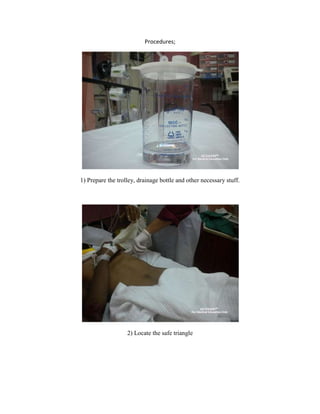
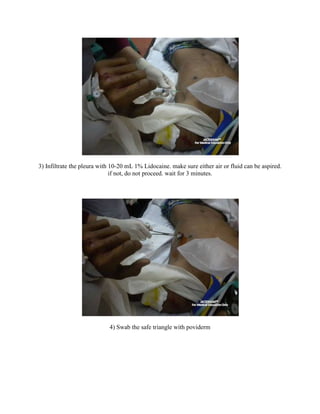
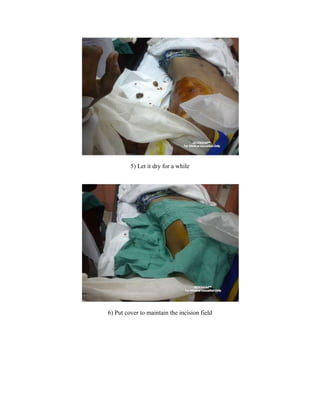
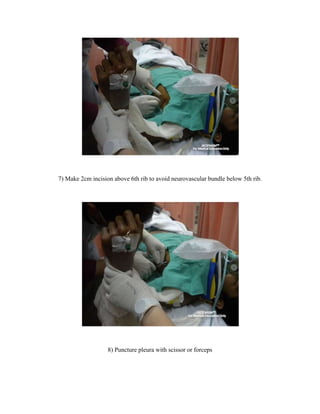
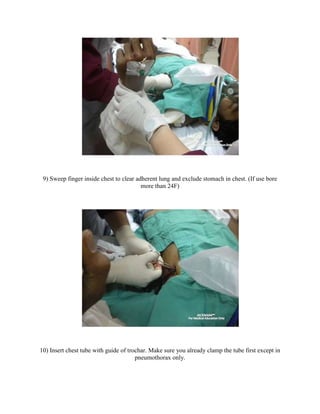
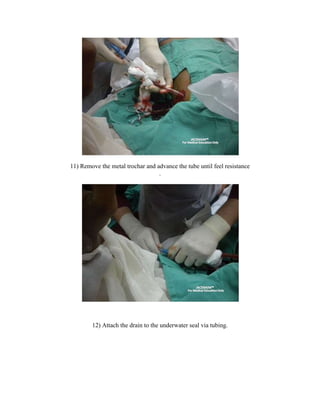
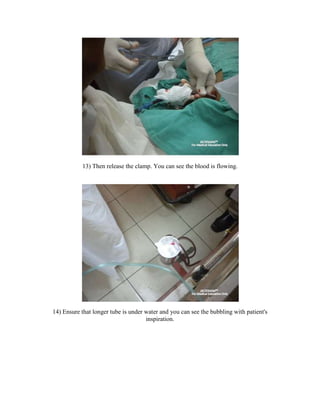
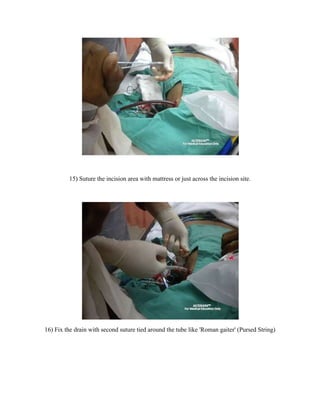
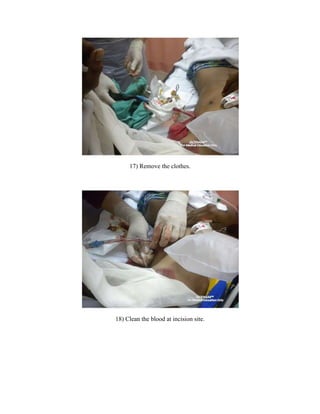
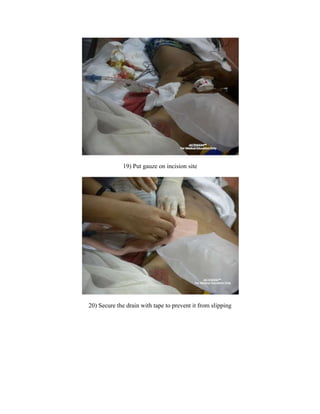
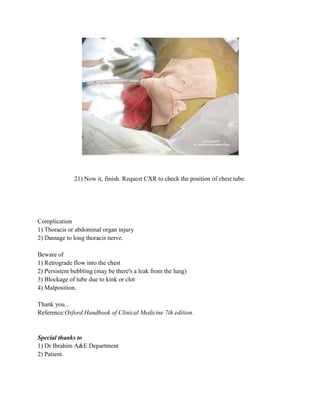
Anterior to mid axillary lineProcedures;<br />1) Prepare the trolley, drainage bottle and other necessary stuff.<br />2) Locate the safe triangle<br />3) Infiltrate the pleura with 10-20 mL 1% Lidocaine. make sure either air or fluid can be aspired. if not, do not proceed. wait for 3 minutes.<br />4) Swab the safe triangle with poviderm<br />5) Let it dry for a while<br />6) Put cover to maintain the incision field<br />7) Make 2cm incision above 6th rib to avoid neurovascular bundle below 5th rib.<br />8) Puncture pleura with scissor or forceps<br />9) Sweep finger inside chest to clear adherent lung and exclude stomach in chest. (If use bore more than 24F)<br />10) Insert chest tube with guide of trochar. Make sure you already clamp the tube first except in pneumothorax only.<br />11) Remove the metal trochar and advance the tube until feel resistance<br />.<br />12) Attach the drain to the underwater seal via tubing.<br />13) Then release the clamp. You can see the blood is flowing.<br />14) Ensure that longer tube is under water and you can see the bubbling with patient's inspiration.<br />15) Suture the incision area with mattress or just across the incision site.<br />16) Fix the drain with second suture tied around the tube like 'Roman gaiter' (Pursed String)<br />17) Remove the clothes.<br />18) Clean the blood at incision site.<br />19) Put gauze on incision site<br />20) Secure the drain with tape to prevent it from slipping<br />21) Now it, finish. Request CXR to check the position of chest tube.<br />Complication1) Thoracis or abdominal organ injury2) Damage to long thoracis nerve.Beware of1) Retrograde flow into the chest2) Persistent bubbling (may be there's a leak from the lung)3) Blockage of tube due to kink or clot4) Malposition.Thank you...Reference:Oxford Handbook of Clinical Medicine 7th edition.<br />Special thanks to1) Dr Ibrahim A&E Department2) Patient.<br />

Chest Tube Insertion Made Easy

  • 1.
    Chest Tube InsertionMade easy (Step by step)<br />http://jacknaimsnotes.blogspot.com/2010/01/chest-tube-insertion.html<br />Indication<br />Pneumothorax
  • 2.
  • 3.
  • 4.
  • 5.
    Post operative procedure.Preparation<br/>Trolley with dressing pack, chest tube set and suture set.
  • 6.
  • 7.
  • 8.
    Chest drain (10-14F, 0r 28-30F for trauma case)
  • 9.
  • 10.
  • 11.
    Suture materials.Location (Safetytriangle)<br />4th to 6th intercostals space
  • 12.
    Anterior to midaxillary lineProcedures;<br />1) Prepare the trolley, drainage bottle and other necessary stuff.<br />2) Locate the safe triangle<br />3) Infiltrate the pleura with 10-20 mL 1% Lidocaine. make sure either air or fluid can be aspired. if not, do not proceed. wait for 3 minutes.<br />4) Swab the safe triangle with poviderm<br />5) Let it dry for a while<br />6) Put cover to maintain the incision field<br />7) Make 2cm incision above 6th rib to avoid neurovascular bundle below 5th rib.<br />8) Puncture pleura with scissor or forceps<br />9) Sweep finger inside chest to clear adherent lung and exclude stomach in chest. (If use bore more than 24F)<br />10) Insert chest tube with guide of trochar. Make sure you already clamp the tube first except in pneumothorax only.<br />11) Remove the metal trochar and advance the tube until feel resistance<br />.<br />12) Attach the drain to the underwater seal via tubing.<br />13) Then release the clamp. You can see the blood is flowing.<br />14) Ensure that longer tube is under water and you can see the bubbling with patient's inspiration.<br />15) Suture the incision area with mattress or just across the incision site.<br />16) Fix the drain with second suture tied around the tube like 'Roman gaiter' (Pursed String)<br />17) Remove the clothes.<br />18) Clean the blood at incision site.<br />19) Put gauze on incision site<br />20) Secure the drain with tape to prevent it from slipping<br />21) Now it, finish. Request CXR to check the position of chest tube.<br />Complication1) Thoracis or abdominal organ injury2) Damage to long thoracis nerve.Beware of1) Retrograde flow into the chest2) Persistent bubbling (may be there's a leak from the lung)3) Blockage of tube due to kink or clot4) Malposition.Thank you...Reference:Oxford Handbook of Clinical Medicine 7th edition.<br />Special thanks to1) Dr Ibrahim A&E Department2) Patient.<br />