
Conrad Lee, CT2
July 2014- Sep 2014
T&O, BSUH
Wardround documentation audit
June - Aug 2014
Section 1: Background
Background Aims /Method Results Discussion Conclusion
Current literature / guidelines
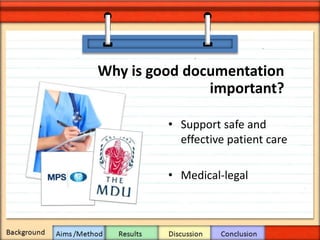
Why is good documentation
important?
• Support safe and
effective patient care
• Medical-legal
Current literature / guidelines
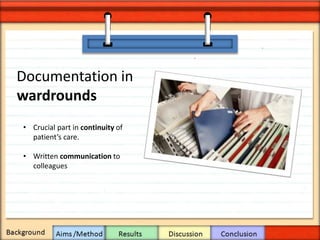
Documentation in
wardrounds
• Crucial part in continuity of
patient’s care.
• Written communication to
colleagues
Current literature / guidelines
“You must keep
clear, accurate and
legible records”
- GMC Good Medical Practice 2013
Current literature / guidelines
Current Standards / guidelines
- Health informatics Unit, Royal College of
Physicans, April 2008
“The standards should be
used for all hospital
patient records”
Current literature / guidelines
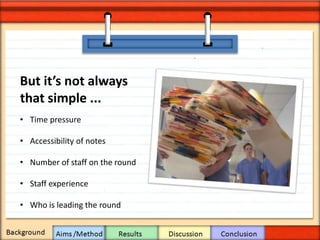
But it’s not always
that simple ...
• Time pressure
• Accessibility of notes
• Number of staff on the round
• Staff experience
• Who is leading the round
BackgroundBackground
Section 2: Aims & Method
Aims /Method Results Discussion Conclusion
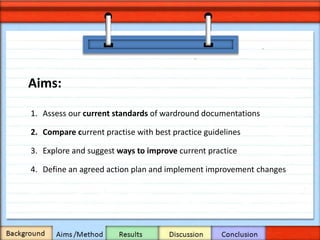
Aims:
1. Assess our current standards of wardround documentations
2. Compare current practise with best practice guidelines
3. Explore and suggest ways to improve current practice
4. Define an agreed action plan and implement improvement changes
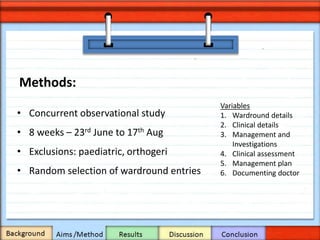
Methods:
• Concurrent observational study
• 8 weeks – 23rd June to 17th Aug
• Exclusions: paediatric, orthogeri
• Random selection of wardround entries
Variables
1. Wardround details
2. Clinical details
3. Management and
Investigations
4. Clinical assessment
5. Management plan
6. Documenting doctor
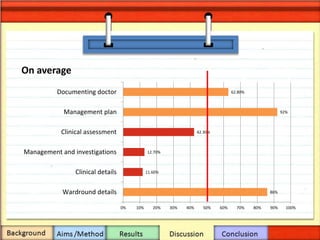
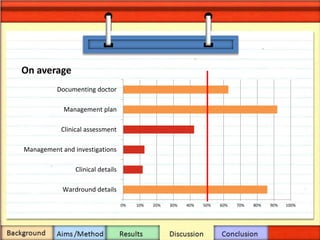
86%
11.60%
12.70%
42.30%
92%
62.80%
0% 10% 20% 30% 40% 50% 60% 70% 80% 90% 100%
Wardround details
Clinical details
Management and investigations
Clinical assessment
Management plan
Documenting doctor
On average
Section 1: Background
BackgroundBackgroundBackground
Section 3: Results
Aims /Method Results Discussion Conclusion
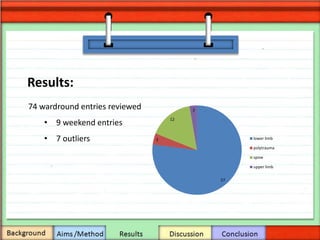
Results:
74 wardround entries reviewed
• 9 weekend entries
• 7 outliers
57
3
12
2
lower limb
polytrauma
spine
upper limb
P.T.O…
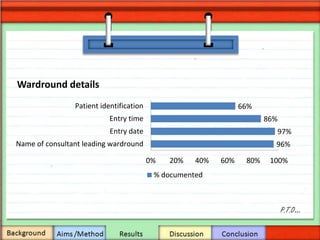
Wardround details
96%
97%
86%
66%
0% 20% 40% 60% 80% 100%
Name of consultant leading wardround
Entry date
Entry time
Patient identification
% documented
P.T.O…
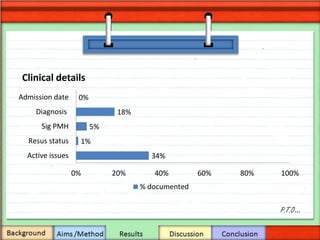
Clinical details
34%
1%
5%
18%
0%
0% 20% 40% 60% 80% 100%
Active issues
Resus status
Sig PMH
Diagnosis
Admission date
% documented
P.T.O…
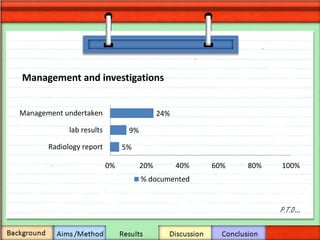
Management and investigations
5%
9%
24%
0% 20% 40% 60% 80% 100%
Radiology report
lab results
Management undertaken
% documented
P.T.O…
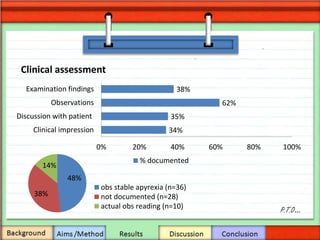
Clinical assessment
34%
35%
62%
38%
0% 20% 40% 60% 80% 100%
Clinical impression
Discussion with patient
Observations
Examination findings
% documented
48%
38%
14%
obs stable apyrexia (n=36)
not documented (n=28)
actual obs reading (n=10)
P.T.O…
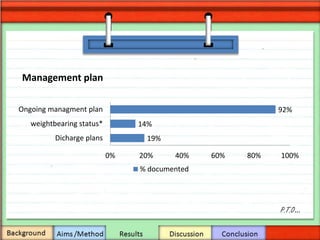
Management plan
19%
14%
92%
0% 20% 40% 60% 80% 100%
Dicharge plans
weightbearing status*
Ongoing managment plan
% documented
P.T.O…
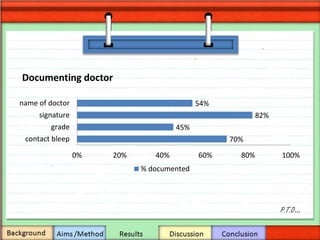
Documenting doctor
70%
45%
82%
54%
0% 20% 40% 60% 80% 100%
contact bleep
grade
signature
name of doctor
% documented
0% 10% 20% 30% 40% 50% 60% 70% 80% 90% 100%
Wardround details
Clinical details
Management and investigations
Clinical assessment
Management plan
Documenting doctor
On average
Section 1: Background
BackgroundBackground
Section 4: Discussion
Aims /Method Results Discussion Conclusion
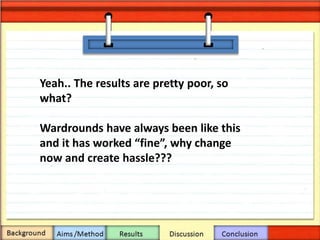
Yeah.. The results are pretty poor, so
what?
Wardrounds have always been like this
and it has worked “fine”, why change
now and create hassle???
We should not just look at the figures,
but focus on why good documentation
is really important for ours patients and
staff.
Who are the stake holders?
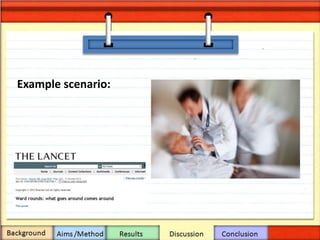
Example scenario:
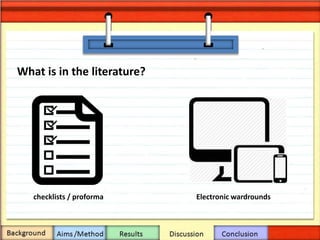
What is in the literature?
checklists / proforma Electronic wardrounds
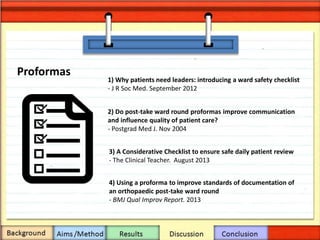
Proformas
4) Using a proforma to improve standards of documentation of
an orthopaedic post-take ward round
- BMJ Qual Improv Report. 2013
2) Do post-take ward round proformas improve communication
and influence quality of patient care?
- Postgrad Med J. Nov 2004
3) A Considerative Checklist to ensure safe daily patient review
- The Clinical Teacher. August 2013
1) Why patients need leaders: introducing a ward safety checklist
- J R Soc Med. September 2012
Proformas
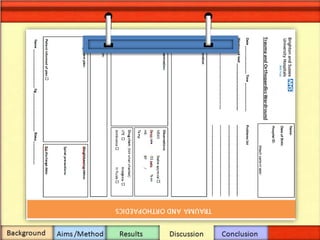
BSUH Surgical department – wardround proforma
Initial resistance from consultants and some registrars,
but highly favoured by junior doctors and nursing staff
6 week reaudit showed improved documentation
Proforma to be made more user friendly
limiting factors to complete documentation
- Time pressure
- Variability between juniors
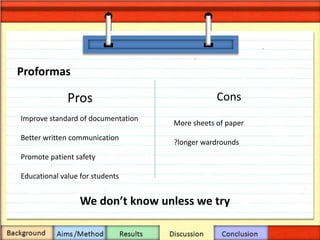
Proformas
Pros Cons
Improve standard of documentation
Better written communication
Promote patient safety
Educational value for students
More sheets of paper
?longer wardrounds
We don’t know unless we try
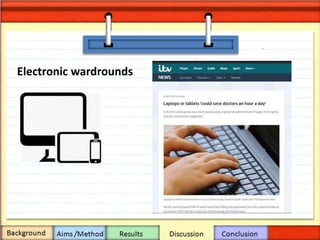
Electronic wardrounds
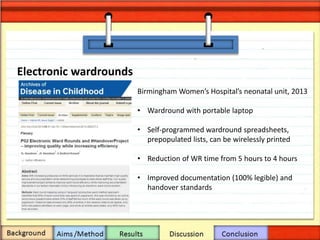
Birmingham Women’s Hospital’s neonatal unit, 2013
• Wardround with portable laptop
• Self-programmed wardround spreadsheets,
prepopulated lists, can be wirelessly printed
• Reduction of WR time from 5 hours to 4 hours
• Improved documentation (100% legible) and
handover standards
Electronic wardrounds
“There were a lot of staff who
were sceptical and the NHS is
set in its ways. I believe the
system we developed could be
of benefit to everywhere that
does an in-patient ward round.”
- Dr Sarah Steadman
Electronic wardrounds
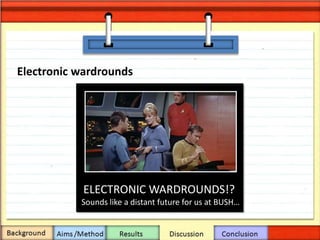
ELECTRONIC WARDROUNDS!?
Sounds like a distant future for us at BUSH…
Electronic wardround:
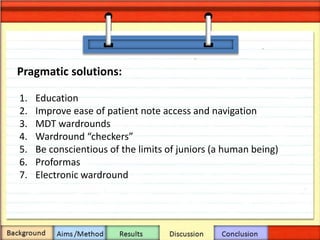
Pragmatic solutions:
1. Education
2. Improve ease of patient note access and navigation
3. MDT wardrounds
4. Wardround “checkers”
5. Be conscientious of the limits of juniors (a human being)
6. Proformas
7. Electronic wardround
BackgroundBackground
Section 5: Conclusion
Aims /Method Results Discussion Conclusion
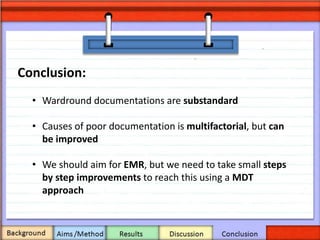
• Wardround documentations are substandard
• Causes of poor documentation is multifactorial, but can
be improved
• We should aim for EMR, but we need to take small steps
by step improvements to reach this using a MDT
approach
Conclusion:
Action plan
References
• Why patients need leaders: introducing a ward safety checklist - J R Soc Med. September 2012
• Do post-take ward round proformas improve communication and influence quality of patient
care? - Postgrad Med J. Nov 2004
• A Considerative Checklist to ensure safe daily patient review - The Clinical Teacher. August 2013
• Using a proforma to improve standards of documentation of an orthopaedic post-take ward
round - BMJ Qual Improv Report. 2013
• Electronic Ward Rounds and #HandoverProject – improving quality while increasing efficiency -
Arch Dis Child 2014
Background Aims /Method Results Discussion Conclusion

Wardround documentation audit

  • 1.
    Conrad Lee, CT2 July2014- Sep 2014 T&O, BSUH Wardround documentation audit June - Aug 2014
  • 2.
    Section 1: Background BackgroundAims /Method Results Discussion Conclusion
  • 3.
    Current literature /guidelines Why is good documentation important? • Support safe and effective patient care • Medical-legal
  • 4.
    Current literature /guidelines Documentation in wardrounds • Crucial part in continuity of patient’s care. • Written communication to colleagues
  • 5.
    Current literature /guidelines “You must keep clear, accurate and legible records” - GMC Good Medical Practice 2013
  • 6.
    Current literature /guidelines Current Standards / guidelines - Health informatics Unit, Royal College of Physicans, April 2008 “The standards should be used for all hospital patient records”
  • 7.
    Current literature /guidelines But it’s not always that simple ... • Time pressure • Accessibility of notes • Number of staff on the round • Staff experience • Who is leading the round
  • 8.
    BackgroundBackground Section 2: Aims& Method Aims /Method Results Discussion Conclusion
  • 9.
    Aims: 1. Assess ourcurrent standards of wardround documentations 2. Compare current practise with best practice guidelines 3. Explore and suggest ways to improve current practice 4. Define an agreed action plan and implement improvement changes
  • 10.
    Methods: • Concurrent observationalstudy • 8 weeks – 23rd June to 17th Aug • Exclusions: paediatric, orthogeri • Random selection of wardround entries Variables 1. Wardround details 2. Clinical details 3. Management and Investigations 4. Clinical assessment 5. Management plan 6. Documenting doctor
  • 11.
    86% 11.60% 12.70% 42.30% 92% 62.80% 0% 10% 20%30% 40% 50% 60% 70% 80% 90% 100% Wardround details Clinical details Management and investigations Clinical assessment Management plan Documenting doctor On average
  • 12.
    Section 1: Background BackgroundBackgroundBackground Section3: Results Aims /Method Results Discussion Conclusion
  • 13.
    Results: 74 wardround entriesreviewed • 9 weekend entries • 7 outliers 57 3 12 2 lower limb polytrauma spine upper limb
  • 14.
    P.T.O… Wardround details 96% 97% 86% 66% 0% 20%40% 60% 80% 100% Name of consultant leading wardround Entry date Entry time Patient identification % documented
  • 15.
    P.T.O… Clinical details 34% 1% 5% 18% 0% 0% 20%40% 60% 80% 100% Active issues Resus status Sig PMH Diagnosis Admission date % documented
  • 16.
    P.T.O… Management and investigations 5% 9% 24% 0%20% 40% 60% 80% 100% Radiology report lab results Management undertaken % documented
  • 17.
    P.T.O… Clinical assessment 34% 35% 62% 38% 0% 20%40% 60% 80% 100% Clinical impression Discussion with patient Observations Examination findings % documented 48% 38% 14% obs stable apyrexia (n=36) not documented (n=28) actual obs reading (n=10)
  • 18.
    P.T.O… Management plan 19% 14% 92% 0% 20%40% 60% 80% 100% Dicharge plans weightbearing status* Ongoing managment plan % documented
  • 19.
    P.T.O… Documenting doctor 70% 45% 82% 54% 0% 20%40% 60% 80% 100% contact bleep grade signature name of doctor % documented
  • 20.
    0% 10% 20%30% 40% 50% 60% 70% 80% 90% 100% Wardround details Clinical details Management and investigations Clinical assessment Management plan Documenting doctor On average
  • 21.
    Section 1: Background BackgroundBackground Section4: Discussion Aims /Method Results Discussion Conclusion
  • 22.
    Yeah.. The resultsare pretty poor, so what? Wardrounds have always been like this and it has worked “fine”, why change now and create hassle???
  • 24.
    We should notjust look at the figures, but focus on why good documentation is really important for ours patients and staff.
  • 25.
    Who are thestake holders?
  • 26.
  • 27.
    What is inthe literature? checklists / proforma Electronic wardrounds
  • 28.
    Proformas 4) Using aproforma to improve standards of documentation of an orthopaedic post-take ward round - BMJ Qual Improv Report. 2013 2) Do post-take ward round proformas improve communication and influence quality of patient care? - Postgrad Med J. Nov 2004 3) A Considerative Checklist to ensure safe daily patient review - The Clinical Teacher. August 2013 1) Why patients need leaders: introducing a ward safety checklist - J R Soc Med. September 2012
  • 29.
    Proformas BSUH Surgical department– wardround proforma Initial resistance from consultants and some registrars, but highly favoured by junior doctors and nursing staff 6 week reaudit showed improved documentation Proforma to be made more user friendly limiting factors to complete documentation - Time pressure - Variability between juniors
  • 31.
    Proformas Pros Cons Improve standardof documentation Better written communication Promote patient safety Educational value for students More sheets of paper ?longer wardrounds We don’t know unless we try
  • 32.
  • 33.
    Electronic wardrounds Birmingham Women’sHospital’s neonatal unit, 2013 • Wardround with portable laptop • Self-programmed wardround spreadsheets, prepopulated lists, can be wirelessly printed • Reduction of WR time from 5 hours to 4 hours • Improved documentation (100% legible) and handover standards
  • 34.
    Electronic wardrounds “There werea lot of staff who were sceptical and the NHS is set in its ways. I believe the system we developed could be of benefit to everywhere that does an in-patient ward round.” - Dr Sarah Steadman
  • 35.
    Electronic wardrounds ELECTRONIC WARDROUNDS!? Soundslike a distant future for us at BUSH…
  • 36.
  • 37.
    Pragmatic solutions: 1. Education 2.Improve ease of patient note access and navigation 3. MDT wardrounds 4. Wardround “checkers” 5. Be conscientious of the limits of juniors (a human being) 6. Proformas 7. Electronic wardround
  • 38.
    BackgroundBackground Section 5: Conclusion Aims/Method Results Discussion Conclusion
  • 39.
    • Wardround documentationsare substandard • Causes of poor documentation is multifactorial, but can be improved • We should aim for EMR, but we need to take small steps by step improvements to reach this using a MDT approach Conclusion:
  • 40.
  • 41.
    References • Why patientsneed leaders: introducing a ward safety checklist - J R Soc Med. September 2012 • Do post-take ward round proformas improve communication and influence quality of patient care? - Postgrad Med J. Nov 2004 • A Considerative Checklist to ensure safe daily patient review - The Clinical Teacher. August 2013 • Using a proforma to improve standards of documentation of an orthopaedic post-take ward round - BMJ Qual Improv Report. 2013 • Electronic Ward Rounds and #HandoverProject – improving quality while increasing efficiency - Arch Dis Child 2014 Background Aims /Method Results Discussion Conclusion

Editor's Notes

  • #4 The main reason for maintaining good medical records is to ensure safe and effective patient care They may also be required for legal purposes defending a complaint http://www.medicalprotection.org/uk/england-factsheets/medical-records
  • #5 Good documentation during wardround is especially crucial as a form of written communication to colleagues. They should therefore be comprehensive enough to allow a colleague to carry on where you left off. Patients report varying and inconsistent plans as one of the most frustrating aspects of care
  • #6 The GMC’s Good Medical Practice dictates that the documents you make, including clinical findings, to formally record your work must be clear, accurate and legible. You should make records at the same time as the events you are recording or as soon as possible afterwards.
  • #7 "There are no national guidelines or templates on how to run a ward round, there is still considerable variation across hospitals. The Health Information Unit at the Royal College of Physicans have developed record keeping standards in 2008 that should be applied to ALL clinical note keeping. In particular, section 3 “ handover documents” are most relevant to routine wardrounds.
  • #8 Despite having these standards and guidelines, it is not always that easy to comply due to a number of reasons.
  • #24 http://www.bbc.co.uk/news/health-19816017
  • #27 http://www.thelancet.com/journals/lancet/article/PIIS0140-6736(12)61740-1/fulltext
  • #28 Everyone hates proformas,
  • #29 http://qir.bmj.com/content/2/1/u200902.w699.abstract http://www.ncbi.nlm.nih.gov/pmc/articles/PMC1743139/
  • #36 http://onlinelibrary.wiley.com/doi/10.1111/j.1743-498X.2012.00566.x/abstract;jsessionid=C0CA2B449D11579AC3E30EBB896B1F91.f03t01?systemMessage=Wiley+Online+Library+will+be+disrupted+on+the+18th+October+from+10%3A00+BST+%2805%3A00+EDT%29+for+essential+maintenance+for+approximately+two+hours+as+we+make+upgrades+to+improve+our+services+to+you
  • #37 http://onlinelibrary.wiley.com/doi/10.1111/j.1743-498X.2012.00566.x/abstract;jsessionid=C0CA2B449D11579AC3E30EBB896B1F91.f03t01?systemMessage=Wiley+Online+Library+will+be+disrupted+on+the+18th+October+from+10%3A00+BST+%2805%3A00+EDT%29+for+essential+maintenance+for+approximately+two+hours+as+we+make+upgrades+to+improve+our+services+to+you
  • #40 http://www.itv.com/news/update/2014-04-08/laptops-or-tablets-could-save-doctors-an-hour-a-day/