CHEST RADIOGRAPH
Dr. Sunil Kalmath, MD
Senior Resident - Interventional radiologyTMH, Mumbai
SR Radiodiagnosis -KMC, Mangalore
SR Radiodiagnosis – PGIMER, Chandigarh
1) DIFFERENT VIEWS.
2)BASIC CHEST X RAY
INTERPRETATION.
3)VARIOUS BASIC PATHOLOGIES.
DIFFERENT VIEWS
BASIC - PA VIEW-ERECT.
ALTERNATE - AP VIEW -ERECT.
-SUPINE.
-SEMIERECT
SUPPLYMENTARY- LATERAL VIEW [erect & decubitus].
- LORDOTIC.
- PA VEIW EXPIRTION
Surface dose for standard patient is 0.3mGy
PA VIEW
185 cm
T5
• Patient position.
• Centering of x ray beam.
• FFD (film to focus distance)
• Low kVp tech(60-70 kVp ) –Adequate for PA view, lungs, ribs & if not using grids.
• High kVp tech(120-150 kVp) –medistinum and heart.
• Exposure time < 40ms and factors mAs – 16-20
PA view
▪ Standard view for evaluation of chest.
▪ Patient stands with chin up and shoulders rotated
forward facing the film.
▪ Exposure is made on full inspiration centring at
T5 .
▪ Low kvp –calcification,pleural plaque ,pulmonary
nodule are visualised excellent in low kvp film.
▪ High kvp used for increased visualisation of
hidden areas, airways, vascular structure etc
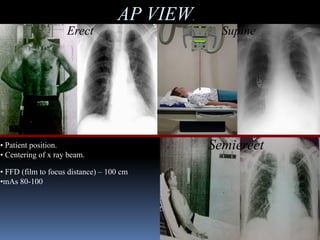
AP VIEW
▪ Sometimes the only projection possible in
sick patients, unable to stand
▪ Helpful in deciding whether the small
pulmonary opacity on PA view is genuine by
altering its relationship to overlying ribs and
vascular shadows.
AP VIEW.
Supine
Erect
Semierect
• Patient position.
• Centering of x ray beam.
• FFD (film to focus distance) – 100 cm
•mAs 80-100
AP PA
DIFFERENCE BETWEEN AP & PA
VIEW
AP VIEW PA VIEW
Clavicles are projected more cranialy Projected more oblique
over the apices
Cardiac shadow more magnified Less magnified
Scapulae overlie lung fields Scapulae do not overlie lung fields
Ribs are more horizontal less horizontal
Vertebral spines are less prominently seen More prominently seen
LATERAL – ERECT.
• Patient position.
• Centering of x ray beam.
• FFD (film to focus distance) 6 ft
• mAs 32-48.
LATERAL VIEW -ERECT
▪ Lesions obscured on PA view are clearly
demonstrated on lateral view (ant
mediastinal masses ,post basal
consolidation,encysted pleural fluid etc)
▪ Helpful in localisation of different lobes and
segments,
▪ Patient stands with side of interest nearer the
film, arms are elevated, forearms are resting
on the head.
LATERAL - DECUBITUS.
• Patient position.
• Centering of x ray beam.
• kV 50-60 , mAs 20 .
T5
LATERAL DECUBITUS
▪ Shows the fluid level particularly well.
▪ Helps to diagnose small pnumothorax or
pleural effusion
▪ Patient lies in lateral recumbant position (lie
in affected side), arms extended above the
head, film is placed in standing position in
front of the chest.
▪ Patient lies in same position for five minutes
to allow the fluid trickle down in dependent
part of chest.
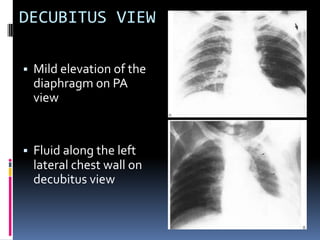
DECUBITUS VIEW
▪ Mild elevation of the
diaphragm on PA
view
▪ Fluid along the left
lateral chest wall on
decubitus view
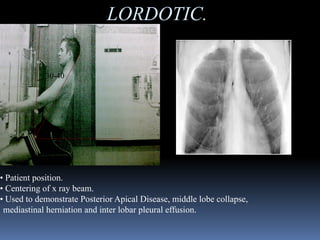
LORDOTIC.
• Patient position.
• Centering of x ray beam.
• Used to demonstrate Posterior Apical Disease, middle lobe collapse,
mediastinal herniation and inter lobar pleural effusion.
30-40
LORDOTIC view
▪ Used to demonstrate Posterior Apical
Disease, middle lobe collapse,
mediastinal herniation and inter lobar
pleural effusion.
▪ Patient leans back in lordotic position or
with cranial tilt of tube
▪ Clavicles projected above the lung field.
OBLIQUEVIEWS
Retrocardiac area
Posterior CP angles
B/L Lung disease – No overlap
RAO - Rt. Anterior Oblique
LAO - Lt. Anterior Oblique
RPO - Rt. Posterior Oblique
LPO – Lt. Posterior Oblique
Basic Chest X-Ray
Interpretation
Have a system
Chest radiograph PA view
Basic Chest X-Ray
Interpretation
•Identification
•Side marker
•Positioning
•Penetration
•Inspiratory film
•Visualized structures
SIDE MARKER
Orientation of the aortic arch, gastric bubble
and heart should be determined to confirm
normal situs and that the side markers are
correct.
POSITIONING
straight vs oblique
PENETRATION
• vertebral bodies and disc spaces should be
just visible down to t8/t9 level through cardiac
shadow
• underpenetration
• overpenetration
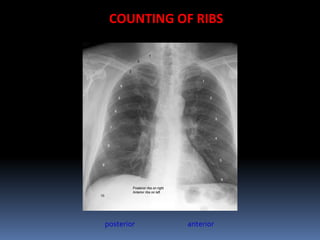
posterior anterior
COUNTING OF RIBS
VISUALISED STRUCTURES
TRACHEA
▪ Trachea should be examined for narrowing,
displacement and intraluminal lesions.
▪ In midline ,deviate slightly to right at around
aortic knuckle
▪ Divides into rt and lt bronchus atT5 .rt
bronchus is short and straight,
▪ Normal carinal angle is 60-75 degree
▪ Right paratracheal stripe< 5mm.
• Position
• Outline
Trachea
2.5cm 5cm
Systematic approach
Trachea
Mediastinum, heart and
Diaphragm
HEART, MEDIASTINUM AND DIAPHRAGM
Cardiac shadow-2/3rd
left
Cardiothoracic ratio<50%
Diaphragm-rt higher,diff<3cm
MEDIASTINUM
1. Anterior
2. Middle
3. Posterior
FISSURES
▪ PA-horizontal run from hilum to sixth rib in
axillary line
▪ Lat- horizontal fissure-run anteriorly
▪ Both oblique commence posteriorly atT4
,pass through hilum ,left finishes 5 cm behind
and rt jus behind ant cp angle.
FISSURES
• Main fissures
1. Oblique
2. Horizontal
• Accessory fissures
1. Azygous fissure (mc)
2. Superior accessory fissure
3. Inferior accessory fissure
4. Left side horizontal fissure
•
Fissures
T4
FISSURES
•
LATERAL FILM
ACCESSORY FISSURES
▪ AZYGOUS FISSURE- comma shaped, right sided,It forms in apex
of lung and consist of paired folds of visceral and parietal pleura
plus the azygous vein which has failed to migrate.
▪ SUPERIOR ACCESSORY FISSURE - separate apical from basal
segment of lower lobe, resembles horizontal fissure on PA view
,on LAT runs posteriorly from hilum.
▪ INF ACCESSORY FISSURE -oblique line running cranially from CP
angle to hilum, separate medial basal from other basal segments.
▪ LEFT HORIZONTAL FISSURE -separate lingula from upper lobe
segments
AZYGOUS FISSURE
LEFT HORIZONTAL
Hilum
• 97% left higher than right
• Pulmonary vessels &upper lobe veins
•Equal size and density
• Bronchial vessels
• Lymphatic system
Lungs
RADIOGRAPHIC ZONES ON CHEST
RADIOGRAPH
ANTERIOR END
OF 2ND
RIB
ANTERIOR END
OF 4TH
RIB
UPPER
ZONE
MID
ZONE
LOWER
ZONE
APEX
LUNGS
SEGMENTS
▪ Lungs are divided into three lobes on right
and two lobes on left side,
▪ Bronchopulmonary segments are based on
the subdivisions of the lobar bronchi.
▪ Supplied by segmental bronchi and vessels.
PULMONARY SEG AND BRONCHI
Right lung Left lung
lateral film
▪ Clear spaces-retrosternal and retrocardiac
▪ Vertebrae become more translucent caudally.
▪ Both diaphragms are visible throughout their
length ,except left anteriorly.
▪ Axillary folds and scapulae overlie the lung
fields.
SILHOUETTE SIGN
# AN INTRATHORASIC LESIONTOUCHING A BORDER
OF HEART,AORTA OR DIAPHRAGMWILL OBLITERATE
THAT BORDER ON CXR.
# AN INTRATHORASIC LESION NOT ANATOMICALLY
CONTINUOUSWITH A BORDER OF ONE OFTHESE
STRUCTURESWILL NOT OBLITERATETHAT BORDER
Localizing disease from the
silhouette sign
RLL
RML
LLL
Lingula
Silhouette Sign
1) Radio-opacity that obliterate
part or all of the heart border
- Anterior Mediastinum
2) Radio-opacity that overlaps
but does not obliterate heart
border
- Posterior Mediastinum
Silhouette Sign
3)Radio-opacity that
obliterates right border of
ascending aorta
- Anterior Mediastinum
4) Radio-opacity that overlaps
but does not obliterate the
right borer of ascending
aorta
- Posterior Mediastinum
Silhouette Sign
5) Radio-opacity that
obliterates left border of
aortic knob
- Posterior Mediastinum
6) Radio-opacity that overlaps
but does not obliterate
aortic knob
- Anterior Mediastinum or
far Posterior Mediastinum
Hilum Overlay sign
▪ To differentiate
between cardiomegaly
& anterior mediastinal
mass.
Hilum Convergence sign
▪ To differentiate
between enlarged
pulmonary artery &
juxta-hilar mass
▪ If the PA branches
converge toward the
mass rather than
towards the heart it is
an enlarged PA.
CERVICOTHORACIC SIGN
▪ Posterior mediastinal
masses have well
defined superior
borders above the
clavicle.
▪ Anterior masses are in
contact with chest wall
,have ill defined
margins.
▪ If the superior border
merges with that of
neck,it is ill defined and
the lesion is both
cervical and thoracic.
Cervico-thoracic sign
AIR BRONCHOGRAM SIGN
▪ Intrapulmonary bronchi are
not visible on normal chest
film,parenchymal
consolidation may result in
visualisation of these bronchi.
▪ SEEN AS SCATTERED
LINEARTRANSLUCENCIES.
▪ SEEN IN CONSOLIDATION
,MALIGNANCIES ETC.
▪ IMP SIGN SHOWINGTHE
LESION IS
INTRAPULMONARY
Air bronchogram sign
Pneumonia Lung cancer
EXTRAPLEURAL SIGN
FEATURES:--
-PENSIL SHARP CONVEX OUTLINE
-TAPPERING MARGINS
SEEN IN:--
-LESIONS INVOLVING RIBS
-MEDIASTINAL MASS
-CHESTWALL INFECTION
A lung mass abutts the mediastinal surface and creates acute angles with the lung, while
a mediastinal mass will sit under the surface creating obtuse angles with the lung
Intraparenchymal vs extraparenchymal
Signs of loss volume
Direct signs: 1) Opacity of the affected lung.
2) Crowding of vessels and bronchi within collapsed area.
3) Displacement or bowing of the fissures.
Indirect signs: 1) Compensatory hypertrophy of normal lungs or lobes
resulting in an increased in transradiancy with separation
of vascular markings.
2) Displacement of the mediastinal structures towards the
affected side.
3) Displacement of ipsilateral hilum which changes shape
4) Elevation of ipsilateral hemi diaphragm.
5) Crowding of ribs on the affected side, particularly common
in children.
ATELECTASIS or COLLAPSE
RUL COLLAPSE
A) PA projection. lesser
fissure is drawn upward,
and often curved,
toward the apex and
mediastinum.
(B) Right lateral view.
Lesser fissure also
displaced upward. Note
some forward
displacement of greater
fissure above the hilum
.
RUL ATELECTASIS
ELEVATION OF HORIZONTAL FISSURE, LAT-ELEVATION OF PART OF OBLIQUE FISSURE
RML COLLAPSE
Right middle lobe collapse
lobe collapse the horizontal fissure and lower
half of the oblique
fissure move toward one another.This can
best be seen in the
lateral projection.The horizontal fissure tends
to be more mobile,
and therefore usually shows greater
displacement. Signs of right
middle lobe collapse are often subtle on the
frontal projection,
since the horizontal fissure may not be visible,
and increased
opacity does not become apparent until
collapse is almost complete.
However, obscuration of the right heart
border is often
RML ATELECTASIS
LOSS OF DEFINATION OF RT HEART BORDER, LAT-WEDGE SHAPED OPACITY
RLL ATELECTASIS
Posterior diaphragm silhouetted
ELEVATION OF RT HEMIDIPHRAGM,DEPRESSION OF RT HILUM
Consolidation
Replacement of air by fluid in one or more
acini.
▪ Most common cause is inflammatory
exudates in pnumonia
▪ Other causes are pulmonary edema
,neoplasm, aspiration etc.
consolidation
UPPER ZONE CONSOLIDATION
MID ZONE CONSOLIDATION
LOWER ZONE CONSOLIDATION
SEPTAL LINES (KERLEY) .
KERLEY A LINES:
1-3MMWIDE 20-30MM LONG ;
NON BRANCHING,radiate from hila
THICKENING OF DEEP SEPTA
KERLEY B LINES:
1-2MM AND 20MM LONG;
NON BRANCHING, SHORT ,STRAIGHT PERIPHERAL
LINES,perpendicular to pleura
THICKENING OF INTERLOBULAR
SEPTA
PULMONARY EDEMA.
PLEURAL EFFUSION
Small effusion collect in post cp angle,100-200
ml needed.
Lat decubitus -10 ml
signs
▪ Meniscus sign-Homogenous opacification of
lower zone , obliteration of cp angle ,upper
margin concave and higher laterally
▪ Thorn sign-fluid entering the minor fissure
▪ Raised rt heidiaphragm with lateralised apex
▪ Lamellar-vertical band of soft tissue density
between lung and chest wall above cp angle
MENISCUS SIGN
THORN SIGN
LATERALISED APEX
LAMELLAR EFFUSION
PNEUMOTHORAX
▪ Supine pt - ant pleural space
▪ Deep sulcus sign-cp angle deep and lucent
▪ Increased lucency over chest &abdomen
▪ Double diaphragm sign - Ant cp angle
visualised as edge separate from diaphragm
but parallel to it
▪ Increased sharpness
DOUBLE DIAPHRAGM SIGN
THANK YOU

chest examination.pptx.pdf

  • 1.
    CHEST RADIOGRAPH Dr. SunilKalmath, MD Senior Resident - Interventional radiologyTMH, Mumbai SR Radiodiagnosis -KMC, Mangalore SR Radiodiagnosis – PGIMER, Chandigarh
  • 2.
    1) DIFFERENT VIEWS. 2)BASICCHEST X RAY INTERPRETATION. 3)VARIOUS BASIC PATHOLOGIES.
  • 3.
    DIFFERENT VIEWS BASIC -PA VIEW-ERECT. ALTERNATE - AP VIEW -ERECT. -SUPINE. -SEMIERECT SUPPLYMENTARY- LATERAL VIEW [erect & decubitus]. - LORDOTIC. - PA VEIW EXPIRTION Surface dose for standard patient is 0.3mGy
  • 4.
    PA VIEW 185 cm T5 •Patient position. • Centering of x ray beam. • FFD (film to focus distance) • Low kVp tech(60-70 kVp ) –Adequate for PA view, lungs, ribs & if not using grids. • High kVp tech(120-150 kVp) –medistinum and heart. • Exposure time < 40ms and factors mAs – 16-20
  • 5.
    PA view ▪ Standardview for evaluation of chest. ▪ Patient stands with chin up and shoulders rotated forward facing the film. ▪ Exposure is made on full inspiration centring at T5 . ▪ Low kvp –calcification,pleural plaque ,pulmonary nodule are visualised excellent in low kvp film. ▪ High kvp used for increased visualisation of hidden areas, airways, vascular structure etc
  • 6.
    AP VIEW ▪ Sometimesthe only projection possible in sick patients, unable to stand ▪ Helpful in deciding whether the small pulmonary opacity on PA view is genuine by altering its relationship to overlying ribs and vascular shadows.
  • 7.
    AP VIEW. Supine Erect Semierect • Patientposition. • Centering of x ray beam. • FFD (film to focus distance) – 100 cm •mAs 80-100
  • 8.
  • 9.
    DIFFERENCE BETWEEN AP& PA VIEW AP VIEW PA VIEW Clavicles are projected more cranialy Projected more oblique over the apices Cardiac shadow more magnified Less magnified Scapulae overlie lung fields Scapulae do not overlie lung fields Ribs are more horizontal less horizontal Vertebral spines are less prominently seen More prominently seen
  • 10.
    LATERAL – ERECT. •Patient position. • Centering of x ray beam. • FFD (film to focus distance) 6 ft • mAs 32-48.
  • 11.
    LATERAL VIEW -ERECT ▪Lesions obscured on PA view are clearly demonstrated on lateral view (ant mediastinal masses ,post basal consolidation,encysted pleural fluid etc) ▪ Helpful in localisation of different lobes and segments, ▪ Patient stands with side of interest nearer the film, arms are elevated, forearms are resting on the head.
  • 12.
    LATERAL - DECUBITUS. •Patient position. • Centering of x ray beam. • kV 50-60 , mAs 20 . T5
  • 13.
    LATERAL DECUBITUS ▪ Showsthe fluid level particularly well. ▪ Helps to diagnose small pnumothorax or pleural effusion ▪ Patient lies in lateral recumbant position (lie in affected side), arms extended above the head, film is placed in standing position in front of the chest. ▪ Patient lies in same position for five minutes to allow the fluid trickle down in dependent part of chest.
  • 14.
    DECUBITUS VIEW ▪ Mildelevation of the diaphragm on PA view ▪ Fluid along the left lateral chest wall on decubitus view
  • 15.
    LORDOTIC. • Patient position. •Centering of x ray beam. • Used to demonstrate Posterior Apical Disease, middle lobe collapse, mediastinal herniation and inter lobar pleural effusion. 30-40
  • 16.
    LORDOTIC view ▪ Usedto demonstrate Posterior Apical Disease, middle lobe collapse, mediastinal herniation and inter lobar pleural effusion. ▪ Patient leans back in lordotic position or with cranial tilt of tube ▪ Clavicles projected above the lung field.
  • 17.
    OBLIQUEVIEWS Retrocardiac area Posterior CPangles B/L Lung disease – No overlap RAO - Rt. Anterior Oblique LAO - Lt. Anterior Oblique RPO - Rt. Posterior Oblique LPO – Lt. Posterior Oblique
  • 19.
  • 20.
    Have a system Chestradiograph PA view
  • 21.
    Basic Chest X-Ray Interpretation •Identification •Sidemarker •Positioning •Penetration •Inspiratory film •Visualized structures
  • 22.
    SIDE MARKER Orientation ofthe aortic arch, gastric bubble and heart should be determined to confirm normal situs and that the side markers are correct.
  • 23.
  • 24.
    PENETRATION • vertebral bodiesand disc spaces should be just visible down to t8/t9 level through cardiac shadow • underpenetration • overpenetration
  • 25.
  • 27.
  • 28.
    TRACHEA ▪ Trachea shouldbe examined for narrowing, displacement and intraluminal lesions. ▪ In midline ,deviate slightly to right at around aortic knuckle ▪ Divides into rt and lt bronchus atT5 .rt bronchus is short and straight, ▪ Normal carinal angle is 60-75 degree ▪ Right paratracheal stripe< 5mm.
  • 29.
  • 30.
  • 31.
    Mediastinum, heart and Diaphragm HEART,MEDIASTINUM AND DIAPHRAGM Cardiac shadow-2/3rd left Cardiothoracic ratio<50% Diaphragm-rt higher,diff<3cm
  • 32.
  • 33.
    FISSURES ▪ PA-horizontal runfrom hilum to sixth rib in axillary line ▪ Lat- horizontal fissure-run anteriorly ▪ Both oblique commence posteriorly atT4 ,pass through hilum ,left finishes 5 cm behind and rt jus behind ant cp angle.
  • 34.
    FISSURES • Main fissures 1.Oblique 2. Horizontal • Accessory fissures 1. Azygous fissure (mc) 2. Superior accessory fissure 3. Inferior accessory fissure 4. Left side horizontal fissure •
  • 35.
  • 36.
  • 37.
    ACCESSORY FISSURES ▪ AZYGOUSFISSURE- comma shaped, right sided,It forms in apex of lung and consist of paired folds of visceral and parietal pleura plus the azygous vein which has failed to migrate. ▪ SUPERIOR ACCESSORY FISSURE - separate apical from basal segment of lower lobe, resembles horizontal fissure on PA view ,on LAT runs posteriorly from hilum. ▪ INF ACCESSORY FISSURE -oblique line running cranially from CP angle to hilum, separate medial basal from other basal segments. ▪ LEFT HORIZONTAL FISSURE -separate lingula from upper lobe segments
  • 38.
  • 39.
  • 40.
    Hilum • 97% lefthigher than right • Pulmonary vessels &upper lobe veins •Equal size and density • Bronchial vessels • Lymphatic system
  • 41.
    Lungs RADIOGRAPHIC ZONES ONCHEST RADIOGRAPH ANTERIOR END OF 2ND RIB ANTERIOR END OF 4TH RIB UPPER ZONE MID ZONE LOWER ZONE APEX LUNGS
  • 42.
    SEGMENTS ▪ Lungs aredivided into three lobes on right and two lobes on left side, ▪ Bronchopulmonary segments are based on the subdivisions of the lobar bronchi. ▪ Supplied by segmental bronchi and vessels.
  • 43.
  • 44.
  • 45.
    lateral film ▪ Clearspaces-retrosternal and retrocardiac ▪ Vertebrae become more translucent caudally. ▪ Both diaphragms are visible throughout their length ,except left anteriorly. ▪ Axillary folds and scapulae overlie the lung fields.
  • 48.
    SILHOUETTE SIGN # ANINTRATHORASIC LESIONTOUCHING A BORDER OF HEART,AORTA OR DIAPHRAGMWILL OBLITERATE THAT BORDER ON CXR. # AN INTRATHORASIC LESION NOT ANATOMICALLY CONTINUOUSWITH A BORDER OF ONE OFTHESE STRUCTURESWILL NOT OBLITERATETHAT BORDER
  • 49.
    Localizing disease fromthe silhouette sign RLL RML LLL Lingula
  • 50.
    Silhouette Sign 1) Radio-opacitythat obliterate part or all of the heart border - Anterior Mediastinum 2) Radio-opacity that overlaps but does not obliterate heart border - Posterior Mediastinum
  • 51.
    Silhouette Sign 3)Radio-opacity that obliteratesright border of ascending aorta - Anterior Mediastinum 4) Radio-opacity that overlaps but does not obliterate the right borer of ascending aorta - Posterior Mediastinum
  • 52.
    Silhouette Sign 5) Radio-opacitythat obliterates left border of aortic knob - Posterior Mediastinum 6) Radio-opacity that overlaps but does not obliterate aortic knob - Anterior Mediastinum or far Posterior Mediastinum
  • 53.
    Hilum Overlay sign ▪To differentiate between cardiomegaly & anterior mediastinal mass.
  • 54.
    Hilum Convergence sign ▪To differentiate between enlarged pulmonary artery & juxta-hilar mass ▪ If the PA branches converge toward the mass rather than towards the heart it is an enlarged PA.
  • 55.
    CERVICOTHORACIC SIGN ▪ Posteriormediastinal masses have well defined superior borders above the clavicle. ▪ Anterior masses are in contact with chest wall ,have ill defined margins. ▪ If the superior border merges with that of neck,it is ill defined and the lesion is both cervical and thoracic.
  • 56.
  • 57.
    AIR BRONCHOGRAM SIGN ▪Intrapulmonary bronchi are not visible on normal chest film,parenchymal consolidation may result in visualisation of these bronchi. ▪ SEEN AS SCATTERED LINEARTRANSLUCENCIES. ▪ SEEN IN CONSOLIDATION ,MALIGNANCIES ETC. ▪ IMP SIGN SHOWINGTHE LESION IS INTRAPULMONARY
  • 58.
  • 59.
    EXTRAPLEURAL SIGN FEATURES:-- -PENSIL SHARPCONVEX OUTLINE -TAPPERING MARGINS SEEN IN:-- -LESIONS INVOLVING RIBS -MEDIASTINAL MASS -CHESTWALL INFECTION
  • 60.
    A lung massabutts the mediastinal surface and creates acute angles with the lung, while a mediastinal mass will sit under the surface creating obtuse angles with the lung Intraparenchymal vs extraparenchymal
  • 61.
    Signs of lossvolume Direct signs: 1) Opacity of the affected lung. 2) Crowding of vessels and bronchi within collapsed area. 3) Displacement or bowing of the fissures. Indirect signs: 1) Compensatory hypertrophy of normal lungs or lobes resulting in an increased in transradiancy with separation of vascular markings. 2) Displacement of the mediastinal structures towards the affected side. 3) Displacement of ipsilateral hilum which changes shape 4) Elevation of ipsilateral hemi diaphragm. 5) Crowding of ribs on the affected side, particularly common in children. ATELECTASIS or COLLAPSE
  • 62.
    RUL COLLAPSE A) PAprojection. lesser fissure is drawn upward, and often curved, toward the apex and mediastinum. (B) Right lateral view. Lesser fissure also displaced upward. Note some forward displacement of greater fissure above the hilum .
  • 63.
    RUL ATELECTASIS ELEVATION OFHORIZONTAL FISSURE, LAT-ELEVATION OF PART OF OBLIQUE FISSURE
  • 64.
    RML COLLAPSE Right middlelobe collapse lobe collapse the horizontal fissure and lower half of the oblique fissure move toward one another.This can best be seen in the lateral projection.The horizontal fissure tends to be more mobile, and therefore usually shows greater displacement. Signs of right middle lobe collapse are often subtle on the frontal projection, since the horizontal fissure may not be visible, and increased opacity does not become apparent until collapse is almost complete. However, obscuration of the right heart border is often
  • 65.
    RML ATELECTASIS LOSS OFDEFINATION OF RT HEART BORDER, LAT-WEDGE SHAPED OPACITY
  • 66.
    RLL ATELECTASIS Posterior diaphragmsilhouetted ELEVATION OF RT HEMIDIPHRAGM,DEPRESSION OF RT HILUM
  • 67.
    Consolidation Replacement of airby fluid in one or more acini. ▪ Most common cause is inflammatory exudates in pnumonia ▪ Other causes are pulmonary edema ,neoplasm, aspiration etc.
  • 68.
  • 69.
  • 70.
  • 71.
  • 72.
    SEPTAL LINES (KERLEY). KERLEY A LINES: 1-3MMWIDE 20-30MM LONG ; NON BRANCHING,radiate from hila THICKENING OF DEEP SEPTA KERLEY B LINES: 1-2MM AND 20MM LONG; NON BRANCHING, SHORT ,STRAIGHT PERIPHERAL LINES,perpendicular to pleura THICKENING OF INTERLOBULAR SEPTA PULMONARY EDEMA.
  • 73.
    PLEURAL EFFUSION Small effusioncollect in post cp angle,100-200 ml needed. Lat decubitus -10 ml
  • 74.
    signs ▪ Meniscus sign-Homogenousopacification of lower zone , obliteration of cp angle ,upper margin concave and higher laterally ▪ Thorn sign-fluid entering the minor fissure ▪ Raised rt heidiaphragm with lateralised apex ▪ Lamellar-vertical band of soft tissue density between lung and chest wall above cp angle
  • 75.
  • 76.
  • 77.
  • 78.
  • 79.
    PNEUMOTHORAX ▪ Supine pt- ant pleural space ▪ Deep sulcus sign-cp angle deep and lucent ▪ Increased lucency over chest &abdomen ▪ Double diaphragm sign - Ant cp angle visualised as edge separate from diaphragm but parallel to it ▪ Increased sharpness
  • 81.
  • 82.