Welcome
Chest Pain   By Iman Noufal   Amb.Nsg. /UCU
Chest Pain Definition Causes of Chest pain  Patient Care Guidelines ( EMS-8) Summary References Introduction
Chest Pain Definition Introduction
Chest Pain What is Chest Pain? Definition
Chest Pain What is Chest Pain? Definition Chest pain is discomfort or pain that the patient feels anywhere along the front of the body between the neck and upper abdomen.
Chest Pain Is chest pain the warning sign of a heart attack only? Or could it be a sign of another illness? Definition
Chest Pain Is chest pain the only  warning sign of a Heart  Attack, or  could it be a sign of  serious illnesses? Definition Many people with chest pain fear a heart attack, but there are many possible causes of chest pain.
Chest Pain Causes of Chest Pain
Chest Pain Causes of Chest Pain   Heart Disease Inflammation Digestive System Problems Anxiety or Panic Disorder Recent Chest Trauma
Chest Pain Heart Disease Causes of Chest Pain   Coronary Artery Disease (Angina) Heart Attack (MI) Heart Valve Disease Heart Muscle Disease (Cardiomyopathy) Aortic Dissection
Heart Disease Symptoms Coronary Artery Disease (Angina) Discomfort, heaviness, pressure, aching, burning,  fullness, squeezing or painful feeling in the chest (It can be mistaken for indigestion or heart burn). Angina is usually felt in the chest, but it may also be felt in the Lt. shoulder, arms, neck, throat , jaw, or back.  S.O.B. palpitation (irregular heart beat , skipped beats, or flip-flop feeling in the chest). Rapid heart beat , weakness, dizziness, nausea and sweating.
Heart Disease Symptoms Heart Attack (MI) Chest discomfort or pain that is crushing or squeezing or feels like a heavy weight on the chest. Sweating . Shortness of breath . Nausea & vomiting . Pain spreads from the chest to the neck, jaw, or to one or both shoulders or arms . Dizziness or light headedness . A fast irregular heart beat .
Heart Disease Symptoms Heart Valve Disease. Palpitations, feeling that the heart is "running away". Pounding in the chest. Dizziness, feeling light headed,  fainting. Shortness of breath. Chest discomfort & fatigue.
Heart Disease Symptoms Heart  Muscles Disease Chest pain or pressure occurs usually with exercise or physical  activity, or  with rest or after meals. Heart failure symptoms, e.g. S.O.B., quick weight gain, dizziness,  swelling in ankles, chest pain. Swelling of the lower extremities. Fatigue & fainting. Palpitation.
Heart Disease Aortic Dissection Tearing of the lining of the aorta (the body's main artery that comes  directly off the heart). It often leads to heart attack or stroke. Symptom: Chest pain is: very sudden and severe in onset described as a tearing  pain, located beneath the breastbone.
Chest Pain Inflammation Causes of Chest Pain   Pneumonia   Pleurisy   Pericarditis  (Acute, chronic) Pericardial Effusion   Bronchial Asthma
Inflammation of the lungs caused by a bacterial or viral infection.  Symptoms often begin suddenly & may follow an upper respiratory infection such as flu or cold. Pneumonia Inflammation
Symptoms Pneumonia Sudden onset  Chest wall pain, getting worse by coughing or deep breathing. Fever, cough with sputum, rapid shallow breathing. Fatigue, shaking chills, malaise. Inflammation
Symptoms Pleurisy Chest pain, sudden onset, stabbing pain increasing on inhalation. Rapid shallow breathing. Pain spreading to the shoulder or the abdomen. Cough or fever.   Inflammation Inflammation of the outside lining of the lungs.
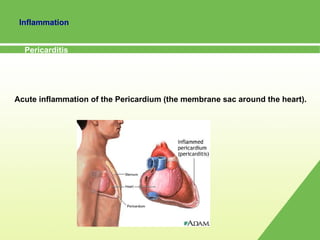
Acute inflammation of the Pericardium (the membrane sac around the heart).  Pericarditis   Inflammation
Symptoms Pericarditis Acute   Severe sudden chest pain, which may spread to the neck, back, shoulders or arms. It gets worse when breathing deeply, moving or lying down. May be relieved by sitting up and leaning forward. Fever. Inflammation
Symptoms Pericarditis Chronic   Difficulty in breathing. Swelling of the legs and abdomen. Fatigue   Inflammation
Fluid in the space between the Pericardium and the Heart.   Pericardial Effusion   Inflammation
Symptoms Pericardial Effusion Chest pain with a feeling of fullness or pressure. Difficulty in breathing and swallowing. Inflammation
Inflammatory disorder of the airways characterized by: Bronchial Asthma Inflammation
Symptoms Bronchial Asthma Periodic attacks of wheezing. Shortness of breath. Chest tightness and cough Inflammation
Chest Pain Digestive System Problems Causes of Chest Pain   Heart Burn or Oesophageal Reflux Oesophageal Spasm Gall Bladder Disease Peptic Ulcer
What does Heartburn feel like? Heartburn ,Oesophageal Reflux Digestive System Problems
What does Heartburn feel like? Heartburn or Oesophageal Reflux A burning feeling in the chest just behind the breast bone that  occurs after eating and lasts for a few minutes to  several hours. Chest pain, especially after bending over, lying down or eating. Burning in the throat or hot, sour, acidic or salty  tasting fluid at the back of the throat. Difficulty in swallowing. Feeling of food "sticking" in the middle of the chest or throat  Digestive System Problems
Is it Heartburn or Heart Attack? Heartburn or Oesophageal Reflux Digestive System Problems
The two problems have many of the same symptoms and occur in  similar types of people e.g., older age group, over weight. Heartburn or Oesophageal Reflux Is it Heartburn or Heart Attack? Also, if the patient has a history of heart problems or is a risk factor for heart attack e.g., has a family history of heart disease, diabetes,  hypertension, is a cigarette smoker, is obese, or is of advanced age, it is more likely to be a heart attack. Digestive System Problems
Heartburn may indicate a serious problem that needs evaluation. Heartburn or Oesophageal Reflux Digestive System Problems
Possible signs of Heartburn could be mistaken for a Heart Attack Heartburn or Oesophageal Reflux Digestive System Problems Heart Burn Angina or Heart Attack Sharp, burning sensation below the breast bone or ribs. 1 Feeling of fullness, tightness or  dull pressure in the center of the  chest Pain does not radiate to the   shoulders, neck or arms. 2 Pain radiating to the shoulders, neck,  jaw or arms. Pain comes after meals when lying on the back or when doing exercise. 3 Sudden chest pain or pressure that worsens. Symptoms respond QUICKLY to antacids. 4 Pain often responds quickly to  nitroglycerin. Rarely accompanied by cold and sweat. 5 Usually accompanied by cold and sweat.
Irregular contraction of the muscles in the Oesophagus  Oesophageal Spasm Digestive System Problems
Symptoms Oesophageal Spasm Pain in the chest or upper abdomen Heartburn Difficulty in swallowing because of pain Digestive System Problems
Includes inflammation, infection, stones, or obstruction of the Gall Bladder.  Gall Bladder Disease Digestive System Problems
Symptoms Gall Bladder Disease Chest pain under the breast bone Heartburn  Nausea & vomiting  Fever  Abdominal pain;  severe , located on the right  upper quadrant  or in the upper  middle  of the abdomen , occurring after meals , worse during deep intake of breath , radiating to the back or below the right shoulder blade , worse after eating or drinking  fatty food. Abdominal fullness or gas  Digestive System Problems
An erosions in the lining of the stomach or duodenum . Peptic Ulcer An ulcer in the stomach is called GASTRIC ULCER, an ulcer in the duodenum is called DUODENAL ULCER. Stomach & duodenal ulcer together, are referred to as a PEPTIC ULCER.   Digestive System Problems
Symptoms Peptic Ulcer Chest pain Nausea and vomiting Weight loss Heart burn, belching Vomiting blood Bloody or dark stools Digestive System Problems
Anxiety or Panic Disorder Chest Pain Causes of Chest Pain   Characterized by repeated  episodes of intense anxiety & fear that occur with or without warning or identifiable causes . Panic attacks are often accompanied by chest pain, caused by muscle contractions in the chest wall.
Anxiety or Panic Disorder PAIN Usually localized to the chest wall Can be fleeting Can be  sharp "catch" that interrupts a breath The chest wall can remain "sore" for hours or days after a panic  attack
The Chest Pain Recent Chest Trauma   Causes of Chest Pain   Chest trauma of any type can cause chest pain by causing a rib fracture, muscle strain or contusion.
Recent Chest Trauma   Almost always localized, is often described as soreness or a sharp pain It usually worsens with breathing The chest wall is tender to touch or to pressure PAIN
Patient Care Guidelines (EMS-8)  Chest Pain
Chest Pain Patient Care Guidelines ( EMS-8)  Triage Assessment Nursing Actions Evaluation
Patient Care Guidelines ( EMS-8)  Initial observation  Subjective assessment Objective assessment  Triage Assessment
Triage Assessment Initial Observation  Skin color  Respiratory effort   Anxiety
Triage Assessment Subjective Assessment Pain Categorization Time of onset ; gradual or sudden Activity at onset Location of pain Sharp, dull, pressure like, or other Intermittent or constant   Radiation Change in pain with deep inspiration, cough or movement
Triage Assessment Associated symptoms Nausea, vomiting   Shortness of breath  Diaphoresis  Cough; productive or nonproductive Fever   Dizziness or change in level of consciousness Palpitation   Subjective Assessment
Triage Assessment Measures taken to relieve pain before arrival at EMS   Relevant medical history. Subjective Assessment
Triage Assessment Objective assessment  Complete vital signs (including apical & peripheral  pulse & breath sounds) Presence or absence of edema: pitting or dependent Presence or absence of neck vein distension
Chest Pain Nursing Actions   Assess patient while obtaining history Classify if chest pain could be of cardiac origin, including epigastric pain in elderly, take to Treatment Area Room Notify clinician immediately Request patient's file Take the vital signs  Facilitate rapid admission Explain treatment to patient & family to diminish anxiety
Chest Pain Evaluation Document initial assessment data and interventions Extent of diminished anxiety
Summary Chest Pain
Chest Pain Any organ or tissue in the chest can be the source of pain, including the Heart, Lungs, Oesophagus, Muscles, Ribs, Tendons, or Nerves.   Summary
Chest Pain The Physical Examination   Summary The physical examination will focus on the chest wall, lungs and heart. The  doctor or nurse may ask questions like the  following:
Summary The Physical Examination  Is the pain between the shoulder blades? Under the breastbone? Does the pain change location? Is it on one side only?  How would you describe the pain? (Severe, tearing or ripping, sharp, stabbing, burning, squeezing, constricting, tight, pressure-like, crushing, aching, dull, heavy)? Does it come on suddenly? Does the pain occur at the same time each day?  Is the pain getting worse? How long does the pain last?  Does the pain go from your chest into your shoulder, arm, neck, jaw, or back?
Summary Is the pain worse when you are breathing deeply, coughing, eating, bending? When you are exercising? Is the pain better after you rest? Is it completely relieved or just less?  Is the pain better after you take nitroglycerin medication? After you drink milk or take antacids? After belching?  What other symptoms are also present?   The Physical Examination
Summary Diagnostic tests that may be performed include: Blood tests (such as  LDH ,  LDH isoenzymes ,  CPK ,  CPK isoenzymes , Troponin,  CBC , and  blood differential ) Cardiac catheterization   ECG   Exercise ECG   Lung scan   X-rays of the chest   Diagnostic Tests
Summary More complex tests may be required depending on the difficulty of  diagnosis or the suspected cause of the chest pain   Diagnostic Tests
References   Chest Pain
Chest Pain References www.webmed.com www.heartdisease.about.com www.health.discovery.com www.health.yahoo.com www.heartcenteronline.com www.e_manual.aramco.com.sa www.mayo clinic.com
Chest Pain Thank You

Chest Pain

  • 1.
  • 2.
    Chest Pain By Iman Noufal Amb.Nsg. /UCU
  • 3.
    Chest Pain DefinitionCauses of Chest pain Patient Care Guidelines ( EMS-8) Summary References Introduction
  • 4.
  • 5.
    Chest Pain Whatis Chest Pain? Definition
  • 6.
    Chest Pain Whatis Chest Pain? Definition Chest pain is discomfort or pain that the patient feels anywhere along the front of the body between the neck and upper abdomen.
  • 7.
    Chest Pain Ischest pain the warning sign of a heart attack only? Or could it be a sign of another illness? Definition
  • 8.
    Chest Pain Ischest pain the only warning sign of a Heart Attack, or could it be a sign of serious illnesses? Definition Many people with chest pain fear a heart attack, but there are many possible causes of chest pain.
  • 9.
    Chest Pain Causesof Chest Pain
  • 10.
    Chest Pain Causesof Chest Pain Heart Disease Inflammation Digestive System Problems Anxiety or Panic Disorder Recent Chest Trauma
  • 11.
    Chest Pain HeartDisease Causes of Chest Pain Coronary Artery Disease (Angina) Heart Attack (MI) Heart Valve Disease Heart Muscle Disease (Cardiomyopathy) Aortic Dissection
  • 12.
    Heart Disease SymptomsCoronary Artery Disease (Angina) Discomfort, heaviness, pressure, aching, burning, fullness, squeezing or painful feeling in the chest (It can be mistaken for indigestion or heart burn). Angina is usually felt in the chest, but it may also be felt in the Lt. shoulder, arms, neck, throat , jaw, or back. S.O.B. palpitation (irregular heart beat , skipped beats, or flip-flop feeling in the chest). Rapid heart beat , weakness, dizziness, nausea and sweating.
  • 13.
    Heart Disease SymptomsHeart Attack (MI) Chest discomfort or pain that is crushing or squeezing or feels like a heavy weight on the chest. Sweating . Shortness of breath . Nausea & vomiting . Pain spreads from the chest to the neck, jaw, or to one or both shoulders or arms . Dizziness or light headedness . A fast irregular heart beat .
  • 14.
    Heart Disease SymptomsHeart Valve Disease. Palpitations, feeling that the heart is "running away". Pounding in the chest. Dizziness, feeling light headed, fainting. Shortness of breath. Chest discomfort & fatigue.
  • 15.
    Heart Disease SymptomsHeart Muscles Disease Chest pain or pressure occurs usually with exercise or physical activity, or with rest or after meals. Heart failure symptoms, e.g. S.O.B., quick weight gain, dizziness, swelling in ankles, chest pain. Swelling of the lower extremities. Fatigue & fainting. Palpitation.
  • 16.
    Heart Disease AorticDissection Tearing of the lining of the aorta (the body's main artery that comes directly off the heart). It often leads to heart attack or stroke. Symptom: Chest pain is: very sudden and severe in onset described as a tearing pain, located beneath the breastbone.
  • 17.
    Chest Pain InflammationCauses of Chest Pain Pneumonia Pleurisy Pericarditis (Acute, chronic) Pericardial Effusion Bronchial Asthma
  • 18.
    Inflammation of thelungs caused by a bacterial or viral infection. Symptoms often begin suddenly & may follow an upper respiratory infection such as flu or cold. Pneumonia Inflammation
  • 19.
    Symptoms Pneumonia Suddenonset Chest wall pain, getting worse by coughing or deep breathing. Fever, cough with sputum, rapid shallow breathing. Fatigue, shaking chills, malaise. Inflammation
  • 20.
    Symptoms Pleurisy Chestpain, sudden onset, stabbing pain increasing on inhalation. Rapid shallow breathing. Pain spreading to the shoulder or the abdomen. Cough or fever. Inflammation Inflammation of the outside lining of the lungs.
  • 21.
    Acute inflammation ofthe Pericardium (the membrane sac around the heart). Pericarditis Inflammation
  • 22.
    Symptoms Pericarditis Acute Severe sudden chest pain, which may spread to the neck, back, shoulders or arms. It gets worse when breathing deeply, moving or lying down. May be relieved by sitting up and leaning forward. Fever. Inflammation
  • 23.
    Symptoms Pericarditis Chronic Difficulty in breathing. Swelling of the legs and abdomen. Fatigue Inflammation
  • 24.
    Fluid in thespace between the Pericardium and the Heart. Pericardial Effusion Inflammation
  • 25.
    Symptoms Pericardial EffusionChest pain with a feeling of fullness or pressure. Difficulty in breathing and swallowing. Inflammation
  • 26.
    Inflammatory disorder ofthe airways characterized by: Bronchial Asthma Inflammation
  • 27.
    Symptoms Bronchial AsthmaPeriodic attacks of wheezing. Shortness of breath. Chest tightness and cough Inflammation
  • 28.
    Chest Pain DigestiveSystem Problems Causes of Chest Pain Heart Burn or Oesophageal Reflux Oesophageal Spasm Gall Bladder Disease Peptic Ulcer
  • 29.
    What does Heartburnfeel like? Heartburn ,Oesophageal Reflux Digestive System Problems
  • 30.
    What does Heartburnfeel like? Heartburn or Oesophageal Reflux A burning feeling in the chest just behind the breast bone that occurs after eating and lasts for a few minutes to several hours. Chest pain, especially after bending over, lying down or eating. Burning in the throat or hot, sour, acidic or salty tasting fluid at the back of the throat. Difficulty in swallowing. Feeling of food "sticking" in the middle of the chest or throat Digestive System Problems
  • 31.
    Is it Heartburnor Heart Attack? Heartburn or Oesophageal Reflux Digestive System Problems
  • 32.
    The two problemshave many of the same symptoms and occur in similar types of people e.g., older age group, over weight. Heartburn or Oesophageal Reflux Is it Heartburn or Heart Attack? Also, if the patient has a history of heart problems or is a risk factor for heart attack e.g., has a family history of heart disease, diabetes, hypertension, is a cigarette smoker, is obese, or is of advanced age, it is more likely to be a heart attack. Digestive System Problems
  • 33.
    Heartburn may indicatea serious problem that needs evaluation. Heartburn or Oesophageal Reflux Digestive System Problems
  • 34.
    Possible signs ofHeartburn could be mistaken for a Heart Attack Heartburn or Oesophageal Reflux Digestive System Problems Heart Burn Angina or Heart Attack Sharp, burning sensation below the breast bone or ribs. 1 Feeling of fullness, tightness or dull pressure in the center of the chest Pain does not radiate to the shoulders, neck or arms. 2 Pain radiating to the shoulders, neck, jaw or arms. Pain comes after meals when lying on the back or when doing exercise. 3 Sudden chest pain or pressure that worsens. Symptoms respond QUICKLY to antacids. 4 Pain often responds quickly to nitroglycerin. Rarely accompanied by cold and sweat. 5 Usually accompanied by cold and sweat.
  • 35.
    Irregular contraction ofthe muscles in the Oesophagus Oesophageal Spasm Digestive System Problems
  • 36.
    Symptoms Oesophageal SpasmPain in the chest or upper abdomen Heartburn Difficulty in swallowing because of pain Digestive System Problems
  • 37.
    Includes inflammation, infection,stones, or obstruction of the Gall Bladder. Gall Bladder Disease Digestive System Problems
  • 38.
    Symptoms Gall BladderDisease Chest pain under the breast bone Heartburn Nausea & vomiting Fever Abdominal pain; severe , located on the right upper quadrant or in the upper middle of the abdomen , occurring after meals , worse during deep intake of breath , radiating to the back or below the right shoulder blade , worse after eating or drinking fatty food. Abdominal fullness or gas Digestive System Problems
  • 39.
    An erosions inthe lining of the stomach or duodenum . Peptic Ulcer An ulcer in the stomach is called GASTRIC ULCER, an ulcer in the duodenum is called DUODENAL ULCER. Stomach & duodenal ulcer together, are referred to as a PEPTIC ULCER. Digestive System Problems
  • 40.
    Symptoms Peptic UlcerChest pain Nausea and vomiting Weight loss Heart burn, belching Vomiting blood Bloody or dark stools Digestive System Problems
  • 41.
    Anxiety or PanicDisorder Chest Pain Causes of Chest Pain Characterized by repeated episodes of intense anxiety & fear that occur with or without warning or identifiable causes . Panic attacks are often accompanied by chest pain, caused by muscle contractions in the chest wall.
  • 42.
    Anxiety or PanicDisorder PAIN Usually localized to the chest wall Can be fleeting Can be sharp "catch" that interrupts a breath The chest wall can remain "sore" for hours or days after a panic attack
  • 43.
    The Chest PainRecent Chest Trauma Causes of Chest Pain Chest trauma of any type can cause chest pain by causing a rib fracture, muscle strain or contusion.
  • 44.
    Recent Chest Trauma Almost always localized, is often described as soreness or a sharp pain It usually worsens with breathing The chest wall is tender to touch or to pressure PAIN
  • 45.
    Patient Care Guidelines(EMS-8) Chest Pain
  • 46.
    Chest Pain PatientCare Guidelines ( EMS-8) Triage Assessment Nursing Actions Evaluation
  • 47.
    Patient Care Guidelines( EMS-8) Initial observation Subjective assessment Objective assessment Triage Assessment
  • 48.
    Triage Assessment InitialObservation Skin color Respiratory effort Anxiety
  • 49.
    Triage Assessment SubjectiveAssessment Pain Categorization Time of onset ; gradual or sudden Activity at onset Location of pain Sharp, dull, pressure like, or other Intermittent or constant Radiation Change in pain with deep inspiration, cough or movement
  • 50.
    Triage Assessment Associatedsymptoms Nausea, vomiting Shortness of breath Diaphoresis Cough; productive or nonproductive Fever Dizziness or change in level of consciousness Palpitation Subjective Assessment
  • 51.
    Triage Assessment Measurestaken to relieve pain before arrival at EMS Relevant medical history. Subjective Assessment
  • 52.
    Triage Assessment Objectiveassessment Complete vital signs (including apical & peripheral pulse & breath sounds) Presence or absence of edema: pitting or dependent Presence or absence of neck vein distension
  • 53.
    Chest Pain NursingActions Assess patient while obtaining history Classify if chest pain could be of cardiac origin, including epigastric pain in elderly, take to Treatment Area Room Notify clinician immediately Request patient's file Take the vital signs Facilitate rapid admission Explain treatment to patient & family to diminish anxiety
  • 54.
    Chest Pain EvaluationDocument initial assessment data and interventions Extent of diminished anxiety
  • 55.
  • 56.
    Chest Pain Anyorgan or tissue in the chest can be the source of pain, including the Heart, Lungs, Oesophagus, Muscles, Ribs, Tendons, or Nerves. Summary
  • 57.
    Chest Pain ThePhysical Examination Summary The physical examination will focus on the chest wall, lungs and heart. The doctor or nurse may ask questions like the following:
  • 58.
    Summary The PhysicalExamination Is the pain between the shoulder blades? Under the breastbone? Does the pain change location? Is it on one side only? How would you describe the pain? (Severe, tearing or ripping, sharp, stabbing, burning, squeezing, constricting, tight, pressure-like, crushing, aching, dull, heavy)? Does it come on suddenly? Does the pain occur at the same time each day? Is the pain getting worse? How long does the pain last? Does the pain go from your chest into your shoulder, arm, neck, jaw, or back?
  • 59.
    Summary Is thepain worse when you are breathing deeply, coughing, eating, bending? When you are exercising? Is the pain better after you rest? Is it completely relieved or just less? Is the pain better after you take nitroglycerin medication? After you drink milk or take antacids? After belching? What other symptoms are also present? The Physical Examination
  • 60.
    Summary Diagnostic teststhat may be performed include: Blood tests (such as LDH , LDH isoenzymes , CPK , CPK isoenzymes , Troponin, CBC , and blood differential ) Cardiac catheterization ECG Exercise ECG Lung scan X-rays of the chest Diagnostic Tests
  • 61.
    Summary More complextests may be required depending on the difficulty of diagnosis or the suspected cause of the chest pain Diagnostic Tests
  • 62.
    References Chest Pain
  • 63.
    Chest Pain Referenceswww.webmed.com www.heartdisease.about.com www.health.discovery.com www.health.yahoo.com www.heartcenteronline.com www.e_manual.aramco.com.sa www.mayo clinic.com
  • 64.