Aluminium
and titanium
Biosensors and biochips
Victoria Saura
María Cascales
A LUMINIUM
D ESCRIPTION

•I’ts a chemical element in the boron group
•Its symbol: Al
•Its atomic number: 13
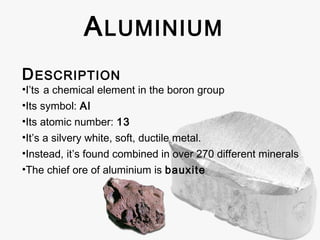
•It’s a silvery white, soft, ductile metal.
•Instead, it’s found combined in over 270 different minerals
•The chief ore of aluminium is bauxite
H ISTORY

A LUMINIUM

•Ancient Greeks and Romans used aluminium salts as:
– dyeing mordants
– astringents for dressing wounds
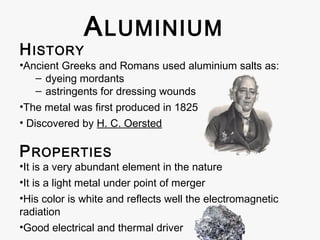
•The metal was first produced in 1825
• Discovered by H. C. Oersted

P ROPERTIES

•It is a very abundant element in the nature
•It is a light metal under point of merger
•His color is white and reflects well the electromagnetic
radiation
•Good electrical and thermal driver
U SES

A LUMINIUM

The uses that aluminium gives to nowadays are
MULTIPLE and we can divide them by sectors:
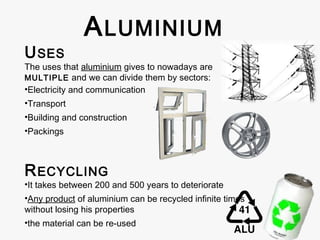
•Electricity and communication
•Transport
•Building and construction
•Packings

R ECYCLING

•It takes between 200 and 500 years to deteriorate
•Any product of aluminium can be recycled infinite times
without losing his properties
•the material can be re-used
H ISTORY

T ITANIUM

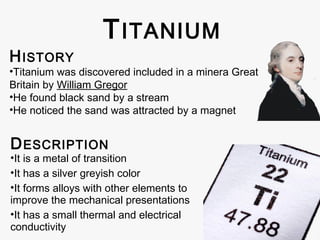
•Titanium was discovered included in a minera Great
Britain by William Gregor
•He found black sand by a stream
•He noticed the sand was attracted by a magnet

D ESCRIPTION

•It is a metal of transition
•It has a silver greyish color
•It forms alloys with other elements to
improve the mechanical presentations
•It has a small thermal and electrical
conductivity
T ITANIUM
P ROPERTIES

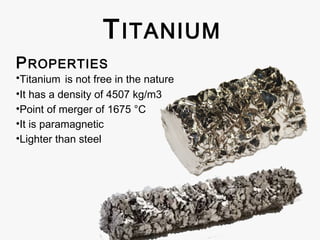
•Titanium is not free in the nature
•It has a density of 4507 kg/m3
•Point of merger of 1675 °C
•It is paramagnetic
•Lighter than steel
T ITANIUM
U SES

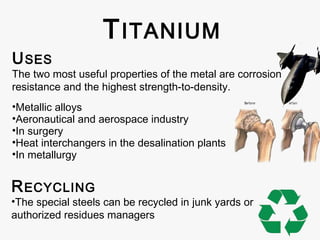
The two most useful properties of the metal are corrosion
resistance and the highest strength-to-density.
•Metallic alloys
•Aeronautical and aerospace industry
•In surgery
•Heat interchangers in the desalination plants
•In metallurgy

R ECYCLING

•The special steels can be recycled in junk yards or
authorized residues managers
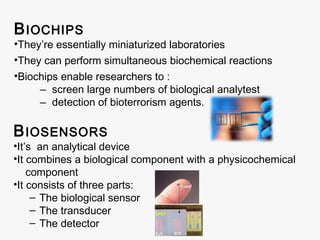
B IOCHIPS

•They’re essentially miniaturized laboratories
•They can perform simultaneous biochemical reactions
•Biochips enable researchers to :
‒ screen large numbers of biological analytest
‒ detection of bioterrorism agents.

B IOSENSORS

•It’s an analytical device
•It combines a biological component with a physicochemical
component
•It consists of three parts:
– The biological sensor
– The transducer
– The detector

Aluminium. Titanium. Biochips. Biosensors

  • 1.
    Aluminium and titanium Biosensors andbiochips Victoria Saura María Cascales
  • 2.
    A LUMINIUM D ESCRIPTION •I’tsa chemical element in the boron group •Its symbol: Al •Its atomic number: 13 •It’s a silvery white, soft, ductile metal. •Instead, it’s found combined in over 270 different minerals •The chief ore of aluminium is bauxite
  • 3.
    H ISTORY A LUMINIUM •AncientGreeks and Romans used aluminium salts as: – dyeing mordants – astringents for dressing wounds •The metal was first produced in 1825 • Discovered by H. C. Oersted P ROPERTIES •It is a very abundant element in the nature •It is a light metal under point of merger •His color is white and reflects well the electromagnetic radiation •Good electrical and thermal driver
  • 4.
    U SES A LUMINIUM Theuses that aluminium gives to nowadays are MULTIPLE and we can divide them by sectors: •Electricity and communication •Transport •Building and construction •Packings R ECYCLING •It takes between 200 and 500 years to deteriorate •Any product of aluminium can be recycled infinite times without losing his properties •the material can be re-used
  • 5.
    H ISTORY T ITANIUM •Titaniumwas discovered included in a minera Great Britain by William Gregor •He found black sand by a stream •He noticed the sand was attracted by a magnet D ESCRIPTION •It is a metal of transition •It has a silver greyish color •It forms alloys with other elements to improve the mechanical presentations •It has a small thermal and electrical conductivity
  • 6.
    T ITANIUM P ROPERTIES •Titaniumis not free in the nature •It has a density of 4507 kg/m3 •Point of merger of 1675 °C •It is paramagnetic •Lighter than steel
  • 7.
    T ITANIUM U SES Thetwo most useful properties of the metal are corrosion resistance and the highest strength-to-density. •Metallic alloys •Aeronautical and aerospace industry •In surgery •Heat interchangers in the desalination plants •In metallurgy R ECYCLING •The special steels can be recycled in junk yards or authorized residues managers
  • 8.
    B IOCHIPS •They’re essentiallyminiaturized laboratories •They can perform simultaneous biochemical reactions •Biochips enable researchers to : ‒ screen large numbers of biological analytest ‒ detection of bioterrorism agents. B IOSENSORS •It’s an analytical device •It combines a biological component with a physicochemical component •It consists of three parts: – The biological sensor – The transducer – The detector