CHEMISTRY
INVESTIGATORY
PROJECT
CHEMISTRY
INVESTIGATORY
PROJECT
ACADEMIC YEAR 2021-2022
TOPIC: COMPARATIVE
STUDY OF RATE OF
FERMENTATION OF VARIOUS
FOODS Arnav Sinha
12-E
Roll Number 24
SNBP RAHATANI
Submitted to: Mrs. Reenu Dubey
Submitted by: Arnav Sinha
CERTIFICATE
THIS IS TO CERTIFY THAT MASTER ARNAV SINHA, ROLL NO 24,
STUDYING IN CLASS XII E, DURING ACADEMIC YEAR 2021-2022
OF SNBP INTERNATIONAL SCHOOL, RAHATANI, HAS COMPLETED
HIS INVESTIGATORY PROJECT OF CHEMISTRY BASED ON
“COMPARATIVE STUDY OF RATE OF FERMENTATION OF VARIOUS
FOODS” AND HAS GIVEN A SATISFACTORY AMOUNT OF IT IN THIS
REPORT FILE CONTAINING RECORD OF HIS WORK.
Submission Date: Issue Stamp: Principal’s Sign: __________
Grade-
Signature of Internal Examiner ___________________ Signature of External Examiner _______________
ACKNOWLEDGEMENT
I would like to thank CBSE for providing me with the opportunity to conduct
this project.
I would like to thank my Principal Ma’am Jayshree Venkatraman for
providing me with the opportunity to conduct this project.
I would like to thank my Chemistry Teacher Reenu Ma’am for her
invaluable guidance in this endeavor and always supporting new ideas.
I would like to extend my thanks to everyone involved in this project for their
support, and ideas.
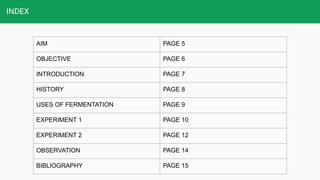
INDEX
AIM PAGE 5
OBJECTIVE PAGE 6
INTRODUCTION PAGE 7
HISTORY PAGE 8
USES OF FERMENTATION PAGE 9
EXPERIMENT 1 PAGE 10
EXPERIMENT 2 PAGE 12
OBSERVATION PAGE 14
BIBLIOGRAPHY PAGE 15
AIM
TO DO A COMPARATIVE STUDY OF
RATE OF FERMENTATION OF
VARIOUS FOODS
OBJECTIVE
The Objective of this project is to study the
rates of fermentation of the following fruit
or vegetable juices;
1)Carrot Juice (Experiment 1)
2)Apple Juice (Experiment 2)
Introduction
Fermentation: chemical process by which molecules such as glucose are
broken down anaerobically.
More broadly, fermentation is the foaming that occurs during the manufacture
of wine, beer, and many other processes which are at least 10,000 years old.
The frothing results from the formation of carbon dioxide gas, though this was
not recognized until the 17th century. French chemist and microbiologist Louis
Pasteur in the 19th century used the term fermentation in a narrow sense to
describe the changes brought about by yeasts (Used in Foods) and other
microorganisms growing in the absence of air (anaerobically).
HISTORY
Since fruits ferment naturally, fermentation precedes human
history. Since ancient times, however, humans have been
controlling the fermentation process. The earliest evidence of
winemaking dates from eight thousand Years ago in Georgia, in the
Caucasus area.
Seven thousand years ago jars containing the remains of wine have
been excavated in the Zagros Mountains in Iran, which are now on
display at the University of Pennsylvania, United States of America.
Pasteur originally defined fermentation as "respiration without air".
USES OF FERMENTATION
1) Fermentation is widely used for the production of alcoholic
beverages, for instance, wine from fruit juices and beer from grains.
2) Fermentation is also extensively used in bread making. When sugar,
yeast, flour and water are combined to form dough, yeast breaks
down the sugar and gives off carbon dioxide, which causes the bread
to rise. Specialty bread such as sourdough uses both yeast and
lactobacilli. This combination gives the dough its stretchy texture
and distinctive sour taste.
3) Fermentation is used in industry to generate ethanol for the
production of biofuel.
4) Lactic acid fermentation is used to flavor or preserve dairy products
and vegetables, for example yogurt, sauerkraut, pickles and kimchi.
EXPERIMENT -1
APPARATUS REQUIRED:
● Conical Flasks (250 Milliliters)
● Test Tubes
● Carrot Juice
● Fehling's Solution (a chemical reagent used to
differentiate between water-soluble
carbohydrate and ketone functional groups)
● Water Bath
PROCEDURE:
1. Take 5.0 ml of carrot juice in a clean 250 ml conical flask and dilute it
with 50 ml of distilled water.
2. Add 2.0 gram of Baker’s yeast and 5.0 ml of solution of Pasteur’s salts to
the above conical flask.
3. Shake well the contents of the flask and maintain the temperature of the
reaction mixture between 35-40°C.
4. After 10 minutes take 5 drops of the reaction mixture from the flask and
add to a test tube containing 2 ml of Fehling reagent. Place the test tube
in the boiling water bath for about 2 minutes and note the colour of the
solution or precipitate.
5. Repeat the step 4 after every 10 minutes when the reaction mixture
stops giving any red colour or precipitate.
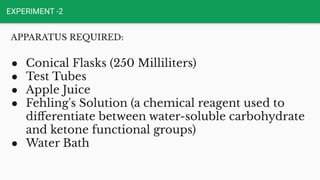
EXPERIMENT -2
APPARATUS REQUIRED:
● Conical Flasks (250 Milliliters)
● Test Tubes
● Apple Juice
● Fehling's Solution (a chemical reagent used to
differentiate between water-soluble carbohydrate
and ketone functional groups)
● Water Bath
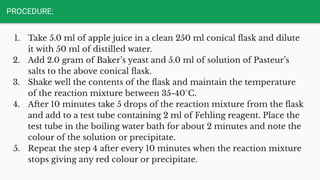
PROCEDURE:
1. Take 5.0 ml of apple juice in a clean 250 ml conical flask and dilute
it with 50 ml of distilled water.
2. Add 2.0 gram of Baker’s yeast and 5.0 ml of solution of Pasteur’s
salts to the above conical flask.
3. Shake well the contents of the flask and maintain the temperature
of the reaction mixture between 35-40°C.
4. After 10 minutes take 5 drops of the reaction mixture from the flask
and add to a test tube containing 2 ml of Fehling reagent. Place the
test tube in the boiling water bath for about 2 minutes and note the
colour of the solution or precipitate.
5. Repeat the step 4 after every 10 minutes when the reaction mixture
stops giving any red colour or precipitate.
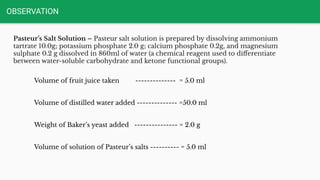
OBSERVATION
Pasteur’s Salt Solution – Pasteur salt solution is prepared by dissolving ammonium
tartrate 10.0g; potassium phosphate 2.0 g; calcium phosphate 0.2g, and magnesium
sulphate 0.2 g dissolved in 860ml of water (a chemical reagent used to differentiate
between water-soluble carbohydrate and ketone functional groups).
Volume of fruit juice taken -------------- = 5.0 ml
Volume of distilled water added -------------- =50.0 ml
Weight of Baker’s yeast added --------------- = 2.0 g
Volume of solution of Pasteur’s salts ---------- = 5.0 ml
BIBLIOGRAPHY
1. https://www.google.com/
2. https://thechemistryguru.com
3. https://www.chemistrylearner.com/fehlings
-solution.html
4. Comprehensive Chemistry Class 12
5. NCERT CLASS 12
6. NCERT CLASS 11

Jjjkalmsnsxjxixnndixndnskaooashbd udnsnjsj

  • 1.
    CHEMISTRY INVESTIGATORY PROJECT CHEMISTRY INVESTIGATORY PROJECT ACADEMIC YEAR 2021-2022 TOPIC:COMPARATIVE STUDY OF RATE OF FERMENTATION OF VARIOUS FOODS Arnav Sinha 12-E Roll Number 24 SNBP RAHATANI Submitted to: Mrs. Reenu Dubey Submitted by: Arnav Sinha
  • 2.
    CERTIFICATE THIS IS TOCERTIFY THAT MASTER ARNAV SINHA, ROLL NO 24, STUDYING IN CLASS XII E, DURING ACADEMIC YEAR 2021-2022 OF SNBP INTERNATIONAL SCHOOL, RAHATANI, HAS COMPLETED HIS INVESTIGATORY PROJECT OF CHEMISTRY BASED ON “COMPARATIVE STUDY OF RATE OF FERMENTATION OF VARIOUS FOODS” AND HAS GIVEN A SATISFACTORY AMOUNT OF IT IN THIS REPORT FILE CONTAINING RECORD OF HIS WORK. Submission Date: Issue Stamp: Principal’s Sign: __________ Grade- Signature of Internal Examiner ___________________ Signature of External Examiner _______________
  • 3.
    ACKNOWLEDGEMENT I would liketo thank CBSE for providing me with the opportunity to conduct this project. I would like to thank my Principal Ma’am Jayshree Venkatraman for providing me with the opportunity to conduct this project. I would like to thank my Chemistry Teacher Reenu Ma’am for her invaluable guidance in this endeavor and always supporting new ideas. I would like to extend my thanks to everyone involved in this project for their support, and ideas.
  • 4.
    INDEX AIM PAGE 5 OBJECTIVEPAGE 6 INTRODUCTION PAGE 7 HISTORY PAGE 8 USES OF FERMENTATION PAGE 9 EXPERIMENT 1 PAGE 10 EXPERIMENT 2 PAGE 12 OBSERVATION PAGE 14 BIBLIOGRAPHY PAGE 15
  • 5.
    AIM TO DO ACOMPARATIVE STUDY OF RATE OF FERMENTATION OF VARIOUS FOODS
  • 6.
    OBJECTIVE The Objective ofthis project is to study the rates of fermentation of the following fruit or vegetable juices; 1)Carrot Juice (Experiment 1) 2)Apple Juice (Experiment 2)
  • 7.
    Introduction Fermentation: chemical processby which molecules such as glucose are broken down anaerobically. More broadly, fermentation is the foaming that occurs during the manufacture of wine, beer, and many other processes which are at least 10,000 years old. The frothing results from the formation of carbon dioxide gas, though this was not recognized until the 17th century. French chemist and microbiologist Louis Pasteur in the 19th century used the term fermentation in a narrow sense to describe the changes brought about by yeasts (Used in Foods) and other microorganisms growing in the absence of air (anaerobically).
  • 8.
    HISTORY Since fruits fermentnaturally, fermentation precedes human history. Since ancient times, however, humans have been controlling the fermentation process. The earliest evidence of winemaking dates from eight thousand Years ago in Georgia, in the Caucasus area. Seven thousand years ago jars containing the remains of wine have been excavated in the Zagros Mountains in Iran, which are now on display at the University of Pennsylvania, United States of America. Pasteur originally defined fermentation as "respiration without air".
  • 9.
    USES OF FERMENTATION 1)Fermentation is widely used for the production of alcoholic beverages, for instance, wine from fruit juices and beer from grains. 2) Fermentation is also extensively used in bread making. When sugar, yeast, flour and water are combined to form dough, yeast breaks down the sugar and gives off carbon dioxide, which causes the bread to rise. Specialty bread such as sourdough uses both yeast and lactobacilli. This combination gives the dough its stretchy texture and distinctive sour taste. 3) Fermentation is used in industry to generate ethanol for the production of biofuel. 4) Lactic acid fermentation is used to flavor or preserve dairy products and vegetables, for example yogurt, sauerkraut, pickles and kimchi.
  • 10.
    EXPERIMENT -1 APPARATUS REQUIRED: ●Conical Flasks (250 Milliliters) ● Test Tubes ● Carrot Juice ● Fehling's Solution (a chemical reagent used to differentiate between water-soluble carbohydrate and ketone functional groups) ● Water Bath
  • 11.
    PROCEDURE: 1. Take 5.0ml of carrot juice in a clean 250 ml conical flask and dilute it with 50 ml of distilled water. 2. Add 2.0 gram of Baker’s yeast and 5.0 ml of solution of Pasteur’s salts to the above conical flask. 3. Shake well the contents of the flask and maintain the temperature of the reaction mixture between 35-40°C. 4. After 10 minutes take 5 drops of the reaction mixture from the flask and add to a test tube containing 2 ml of Fehling reagent. Place the test tube in the boiling water bath for about 2 minutes and note the colour of the solution or precipitate. 5. Repeat the step 4 after every 10 minutes when the reaction mixture stops giving any red colour or precipitate.
  • 12.
    EXPERIMENT -2 APPARATUS REQUIRED: ●Conical Flasks (250 Milliliters) ● Test Tubes ● Apple Juice ● Fehling's Solution (a chemical reagent used to differentiate between water-soluble carbohydrate and ketone functional groups) ● Water Bath
  • 13.
    PROCEDURE: 1. Take 5.0ml of apple juice in a clean 250 ml conical flask and dilute it with 50 ml of distilled water. 2. Add 2.0 gram of Baker’s yeast and 5.0 ml of solution of Pasteur’s salts to the above conical flask. 3. Shake well the contents of the flask and maintain the temperature of the reaction mixture between 35-40°C. 4. After 10 minutes take 5 drops of the reaction mixture from the flask and add to a test tube containing 2 ml of Fehling reagent. Place the test tube in the boiling water bath for about 2 minutes and note the colour of the solution or precipitate. 5. Repeat the step 4 after every 10 minutes when the reaction mixture stops giving any red colour or precipitate.
  • 14.
    OBSERVATION Pasteur’s Salt Solution– Pasteur salt solution is prepared by dissolving ammonium tartrate 10.0g; potassium phosphate 2.0 g; calcium phosphate 0.2g, and magnesium sulphate 0.2 g dissolved in 860ml of water (a chemical reagent used to differentiate between water-soluble carbohydrate and ketone functional groups). Volume of fruit juice taken -------------- = 5.0 ml Volume of distilled water added -------------- =50.0 ml Weight of Baker’s yeast added --------------- = 2.0 g Volume of solution of Pasteur’s salts ---------- = 5.0 ml
  • 15.
    BIBLIOGRAPHY 1. https://www.google.com/ 2. https://thechemistryguru.com 3.https://www.chemistrylearner.com/fehlings -solution.html 4. Comprehensive Chemistry Class 12 5. NCERT CLASS 12 6. NCERT CLASS 11