Chemical Reactions
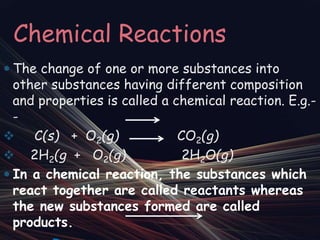
 The change of one or more substances into
other substances having different composition
and properties is called a chemical reaction. E.g.-
-
 C(s) + O2(g) CO2(g)
 2H2(g + O2(g) 2H2O(g)
 In a chemical reaction, the substances which
react together are called reactants whereas
the new substances formed are called
products.
Types Of Chemical Reactions
Combination Reactions
Decomposition Reactions
Displacement Reactions
Double - Displacement Reactions
Oxidation and Reduction Reactions
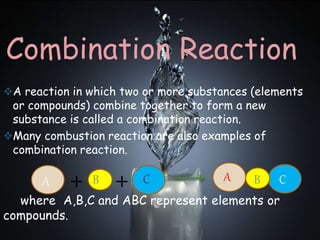
B C A B C+ +
Combination Reaction
A
A reaction in which two or more substances (elements
or compounds) combine together to form a new
substance is called a combination reaction.
Many combustion reaction are also examples of
combination reaction.
where A,B,C and ABC represent elements or
compounds.
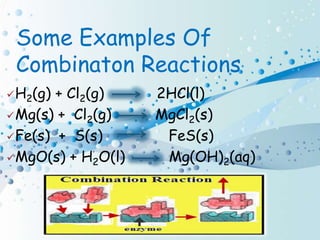
H2(g) + Cl2(g) 2HCl(l)
Mg(s) + Cl2(g) MgCl2(s)
Fe(s) + S(s) FeS(s)
MgO(s) + H2O(l) Mg(OH)2(aq)
Some Examples Of
Combinaton Reactions
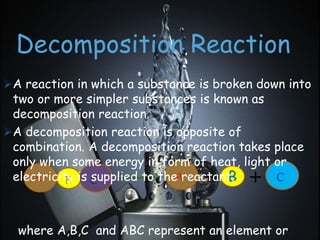
Decomposition Reaction
A B C A C+ +B
A reaction in which a substance is broken down into
two or more simpler substances is known as
decomposition reaction.
A decomposition reaction is opposite of
combination. A decomposition reaction takes place
only when some energy in form of heat, light or
electricity is supplied to the reactant.
where A,B,C and ABC represent an element or
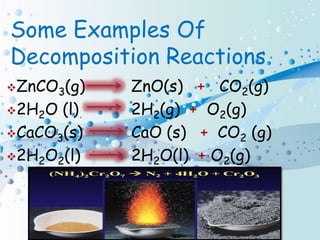
Some Examples Of
Decomposition Reactions
ZnCO3(g) ZnO(s) + CO2(g)
2H2O (l) 2H2(g) + O2(g)
CaCO3(s) CaO (s) + CO2 (g)
2H2O2(l) 2H2O(l) + O2(g)
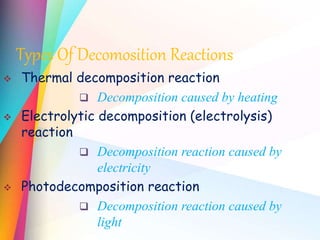
Types Of Decomosition Reactions
 Thermal decomposition reaction
 Decomposition caused by heating
 Electrolytic decomposition (electrolysis)
reaction
 Decomposition reaction caused by
electricity
 Photodecomposition reaction
 Decomposition reaction caused by
light
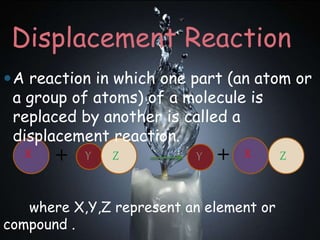
Displacement Reaction
Y Z+X X ZY +
A reaction in which one part (an atom or
a group of atoms) of a molecule is
replaced by another is called a
displacement reaction.
where X,Y,Z represent an element or
compound .
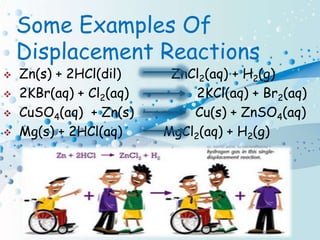
Some Examples Of
Displacement Reactions
 Zn(s) + 2HCl(dil) ZnCl2(aq) + H2(g)
 2KBr(aq) + Cl2(aq) 2KCl(aq) + Br2(aq)
 CuSO4(aq) + Zn(s) Cu(s) + ZnSO4(aq)
 Mg(s) + 2HCl(aq) MgCl2(aq) + H2(g)
Z+X X ZY +W WYW
Double-Displacement Reaction
Z+X X ZY +W WY
A reaction in which the two reacting
ionic compounds exchange their
corresponding ions is called a double-
displacement reaction.
where W,X,Y,Z represent an element or
compound.
Z+X X ZY +W WY
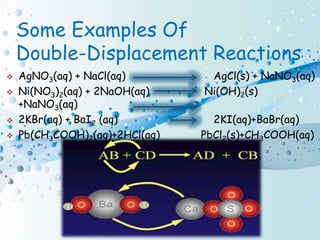
 AgNO3(aq) + NaCl(aq) AgCl(s) + NaNO3(aq)
 Ni(NO3)2(aq) + 2NaOH(aq) Ni(OH)2(s)
+NaNO3(aq)
 2KBr(aq) + BaI2 (aq) 2KI(aq)+BaBr(aq)
 Pb(CH3COOH)2(aq)+2HCl(aq) PbCl2(s)+CH3COOH(aq)
Some Examples Of
Double-Displacement Reactions
Oxidation-Reduction
Reaction
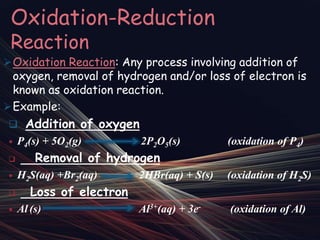
Oxidation Reaction: Any process involving addition of
oxygen, removal of hydrogen and/or loss of electron is
known as oxidation reaction.
Example:
 Addition of oxygen
 P4(s) + 5O2(g) 2P2O5(s) (oxidation of P4)
 Removal of hydrogen
 H2S(aq) +Br2(aq) 2HBr(aq) + S(s) (oxidation of H2S)
 Loss of electron
 Al (s) Al3+(aq) + 3e- (oxidation of Al)
Oxidising Agent : The substance which brings about
oxidation of other substances is called an oxidising agent.
 Example: 1. KMnO4 (Potassium Permanganate)
2 .H2SO4 (Conc. Sulphuric acid)
Reduction Reaction: Any process involving removal of oxygen,
addition of hydrogen and/or gain of electron is known as
reduction reaction.
 Example:
 Removal of oxygen
 Fe2O3(s) + 3CO(g) Fe(s) + 3CO2(g) (reduction of Fe2O3)
 Addition of hydrogen
 H2S(aq) + Cl2(g) 2HCl(aq) + S(s) (reduction of Cl)
 Gain of electron
2+ - 2+
 Reducing Agent: The substance which brings about
reduction of other substance is called a reducing
agent.
 Example: 1. H2 (Hydrogen)
2.SO2 (Sulphur Dioxide)
“Reduction is the reverse of oxidation”
 “Oxidation and reduction are mutually
dependent, i.e. oxidation and reduction are
reciprocal. Thus, in a reaction if a substance
Chemical Reactions (Class-10)

Chemical Reactions (Class-10)

  • 2.
    Chemical Reactions  Thechange of one or more substances into other substances having different composition and properties is called a chemical reaction. E.g.- -  C(s) + O2(g) CO2(g)  2H2(g + O2(g) 2H2O(g)  In a chemical reaction, the substances which react together are called reactants whereas the new substances formed are called products.
  • 3.
    Types Of ChemicalReactions Combination Reactions Decomposition Reactions Displacement Reactions Double - Displacement Reactions Oxidation and Reduction Reactions
  • 4.
    B C AB C+ + Combination Reaction A A reaction in which two or more substances (elements or compounds) combine together to form a new substance is called a combination reaction. Many combustion reaction are also examples of combination reaction. where A,B,C and ABC represent elements or compounds.
  • 5.
    H2(g) + Cl2(g)2HCl(l) Mg(s) + Cl2(g) MgCl2(s) Fe(s) + S(s) FeS(s) MgO(s) + H2O(l) Mg(OH)2(aq) Some Examples Of Combinaton Reactions
  • 6.
    Decomposition Reaction A BC A C+ +B A reaction in which a substance is broken down into two or more simpler substances is known as decomposition reaction. A decomposition reaction is opposite of combination. A decomposition reaction takes place only when some energy in form of heat, light or electricity is supplied to the reactant. where A,B,C and ABC represent an element or
  • 7.
    Some Examples Of DecompositionReactions ZnCO3(g) ZnO(s) + CO2(g) 2H2O (l) 2H2(g) + O2(g) CaCO3(s) CaO (s) + CO2 (g) 2H2O2(l) 2H2O(l) + O2(g)
  • 8.
    Types Of DecomositionReactions  Thermal decomposition reaction  Decomposition caused by heating  Electrolytic decomposition (electrolysis) reaction  Decomposition reaction caused by electricity  Photodecomposition reaction  Decomposition reaction caused by light
  • 9.
    Displacement Reaction Y Z+XX ZY + A reaction in which one part (an atom or a group of atoms) of a molecule is replaced by another is called a displacement reaction. where X,Y,Z represent an element or compound .
  • 10.
    Some Examples Of DisplacementReactions  Zn(s) + 2HCl(dil) ZnCl2(aq) + H2(g)  2KBr(aq) + Cl2(aq) 2KCl(aq) + Br2(aq)  CuSO4(aq) + Zn(s) Cu(s) + ZnSO4(aq)  Mg(s) + 2HCl(aq) MgCl2(aq) + H2(g)
  • 11.
    Z+X X ZY+W WYW Double-Displacement Reaction Z+X X ZY +W WY A reaction in which the two reacting ionic compounds exchange their corresponding ions is called a double- displacement reaction. where W,X,Y,Z represent an element or compound. Z+X X ZY +W WY
  • 12.
     AgNO3(aq) +NaCl(aq) AgCl(s) + NaNO3(aq)  Ni(NO3)2(aq) + 2NaOH(aq) Ni(OH)2(s) +NaNO3(aq)  2KBr(aq) + BaI2 (aq) 2KI(aq)+BaBr(aq)  Pb(CH3COOH)2(aq)+2HCl(aq) PbCl2(s)+CH3COOH(aq) Some Examples Of Double-Displacement Reactions
  • 13.
    Oxidation-Reduction Reaction Oxidation Reaction: Anyprocess involving addition of oxygen, removal of hydrogen and/or loss of electron is known as oxidation reaction. Example:  Addition of oxygen  P4(s) + 5O2(g) 2P2O5(s) (oxidation of P4)  Removal of hydrogen  H2S(aq) +Br2(aq) 2HBr(aq) + S(s) (oxidation of H2S)  Loss of electron  Al (s) Al3+(aq) + 3e- (oxidation of Al)
  • 14.
    Oxidising Agent :The substance which brings about oxidation of other substances is called an oxidising agent.  Example: 1. KMnO4 (Potassium Permanganate) 2 .H2SO4 (Conc. Sulphuric acid) Reduction Reaction: Any process involving removal of oxygen, addition of hydrogen and/or gain of electron is known as reduction reaction.  Example:  Removal of oxygen  Fe2O3(s) + 3CO(g) Fe(s) + 3CO2(g) (reduction of Fe2O3)  Addition of hydrogen  H2S(aq) + Cl2(g) 2HCl(aq) + S(s) (reduction of Cl)  Gain of electron 2+ - 2+
  • 15.
     Reducing Agent:The substance which brings about reduction of other substance is called a reducing agent.  Example: 1. H2 (Hydrogen) 2.SO2 (Sulphur Dioxide) “Reduction is the reverse of oxidation”  “Oxidation and reduction are mutually dependent, i.e. oxidation and reduction are reciprocal. Thus, in a reaction if a substance