By;
Mrigendra singh
Chemical machining
Chemical machining
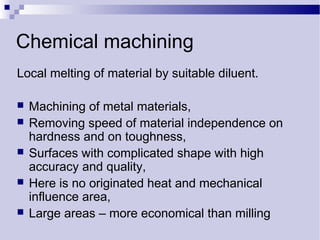
Local melting of material by suitable diluent.
 Machining of metal materials,
 Removing speed of material independence on
hardness and on toughness,
 Surfaces with complicated shape with high
accuracy and quality,
 Here is no originated heat and mechanical
influence area,
 Large areas – more economical than milling
Chemical machining
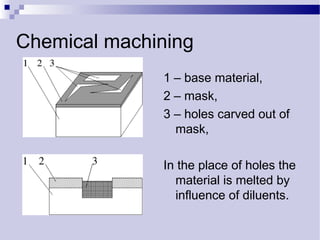
1 – base material,
2 – mask,
3 – holes carved out of
mask,
In the place of holes the
material is melted by
influence of diluents.
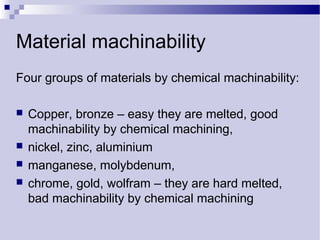
Material machinability
Four groups of materials by chemical machinability:
 Copper, bronze – easy they are melted, good
machinability by chemical machining,
 nickel, zinc, aluminium
 manganese, molybdenum,
 chrome, gold, wolfram – they are hard melted,
bad machinability by chemical machining
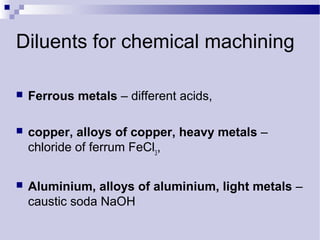
Diluents for chemical machining
 Ferrous metals – different acids,
 copper, alloys of copper, heavy metals –
chloride of ferrum FeCl3
,
 Aluminium, alloys of aluminium, light metals –
caustic soda NaOH
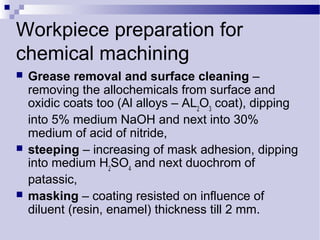
Workpiece preparation for
chemical machining
 Grease removal and surface cleaning –
removing the allochemicals from surface and
oxidic coats too (Al alloys – AL2
O3
coat), dipping
into 5% medium NaOH and next into 30%
medium of acid of nitride,
 steeping – increasing of mask adhesion, dipping
into medium H2
SO4
and next duochrom of
patassic,
 masking – coating resisted on influence of
diluent (resin, enamel) thickness till 2 mm.
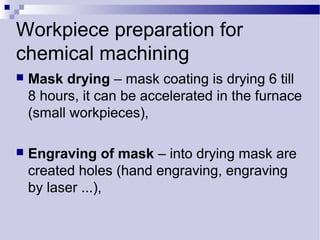
Workpiece preparation for
chemical machining
 Mask drying – mask coating is drying 6 till
8 hours, it can be accelerated in the furnace
(small workpieces),
 Engraving of mask – into drying mask are
created holes (hand engraving, engraving
by laser ...),
Time needed for machining
 It is independence on the size of the machined
surface,
 It is depend on depth of machining only,
 Speed of outline 0,01 till 0,5 mm/min.,
 mask resisted to outlining approximately 8 hours.
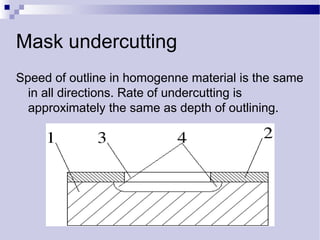
Mask undercutting
Speed of outline in homogenne material is the same
in all directions. Rate of undercutting is
approximately the same as depth of outlining.
Mask undercutting
 Is not possible to make shape rims,
 In immersion into etching pool is needed to
assure that origin gas is not to mass in the place
of undercut (scaling of mask, non-constant speed
of undercutting....), side long immersion,
mixturing,
 Mixturing of etching pool:
 Washing off etching impurities,
 Asked concentration of etchant in the place of etching,
 Outflow of gas bubbles.
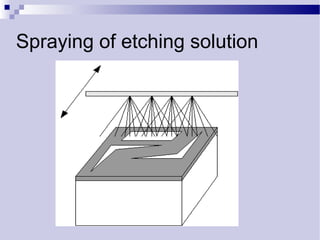
Spraying of etching solution
Kinds of chemical machining
 Chemical clipping,
 chemical milling (deeping),
 Chemical engraving
 chemical sharping,
 Chemical polishing,
 Machining by active substance,
 Photochemical machining,
 termic removing of burrs.
Chemical clipping
 Thin plates,
 Completely component is sinking,
 Small, shape difficult components
Example:
 Plotters of shavers
Chemical milling
Accuracy shaping of difficult big shape surfaces.
Speed of removing is moving round 0,025 mm/min.
Originated undercutting, is necessary to speculate
with undercutting in the mask production.
Dimensions accuracy is given by thickness of
removing layer. Roughness is between Ra
=0,75 to
Ra
=3,8.
Chemical milling
Using of chemical milling:
 aerial and cosmic industry – local releasing
of casts and forgings of light and high
strength alloys,
 Small metal components of high strength
material when is not economical to produce
dies.
Chemical engraving, grinding,
polishing
 engraving – dimension of picturing is small for
using of mechanical engraving – matrixs of post
marks,
 grinding – very accurated shapes (accuracy
under 1mm), low roughness (Ra 0,01),
 polishing – still softer than grinding, using in
small and shape difficult components that by
mechanical kind is not possible to polish.
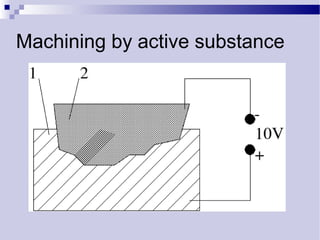
Machining by active substance
Machining shape difficult surfaces.
Semi-solid substance of cellulose (electro gel)
impregnated by acid is attach to the workpiece
surface. In the place of contact the workpiece is
melted.
Is possible to achieve step by step removing until
depth 10 mm. Dimension accuracy is from 0,02 to
0,07 mm.
For acceleration of process is possible to connected
electric voltage until 10V.
Machining by active substance
Photochemical machining
Mask is created by photographic kind.
Using in production:
 Masks of TV set and screening,
 Code disks,
 Optical divider,
 gasket,
 Ornamental object,
 Semiconductor components.
Photochemical machining
 Patern of production – laser beam creating
the sign in the photographical film. This picture
(master) is frequently applied to photo tool.
(patern).
 Preparation of surface – surface must be
cleaned, grease removing, eventually to pickle,
 Coating of photoresist – it is polymer sensitive
to ultraviolet emission is necessary to dry him.
 Processing of photoresist – through the
pattern is photoresist emissed by light of
suitable wave length (UV) and is created mask
(positive, negative).
Photochemical machining
Advantage of photochemical machining:
 Low costs of tools,
 Low costs of modification,
 Simply transmission to series production,
 Properties of the base material are not damages,
 No originated burrs.
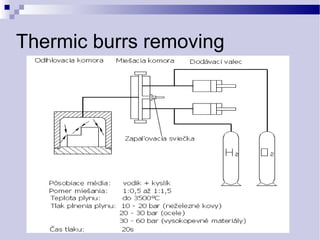
Thermic removing of burrs
Burrs are removed by influence of thermic
wave (by explosion).
Thermic wave has temperature more than
3000°C and lasted particular µs.
Burrs are melted or evaporated but workpiece
is not in time to absorbing a lot of heat.
Burrs are verily removed from inaccessible
places.
Thermic burrs removing

Chemical machining process

  • 1.
  • 2.
    Chemical machining Local meltingof material by suitable diluent.  Machining of metal materials,  Removing speed of material independence on hardness and on toughness,  Surfaces with complicated shape with high accuracy and quality,  Here is no originated heat and mechanical influence area,  Large areas – more economical than milling
  • 3.
    Chemical machining 1 –base material, 2 – mask, 3 – holes carved out of mask, In the place of holes the material is melted by influence of diluents.
  • 4.
    Material machinability Four groupsof materials by chemical machinability:  Copper, bronze – easy they are melted, good machinability by chemical machining,  nickel, zinc, aluminium  manganese, molybdenum,  chrome, gold, wolfram – they are hard melted, bad machinability by chemical machining
  • 5.
    Diluents for chemicalmachining  Ferrous metals – different acids,  copper, alloys of copper, heavy metals – chloride of ferrum FeCl3 ,  Aluminium, alloys of aluminium, light metals – caustic soda NaOH
  • 6.
    Workpiece preparation for chemicalmachining  Grease removal and surface cleaning – removing the allochemicals from surface and oxidic coats too (Al alloys – AL2 O3 coat), dipping into 5% medium NaOH and next into 30% medium of acid of nitride,  steeping – increasing of mask adhesion, dipping into medium H2 SO4 and next duochrom of patassic,  masking – coating resisted on influence of diluent (resin, enamel) thickness till 2 mm.
  • 7.
    Workpiece preparation for chemicalmachining  Mask drying – mask coating is drying 6 till 8 hours, it can be accelerated in the furnace (small workpieces),  Engraving of mask – into drying mask are created holes (hand engraving, engraving by laser ...),
  • 8.
    Time needed formachining  It is independence on the size of the machined surface,  It is depend on depth of machining only,  Speed of outline 0,01 till 0,5 mm/min.,  mask resisted to outlining approximately 8 hours.
  • 9.
    Mask undercutting Speed ofoutline in homogenne material is the same in all directions. Rate of undercutting is approximately the same as depth of outlining.
  • 10.
    Mask undercutting  Isnot possible to make shape rims,  In immersion into etching pool is needed to assure that origin gas is not to mass in the place of undercut (scaling of mask, non-constant speed of undercutting....), side long immersion, mixturing,  Mixturing of etching pool:  Washing off etching impurities,  Asked concentration of etchant in the place of etching,  Outflow of gas bubbles.
  • 11.
  • 12.
    Kinds of chemicalmachining  Chemical clipping,  chemical milling (deeping),  Chemical engraving  chemical sharping,  Chemical polishing,  Machining by active substance,  Photochemical machining,  termic removing of burrs.
  • 13.
    Chemical clipping  Thinplates,  Completely component is sinking,  Small, shape difficult components Example:  Plotters of shavers
  • 14.
    Chemical milling Accuracy shapingof difficult big shape surfaces. Speed of removing is moving round 0,025 mm/min. Originated undercutting, is necessary to speculate with undercutting in the mask production. Dimensions accuracy is given by thickness of removing layer. Roughness is between Ra =0,75 to Ra =3,8.
  • 15.
    Chemical milling Using ofchemical milling:  aerial and cosmic industry – local releasing of casts and forgings of light and high strength alloys,  Small metal components of high strength material when is not economical to produce dies.
  • 16.
    Chemical engraving, grinding, polishing engraving – dimension of picturing is small for using of mechanical engraving – matrixs of post marks,  grinding – very accurated shapes (accuracy under 1mm), low roughness (Ra 0,01),  polishing – still softer than grinding, using in small and shape difficult components that by mechanical kind is not possible to polish.
  • 17.
    Machining by activesubstance Machining shape difficult surfaces. Semi-solid substance of cellulose (electro gel) impregnated by acid is attach to the workpiece surface. In the place of contact the workpiece is melted. Is possible to achieve step by step removing until depth 10 mm. Dimension accuracy is from 0,02 to 0,07 mm. For acceleration of process is possible to connected electric voltage until 10V.
  • 18.
  • 19.
    Photochemical machining Mask iscreated by photographic kind. Using in production:  Masks of TV set and screening,  Code disks,  Optical divider,  gasket,  Ornamental object,  Semiconductor components.
  • 20.
    Photochemical machining  Paternof production – laser beam creating the sign in the photographical film. This picture (master) is frequently applied to photo tool. (patern).  Preparation of surface – surface must be cleaned, grease removing, eventually to pickle,  Coating of photoresist – it is polymer sensitive to ultraviolet emission is necessary to dry him.  Processing of photoresist – through the pattern is photoresist emissed by light of suitable wave length (UV) and is created mask (positive, negative).
  • 21.
    Photochemical machining Advantage ofphotochemical machining:  Low costs of tools,  Low costs of modification,  Simply transmission to series production,  Properties of the base material are not damages,  No originated burrs.
  • 22.
    Thermic removing ofburrs Burrs are removed by influence of thermic wave (by explosion). Thermic wave has temperature more than 3000°C and lasted particular µs. Burrs are melted or evaporated but workpiece is not in time to absorbing a lot of heat. Burrs are verily removed from inaccessible places.
  • 23.