

ARTICLES
CONTENTS
Articles
Types of articles
Definite article
Uses of ‘the’
Indefinite articles
Uses of ‘a’ and ‘an’
Omission of articles
END !!
Articles
Anarticle is a word that is witha nounto indicatethe typeof referencebeing made by the noun.
The articles in the Englishlanguage are‘the anda/an’.
an articleis usually consideredto be a type of adjective. It is alsopossible for articles to be part
of another part of speech category such as a determiner.
In languages that employ articles, every commonnoun, with some exceptions, is expressedwith
a certaindefiniteness(e.g., definiteor indefinite). Every nounmust be accompaniedby the
article, if any, correspondingto its definiteness. This obligatory nature of articles makes them
among the most commonwords, for example, the most frequent wordis the.
Types of articles
Articles are usually characterized as either definite or indefinite. A
few languages with well-developed systems of articles may
distinguish additional subtypes.-
-Partitive article
A partitive article is a type of indefinite article used with a mass
noun such as water, to indicate a non-specific quantity of it.
-Negative article
A negative article specifies none of its noun, and can thus be
regarded as neither definite nor indefinite.
-Zero article
The zero article is the absence of an article.
An indefinite article indicates that its noun is not
a particular one (or ones) identifiable to the listener.
It may be something that the speaker is mentioning
for the first time, or its precise identity may be
irrelevant or hypothetical, or the speaker may be
making a general statement about any such thing.
English uses a/an, from the Old English forms of
the number 'one', as its primary indefinite article
Indefinite
articles
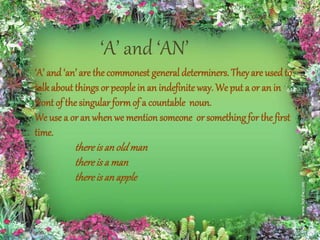
‘A’ and ‘AN’
‘A’ and ‘an’ are the commonest general determiners. Theyare usedto
talkabout things or people in an indefinite way. We put a or an in
front of the singular formof a countable noun.
We use a or an whenwe mention someone or something for the first
time.
thereis anoldman
thereis a man
thereis anapple
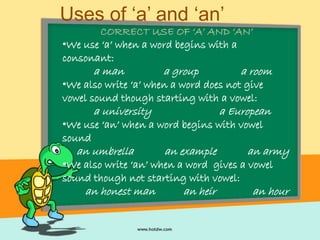
Uses of ‘a’ and ‘an’
CORRECT USE OF ‘A’ AND ‘AN’
•We use ‘a’ when a word begins with a
consonant:
a man a group a room
•We also write ‘a’ when a word does not give
vowel sound though starting with a vowel:
a university a European
•We use ‘an’ when a word begins with vowel
sound
an umbrella an example an army
•We also write ‘an’ when a word gives a vowel
sound though not starting with vowel:
an honest man an heir an hour
Uses of ‘a’ and ‘an’
GENERAL USES OF ‘A’ AND ‘AN’
1. Before a singular noun which is countable when it is
mentioned for the first time and represents no particular
person or thing
a cow is an animal
2. Before a singular countable noun which represents a class
of things.
an elephant has a tusk
3. With a noun complement it includes names of professions
he is an engineer
he is a good doctor
4. Before certain numerical expression
a dozen a score a gross
5. In expression of price, speed, ratio
5 a kg a metre 5 times a day
6. In exclamations before a singular countable noun.
‘The’ is the definite article. A
definite article indicates that
its noun is a particular one (or
ones) identifiable to the
listener. It may be something
that the speaker has already
mentioned, or it may be
something uniquely specified.
The definite article in English,
for both singular and plural
nouns.
Definite article
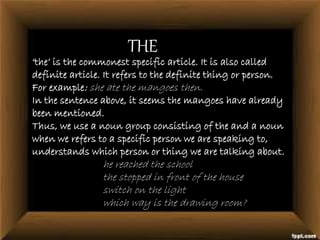
THE
‘the’ is the commonest specific article. It is also called
definite article. It refers to the definite thing or person.
For example: she ate the mangoes then.
In the sentence above, it seems the mangoes have already
been mentioned.
Thus, we use a noun group consisting of the and a noun
when we refers to a specific person we are speaking to,
understands which person or thing we are talking about.
he reached the school
the stopped in front of the house
switch on the light
which way is the drawing room?
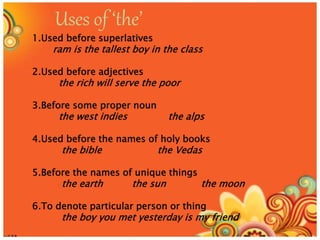
Uses of ‘the’
1.Used before superlatives
ram is the tallest boy in the class
2.Used before adjectives
the rich will serve the poor
3.Before some proper noun
the west indies the alps
4.Used before the names of holy books
the bible the Vedas
5.Before the names of unique things
the earth the sun the moon
6.To denote particular person or thing
the boy you met yesterday is my friend
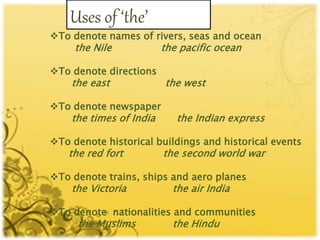
Uses of ‘the’
To denote names of rivers, seas and ocean
the Nile the pacific ocean
To denote directions
the east the west
To denote newspaper
the times of India the Indian express
To denote historical buildings and historical events
the red fort the second world war
To denote trains, ships and aero planes
the Victoria the air India
To denote nationalities and communities
the Muslims the Hindu
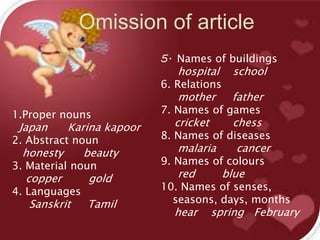
Omission of article
5. Names of buildings
hospital school
6. Relations
mother father
7. Names of games
cricket chess
8. Names of diseases
malaria cancer
9. Names of colours
red blue
10. Names of senses,
seasons, days, months
hear spring February
1.Proper nouns
Japan Karina kapoor
2. Abstract noun
honesty beauty
3. Material noun
copper gold
4. Languages
Sanskrit Tamil
Thank you

english grammar- articles

  • 1.
  • 2.
    CONTENTS Articles Types of articles Definitearticle Uses of ‘the’ Indefinite articles Uses of ‘a’ and ‘an’ Omission of articles END !!
  • 3.
    Articles Anarticle is aword that is witha nounto indicatethe typeof referencebeing made by the noun. The articles in the Englishlanguage are‘the anda/an’. an articleis usually consideredto be a type of adjective. It is alsopossible for articles to be part of another part of speech category such as a determiner. In languages that employ articles, every commonnoun, with some exceptions, is expressedwith a certaindefiniteness(e.g., definiteor indefinite). Every nounmust be accompaniedby the article, if any, correspondingto its definiteness. This obligatory nature of articles makes them among the most commonwords, for example, the most frequent wordis the.
  • 4.
    Types of articles Articlesare usually characterized as either definite or indefinite. A few languages with well-developed systems of articles may distinguish additional subtypes.- -Partitive article A partitive article is a type of indefinite article used with a mass noun such as water, to indicate a non-specific quantity of it. -Negative article A negative article specifies none of its noun, and can thus be regarded as neither definite nor indefinite. -Zero article The zero article is the absence of an article.
  • 5.
    An indefinite articleindicates that its noun is not a particular one (or ones) identifiable to the listener. It may be something that the speaker is mentioning for the first time, or its precise identity may be irrelevant or hypothetical, or the speaker may be making a general statement about any such thing. English uses a/an, from the Old English forms of the number 'one', as its primary indefinite article Indefinite articles
  • 6.
    ‘A’ and ‘AN’ ‘A’and ‘an’ are the commonest general determiners. Theyare usedto talkabout things or people in an indefinite way. We put a or an in front of the singular formof a countable noun. We use a or an whenwe mention someone or something for the first time. thereis anoldman thereis a man thereis anapple
  • 7.
    Uses of ‘a’and ‘an’ CORRECT USE OF ‘A’ AND ‘AN’ •We use ‘a’ when a word begins with a consonant: a man a group a room •We also write ‘a’ when a word does not give vowel sound though starting with a vowel: a university a European •We use ‘an’ when a word begins with vowel sound an umbrella an example an army •We also write ‘an’ when a word gives a vowel sound though not starting with vowel: an honest man an heir an hour
  • 8.
    Uses of ‘a’and ‘an’ GENERAL USES OF ‘A’ AND ‘AN’ 1. Before a singular noun which is countable when it is mentioned for the first time and represents no particular person or thing a cow is an animal 2. Before a singular countable noun which represents a class of things. an elephant has a tusk 3. With a noun complement it includes names of professions he is an engineer he is a good doctor 4. Before certain numerical expression a dozen a score a gross 5. In expression of price, speed, ratio 5 a kg a metre 5 times a day 6. In exclamations before a singular countable noun.
  • 9.
    ‘The’ is thedefinite article. A definite article indicates that its noun is a particular one (or ones) identifiable to the listener. It may be something that the speaker has already mentioned, or it may be something uniquely specified. The definite article in English, for both singular and plural nouns. Definite article
  • 10.
    THE ‘the’ is thecommonest specific article. It is also called definite article. It refers to the definite thing or person. For example: she ate the mangoes then. In the sentence above, it seems the mangoes have already been mentioned. Thus, we use a noun group consisting of the and a noun when we refers to a specific person we are speaking to, understands which person or thing we are talking about. he reached the school the stopped in front of the house switch on the light which way is the drawing room?
  • 11.
    Uses of ‘the’ 1.Usedbefore superlatives ram is the tallest boy in the class 2.Used before adjectives the rich will serve the poor 3.Before some proper noun the west indies the alps 4.Used before the names of holy books the bible the Vedas 5.Before the names of unique things the earth the sun the moon 6.To denote particular person or thing the boy you met yesterday is my friend
  • 12.
    Uses of ‘the’ Todenote names of rivers, seas and ocean the Nile the pacific ocean To denote directions the east the west To denote newspaper the times of India the Indian express To denote historical buildings and historical events the red fort the second world war To denote trains, ships and aero planes the Victoria the air India To denote nationalities and communities the Muslims the Hindu
  • 13.
    Omission of article 5.Names of buildings hospital school 6. Relations mother father 7. Names of games cricket chess 8. Names of diseases malaria cancer 9. Names of colours red blue 10. Names of senses, seasons, days, months hear spring February 1.Proper nouns Japan Karina kapoor 2. Abstract noun honesty beauty 3. Material noun copper gold 4. Languages Sanskrit Tamil
  • 14.