Chemical Engineering and its
Applications
by
Cumali KALKAN
What is Chemical Engineering?
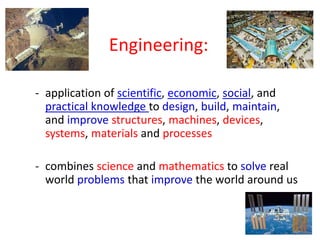
Engineering:
- application of scientific, economic, social, and
practical knowledge to design, build, maintain,
and improve structures, machines, devices,
systems, materials and processes
- combines science and mathematics to solve real
world problems that improve the world around us
• Engineers implement ideas in a cost effective
and practical approach
• Engineers are problem solvers, organisers,
communicators, calculators and designers
• The crucial and unique task of the engineer is
to identify, understand, and interpret the
constraints to produce a successful result
• It is usually not enough to produce a
technically successful product; it must also
meet further requirements
Constraints/limitations may include:
- available resources
- physical, imaginative or technical limitations
- flexibility for future modifications
- other factors, such as requirements for
cost, safety, marketability, and serviceability
• engineers must also take into account safety,
efficiency, economy, reliability and
constructibility or ease of fabrication
• as well as legal considerations such as patent
infringement or liability in the case of failure
of the solution
• By understanding the constraints, engineers
derive specifications for the limits within
which a viable product or system may be
produced and operated
A Sample
Specification
for a chemical
(sealant)
complying to
various
standards
A Sample
Standard
for
Aluminium
(ASTM
B-221-08)
A sample Certificate of Test showing standards and specifications
• Engineering is quite different from science.
• Scientists try to understand nature. Engineers try to
make things that do not exist in nature.
• Engineers try to invent and design something that
people can use
• That something can be a device, a material, a method,
a computing program, a new solution to a problem, or
an improvement on something existing
Chemical:
• Inorganic chemicals (H2O, CO, CO2, NaCl etc.)
• Organic chemicals (large class of chemical
compounds whose molecules contain carbon
like methane-CH4)
• Compounds based primarily on carbon (C) and hydrogen (H) atoms are
called organic compounds, and all others are called inorganic compounds.
• Organic compounds are produced by living
things.
• Inorganic compounds are produced by non-
living natural processes or by human
intervention in the laboratory.
Inorganic
compounds
Organic
compounds
can form salts + -
contain carbon - +
contain (C-H) bonds - +
contain metal atoms + -
Chemical Engineering:
• Basically, Chemical Engineering is applied
chemistry
• It is the practical application of chemistry
• applies sciences (e.g. chemistry and physics)
together with mathematics and economics
• essentially deals with chemicals, materials,
energy and the processes to create &/or
convert them
• concerned with design, construction, and
operation of machines, processes &/or factories
• to produce useful products or solve practical
problems
• by performing chemical reactions and converting
raw-materials or chemicals into more useful or
valuable forms
• also involved with pioneering valuable
materials, techniques & fields
like nanotechnology, fuel cells and
bioengineering.
• Chemical engineers are not chemistry experts. Their
purpose is to apply chemistry to PRACTICAL problems.
• Apart from chemistry, chemical engineers are trained
in economics, business practice, environmental factors
and ethics.
• Chemists are trained only in the theory of chemistry
whereas engineers implement chemical theory in
everyday life to solve problems.
Applications / Industries:
- Petrochemical
- Plastics
- Rubber
- Paint & coating
- Cement
- Fertilizer
- Soaps, detergents, etc.
- Sugar
- Glass
- Ceramic
- Paper
Applications / Industries:
- Water treatment and purification
- Cosmetics
- Pharmaceuticals
- Foods & Beverages
- Industrial Chemicals
- Mining / Mineral Extraction and Processing
- Leather
- Textile
- Agrochemicals
- Explosives
- Gases
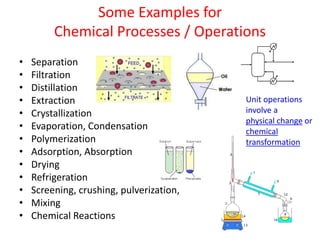
Some Examples for
Chemical Processes / Operations
• Separation
• Filtration
• Distillation
• Extraction
• Crystallization
• Evaporation, Condensation
• Polymerization
• Adsorption, Absorption
• Drying
• Refrigeration
• Screening, crushing, pulverization,
• Mixing
• Chemical Reactions
Unit operations
involve a
physical change or
chemical
transformation
Process Flow Diagram
(Flow Sheet)
• Flow sheet is a diagram showing the progress
of material through a chemical factory. It
shows the material and energy flow in each
process and operation.
Flowsheet (Example)
HCl Acid Recovery
Flow Diagram
A
Typical
Oil
Refinery
Typical Content of a Process Flow Diagram
• Process piping
• Major equipment items
• Control valves and other major valves
• Connections with other systems
• Major bypass and recirculation streams
• Operational data (temperature, pressure, mass flow
rate, density, etc.), mass balance
• Process stream names
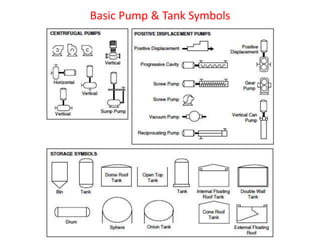
Design Elements
Basic Pump & Tank Symbols
Basic Compressor, Turbine & Motor Symbols
Basic Heat Exchanger & Cooling Tower Symbols
Basic Reactor Symbols
Basic Furnace & Boiler
Symbols
A Sample
Product
Data Sheet
(TDS)
A Sample
Product
Data Sheet
(TDS)
A Sample
Material
Safety Data
Sheet
(MSDS)
A Sample
Material
Safety Data
Sheet
(MSDS)
THANK YOU
FOR LISTENING
• I HOPE IT WAS INFORMATIVE 

Chemical Engineering and its Applications (2)

  • 1.
    Chemical Engineering andits Applications by Cumali KALKAN
  • 2.
    What is ChemicalEngineering?
  • 3.
    Engineering: - application ofscientific, economic, social, and practical knowledge to design, build, maintain, and improve structures, machines, devices, systems, materials and processes - combines science and mathematics to solve real world problems that improve the world around us
  • 4.
    • Engineers implementideas in a cost effective and practical approach • Engineers are problem solvers, organisers, communicators, calculators and designers
  • 5.
    • The crucialand unique task of the engineer is to identify, understand, and interpret the constraints to produce a successful result • It is usually not enough to produce a technically successful product; it must also meet further requirements
  • 6.
    Constraints/limitations may include: -available resources - physical, imaginative or technical limitations - flexibility for future modifications - other factors, such as requirements for cost, safety, marketability, and serviceability
  • 7.
    • engineers mustalso take into account safety, efficiency, economy, reliability and constructibility or ease of fabrication • as well as legal considerations such as patent infringement or liability in the case of failure of the solution
  • 8.
    • By understandingthe constraints, engineers derive specifications for the limits within which a viable product or system may be produced and operated
  • 9.
    A Sample Specification for achemical (sealant) complying to various standards
  • 10.
  • 11.
    A sample Certificateof Test showing standards and specifications
  • 12.
    • Engineering isquite different from science. • Scientists try to understand nature. Engineers try to make things that do not exist in nature. • Engineers try to invent and design something that people can use • That something can be a device, a material, a method, a computing program, a new solution to a problem, or an improvement on something existing
  • 13.
  • 14.
    • Inorganic chemicals(H2O, CO, CO2, NaCl etc.) • Organic chemicals (large class of chemical compounds whose molecules contain carbon like methane-CH4) • Compounds based primarily on carbon (C) and hydrogen (H) atoms are called organic compounds, and all others are called inorganic compounds.
  • 15.
    • Organic compoundsare produced by living things. • Inorganic compounds are produced by non- living natural processes or by human intervention in the laboratory.
  • 16.
    Inorganic compounds Organic compounds can form salts+ - contain carbon - + contain (C-H) bonds - + contain metal atoms + -
  • 17.
    Chemical Engineering: • Basically,Chemical Engineering is applied chemistry • It is the practical application of chemistry
  • 18.
    • applies sciences(e.g. chemistry and physics) together with mathematics and economics
  • 19.
    • essentially dealswith chemicals, materials, energy and the processes to create &/or convert them
  • 20.
    • concerned withdesign, construction, and operation of machines, processes &/or factories • to produce useful products or solve practical problems • by performing chemical reactions and converting raw-materials or chemicals into more useful or valuable forms
  • 21.
    • also involvedwith pioneering valuable materials, techniques & fields like nanotechnology, fuel cells and bioengineering.
  • 22.
    • Chemical engineersare not chemistry experts. Their purpose is to apply chemistry to PRACTICAL problems. • Apart from chemistry, chemical engineers are trained in economics, business practice, environmental factors and ethics. • Chemists are trained only in the theory of chemistry whereas engineers implement chemical theory in everyday life to solve problems.
  • 24.
    Applications / Industries: -Petrochemical - Plastics - Rubber - Paint & coating - Cement - Fertilizer - Soaps, detergents, etc. - Sugar - Glass - Ceramic - Paper
  • 25.
    Applications / Industries: -Water treatment and purification - Cosmetics - Pharmaceuticals - Foods & Beverages - Industrial Chemicals - Mining / Mineral Extraction and Processing - Leather - Textile - Agrochemicals - Explosives - Gases
  • 26.
    Some Examples for ChemicalProcesses / Operations • Separation • Filtration • Distillation • Extraction • Crystallization • Evaporation, Condensation • Polymerization • Adsorption, Absorption • Drying • Refrigeration • Screening, crushing, pulverization, • Mixing • Chemical Reactions Unit operations involve a physical change or chemical transformation
  • 27.
    Process Flow Diagram (FlowSheet) • Flow sheet is a diagram showing the progress of material through a chemical factory. It shows the material and energy flow in each process and operation.
  • 28.
  • 29.
  • 32.
  • 33.
    Typical Content ofa Process Flow Diagram • Process piping • Major equipment items • Control valves and other major valves • Connections with other systems • Major bypass and recirculation streams • Operational data (temperature, pressure, mass flow rate, density, etc.), mass balance • Process stream names
  • 34.
  • 35.
    Basic Pump &Tank Symbols
  • 36.
  • 37.
    Basic Heat Exchanger& Cooling Tower Symbols
  • 38.
    Basic Reactor Symbols BasicFurnace & Boiler Symbols
  • 39.
  • 40.
  • 41.
  • 42.
  • 43.
    THANK YOU FOR LISTENING •I HOPE IT WAS INFORMATIVE 