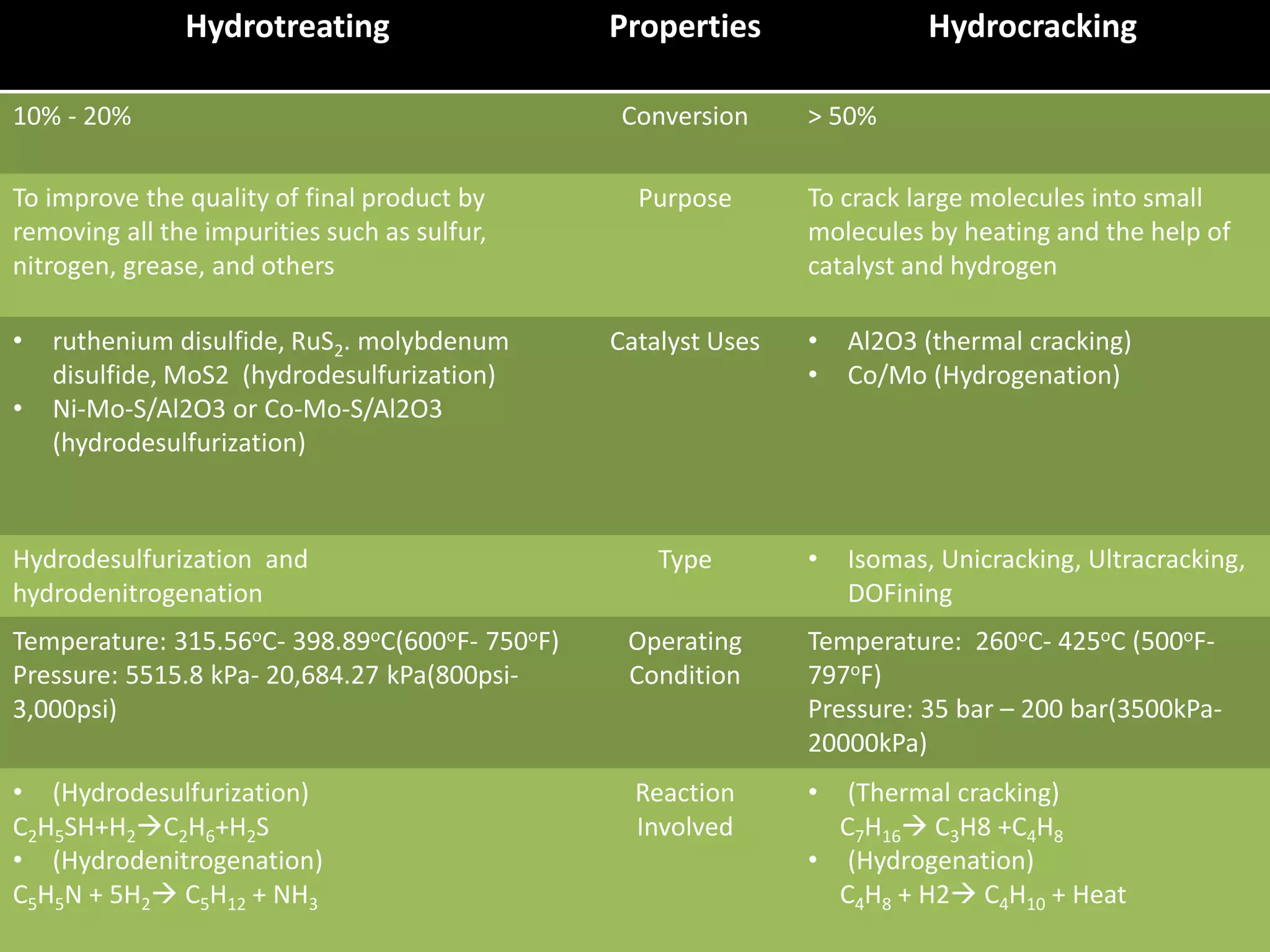
Hydrotreating Properties Hydrocracking
10% - 20% Conversion > 50%
To improve the quality of final product by
removing all the impurities such as sulfur,
nitrogen, grease, and others
Purpose To crack large molecules into small
molecules by heating and the help of
catalyst and hydrogen
• ruthenium disulfide, RuS2. molybdenum
disulfide, MoS2 (hydrodesulfurization)
• Ni-Mo-S/Al2O3 or Co-Mo-S/Al2O3
(hydrodesulfurization)
Catalyst Uses • Al2O3 (thermal cracking)
• Co/Mo (Hydrogenation)
Hydrodesulfurization and
hydrodenitrogenation
Type • Isomas, Unicracking, Ultracracking,
DOFining
Temperature: 315.56oC- 398.89oC(600oF- 750oF)
Pressure: 5515.8 kPa- 20,684.27 kPa(800psi-
3,000psi)
Operating
Condition
Temperature: 260oC- 425oC (500oF-
797oF)
Pressure: 35 bar – 200 bar(3500kPa-
20000kPa)
• (Hydrodesulfurization)
C2H5SH+H2C2H6+H2S
• (Hydrodenitrogenation)
C5H5N + 5H2 C5H12 + NH3
Reaction
Involved
• (Thermal cracking)
C7H16 C3H8 +C4H8
• (Hydrogenation)
C4H8 + H2 C4H10 + Heat
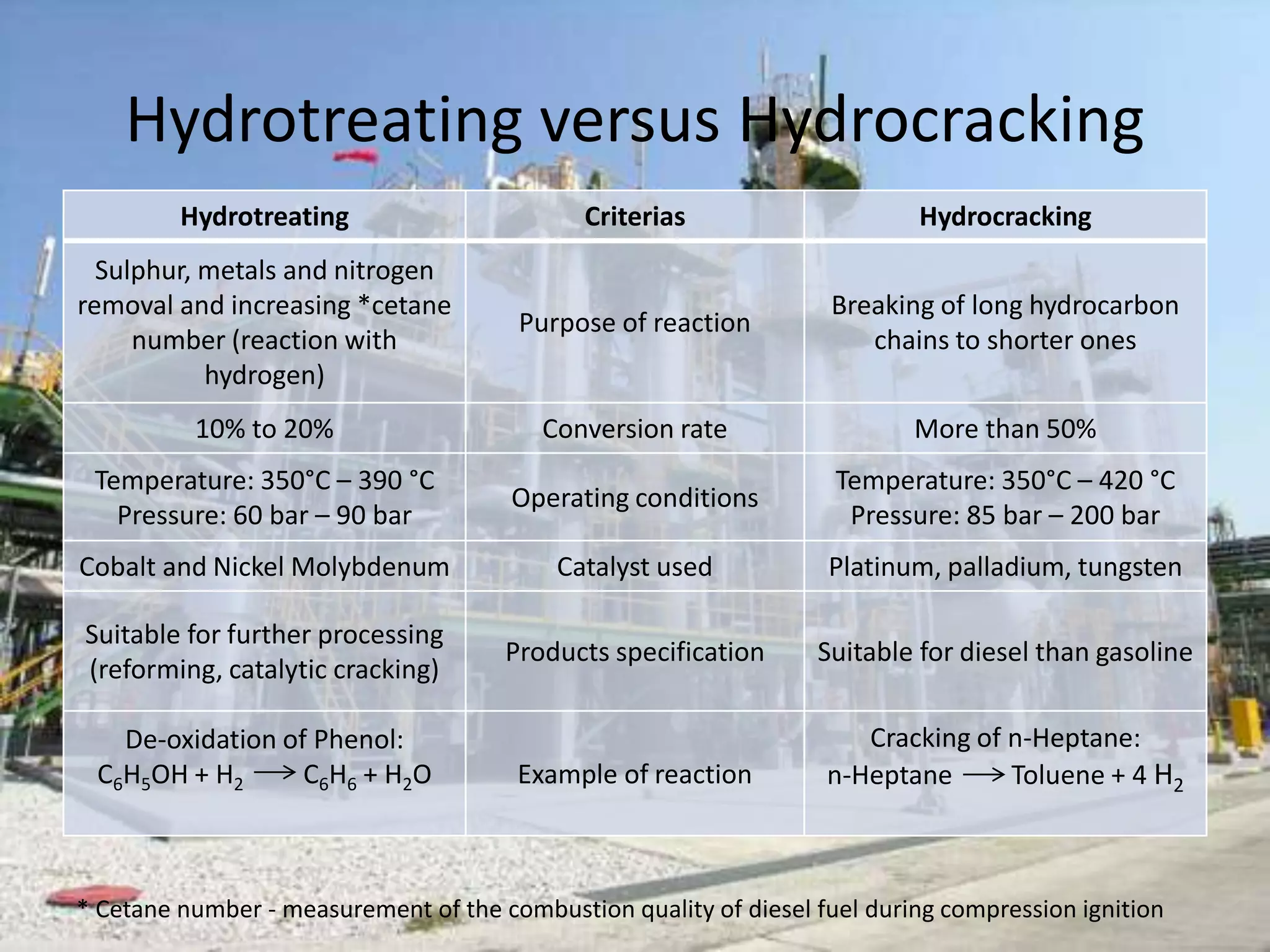
Hydrotreating versus Hydrocracking
Hydrotreating Criterias Hydrocracking
Sulphur, metals and nitrogen
removal and increasing *cetane
number (reaction with
hydrogen)
Purpose of reaction
Breaking of long hydrocarbon
chains to shorter ones
10% to 20% Conversion rate More than 50%
Temperature: 350°C – 390 °C
Pressure: 60 bar – 90 bar
Operating conditions
Temperature: 350°C – 420 °C
Pressure: 85 bar – 200 bar
Cobalt and Nickel Molybdenum Catalyst used Platinum, palladium, tungsten
Suitable for further processing
(reforming, catalytic cracking)
Products specification Suitable for diesel than gasoline
De-oxidation of Phenol:
C6H5OH + H2 C6H6 + H2O Example of reaction
Cracking of n-Heptane:
n-Heptane Toluene + 4 H2
* Cetane number - measurement of the combustion quality of diesel fuel during compression ignition
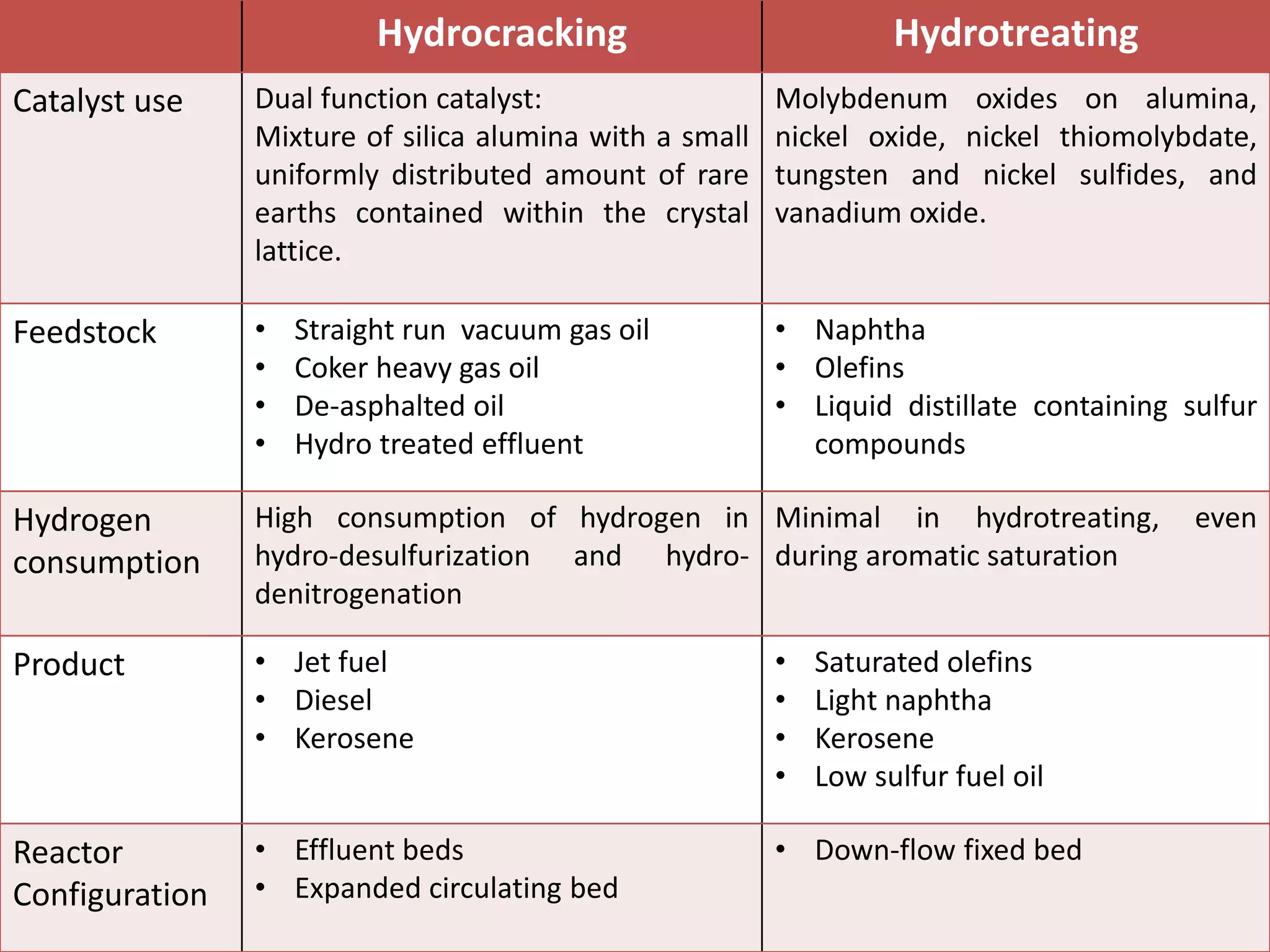
Hydrocracking Hydrotreating
Catalyst use Dual function catalyst:
Mixture of silica alumina with a small
uniformly distributed amount of rare
earths contained within the crystal
lattice.
Molybdenum oxides on alumina,
nickel oxide, nickel thiomolybdate,
tungsten and nickel sulfides, and
vanadium oxide.
Feedstock • Straight run vacuum gas oil
• Coker heavy gas oil
• De-asphalted oil
• Hydro treated effluent
• Naphtha
• Olefins
• Liquid distillate containing sulfur
compounds
Hydrogen
consumption
High consumption of hydrogen in
hydro-desulfurization and hydro-
denitrogenation
Minimal in hydrotreating, even
during aromatic saturation
Product • Jet fuel
• Diesel
• Kerosene
• Saturated olefins
• Light naphtha
• Kerosene
• Low sulfur fuel oil
Reactor
Configuration
• Effluent beds
• Expanded circulating bed
• Down-flow fixed bed

Chapter 6 -_comparison_ht_hc

  • 1.
    Hydrotreating Properties Hydrocracking 10%- 20% Conversion > 50% To improve the quality of final product by removing all the impurities such as sulfur, nitrogen, grease, and others Purpose To crack large molecules into small molecules by heating and the help of catalyst and hydrogen • ruthenium disulfide, RuS2. molybdenum disulfide, MoS2 (hydrodesulfurization) • Ni-Mo-S/Al2O3 or Co-Mo-S/Al2O3 (hydrodesulfurization) Catalyst Uses • Al2O3 (thermal cracking) • Co/Mo (Hydrogenation) Hydrodesulfurization and hydrodenitrogenation Type • Isomas, Unicracking, Ultracracking, DOFining Temperature: 315.56oC- 398.89oC(600oF- 750oF) Pressure: 5515.8 kPa- 20,684.27 kPa(800psi- 3,000psi) Operating Condition Temperature: 260oC- 425oC (500oF- 797oF) Pressure: 35 bar – 200 bar(3500kPa- 20000kPa) • (Hydrodesulfurization) C2H5SH+H2C2H6+H2S • (Hydrodenitrogenation) C5H5N + 5H2 C5H12 + NH3 Reaction Involved • (Thermal cracking) C7H16 C3H8 +C4H8 • (Hydrogenation) C4H8 + H2 C4H10 + Heat
  • 2.
    Hydrotreating versus Hydrocracking HydrotreatingCriterias Hydrocracking Sulphur, metals and nitrogen removal and increasing *cetane number (reaction with hydrogen) Purpose of reaction Breaking of long hydrocarbon chains to shorter ones 10% to 20% Conversion rate More than 50% Temperature: 350°C – 390 °C Pressure: 60 bar – 90 bar Operating conditions Temperature: 350°C – 420 °C Pressure: 85 bar – 200 bar Cobalt and Nickel Molybdenum Catalyst used Platinum, palladium, tungsten Suitable for further processing (reforming, catalytic cracking) Products specification Suitable for diesel than gasoline De-oxidation of Phenol: C6H5OH + H2 C6H6 + H2O Example of reaction Cracking of n-Heptane: n-Heptane Toluene + 4 H2 * Cetane number - measurement of the combustion quality of diesel fuel during compression ignition
  • 3.
    Hydrocracking Hydrotreating Catalyst useDual function catalyst: Mixture of silica alumina with a small uniformly distributed amount of rare earths contained within the crystal lattice. Molybdenum oxides on alumina, nickel oxide, nickel thiomolybdate, tungsten and nickel sulfides, and vanadium oxide. Feedstock • Straight run vacuum gas oil • Coker heavy gas oil • De-asphalted oil • Hydro treated effluent • Naphtha • Olefins • Liquid distillate containing sulfur compounds Hydrogen consumption High consumption of hydrogen in hydro-desulfurization and hydro- denitrogenation Minimal in hydrotreating, even during aromatic saturation Product • Jet fuel • Diesel • Kerosene • Saturated olefins • Light naphtha • Kerosene • Low sulfur fuel oil Reactor Configuration • Effluent beds • Expanded circulating bed • Down-flow fixed bed