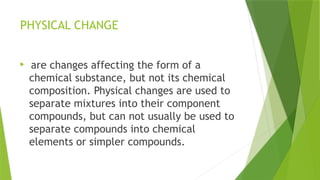
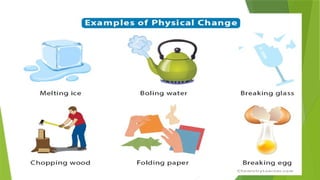
PHYSICAL CHANGE
are changesaffecting the form of a
chemical substance, but not its chemical
composition. Physical changes are used to
separate mixtures into their component
compounds, but can not usually be used to
separate compounds into chemical
elements or simpler compounds.
4.
CHEMICAL CHANGE
occurwhen a substance combines with
another to form a new substance, called
chemical synthesis or, alternatively, chemical
decomposition into two or more different
substances. These processes are called
chemical reactions and, in general, are not
reversible except by further chemical
reactions.
6.
Signs of ChemicalChange
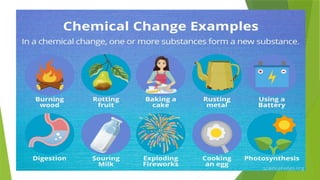
A chemical change can be recognized by the following
indicators [1-4]
:
1. Change in Temperature
A chemical change accompanies a change in energy. Since a
chemical change involves energy, there can also be a
temperature change. The change is exothermic if heat is given
off during the reaction. When heat is absorbed, it is called an
endothermic reaction. For example, a thermite reaction is
accompanied by a temperature increase (exothermic).
7.
2. Changein Color
An example of color change in a chemical reaction is
rusting. Rusting occurs when iron reacts with oxygen in
the presence of moisture to form reddish-brown iron (III)
oxide, commonly known as rust.
3. Noticeable Odor
When two substances react or when a substance
decomposes and produces a distinct odor, it indicates a
chemical change. For example, the decomposition of an
egg gives a foul smell.
8.
4. Formationof Precipitate
The formation of a precipitate is the most common sign of a chemical
change. A precipitate is a solid that forms during a chemical reaction and
does not go into the solution. It either settles at the bottom or remains
suspended. For example, when the aqueous salt of silver (I) nitrate
combines with sodium chloride salt solution, a white precipitate of
silver(I) chloride forms.
5. Formation of Bubbles
Bubble formation is also an indicator of a chemical change. It is generally
accompanied by temperature change. For example, the reaction between
sodium carbonate and hydrochloric acid results in the formation of carbon
dioxide gas, which is observed as bubbles.
9.
Group Activity
GroupA-Get a piece of paper . Crumple it
and explain.
Group B_ Get the egg, break it. What will
happened to the egg? Is there a change?
Explain it
Group C- Chopping a carrot/ apple. What
can you say about it?
Question and Answer
1. Classify the following as Chemical or Physical change.
Tearing a piece of paper 100 times.
A. Physical Change
B. Chemical Change
2.Burning a piece of paper
A. Chemical Change
B. Physical Change
3. Classify the following as a physical or chemical change: A reaction occurs,
and the product is different from what you started with.
A. Physical Change B. Chemical Change
4. Hammering a nail into a piece of wood
A. Physical Change B. Chemical Change
5. Letting the nail rust.
A. Physical Change B. Chemical Change
12.
What isthe difference between a physical and chemical change in one
sentence?
Summary. Chemists make a distinction between two different types of
changes that they study—physical changes and chemical changes. Physical
changes are changes that do not alter the identity of a substance. Chemical
changes are changes that occur when one substance is turned into another
substance.
In a physical change the appearance or form of the matter changes but the
kind of matter in the substance does not. However in a chemical change, the
kind of matter changes and at least one new substance with new properties is
formed.
13.
Assignment:
By group:
1. You combine two clearly liquids and they
turn cloudy white.
2. You put a yellow liquid and a blue liquid
together, and they become green
3. Cutting an apple in half.


![Signs of Chemical Change
A chemical change can be recognized by the following
indicators [1-4]
:
1. Change in Temperature
A chemical change accompanies a change in energy. Since a
chemical change involves energy, there can also be a
temperature change. The change is exothermic if heat is given
off during the reaction. When heat is absorbed, it is called an
endothermic reaction. For example, a thermite reaction is
accompanied by a temperature increase (exothermic).](https://image.slidesharecdn.com/changesofmaterials-memenmegawide-250622174359-c33e2edc/85/CHANGES-OF-MATERIALS-power-point-presentation-6-320.jpg)