1
Changes in Matter
2
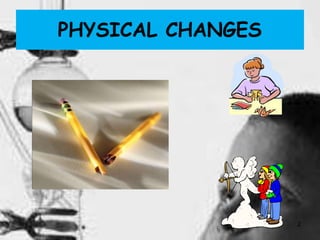
PHYSICAL CHANGES
3
occurs when the substance changes state
but does not change its chemical
composition.
For example: water freezing into ice,
cutting a piece of wood into smaller pieces,
etc.
 The form or appearance has changed,
but the properties of that substance are
the same
(i.e. it has the same melting point, boiling
point, chemical composition, etc.)
4
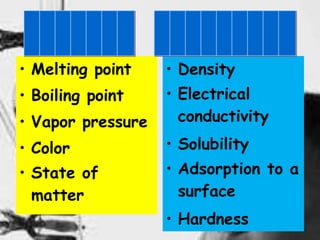
• Melting point
• Boiling point
• Vapor pressure
• Color
• State of
matter
• Density
• Electrical
conductivity
• Solubility
• Adsorption to a
surface
• Hardness
5
Physical Changes
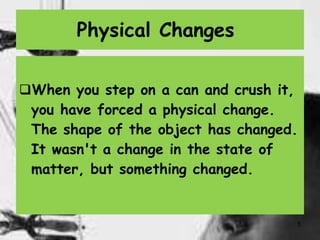
When you step on a can and crush it,
you have forced a physical change.
The shape of the object has changed.
It wasn't a change in the state of
matter, but something changed.
6
7
CHEMICAL CHANGES
8
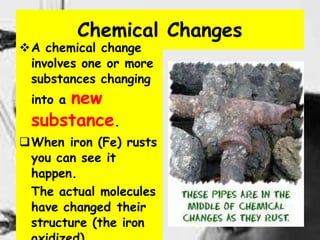
Chemical Changes
A chemical change
involves one or more
substances changing
into a new
substance.
When iron (Fe) rusts
you can see it
happen.
The actual molecules
have changed their
structure (the iron
9
occurs when a substance changes into something
new.
This occurs due to heating, chemical reaction,
etc.
You can tell a chemical change has occurred if
the density, melting point or freezing point of the
original substance changes.
 Many common signs of a chemical change can be
seen (bubbles forming, mass changed, etc).
10
• Reaction with
acids
• Reaction with
bases (alkalis)
• Reaction with
oxygen
(combustion)
• Reaction with
other elements
• Decomposition
into simpler
substances
• Corrosion
11
Chemical Changes
The ability of a substance to undergo
a specific chemical change is called a
chemical property.
iron plus oxygen forms rust, so the
ability to rust is a chemical
property of iron
• During a chemical change (also called
chemical reaction), the composition of
matter always changes.
12
Chemical Reactions are…
• When one or more substances are
changed into new substances.
• Reactants- the stuff you start with
• Products- what you make
• The products will have NEW
PROPERTIES different from the
reactants you started with
• Arrow points from the reactants to
the new products
Recognizing Chemical Changes
 Energy is absorbed or released
(temperature changes hotter or colder)
 Gas production (bubbling, fizzing, or odor
change; smoke)
 formation of a precipitate - a solid that
separates from solution (won’t dissolve)
 Irreversibility - not easily reversed
But, there are examples of these that are
not chemical – boiling water bubbles, etc
13
.
14
Physical vs. Chemical Change
• Physical change will change the
visible appearance, without changing
the composition of the material.
– Boil, melt, cut, bend, split, crack
– Is boiled water still water?
• Can be reversible, or irreversible
• Chemical change - a change where a
new form of matter is formed.
– Rust, burn, decompose, ferment
15
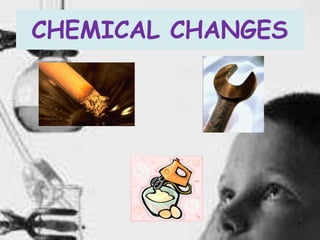
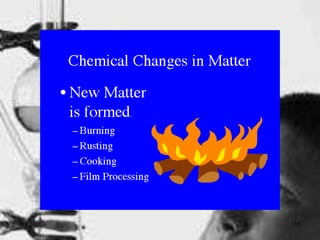
Chemical changes in matter
New Matter is formed.
– Burning
– Rusting
– Cooking
16

changesofmatter-120111022019-phpapp01.pptx

  • 1.
  • 2.
  • 3.
    3 occurs when thesubstance changes state but does not change its chemical composition. For example: water freezing into ice, cutting a piece of wood into smaller pieces, etc.  The form or appearance has changed, but the properties of that substance are the same (i.e. it has the same melting point, boiling point, chemical composition, etc.)
  • 4.
    4 • Melting point •Boiling point • Vapor pressure • Color • State of matter • Density • Electrical conductivity • Solubility • Adsorption to a surface • Hardness
  • 5.
    5 Physical Changes When youstep on a can and crush it, you have forced a physical change. The shape of the object has changed. It wasn't a change in the state of matter, but something changed.
  • 6.
  • 7.
  • 8.
    8 Chemical Changes A chemicalchange involves one or more substances changing into a new substance. When iron (Fe) rusts you can see it happen. The actual molecules have changed their structure (the iron
  • 9.
    9 occurs when asubstance changes into something new. This occurs due to heating, chemical reaction, etc. You can tell a chemical change has occurred if the density, melting point or freezing point of the original substance changes.  Many common signs of a chemical change can be seen (bubbles forming, mass changed, etc).
  • 10.
    10 • Reaction with acids •Reaction with bases (alkalis) • Reaction with oxygen (combustion) • Reaction with other elements • Decomposition into simpler substances • Corrosion
  • 11.
    11 Chemical Changes The abilityof a substance to undergo a specific chemical change is called a chemical property. iron plus oxygen forms rust, so the ability to rust is a chemical property of iron • During a chemical change (also called chemical reaction), the composition of matter always changes.
  • 12.
    12 Chemical Reactions are… •When one or more substances are changed into new substances. • Reactants- the stuff you start with • Products- what you make • The products will have NEW PROPERTIES different from the reactants you started with • Arrow points from the reactants to the new products
  • 13.
    Recognizing Chemical Changes Energy is absorbed or released (temperature changes hotter or colder)  Gas production (bubbling, fizzing, or odor change; smoke)  formation of a precipitate - a solid that separates from solution (won’t dissolve)  Irreversibility - not easily reversed But, there are examples of these that are not chemical – boiling water bubbles, etc 13 .
  • 14.
    14 Physical vs. ChemicalChange • Physical change will change the visible appearance, without changing the composition of the material. – Boil, melt, cut, bend, split, crack – Is boiled water still water? • Can be reversible, or irreversible • Chemical change - a change where a new form of matter is formed. – Rust, burn, decompose, ferment
  • 15.
    15 Chemical changes inmatter New Matter is formed. – Burning – Rusting – Cooking
  • 16.